Kinetics of Oxidation of Triaryl Methane Dye, Brilliant Blue-R with Chlorine Dioxide
Abstract
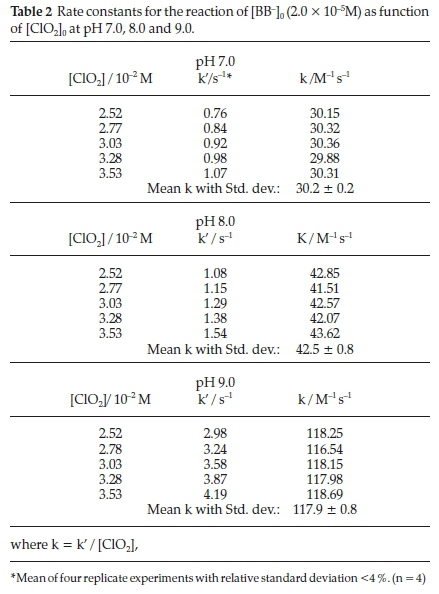
The fast decolourization of multi-purpose dye, Brilliant blue (BB-) oxidized by chlorine dioxide was investigated using the stopped flow technique under varied pH conditions by monitoring its oxidation kinetics. The products were identified and reaction mechanism is described, which is confirmed by kinetic simulations. Under [ClO2]0 > [OH-]0 > [BB-]0 conditions, the oxidation kinetics showed first-order dependence on BB- and chlorine dioxide. The overall second-order rate coefficient enhanced with increasing pH, and values were 30.2 ± 0.2 M-1 s-1,42.5 ± 0.8 M-1 s-1 and 117.9 ± 0.8 M-1 s-1 at pH 7.0,8.0 and 9.0, respectively. In the pH range 7.0 to 9.0, the catalytic constant for [OH-] catalyzed reaction was 9.0 X 10⁶ M-2 s-1 with energy of activation of 50.06 kJ mol-1. Observed negative entropy of activation of -658.73 J K-1 mol-1 suggests the formation a compact transient activated complex.
Dye; oxidative degradation; chlorine dioxide; tertiary treatment; stopped flow study; fast kinetics
1. Introduction
Virtually every manmade material comprises either a dye or pigment. A wide range of modified natural and synthetic dyes are used to colour fabrics, leather, paper, ink, lacquers, varnishes, plastics, cosmetics, and many other odd items.1et al.in their review, reported that over ten thousand types of dyes or pigments are in use for various purposes.23245
Reportedly in textile industry, among various synthetic dyes, triarylmethane type dyes are more popularly used due their cost effectiveness, which contribute to about 30-10 % of the total dyes and pigments used.67,8 Some triaryl dyes are used as for staining biological and bacteriological specimens and as targetable photo sensitizers.7 3TiO.SrO3TiO as catalyst has been reported.910 11121314,15 Taking into consideration the detrimental effects and potential toxicity of these dyes, it is of paramount importance to understand their degradation mechanisms and to remove these dyes from wastewaters and aquatic bodies.
Forgacs et al.1614-17 oxidative degradation,18 192021222324252627 28,29 We have also reported the scope of ozone and hypochlorite as oxidants in degradation of Amaranth, an azo dye.30,31 The extent of degradation of the dyes in these studies varied with nature of oxidant and oxidation duration, offering partial oxidation to complete mineralization.
In the recent past, we investigated the potential of chlorine dioxide, in decolourization of Amaranth under varied pH conditions by kinetic approach and elucidating the reaction mechanism and establishing the role of hydroxide ion3233-), under aqueous conditions using chlorine dioxide as oxidant. Brilliant blue-R is also known as Coomassie brilliant blue and Brilliant indo-cyanine 6B. Firstly, BB- was generated as a textile dye for dyeing wool, silk, nylon etc., but it is also extensively used in paint and leather industries.34- and Na+ and reveals significants peaks at 285 and 555 nm (λ555nm= 4.3 x 10⁴-1 cm-1). pH variation has no effect on its spectrum.3536
Although, chlorination is the most cost effective means in water treatment, its efficiency depends on the method of the process and water pH.3738,39 Among different chemicals used as chlorine alternatives in water treatment; chlorine dioxide has attracted sizeable attention, due its distinctly different properties, although it contains chlorine.40 41,42 Chlorine dioxide is also used for colour removal and odour control of waters in addition to oxida-tive removal of iron and manganese. Reportedly, over 800 water works practice chlorine dioxide usage for drinking water treat-ment.43
2. Experimental
Brilliant blue-R (Aldrich, USA 95 % purity) was used with no further purification. Sodium hydroxide (BDH), sodium chlorite (BDH), 98 % sulfuric acid (BDH) Analar grades were used as supplied. The stock solution was further diluted requisite to the need of experiments. The stock solution of aqueous ClO2 was prepared by acidifying sodium chlorite and stored in the dark. ClO2 solutions were standardized prior to use.31
3. Results and Discussion
3.1.
Kinetic RunsKinetic experiments were conducted at 25 ± 0.1 °C with surplus concentrations of the other reagents relative to the substrate dye, which was monitored. A HI-TECH micro-volume double mixing stopped-flow apparatus was used to monitor the reactions. The data collected at selected fixed wavelength was analyzed using the KinetAsyst™ 3.10 software. The KinetAsyst™ software facilitates the estimation of the rate constants by matching of absorbance versus time data with different rate equations.
3.2. Reaction Orders for ClO2 and BB"
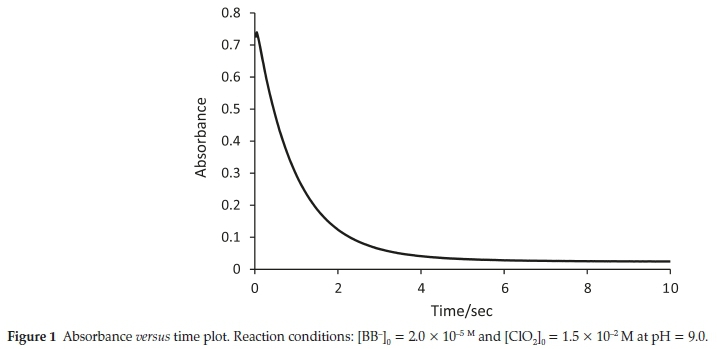
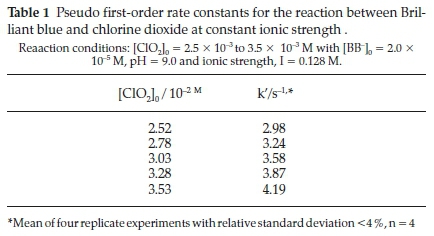
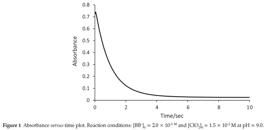
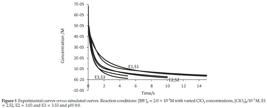
The rates of reaction employing varied surplus initial concentrations of oxidant, at pH (9.0) and fixed ionic strength, monitoring the depletion of dye at low concentrations were carried out to determine the reaction order wrt the oxidant. All the kinetic runs were conducted at 25 (± 0.1) °C unless otherwise specified. Figure 1 illustrates the dye depletion as function of time at pH 9, for concentrations [ClO2]0 = 1.5x10⁻²Mand [dye]0 = 2.0 x 10⁻⁵ M. An observation of the curves indicates that the dye was consumed very quickly in <2 s. Using kinetic fit software, the kinetic data were analyzed and found to fit well with the first-order equation suggesting that reaction follows first-order kinetics for the chosen reaction conditions. The k' (pseudo first-order rate constants) values were estimated at fixed ionic strength with varied [ClO2]0 conditions. The slope of the log-log plot of [ClO2] against k' was 1.02 (corr. coeff. 0.99), positively designate the first-order rate dependance on the oxidant, ClO2 (Table 1).
3.3. Role of pH and Hydroxide Ion
While chlorine or hypochlorite react with substrate by additon or substitution reactions, ClO2 abstracts free radical during the attack.4445352. Table 2 summarizes the k' values as function of ClO2 concentration at different initial hydroxide conditions. Perusal of the results indicates that the increase in hydroxide concentration has a profound positive effect on the rate constants. The log-log plots of k' and [ClO2]0 gave slopes equivalent to 0.99, 1.05 and 1.02 at pH 7.0,8.0 and 9.0, respectively. The observed reaction order with respect to ClO2 under different pH conditions was unity, suggesting that reaction mechanism is unaltered.
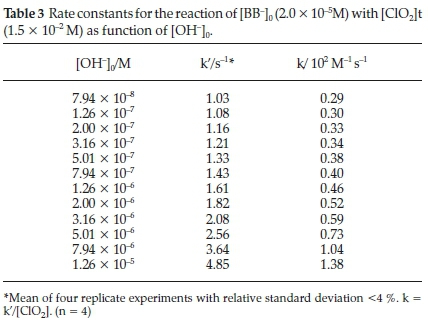
To establish the reaction mechanism and activity of hydroxide with fixed initial concentrations of dye and ClO2 the reaction was studied under diverse initial concentrations of hydroxide ion. Table 3 illustrates the obtained results. Similar to our earlier observations on oxidative degradation of Amaranth by chlorine dioxide,35-, the second reaction will remain predominant. At very low [OH-] conditions, the very slow reaction will prevail. The rate-limiting reactions maybe expressed as follows:


{BB-ClO2OH-} ® ClO2- + {HO BB}- (Rate-determiningstep) Summing up the contribution of the two competitive reactions, the probable rate of reaction may be stated as,

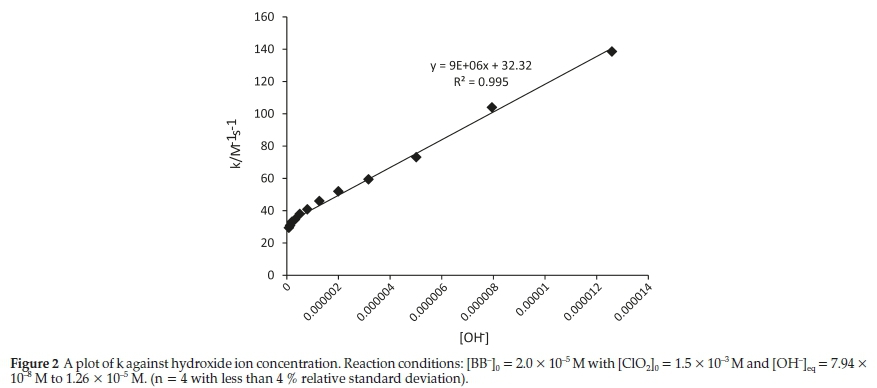
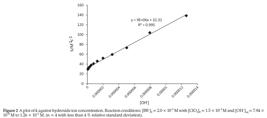
In the above equations, k' represents the pseudo first-order rate coefficient, when [BB-] < [ClO2]. k = k'/[ClO2] is the second-order rate constant at fixed pH, where k = {k1 + kOH- [OH-]} and k1 is the second-order rate coefficient for the uncatalyzed path between Brilliant blue and oxidant. kOH- represents catalytic constant for the hydroxide ion catalyzed path. Table 3 summarizes the calculated values for the second-order rate and Fig. 2 illustrates the graph of k versus [OH-]. An observation of Fig. 2 shows that the value of y-intercept (k1) is trivial, signifying the reaction will be very slow with no presence of hydroxide ion. It is anticipated from the known inert behaviour of chlorine dioxide at low pH.46- catalyzed path (pH between 7.0 and 9.0), kOH- the catalytic constant was large and equal to 9.0 x 10⁶-2 s-1 (Fig. 2) confirming that hydroxide catalyzed reaction is very fast.
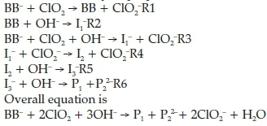
Employing different molar ratios of dye and oxidant, the stoichiometry experiments. The residual concentrations of the substrate and chlorine dioxide reacted were determined based on their redisual and initial concentrations. The stoichiometric ratio between BB- and ClO2 was found to be roughly 1:2 (±10 %). The overall stoichiometry of the reaction is represented as follows:

3.4.
Kinetic Salt EffectProfound effect of hydroxide ion on the rate of the reaction clearly suggests the role of hydroxide ion as catalyst and its involvement in the slow step of the reaction. To validate its role, the kinetic salt effect on the reaction rate was investigated using fixed concentrations of oxidant, dye and hydroxide. The log k' against square root of ionic strength graph was straight line and gradient of 0.90 (R2- and BB- ions.
3.5.
Energy ParametersThe magnitude and sign of the thermodynamic parameters of the activated complex afford an insight into the nature of the transition state. Hence the kinetics of the title reaction were investigated as function of temperature (10 °C to 30 °C) and the values of activation energy, enthalpy and entropy were calculated. While the activation energy was estimated as 50.06 kJ mol-1 and and enthalpy of activation was 47.58 kJ mol-1 and the entropy of activation was negative and equal to -676.36 J K-1 mol-1. The negative entropy value suggests a compact conformation of activated complex, which is the proposed feature of the activated complex in proposed mechanism.
3.6. Product Characterization
Column (silica gel stationary phase) chromatography was used to separate the reaction products from crude organic extract of the reaction mixture immediate after decolourization of the dye (0.44 g). Collecting 10 mL fractions in each step, mobile phase of hexane: dichloromethane (DCM) was used in stepwise gradient as follows: for the fractions 1-20 (100 % hexane), fractions 20-30 (10 % DCM in hexane), fractions 30-40 (30 % DCM in hexane) and fractions 40-50 (50 % DCM in hexane) and so on. Compound one (8 mg) with 50 % dichloromethane as eluent and compound two (5 mg) with 80 % dichloromethane were obtained after fractionation and purification. The two products were positively identified as 4-(4-ethoxy-phenylamino)-benzoic acid (P1), and 3,3,-(biphenyl-4,4,-diylbis(ethylazanediyl))-bis (methylene) 3-dibenzenesulfonate (P2).
The proton NMR spectrum of the product (P1) exhibited a triplet for methyl protons at d 1.50 and a quartet for the methylene protons at d 3.62 and two sets of doublets, at d 8.07, d 7.92 and d 7.46 (two overlapping resonances) for each of the ortho coupled protons on the two aromatic rings (Supplementary material, Fig. S1). The 132) and d 14.08 (CH3) indicating the presence of the ethoxy group (Fig. S2). The GC-MS spectrum showed a molecular ion peak at m/z 258 (M+) for the protonated product of P1. This corresponds to a molecular formula of C15H16NO3. The observed prominent peak m/z = 229 was resultant of the ethyl group loss, and the peak at m/z 110 corresponds to the protonated p-aminophenol that results from fragmentation of P1 (cleavage of the carboxybenzyl and ethyl groups with concomitant hydrogen migrations) (Fig. S3).
Fig. S1The 12 displayed ethyl protons at d 1.49 followed
by d 4.17-4.19 as triplet and quartets respectively representing the protons from the methyl and methylene groups. The benzyl methylene protons are observed at d 5.29 and aromatic protons are observed as in the range of d 6.71 - d 8.08 (Fig. S4). The 13Fig. S5). The mass spectrum of P2 exhibited molecular a molecular ion peak at 578 (M+) which was in agreement with the molecular mass of P2. The peak at m/z 521 is due to the fragmentation of two ethyl groups with simultaneous hydrogen migrations to the nitrogen atoms (Fig. S6).
3.7.
Mechanistic SchemeWhen Brilliant blue is reacted with the oxidant chlorine dioxide, the oxidizing agent removes an electron from the central olefinic bond of the molecule, resulting in a radical species which reacts with a hydroxyl radical to form the hydroxyl intermediate, I1. The the hydroxyl base abstracts a proton form the hydroxyl group producing the ketone I2 and H2O. A hydroxide ion is substituted onto the ketone, which is driven by the positively charged nitrogen atom in a position para to the quinone ring, resulting in the benzoic acid, P1 and the biphenyl product P2. The probable mechanism for formation of the two oxidation products is illustrated in Scheme 1.
3.7.1. Proposed Mechanism
Based on the experimental results, the kinetic data, products identified and proposed mechanistic scheme, the overall reaction mechanism may be proposed as follows.
3.8.
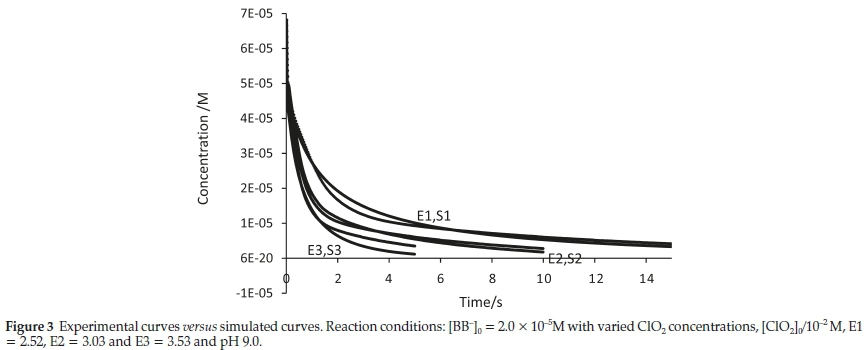
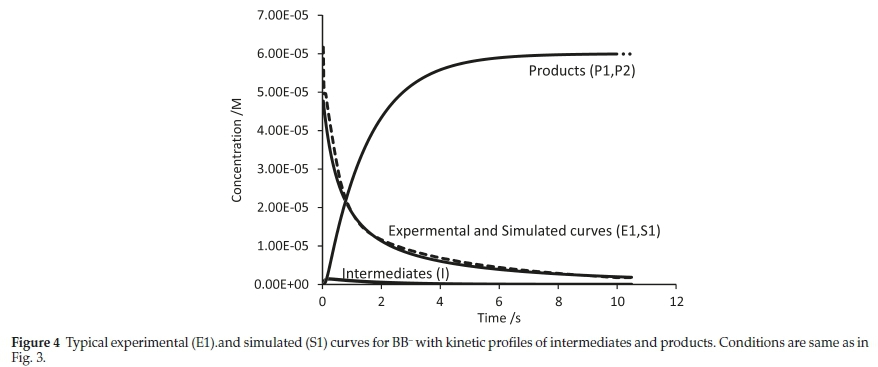
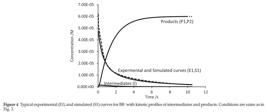
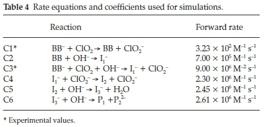
SimulationsSimulations were done to validate the proposed mechanisms and to prove that it is the more probable one. Simkine 3 software was used to compute the kinetic profiles of the reactants, intermediates and products.47,48 The estimated rate constant were optimized and adjusted until the simulated curves the product analysis gives details for the intermediate structures. The computed curves agreed well with the experimental kinetic profiles, confirming the suggested mechanism to be probable (Fig. 3). The rate constants used for C1 and C3 in simulations were experimental values and C2, C4, C5 and C6 were the estimated rate constants. Figure 4 illustrates experimental E1 and simulated S1 together with the profiles of intermediates and final products P1 and P2. A fair agreement in between the experimental curves and the computed profiles, endorse the probability of the proposed mechanism.
4. Conclusions
The main products of oxidation of Brilliant blue by chlorine dioxide immediately after its decolourization are 4-(4-ethoxy-phenylamino)-benzoic acid (P1), and 3,3'-(biphenyl-4,4'-diylbis(ethylazanediyl))bis(methylene) 3-dibenzenesulfonate (P2) and both are less toxic than the starting compound. While the catalysing characteristic of hydroxide ion is positively established, reaction orders with respect to Brilliant blue and chlorine dioxide were unity. The catalytic constant for the hydroxide ion catalyzed path was high and found to be 9.0 x 10⁶ M-2 s-1.
Supplementary Material
Supplementary information is provided in the online supplement.
ORCID iD
S.B. Jonnalagadda: orcid.org/0000-0001-6501-8875
Acknowledgements
The authors acknowledge the financial support received from the National Research Foundation, South Africa, in the form of bursary to SN.
References
- 1 N.C. Burton, A. Adhikari, Y. Iossifova, S.A. Grinshpun and T. Reponen, Effect of gaseous chlorine dioxide on indoor microbial contaminants, J. Air Waste Manage. Assoc., 2008, 58, 647-656.
- 2 C.M. Carliell, S.J. Barclay, C. Shaw, A.D. Wheatley and C.A. Buckley, The effect of salts used in textile dyeing on microbial decolourisation of a reactive azo dye, Environ. Tech., 1998,19, 1133-1137.
- 3 T. Inoue, K. Kikuchi, K. Hirose, M. Iino and T. Nagano, Small molecule-based laser inactivation of inositol 1,4,5-trisphosphate receptor, Chem. Biol., 2001, 8, 9-15.
- 4 Y. Ji, X.T. Li and G.Q. Chen, Interactions between a poly(3-hydroxy-butyrate-co-3-hydroxyvalerate-co-3-hydroxyhexanoate) terpolyester and human keratinocytes, Biomaterials, 2008, 29, 3807-3814.
- 5 T. Robinson, G. McMullan, R. Marchant and P. Nigam, Remediation of dyes in textile effluent: a critical review on current treatment technologies with a proposed alternative. Bioresour. Technol., 2001, 77, 247-255.
- 6 S. Rodriguez Couto, Dye removal by immobilised fungi,. Biotechnol. Adv., 2009, 27, 227-235.
- 7 H. Zollinger. Color Chemistry: Syntheses, Properties, Applications of Organic Dyes Pigments, Wiley-VCH, Weinheim, NY, 1991.
- 8 C.M. Carliell, S.J. Barclay, C. Shaw, A.D. Wheatley and C.A. Buckley, The effect of salts used in textile dyeing on microbial decolourisation of a reactive azo dye, Environ. Tech., 1998,19, 1133-1137.
- 9 T. Inoue, K. Kikuchi, K. Hirose, M. Iino and T. Nagano, Small molecule-based laser inactivation of inositol 1,4,5-trisphosphate receptor. Chem. Biol., 2001, 8, 9-15.
- 10 J.I. Kroschwitz, Kirk-Othmer Encyclopedia of Chemical Technology. Wiley-Interscience, Hoboken, N.J., 2007.
- 11 S. Nihalani, A. Vijay, N. Tripathi and S. Bhardwaj, Photo catalytic water treatment by an eco friendly process-BaO3TiO.SrO3TiO used in degradation of Malachite green and Crystal violet in aqueous suspension, IOSR-J. Appli. Chem., 2012, 2, 20-26.
-
12 S.L. Franklin, C. Jayadev, R. Poulsen, P. Hulley and A. Price, An ink surgical marker pen is damaging to tendon cells, Bone & Joint Res, 2012,1, 36-40. http://dx.doi.org/10.1302/2046-3758.13.2000032
» http://dx.doi.org/10.1302/2046-3758.13.2000032 -
13 R.D. Combes and R.B.H. Smith, A review of the genotoxicity of food, drug and cosmetic colours and other azo, triphenylmethane and xanthene dyes, Mutat. Res., 1982, 98, 101-248. http://dx.doi.org/10.1016/0165-1110(82)90015-X
» http://dx.doi.org/10.1016/0165-1110(82)90015-X -
14 http://www.sciencelab.com/xMSDS-Light_Green_SF_Yellowish-9927208 (accessed on 3 May 2013).
» http://www.sciencelab.com/xMSDS-Light_Green_SF_Yellowish-9927208 - 15 W.H. Hansen, E.L. Long, K.J. Davis, A.A. Nelson and O.G Fitzhugh, Chronic toxicity of three food colourings: Guinea green B, Light green SF yellowish and Fast green FCF in rats, dogs and mice, Food & Cosmet. Toxicol., 1966,4, 389-410.
-
16 A. Mittal, J. Mittal, A. Malviya, D. Kaur and VK. Gupta, Decoloration treatment of a hazardous triarylmethane dye, Light green SF (yellowish) by waste material adsorbents, J. Collid. Interface. Sci, 2010,342, 518-527. http://dx.doi.org/10.1016/j.jcis.2009.10.046
» http://dx.doi.org/10.1016/j.jcis.2009.10.046 - 17 M.G. Allmark, H.C. Grice and W.A. Mannell, Chronic toxicity studies on food colours. II. observations on the toxicity of FD & C green No. 2 (Light green SF yellowish), FD & C orange No. 2 (orange SS) and FD & C red No. 32 (oil Red XO) in rats, J. Pharm. Pharmacol, 1956, 8, 417-424.
-
18 E. Forgacs, T. Cserháti and G. Oros, Removal of synthetic dyes from wastewaters: a review, Environ. Inter., 2004, 30, 953-971. http://dx.doi.org/10.1016/j.envint.2004.02.001
» http://dx.doi.org/10.1016/j.envint.2004.02.001 -
19 A. Bousher, X. Shen, R.G. Edyvean, Removal of coloured organic matter by adsorption onto low-cost waste materials, J. Water Res. , 1997, 31, 2084-2092. http://dx.doi.org/10.1016/S0043-1354(97)00037-7
» http://dx.doi.org/10.1016/S0043-1354(97)00037-7 -
20 F. Gosetti, V. Gianotti, S. Angioi, S. Polati, E. Marengo and M.C. Gennaro, Oxidative degradation of food dye E133 brilliant blue FCF: liquid chromatography-electrospray mass spectrometry identification ofthe degradation pathway, J. Chromatogr, A, 2004,1054,379-387. http://dx.doi.org/10.1016/j.chroma.2004.07.106
» http://dx.doi.org/10.1016/j.chroma.2004.07.106 -
21 P. Bouras and P. Lianos, Photodegradation of dyes in aqueous solutions catalyzed by highly efficient nanocrystalline titania films. J. Appl. Electrochem. , 2005, 35, 831-836. http://dx.doi.org/10.1007/s10800-005-1616-9
» http://dx.doi.org/10.1007/s10800-005-1616-9 -
22 Z. Shen, W. Wang, J. Jia, J. Ye and X. Feng, A. Peng, Degradation of dye solution by an activated carbon fiber electrode electrolysis system, J. Hazar. Mater., 2001, 84, 107-116. http://dx.doi.org/10.1016/S0304-3894(01)00201-1
» http://dx.doi.org/10.1016/S0304-3894(01)00201-1 -
23 R. Ahlawat, VC. Srivastava, I.D. Mall and S. Sinha, Investigation of the electrocoagulation treatment of cotton blue dye solution using aluminum electrodes, Clean : Soil, Air, Water, 2008, 36, 863-869. http://dx.doi.org/10.1002/clen.200800019
» http://dx.doi.org/10.1002/clen.200800019 -
24 G.S. Nyanhongo, J. Gomes, G.M. Gübitz, R. Zvauya, J. Read and W. Steiner, Decolorization of textile dyes by laccases from a newly isolated strain of Trametes modesta, Water Res., 2002, 36, 1449-1456. https://doi.org/10.1016/S0043-1354(01)00365-7
» https://doi.org/10.1016/S0043-1354(01)00365-7 - 25 E. Abadulla, K.H. Robra, G.M. Gübitz, L.M. Silva and A.C. Paulo, Enzymatic decolorization of textile dyeing effluents. Tex. Res. J., 2000, 70, 409-414.
-
26 C.J. Ogugbue and T. Sawidis, Bioremediation and detoxification of synthetic wastewater containing triarylmethane dyes by Aeromonas hydrophila isolated from industrial effluent, Biotech. Res. Inter., 2011,967925-967935. http://dx.doi.org/10.4061/2011/967925
» http://dx.doi.org/10.4061/2011/967925 -
27 K. Kumar, S. Saravana Devi, K. Krishnamurthi, S. Gampawar, N. Mishra, G.H. Pandya and T. Chakrabarti, Decolorisation, biodegra-dation and detoxification of benzidine based azo dye, Bioresour. Technol, 2006, 97, 407-413. http://dx.doi.org/10.1016/j.biortech.2005.03.031
» http://dx.doi.org/10.1016/j.biortech.2005.03.031 -
28 C.P.L. Grady, Biodegradation of hazardous waste by conventional biological treatment, Hazard Waste Hazard. Mater., 1986, 3, 333-365. https://doi.org/10.1089/hwm.1986.3.333
» https://doi.org/10.1089/hwm.1986.3.333 -
29 T. Mushinga and S.B. Jonnalagadda, Akinetic approach for the mechanism of Malachite green-peroxydisulphate reaction in aqueous solution, Int. J. Chem. Kinet., 1992, 24, 41-49. http://dx.doi.org/10.1002/kin.550240106
» http://dx.doi.org/10.1002/kin.550240106 -
30 S.B. Jonnalagadda, C. Chinake and R.H. Simoyi, Kinetics and mechanism of the reaction between Thymol blue and bromate in acidic medium, J. Chem. Soc. Faraday Trans., 1995, 91, 1635-1640. http://dx.doi.org/10.1039/FT9959101635
» http://dx.doi.org/10.1039/FT9959101635 - 31 S.B. Jonnalagadda and M.A. Salem, Chemistry of a non-linear reaction between Aniline blue and acidic bromate, Phys. Chem. Chem. Phys., 1999, 1, 821-826.
-
32 P. Dachipally and S.B. Jonnalagadda, Kinetics of ozone-initiated oxidation of textile dye, Amaranth in aqueous systems. J. Environ. Sci. Health. Part A, 2011, 46, 887-897. http://dx.doi.org/10.1080/10934529.2011.580201
» http://dx.doi.org/10.1080/10934529.2011.580201 -
33 S. Nadupalli, N. Koorbanally and S.B. Jonnalagadda, Kinetics and mechanism of the oxidation of Amaranth with hypochlorite, J. Phys. Chem. A, 2011, 115, 7948-7954. http://dx.doi.org/10.1021/jp202812f
» http://dx.doi.org/10.1021/jp202812f -
34 S. Nadupalli, N. Koorbanally and S.B. Jonnalagadda, Chlorine dioxide-facilitated oxidation of the azo dye Amaranth, J. Phys. Chem. A, 2011, 115, 11682-11688. http://dx.doi.org/10.1021/jp206175s
» http://dx.doi.org/10.1021/jp206175s -
35 I. Ofori, S. Maddila, J. Lin and S.B. Jonnalagadda, Chlorine dioxide oxidation of Escherichia coli in water - A study of the disinfection kinetics and mechanism, J. Env. Sci. Heal. A, 2017, 52, 1-9. http://dx.doi.org/10.1080/10934529.2017.1293993
» http://dx.doi.org/10.1080/10934529.2017.1293993 - 36 R. Sylla and T. Gianni, Patterns of European Industrialization: the Nineteenth Century. Routledge, London, U.K., 1992.
-
37 S.B. Bukallah, M.A. Rauf and S.S. Ashraf, Photocatalytic decoloration of Coomassie brilliant blue with titanium oxide, Dyes & Pigments, 2007, 72, 353-356. http://dx.doi.org/10.1016/j.dyepig.2005.09.016
» http://dx.doi.org/10.1016/j.dyepig.2005.09.016 - 38 S. Nadupalli, N. Koorbanally and S.B. Jonnalagadda, Kinetics and mechanism of the oxidation of triaryl dye, Brilliant blue-R with OCl-/HOCl, S. Afr. J. Chem., 2015, 68 , 85-92.
- 39 R.W. Fullerton, WEFTEC 2007, 2007, 4801-4808.
- 40 G.C. White, The Handbook of Chlorination, Van Nostr Reinhold, New York, U.S.,1986.
- 41 S.B. Jonnalagadda, V.S.R. Pullabhotla, S. Maddila and E.C. Chetty, Ozone for drinking and wastewater treatment and for value added products, Int. J. Chem., 2011, 1, 119-129.
- 42 S. Sussman and W. Ward, Chlorine dioxide is an attractive (water) treatment alternative. J. Water Sewage Works, 1979, 120-121.
- 43 A.M. Dietrich, M. P. Orr, D.L. Gallagher and R.C. Hoehn, Tastes and odors associated with chlorine dioxide, J. Amer. Water Works Assoc., 1992, 84, 82-88.
- 44 B.W. Lykins and H.G. Griese, Using chlorine dioxide for trihalo-methane control. J. Amer. Water Works Assoc., 1986, 71, 88-93.
- 45 R.C. Hoehn, A.M. Dietrich, W.S. Farmer, M.P. Orr, R.G. Lee, M. Aieta, D.W. Wood and G. Gordon, Household odors associated with the use of chlorine dioxide, J. Amer. Water Works Assoc., 1990, 82, 166-172.
-
46 G.A. Gagnon, J.L. Rand, K.C.O. Leary, A.C. Rygel, C. Chauret and R.C. Andrews, Disinfectant efficacy of chlorite and chlorine dioxide in drinking water biofilms, Water Res., 2005, 39, 1809-1817. http://dx.doi.org/10.1016/j.watres.2005.02.004
» http://dx.doi.org/10.1016/j.watres.2005.02.004 - 47 B.R. Deshwal and H.K. Lee, Variation in CIO2/Cl2 ratio in the chloride-chlorate process under different conditions, J. Ind. Eng. Chem., 2004, 10, 667-673.
-
48 S.B. Jonnalagadda, M. Shezi and B. Pare, Uncatalyzed and ruthe-nium(III)-catalyzed reaction of acidic chlorite with methylene violet, Int. J. Chem. Kinet., 2003, 35, 294-303. http://dx.doi.org/10.1002/kin.10128
» http://dx.doi.org/10.1002/kin.10128 -
49 S.B. Jonnalagadda, N. Paramasur and M.N. Shezi, A user-friendly programme 'Simkine' for simulation of kinetics involving complex reaction mechanisms, Comp. Biol. & Chem., 2003, 27, 147-152. http://dx.doi.org/10.1016/S1476-9271(02)00084-1.10
» http://dx.doi.org/10.1016/S1476-9271(02)00084-1.10 -
50 M.N. Shezi and S.B. Jonnalagadda, Easy to use program 'Simkine 3'for simulating kinetic profiles of intricate chemical systems and optimizing predictable rate coefficients therein. Bull. Chem. Soc. Ethio., 2012, 26, 267-277. http://dx.doi.org/10.4314/bcse.v26i2
» http://dx.doi.org/10.4314/bcse.v26i2
Revised 16 December 2018
Accepted 16 December 2018