Experimental Design and Statistical Modelling for Analysis of Inhibition Efficiency Using Daucus crinitus Essential Oil in corrosion Processes
Abstract
This research explores the effectiveness of Daucus crinitus essential oil as a corrosion inhibitor for copper in a 0.5 M sulfuric acid solution, utilizing experimental design and statistical analysis. The study examines how temperature, inhibitor concentration, and immersion duration influence inhibition efficiency (IE) through Response Surface Methodology (RSM). GC/MS analysis identified the essential oil's main components as aliphatic compounds, such as dodecyl acetate (28.5%), undecane (35.2%), and dodecanal (14%).The highest inhibition efficiency (85%) was obtained at an inhibitor concentration of 10.25 (v/v), a temperature of 40 °C, and an immersion period of 3 hours. Elevated temperatures decreased IE, indicating a physisorption-based mechanism, whereas higher concentrations and longer immersion times improved copper protection. Statistical evaluation confirmed the model's reliability, with an of 0.991 and a value above 0.95, reflecting strong predictive capability. These results position D. crinitus essential oil as an eco-friendly and sustainable substitute for traditional synthetic inhibitors, demonstrating its potential for effective corrosion control in industrial settings. The study emphasizes the value of plant-derived inhibitors for reducing copper corrosion in acidic environments and offers insights for enhancing corrosion prevention approaches.
Daucus crinitus essential oil; corrosion inhibition; experimental design; response surface methodology
INTRODUCTION
Corrosion persists as a formidable obstacle across numerous industries, inflicting economic losses amounting to billions of dollars each year.12 3
For decades, corrosion inhibitors have played a key role in shielding metals from decay. Synthetic inhibitors, prized for their strong protective qualities, have long been the standard in industrial settings. Yet, their harmful effects on human health and ecosystems have driven a push toward sustainable option.45-7 These natural solutions mark a promising shift in corrosion science, balancing performance with ecological responsibility.
Among these natural resources, Daucus crinitus, a member of the Apiaceae family, distinguishes itself. Renowned for its medicinal uses-such as treating wounds, asthma, abdominal pain, rheumatism, and acting as an aphrodisiac-this plant also exhibits a wide range of biological effects, including antioxidant, antimicrobial, and hypolipidemic properties.8-10 Recent studies have further revealed its anticorrosive potential, with hydroalcoholic extracts and zinc nanoparticles from D. crinitus demonstrating success in protecting carbon steel in acidic media like 1 M hydrochloric acid.11
Modern corrosion research has increasingly adopted sophisticated tools and experimental frameworks to refine its approaches.12-13 Corrosion research increasingly leverages Design of Experiments (DoE) techniques and software to optimize inhibition processes and predict outcomes. DoE, a statistical approach, systematically adjusts input variables to assess their impact on responses, enhancing efficiency, cutting costs, and improving quality across engineering and industrial applications.14-18 Response Surface Methodology (RSM), a multivariate optimization tool, fits experimental data to polynomial equations, illuminating complex variable interactions. This enables researchers to pinpoint optimal conditions effectively. For reliable predictions, the response function must precisely reflect dataset behaviour, ensuring robust system performance and advancing corrosion protection strategies. Such methods reduce reliance on time-consuming trial-and-error practices, enabling more precise and efficient studies .19-20
Building on these advancements, this study evaluates the corrosion inhibition potential of Daucus crinitus essential oil on copper in 0.5 M sulfuric acid solution. Employing mass lossmeasurements and a structured experimental design, this study examines the impact of three primary variables: immersion period, inhibitor concentration, and temperature on inhibition efficiency. By merging natural inhibitors with cutting-edge analytical techniques, this research aims to contribute to sustainable and effective corrosion prevention strategies.
MATERIALS AND METHODS
Preparation of inhibitors
The roots of D. Crinitus were harvested in May 2024 from Bourakba (Algeria), located at 34°56'17" N latitude,1°45'26" W longitude and at an altitude of 692 m. The plant material was air-dried at ambient temperature and then hydro-distilled for 5 hours using a Clevenger-type apparatus, following the European Pharmacopoeia guidelines.21
Analysis conditions and identification
Chemical analysis was conducted using a PerkinElmer Autosystem GC (Waltham, MA, USA) equipped with dual flame ionization detectors (FID) and configured for simultaneous analysis on two fused silica capillary columns (60 m x 0.22 mm ID, 0.25 μm film thickness) featuring different stationary phases: Rtx-1 (polydimethylsiloxane) and Rtx-Wax (polyethylene glycol).
The oven temperature was programmed to start at 60 °C, increase at 2 °C/min to 230 °C, and maintains an isothermal hold at 230 °C for 30 minutes. High-purity helium was used as the carrier gas with a constant flow rate of 1.0 mL/min. The injector and detector temperatures were set to 280 °C, and samples (0.1 μL) were injected in split mode with a 1:80 split ratio.
For compound identification, a PerkinElmer TurboMass quadrupole mass spectrometer, interfaced with an Autosystem XL GC, was utilized under the same chromatographic conditions. Mass spectra were acquired via electron impact ionization at 70 eV, scanning a mass-to-charge range of 35-350 m/z, with the ion source temperature maintained at 150 °C.
Component identification was achieved by comparing their gas chromatography retention indices (RI) on non-polar and polar columns, calculated relative to the retention times of a series of n-alkanes using linear interpolation, with those of authentic standards or literature data.22-27 Additionally, identification was supported by computer-based matching with commercial mass spectral libraries and comparison with published literature data.24-28
Gravimetric corrosion tests
Specimens of commercially pure copper were subjected to sequential polishing using emery paper with progressively finer grit sizes (400, 800, and 1200) until a smooth, mirror-like surface was achieved. Following polishing, the specimens were meticulously cleaned by rinsing with distilled water, followed by acetone, and subsequently dried using a hot air blower. A 0.5 molar sulfuric acid solution was prepared by carefully diluting high-purity sulfuric acid (95-97%, Sigma-Aldrich) with distilled water under controlled conditions.To prepare the inhibitor solutions, varying quantities of essential oil, ranging from 0.5 to 20 μL, were dissolved in the corrosive sulfuric acid solution.
Weight loss measurement
The copper samples were accurately weighed using an analytical balance with a precision of 0.1 mg. Each specimen was immersed in 100 mL of the corrosive solution, either with or without an inhibitor, for durations ranging from 1 to 3 hours at temperatures between 293 and 323 K. Following immersion, the samples were removed, thoroughly rinsed with distilled water, dried, and reweighed to determine the weight loss caused by corrosion. All experiments were conducted in triplicate, and the results are presented as mean values.
The inhibition efficiency (IE, %) and corrosion rates (CR) were determined according to established methods.29


where mi and mf = initial and final mass (g) of the specimen, respectively, after immersion time (t) in the corrosive medium, S is the surface area of the immersed specimen(cm20 and CRinh= corrosion rates (g-cm-2-h-1) in the absence and presence of the inhibitor, respectively.
Scanning electron microscopy (SEM)
A Hitachi TM1000 scanning electron microscope was employed to analyze the surface topography of the copper surfaces at 500x magnification (200 μm scale). To evaluate the influence of the inhibitors, the specimens were immersed insulfuric acid solution. Following 3 hours of immersion under optimized conditions, SEM micrographs were obtained for both the mechanically polished copper surface and the samples exposed to the acidic solution, with and without the addition of inhibitors.
Chemical composition of essential oil
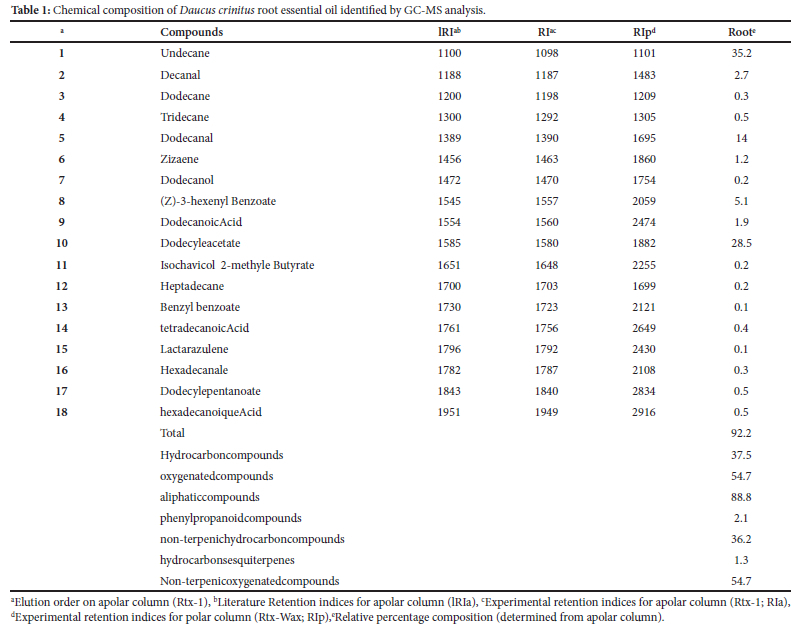
Hydro distillation of the roots of Daucus crinitus produced a yellow essential oil with a yield of 0,2%. GC and GC-MS analysis led to the identification of 18 compounds, representing 92.2% of the oil's total composition (Table 1).
The chemical composition is dominated by aliphatic compounds (88.8%), reflecting a predominance of long-chain linear or branched structures with long carbon chains. A high proportion of non-terpenic hydrocarbon compounds (36.2%), with undecane (35.2%) is in the majority, while dodecane, tridecane and heptadecane are present in trace amounts (less than 1%). Non-terpenic oxygenated compounds (54.7%) are also well represented, with the major constituents being dodecyl acetate (28.5%), dodecanal (14%), (Z)-3-hexenyl benzoate (5.1%), decanal (2.7%) and dodecanoic acid (1.9%). Other oxygenated compounds, mainly acids, are present in trace amounts(less than 1%). On the other hand, the proportion of hydrocarbon sesquiterpenes (1.3%) and phenylpropanoid compounds (2.1%) represent the smallest fraction ofthe composition.
Design of experiments study
Response Surface Methodology (RSM) is a mathematical and statistical approach used to model and analyze processes involving multiple variables. It enables the evaluation of the impact of various factors and their interactions on one or more response variables. Response Surface Methodology (RSM) was implemented to statistically optimize key corrosion parameters. The model incorporated Partial Least Squares (PLS) and Multiple Linear Regression (MLR) analyses to quantify relationships between variables, with inhibition efficiency (IE) and corrosion rate (CR) expressed through the quadratic formulation in Equation 3:

where, Y represents the response matrix, Xi and Xj are independent coded variables, a0 is the intercept, ai, aii, and aij denote the linear, quadratic, and interaction regression coefficients, respectively, and ε accounts for statistical random errors.
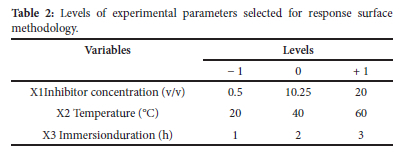
In this study, the experimental design and statistical analysis were performed using MODDE° 9.1 software. The investigation applied multiple linear regression to assess both individual and synergistic effects of three critical parameters: inhibitor concentration (X1), temperature (X2), and immersion duration (X3). Inhibition efficiency (Y) was chosen as the response variable and modelled using a second-order polynomial equation (Equation 3). The specific settings and levels for each parameter are detailed in Table 2.
RESULTS AND DISCUSSION
Response Surface Methodology (RSM) was employed to develop empirical models based on experimental data. In this study, the independent variables included working temperature, immersion time, and inhibitor concentration, while inhibition efficiency (IE) served as the response variable.
Before the Response Surface Methodology (RSM) analysis, various 1N acidic solutions were evaluated. The corrosion inhibition efficacy of Daucus crinitus essential oil was most effective in sulfuric acid (92.18%), followed by hydrochloric acid (72.88%), and nitric acid (66.64%). The enhanced performance in sulfuric acid likely arises from the superior adsorption of sulfate ions and the oil's active components onto the copper surface. Consequently, this study concentrates on sulfuric acid due to its optimal adsorption characteristics.
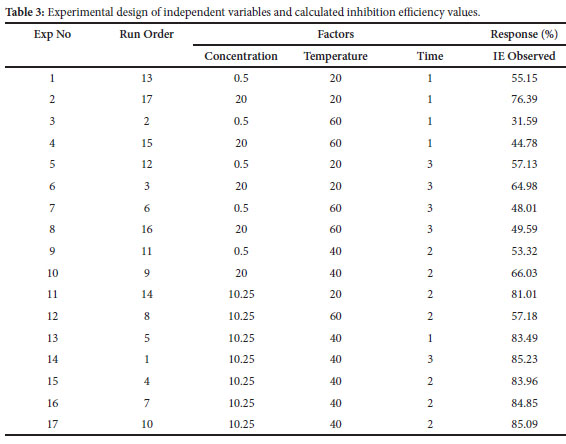
Table 3 presents the outcomes of17 experiments designed to optimize the corrosion inhibition efficiency (IE) of Daucus crinitus essential oil on copper in a 0.5 M H2SO4 solution. The study used Response Surface Methodology (RSM) with nonlinear regression to analyze three factors: inhibitor concentration (v/v), temperature (°C), and immersion time (hours). The observed IE values, ranging from 31.59% to 85.23%, reflect how these variables influence the oil's protective performance. The highest IE (85.23 %) was achieved at a concentration of 10.25 (v/v), a temperature of 40 °C, and an immersion time of 3 hours (Exp. No. 14). This optimal condition suggests a balance where the inhibitor effectively coats the copper surface without being disrupted by excessive heat or insufficient exposure time. Other high IE values (e.g., 85.09%, 84.85%) at similar conditions (10.25 v/v, 40 °C, 2-3 hours) reinforce this as a robust peak performance zone. Conversely, the lowest IE (31.59%) occurred at 0.5 (v/v), 60 °C, and 1 hour (Exp. No. 3), indicating that low concentration and high temperature severely limit protection.
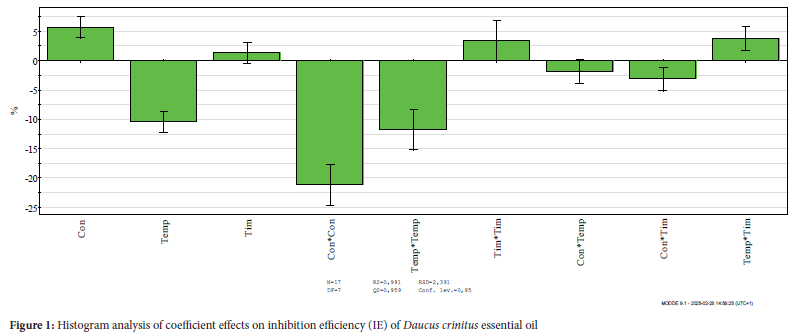
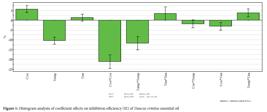
Response Surface Methodology (RSM) played a crucial role in identifying the optimal conditions for maximizing the corrosion inhibition efficiency (IE) of Daucus crinitus essential oil on copper. The relationship between the three key factors-inhibitor concentration, temperature, and immersion time-and their impact on IE is captured in a second-order polynomial equation, which is visually represented in (Figure 1). This figure presents histograms that illustrate the effects of the equation's coefficients on inhibition efficiency, providing a clear depiction of each factor's influence. The polynomial equation (Equation 4) is given as:

where X1 represents inhibitor concentration, X2 denotes temperature, and X3 stands for immersion time, all expressed in coded units.
The coefficients in this equation, as highlighted in (Figure 1), reveal how each variable shapes the outcome. Concentration, with a positive coefficient of 5.657, significantly boosts inhibition efficiency by increasing the availability of inhibitor molecules to coat the copper surface, while immersion time, with a coefficient of 1.35401, also contributes positively, though to a lesser extent, by allowing the protective layer to stabilize over time. In stark contrast, temperature, marked by a substantial negative coefficient of -10.351, reduces efficiency, suggesting that higher heat disrupts the inhibitor's adsorption, likely through a physisorption mechanism where molecules detach more easily from the surface.The quadratic terms in the equation, also visualized in (Figure 1), provide deeper insight. The large negative coefficients for concentration (-21.1746x1222321x2) and between concentration and immersion time (-3.125x1x3) imply that combining high values of these pairs can counteract the protective benefits, possibly due to competing surface dynamics. However, the positive interaction between temperature and immersion time (3.8325x2x3) indicates a slight improvement in efficiency when both rise together, perhaps because prolonged exposure offsets some thermal disruption.
Statistical tests and models analysis
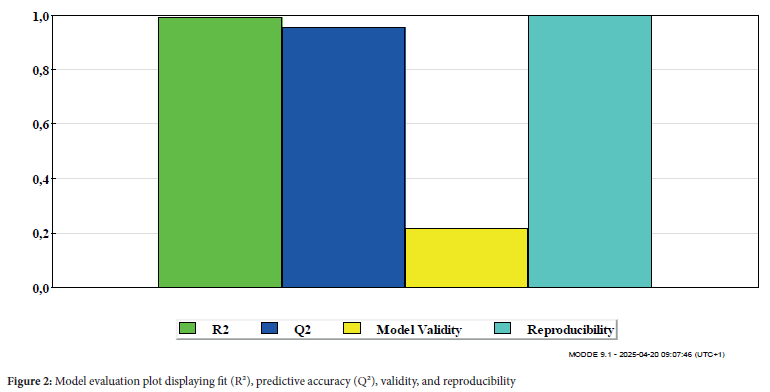
Statistical evaluation of the model was performed using analysis of variance (ANOVA), with results presented in (Table 4). The model's robustness and predictive power are illustrated in the fit summary graph (Figure 2), which includes key metrics such as validity, reproducibility, R2Table 4), the coefficient of determination (R230 31Table 4) highlights the model's outstanding predictive accuracy. Moreover, the small gap between and -well below the acceptable threshold of 0.3further substantiates the model's reliability. Both the and adjusted (R2 Daucus essential oil. The analysis was conducted at a 95% confidence level.
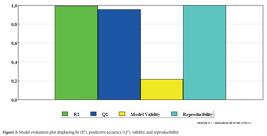
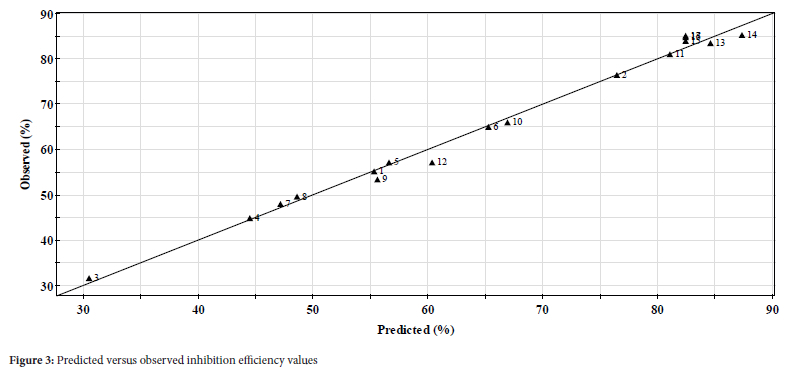
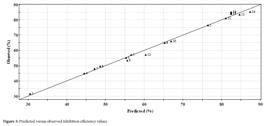
Additionally, the reproducibility metric, approaching 0.998724, demonstrates near-perfect consistency across experimental replicates. (Figure 3) presents a linear plot, reinforcing the model's appropriateness by illustrating the close alignment between predicted and observed inhibition efficiencies of Daucus essential oil in the corrosion inhibition process.
Main effects
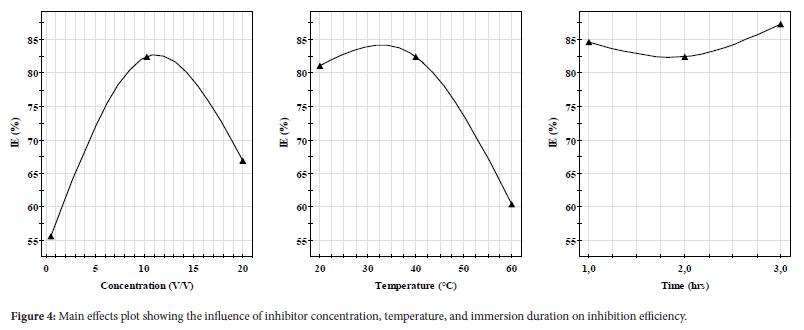
The influence of each parameter on corrosion inhibition efficiency (IE%) is depicted in (Figure 4). Each data point reflects the mean IE% at a specific parameter level, calculated independently of the other variables. A reference line representing the overall average IE% is included in each panel to underscore the distinct effects of inhibitor concentration, temperature, and immersion time on the protective performance of Daucus crinitus essential oil. Risinginhibitor concentration markedly enhanced corrosion inhibition efficiency. The most pronounced effect was observed at 10.25 (v/v), where IE% peaked, demonstrating optimal protection of the copper surface. However, beyond this threshold, a subtle decline in efficacy emerged at excessively high concentrations. This trend may stem from saturation of adsorption sites on the metal, limiting further attachment of inhibitor molecules, or from intermolecular competition that disrupts the uniformity of the protective layer.32 33
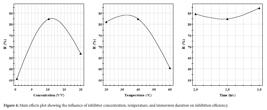
At higher temperatures, such as 60 °C, IE% plummeted to 31.59% with a minimal inhibitor concentration of 0.5 (v/v). The reduced performance likely arises from heightened molecular kinetic energy, which destabilizes the adsorbed inhibitor film and accelerates copper dissolution by weakening surface interactions.
The impact of immersion time on IE% was comparatively subdued yet nuanced. Efficiency remained largely consistent across durations, with a modest uptick observed as immersion extended. This gradual improvement suggests a slow reinforcement of the inhibitor film over time, possibly due to increased surface coverage or stabilization of the protective layer.34
The optimal condition for corrosion protection was achieved with an inhibitor concentration of 10.25 (v/v), a temperature of 40 °C, and an immersion duration of 3 hours, yielding an IE% exceeding 85%. This combination reflects a balance where adsorption is maximized without thermal disruption. Conversely, the lowest efficiency (31.59%) occurred at 0.5 (v/v) inhibitor concentration, 60 °C, and 1 hour of immersion, highlighting the detrimental synergy of low inhibitor presence and elevated temperature.
Contour plot
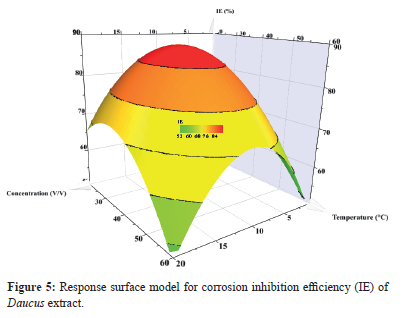
This section aims to pinpoint the optimal conditions for inhibition efficiency (IE), a metric that evaluates how well Daucus crinitus essential oil inhibits a reaction, presumably corrosion, on a metal surface. To examine the effects of temperature and inhibitor concentration on IE across varying exposure durations, the investigators employed surface and contour plots, as depicted in (Figure 5 and 6). The results indicate that IE improves at lower temperatures (20-30 °C) for a fixed inhibitor level. This trend is likely due to the detachment of inhibitor molecules from the metal surface at elevated temperatures, suggesting a physical rather than chemical bonding mechanism.35
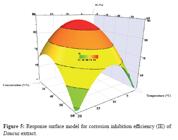
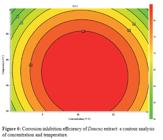
Analysis of (Figure 5) reveals a nuanced relationship: IE rises as inhibitor concentration shifts from low to intermediate levels, yet this advantage diminishes with increasing temperature. The highest IE is achieved at cooler temperatures (20-30 °C), extended immersion periods (2-3 hours), and a moderate concentration of Daucus crinitus essential oil, rather than the maximum. This implies that excessive inhibitor amounts may not always enhance performance, potentially due to saturation or other constraints.
Scanning electron microscopy
To assess the corrosion inhibition performance, scanning electron microscopy (SEM) was employed to analyse copper surfaces before and after 3 hours of immersion in 0.5 M H2SO4 at 30 °C. The evaluation was carried out under three different conditions: the first (1) without inhibitor, (2) with 0.5 of inhibitor per 100 mL of solution, and (3) with 10.25 of inhibitor per 100 mL of solution.
In the absence of the inhibitor (Figure 7b), the copper surface exhibited severe deterioration, characterized by deep pits and widespread surface damage, indicative of intense corrosive attack. In contrast, the unexposed copper surface (Figure 7a) appeared smooth, with only minor abrasions resulting from mechanical polishing.
At the lower inhibitor dosage (0.5 μΕ/100 mL, Figure 7c), the surface showed a marked reduction in corrosion features, with fewer pits and cracks. At the highest concentration tested (10.25 μΕ/100 mL, Figure 7d), the surface remained largely undamaged, suggesting the development of a uniform and adherent protective film.36
CONCLUSION
This investigation underscores the remarkable potential of Daucus crinitus essential oil as an efficient and environmentally benign corrosion inhibitor for copper in acidic media. By employing Response Surface Methodology (RSM), we systematically evaluated the influence of critical parameters-namely inhibitor concentration, temperature, and immersion time-on inhibition efficiency. The optimal conditions, yielding a peak efficiency of 85%, were identified as an inhibitor concentration of 10.25 (v/v), an immersion duration of 3 hrs, and a temperature of 40 °C. The findings reveal that higher concentrations bolster efficiency by establishing a robust protective barrier, whereas increased temperatures diminish performance due to desorption phenomena. SEM analysis further confirmed these results, showing significant surface preservation at high inhibitor concentrations and extensive corrosion in uninhibited conditions. The formation of a uniform and adherent film supports the proposed inhibition mechanism. Statistical analysis reinforced the reliability of these results, with an value of 0.991 affirming the model's exceptional predictive precision. Collectively, these insights position Daucus crinitus essential oil as a viable, green substitute for conventional synthetic inhibitors, offering substantial promise for industrial applications under controlled conditions. This work not only advances the case for plant-based solutions in corrosion management but also paves the way for future innovations in sustainable material protection strategies.
AUTHOR CONTRIBUTIONSManel Fellahi: Design of anticorrosion tests and experiments; Yazid Datoussaid: Analysis, Writing - Original Draft; Abbe Benchadli: performed the experiments; Tarik Attar: Methodology, analyzed and interpreted the data; Mohammed El Amine Dib: Conceptualization, Methodology, Writing - Review & Editing, Supervision
DECLARATION OF COMPETING AND FINANCIAL INTERESTSThe authors declare that there are no competing interests.
ORCID IDSManel Fellahi: https://orcid.org/0009-0001-7548-6274
Yazid Datoussaid: https://orcid.org/0000-0002-1696-5320
Tarik Attar: https://orcid.org/0000-0003-2355-1924
Abbe Benchadli: https://orcid.org/0009-0001-1807-5663
Mohammed El Amine Dib: https://orcid.org/0000-0003-4612-5303
ACKNOWLEDGEMENTS
Authors sincerely thank the research laboratories of Abou bekr Belkaïd University of Tlemcen, Algeria, for their generous support and funding of this work.
REFERENCES
-
1. Derfouf H, Messaoudi B, Attar T, Guezzoul M, Basirun WJ. Experimental and theoretical study of Atriplex halimus L. leaves extract as an ecologic corrosion inhibitor for XC38 carbon steel in an HCl environment. J. Mol. Liq. 2025;433:127785. https://doi.org/10.1016/j.molliq.2025.127785.
» https://doi.org/10.1016/j.molliq.2025.127785 -
2. Vargas IT, Fischer DA, Alsina MA, Pavissich JP, Pasten PA, Pizarro GE. Copper corrosion and biocorrosion events in premise plumbing. Materials. 2017;10(9):1036. https://doi.org/10.3390/ma10091036.
» https://doi.org/10.3390/ma10091036 -
3. Hussin MH, Kassim MJ, Razali N, Dahon N, Nasshorudin D. The effect of tinospora crispa extracts as a natural mild steel corrosion inhibitor in 1 M HCl solution. Arab. J. Chem. 2016;9:S616-S624. https://doi.org/10.1016/j.arabjc.2011.07.002.
» https://doi.org/10.1016/j.arabjc.2011.07.002 -
4. Ostovari A, Hoseinieh S, Peikari M, Shadizadeh S, Hashemi S. Corrosion inhibition of mild steel in 1 M HCl solution by henna extract: A comparative study of the inhibition by henna and its constituents (lawsone, gallic acid, α-d-glucose and tannic acid). Corros. Sci. 2009;51(9):1935-1949. https://doi.org/10.1016/j.corsci.2009.05.024.
» https://doi.org/10.1016/j.corsci.2009.05.024 -
5. Holla BR, Mahesh R, Manjunath HR, Anjanapura VR. Plant extracts as green corrosion inhibitors for different kinds of steel: A review. Heliyon. 2024;10(14):e33748. https://doi.org/10.1016/j.heliyon.2024.e33748
» https://doi.org/10.1016/j.heliyon.2024.e33748 -
6. Abdallah M, Soliman K, Al Jahdaly B, Al-Fahemi JH, Hawsawi H, Altass H, Motawea M, Al-Juaid SS. Natural parsley oil as a green and safe inhibitor for corrosion of x80 carbon steel in 0.5 mh 2 so 4 solution: A chemical, electrochemical, DFT and mc simulation approach. RSC Adv. 2022;12(5):2959-2971. https://doi.org/10.1039/d1ra08855f.
» https://doi.org/10.1039/d1ra08855f -
7. Marzorati S, Verotta L, Trasatti SP. Green corrosion inhibitors from natural sources and biomass wastes. Molecules. 2018;24(1):48. https://doi.org/10.3390/molecules24010048.
» https://doi.org/10.3390/molecules24010048 -
8. Bendiabdellah A, Dib MEA, Meliani N, Djabou N, Allali H, Tabti B. Preliminary phytochemical screening andantioxidant activities of solvent extracts from daucus crinitus desf., from algeria. Appl. Pharm. Sci. 2012;2(7):92-95. https://doi.org/10.7324/JAPS.2012.2710.
» https://doi.org/10.7324/JAPS.2012.2710 -
9. Abdoune MA, Benbelaïd F, Khadir A, Bendahou M. Evaluation of antimicrobial activity of solvent extracts from different parts of daucus crinitus desf. J. Appl. Pharm. Sci. 2013;3(11):117-121. https://doi.org/10.7324/JAPS.2013.31121.
» https://doi.org/10.7324/JAPS.2013.31121 -
10. Lanfranchi D-A, Laouer H, El Kolli M, Prado S, Maulay-Bailly C, Baldovini N. Bioactive phenyl propanoids from daucus crinitus desf. From algeria. J. Agri. Food Chem. 2010;58(4):2174-2179. https://doi.org/10.1021/jf903576x.
» https://doi.org/10.1021/jf903576x -
11. Beddiar H, Boudiba S, Benahmed M, Hanini K, Tamfu AN, Boudiba L, Soltani H, Laouer H, Akkal S. Evaluation of the potential of daucus crinitus extracts and their synthesized zno nanoparticles in inhibiting the corrosion of carbon steel. J. Chem. 2024:7703829. https://doi.org/10.1155/2024/7703829.
» https://doi.org/10.1155/2024/7703829 -
12. Zhang S, Zhou W. Bayesian dynamic linear model for growth of corrosion defects on energy pipelines. Reliab. Eng. Syst. Safe. 2014;128:24-31. https://doi.org/10.1016/j.ress.2014.04.001.
» https://doi.org/10.1016/j.ress.2014.04.001 -
13. Gapsari F, Soenoko R, Suprapto A, Suprapto W. Minimization of corrosion rate using response surface methodology. Eng. Rev. 2018; 38(1):115-119. https://hrcak.srce.hr/192863.
» https://hrcak.srce.hr/192863 -
14. Yang J, Qiu K. Experimental design to optimize the preparation of activated carbons from herb residues by vacuum and traditional ZnCl2 chemical activation. Ind. Eng. Chem. Res. 2011;50(7):4057-4064. https://doi.org/10.1021/ie101531p.
» https://doi.org/10.1021/ie101531p -
15. Nwose SA, Edoziuno FO, Osuji SO. Statistical analysis and response surface modelling of the compressive strength inhibition of crude oil in concrete test cubes. AJET. 2021;4:99-107. https://doi.org/10.5281/zenodo.4696030.
» https://doi.org/10.5281/zenodo.4696030 -
16. Afzalkhah M, Masoum S, Behpour M, Naeimi H, Reisi-Vanani A. Experimental and theoretical investigation of inhibition efficiency of 2-(2-hydroxyphenyl)-benzothiazole using impedance spectroscopy, experimental design, and quantum chemical calculations. Ind. Eng. Chem. Res. 2017;56(32):9035-9044. https://doi.org/10.1021/acs.iecr.7b02030.
» https://doi.org/10.1021/acs.iecr.7b02030 - 17. Al-Shamkhani MT, Ateik AA. Use of experimental designs to evaluate the influence of Ziziphus leaves extracts as a corrosion inhibitor for mild steel in (3.5 M) NaCl. Int. J. Appl. Eng. Res. 2018;13(10):7416-7423.
-
18. Belkhodja A, Choukchou-Braham E, Benkhaled A, Guendouz S. Study of the adsorption of a textile dye by alginate-bentonite beads: CCD-RSM design conception. J. Macromol. Sci. Part B. 2024:1-23. https://doi.org/10.1080/00222348.2024.2437854.
» https://doi.org/10.1080/00222348.2024.2437854 -
19. Benchadli A, Mellal T, Attar T, Dali Youcef B, Choukchou-Braham E. Optimization of inhibition efficiencies process of polyvinylpyrrolidone using response surface methodology. Revista Mexicana de Física. 2022;68(4):41003. https://doi.org/10.31349/RevMexFis.68.041003.
» https://doi.org/10.31349/RevMexFis.68.041003 -
20. Prabhu D, Prabhu PR, Rao P. Thermodynamics, adsorption, and response surface methodology investigation of the corrosion inhibition of aluminum by Terminaliachebula Ritz. extract in H3PO4. Chem. Pap. 2021;75(2):653-667. https://doi.org/10.1007/s11696-020-01318-8.
» https://doi.org/10.1007/s11696-020-01318-8 - 21. Europe Co. European Pharmacopoeia. 3rd ed. Strasbourg: Council of Europe; 1997.
- 22. Jennings W. Qualitative analysis of flavor and fragrance volatiles by glass capillary gas chromatography. Elsevier; 2012.
-
23. NIST Mass Spectrometry Data Center, Wallace WE. Names, 2-D Structures, Retention Indexes, Mass and IR Spectra data. In: Linstrom PJ (editor), NIST chemistry webbook. NIST Standard Reference Database Number 69. U.S. Secretary of Commerce; 2025. https://doi.org/10.18434/T4D303.
» https://doi.org/10.18434/T4D303 - 24. König, WA, Hochmuth, DH and Joulain D. Terpenoids and Related Constituents of Essential Oils. Library of MassFinder 2.1. University of Hamburg, Institute of Organic Chemistry, Hamburg, Germany; 2001.
- 25. Standards NIo, Technology. PC version 1.7 of the NIST/EPA/NIH mass spectral library. Norwalk: Perkin Elmer Corporation; 1999.
- 26. McLafferty FW, Stauffer D. Registry of mass spectral data. Hoboken: John Wiley; 2009.
- 27. McLafferty FW, Stauffer DB. The Wiley/NBS Registry of Mass Spectral Data; 4th ed. New York: Wiley-Interscience; 1988.
-
28. Hassan ST, Svajdlenka E, Rengasamy KR, Melichárková R, Pandian SK. The metabolic profile of essential oils and assessment of anti-urease activity by esi-mass spectrometry of Salvia officinalis. S. Afr. J. Bot. 2019;120:175-178. https://doi.org/10.1016/j.sajb.2018.04.023.
» https://doi.org/10.1016/j.sajb.2018.04.023 -
29. Attar T, Benchadli A. Studying the effectiveness of an expired betamethasone drug in sulfuric acid solutions to examine the corrosive behavior of copper using weight loss and experimental design. JOTCSA. 2024;11(1):291-302. https://doi.org/10.18596/jotcsa.1353785.
» https://doi.org/10.18596/jotcsa.1353785 -
30. Dennison TJ, Smith J, Hofmann MP, Bland CE, Badhan RK, Al-Khattawi A, Mohammed AR. Design of experiments to study the impact of process parameters on droplet size and development of non-invasive imaging techniques in tablet coating. PLoS One. 2016;11(8):e0157267. https://doi.org/10.1371/journal.pone.0157267.
» https://doi.org/10.1371/journal.pone.0157267 -
31. Gao X, Dai K, Wang Z, Wang T, He J. Establishing quantitative structure tribo-ability relationship model using bayesian regularization neural network. Friction. 2016;4:105-115. https://doi.org/10.1007/s40544-016-0104-z.
» https://doi.org/10.1007/s40544-016-0104-z -
32. Wang X, Liu L, Wang P, Li W, Zhang J, Yan Y. How the inhibition performance is affected by inhibitor concentration: A perspective from microscopic adsorption behavior. Ind. Eng. Chem. Res. 2014;53(43):16785-16792. https://doi.org/10.1021/ie502790c.
» https://doi.org/10.1021/ie502790c - 33. Hammouti B, Zarrouk A, Al-Deyab S, Warad I. Temperature effect, activation energies and thermodynamics of adsorption of ethyl 2-(4-(2-ethoxy-2-oxoethyl)-2-p-tolylquinoxalin-1(4h)-yl) acetate on Cu in HNO3. Orient. J. Chem. 2011;27(1):23-31.
-
34. Gómez-Sánchez G, Olivares-Xometl O, Arellanes-Lozada P, Likhanova NV, Lijanova IV, Arriola-Morales J, Díaz-Jiménez V, López-Rodríguez J. Temperature effect on the corrosion inhibition of carbon steel by polymeric ionic liquids in acid medium. Int. J. Mol. Sci. 2023;24(7):6291. https://doi.org/10.3390/ijms24076291.
» https://doi.org/10.3390/ijms24076291 -
35. Naceur B, Attar T, Benchadli A, Choukchou-braham E. Enhancing corrosion resistance of carbon steel using expired pharmaceutical drug sulpuren: À response surface methodology approach in acidic media. Rev. Roum. Chim. 2024;69(3-4):157-169. https://doi.org/10.33224/rrch.2024.69.3-4.06.
» https://doi.org/10.33224/rrch.2024.69.3-4.06 -
36. Datoussaid Y, Missoum H, Attar T, Messaoudi B, Benchadli A, Choukchou-braham E, Choukchou-Brahamb N, Ziani-cherif C. Experimental and theoretical studies of aminothiophene derivatives inhibitors on carbon steel corrosion in perchloric acid medium. Rev. Roum. Chim. 2024;69(3-4):139-148. https://doi.org/10.33224/rrch.2024.69.3-4.04.
» https://doi.org/10.33224/rrch.2024.69.3-4.04
Revised 16 July 2025
Accepted 21 July 2025