Efficient Vortex-assisted Extraction of Phorbol Esters from Jatropha Leaves and Correlation Between Leaves and Seeds in Phorbol EstersContent
Abstract
This work aimed to optimise and validate the vortex-assisted extraction with high-performance liquid chromatography-ultraviolet detection (HPLC-UV) method to quantify phorbol esters (PEs) in Jatropha leaves. Additionally, to evaluate the correlation between PEs content in leaves and seeds. The results of PEs content were expressed as equivalent of the major Jatropha phorbol ester, 12-deoxy-16-hydroxyphorbol-4'-[12',14'-butadienyl]-6'-[16',18',20'-nonatrienyl]-bicyclo[3.1.0]-hexane-(13-O)-2'-[carboxylate]-(16-O)-3'-]8'-butenoic-10']ate (DHPB) . One-variable-at-time strategy and 25-1V factorial fractional design were employed to determine the effects of solvent type, volume, stirring frequency, extraction time and cycles on yield. The quantification was performed using HPLC-UV. The optimum conditions were three extractions with 2% tetrahydrofuran:dichloromethane (1:1) in methanol (THF:DCM/MeOH). The sample:solvent ratio was 1 mg:25 μL, and the vortex stirring was 2200 rpm for 5 minutes. The method showed good linearity (R2 0.999), recoveries (97 to 105%), selectivity and repeatability (RSD 1.93-7.95%). In addition, good limits of detection and quantification of 2.19 and 6.65 ng μL"1, respectively, were noted. DHPB content in leaves and seeds ranged from 0.01 to 0.38 mg g"1 and 0.41 to 1.82 mg g"1, respectively. There is a statistically significant and positive linear relationship between leaves and seeds for DHPB content. These results may have practical application in analysing and predicting the amount of PEs in Jatropha leaves for environmental safety studies and the selection of better varieties for genetic improvement.
correlation; Jatropha leaves; Jatropha seeds; phorbol esters; vortex-assisted
1. Introduction
Jatropha is a non-edible, drought-resistant, multipurpose oil crop grown in many tropical and subtropical countries.1Jatropha has been promoted especially for biodiesel production to reduce dependence on fossil fuel imports, improving rural livelihoods.2,3
Several Jatropha germplasms have been established worldwide, through which breeding programs have been performed to turn Jatropha into a profitable industrial crop.4,5 Intensification of cultivation campaigns of Jatropha has led to a significant increase of contact between humans and the Jatropha plant. This contact imminently leads to occupational health risks due to toxic tigliane diterpenes (referred to as phorbol esters (PEs)) in the whole plant.678
On the other hand, Kato and Takechi9-1. These facts signal the urgent need to assess the human health risks associated with short- and long-term contact with the PEs-containing Jatropha plant. For this purpose, robust and sensitive analytical methods for determining PEs in all Jatropha aerial parts are critical.
Efficient and accurate methods for quantifying PEs in seeds have already been developed, optimised and their fitness-for-purpose was demonstrated through a comprehensive validation process10111212
Vortex agitation represents a low-cost, simple and effective technique to provide the mechanical energy required to enhance the dispersion of extracting solvent within the sample matrix12-14. It improves the extraction efficiency through the reduction of the time required to attain partition equilibrium.12,14 It has been employed to assist several environmental and food samples preparation techniques. Some of these techniques are dispersive liquid-liquid microextraction,12-14 surfactant-enhanced-emulsification liquid-liquid microextraction,15 16171010,12-15 and/or spectroscopic techniques.13,17 Therefore, the vortex agitation approach can be a suitable alternative to the previously reported method for extracting PEs from Jatropha leaves.
This study employed the experimental design to optimise the vortex-assisted solid-liquid extraction coupled to HPLC-UV for determining the PEs in Jatropha leaves. Furthermore, the correlation between seeds and leaves in terms of the amount of PE was evaluated.
2. Experimental
2.1. Chemicals
HPLC grade water (18 MOcm-1) was purified by a Milli-Q system (Milli-Q direct 8.0, Japan). All chemicals were purchased from Fluka Chemika and Skylabs (South Africa) unless otherwise specified. Tetrahydrofuran (THF), ethylacetate (EtAc), ethanol (EtOH) and dichloromethane (dCM) were of analytical grade, whereas methanol (MeOH) and acetonitrile were of HPLC grade. The standard of the major Jatropha phorbol ester, 12-deoxy-16-hydroxyphorbol-4,-[12,,14'-butadienyl]-6,-[16,48,,20,-nonatrienyl] -bicyclo[3.1.0]hexane-(13-O)-2'-[carboxylate]-(16-O)-3,-]8,-butenoic-10,]ate (DHPB), was prepared in Kurume University, Japan, following the method described by Nakao et al.ls
Sampling and pre-sample preparation
Eleven Jatropha accessions from the Jatropha germplasm bank established in Boane district (26Q02,20.4"S, 32Q21O6.5" E), Maputo Mozambique, were used. These specimens were authenticated by the Botanical Laboratory of the Eduardo Mondlane University. The samples were air-dried at room temperature, crushed in a mortar (until kernels and leaves became sticky and fine powder, respectively) and stored at -14°C in screw-capped polypropylene tubes.
Extraction of PEs from Jatropha leaves and seeds
PEs were extracted following the procedure previously described by Zimila et al.10
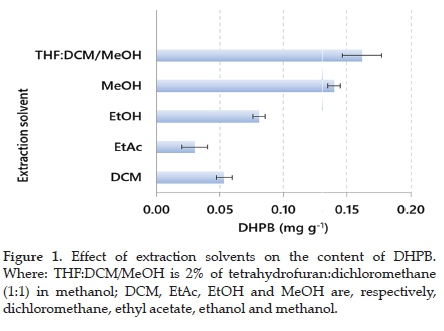
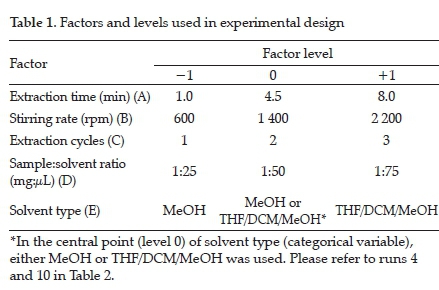
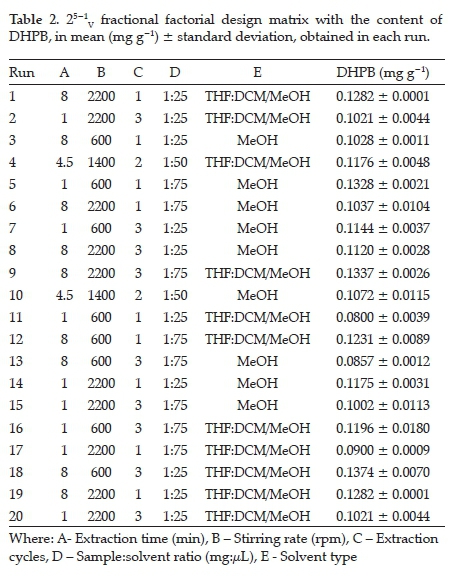
Optimisation of the conditions for extraction of PEs from leaves consisted of solvent selection by a one-variable-at-time strategy and the whole factors screening through experimental design. The extraction efficiency of DCM, EtAc, EtOH, MeOH, and THF:DCM/MeOH was evaluated, and the two best solvents were selected for experimental design. The sample:solvent ratio, extraction time, vortex-stirring frequency and extraction cycles were kept at 1 mg:50 μL, 3 mm/cycle, 3200 rpm, and 2 cycles, respectively. The influence of extraction time, stirring frequency, extraction cycles, solvent type and volume was screened by the fractional factorial with resolution V (25-1V) and two centre points. The factor levels are displayed in Table 1.
To extract PEs from the seed kernels, two extractions with methanol at 1 mg:50 sample:solvent ratio, under vortex stirring at 3200 rpm for 3 min/cycle were applied.10
Chromatographic analysis
The chromatographic analyses were performed according to Zimila et al.10-1. The wavelength was set at 282 nm and the run time was 20 min. The chromatographic peaks of PEs were in the range of 10 to 15.5 min, and the methanol solutions of DHPB at 2.5, 5.0, 10.0, 25.0 and 50.0 ng μL-1 were used to obtain the calibration curve.
Statistical analysis
Analysis of Variance (ANOVA) toolbox of Minitab 18.0 statistical software at 95% confidence level was used for experimental design and data processing. The statistical significance was considered at p < 0.05.
Results and Discussion
Solvent selection for extraction of PEs from Jatropha leaves
The crucial step for efficient extraction and analysis of PEs from leaves is the selection of a suitable solvent. According to Schmidt and Hecker,19Fig 1.
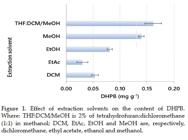
The best DHPB recovery was obtained using MeOH and THF:DCM/MeOH; hence these solvents were selected for the experimental design. Despite the difference in nature of the matrices, this result is in accordance with previous studies by Devappa et al.20Jatropha oil.
Both DCM and EtAc showed low extraction yields and chromatograms with poorly resolved peaks, presumably due to co-extraction of metabolites with retention times close to those of PEs. On the other hand, EtOH exhibited well-resolved chromatograms, but its extraction efficiency was relatively low.
Optimisation of the extraction of DHPB from Jatropha leaves
Solvent extraction is a series of phenomenological processes strongly affected by various factors, including solvent type, volume, matrix composition, extraction time, sample size, and temperature215-1V). Two centre points were included to assess the possible nonlinear relationship between variables and extraction yield.22Table 2.
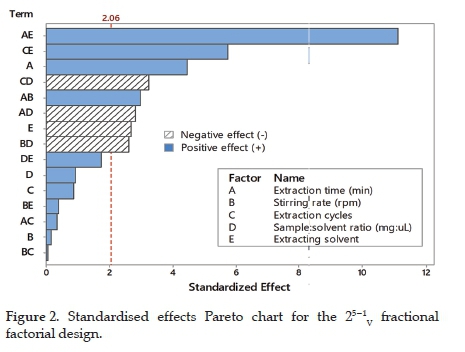
The effects of the studied variables are shown in Fig. 2 as a Pareto chart. In this chart, the length of the bar is proportional to the effect of the variable on the extraction yield.23
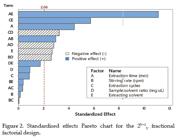
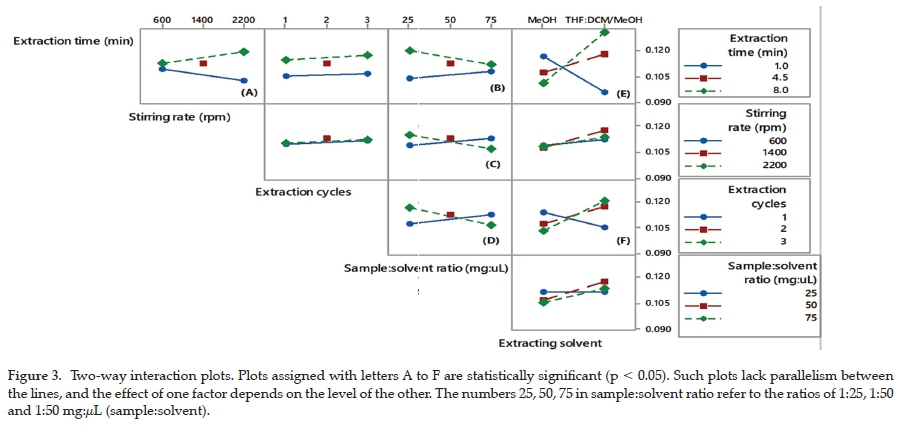
Factors whose bar lengths extend beyond the critical value of 2.06 are statistically significant at the 95% confidence level (p < 0.05). Thus, extraction time and solvent were the most influential variables, whereas the others had little effect on extraction recovery. On the other hand, five 2-way interactions (extraction time X stirring rate, extraction time X sample:solvent ratio, extraction time X extracting solvent, stirring rate X sample:solvent ratio, extraction cycles X sample:solvent ratio and extraction cycles X extracting solvent) were statistically significant. Graphically, such interactions lacked parallelism (Fig. 3) and were assigned with letters A to F.
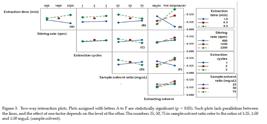
According to Montgomery,24extraction time X extraction solvent (Fig. 3E) reveals that MeOH provided higher DHPB recovery than THF:DCM/MeOH when extraction was performed for 1 min. In comparison, THF:DCM/MeOH exhibited higher efficiency than MeOH when extraction time was extended to 4.5 or 8.0 min. On the other hand, Fig. 3A and 3B show that when the extraction time was at 8 min, good recoveries were obtained by combining a sample:solvent ratio of 1:25 with vigorous stirring (2200 rpm). In contrast, the extraction was carried out for 1 min, and high recoveries were attained by a low stirring rate (600 rpm) and a sample:solvent ratio of 1:75. These facts imply that the decrease of both polarity and dielectric constant due to the addition of THF:DCM had a notable effect on MeOH extraction capacity. Perhaps, the modifiers improved their ability to overcome the intermolecular forces binding the DHPB to the matrix, increasing the extraction efficiency. Nevertheless, the time required to attain the highest recovery probably increased because the modifiers decreased the mass transfer rate of PEs to the liquid medium.
Fig. 3F (interaction extraction cycles X extraction solvent) indicates that good yields were obtained by making several extractions with THF:DCM/MeOH or a single MeOH extraction. Fig. 3D shows that high yields were achieved with a single extraction at the sample:solvent ratio of 1:75 or three successive extractions with a sample:solvent ratio of 1:25. This phenomenon may be related to a drop in MeOH solubilisation capability due to the addition of modifiers. Regular solvent renewal is of utmost importance to ensure good yields.1810
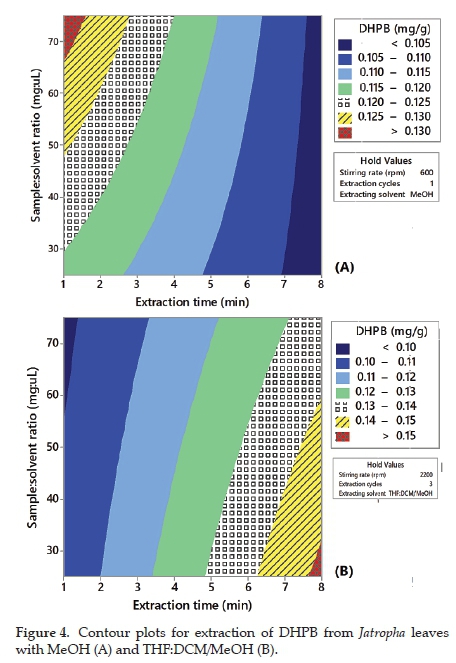
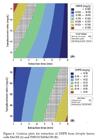
In short, the conditions for obtaining high extraction yields with MeOH are single extraction (~1 min) at the sample:solvent ratio of 1:75 and vortexing at 600 rpm. If THF:DCM/MeOH is used, then three successive extractions (8 min/extraction) in the sample:solvent ratio of 1:25 under vortex agitation at 2200 rpm should be applied. These conditions are in accordance with the contours of Fig. 4, in which the red-coloured surfaces represent the maximum yield conditions.
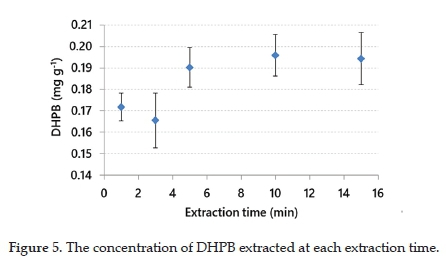
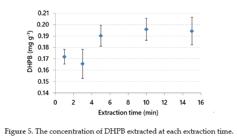
Since extraction time was the unique important continuous variable, further assays were performed at different levels of extraction time (1, 3, 5, 10, 15 min) to determine the minimum time required to achieve good yields. The extraction was performed with THF:DCM/MeOH, at the sample:solvent ratio of 1:25, under stirring at 2200 rpm. The results are illustrated in Fig. 5. ANOVA showed that the yield differences obtained for times 5, 10 and 15 minutes are not statistically significant (p > 0.05). Therefore, the optimised method was three extraction cycles (5 min/cycle) with THF:DCM/MeOH, at a sample:solvent ratio of 1:25, under vortex stirring at 2200 rpm.
Quality assurance parameters
The optimised method was validated for linearity, selectivity, repeatability, recovery, limits of detection (LOD) and quantification (LOQ), according to Huber 2526
Linearity, LOD and LOQ were estimated on the basis of a 5-point calibration curve of DHPB (2.5, 5.0, 10.0, 25.0 and 50.0 ng μL-1). The peak areas were found to be linear over the analytical range of 2.5 to 50 ng μL-1, with a coefficient of determination (R2-1, respectively.
For recovery studies, a PEs-free sample (seeds collected from a non-toxic Jatropha variety) was spiked with a known amount of DHPB and extracted according to the optimised method. The highest DHPB content obtained in the optimisation process (0.15 mg g-1) was assigned the value of 100%. Then, the levels corresponding to 50% and 150% were found to be 0.07 mg g-1 and 0.23 mg g-1, respectively. The recovery was expressed as the percentage of DHPB extracted against the amount spiked in the sample. The repeatability was evaluated by calculating the relative standard deviation (RSD) of six replicates at each concentration level. The recoveries were found to be 104.96±2.11%, 102.58±8.39% and 96.81±4.73% at the concentration levels of 50%, 100% and 150%, respectively. Hence, the method showed both good repeatability (RSD 1.937.95%) and recoveries.
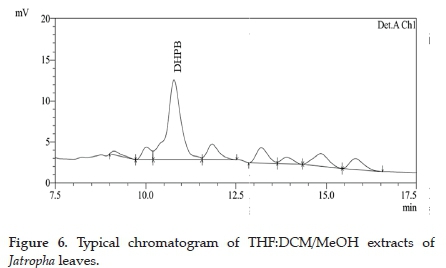
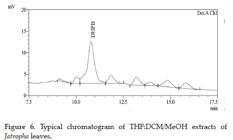
The method selectivity was assessed by checking the presence of interfering peaks in the retention time range of PEs. The chromatogram of the extracts did not present any additional peaks besides the five reported peaks of PEs in the range of 10 -15.5 min (Fig. 6).
Comparison with previous methods
The only previously reported method found to determine PEs in Jatropha leaves is the ultrasound-assisted extraction followed by HPLC-UV described by Baldini et ai}1-1 vs 0.20 ± 0.01 mg g-1) and selectivity.
Correlation between seeds and leaves in terms of the content of DHPB
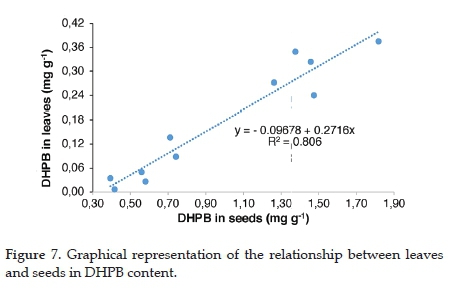
Leaf-seed correlation studies in terms of PEs is a useful tool for predicting the amount of these metabolites in leaves by their content in the seeds, or vice-versa. Eleven Jatropha genotypes, with increasing content of DHPB in seed kernels, were chosen for this study, and the results are presented in Fig. 7.
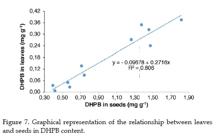
A strong, positive (r = 0.927) and significant (p < 0.05) linear model, with R2
These results imply that if the amount of PEs in the seeds is high, then the PEs amounts in the leaves will also be high. However, similarly to the result reported by Makkar and Becker627
Conclusions
A simple, reliable, cost-effective and fast method for determining PEs in Jatropha leaves has been optimised and validated. Among the five factors considered in this study, only the extraction time and the nature of the solvent had significant effects. The modification of MeOH with 2% THF:DCM(1:1) improved its extractive capacity. Jatropha leaves and seeds are strongly correlated with each other in terms of the content of DHPB. The results of the present study evidenced that the optimised method has numerous advantages over the previously reported and has the potential to provide accurate content of PEs in Jatropha leaves for ecotoxicological risk assessments. Furthermore, the content of PEs in Jatropha leaves can be easily deduced by their content in seeds or vice-versa.
ORCID iDs
Motoyuki Nakao: https/orcid.org/0000-0002-1901-554X
Hercilio Zimila: https/orcid.org/0000-0001-5183-6586
Jaime Mandlate: https/orcid.org/0000-0001-6790-5574
Amalia Uamusse: https/orcid.org/0000-0003-4492-4443
Tercina Ngovene: https/orcid.org/0000-002-5850-8750
Acknowledgements
The authors would like to express their sincere gratefulness to Japan International Cooperation Agency (JICA) for financial support of the Project on Sustainable Production of Biodiesel from Jatropha in Mozambique. The authors would also like to thank Amon Tikoko for his help in language and grammar editing.
References
- 1 R. Brittaine and N. Lutaladio, Jatropha: A smallholder bioenergy crop -The potential for pro-poor development, FAO, Rome, 2010.
- 2 I. Soto, C. Ellison, M. Kenis, B. Diaz, B. Muys and E. Mathijs, Why do farmers abandon Jatropha cultivation? The case of Chiapas, Mexico, Energy Sustain. Dev., 2018, 42, 77-86.
- 3 M. Slingerland and M. Schut, Jatropha developments in Mozambique: Analysis of structural conditions influencing niche-regime interactions, Sustainability, 2014, 6, 7541-7563.
- 4 A.J. King, L.R. Montes, J.G. Clarke, J. Affleck, Y. Li, H. Witsenboer, E. van der Vossen, P Van Der Linde, Y. Tripathi, E. Tavares, P Shukla, T. Rajasekaran, E.N. van Loo and I.A. Graham, Linkage mapping in the oilseed crop Jatropha curcas L. reveals a locus controlling the biosynthesis of phorbol esters which cause seed toxicity, Plant Biotechnol. J, 2013, 11, 986-996.
- 5 C. Yi, C. Reddy, K. Varghese, T. Ngoc, H. Bui, S. Zhang, M. Kallath, B. Kunjachen, S. Ramachandran and Y. Hong, A New Jatropha curcas Variety (JO S2) with Improved Seed Productivity, Sustainability, 2014, 4355-4368.
- 6 H.PS. Makkar and K. Becker, Jatropha curcas, a promising crop for the generation of biodiesel and value-added coproducts, Eur. J. Lipid Sci. Technol., 2009, 111, 773-787.
- 7 G. Goel, H.PS. Makkar, G. Francis and K. Becker, Phorbol esters: Structure, biological activity, and toxicity in animals, Int. J. Toxicol., 2007, 26, 279-288.
- 8 R.K. Devappa, J.S. Roach, H.PS. Makkar and K. Becker, Occular and dermal toxicity of Jatropha curcas phorbol esters, Ecotoxicol. Environ. Saf., 2013, 94, 172-178.
- 9 J. Kato and S. Takechi, Utilisation of Jatropha curcas: Toxicity of phorbol esters and risk management, J. Japanese Soc. Risk Res., 2015, 24, 221-230.
- 10 H.E. Zimila, J.S. Mandlate, R.S. Chivodze, H.F. Muiambo, V Skripets and A.A. Uamusse, An optimised solid-liquid method for rapid extraction of phorbol esters from Mozambican Jatropha seeds, Ind. Crops Prod., 2018, 124, 941-946.
- 11 M. Baldini, C. Ferfuia, R. Bortolomeazzi, G. Verardo, J. Pascali, E. Piasentier and L. Franceschi, Determination of phorbol esters in seeds and leaves of Jatropha curcas and in animal tissue by high-performance liquid chromatography tandem mass spectrometry, Ind. Crops Prod, 2014, 59, 268-276.
- 12 E. Psillakis, Vortex-assisted liquid-liquid microextraction revisited, Trends Anal. Chem, 2018, 113, 332-339.
- 13 C.B. Ojeda, F.S. Rojas, Vortex-assisted liquid-liquid microextraction (VALLME): The latest applications, Chromatographia, 2018, 81, 89-103.
- 14 R. Zhang, Z.-C. Tan, K.-C. Huang, Y. Wen, X.-Y. Li, J.-L. Zhao, C.-L. Liu, A vortex-assisted dispersive liquid-liquid microextraction followed by UPLC-MS/MS for simultaneous determination of pesticides and aflatoxins in herbal tea, Molecules, 2019, 24, 1029.
- 15 Z. Yang, Y. Lu, Y. Liu, T. Wu, Z. Zhou, D. Liu, Vortex-assisted surfactant-enhanced-emulsification liquid-liquid microextraction, J. Chromatogr. A., 2011, 1218, 7071-7077.
- 16 X. Cheng, H. Yan, X. Wang, N. Sun, X. Qiao, Vortex-assisted magnetic dispersive solid-phase microextraction for rapid screening and recognition of dicofol residues in tea products, Food Chem., 2014, 162, 104-109.
- 17 E. Yilmaz, M. Soylak, Preparation and characterisation of magnetic carboxylated nanodiamonds for vortex-assisted magnetic solid-phase extraction of ziram in food and water samples, Talanta, 2016, 158, 152-158.
- 18 M. Nakao, G. Hasegawa, T. Yasuhara, Y. Ishihara, Degradation of Jatropha curcas phorbol esters derived from Jatropha oil cake and their tumor-promoting activity, Ecotoxicol. Environ. Saf., 2015, 114, 357-364.
- 19 R. Schmidt, E. Hecker, Autoxidation of phorbol esters under normal storage conditions, Cancer Res, 1975, 35, 1375-1377.
- 20 R.K. Devappa, H.PS. Makkar, K. Becker, Optimisation of conditions for the extraction of phorbol esters from Jatropha oil, Biomass and Bioenergy, 2010, 34, 1125-1133.
- 21 M. D. L. De Castro and J. L. L. Garcia, Acceleration and Automation of Solid Sample Treatment, vol. 24, Elsevier Science B.V, 2002, pp. 233-279.
- 22 T. Lundstedt, E. Seifert, L. Abramo, B. Thelin, Â. Nyström, J. Pettersen, R. Bergman, Experimental design and optimization, Chemom. Intell. Lab. Syst, 1998, 42, 3-40.
- 23 S. Khodadoust, M. Hadjmohammadi, Determination of N-methylcarbamate insecticides in water samples using dispersive liquid-liquid microextraction and HPLC with the aid of experimental design and desirability function, Anal. Chim. Acta. 2011, 699, 113-119.
- 24 D.C. Montgomery, Design and analysis of experiments, 8th ed., John Wiley & Sons, Inc., USA, 2013.
- 25 L. Huber, Validation of analytical methods, Agilent Technologies, New York, 2010.
-
26 AOAC International, Guidelines for single laboratory validation of chemical methods for dietary supplements and botanicals, 2002, 38. www.aoac.org.
» www.aoac.org - 27 S. Cleemput, Breeding for a reduced glucosinolate content in the green mass of rapeseed to improve its suitability for biogas production, PhD thesis, University of Göttingen, Germany, 2011.
Revised 07 May 2021
Accepted 16 June 2021