Relationship of testicular development with age, body weight, semen characteristics and testosterone in Kivircik ram lambs
Abstract
The study was conducted to measure the development of several testicular characteristics and to investigate the relationship between testicular parameters with body growth, semen characteristics and serum testosterone levels in growing ram lambs. Seventeen single born Kivircik ram lambs from three to four year old ewes were used. When the rams were two months old measurements of the length, diameter and circumference of their testes and body weights started, and blood samples were collected at 20-day intervals for the next 12 months. From seven to 14 months of age semen was collected at monthly intervals. There was a gradual and linear increase in testicular dimensions from two to 11 months of age. A rapid increase in all testicular dimensions was observed between 140 to 160 days of age. All measurements of testes, live weight, age and serum testosterone concentrations were positively and significantly correlated with each other. While a significant positive correlation was found at seven and eight months of age between all testicular measurements and semen volume and motility, no such correlations were observed between nine and 14 months of age. From seven to 14 months of age no correlation was measured between serum testosterone concentrations and spermatological characteristics. These results demonstrated that testicular measurements, especially scrotal circumference, can be used as criteria for early selection of ram lambs to be used in breeding at relatively young ages.
Kivircik lamb; testicular development; semen characteristics; testosterone
Introduction
The Kivircik is the main native sheep breed of the Thrace and Marmara regions of Turkey. It has a thin tail and short ears, and produces meat, wool and milk. Besides Turkey, the Kivircik breed is also found in Bulgaria and Greece. The quality of Kivircik meat is considered to be the best among local and imported breeds because of good marbling. Studies have been conducted on the testicular development of Kivircik rams, though to a limited extent (Taşkin et al., 1996; Koyuncu et al., 2005). However, as far as we know, no study has been conducted on the relation between testicular dimensions, spermatological characteristics and reproductive hormones of Kivircik rams.
Recognition of the reproductive characteristics of a sheep breed is an essential starting point towards improving its productivity. Characterization of puberty and early sexual development is a valuable tool for selection within the males of a breed (Madani et al., 1989). In fertility studies in livestock there is a tendency to focus more on the female side with much less emphasis on the male side. However, male fertility is as important as that of the female (Davidson & Farver, 1980; Syrstad, 1981). Since most selection responses derive from sire selection, improved reproduction in their female offspring could accrue from genetic progress in the sires. Indirect selection recognizes that decisions related to selection may be based on traits that are relatively easy to measure, are expressed early in life and are highly heritable (Toe et al., 2000). Measures of testicular size have received considerable attention as possible selection criteria for improving fertility in sheep, primarily because of their high heritable (Toe et al., 2000) and their favourable to neutral association with female reproduction (Purvis et al., 1988). Other desirable attributes of these traits include ease of measurement and high repeatability (Knight, 1977) as well as the fact that they can be measured on young animals. A review by Matos & Thomas (1992) concluded that selection for male reproductive performance using testicular size can yield responses of 1 to 2% per year. Maintaining a high fertility by genetically superior rams producing large numbers of high quality spermatozoa, is important for the improvement of overall flock fertility (Rege et al., 2000). By using rams with a high concentration of spermatozoa in their testes, more ewes per ram can be employed; conception rates would increase and the percentage of non-pregnant ewes would be reduced (Gherardi et al., 1980). However, evidence of a relationship between testicular size and spermatological characteristics is inconclusive. While some researchers suggested that testicular size provided a good index of testicular sperm output in rams (Lino, 1972), others reported that biweekly scrotal measurements were poorly correlated with semen quality in adult rams (Langford et al., 1989). Fernandez et al. (1999) did not record a relationship between testicular size and sperm production. In contrast, testicular volume during late spring was correlated with sperm production in autumn.
These conflicting data justify the need for further studies on the relationship between testicular measurements and semen characteristics in rams. The aim of this study was to measure the development of several testicular characteristics and to investigate the relationship between testicular parameters with body growth, spermatological traits and serum testosterone levels in growing ram lambs.
Materials and Methods
The study was conducted at the Research Farm of the Veterinary Faculty of Istanbul University, Turkey. In this region the breeding season of sheep is between July and October. Seventeen Kivircik ram lambs, 2-month old, single born from 3 - 4 year old ewes, were used. The lambs grazed with their dams until weaning. The ram lambs were weaned at 100 days of age and then housed separately in a shed and raised under the same management and nutritional conditions. After weaning, the lambs were fed a standard balanced diet of a concentrate (160 g protein/kg plus vitamins and minerals) and clover hay. When the animals were two months old, length, diameter and circumference of the testes and body weights were measured. Each testis was moved into the distal part of the scrotum and its circumference was measured with a flexible cloth tape. The length and diameter of each testis were measured with a calliper after forcing it against the scrotum (Salhab et al., 2001). The volume of the testes was calculated as reported by Godfrey et al. (1998):
Testes volume (cm3) = 0.0396 x (average testis length) x (scrotal circumference)2.
At 20-day intervals between two and 14 months of age (from March to March) blood samples were collected by jugular venipuncture. Within 30 min of collection the samples (7 to 10 mL) were centrifuged at 3000 χ g for 15 min. Plasma aliquots (500 μL) were then stored at -20 °C until assayed. Testosterone (T) concentrations were measured by radioimmunoassay using a commercial kit (DSL-4000, DSL, Texas, USA). Assay sensitivity was 0.12 ng/mL serum with a coefficient of variation of <10%.
From seven to 14 months of age, semen samples were obtained monthly from each ram lamb using an electro-ejaculator (P-T Electronics, Model 304, USA). The volume of the ejaculate was read directly from a graduated collection tube. Sperm concentration was determined by optical density with a spectrophotometer (Photometer SDM4, Minitüb, Germany) calibrated for rams. By examining one drop of semen diluted with physiological saline, individual progressive motility was estimated under a phase-contrast microscope at a medium magnification (10 x 40).
All statistical analyses were carried out using the SPSS program v. 10.0 for windows (SPSS Inc, Chicago, IL). One-way ANOVA was used for repeated measurements. Significant differences between means were detected, using the Duncan's test. Correlations between measurements were obtained by means of the Pearson Correlation Test.
Results and Discussion
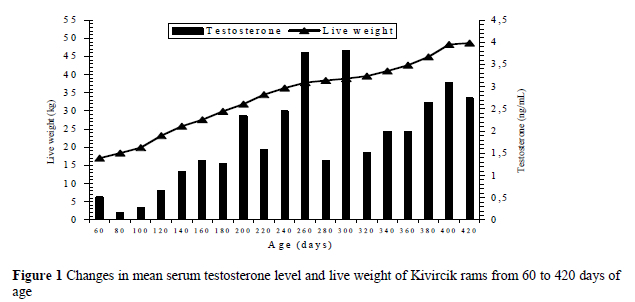
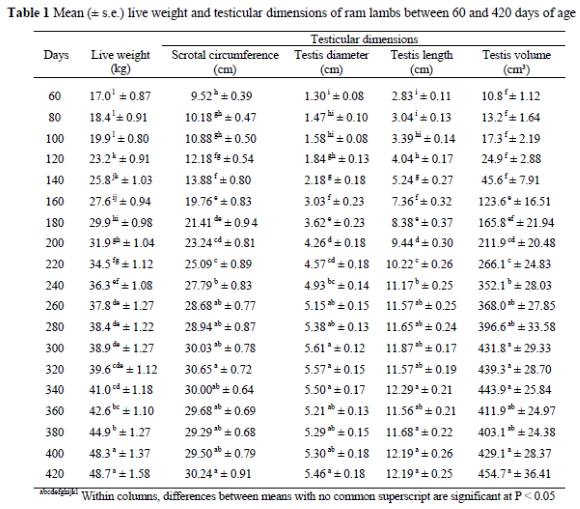
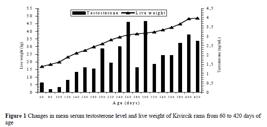
Table 1 summarizes the development of testicular dimensions and live weights during the study. Live weights increased continuously between 60 and 420 days, most rapidly from 100 to 120 days and again from 380 to 400 days of age. There were no differences between measurements of the right and left testes (P > 0.05). There was a gradual and linear increase in testicular dimensions from 60 days of age until the end of the breeding season (300 - 320 days). Thereafter, testicular dimensions remained relatively constant until 420 days of age, though slight fluctuations were observed. The mean serum testosterone level showed sharp fluctuations between 240 and 320 days of age (P < 0.05). Highest testosterone levels were recorded at 260 and 300 (autumn) days of age (Figure 1).
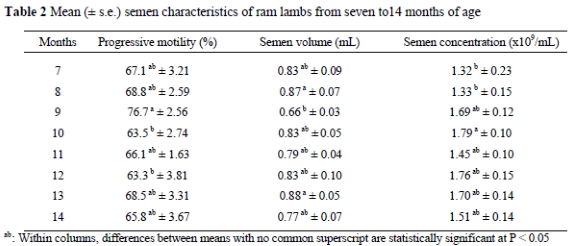
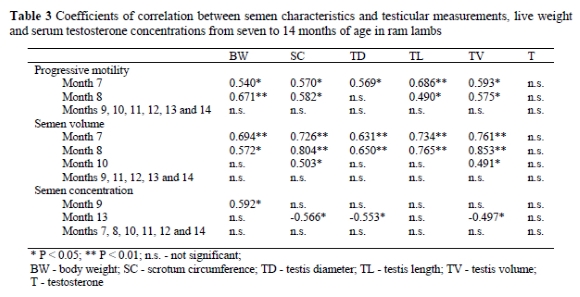
It is generally accepted that semen characteristics improve with age (Wiemer & Ruttle, 1987). It has been observed that semen concentration increased linearly between seven and 10 months of age. However, in the present study the semen volume and progressive motility did not increase with age between seven and 14 months of age (Table 2). Similarly, it has been reported that only small fluctuations in motility occured from 32 to 46 weeks of age (Alexopoulos et al., 1991). There are differences in opinion about the relationship between testicular measurements and spermatological characteristics in rams. While several researchers concluded that there are favourable genetic and phenotypic correlations between semen characteristics and testicular measurements in rams (Rege et al., 2000) others reported no relationship between testicular size and sperm production measured at the same time (Fernandez-Abella et al., 1999). In the present study a significant positive correlations were observed between all testicular measurements with semen volume and motility rate at seven and eight months of age, while no correlation was found from nine to 14 months of age (Table 3). In accord with the present study Bruere (1986) concluded that an increase in testicular size resulted in increasing spermatogenesis, which was more evident in young than in older rams. It has been reported that biweekly scrotal measurements are poorly correlated with semen quality within adult rams (Langford et al., 1989; Aksoy et al., 1994).
Progressive motility is the most common criterion used for the determination of semen quality. Heritability estimates reported by Rege et al. (2000) suggested a high potential for genetic improvement in spermatozoa motility and in reducing spermatozoa abnormality. They suggested that selection on spermatozoa motility is likely to be accompanied by favourable correlated responses with other spermatozoa traits. Although morphological defects were not considered in the present study, abnormal spermatozoa rate has been reported to decrease rapidly after five months of age (Alexopoulos et al., 1991). Depending on the results of the study it is possibly to say that semen collected from seven-month old Kivircik rams are of sufficient quality to be used for artificial insemination (Bruere, 1986). Similarly, Taşkın & Kaymakçı (1996) found the fertile semen production age for Kivircik rams to be 195.4 days. A gradual and linear increase in testicular dimensions was observed from two to 11 months of age. However, during the winter months (when the rams were about 11 - 13.5 months old), a pause or slight decrease was noticed in the development of all testicular parameters. A rapid increase in testicular dimensions was observed from 140 to 160 days of age, at the average live weight of 25.8 kg. The obtained data suggested that ram lambs were in a rapid sexual developmental stage during this period. In agreement with this Taşkın & Kaymakçı (1996) reported that the initial semen collection age for Kivircik ram lambs was 144.4 days.
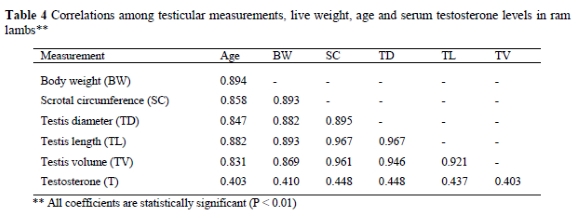
The different testicular measurements of the Kivircik ram lambs were better correlated with body weight than with age. As would be expected, all measurements of testis, live weight, age and serum testosterone concentrations were positively (P < 0.01) correlated with one another (Table 4). Scrotal circumference could provide a useful estimate of testicular growth since its correlations with the other testicular measurements were the highest. These results are in accordance with the findings of Salhab et al. (2001).
Conclusions
It was clearly established in the present study that there is a significant and positive correlation between testicular measurements and semen characteristics (progressive motility, semen volume) in ram lambs at the age of seven to eight months. Therefore, this can be used as a selection criterion to use the ram lambs at an early age. This application can also be considered to reduce the costs of keeping surplus ram lambs.
Acknowledgements
This article is a part of the PhD thesis of the first author and was supported by the Research Fund of Istanbul University (Project number: T-1107/18062001).
References
- Aksoy, M., Ataman, M.B., Karaca, F. & Kaya, A., 1994. The investigation of the relation between semen quality and morphometric measurements of testicles in Merino lambs. J. Vet. Sci. 10, 127-129 (in Turkish, English abstract).
- Alexopoulos, K., Karagiannidis, A. & Tsakalof, P., 1991. Development of macroscopic and microscopic characteristics of ejaculates from Chios, Serres and Karaguniki breed lambs. Theriogenology 36, 667-680.
- Bruere, A.N., 1986. Examination of the ram for breeding soundness. In: Current Therapy in Theriogenology. Ed. Morrow, D.A., 2nd ed. W.B. Saunders Company, Philadelphia. pp. 874-880.
- Davidson, J.N. & Farver, T.B., 1980. Conception rate of Holstein for artificial insemination on a California dairy. J. Dairy Sci. 63, 621-626.
- Fernandez-Abella, D., Becu-Villalobos, D., Lacau-Mengido, I.M., Villegas, N. & Bentancur, O., 1999. Sperm production, testicular size, serum gonadotropins and testosterone levels in Merino and Corriedale breeds. Reprod. Nutr. Dev. 39, 617-624.
- Gherardi, P.B., Lindsay, D.R. & Oldham, C.M., 1980. Testicle size in rams and flock fertility. Proc. Aust. Soc. Anim. Prod. 13, 48-50.
- Godfrey, R.W., Collins, J.R. & Gray, M.L., 1998. Evaluation of sexual behavior of hair sheep rams in a tropical environment. J. Anim. Sci. 76, 714-717.
- Knight, T.W., 1977. Methods for the indirect estimate of testes weight and sperm numbers in Merino and Romney rams. N. Z. J. Agric. Res. 20, 291-296.
- Koyuncu, M., Kara Uzun, S., Ozis, S. & Duru, S., 2005. Development of testicular dimensions and size, and their relationship to age and body weight in growing Kivircik (Western Thrace) ram lambs. Czech. J. Anim. Sci. 50, 243-248.
- Langford, G.A., Shrestha, J.N.B. & Marcus, G.J., 1989. Repeatability of scrotal size and semen quality measurements in rams in a short-day light regime. Anim. Reprod. Sci. 19, 19-27.
- Lino, B.F., 1972. The output of spermatozoa in rams. II. Relationship to scrotal circumference, testis weight, and the number of spermatozoa in different parts of the urogenital tract. Aust. J. Biol. Sci. 25, 359-366.
- Madani, M.O.K., Rahal, M.S., Zawia, M.T. & Eluwhaishi, B.A., 1989. Puberty and early sexual development in Libyan fat-tailed ram lambs. Br. Vet. J. 145, 276-288.
- Matos, C.A.P. & Thomas, D.L., 1992. Physiology and genetics of testicular size in sheep: a review. Livest. Prod. Sci. 32, 1-30.
- Purvis, I.W., Piper, L.R., Edey, T.N. & Kilgour, R.J., 1988. The genetic relationship between ovulation rate and testicular diameter in random breeding merino flock. Livest. Prod. Sci. 18, 35-54.
- Rege, J.E.O., Toe, F., Mukasa-Mugerwa, E., Tembely, S., Anindo, D., Baker, R.L. & Lahlou-Kassi, A., 2000. Reproductive characteristics of Ethiopian highland sheep II. Genetic parameters of semen characteristics and their relationships with testicular measurements in ram lambs. Small Rumin. Res. 37, 173-187.
- Salhab, S.A., Zarkawi, M., Wardeh, M.F., Al-Masri, M.R. & Kassem R., 2001. Development of testicular dimensions and size, and their relationship to age, body weight and parental size in growing Awassi ram lambs. Small Rumin. Res. 40, 187-191.
- Syrstad, O., 1981. Selection for fertility on the basis of AI data. Livest. Prod. Sci. 8, 247-252.
- Taşkın, T. & Kaymakçı, M., 1996. Variation of some reproductive characteristics in male Kivircik and Daglic lambs. J. Agri. Fac. Ege Uni. 33, 73-80 (in Turkish, English abstract).
- Toe, F., Rege, J.E.O., Mukasa-Mugerwa, E., Tembely, S., Anindo, D., Baker, R.L. & Lahlou-Kassi, A., 2000. Reproductive characteristics of Ethiopian highland sheep I. Genetic parameters of testicular measurements in ram lambs and relationship with age at puberty in ewe lambs. Small Rumin. Res. 36, 227-240.
- Wiemer, K.E. & Ruttle, J.L., 1987. Semen characteristics, scrotal circumference and bacterial isolates of fine wool range rams. Theriogenology 28, 625-637.