Development and characterisation of a tambaqui (Colossoma macropomum) fish burger enriched with soy okara
Abstract
This study aimed to develop and characterise a fish burger made from mechanically separated tambaqui (Colossoma macropomum) meat and incorporating soy okara as a functional ingredient. Four fish burger formulations were developed and the physicochemical characteristics (moisture, ash, lipid, protein, carbohydrate, and energy), instrumental colour parameters (L*, a*, b*, chroma, and hue angle), microbiological quality (facultative aerobic mesophiles, psychrophiles, moulds and yeasts, total coliforms, thermotolerant coliforms, Escherichia coli, coagulase-positive staphylococci, and Salmonella species), cooking characteristics, texture profile, and sensory traits of the tambaqui mechanically separated meat (MSM) and okara were analysed. Tambaqui MSM contained 78.18% moisture, 4.92% ash, 2.98% lipids, 12.47% protein, 1.45% carbohydrates, and 412.09 kcal energy/100 g. Okara contained 80.19% moisture, 3.48% ash, 3.90% lipids, 4.32% protein, 8.11% carbohydrates, and 417.00 kcal energy/100 g. The tambaqui MSM contained <10 most probable number (MPN)/g total and thermotolerant coliforms, and no E. coli or coagulase-positive staphylococci. The fresh okara contained 3.3 × 10³ colony-forming units (CFU)/g facultative aerobic mesophiles, <10 CFU/g psychrotrophic bacteria when incubated at 7 °C for 7 days, 2.6 × 10³ CFU/g moulds and yeasts, <10 MPN/g total and thermotolerant coliforms, and no E. coli. The intention to buy indicated that the tasters would buy the okara-enriched tambaqui fish burgers, and the fish burgers had good sensory acceptability, while the okara added nutritional value to the product. These results provide a promising option for making burgers using functional ingredients from by-products, as well as for adding value to the soy production chain by reducing waste.
fish products; formulation parameters; sensory analysis; soy co-product
Introduction
Current food trends show that consumers are increasingly interested in safe foods that can improve health, and are looking for products with the potential to replace traditional ingredients with healthier ones (Trigo et al., 2020). The nutritional importance of fish and its roles in reducing cardiovascular disease and positively affecting anti-inflammatory and cognitive systems are well known (Chen et al., 2022).
Tambaqui (Colossoma macropomum), a fish species indigenous to Brazil, has shown acceptable productive performance in marketing and is widely distributed in Brazilian fish farming operations (Santos et al., 2021). The tambaqui is a species native to the Amazon basin with an omnivorous feeding habit and productive potential owing to its hardiness, adaptation to artificial diets, reproduction in captivity, and rapid growth (Souza et al., 2023). It is also the second most produced fish species in Brazil, accounting for 18.2% of national production (Hilsdorf et al., 2022).
Studies on fish-based food products, such as fish burgers, indicate sensory acceptability, but research is still needed to improve the development process, with a focus on commercial and health aspects (Anjos et al., 2021). Naylor et al. (2021) noted that the inclusion of sustainably managed fish in the human diet will depend on the species used and production practices. Fish processing facilitates the development of new products, extends shelf life, and encourages increased consumption by using as many types of fish as possible, even those of low commercial value (FAO, 2020).
The aqueous extract of soybeans (soy milk) generates a by-product called okara during processing. The washed and macerated soybeans are ground and heated, then undergo a filtration process that separates the aqueous extract from its by-product, okara (O'Toole, 1999). Okara is being produced in increasing volumes every year by the food industry, with approximately 20 million tonnes produced worldwide. Okara consists of approximately 35% dietary fibre, 20% protein, and 10% carbohydrates. It can be added to foods or beverages and is a good dietary fibre supplement (Sun et al., 2020).
This study aimed to develop innovative fish burger formulations using mechanically separated meat (MSM) from tambaqui and incorporating soy okara as a novel functional ingredient. These formulations were then evaluated for their sensory acceptance, as well as for their physicochemical and microbiological properties.
Materials and methods
The project was submitted to the Research Ethics Committee (CEP) of the Instituto Federal Goiano and was approved under reference numbers 5.814.349 and CAAE: 64631322.0.0000.8082.
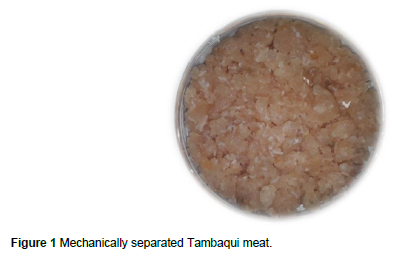
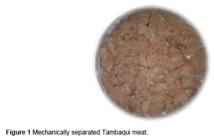
The tambaqui MSM (Figure 1) was obtained in the city of Campo Grande, Mato Grosso do Sul (MS), Brazil, and transported aseptically in isothermal boxes with ice to the Meat and Fish Processing Laboratory of the Federal Institute of Mato Grosso do Sul (IFMS), Coxim Campus, MS. It was then stored at -18 °C for later use.
To obtain the okara, soybeans were purchased from local businesses in Coxim, MS, and transported to the Vegetable Laboratory at the IFMS, Coxim Campus, MS. The soybeans were properly sanitised under running water, then placed in a container with 3 L of water and heated for 50 minutes. After the beans were cooked, they were ground in a blender (Model PLQ 1600 Turbo) until an aqueous soy extract was obtained, which was then sieved manually. The content retained in the stainless-steel sieve (33 cm with a 17 cm-diameter handle) was characterised as okara, and was stored in a freezer at -18 °C to maintain its nutritional properties until the tambaqui fish burgers were produced. The other ingredients were purchased from local shops in the city of Coxim, MS. These included sodium chloride (NaCl), dehydrated paprika, monosodium glutamate, and dehydrated garlic, onion, and parsley. Fresh lemon was also used, and an MPN-01-BE model multiprocessor was used to extract the lemon pulp.
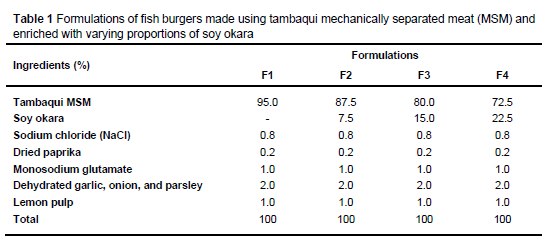
The tambaqui fish burgers were processed in the Meat and Fish Processing Laboratory at the IFMS, Coxim Campus. The ingredients used to make the tambaqui fish burgers enriched with soy okara are described in Table 1. After weighing, the ingredients were mixed manually in a container for 3 minutes until a homogeneous mass was obtained. The fish burgers were then moulded to a diameter of 12 cm and stored frozen at -18 °C for 24 hours until physicochemical and microbiological analyses. The physicochemical and microbiological properties of the tambaqui MSM, soy okara, and fish burgers were determined in triplicate.
The samples were analysed in triplicate to determine their moisture, ash, protein, lipid, and carbohydrate content according to official AOAC methodology (2019). The moisture content was assessed using the gravimetric method, which entailed drying the samples in an oven at 105 °C until they reached a constant weight. The ash content was also determined using the gravimetric method after incinerating the organic matter in a muffle furnace at 550 °C. Protein analysis was carried out using the conventional Kjeldahl method. The lipid content was determined according to the method described by Bligh & Dyer (1959). The carbohydrate content was calculated as the difference between the moisture, lipid, protein, and ash concentrations. The total energy value was estimated using Atwater's conversion factors of 4 kcal/g of protein, 4 kcal/g of carbohydrates, and 9 kcal/g of lipids, as recommended by Watt & Merrill (1963).
The colour analysis was carried out using a CHROMA METER model CR-400 colourimeter, with a D65 illuminant, calibrated to a white standard and with an observation angle of 10° (CIELab system). The results are expressed as angular coordinates, with L* indicating luminosity (0 = black and 100 = white), a* indicating red intensity (-80-0 = green, 0-100 = red), and b* indicating yellow intensity (-100-0 = blue, 0-70 = yellow). Subsequently, the chroma and hue angle were calculated using the following formulae:


where: arctan indicates the tangent arc, and 57.3 is the factor that converts the hue angle value from radians to degrees (Ramos & Gomide, 2017).
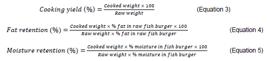
Cooking yield, fat retention, and moisture retention were determined as described by Aleson-Carbonell et al. (2005). After thawing, the raw fish burgers were weighed and then cooked, with the cooked weight also being determined, using four fish burgers from each formulation. An average cooking time of 12 minutes was used for the fish burgers, and they were cooked on a PCQ1500D electric grill, turning every 2 minutes and ensuring that the temperature in the centre of the product reached 75 °C (Arisseto & Polonio, 2005). The cooking characteristics were calculated according to equations 3, 4, and 5:
The microbiological analyses were carried out at the Biology/Microbiology Laboratory of the IFMS, Coxim Campus, in accordance with Normative Instruction (IN) number 161 of July 2022 (República Federativa do Brasil , 2022b), under the terms of Collegiate Board Resolution (RDC) number 724 of July 1, 2022 (República Federativa do Brasil, 2022c). The tambaqui MSM, soy okara, and fish burger formulation samples were analysed for psychrophilic bacteria, moulds and yeasts, total and thermotolerant coliforms, Escherichia coll, and coagulase-positive staphylococci. They were also tested for the presence or absence of Salmonella species.
The texture of the fish burgers was assessed using the texture profile analysis (TPA) test on a Brookfield CT3 texturometer (Brookfield Engineering 34 Laboratories, INC, Middleboro Massachusetts, USA). All the analyses were carried out using an aluminium probe with a diameter of 25 mm. Five sections (replicates) were analysed per treatment. The fish burger samples were roasted on a PCQ1500D electric grill in the Meat and Fish Laboratory of the IFMS, Coxim Campus, prior to textural analysis. They were compressed twice to 50% of their original size using a 7.5 cm-diameter compression plate, with no rest time between the two compression cycles. The deformation curve over time was obtained at a compression speed of 300 mm per minute (5 mm per second), from which six texture characteristics were generated: hardness (N), elasticity (mm), cohesiveness, gumminess (N), chewiness (mJ), and resilience (Ramos et al., 2007).
The fish burgers were also subjected to a check-all-that-apply (CATA) sensory test. To carry out the CATA test, three main steps were essential: (1) obtaining consensus on the descriptors, (2) developing the CATA questionnaire, and (3) having the samples evaluated by the sensory analysis assessors (Alcantara & Freitas-Sá, 2018). The analysis was carried out in the Sensory Analysis Laboratory of the IFMS, Coxim Campus, using 100 untrained tasters (50 men and 50 women) aged between 14 and 54, recruited from among the students and staff of the IFMS, Coxim Campus.
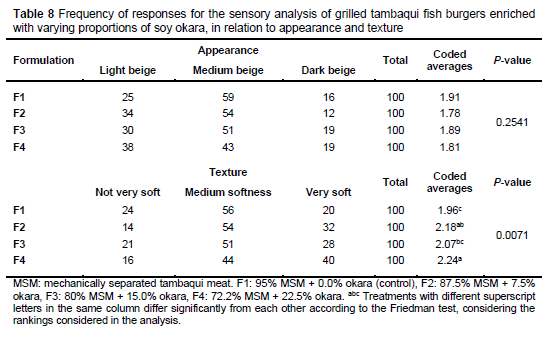
The qualitative variables, i.e. appearance, aroma (roasted, fried, and characteristic of fish), texture, and flavour, were coded and subjected to Friedman analysis, with individuals considered as a block effect. The variables were coded as follows:
• Appearance: light beige = 1, medium beige = 2, and dark beige = 3.
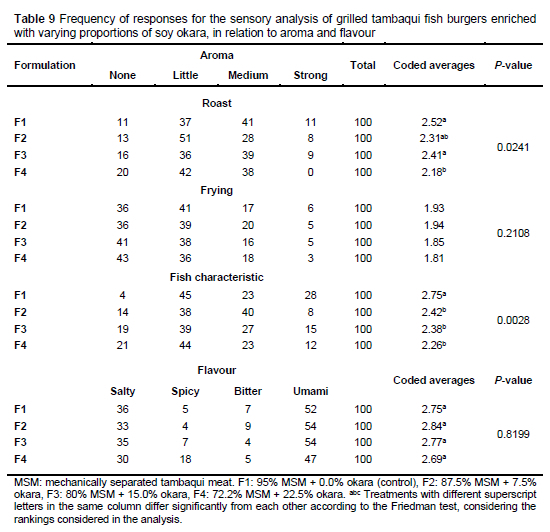
• Aroma: none = 1, little = 2, medium = 3, and strong = 4.
• Texture: not very soft = 1, medium softness = 2, and very soft = 3.
• Taste: salty = 1, spicy = 2, bitter = 3, and umami = 4.
The study was carried out using a completely randomised design with four treatments (F1: control, F2: 87.5% tambaqui MSM, F3: 80% tambaqui MSM, and F4: 72.5% tambaqui MSM) and three replicates per treatment. The data were tabulated and analysed using analysis of variance (ANOVA) and Tukey's test, with a significance level of 5% (P <0.05). The Friedman test was used to analyse the sensory analysis data. All analyses were performed using the statistical software package R, version 4.3.3 (R Core Team, 2021).
Results and discussion
Physicochemical and instrumental colour results for fresh tambaqui MSM and fresh soy okara
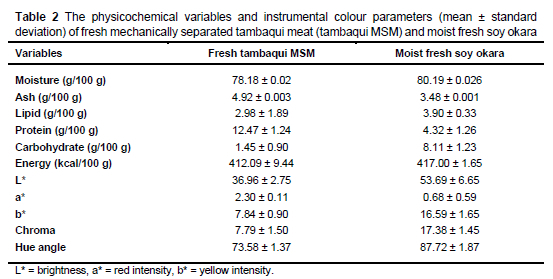
The results of the physicochemical and instrumental colour analyses of the fresh tambaqui MSM and the moist fresh soy okara are shown in Table 2.
Both products had high moisture contents, which is typical for fresh animal and plant-based pastes. This high moisture content may limit shelf life by increasing the microbial growth risk, requiring the products to be adequately preserved or processed (e.g. frozen or dried) for storage. It also influences the texture of the products, making them softer or more spreadable, and effects how the products behave during processing for inclusion in formulations (e.g. emulsions or sausages).
The moisture content of the tambaqui MSM in this study was 78.18%, which is similar to the results of Anjos (2019), who reported an average moisture content of 76.32% in hamburgers made from tambaqui filleting by-products, and Morais (2016), who reported an average moisture content of 78.12% in fresh tambaqui fillets. In contrast, Almeida & Franco (2006) reported an average moisture content of 72%, while De Paula (2009) reported a moisture content of 74.9%, which may have been linked to the diet fed to the fish. For Nile tilapia MSM, Bernadino Filho & Xavier (2019), reported an average moisture content of 75.08%, which is similar to the results of this study. Pauletto & Fogaça (2012) reported a soy okara moisture concentration of 84.2%, which is also similar to the results of this study. However, Lazarin (2018) obtained a value of 74.84% moisture in soy okara, which is lower than the value found in this study. The moisture content of wet soybeans is around 80%, making them highly perishable.
The ash content indicates the total mineral content of a product. The average ash concentration found in soy okara in this study was lower than that reported by Pauletto & Fogaça (2012), who reported a high mineral content (4.35%) in okara samples. However, they were similar to those reported for dried okara by Redondo-Cuenca et al. (2008) and Mateos-Aparacio et al. (2010a), who reported values of 3.61% and 3.70%, respectively. The tambaqui MSM had a higher ash content than the soy okara, suggesting that it is a better source of essential minerals (e.g. calcium, phosphorus). This might offer nutritional advantages but could also affect the taste or pH of formulations. The ash content of the tambaqui MSM found in this study (4.92%) was substantially higher than that reported by Anjos (2019), who reported an ash content of 2.21%. Bernadino Filho & Xavier (2019) reported an ash concentration of 1.75%, which is also lower than that observed in this study. The significant ash content found in this study may be related to the bones remaining in the product after the processing of the tambaqui MSM.
The tambaqui MSM had a substantially higher protein content than the soy okara, making it a better protein source. Soy okara, being a by-product of soy milk production, retains some protein, but not as much as is found in MSM. This means that tambaqui MSM is more suitable for protein-rich products, whereas soy okara may need protein supplementation if used in formulations meant to be high in protein. The tambaqui MSM (Figure 1) had a protein concentration of 12.47%, close to the value found by Anjos (2019) in tambaqui MSM (15.60%). Although there is no MSM legislation for fish, the protein content found in this study is in line with the MSM legislation for meat from poultry, cattle, and pigs (República Federativa do Brasil, 2000), which stipulates a minimum protein content of 12%. Bernadino Filho & Xavier (2019) reported a protein content of 12.46%, which is similar to the finding in this study. Lazarin (2018) reported a protein content of 9.31% for soy okara, which is higher than that found for okara in this study. However, similar protein concentrations were obtained by Turhan et al. (2007), Zhu et al. (2008), and Fafaungwithayakul et al. (2011), who reported values of 4.5 g/100 g, 3.6 g/100 g, and 4.2 g/100 g, respectively.
Both the tambaqui MSM and the soy okara had moderate fat contents, with the soy okara containing slightly more, possibly because of residual oil. The type of fat (saturated versus unsaturated) present was not determined, but soybean products are typically rich in unsaturated fats. Fat affects flavour, texture, and energy content, and also contributes to emulsion stability in processed foods. The lipid content of the tambaqui MSM used in this study was 2.98%, lower than the 5.74% found in tambaqui MSM by Anjos (2019). Morais (2016) obtained a value of 2.63%, corroborating the results of this study, whereas Bernadino Filho & Xavier (2019) reported a lipid content of 10.63%, which is much higher than that found in this study. These variations may occur because of the type of diet fed to the fish. Alternatively, Dallabona et al. (2013) stated that a higher MSM fat content can be caused by differences in the way the carcass was cleaned before extraction, with some methods allowing more fat to adhere to the carcass, resulting in the fat being extracted along with the MSM. Comparing the lipid concentrations in the tambaqui MSM (Table 2) with the MSM standards for poultry, beef, and pork (República Federativa do Brasil, 2000) indicates that the tambaqui MSM meets these requirements, as the standards stipulate a maximum fat content of 30%. The lipid content found in the soy okara used in this study was higher than that reported by Lazarin (2018), who reported a lipid concentration of 2.50% in okara. Genotype and environmental conditions have a considerable influence on the chemical composition of soybeans, and thus on the composition of their derivatives.
Okara typically contains a significantly higher proportion of carbohydrates than tambaqui MSM, with most of these carbohydrates being in the form of dietary fibre, which is nutritionally beneficial for digestive health. This makes okara useful for developing fibre-enriched products, but may affect texture and water binding in formulations. Tambaqui MSM is more protein-dense and low in carbohydrates, making it ideal for inclusion in low-carbohydrate diets. The carbohydrate concentration (non-nitrogenous compounds) in the tambaqui MSM used in this study was lower than that reported by Silva (2019), who, when evaluating fresh tambaqui ribs, found a carbohydrate value of 18.84%. Lazarin (2018), Redondo-Cuenca et al. (2008), and Mateos-Aparacio et al. (2010b) reported lower carbohydrate concentrations in soy okara (12.56%, 54.3%, and 55.48%, respectively) than that found in this study.
Canaan (2019) found a lower energy value for soy okara (102.37 kcal) than that observed in this study. Similarly, Barros (2016) obtained an energy value of 404 kcal/100 g on a dry basis, which is also lower than that found in this study, in which the material was wet and fresh. Proteins, lipids, and carbohydrates have a high energy value and are nutritious, so regardless of processing, they have a high energy value. Thus, despite its lower protein content, okara has a similar or slightly higher caloric value than tambaqui MSM, because of its higher fat and carbohydrate content. Tambaqui MSM provides energy primarily through protein, while soy okara does so via carbohydrates and fats. Filho (2021) determined the caloric value of different cuts of tambaqui meat, and reported a caloric value of 192.2 kcal/100 g, a result lower than that observed in this study. These values differ because of the increased deposition of lipids and the decreased moisture content of the fish used in this study (Baldisserotto, 2013). The energy value found by Filho (2021) for the tail fillet of the pirarucu (Arapaima gigas) was 136.52 kcal/100g, which is also lower than the 412.09 kcal/100 g found in this study.
The nutritional composition and energy values of the soy okara used in this study align with expected results for soy-based foods. It is worth noting that okara is of good quality and can be used in food to increase its nutritional value. The incorporation of moist fresh soy okara into tambaqui fish burgers therefore presents a promising strategy for enhancing the product's nutritional and functional profile. Okara contributes additional dietary fibre and carbohydrates, which may improve the texture and mouthfeel of the final product, while also increasing its energy value. Moreover, the lighter colour (higher L* value) and elevated chromaticity of okara can influence the visual appeal of the burger, potentially making it more attractive to consumers. From a sustainability perspective, using okara, a by-product of soy processing, also adds value by reducing food waste and promoting circular economy practices in food production.
Soy okara is typically lighter (higher L*), more yellow (higher b*), and has a higher hue angle, indicating a more yellowish appearance than the more reddish tone of tambaqui MSM. Consumers often associate a lighter colour in plant-based pastes with freshness and a clean flavour. Darker products like tambaqui MSM may appear richer or more natural for meat-based products, but could also be perceived as less fresh if oxidation or browning occurs. From a marketing standpoint, a lighter appearance is more versatile, especially for blending with other ingredients or for plant-based product lines. Both products typically have low a* values (red intensity), indicating minimal red pigmentation, which correlates with low concentrations of myoglobin or other pigments. Soy okara's high b* value (yellow) makes it appear paler and more yellowish, which is common and acceptable for plant-based ingredients. Tambaqui MSM, which normally has moderate b* and low a* values, may appear greyish or dull, which could be unappealing to some consumers unless its colour is enhanced (e.g. using natural colourants or spices).
The instrumental colour values for the tambaqui MSM are shown in Table 2. Morais (2016) reported an L* value of 47, an a* value of 3.37, and a b* value of 36 in fresh tambaqui fillets, with these values being higher than those observed in this study. Ribeiro (2005) obtained an L* value of 69.82, an a* value of 0.98, and a b* value of 17.59 in mapará (Hypophthalmus edentatus) fillet, which also exceed the L* and b* values found in this study. Consequently, the MSM used in this study generally had lower instrumental colour values than those reported in the literature; these differences may have been caused by variations in the locations where these fish were farmed and the feeds used. Similar to the findings of this study, Souza et al. (2020) reported higher b* values (2.79 ± 1.49) than a* values (-1.67 ± 0.34) for tambaqui fillet surimi, and it can be seen in the literature that tambaqui MSM tends to have higher b* values (corresponding to yellow tones) than a* values (related to red tones). A further important observation is that both these coordinates (a* and b*) tend to have values close to zero, indicating almost no pigmentation, which is known as low saturation or low chromaticity (Pathare et al., 2013).
The chroma value defines the purity of a colour, indicating how much a given colour differs from grey; thus, the higher the chroma value, the more intense the colour (Silva et al., 2017). Souza et al. (2020) showed that tambaqui fillet surimi has a low chroma value of 3.3, compared to the results of this study. Chroma values that are close to zero indicate that the colour of the product is not very saturated (Soares, 2017). Altemio et al. (2023) reported a hue angle value of 54.43° in tilapia (Oreochromis niloticus) MSM, which is lower than the value found in this study. For the tambaqui MSM, the hue angle (around 73°) leaned more towards the yellow-orange spectrum, but was still not vivid - this dullness could be a challenge for visual appeal unless compensated for through processing or formulation strategies. The low chroma value found for the tambaqui MSM in this study indicates that the samples have little pigmentation; therefore, the tambaqui MSM is considered to be white in colour.
With regard to the colour values for the soy okara, it can be seen that the brightness (L*) of the samples was lower than that found by Yoshida & Prudencio (2020), who obtained an L* value of 67.27 for defatted okara. Priulli (2020) also found higher a* (4.52) and b* (23.20) values than those obtained in this study. With the addition of okara flour that had been processed by bleaching and drying heat treatments, the a* values showed a shift to positive and increasing values, indicating a small amount of red pigmentation. The b* variable in this study is lower, indicating yellowish pigmentation. Low chroma values indicate low colour saturation, which means that the product appears pale or dull - a characteristic that might suggest blandness or a lack of freshness to consumers. Higher chroma values in soy okara give it a more vivid yellowish tone, which can suggest natural, wholesome plant ingredients. Hue angle values closer to 90° indicate a colour closer to pure yellow, which is often seen as neutral or appealing in plant-based formulations. Barbosa (2016) reported a lower average chroma value (15.22) for a water-soluble soy extract than that found in this study, but reported similar values for the other colour variables.
The differences in the colour saturation of microencapsulated okara samples reported by Justus et al. (2020) led to variations in the colour of the dry product obtained after spray drying. With regard to the chromatic hue, Justus et al. (2020) observed that the results of the samples fluctuated throughout storage, so it was not possible to verify the trend of the values over time. The same author found values between 85 and 90 in all the treatments tested, corroborating the results of this study. However, Barbosa (2016) reported a hue angle value of 85.96° for water-soluble soy extract, which is lower than that found in this study and indicates a yellow-orange hue.
The physicochemical values found suggest that tambaqui MSM is a good candidate for protein-fortified, mineral-rich, low-carbohydrate formulations, like high-protein spreads or fish patties. Soy okara is better suited for fibre-enriched, possibly plant-based or vegetarian-friendly products, but would need protein enhancement for nutritionally balanced applications. The differences in these two products can thus be complementary when combined.
The strategic recommendations for the use of tambaqui MSM, based on our results, include the following:
• Consider using natural colour enhancers (e.g. paprika, annatto, or turmeric) in formulations to make the product more visually appealing.
• Use protective packaging (e.g. opaque or tinted films) to reduce the consumers' perception of dullness and oxidation.
• Position the product as protein-rich and emphasise its traditional/meat-based identity in marketing.
The strategic recommendations for the use of soy okara, based on the results of this study, include the following:
• Emphasise its light colour and natural appearance in plant-based product lines.
• Use colour as a clean-label marketing advantage, as no artificial colourants are needed.
• Highlight its fibre and moisture content in health-driven product promotions.
The instrumental colour measurements suggest that soy okara has a visual advantage in terms of shelf appeal and the consumer perception of freshness, especially in the growing plant-based market. Tambaqui MSM, while nutritionally valuable, may require visual enhancements to meet consumer expectations and improve marketability, especially for products where appearance heavily influences purchase decisions (e.g. ready-to-eat foods, spreads, or emulsified products).
Microbiological test results for fresh tambaqui MSM and fresh soy okara
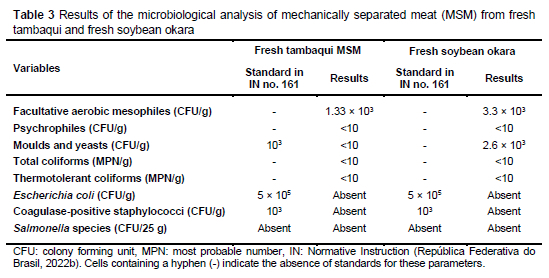
The results of the facultative aerobic mesophile, psychrophile, mould and yeast, total and thermotolerant coliform, E. coli, and coagulase-positive staphylococci counts, and the presence/absence of Salmonella species in the fresh tambaqui MSM are shown in Table 3.
The microbiological profile of fish can be related to the place of farming, the fish's natural microbiota, and the method of capture and slaughter, among other fish handling processes (Ghaly et al., 2010). Microbiological analyses aimed at detecting contaminating microorganisms provide important results for guaranteeing the quality of fish for consumption and/or assessing the effects of processing by-products. Soares & Gonçalves (2012) noted that fish products are highly perishable compared to other foods of animal origin, as they contain a large amount of water in their tissues, a pH close to neutral, and a high content of phospholipids and nutrients. This can encourage the proliferation of contaminating microorganisms that, in most cases, do not alter the appearance of the fish, but can be highly pathogenic to humans.
The psychrotrophic bacteria determined in the tambaqui MSM (Table 3) were observed at a temperature of 7 °C. The importance of the microbiological analysis of this group of bacteria, despite the fact that legislation does not establish threshold values for them, is based on the recognised ability of some microorganisms to deteriorate fish through proteolytic processes, even at cool or freezing temperatures, which would reduce shelf life (Santos et al., 2008). Current legislation also does not set standard values for the occurrence of moulds and yeasts in fish products, but the results of this analysis can indicate the hygienic/sanitary quality of the product.
The analysis of the total and thermotolerant coliforms in the tambaqui MSM resulted in average values of <10 MPN/g (Table 3). Even though IN number 161 of July 1, 2022 (República Federativa do Brasil, 2022b) does not establish standards for these groups of microorganisms for fish, their presence in high numbers may indicate flaws in the processing environment that seriously compromise the hygienic quality of the fish, as thermotolerant coliforms are of faecal origin (Santos et al., 2019). The absence of specific microbiological standards for certain groups of microorganisms in fish, as observed in regulatory frameworks such as IN number 161 (República Federativa do Brasil, 2022b), may be influenced by several factors related to the biological and environmental characteristics of fish, as well as the regulatory oversight structure. For example, these regulatory gaps may be related to biological and environmental differences, a lack of uniform reference microbiota, differences in consumption and processing norms, regulatory gaps and risk assessments, and challenges in their direct comparison with terrestrial meat.
No E. coli was detected in the tambaqui MSM (Table 3). Greig & Ravel (2009) noted that E. coli is among the pathogenic bacteria that contaminate fish products and can cause serious risks to human health even at low counts. The legal limit established by Brazilian legislation for E. coli in fresh, chilled, or frozen fish and fish products not consumed raw is 5 × 10⁵ MPN/g, and this is the maximum count allowed according to IN number 161 (República Federativa do Brasil, 2022b). However, Santos et al. (2019) found E. coli in 43.3% of the samples of tambaqui fillet sold at street markets, but found no samples contaminated with this bacterium in samples of tambaqui fillet sold in supermarkets in the city of São Luis, MA, indicating that inadequately hygienic handling can cause serious public health problems (Santos et al., 2019).
Coagulase-positive staphylococci were not found in the tambaqui MSM samples in this study. According to IN number 161, the limit for these bacteria is 103 CFU/g (República Federativa do Brasil, 2022b). Bartolomeu et al. (2011) noted that coagulase-positive staphylococci are linked to poor hygiene and excessive handling during fish processing; however, this study did not observe such contamination, and the results comply with Brazilian legislation.
Salmonella species were not detected in the samples in this study, which aligns with the standards set forth in IN number 161 (República Federativa do Brasil, 2022b). Salmonella species are pathogenic bacteria that are native to the intestinal tract and are not part of the natural microbiota of fish (Roberts et al., 2005). Their presence is thus indicative of faecal contamination from human or animal sources as a result of handling or contact with inadequately sanitised surfaces during the catching, processing, distribution, and/or storage stages (Ghasemi et al., 2010).
Although some of the microorganisms measured in this study do not have values established in the legislation, the results obtained serve as a guide to quality when compared with previous research on tambaqui. Thus, according to IN number 161 (República Federativa do Brasil, 2022b), MSM from fresh tambaqui can be classified as a product of acceptable microbiological quality. However, compliance with regulatory standards alone does not fully guarantee consumer safety. The absence of pathogenic microorganisms such as Salmonella species and E. coli, as well as low counts of coagulase-positive staphylococci, suggests that good hygiene practices were likely followed during processing. This reflects favourably on the hygienic conditions of handling and equipment sanitation. Additionally, the low microbial loads, particularly the counts of mesophilic and psychrophilic bacteria, indicate a minimal risk of spoilage at the time of analysis, which can positively influence the initial shelf life of the product. Nonetheless, the shelf life will ultimately depend on post-processing conditions, such as packaging, storage temperature, and distribution logistics. Therefore, while the product is microbiologically acceptable at the point of testing, maintaining safety and quality throughout its shelf life requires continuous control of environmental conditions and adherence to good manufacturing and storage practices.
The results of the microbiological analysis of the soybean okara are extremely important because the okara soybean by-product is still wet and can be used in the formulation of the tambaqui fish burgers. It is therefore necessary to guarantee the microbiological quality of this ingredient, as the water present in the product can facilitate the proliferation of microorganisms and thus product deterioration. Microbiological analysis aims to confirm whether food is safe from a microbiological point of view, with no biological contaminants that could compromise consumer health (Roriz, 2012).
The average count of facultative aerobic mesophiles in the fresh okara was 3.3 × 10³ CFU/g. The current legislation (IN number 161 of 2022) does not provide specific microbiological values for soy okara, and values for vegetable seeds were thus used as a comparison; however, this legislation also does not have a standard limit for this type of microorganism (República Federativa do Brasil, 2022b).
Psychrotrophic bacteria were found at <10 CFU/g when the wet, fresh okara samples were incubated at 7 °C for seven days. This count is important because fish burgers are fish-based products that must be refrigerated and/or frozen to preserve their microbiological quality, and only ingredients that do not compromise the product's safety should be used in formulations.
The count for moulds and yeasts was 2.6 × 10³ CFU/g. Normative Instruction number 161 (República Federativa do Brasil, 2022b) does not provide standard values for these microorganisms. However, Góes-Favoni et al. (2022) obtained a value for moulds and yeasts in okara flour of 8.14 × 10⁴ CFU/g, which is higher than that found in this study.
The results for total and thermotolerant coliforms in the wet, fresh okara samples were <10 MPN/g. Current legislation does not set quantitative limits for these microorganisms (República Federativa do Brasil, 2022b). Jabs (2013) explained that the presence of total and thermotolerant bacteria at 45 °C indicates the need for rapid processing of the by-product in order to reduce the bacterial load. Soy okara is generally used in the form of flour, and the drying process reduces the bacterial load, which is much lower than in the fresh, wet product. However, the location and handling of this product also influence the microbiological results. Canaan (2019) assessed the microbiological quality of fresh okara and okara flour and obtained <3 MPN/g for both products, which was lower than that found in this study. Góes-Favoni et al. (2022) evaluated okara flour microbiologically and obtained a value of 1.9 × 10³ CFU/g for total coliforms, a value higher than that found in this study for wet okara.
No E. coli was detected in the wet, fresh okara (Table 3). Brazilian legislation establishes a maximum limit of 102 MPN/g for E. coli in fresh seeds (República Federativa do Brasil, 2022b). Cieza Castañeda & Ninoska (2022) complied with hygiene and sanitation requirements during the production of soy okara flour and reported the same results as those found in this study. Góes-Favoni et al. (2022) also assessed the presence of E. coli in okara flour and found none, as was the case in this study.
The results of this study indicate the absence of coagulase-positive staphylococci and IN number 161 does not provide standards for these microorganisms (República Federativa do Brasil, 2022b). Bartolomeu et al. (2011) explained that the presence of coagulase-positive staphylococci is due to inadequate hygiene conditions during product handling, causing contamination.
Salmonella species were not detected in the fresh wet okara samples (Table 3), which complies with the standards of IN number 161 (República Federativa do Brasil, 2022b). Canaan (2019), who assessed the microbiological quality of fresh okara and okara flour, also obtained negative results for the presence of these bacteria in both products. Góes-Favoni et al. (2022) similarly found no Salmonella species in okara flour, corroborating the findings of this study.
Physicochemical and instrumental colour results for grilled tambaqui fish burgers
Oliveira et al. (2020) incorporated up to 25% okara flour in tilapia hamburgers and found that 10%-15% inclusion provided the best sensory acceptance, suggesting this range as a practical upper limit for fish-based products. High-fibre formulations (above 20%) may offer functional benefits, but require binding agents such as egg, starch, or gums to maintain their texture.
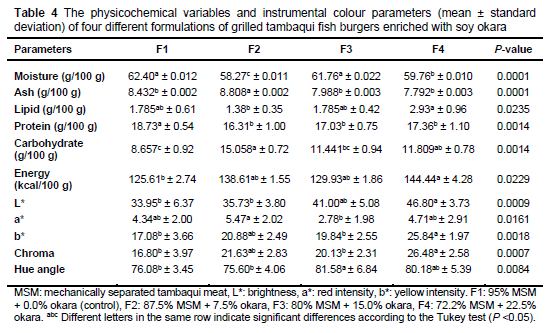
The chemical compositions of the four different formulations of tambaqui fish burgers enriched with soy okara are shown in Table 4. The formulation with 87.5% MSM + 7.5% okara (F2) had the lowest (P = 0.0001) moisture content, followed by the formulation with 72.2% MSM + 22.5% okara (F4). The control formulation (F1: 95% MSM + 0.0% okara) and the formulation with 80% MSM + 15.0% okara (F3) had the same moisture concentrations. The higher moisture content in F3 is explained by the high capacity of okara proteins to bind with water. Borba et al. (2013) observed a lower moisture content (48.3 g/100 g) in chicken burgers than that found in this study, as did Cristofel (2014) for tilapia burgers enriched with a guabiroba (Campomanesia xanthocarpa) by-product (56%).
The average ash content of the F2 formulation was higher (P = 0.0001) than that of the other formulations. Devide et al. (2019) reported reduced ash concentrations (an average of 2%) in chicken burgers made with okara, a result that differs from this study because of the high addition of okara. Kirschnik (2007) evaluated the effects of adding banana peel to tilapia burgers and found an ash content of 3.71%. The ash content of freshwater fish meat varies greatly, depending on the state of the fish and environmental and nutritional factors during the fish's development.
The lipid content differed (P = 0.0235) between the formulations, with F4 having a higher content than F2. Devide et al. (2019) evaluated the lipid content of chicken burgers formulated with okara and found an average value of 13.9%, which is higher than that found in the present study. Similarly, Borba (2013) reported higher lipid values (20.3%) for chicken burgers than those found in this study. Higher lipid values (6.46 g/100g) were also found in tilapia burgers by Meleiro et al. (2013). Oliveira et al. (2010) evaluated the effects of the inclusion of a powdered shrimp by-product in tilapia burgers at 5% and 2.5%, and obtained lipid values of 2.44% and 2.09%, respectively. The lipid content of fish varies widely, depending on the species, age, body part, sexual cycle, and diet.
Devide et al. (2019) reported higher protein concentrations than those found in this study, possibly because of the decrease in the moisture content relative to the protein concentration, resulting in an increase in the protein content of the cooked product. However, similar protein values (with an average of 17.8%) were reported by Carvalho Filho et al. (2011) when they added 5% wheat flour to the formulation of tilapia burgers. Borba (2010) also obtained protein values ranging from 14.62% to 21.31% in a study analysing the composition of beef burgers.
The carbohydrate concentration differed (P = 0.0014) between the formulations, with the highest concentration of carbohydrates being found in F2. Formulations F1 and F3 had the lowest carbohydrate concentrations. Although carbohydrates are present in fish in the form of muscle glycogen, this only makes up a small percentage of the muscle composition (Babalola et al., 2011). These results are in line with the literature, as fish burgers containing vegetable-based ingredients in their formulation naturally have a higher carbohydrate content.
The energy content differed (P = 0.0229) between the formulations, with the highest value being observed in F4, which contained the highest concentration of okara and the lowest concentration of tambaqui MSM. These differences in the caloric value of the fish burgers may be related to the chemical composition of the meat and the percentage of ingredients used in the fish burger formulation.
The L* (lightness) values of the fish burgers increased (P = 0.0009) with the increasing inclusion of soy okara. Higher L* values were obtained by Miranda et al. (2022), who reported an L* value of 64.96 for fish meat burgers made with resistant starch. In the fish burgers enriched with soy okara, the lightness parameter was highest in F4, the formulation containing the highest proportion of soy okara.
With regard to red intensity (a*), the F2 formulation had the highest value (P = 0.0161). The increase in the addition of soy okara contributed to the product obtaining a lighter colour, compared with the F1 control. The b* values were highest (P = 0.0018) in F4, but there was no difference between F4 and F2. These results are in contrast with the findings of Jorge et al. (2022), who found that the addition of pequi (Caryocar brasiliense) flour to burgers caused high a* and b* values (a slightly red colour with a stronger yellow tone), due to pequi's high carotenoid concentration.
The formulations differed (P = 0.0007) in terms of their chroma values, with F4 having the highest value, while F3 had the highest (P = 0.0084) hue angle value. Araújo et al. (2022) found lower chroma (25.85) and hue angle (71.27) values for burgers made with chicken meat than those obtained in this study.
Microbiological test results for grilled tambaqui fish burgers
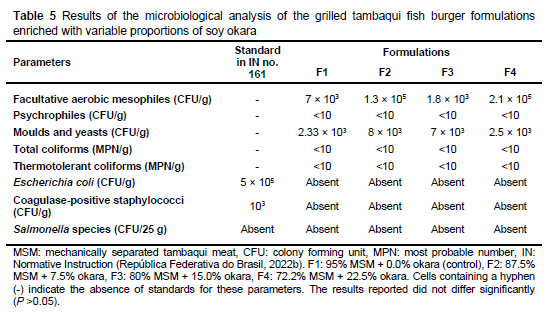
The results of the microbiological analysis of the fish burger formulations are shown in Table 5.
The mesophile counts of the four formulations ranged from 1.8 × 10³ to 2.1 × 10⁵ CFU/g, with the formulations including soy okara tending to contain lower numbers of mesophilic bacteria (Table 5). The legislation does not provide guidelines or restrictions regarding the number of mesophilic microorganisms present in fish derivatives (República Federativa do Brasil, 2022b).
The count of psychrophilic bacteria was less than 10 CFU/g in all formulations. Psychrophilic bacteria occur in food products as a result of poor food handling practices, and this type of microbial contamination can lead to sensory alterations in products, making them unacceptable to consumers (Souza et al., 2023).
The results of the mould and yeast analyses ranged from 2.33 × 10³ to 8.0 × 10³ CFU/g. In comparison, 61% of the hamburger samples analysed by Santana et al. (2015) did not meet the criteria for moulds and yeasts adopted by legislation. High mould and yeast counts indicate a lack of sanitation in food processing or poor selection of raw materials, leading to the handling of contaminated products.
Brazilian legislation does not specify limits for total and thermotolerant coliforms, but controls on good food handling practices are stricter at the time of product preparation, and fish and fish products with high coliform counts are considered unfit for consumption. Thermotolerant coliforms are capable of fermenting lactose, with the production of gas and aldehydes. These bacteria are considered to be indicators of faecal contamination, as they originate in the gastrointestinal tracts of humans and other homeothermic animals. As they are therefore not part of the natural microbiota of fish, they are also considered indicators of hygienic and sanitary conditions based on their enumeration in water and food samples (Silva, 2002). In terms of the total and thermotolerant coliform counts, all the fish burger formulations had values lower than 10 CFU/g. Filho et al. (2014) investigated the microbiological quality of fish burgers made from tucunaré (Cichla ocellaris) fish fillets, and reported a count of 6.1 × 10 MPN/g of thermotolerant coliforms, which was higher than the values obtained in this study.
Escherichia coli was not detected in the four fish burger formulations, and they thus comply with the standard limit established by IN number 161 (República Federativa do Brasil, 2022b).
The coagulase-positive staphylococci counts for the fish burger formulations were in line with the values set out in legislation, indicating that appropriate protocols for good food handling practices were followed when the fish burgers were formulated (República Federativa do Brasil, 2022a). Anjos et al. (2021) reported coagulase-positive staphylococci counts between 0 and 103 CFU/g in tambaqui burgers enriched with green banana biomass and chitosan. Figueiredo et al. (2023) investigated the microbiological quality of fish burgers formulated using mapará by-products and found counts of lower than 10 CFU/g (the maximum limit enforced under Brazilian legislation).
There was no evidence of the presence of Salmonella species in the formulations, aligning with the standards outlined in IN number 161 (República Federativa do Brasil, 2022a). Salmonella species occur in food products as a result of poor handling conditions at the facilities in which the products are prepared. Anjos et al. (2021) also found no Salmonella species in tambaqui burgers enriched with green banana biomass and chitosan. The microbiological results indicate that the fish burger formulations were prepared with adequate hygiene conditions during packaging and storage, up until the time of analysis.
Cooking yield and fat and moisture retention parameters for grilled tambaqui fish burgers
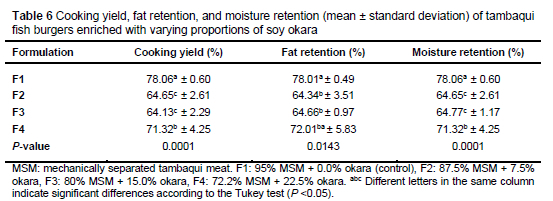
The cooking yield and fat and moisture retention parameters of the tambaqui fish burgers enriched with soy okara are provided in Table 6.
With regard to the cooking yield, the formulations containing soy okara obtained lower yields (P = 0.0001) than the control, with F2 and F3 having the lowest values, demonstrating that the variation in the cooking yields of these formulations is due to the addition of the soy okara. Lima et al. (2020) observed higher yields in burgers made with oat flour than those described in this study. The fat retention in the F2 and F3 formulations was lower (P = 0.0143) than that in the F1 and F4 formulations. Formulations F1 and F4 also had higher moisture retention values, with averages of 78.06% and 71.32%, respectively. Formulation F2 showed the lowest moisture retention value, at 64.65%, but this did not differ from that of formulation F3, which had an average of 64.77% moisture retention. These results do not support those of Devide et al. (2019), who found lower fat-retention percentages in a study of chicken burgers enriched with soy okara. Moisture retention in fish burgers is related to the weight loss and quality of the product when using MSM in its formulation, as well as to the processing, storage, and cooking methods used. The fat-retention results for these fish burgers in this study can help reduce formulation costs.
Instrumental texture parameters for grilled tambaqui fish burgers
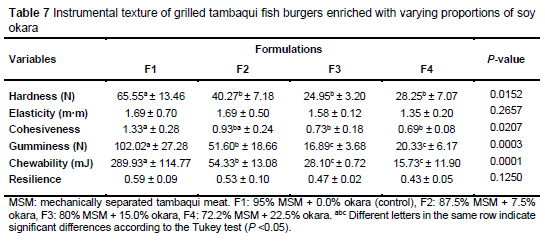
The instrumental texture data for the tambaqui fish burgers enriched with soy okara are shown in Table 7. In terms of hardness, the formulations including soy okara were less hard. This can be attributed to the fish burgers' ability to absorb water, resulting in lower hardness. Miranda (2022) obtained higher hardness because of the particle size and rigidity formed by the inclusion of white wheat fibre.
The inclusion of soy okara had no effect (P = 0.2657) on the elasticity of the different fish burger formulations, which differs from the results of Pedreira (2022), who reported differences in the elasticity of formulations including synthetic additives (acerola and citrus) in beef burgers, because of the presence of yeasts capable of solubilising the proteins.
There was a reduction (P = 0.0207) in the cohesiveness of the samples as the inclusion of soy okara in the formulation increased. As suggested by Raúl et al. (2018), because of the nature of dietary fibre, the reduced cohesiveness may be related to weakened interactions between other chemical components and myofibrillar proteins, thus allowing for less cohesiveness in the dough.
Gumminess (P = 0.0003) and chewiness (P = 0.0001) also decreased as the inclusion of soy okara in the fish burger formulations increased. Gumminess and chewiness are mechanical properties of texture that are interconnected with cohesiveness, where the former corresponds to the number of bites or the time needed for the food to be swallowed, and the latter refers to the force needed to break the food at swallowing points (Miranda et al., 2022).
Regarding resilience, there was no difference (P = 0.1250) between the samples. Resilience is a property that measures the return of a material to its original state after deformation, involving both resistance and speed (Oliveira, 2015). However, it is worth noting that the okara-enriched fish burgers fall into the range of being less elastic and firm, with lower cohesion, and therefore require less force to break when bitten.
Sensory parameters for grilled tambaqui fish burgers
The formulations differed (P = 0.0071) in the texture variable, as obtained during sensory analysis (Table 8), and it was found that F4 had similar averages to F2 but differed from the other formulations. According to Figueredo et al. (2023), the use of water with a pH of 7.2 resulted in changes in the sensory attributes of taste and texture of fish burgers made with a mapará by-product, with this pH resulting in the lowest average acceptance by the tasters of all the products analysed.
For the roasted aroma variable, the sensory assessors' perceptions showed that F4 obtained a lower (P = 0.0241) average than F1, and did not receive a strong rating (Table 9). For the characteristic fish aroma variable, there were lower (P = 0.0028) averages with the inclusion of soy okara in the formulation (Table 9).
According to Los et al. (2020), burgers formulated with a reduced fat content showed satisfactory sensory acceptance, which was consistent with the results of Valério et al. (2022), who formulated low-fat beef burgers with the addition of okara. In contrast, Marques (2007) studied the replacement of meat with oats in beef burger recipes and observed that a higher fibre content resulted in lower average acceptability.
The formulations did not differ (P = 0.8199) in terms of taste. Marins et al. (2021) reported that pork burgers with added rosemary differed in taste to pork burgers without added rosemary. The highest score was obtained for the formulation with 0.25% rosemary, which had greater acceptance values because of the balance and lower level of fragrance than found for the formulations that had a higher level of fragrance and contained 0.5% rosemary. Seidmeier et al. (2014) sensorially evaluated ground beef with low levels of natural flavouring and sodium, and found that formulations containing natural flavouring spices received the highest ratings, having the most votes in the sensory analysis (88.18%) corresponding to medium preference ('I liked it very much' and 'I liked it extremely'). According to Oliveira et al. (2016), the addition of 10% soy okara to burgers contributed to the juiciness of the product because of the soy okara's water retention capacity. As observed, this study found that there was good overall acceptability in terms of appearance, aroma, texture, and flavour.
Valério et al. (2022) carried out a CATA analysis on low-fat beef burgers with added okara, assessing the following attributes: juicy, soft, salty, dry, special flavour, healthy product, hamburger smell, premium, brown, 'I want more flavour', and shiny. In this analysis, a Cochran test was carried out for each attribute and a corresponding analysis performed. Cochran's Q test indicated that the 'soft' and 'dry' attributes obtained values that differed from each other for these attributes. Other properties were important for characterising the samples, but there were no differences between the formulations.
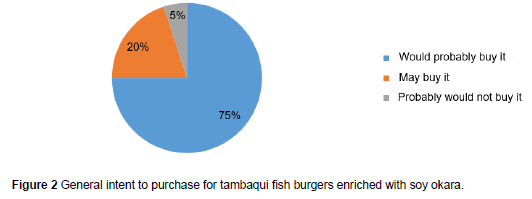
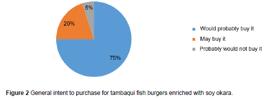
This study also assessed the general intention to buy the formulations (Figure 2) and found that 75% of the tasters would probably buy the samples evaluated, 20% might buy them, and 5% of the tasters would probably not buy the samples evaluated. These results show that the product is well accepted by the community and has the potential to be marketed.
Valério et al. (2022) reported that 70% of their evaluators would pay to obtain a meat burger formulated with the addition of okara flour. Silva & Fernandes (2011), Amaral et al. (2016), and Atayde et al. (2021) reported a high acceptability of fish burgers, and although the formulations used in these studies differed from those used in this study, the positive acceptability index indicates that commercial success is promising and that it is strategic to introduce fish burgers into the Brazilian market.
Overall comparison of tambaqui fish burger formulations
Tambaqui are typically raised on commercial aquafeeds rich in plant-based ingredients, including soybean meal and corn. Diets rich in plant protein can reduce the intramuscular fat content, influence the fatty acid profile and protein content of the fish, and affect muscle firmness and water retention because of the lower lipid content and higher muscle fibre density (Cyrino et al., 2010). This supports the idea that feed composition influences the protein-lipid balance in fish meat.
Fresh tambaqui MSM had a lower lipid content (2.98 g/100 g) and higher protein content (12.47 g/100 g) than soy okara. Consequently, formulations with a higher MSM content, such as F1, had a higher protein content, better texture and cooking yield, and a more pronounced fish aroma, as this is linked to protein breakdown and lipid oxidation volatiles. Soy okara is high in fibre and carbohydrates, both of which are absent from fish meat. Its inclusion in the fish burgers thus modified the nutritional balance by increasing the carbohydrate content and decreasing the protein content (F4), changed the texture - with more okara resulting in a softer fish burger, and altered the sensory attributes by reducing the fish aroma.
Tambaqui thrive in warm, oxygen-rich freshwater environments, and rearing under clean and controlled water conditions reduces microbial contamination and stress-induced metabolic changes (e.g. excessive proteolysis). The fresh tambaqui MSM had low microbial counts and an absence of pathogens like Salmonella species, E. coli, and Staphylococcus species. This suggests that good aquaculture practices were applied, such as ensuring clean rearing tanks or ponds, timely harvesting, rapid chilling post-harvest, and hygienic handling before mechanical separation. Low psychrophile and mesophile counts suggest efficient cold chain management and prompt processing, which preserved the sensory integrity and microbial safety of the final burgers.
Mechanically separated meat is obtained through automated deboning, yielding a higher surface area, which is prone to oxidation and microbial growth if not controlled, and a modified texture (less fibrous and more paste-like). However, the MSM used in this study retained a good protein content and acceptable functional properties such as colour and cooking performance in F1. The inclusion of okara (a by-product of soy milk production) introduced moisture-retaining fibres and plant proteins with different functional and textural properties. Higher okara levels (F4) softened the product but reduced the fishy aroma, which may improve acceptance by some consumers, as well as increasing the carbohydrate and energy content. Grilling (a dry-heat method) the fish burgers helped retain key aroma compounds (e.g. Maillard reaction products) and minimised microbial risks through the high temperatures applied. The cooking yield, moisture/fat retention, and texture values all decreased with higher okara inclusion, likely because of the reduced gelation capacity from the dilution of the fish proteins. However, the F4 fish burgers still obtained acceptable values, indicating functional synergy between fish and okara components.
Understanding how production inputs (feed, environment) and technological choices (MSM use, okara enrichment, cooking) affect the final product attributes is crucial for developing sustainable, nutritious, and consumer-acceptable fish-based products, particularly when incorporating by-products like okara to reduce waste and costs.
Conclusions
This study successfully achieved its objective of developing grilled tambaqui fish burgers enriched with wet soy okara, demonstrating both technical feasibility and market potential. The incorporation of soy okara, an agro-industrial by-product, added significant nutritional and functional benefits while contributing to the sustainability of production.
The formulation containing 87.5% tambaqui MSM and 7.5% soy okara (F2) showed the most favourable balance between nutritional composition and sensory acceptance, with a notably lower fat content and the highest overall acceptability index. Functionally, the addition of soy okara improved moisture retention and cooking yield, critical factors for product juiciness and processing efficiency. The texture analysis indicated that fish burgers with moderate okara levels maintained acceptable hardness, cohesiveness, and chewability, ensuring desirable sensory characteristics. Sensory evaluation revealed similar appearances across formulations, with umami as the predominant flavour attribute, enhancing overall palatability. Microbiological analyses confirmed product safety within regulatory standards.
The limitations of this study include its focus on a limited range of okara inclusion levels and a lack of long-term storage stability data. The sensory panel size was moderate, and consumer acceptability was tested in a controlled setting rather than a broader market environment. Additionally, the study did not assess the bioavailability of nutrients or the impact of okara enrichment on shelf life beyond initial microbiological safety. Future research should explore the optimisation of okara levels to maximise both functional and sensory quality, and should include shelf-life studies under different packaging and storage conditions. The evaluation of nutritional bioavailability and health benefits, and the performance of consumer studies in real market settings to assess broader acceptance should also be considered. Other plant-based by-products or natural additives to further enhance fish burger formulations should also be explored.
Overall, enriching tambaqui fish burgers with wet soy okara presents a promising strategy to produce healthier, more sustainable, and consumer-acceptable fish products, while adding value to both fish and soy industries and supporting circular economy principles.
The authors thank the National Council for Scientific and Technological Development for the financial aid that made this study possible. The other institutions that provided financial support include FAPEG, the Science and Technology Development Support Foundation (Facto), FINEP, IF Goiano, and IFMS through Notice 02 of 2022 (IF Goiano, IFMS Technical Cooperation).
We would like to thank the State University of the Tocantina Region of Maranhão for the Research Productivity Grant awarded to the third author.
Authors' contributions
C.S.S. and M.O.S.: Data curation, investigation, review, and editing. R.F.O.: Conceptualisation, visualisation, investigation, editing, project administration, and writing (review). L.S.C.: Methodology, formal analysis, and writing (original draft). A.C.C. and M.A.P.S.: Formal analysis. The final version of this manuscript was read, reviewed, and approved by all the authors.
Conflicts of interest
The authors declare that there is no conflict of interest.
Acknowledgements
This work was carried out with the support of the Coordination for the Improvement of Higher Education Personnel of Brazil (CAPES), funding code 001.
References
-
Alcantara, M. & Freitas-Sá, D.G.C., 2018. Metodologias sensoriais descritivas mais rápidas e versáteis - uma atualidade na ciência sensorial. Brazilian Journal of Food Technology, 21:e2016179. DOI: https://doi.org/10.1590/1981-6723.17916 (in Portuguese)
» https://doi.org/10.1590/1981-6723.17916 -
Aleson-Carbonell, L., Fernández-López, J., Pérez-Alvarez, J.A., & Kuri, V., 2005. Characteristics of beef burger as influenced by various types of lemon albedo. Innovative Food Science and Emerging Technologies, 6:247-255. DOI: https://doi.org/10.1016/j.ifset.2005.01.002
» https://doi.org/10.1016/j.ifset.2005.01.002 -
Almeida, N.M. & Franco, M.R.B. 2006. Determination of essential fatty acids in captured and farmed tambaqui (Colossoma macropomum) from the Brazilian Amazonian area. Journal of the American Oil Chemists' Society, 83:707-711. DOI: https://doi.org/10.1007/s11746-006-5027-9
» https://doi.org/10.1007/s11746-006-5027-9 - Altemio, A.D.C., Lyra, B.I.P., Esteves, C.S., Andrade, R.R.C., Aranha, C.P.M., & Martelli, S.M., 2023. Reaproveitamento de matérias-primas oriundas da filetagem para produção de carne mecanicamente separada de Tilápia do Nilo (Oreochomis niloticus): caracterização física e química. Peer Review, 5:202-218 (in Portuguese).
-
Amaral, M.T., Rodrigues, F.C., Souza, P.L., & Jimenez, É.A., 2016. Elaboração e avaliação da aceitabilidade do fish burger de acará-açu (Lobotessurinamensis) no mercado macapaense - AP, Brasil. Demetra: Food, Nutrition & Health/Alimentação, Nutrição & Saúde, 11(4):965-975. DOI: https://doi.org/10.12957/demetra.2016.18445 (in Portuguese)
» https://doi.org/10.12957/demetra.2016.18445 - Anjos, E.S., 2019. Desenvolvimento e aceitação de hambúrguer com resíduos da filetagem do tambaqui (Colossoma macropomum) e farinha do bagaço de mandioca (Manihot esculentaCrantz). MSc (Food Science and Technology) dissertation, Universidade Federal do Tocantins, Palmas, Brazil.
-
Anjos, R.Q., Mota, T.A., Santana, T.S., Costa, M.O., Moura, L.A.M., & Evangelista Barreto, N., 2021. Formulação e aceitação de hambúrguer de tambaqui (Colossoma macropomum) sabor defumado, enriquecido com biomassa de banana verde e quitosana. In: Ciência e Tecnologia do Pescado Uma Análise Pluralista, volume 2. Eds: Cordeiro, C.A.M. & da Silva B.A., Editora Científica Digital. pp. 135-146. DOI: https://doi.org/10.37885/210404353
» https://doi.org/10.37885/210404353 -
Araújo, M.R., Rodrigues, E.C., Morais, E.C., Costa Erika S., Costa, J.C.N., Picanço, N.F.M., Nascimento, E., & de Faria R.A.P.G., 2022. Caracterização físico-química e teste de aceitação de hambúrguer misto adicionado de alecrim [Physicochemical characterization and acceptance test of mixed hamburger with rosemary]. Brazilian Journal of Development, 8(10):69697-69708. DOI: https://doi.org/10.34117/bjdv8n10-313 (in Portuguese, English abstract)
» https://doi.org/10.34117/bjdv8n10-313 - Arisseto, A.P. & Pollonio, M.A.R., 2005. Avaliação da estabilidade oxidativa do hambúrguer tipo calabresa, formulado com reduzidos teores de nitrito e diferentes percentagens de gordura, durante armazenamento congelado. Higiene Alimentar, 136:72-80 (in Portuguese).
- Association of Official Analytical Chemists (AOAC), 2019. Official Methods of Analysis, 21st edition. AOAC, Washington, DC, USA.
-
Atayde, H.M., Amorim Ezia, L., Beleza, E.S., Queiroz-de-Vasconcelos, E.L., & Oliveira, M.J.M., 2021. Efeito de farinhas espessantes na aceitabilidade do fishburguer de aruanã branco (Osteoglossum bicirrhosum). Científica, 49:51-57. DOI: https://doi.org/10.15361/1984-5529.2021v49n2p51-57 (in Portuguese)
» https://doi.org/10.15361/1984-5529.2021v49n2p51-57 - Babalola, A.F., Adeyemi, R.S., Olusola, A.O., Salaudeen, M.M., Olajuyigbe, O.O., & Akande, G.R., 2011. Proximate and mineral composition in the flesh of five commercial fish species in Nigeria. Internet Journal of Food Safety, 13:208-213.
- Baldisserotto, B., 2013. Fisiologia de Peixes Aplicada à Piscicultura (3a edição revista e ampliada). Editora UFSM, Santa Maria, Brazil (in Portuguese).
- Barbosa, M.L.S., 2016. Fabricação de bebidas fermentadas a partir de extrato hidrossolúvel de soja (Glycine max) e de Castanha-Do-Brasil (Bertholletia excelsa). Monograph (Agronomy specialisation course), University of Brasília, Federal District, Brazil.
-
Bartolomeu, D.A.F.S., Dallabona, B.R., Macedo, R.E.F., & Kirschnik, P.G., 2011. Contaminação microbiológica durante as etapas de processamento de filé de tilápia (Oreochromis niloticus). Archives of Veterinary Science, 16:1-10. DOI: http://dx.doi.org/10.5380/avs.v16i1.22788 (in Portuguese)
» http://dx.doi.org/10.5380/avs.v16i1.22788 -
Bernadino Filho, R. & Xavier, L.C.A., 2019. Obtenção, rendimento e caracterização de CMS produzida com resíduos da filetagem de Tilápia do Nilo. Revista Brasileira de Agrotecnologia, 9:1-4. DOI: http://dx.doi.org/10.18378/rebagro.v9i2.7534 (in Portuguese)
» http://dx.doi.org/10.18378/rebagro.v9i2.7534 -
Bligh, E.G. & Dyer, W.J., 1959. A rapid method of total lipid extraction and purification. Canadian Journal of Biochemistry and Physiology, 37:911-917. DOI: https://doi.org/10.1139/o59-099
» https://doi.org/10.1139/o59-099 -
Borba, C.M., Oliveira, V.R., Montenegro, K.R., Hertz, P.F., & Venzke, J.G., 2013. Avaliação físico-química de hambúrguer de carne bovina e de frango submetidos a diferentes processamentos térmicos. Brazilian Journal of Food and Nutrition, 24:21-27. URI: http://hdl.handle.net/10183/28188 (in Portuguese)
» http://hdl.handle.net/10183/28188 - Borba, C.M., 2010. Avaliação físico-química de hambúrguer de carne bovina e de frango submetidos a diferentes processamentos térmicos. BSc (Nutrition) final project, Universidade Federal do Rio Grande do Sul, Porto Alegre, Brazil.
- Canaan, J.M.M., 2019. Avaliação do potencial antioxidante do okara in natura e da farinha de okara. MSc (Engenharia de Biomateriais e Bioprocessos [Biomaterials and Bioprocess Engineering]) thesis, Universidade Estadual Paulista [São Paulo State University], Araraquara, SP, Brazil.
-
Carvalho Filho, D.U., Muratori, M.C.S., Lopes, J.B., Pereira, M.M.G., & Silva, M.C.M., 2021. Avaliação da qualidade de fish burger de tilápia em diferentes concentrações de farinha de trigo. Revista Científica de Produção Animal, 13:160-165. DOI: http://dx.doi.org/10.15528/2176-4158/rcpa.v13n1p160-165 (in Portuguese)
» http://dx.doi.org/10.15528/2176-4158/rcpa.v13n1p160-165 -
Chen, J., Jayachandran, M., Bai, W., & Xu, B., 2022. A critical review on the health benefits of fish consumption and its bioactive constituents. Food Chemistry, 369:130874. DOI: https://doi.org/10.1016/j.foodchem.2021.130874
» https://doi.org/10.1016/j.foodchem.2021.130874 - Cieza Castañeda, P.C. & Ninoska, O.M.C., 2022. Formulación de galletas sustituyendo parcialmente harina de de trigo (Triticum aestivum) por harinas de okara de soja (Glycine max) y bagazo de piña (Ananas comosus). BSc (Ingeniería Química e Industrias Alimentarias [Chemical Engineering and Food Industries]) thesis, Universidad Nacional "Pedro Ruiz Gallo" [National University "Pedro Ruiz Gallo"], Lambayeque, Peru.
- Cristofel, C.J., 2014. Elaboração de hambúrguer de tilápia (Oreochromis niloticus) enriquecido com ingrediente funcional e resíduo de guabiroba (Campomanesia xanthocarpa): características físicas, químicas e sensoriais. BSc (Food Engineering) thesis, Universidade Federal da Fronteira Sul Campus Laranjeiras do Sul [Federal University of the Southern Border, Laranjeiras do Sul Campus], Laranjeiras do Sul, Brazil.
- Cyrino, J.E.P., Bicudo, A.J.A., Sado, R.Y., Borghesi, R., Daikiri, J.K., 2010. A piscicultura e o ambiente - o uso de alimentos ambientalmente corretos em piscicultura. Revista Brasileira de Zootecnia, 39: 68-87.
-
Dallabona, B.R., Karam, L.B., Wagner, R., Bartolomeu, D.A.F.S., Mikos, J.D., Francisco, J.G.P., Macedo, R.E., & Kirschnik, P.G., 2013. Effect of heat treatment and packaging systems on the stability of fish sausage. Revista Brasileira de Zootecnia, 42:835-843. DOI: https://doi.org/10.1590/S1516-35982013001200001
» https://doi.org/10.1590/S1516-35982013001200001 - De Paula, F.G., 2009. Desempenho do tambaqui (Colossoma macropomum), de pirapitinga (Piaractus brachypomum), e do híbrido tambatinga (C. macropomum x P.brachypomum) mantidos em viveiros fertilizados, na fase de engorda. MSc dissertation, Universidade Federal de Goiás, Escola de Veterinária [Federal University of Goiás, School of Veterinary Medicine], Goiânia, Brazil.
-
Devide, J.C., Pedrão, M.R., Seibel, N.F., & Assis, R.Q., 2019. Incorporação de okara na formulação de hambúrguer de frango: influência nas características físicas e químicas. Revista Brasileira de Tecnologia Agrolndustrlal, 13:1-15. DOI: http://dx.doi.org/10.3895/rbta.v13n1.6952 (in Portuguese)
» http://dx.doi.org/10.3895/rbta.v13n1.6952 -
Faungwithayakul, N., Hongsprabhas, P., & Hongsprabhas, P., 2011. Effect of soy soluble polysaccharide on the stability of soy stabilised emulsions during in vitro protein digestion. Food Biophysics, 6:407-415. DOI: http://dx.doi.org/10.1007/s11483-011-9216-1
» http://dx.doi.org/10.1007/s11483-011-9216-1 -
Figueiredo, E.K.M., Marinho, A.R.N., Marinho, M.K.S., Lobato, W.F.F., & Atayde, H.M., 2023. Indicadores de viabilidade, de produção e comerciais para o fishburguer de resíduos de mapará. Ciencia y Tecnología, 16:60-66. DOI: http://dx.doi.org/10.18779/cyt.v16i1.556 (in Portuguese)
» http://dx.doi.org/10.18779/cyt.v16i1.556 - Filho, R.F.B., Queiroga, A.A.X.M., Gomes, Q.O., Pereira, B.B.M., & Maracajá, P.B., 2014. Elaboração de hambúrguer formulado com filé de peixe tucunaré (Cichla ssp.). Revista Verde de Agroecologia e Desenvolvimento Sustentável, 3:75-80 (in Portuguese).
-
Food and Agriculture Organization of the United Nations (FAO), 2020. The State of World Fisheries and Aquaculture 2020: Sustainability in Action. FAO, Rome. DOI: https://doi.org/10.4060/ca9229en
» https://doi.org/10.4060/ca9229en - Góes-Favoni, S.P., Sá, A.P.N., Dorta, C., Marinelli, O.S., Giannoni, J.Á., Shigematsu, E., & Arthur, V., 2022. Farinha de soja à base de okara, temperada e irradiada. Nutrição nos Ciclos da Vida. Pesquisa Avançada, 1:47-58 (in Portuguese).
-
Ghaly, A.E., Dave, D., Budge, S., & Brooks, M.S., 2010. Fish spoilage mechanisms and preservation techniques: review. American Journal of Applied Sciences, 7:859-877. DOI: https://doi.org/10.3844/ajassp.2010.859.877
» https://doi.org/10.3844/ajassp.2010.859.877 -
Greig, J.D. & Ravel, A., 2009. Analysis of foodborne outbreak data reported internationally for source attribution. International Journal of Food Microbiology, 130:77-87. DOI: https://doi.org/10.1016/j.ijfoodmicro.2008.12.031
» https://doi.org/10.1016/j.ijfoodmicro.2008.12.031 -
Hilsdorf, A.W.S., Hallerman, E., Valladão, G.M.R., Zaminhan-Hassemer, M., Hashimoto, D.T., Dairiki, J.K., & Cyrino, J.E.P., 2022. The farming and husbandry of Colossoma macropomum: from Amazonian waters to sustainable production. Reviews in Aquaculture, 14:993-1027. DOI: https://doi.org/10.1111/raq.12638
» https://doi.org/10.1111/raq.12638 - Jabs, D., 2013. Estudo da temperatura de secagem do okara (resíduo do extrato aquoso de soja), caracterização e avaliação do produto como complemento nutricional. Undergraduate thesis, Universidade Tecnológica Federal do Paraná, Curitiba, Brazil.
-
Jorge, J.K.S., Schmiele, M., Verde, K.V., Gonçalves, B.N.A., Cardoso, G.P., & Andrade, M.P.D., 2022. Caracterização de hambúrguer de frango elaborado com farinha de pequi. Research Society and Development, 11:1-9. DOI: http://dx.doi.org/10.33448/rsd-v11i3.26778 (in Portuguese)
» http://dx.doi.org/10.33448/rsd-v11i3.26778 -
Justus, A., Benassi, M.T., Ida, E.L., & Kurozawa, L.E., 2020. Physical and chemical stability of microencapsulated okara protein hydrolysate by spray drying. Brazilian Journal of Food Technology, 23:e2019135. DOI: http://dx.doi.org/10.1590/1981-6723.13519
» http://dx.doi.org/10.1590/1981-6723.13519 - Kirschnik, P.G., 2007. Avaliação da estabilidade de produtos obtidos de carne mecanicamente separada de tilápia nilótica (Oreochromis Niloticus). PhD (Aquaculture) dissertation, Universidade Estadual Paulista, Jaboticabal, Brazil.
- Lazarin, R.A., 2018. Secagem de okara em leito pulso fluidizado com e sem aplicação de micro-ondas. MSc (Food Engineering) dissertation, Universidade Estadual de Campinas (Unicamp), Campinas, Brazil.
- Lima, Í.A., Inõ, M.M.O., Oliveira, A.M., Kunz, V.R., & Almeida, L.F.S., 2020. Características tecnológicas e sensoriais de hambúrgueres elaborados com farinha de aveia como substituto parcial de gordura. In: Congresso Internacional da Agroindústria-CIAGRO, 25-27 September, Federal University of Recôncavo da Bahia, Brazil.
-
Los, P.R., Marson, G.V., Dutcosky, S.D., Nogueira, A., Marinho, M.T., & Simões, D.R.S., 2020. Optimization of beef patties produced with vegetable oils: a mixture design approach and sensory evaluation. Food Science and Technology, 40:12-20. DOI: https://doi.org/10.1590/fst.22518
» https://doi.org/10.1590/fst.22518 -
Marins, A.R., Sartorelli, A., Silva, L.A., Campos, T.A.F., Artilha, C.A.F., Silva, N.M., Feihrmann, A.C., Gomes, R.G., & Marinho, M.T., 2021. Influência da adição de alecrim (Rosmarinus Officinalis l.) e orégano (Origanum Vulgare) na estabilidade lipídica, textura e características sensoriais de hambúrguer suíno. Research, Society and Development, 10:1-15. DOI: http://dx.doi.org/10.33448/rsd-v10i11.19477 (in Portuguese)
» http://dx.doi.org/10.33448/rsd-v10i11.19477 - Marques, J.M., 2007. Elaboração de um produto de carne bovina ''tipo hambúrguer'' adicionado de farinha de aveia. MSc (Food Technology) dissertation, Universidade Federal do Paraná, Curitiba, Brazil.
-
Mateos-Aparacio, I., Redondo-Cuenca, A., & Villanueva-Suarez, M.J., 2010a. Isolation and characterisation of cell wall polysaccharides from legume by-products: Okara (soymilk residue), pea pod and broad bean pod. Food Chemistry, 122:339-345. DOI: https://doi.org/10.1016/j.foodchem.2010.02.042
» https://doi.org/10.1016/j.foodchem.2010.02.042 -
Mateos-Aparacio, I., Redondo-Cuenca, A., Villanueva-Suarez, M.J., Zapata-Revilla, M.A., & Tenorio-Sanz, M.D., 2010b. Pea pod, broad bean pod and okara, potential sources of functional compounds. LWT- Food Science and Technology, 43:1467-1470. DOI: https://doi.org/10.1016/j.lwt.2010.05.008
» https://doi.org/10.1016/j.lwt.2010.05.008 - Meleiro, V.C., Cavalcante, R., Nery, I.A., & Barbosa M.I., 2013. Elaboração da composição centesimal e avaliação da estabilidade oxidativa de hambúrgueres de tilápia-do-nilo (Oreochromis niloticus Linnaeus, 1758), adicionados de carotenóides de Bixa orellana L. Perspectivas da Ciência e Tecnologia, 5(1/2):18-26.
-
Miranda, A.V.S., Gomes, L.R., Santos, J.L., Rodrigues, S.M., Nascimento, G.K.S., Andrade, M.P.D., & Schmiele, M., 2022. Fibras alimentares como potenciais substitutos parciais de carne na qualidade tecnológica de hambúrguer de peixe. Research Society and Development, 11:1-27. DOI: http://dx.doi.org/10.33448/rsd-v11i11.33717 (in Portuguese)
» http://dx.doi.org/10.33448/rsd-v11i11.33717 - Morais, B.H.S., 2016. Aplicação da Técnica de Sous Vide em Tambaqui (Colossoma Macropomum) Com Molho De Tucupi. MSc (Food Science and Technology) dissertation, Universidade Federal do Pará Instituto de Tecnologia Programa de Pós-Graduação em Ciência e Tecnologia de Alimentos, Pará, Brazil.
-
Naylor, R.L., Kishore, A., Sumaila, U.R., Issifu, I., Hunter, B.P., & Belton, B., 2021. Blue food demand across geographic and temporal scales. Nature Communications, 12:5413. DOI: https://doi.org/10.1038/s41467-021-25516-4
» https://doi.org/10.1038/s41467-021-25516-4 -
O'Toole, D.K., 1999. Characteristics and use of okara, the soybean residue from soy milk production - A review. Journal of Agriculture and Food Chemistry, 47:363-371. DOI: https://doi.org/10.1021/jf9807541
» https://doi.org/10.1021/jf9807541 - Oliveira, D.L., 2015. Influência dos processos de lavagens e tipos de crioprotetores na produção de surimi de tilápia. MSc (Veterinary Medicine) dissertation, Universidade Estadual Paulista "Júlio de Mesquita Filho" Faculdade de Medicina Veterinária Campus de Araçatuba, Araçatuba, Brazil.
- Oliveira, J.S., Silva, M.T.M., Martins, F.F.F., Farias, K.C., & Castro, L.A.A., 2010. Composição centesimal de "fishburguer" elaborado a partir da farinha do resíduo de camarão. Ciência e Tecnologia do Ceará, 1:1-9 (in Portuguese).
- Oliveira, M.R., Santos, T.B.A., Bezerra, T.K.A., & Silva, F.L.H., 2020. Utilização de farinha de okara na elaboração de hambúrgueres de tilápia do Nilo (Oreochromis niloticus). Revista Ibero-Americana de Tecnologia Postharvest, 21(1):75-84 (in Portuguese).
-
Oliveira, R.B.S., Della Lucia, F., Ferreira, E.B., Oliveira, R.M.E., Pimenta, C.J., & Pimenta, M.E.S.G., 2016. Quality of beef burger with addition of wet okara along the storage. Ciência e Agrotecnologia, 40:706-717. DOI: https://doi.org/10.1590/1413-70542016406005816
» https://doi.org/10.1590/1413-70542016406005816 -
Pathare, P.B., Opara, U.L., & Al-Said, F. A.-J., 2013. Color measurement and analysis in fresh and processed foods: A review. Food and Bioprocess Technology, 6(1):36-60. DOI: https://doi.org/10.1007/s11947-012-0867-9
» https://doi.org/10.1007/s11947-012-0867-9 -
Pauletto, F.B. & Fogaça, A.O., 2012. Avaliação da composição centesimal de tofu e okara. Disciplinarum Scientia, 13:85-95. DOI: https://doi.org/10.37777/993 (in Portuguese)
» https://doi.org/10.37777/993 - Pedreira, J.F., 2022. Substituição de aditivos sintéticos por fontes naturais em hambúrguer bovino. MSc thesis, Universidade Tecnológica Federal do Paraná, Brazil.
- Priulli, E., 2020. Aproveitamento do resíduo do extrato hidrossolúvel de soja (okara) na elaboração de tapioca. MSc (Food Science and Technology) dissertation, Universidade Federal do Tocantins Programa de Pós-Graduação em Ciência e Tecnologia de Alimentos, Palmas, Brazil.
- Ramos, E.M. & Gomide, L.A.M., 2017. Avaliação da Qualidade de Carnes: Fundamentos e Metodologias. Editora UFV, Viçosa, Brazil.
-
Raúl, L.J., Araújo, I.B., Barbosa, R.C., Maciel, M.I.S., Shinohara, N.K.S., & Oliveira Filho, P.R.C., 2018. Manufacture of biquara (Haemulon plumierii - Lacepède, 1801) fish burger with addition of wheat bran. Journal of Aquatic Food Product Technology, 27(5):544-556. DOI: http://dx.doi.org/10.1080/10498850.2018.1461159.
» http://dx.doi.org/10.1080/10498850.2018.1461159 -
Redondo-Cuenca, A., VillanuevaI-Suarez, M.J., & Mateos-Aparicio, I., 2008. Soybean seeds and its by-product okara as sources of dietary fibre. Measurement by AOAC and Englyst methods. Food Chemistry, 108:1099-1105. DOI: https://doi.org/10.1016/j.foodchem.2007.11.061
» https://doi.org/10.1016/j.foodchem.2007.11.061 - República Federativa do Brasil. Ministério da Agricultura, Pecuária e Abastecimento (MAPA) [Federative Republic of Brazil. Ministry of Agriculture, Livestock and Food Supply], 2000. Regulamento técnico para fixação de identidade e qualidade de carne mecanicamente separada (CMS) de aves, bovinos e suínos [Technical regulation for establishing the identity and quality of mechanically separated meat (MSM) from poultry, cattle and swine]. Instrução Normativa n° 4 de 31 Mar. 2000 [Normative Instruction No. 4 of March 31, 2000], Diário Oficial da União [Official Gazette of the Union], Brasília, DF, Brazil.
- República Federativa do Brasil. MAPA [Federative Republic of Brazil. MAPA], 2022a. Métodos Oficiais para Análise de Produtos de Origem Animal [Official Methods for Analyzing Products of Animal Origin]. MAPA, Secretaria de Defesa Agropecuária [Secretariat of Agricultural Defense], Brazil.
- República Federativa do Brasil. ANVISA [Federative Republic of Brazil. ANVISA], 2022b. Instrução normativa n° 161, de 1° de Julho de 2022 - Estabelece os padrões microbiológicos dos alimentos [Normative instruction No. 161, of July 1, 2022 - Establishes the microbiological standards for food]. Publicada no Diário Oficial da União n° 126, de 6 de julho de 2022 [Published in the Official Gazette of the Union No. 126, of July 6, 2022], Brazil.
- República Federativa do Brasil. ANVISA [Federative Republic of Brazil. ANVISA], 2022c. Resolução da diretoria colegiada (RDC) n° 623, de 9 de Março de 2022 [Collegiate board resolution no. 623, of March 9, 2022].
- Ribeiro, S.C.A., 2005. Estudo do processo de desidratação osmótica e secagem de filés de mapará (Hypophtalmus edentatus). Thesis, Universidade Estadual de Campinas, Brazil.
-
Roberts, T.A., Cordier, J.-L., Gram, L., Tompkin, R.B., Pitt, J.I., Gorris, L.G.M, & Swanson, K.M.J. Eds., 2005. Microorganisms in Foods 6: Microbial Ecology of Food Commodities (2nd edition). Springer New York, NY, USA. DOI: https://doi.org/10.1007/0-387-28801-5
» https://doi.org/10.1007/0-387-28801-5 - Roriz, R.F.C., 2012. Aproveitamento dos resíduos alimentares obtidos das centrais de abastecimento do Estado de Goiás S/A para alimentação humana. MSc (Food Science and Technology) dissertation, Universidade Federal de Goiás. Brazil.
- Santana, F.A., Vieira, M.C., & Pinto, U.M., 2015. Qualidade microbiológica de sanduíches de estabelecimentos com serviço tipo delivery. Revista do Instituto Adolfo Lutz, 74:156-161.
-
Santos, E.J.R., Galeno, L.S., Bastos, L.S., Costa, T.F., Carvalho, I.A., & Costa, F.N., 2019. Qualidade higiênico-sanitária de tambaqui (Colossoma macropomum) comercializado na cidade de São Luís - MA. Ciencia Animal Brasileira, 20:1-12. DOI: http://dx.doi.org/10.1590/1809-6891v20e-46537 (in Portuguese)
» http://dx.doi.org/10.1590/1809-6891v20e-46537 -
Santos, F.A.C., Boaventura, T.P., Julio, G.S.C., Cortezzi, P.P., Figueiredo, L.G., & Favero, G.C., 2021. Growth performance and physiological parameters of Colossoma macropomum in a recirculating aquaculture system (RAS): Importance of stocking density and classification. Aquaculture, 534:736274. DOI: http://dx.doi.org/10.1016/j.aquaculture.2020.736274 (in Portuguese)
» http://dx.doi.org/10.1016/j.aquaculture.2020.736274 -
Santos, T.M., Martins, R.T., Santos, W.L.M., & Martins, N.E., 2008. Inspeção visual e avaliações bacteriológica e físico-química da carne de piramutaba (Brachyplatistoma vaillanti) congelada. Arquivo Brasileiro de Medicina Veterinária e Zootecnia, 60:1538-1545. DOI: https://doi.org/10.1590/S0102-09352008000600034 (in Portuguese)
» https://doi.org/10.1590/S0102-09352008000600034 -
Silva, E.K., Toledo Hijo, A.A.C., Costa, J.M.G., Marques, G.R., Pereira, J., & Borges, S.V., 2017. Influence of the addition of microencapsulated Swiss cheese bioaroma on the technical and sensory qualities of cheese bread. International Journal of Dairy Technology, 70(3):372-379. DOI: http://dx.doi.org/10.1111/1471-0307.12358
» http://dx.doi.org/10.1111/1471-0307.12358 - Silva, S.R. & Fernandes, E.C.S., 2011. Aproveitamento da corvina (Argyrosomus Regius) para elaboração do fish burger. Cadernos de Pesquisa, 17(3):67-70 (in Portuguese).
-
Soares, K.M.P. & Gonçalves, A.A., 2012. Qualidade e segurança do pescado. Revista do Instituto Adolfo Lutz, 71:1-10. DOI: http://dx.doi.org/10.53393/rial.2012.71.32384 (in Portuguese) Soares,
» http://dx.doi.org/10.53393/rial.2012.71.32384 - R.V., 2017. Gerenciamento de cores: fundamentos. SENAI-SP, São Paulo, Brazil.
-
Souza, A.R.L., Copatti, C.E., Morante, V.H.P., Da Costa, M.M., Braga, L.G.T., Souza, A.M., & Melo, J.F.B., 2023. Crude extract from yellow yam (Dioscorea cayennensis) in in-vitro Lactobacillus spp. assessment, and as a growth promoter in tambaqui juveniles (Colossoma macropomum). Journal of Applied Aquaculture, 35(2):448-472. DOI: http://dx.doi.org/10.1080/10454438.2021.1976347
» http://dx.doi.org/10.1080/10454438.2021.1976347 -
Souza, J.H.R., Souza, C.O.S.S., Hoshiba, M.A., Abreu, J.S., & Savay-da-Silva, L.K., 2020. Influência colorimétrica em surimis de tambaqui submetidos a diferentes crioprotetores. Brazilian Journal of Development, 6:23264-23277. DOI: https://doi.org/10.34117/bjdv6n5-034 (in Portuguese)
» https://doi.org/10.34117/bjdv6n5-034 -
Sun, Y., Zhang, M., & Fang, Z., 2020. Efficient physical extraction of active constituents from edible fungi and their potential bioactivities: A review. Trends in Food Science and Technology, 105:468-482. DOI: http://dx.doi.org/10.1016/j.tifs.2019.02.026
» http://dx.doi.org/10.1016/j.tifs.2019.02.026 -
Trigo, J.P., Alexandre, E.M.C., Saraiva, J.A., & Pintado, M.E., 2022. High value-added compounds from fruit and vegetable by-products - Characterization, bioactivities, and application in the development of novel food products. Critical Reviews in Food Science and Nutrition, 60:1388-1416. DOI: http://dx.doi.org/10.1080/10408398.2019.1572588
» http://dx.doi.org/10.1080/10408398.2019.1572588 -
Turhan, S.H., Temiz, M., & Sagir, I., 2007. Utilization of wet okara in low-fat beef patties. Journal of Muscle Foods, 18:226-235. DOI: http://dx.doi.org/10.1111/j.1745-4573.2007.00081.x
» http://dx.doi.org/10.1111/j.1745-4573.2007.00081.x -
Valério, T.P., Carneiro, A.C., Vale, P.S., Voorsluys, A., Bolanho, B.C., Los, P.R., Marinho, M.T., Sydney, E.B., & Danesi, E.D.G., 2022. Desenvolvimento de hambúrgueres com baixos teores de gordura com subprodutos de cogumelo (Agaricus bisporus) e soja (Glycine max). Revista Tecnológica, 31:67-80. DOI: https://doi.org/10.4025/revtecnol.v31i0.56411 (in Portuguese)
» https://doi.org/10.4025/revtecnol.v31i0.56411 - Yoshida, B.Y. & Prudencio, S.H., 2020. Rendimento e propriedades físico-químicas de okara de soja envelhecida. Boletim do Centro de Pesquisa de Alimentos, 36:2 (in Portuguese).
-
Zhu, Y.P., Fan, J.F., Cheng, Y.Q., & Li, L.T., 2008. Improvement of the antioxidant activity of Chinese traditional fermented okara (Meitauza) using Bacillus subtilis B2. Food Control, 19:654-661. DOI: https://doi.org/10.1016/j.foodcont.2007.07.009
» https://doi.org/10.1016/j.foodcont.2007.07.009
Accepted 17 September 2025
Published 30 December 2025