Impact of multi-enzyme supplementation on sow reproductive performance, apparent nutrient digestibility, and lactation performance
Abstract
This study evaluated the effects of supplementing a reduced-energy diet with a compound enzyme on sow performance, nutrient utilisation, and faecal characteristics. Thirty healthy multiparous Danish hybrid sows with similar parities and expected farrowing dates were randomly assigned to a control diet, a negative control diet (50 kcal/t less net energy), or a multi-enzyme diet (negative control diet + 150 g/t of a compound enzyme product). The three experimental diets were fed from day 85 of gestation until weaning. During lactation, feed intake tended to be higher in sows fed the control and multi-enzyme diets than in those fed the negative control diet. Body condition parameters and reproductive performance traits (litter weight, birthweight, and numbers of live-born, healthy, and stillborn piglets) did not differ among the dietary treatments. Compared with the negative control group, sows receiving the multi-enzyme diet showed improved faecal characteristics during the periparturient period and lactation, whereas a higher incidence of constipation was observed in sows fed the negative control diet. Apparent digestibility of crude protein and dietary fibre was higher in the multi-enzyme group than in the control and negative control groups, while fat digestibility was higher in the control and multi-enzyme groups than in the negative control group. Piglets from the negative control group tended to show a higher incidence of diarrhoea during lactation. In conclusion, supplementing a reduced-energy diet with a compound enzyme improved nutrient digestibility and faecal characteristics in sows, whereas effects on reproductive performance and piglet growth were limited under the conditions of this study.
apparent nutrient digestibility; constipation; faecal characteristics; lactation performance; multi-enzyme supplementation; sow nutrition
Introduction
Optimising nutrient utilisation efficiency during gestation and lactation is essential for maintaining sow body condition, supporting normal foetal development, and improving reproductive performance. Late gestation and lactation represent the periods of greatest metabolic demand in sows. Insufficient nutrient intake during these stages may lead to excessive mobilisation of maternal energy reserves, reduced milk production capacity, and impaired growth performance of the offspring (Theil, 2015). Under intensive production systems, dietary energy level is recognised as one of the key nutritional factors regulating feed intake behaviour, body condition dynamics, and reproductive outcomes in sows (Cooper et al., 2001). However, in commercial practice, dietary energy density is often moderately reduced to lower feed costs and formulate more economical diets. These reductions in dietary energy may compromise nutrient utilisation efficiency and consequently impair productive performance. Therefore, nutritional strategies capable of maintaining or improving nutrient utilisation under reduced-energy feeding conditions are of considerable practical importance.
Maize-soybean meal-based diets typically contain appreciable amounts of non-starch polysaccharides (NSPs) (Choct, 1997). Increased dietary fibre concentrations associated with NSPs may reduce protein and amino acid utilisation in gestating sows (Cong et al., 2025). Previous studies have shown that high-fibre diets decreased the standardised ileal digestibility of amino acids in sows, thereby limiting nutrient utilisation efficiency (Shipman et al., 2023). Exogenous carbohydrases -including β-mannanase, xylanase, cellulase, and β-glucanase - can degrade NSP structures and release encapsulated nutrients, thereby enhancing substrate accessibility to endogenous digestive enzymes and the hindgut microbiota. Such effects have been well documented in growing-finishing pigs, where improvements in apparent nutrient digestibility and feed efficiency have been reported (Fang et al., 2007; Ao et al., 2010; Jerez-Bogota et al., 2020). Previous studies have reported that such multi-enzyme blends in gestating and lactating sow diets can improve nutrient digestibility, fibre utilisation, feed efficiency, and energy utilisation (Llamas-Moya et al., 2022; Crome et al., 2023; Shipman et al., 2025). In particular, these enzyme preparations have been shown to enhance fibre degradation and increase the available energy value of fibrous feed ingredients in sow diets. Nevertheless, long-term studies evaluating multi-carbohydrase supplementation under practical reduced-energy feeding conditions remain limited, and systematic evidence regarding its effects on reproductive performance and gastrointestinal function is still lacking.
Therefore, the present study evaluated the effects of providing a multi-enzyme preparation to late-gestation and lactating sows under moderately reduced dietary energy conditions on nutrient utilisation, faecal characteristics, reproductive performance, and offspring growth performance. The findings are expected to provide a theoretical basis for the precision nutritional regulation of low-energy diets in sow production systems.
Materials and methods
The trial was conducted at a commercial swine research unit located in Changzhou, Jiangsu Province, China. All animal procedures were reviewed and authorised by the institutional Animal Ethics Committee in accordance with national regulations (approval number: ANS-CEUA-PJT/PL/202411/302).
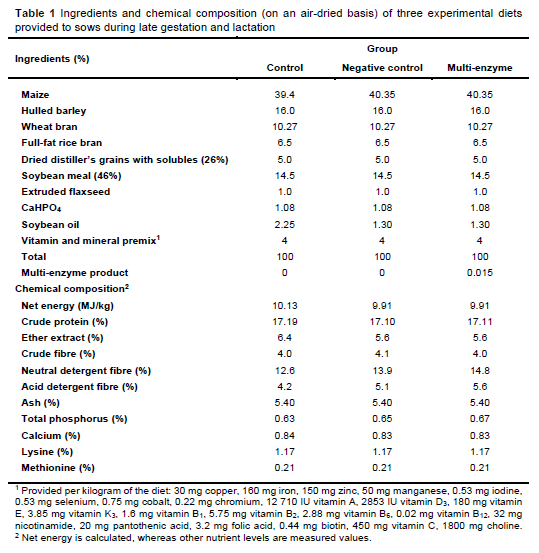
Thirty second-parity cross-bred sows (Landrace χ Yorkshire) in sound body condition (mean backfat thickness: 22.10 ± 0.37 mm) and free from clinical disorders were selected from the herd. All sows were managed under the farm's routine vaccination schedule. Animals were stratified by parity and backfat thickness and subsequently allocated at random to one of three dietary treatments (n = 10 per treatment): a control group receiving the basal diet; a negative control group receiving the basal diet with the net energy content reduced by 50 kcal/t; and a multi-enzyme group receiving the negative control diet supplemented with 150 g/t of a compound enzyme preparation. The experimental period extended from day 85 of gestation to weaning. The same diet was provided throughout both late gestation and lactation, following the standard practice of the experimental farm, where sows are routinely fed the lactation diet during late gestation. The enzyme preparation provided ß-mannanase (>9.0 × 10⁶ U/kg), xylanase (>9.0 × 10⁷ U/kg), cellulase (>3.5 × 10⁶ U/kg), and ß-glucanase (>3.0 × 10⁶ U/kg). The formulations and calculated nutrient compositions of the diets are presented in Table 1.
The backfat thickness and body weights of sows were measured on day 85 of gestation, three days before farrowing, and at weaning. All sow measurements were conducted after fasting overnight. Backfat thickness was measured at the left side of the dorsal midline at the level of the 10th rib, approximately 65 mm from the midline, using an ultrasound backfat analyser (Shu Shuang Lean-Meater, China).
From day 85 of gestation, sows were housed and managed according to the standard practices of the experimental farm. During late gestation, sows were fed twice daily at a total allowance of 3.5 kg/day, and the amount of feed provided was weighed and recorded daily. During lactation, sows were allowed ad libitum access to feed, and daily feed intake was determined based on the amount of feed offered and the feed refusals. Feed intake data were used to calculate total feed intake and average daily feed intake (ADFI).
During farrowing, the number of piglets per litter was recorded, including total born, live-born, healthy piglets, weak piglets, mummified foetuses, and stillborn piglets. Healthy piglets were defined as piglets with birthweights of >0.8 kg, whereas weak piglets were defined as piglets with birthweights of <0.8 kg, according to farm management standards (Cong et al., 2024).
Individual piglet birthweight was recorded immediately after delivery and before colostrum intake to calculate the litter weight and the mean birthweights of the live-born piglets. Piglet body weight was measured individually on days 5 and 21 of lactation. Daily milk yield was estimated based on litter average daily gain from day 5 to day 21 of lactation using the following equation:

Piglet mortality and the incidences of diarrhoea were recorded daily throughout the lactation period.
Faecal scores of sows from late gestation through lactation were recorded according to the criteria described by Cong et al. (2025) using a 1-5 point scale. Faecal scores during the periparturient period (from seven days before farrowing to three days after farrowing) were analysed separately. Scores <3 were classified as constipation, scores of 3 to 4 as normal faeces, and a score of 5 as diarrhoea. Faecal scoring was conducted independently by three trained evaluators simultaneously following standardised criteria, and inter-observer consistency was ensured through prior training. During the final three days of the experimental period, fresh faecal samples were collected directly from the rectum of each sow and immediately frozen at -80 °C until analysis.
Feed and faecal samples were analysed for crude protein (N χ 6.25), ether extract, crude fibre, neutral detergent fibre (NDF), and acid detergent fibre (ADF) according to standard methods: GB/T 6436-2018, GB/T 6434-2006, GB/T 6434-2022, GB/T 20806-2022, and NY/T 459-2022, respectively. Acid-insoluble ash (AIA) was determined using method GB/T 23742-2009 and was used as an internal marker to calculate the apparent total tract digestibility (ATTD) of nutrients. The calculation was performed using the following equation:

All data were compiled in Microsoft Excel and analysed using SPSS 31.0 (IBM, Armonk, NY, USA). Prior to analysis, data were checked for normality and the presence of outliers using the UNIVARIATE procedure, and homogeneity of variance was assessed using Levene's test. Variables that satisfied the assumptions of normality and equal variance were analysed using one-way analysis of variance (ANOVA). When significant differences were detected, means were compared using Duncan's multiple range test. Variables that did not meet the assumptions of normality or variance homogeneity were analysed using the Kruskal-Wallis test. Reproductive traits were analysed at the sow or litter level, whereas other variables, including feed intake, backfat thickness, faecal score, apparent nutrient digestibility, and piglet growth, were analysed at the individual level. Statistical significance was set at P <0.05, and 0.05< P <0.10 was considered indicative of a trend. Data are presented as the mean ± the standard error of the mean.
Results
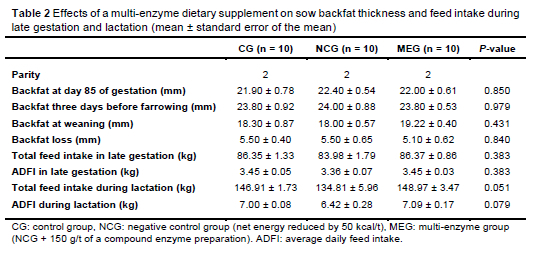
As shown in Table 2, sows in the control and multi-enzyme groups showed a tendency for a greater total feed intake (P = 0.051) and higher ADFI during lactation (P = 0.079), compared to the negative control group. No significant differences were detected among treatments in initial backfat thickness, pre-farrowing backfat thickness, weaning backfat thickness, backfat loss, or feed intake during gestation.
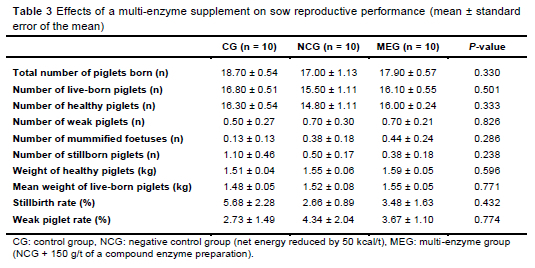
As shown in Table 3, no significant differences were observed among treatments in the total litter size, the number of live-born, healthy, weak, mummified, and stillborn piglets, the healthy piglet weight, the mean weight of live-born piglets, the stillbirth rate, or the weak piglet rate.
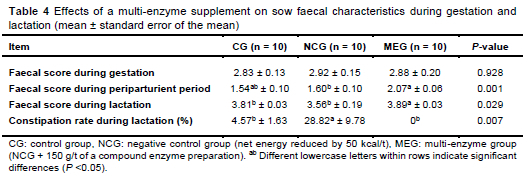
As shown in Table 4, sows in the multi-enzyme group had higher faecal scores during the periparturient period than sows in the other treatments (P <0.05). During lactation, faecal scores in the multi-enzyme group also exceeded those of both the control and negative control groups (P <0.05). In contrast, the negative control group had a significantly higher incidence of constipation during lactation, compared with the control and multi-enzyme groups (P <0.05).
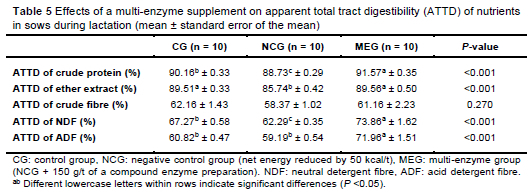
As shown in Table 5, the ATTD values for crude protein, NDF, and ADF were higher in the multi-enzyme group than in both the control and negative control groups (P <0.05). Furthermore, the negative control group had lower digestibility values for these nutrients than the control group (P <0.05). In addition, the ATTD of ether extract was higher in the control and multi-enzyme groups than in the negative control group (P <0.05).
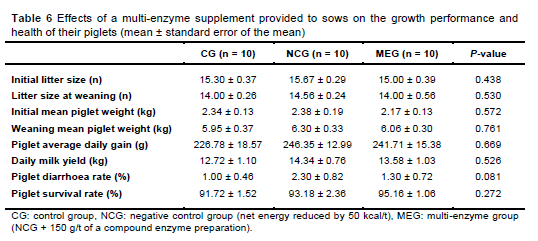
As shown in Table 6, piglets from the negative control group tended to have a higher diarrhoea rate than piglets from the other two groups (P = 0.081). No significant differences were detected among treatments in litter size at weaning, weaning weight, average daily gain, daily milk yield, or survival rate (P >0.05).
Discussion
Thus far, research on multi-enzyme preparations in swine nutrition has primarily focused on nursery and growing-finishing pigs, where the value of these preparations for improving growth performance and feed efficiency has been well established (Fang et al., 2007; Yoon et al., 2010; Kim et al., 2013). In contrast, studies in sows remain limited, particularly under conditions of reduced dietary energy supply. Therefore, the present study evaluated the effects of multi-enzyme supplementation on reproductive performance and nutrient utilisation in sows fed a diet with a reduced net energy content during late gestation and lactation. The results indicated that the enzyme preparation mainly exerted its effects through improving nutrient utilisation and gastrointestinal function, while reproductive performance was not significantly affected. Exogenous carbohydrases - including ß-mannanase, xylanase, cellulase, and ß-glucanase - degrade dietary NSPs, thereby reducing the encapsulation of nutrients within plant cell walls and enhancing substrate accessibility to endogenous digestive enzymes and hindgut microbiota (Bedford & Schulze 1998; Moreira & Filho 2016; Yamsakul et al., 2026). Non-starch polysaccharide degradation disrupts cell wall structures and increases nutrient availability, ultimately improving digestive efficiency. Similar responses have been reported in gestating and lactating sows supplemented with carbohydrase complexes (Zhe et al., 2022; Yamsakul et al., 2026). Consistent with these mechanisms, the apparent digestibility of crude protein, NDF, and ADF was significantly increased in the sows supplemented with the multi-enzyme product in the present study. Meanwhile, the reduction in nutrient digestibility observed in sows fed the low-energy diet suggests that insufficient fibre utilisation may become a limiting factor for nutrient use when dietary energy density decreases.
Regarding feed intake during lactation, no significant differences were detected among treatments; however, sows in the control and multi-enzyme groups showed a tendency towards higher feed intake, compared to those fed the reduced-energy diet alone. Lactation represents the period of greatest nutritional demand and metabolic load in sows. Voluntary feed intake is regulated not only by energy requirements but also by gastrointestinal capacity and digestive comfort (Lynch, 1989; Theil, 2015; Cong et al., 2025). Growing pigs are generally able to adjust feed intake in response to dietary energy changes, whereas this regulatory mechanism appears less stable in lactating sows. In the present study, dietary energy reduction was mainly achieved by decreasing added oil, which may have reduced diet palatability and consequently suppressed feed intake. Moreover, the higher incidence of constipation observed in the negative control group suggests reduced intestinal motility and increased gastrointestinal discomfort, which may have further constrained feeding behaviour. Supplementation with multi-enzymes tended to improve feed intake and significantly improved faecal characteristics under energy-restricted conditions, indicating that enhanced fibre degradation and improved gut function may help alleviate reductions in feed intake associated with low-energy diets.
Despite the significant improvement in nutrient digestibility, reproductive performance parameters did not differ among treatments. This finding agrees with previous studies showing that improved nutrient utilisation does not necessarily translate into changes in litter size or birthweight (Kim et al., 2018; Velayudhan et al., 2018). Reproductive performance in sows is jointly regulated by endocrine status and metabolic condition. When body energy reserves are adequate and nutrient supply remains close to physiological requirements, moderate dietary adjustments often fail to elicit marked reproductive responses (Prunier & Quesnel 2000; Thaker & Bilkei 2005). In the present study, backfat thickness was similar among groups at the start of the experiment and body condition remained stable throughout the trial, indicating an overall adequate nutritional status, which likely reduced the probability of detecting reproductive differences.
In addition, multi-enzyme supplementation significantly improved faecal scores and reduced the incidence of constipation. Constipation is relatively common in periparturient sows in intensive production systems and is frequently associated with reduced feed intake and decreased levels of fermentable fibre around parturition. These changes increase the faecal dry matter content and reduce defaecation frequency, thereby elevating constipation risk (Wenk, 2001; Tabeling et al., 2003; Cong et al., 2025). Enzymatic degradation of NSPs generates oligosaccharides that promote microbial fermentation and increase short-chain fatty acid production. Short-chain fatty acids stimulate intestinal motility and improve faecal consistency (Kouzounis et al., 2021; Lu et al., 2022). Accordingly, the improvement in faecal condition observed in this study was likely associated with enhanced fibre fermentability and improved gut function induced by enzyme supplementation. Improved maternal intestinal function may also exert indirect maternal effects on offspring. However, piglet growth performance did not differ significantly among treatments, although a tendency towards increased diarrhoea incidence was observed in piglets from the reduced-energy group. When milk production is sufficient to support piglet growth, improvements in maternal nutrient digestibility may not be directly reflected in litter growth performance (Theil, 2015). Notably, piglets from the enzyme-supplemented group showed a tendency towards reduced diarrhoea incidence, suggesting a potential maternal regulatory effect on piglet gut health, although the underlying mechanisms require further investigation.
Conclusions
Multi-enzyme supplementation improved fibre degradation, nutrient digestibility, and faecal quality in sows fed reduced-energy diets, but did not significantly affect reproductive performance or piglet growth. The benefits of multi-enzyme supplementation under practical production conditions may primarily relate to improved digestive stability and nutrient utilisation.
Authors' contributions
All authors participated in this research and have read and approved the final manuscript.
Conflict of interest declaration
G.C., C.L., S.X., J.L., and I.H., were employed by the Anyou Biotechnology Group Co., Ltd.
Acknowledgements
The Taicang City of China Science and Technology Talents Plan (Innovation) Project (TCRC2022067) provided the financial support for this study.
References
-
Ao, X., Meng, Q.W., Yan, L., Kim, H.J., Hong, S.M., Cho, J.H., & Kim, I.H., 2010. Effects of non-starch polysaccharide-degrading enzymes on nutrient digestibility, growth performance and blood profiles of growing pigs fed a diet based on corn and soybean meal. Asian-Australasian Journal of Animal Sciences, 23:1632-1638. DOI: https://doi.org/10.5713/ajas.2010.10123
» https://doi.org/10.5713/ajas.2010.10123 -
Bedford, M.A. & Schulze, H., 1998. Exogenous enzymes for pigs and poultry. Nutrition Research Reviews, 11:91-114. DOI: https://doi.org/10.1079/NRR19980007
» https://doi.org/10.1079/NRR19980007 - Choct, M., 1997. Feed non-starch polysaccharides: chemical structures and nutritional significance. Feed Milling International, 191:13-26.
-
Cong, G.L., Liu, C., Xia, S., Li, J., & Hung, I., 2025. Dietary fibre supplementation in late gestation modulates gut microbiota and improves reproductive performance and colostrum quality in sows. Frontiers in Microbiology, 16:1667697. DOI: https://doi.org/10.3389/fmicb.2025.1667697
» https://doi.org/10.3389/fmicb.2025.1667697 -
Cong, G.L., Xia, S., Liu, C., Li, J., & Hung, I., 2024. Effects of guanidine acetic acid supplementation from gestation to lactation on reproductive performance, colostrum quality, blood biochemistry, and intestinal microflora diversity of sows. Frontiers in Veterinary Science, 11:1476328. DOI: https://doi.org/10.3389/fvets.2024.1476328
» https://doi.org/10.3389/fvets.2024.1476328 -
Cooper, D.R., Patience, J.F., Zijlstra, R.T., & Rademacher, M., 2001. Effect of energy and lysine intake in gestation on sow performance. Journal of Animal Science, 79:2367-2377. DOI: https://doi.org/10.2527/2001.7992367x
» https://doi.org/10.2527/2001.7992367x -
Crome, T.A., Giesemann, M.A., Miller, H.E., & Petry, A.L., 2023. Influence of fiber type and carbohydrase supplementation on nutrient digestibility, energy and nitrogen balance, and physiology of sows at mid and late gestation. Journal of Animal Science, 101:skad390. DOI: https://doi.org/10.1093/jas/skad390
» https://doi.org/10.1093/jas/skad390 -
Fang, Z.F., Peng, J., Liu, Z.L., & Liu, Y.G., 2007. Responses of non-starch polysaccharide-degrading enzymes on digestibility and performance of growing pigs fed a diet based on corn, soya bean meal and Chinese double-low rapeseed meal. Journal of Animal Physiology and Animal Nutrition, 91:361-368. DOI: https://doi.org/10.1111/j.1439-0396.2006.00664.x
» https://doi.org/10.1111/j.1439-0396.2006.00664.x -
Jerez-Bogota, K., Sánchez, C., Ibagon, J., Jlali, M., Cozannet, P., Preynat, A., & Woyengo, T.A., 2020. Growth performance and nutrient digestibility of growing and finishing pigs fed multienzyme-supplemented low-energy and -amino acid diets. Translational Animal Science, 4:602-615. DOI: https://doi.org/10.1093/tas/txaa040
» https://doi.org/10.1093/tas/txaa040 -
Kim, J.S., Ingale, S.L., Lee, S.H., Kim, K.H., Lee, J.H., & Chae, B.J., 2013. Effects of energy levels of diet and β-mannanase supplementation on growth performance, apparent total tract digestibility and blood metabolites in growing pigs. Animal Feed Science and Technology, 186:64-70. DOI: https://doi.org/10.1016/j.anifeedsci.2013.08.008
» https://doi.org/10.1016/j.anifeedsci.2013.08.008 -
Kim, J.S., Hosseindoust, A., Ju, I.K., Yang, X., Lee, S.H., Noh, H.S., Lee, J.H., & Chae, B.J., 2018. Effects of dietary energy levels and β-mannanase supplementation in a high mannan-based diet during lactation on reproductive performance, apparent total tract digestibility and milk composition in multiparous sows. Italian Journal of Animal Science, 17:128-134. DOI: https://doi.org/10.1080/1828051X.2017.1345663
» https://doi.org/10.1080/1828051X.2017.1345663 -
Kouzounis, D., Hageman, J.A., Soares, N., Michiels, J., & Schols, H.A., 2021. Impact of xylanase and glucanase on oligosaccharide formation, carbohydrate fermentation patterns, and nutrient utilization in the gastrointestinal tract of broilers. Animals, 11:1285. DOI: https://doi.org/10.3390/ani11051285
» https://doi.org/10.3390/ani11051285 -
Llamas-Moya, S., Duong, T., Petersen, G.I., Bertram, M.J., & Kitt, S.J., 2022. Effect of a multicarbohydrase containing α-galactosidase in sow lactating diets with varying energy density. Translational Animal Science, 6:txac159. DOI: https://doi.org/10.1093/tas/txac159
» https://doi.org/10.1093/tas/txac159 -
Lu, D., Pi, Y., Ye, H., Wu, Y., Bai, Y., Lian, S., Han, D., Ni, D., Zou, X., & Zhao, J., 2022. Consumption of dietary fiber with different physicochemical properties during late pregnancy alters the gut microbiota and relieves constipation in sow model. Nutrients, 14:2511. DOI: https://doi.org/10.3390/nu14122511
» https://doi.org/10.3390/nu14122511 -
Lynch, P.B., 1989. Voluntary food intake of sows and gilts. BSAP Occasional Publication, 13:71-77. DOI: https://doi.org/10.1017/S0263967X00003086
» https://doi.org/10.1017/S0263967X00003086 -
Moreira, L.R.S. & Filho, E.X.F., 2016. Insights into the mechanism of enzymatic hydrolysis of xylan. Applied Microbiology and Biotechnology, 100:5205-5214. DOI: https://doi.org/10.1007/s00253-016-7555-z
» https://doi.org/10.1007/s00253-016-7555-z -
Prunier, A. & Quesnel, H., 2000. Nutritional influences on the hormonal control of reproduction in female pigs. Livestock Production Science, 63:1-16. DOI: https://doi.org/10.1016/S0301-6226(99)00113-X
» https://doi.org/10.1016/S0301-6226(99)00113-X -
Shipman, G., Palencia, J.P., Patterson, R., & Levesque, C.L., 2023. Dietary carbohydrase mixture supplementation and fiber levels on ileal digestibility of nutrients in diets for gestating sows. Journal of Animal Science, 101:188-189. DOI: https://doi.org/10.1093/jas/skad341.207
» https://doi.org/10.1093/jas/skad341.207 -
Shipman, G.L., Perez-Palencia, J.Y., Hong, J., Niu, Y., Rogiewicz, A., Patterson, R., & Levesque, C.L., 2025. Effects of multienzyme supplementation on energy and nutrient digestibility in various feed ingredients for pregnant gilts. Journal of Animal Science, 103:skaf017. DOI: https://doi.org/10.1093/jas/skaf017
» https://doi.org/10.1093/jas/skaf017 -
Tabeling, R., Schwier, S., & Kamphues, J., 2003. Effects of different feeding and housing conditions on dry matter content and consistency of faeces in sows. Journal of Animal Physiology and Animal Nutrition, 87:116-121. DOI: https://doi.org/10.1046/j.1439-0396.2003.00423.x
» https://doi.org/10.1046/j.1439-0396.2003.00423.x -
Thaker, M.Y.C. & Bilkei, G., 2005. Lactation weight loss influences subsequent reproductive performance of sows. Animal Reproduction Science, 88:309-318. DOI: https://doi.org/10.1016/j.anireprosci.2004.10.001
» https://doi.org/10.1016/j.anireprosci.2004.10.001 -
Theil, P.K., 2015. Transition feeding of sows. In: The Gestating and Lactating Sow. Ed: Farmer, C., Wageningen Academic Publishers, Wageningen, Netherlands. pp. 147-172. DOI: https://doi.org/10.3920/9789086868032_008
» https://doi.org/10.3920/9789086868032_008 -
Velayudhan, D.E., Hossain, M.M., Regassa, A., & Nyachoti, C.M., 2018. Effect of canola meal inclusion as a major protein source in gestation and lactation sow diets with or without enzymes on reproductive performance, milk composition, fecal bacterial profile and nutrient digestibility. Animal Feed Science and Technology, 241:141-150. DOI: https://doi.org/10.1016/j.anifeedsci.2018.05.001
» https://doi.org/10.1016/j.anifeedsci.2018.05.001 -
Wenk, C., 2001. The role of dietary fibre in the digestive physiology of the pig. Animal Feed Science and Technology, 90:21-33. DOI: https://doi.org/10.1016/S0377-8401(01)00194-8
» https://doi.org/10.1016/S0377-8401(01)00194-8 -
Yamsakul, P., Yano, T., & Eiamsam-Ang, T., 2026. The role of exogenous non-starch polysaccharide enzymes in enhancing digestibility and performance of pig. Biology, 15:13. DOI: https://doi.org/10.3390/biology15010013
» https://doi.org/10.3390/biology15010013 -
Yoon, S.Y., Yang, Y.X., Shinde, PL., Choi, J.Y., Kim, J.S., Kim, Y.W., Yun, K., Jo, J.K., Lee, J.H., & Ohh, S.J., 2010. Effects of mannanase and distillers dried grain with solubles on growth performance, nutrient digestibility, and carcass characteristics of grower-finisher pigs. Journal of Animal Science, 88:181-191. DOI: https://doi.org/10.2527/jas.2008-1741
» https://doi.org/10.2527/jas.2008-1741 -
Zhe, L., Zhou, R., Theil, P.K., Krogh, U., Yang, L., Zhuo, Y., Lin, Y., Xu, S., Jiang, X., Huang, L., Che, L., Feng, B., Wu, D., & Fang, Z., 2022. The impact of enhancing diet quality or dietary supplementation of flavor and multi-enzymes on primiparous lactating sows. Animals, 12:1493. DOI: https://doi.org/10.3390/ani12121493
» https://doi.org/10.3390/ani12121493
Accepted 10 July 2026
Published 29 July 2026