Communication Channels Used by Emerging Farmers to Access High-Value Markets: Greater Giyani Local Municipality
Abstract
This paper was prompted by the observation that although access to high-value markets for emerging farmers has received extensive attention regarding income generation and food security, a gap existed with regard to associated communication channels, especially in the Greater Giyani Local Municipality (GGLM). A sample of 215 farmers was extracted from a population of482 emerging farmers in the GGLM using clustered random selection techniques. Descriptive and inferential statistical analyses were used to assess the communication channels used. The study's general findings were that most farmers had no formal education, with very few acquiring tertiary education. Elderly farmers (above 55 years) dominated the emerging livestock farming sector, with minimal youth participation. In terms of utilisation of the various channels, the study uncovered substantial reliance on cell phones (84.2 %), farmers' unions (74.9 %), and radio (56.7 %). Inferential statistical results revealed that the use of television had a significant but negative influence on access to high-value markets. Farmer unions and other farmers hadpositive attributes (10% significance) in accessing high-value markets. The paper recommends promoting cell phone usage by other farmers and farmer unions to enhance the participation of emerging livestock farmers in high-value markets, especially in the GGLM. More youth participation also needs to be encouraged to prevent succession crises.
Communication; Channels; High-Value Markets; Livestock Marketing; Emerging Farmer
1. INTRODUCTION
The participation of emerging farmers in high-value markets (characterised by offering higher product prices and high product demand), especially in South Africa, has been highlighted by several studies (Oduniyi, Antwi & Mukwevho, 2021). However, the latter has focused more on the impact of high-value markets on food security and income generation. This paper identified a critical gap related to marketing channels used to access these high-value market channels. Therefore, this study aims to analyse communication channels emerging livestock farmers use to access high-value markets in the Greater Giyani Local Municipality. Inadequate communication channels employed by emerging farmers usually hinder their ability to establish and maintain relationships with high-value market stakeholders, affecting their market access and economic empowerment (Glogovetan & Pocol, 2024). Effective communication is a critical success factor for the farming industry, but more so for the emerging farming sector. It should be noted that marketing communication is an essential and intricate component of the marketing efforts that a company undertakes (Rosário & Raimundo, 2021). Communication channels are therefore critical for farmers in their quest to access critical related information that includes produce marketing, weather predictions, and adoption of best practices (Simelton & McCampbell, 2021). Whereas emerging farmers are known to mostly transition from producing for their consumption, they often sell surplus produce to the market to generate additional income required for other household needs (Getahun, 2020), thus, the critical role of adopting effective marketing channels. Communication channels are further necessitated by the need to enhance operational productivity, increase job opportunities, and alleviate general poverty for farmers and the broader citizenry. The study leverages emerging farmers' reliance on technological innovations such as cell phones to access high-value markets. The findings and recommendations of this study will be helpful not only to policymakers in the Limpopo Department of Agriculture and Rural Development (LDARD) and other stakeholders within the agribusiness value chain. As Kountios et al. (2023) and Juska (2021) noted, communication is critical in ensuring effective production, distribution, storage and marketing of agricultural products and market trends.
In Africa, especially for countries in sub-Saharan Africa and Nigeria, poor access to effective communication channels has negatively affected livestock farmers, especially regarding poor access to information on markets, market prices, productivity and profits (Okediran, 2019). For these countries, it has been recommended that enhancing produce marketing will require effective communication tools such as mobile phones and the Internet (Mapiye et al., 2021). Information transmission can be challenging due to the highly localised nature of agriculture, which means that information must be explicitly personalised to distinct conditions (Xu & LI, 2022). A study conducted on emerging farmers' ICT usage in Kenya attests to the critical role that the strategy played in transmitting necessary information, primarily via the utilisation of platforms such as mobile phones, radio, and television (Mauti, 2021). Similar findings were confirmed in Kulon Progo. The role of ICT in reducing distances between markets and farms has also been acknowledged by researchers such as Sikundla et al. (2018). Some studies have observed that access to ICT benefits had gender dimensions, with women on the receiving end (Tanti et al., 2022). Another worrying observation is reliance on intermediaries who usually take advantage of emerging farmers' poor market information acquisition skills, especially in terms of accurate and timely marketing information for perishable crops (Baloyi, 2010; Bacco et al., 2019; Thaqi & Beqaj, 2017).
The importance of communication channels has been further highlighted in various studies. A study in Nigeria, for example, revealed that, as an information sector, the agricultural sector calls for farmers to be exposed to accurately packaged information (Okediran, 2019). As asserted by Awazi et al. (2019), emerging farmers, particularly those who rely on traditional markets, find it difficult to compete within the high-value or modern markets that display higher earnings per hectare or kilogram marketed. Thus, emerging farmers must be integrated into the value chain and supported effectively to become competent in accessing profitable, high-value markets. As attested by a study conducted in India, if well supported, emerging farmers can successfully adopt modern technologies such as computers and cell phones (Khou & Suresh, 2018). Following the above, India's digital landscape has become more inclusive and innovative, enhancing productivity and market access (Mazana et al., 2021; Parthiban et al., 2022).
Effective marketing channels are also crucial for the timely receipt of updates on market developments, price variations, and manufacturing experiences over the Internet (Nghi, 2021). The critical role of cell phones as market communication tools has also been confirmed by several studies that were conducted in countries such as Ethiopia, Uganda, Tanzania, Zimbabwe and China, primarily through the use of SMSs and other multimedia support systems (Anadozie et al, 2022; Mutambara, 2021; Ndimbo et al, 2024; Ujakpa et al, 2021). The efficient use of mobile phones in facilitating information access among farmers is far-reaching, as it provides communication links even in isolated circumstances and aids in reaching farmers living in remote areas (Sikundla et al., 2018).
Whereas the speed at which digital communication tools are adopted is low, widespread adoption is believed to eliminate the challenges of imperfect markets. Other associated social media platforms that could enhance the use of cell phones are Teams, Zoom, and videoconferencing (Aladenika, 2022). It is unfortunate, however, that the use of technology-based market communication tools has elements of gender inequality, with males on the dominant side. Consequently, as noted by the literature, male farmers had greater access to rural advisory and extension services, financial flexibility, decision-making authority, and market access than female farmers (Tanti et al., 2022). Therefore, it follows that the need to address gender inequality within the agricultural communication and marketing spaces is critical, especially in that gadgets such as mobile phones can facilitate agricultural decision-making, marketing of farm produce and provision of information related to crops, weather prediction, seeds, fertilisers, bio-pesticides, soil fertility, pest and disease diagnoses, demand and supply of agricultural products, different schemes, and technologies (Ara et al., 2021; Emeana et al., 2020).
2. RESEARCH DESIGN AND METHODOLOGY
2.1. Study Area and Research Design
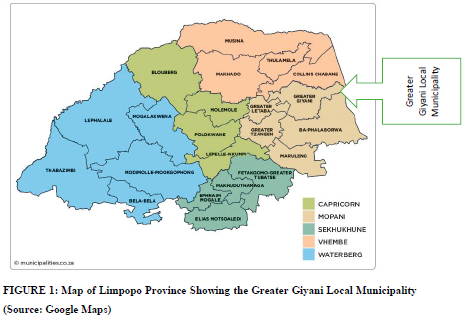
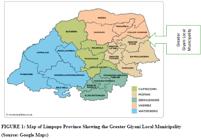
The study was conducted in the Greater Giyani Local Municipality (GGLM), in the Mopani District of Limpopo Province (see Figure 1 below). GGLM is north of Mopani District, bordering the Kruger National Park to the east, Vhembe District to the north and Capricorn District to the western side. It is one of five (5) local municipalities falling within the Mopani District Municipality in Limpopo Province. The other four local municipalities are Greater Tzaneen, Greater Letaba, Ba-Phalaborwa, and Maruleng. The significant economic hub within the GGLM is Giyani Town. The economic activities of the municipality are agriculture, forestry, and fishing (1.6%), mining and quarrying (3.3%), manufacturing (3.0%), utilities (3.5%), trade and accommodation (17.3%), construction (1.6%), transport and communication (7.7%) and finance and real estate (25.1%) (IDP, 2020/2021). The municipality is characterised by extremely hot summers, moderate winters, and low rainfall patterns, making it unsuitable for crop production.
The study adopted the quantitative research approach. According to McMillan and Schumacher (2006), a quantitative research method systematically investigates phenomena via statistical, mathematical, or computational techniques. Its objective is, therefore, to develop and use mathematical models, theories, and hypotheses about phenomena of the total population of the GGLM, which is 256300 (IDP, 2020/2021).
2.2. Data Collection and Sampling Procedure
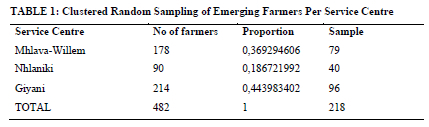
Data was collected through structured questionnaires that mainly focused on demographic characteristics and communication channels emerging farmers use to access high-value markets. Sampling was conducted using acceptable scientific techniques that allowed representativity of the population (Leedy & Ormrod, 2004: 150). The Department of Agriculture and Rural Development in Giyani confirmed that many emerging farmers in the GGLM practise livestock farming due to the area being very dry for crop farming. It was further highlighted that there were 482 livestock farmers in the local municipality. Thus, clustered proportional random sampling was adopted for this study as follows: the sample population (N-482) of emerging livestock farmers were first clustered according to the three (3) Agricultural service centres. According to farming type (livestock), a proportion of farmers within the Agricultural Service Centre was determined. A sample size of 218 from the population of emerging farmers was randomly selected. Out of the 218 emerging farmers who were randomly selected, three (3) decided to withdraw from participating in the study, which led the sample to 215 emerging farmers.
The sample was calculated using the Yemen formula (Yemen, 1973, as cited by Chaokromthong & Sintao, 2021):

The confidence level was 95, and the margin of error was 5%.
2.3. Data Analysis Technique
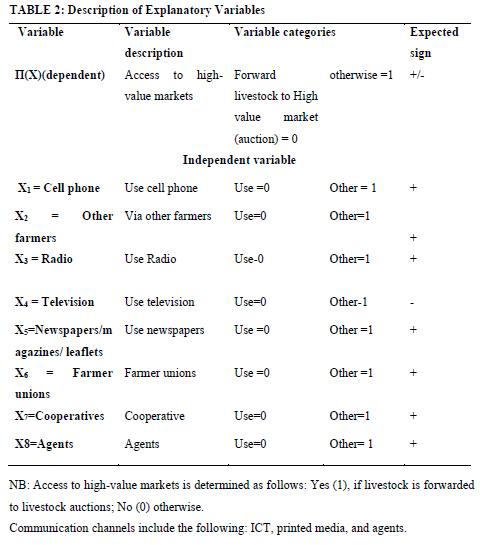
The analysis of the data was carried out using a variety of statistical methods to accomplish the purpose of the study. Descriptive statistical tools such as percentages and frequencies were utilised to analyse the communication techniques used by emerging farmers in the Greater Giyani Local Municipality to gain access to high-value livestock markets. In addition, inferential statistics was employed to diagnose and analyse the communication methods used by emerging livestock farmers. The relationship between the dichotomous dependent variable, which in this case was access to high-value markets, and a set of independent variables, which were the communication channels shown in Table 1, was modelled with the help of a binary logistic regression model. The results of this analysis are presented below.
The regression model was specified as:

(Tshikororo, 2020, citing Norusis, 1993)
Where πi= probability of the ith case; Zi = value of the independent variable for the ith case.
The relationship between the binary status variable (Zi) and its determinant Xi is specified as

ßi = vector of the respective parameter estimated using the maximum likelihood method and ε = error term.
According to Norusis' study (as cited in Tshikororo, 2020), the probability of emerging livestock farmers forwarding their livestock to high-value markets is estimated as follows:

Because the cutoff value is 0.5, if the estimated probability of the event is less than 0.5, it is predicted that the event will not occur. If it is greater than 0.5, the prediction is that the event will occur. In the unlikely event that the probability is exactly 0.5, one can flip a coin for prediction (Tshikororo, 2020, as cited by Norusis, 1993).

Z is the linear combination and is expressed as follows:

Po and βi are the estimated coefficients of the parameters as depicted in Table 1.
3. RESULTS
3.1. Age and Level of Education Attained by Livestock Farmers
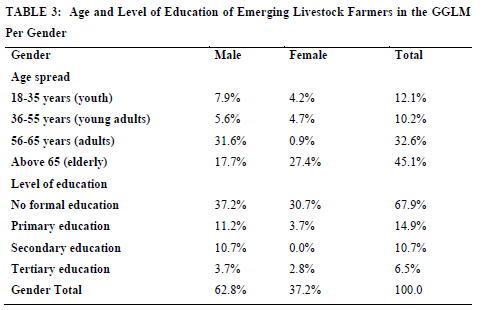
The age and level of education attained by emerging livestock farmers in the GGLM are presented in Table 2. The table indicates that most emerging livestock farmers in the study area were male (62.8%). Regarding the age spread, most (45.1%) were above 65 years, followed by those aged 56 to 65 (32.6%). The latter translates into most livestock owners being above 55 years (a combination of 77,7%). Youth participation (35 years and below) in livestock farming is minimal (about 12%). The level of education attained by livestock farmers in the study area is quite dismal (with 67.9% being illiterate). Interestingly, in terms of gender balance, most of the illiterates are males (37.2%). The proportion of farmers with tertiary educational qualifications is relatively low (6.5%).
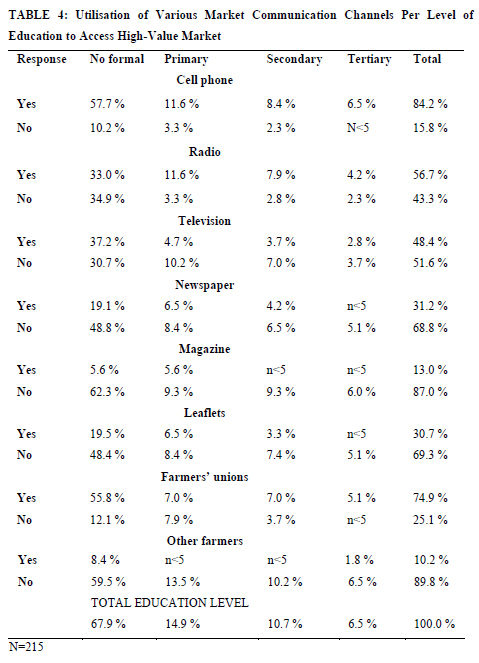
Table 2 presents the extent of communication channel usage by livestock farmers in the GGLM to access high-value markets, contrasted with the level of education attained. The first observation is that the majority (67.9%) had no formal education, with only 6.5% having obtained a tertiary education level. The latter could explain the reason why almost a quarter of respondents relied on cell phones (84.2%) and farmers' unions (74.9%) for farming information, followed by dependence on radio broadcasts (56.7%), which also displays a significant component of reliance by farmers. The observation of the least dependence on magazines (13.30%) also reflects the expectations of people with minimal educational attainment. The table also reflects that almost all farmers reported non-use of other farmers (89.8%), followed by those that shunned the use of magazines (87 %), newspapers (68.8%), and leaflets (69.3%). While television is regarded as an important source of agricultural information, many young farmers use mobile phones and smartphones to access information about the production and marketing of their products (Subejo et al., 2019).
3.2. Inferential Statistical Analysis of Communication Channels Used by Emerging Farmers in Accessing High-Value Livestock Market
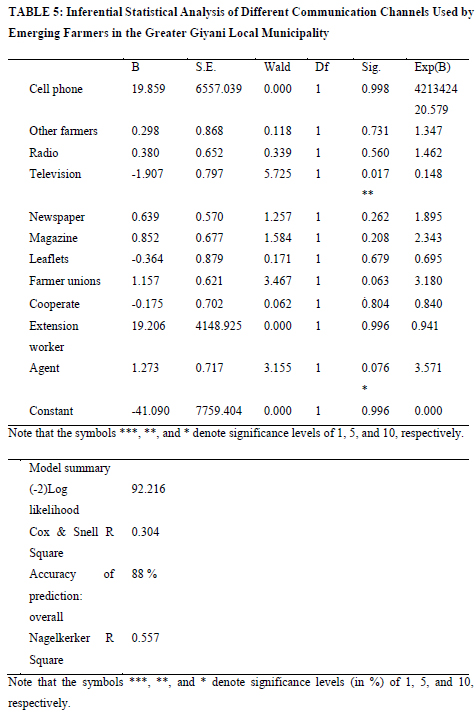
The inferential statistical results of utilising various communication channels are presented in Table 3. The information below the table reflects the diagnosis of the results. Accordingly, a -2-log likelihood indicates the probability at which it was determined that the null hypothesis could be rejected. The Cox and Snell R-squared was 0.304, which suggests that the model fits the data well. This is because a value of the Cox and Snell R-squared less than 1 indicates that the model fits the data well. The value of Nagelkerke was 0.557, which means a strong relationship (88%) between the independent and the dependent variables. A higher Nagelkerke value indicates a more consistent measurement of the relationship between the dependent and independent variables. The outcome of the above is explained below.
3.2.1. Use of Television
The use of television had a negative influence on emerging livestock farmers in the Greater Giyani Local Municipality's access to high-value markets. This variable was a significant (5 % significance level) with a negative coefficient. The negative coefficient may suggest that, with the use of television to market their products, there will be reduced access to high-value markets. The outcome contrasts with that found by Subejo et al. (2019), which depicted that farmers with relatively low levels of education continue to rely mostly on television and mobile phones to acquire information about agricultural productivity (Subejo et al., 2019).
3.2.2. Use of Farmer Unions
The use of farmers' unions had a positive influence on emerging livestock farmers' access to high-value markets in the Greater Giyani Local Municipality. This variable was significant (10 %), with a positive coefficient of 1.157. The positive coefficient may suggest that, with the use of farmers' unions to market their products, there is an increased possibility of access to high-value markets. Zakaria et al. (2021) attested that institutional engagement in sustainable partnerships between farmer groups and an ICT system enhanced agribusiness performance.
3.2.3. Use of Agents/Intermediaries
Agents/intermediaries directly influenced access to high-value markets by emerging Greater Giyani Local Municipality livestock farmers. The variable was significant (10%), with a positive coefficient of 1.273. The positive coefficient implies that with the use of agents/intermediaries to market their products, there is a higher possibility of accessing high-value markets. As observed by Khou and Suresh (2018), intermediated channels are part of a more compact supply chain that connects producers directly to end users through intermediaries like wholesalers and retailers (Dimitri & Gardner, 2019; Petkovic & Uzar, 2020). As noted by Tewari et al. f2018) and Plakias et al. (2020), consumers have easy access to local and sustainable products brought to the market by an intermediary.
4. DISCUSSION
The study's descriptive statistics revealed that emerging farmers in the GGLM obtain information about the markets mainly through cell phones (84.2%), farmers' unions (74.9%), and radio (56.7%). The above results align well with the level of education attained by emerging livestock farmers in the study area. The high number of farmers who shun communicating with other farmers (89.8 %) is a serious concern for respondents with high levels of illiteracy. Previous studies attest to the study findings regarding dependence on technologies such as cell phones and television (Mauti, 2021; Sikundla et al., 2018).
Inferential statistical results revealed that dependence on television was significant (5% significance level) but negatively influenced access to high-value markets. Farmers' unions and agents were all significant (10% levels of significance), with positive influences on access to high-value markets by emerging livestock farmers. The above is supported by Sikundla et al. (2018). Mtega (2021) noted that limited market access, particularly in rural areas, often necessitates farmers and entrepreneurs to travel several kilometres to designated markets.
5. CONCLUSIONS
The study explored different communication channels emerging farmers use to access high-value livestock markets. The major problem of the study hinged on the observation that although the impact of access to high-value markets by emerging farmers focuses more on food security and income generation, a gap existed in terms of associated market communication channels. Therefore, the study aimed to unravel the communication channels used by emerging livestock farmers in the Greater Giyani Local Municipality.
The study's descriptive statistics revealed that emerging farmers in the GGLM obtain market information through cell phones (84.2 %) and farmers' unions (74.9 %). Inferential statistical results showed that only three variables were statistically significant at 5% (negative for television) and for farmer unions and other farmers (positive at a 10% significance level).
This paper recommends that officials assisting emerging farmers, especially in the study area and similar localities, promote cell phones, farmers' unions, and radio to share information on high-value markets with emerging farmers. Minimal use of other farmers as marketing information sources needs to be redressed. Responsible officials, especially extension workers, must encourage liaison with other farmers to join farmers' unions, as the latter could easily enhance the passing of information through word of mouth. Other critical intervention channels could include the initiation of training and capacity-building programmes that facilitate access to high-value markets. The above could further be enhanced by introducing market information agents that connect emerging farmers to high-value markets. Encouraging increased youth participation is imperative, especially to prevent succession crises when the elderly pass on.
6. ACKNOWLEDGEMENTS
This study received funding from Unisa's student funding directorate (DSF).
REFERENCES
- ALADENIKA, B., 2022. Digital communication tools usage and buyer-seller relationship: Cocoa smallholder farmers' perspectives. Digit. Commun., 13(12): 18-30.
- ANADOZIE, C., FONKAM, M. & CLERON, J.P., 2022. Assessing mobile phone use in farming: The case of Nigerian rural farmers. Afr. J. Sci. Technol. Innov. Dev., 14(2): 418-427.
- ARA, I., TURNER, L., HARRISON, M.T., MONJARDINO, M., DEVOIL, P. & RODRIGUEZ, D., 2021. A review: Adoption and opportunities for improving decision support systems in irrigated agriculture. Agric. Water Manag., 257: 107161.
- BACCO, M., BARSOCCHI. P., FERRO, E., GOTTA, A. & RUGGERI, M., 2019. The digitisation of agriculture: A survey of research activities on smart farming. Array., 3: 100009.
- BALOYI, J.K., 2010. An analysis of constraints facing smallholder farmers in the Agribusiness value chain: A case study of farmers in the Limpopo Province. Doctoral dissertation, University of Pretoria.
- BHAN, M., ANIL, P.N. & CHAITRA, D.T., 2020. E-agriculture. New Trends in Comput. Vision and Bio-Inspired Computing. Selected works presented at the ICCVBIC 2018: Coimbatore, India, pp. 233-245.
- CHAOKROMTHONG, K. & SINTAO, N., 2021. Sample size estimation using Yamane and Cochran and Krejcie and Morgan and green formulas and Cohen statistical power analysis by G* Power and comparisions. Int. J. Interdiscip. Soc. Sci., 10(2): 76-86.
- DIMITRI, C. & GARDNER, K., 2019. Farmers' use of intermediated market channels: A review. Renew. Agric. Food Syst. , 34(3): 181 -197.
- EMEANA, E.M., TRENCHARD, L. & DEHNEN-SCHMUTZ, K., 2020. The revolution of mobile phone-enabled services for agricultural development (m-Agri services) in Africa: The challenges for sustainability. Sustaina., 12(2): 485.
- GETAHUN, A., 2020. Smallholder farmers agricultural commercialization in Ethiopia: A review. Agric. For. Fish., 9(3): 67.
- GLOGOVETAN, A.I. & POCOL, C.B., 2024. The role of promoting agricultural and food products certified with European Union quality schemes. Foods., 13(6): 970.
-
GREATER GIYANI MUNICIPALITY., 2020. Greater Giyani Municipality Integrated Development Plan 2020/2021. Available from https://www.cogta.gov.za/wp-content/uploads/2020/12/Greater-Giyani-IDP-2020-2021-final.pdf.
» https://www.cogta.gov.za/wp-content/uploads/2020/12/Greater-Giyani-IDP-2020-2021-final.pdf - KHOU, A. & SURESH, K.R., 2018. A study on the role of social media mobile applications and their impact on agricultural marketing in the Puducherry Region. J. Manage., 5(6): 28-35.
- KOUNTIOS, G., KONSTANTINIDIS, C. & ANTONIADIS, I., 2023. Can the adoption of ICT and advisory services be considered as a tool of competitive advantage in agricultural holdings? A literature review. Agronomy., 13(2): 530.
- JUSKA, J.M., 2021. Integrated marketing communication: advertising and promotion in a digital world. Routledge.
- LEEDY, P. & ORMROD, J., 2004. Practical research: Planning and design (8th Edition). Prentice-Hall.
- LEGESSE, T., KEBEDE, K., ASHEBIR, A., GANEWO, Z., ALEMU, A. & SAMUEL, A., 2024. Can high-value markets ensure households food security? Evidence from avocado producers in Sidama Region of Ethiopia. CogentSoc. Sci., 10(1): 2297758.
- MAPIYE, O., MAKOMBE, G., MOLOTSI, A., DZAMA, K. & MAPIYE, C., 2021. Towards a revolutionized agricultural extension system for the sustainability of smallholder livestock production in developing countries: The potential role of ICTs. Sustainability. , 13(11): 5868.
- MAUTI, K. O., 2021. Role of information and communication technology and socio-economic factors on marketing of tomatoes among smallholder farmers in Kirinyaga County, Kenya. Doctoral dissertation, University of Embu.
- MAZANA, M.Y., TAMBWE, M.A., MAPUNDA, M.A. & KIRUMIRAH, M.H., 2021. ICT and marketing for agricultural products: Determinants of mobile phone usage to small scale orange farmers in Tanzania. Educ. J., 10(1): 1-13.
- MCMILLAN, J.H. & SCHUMACHER, S., 2006. Research in education: Evidence-based inquiry. Pearson Education.
- MTEGA, W.P., 2021. Communication channels for exchanging agricultural information among Tanzanian farmers: A meta-analysis. IFLA J., 47(4): 570-579.
- MUTAMBARA, H., 2021. Use of mobile phones in communicating agricultural information in smallholder farming systems in Zimbabwe. Doctoral dissertation, Africa University.
- NDIMBO, G.K., GU, J., HAULLE, E. & YU, L., 2024. Why mobile phone matters: The role of ICT in promoting farmers' access to agricultural information and extension services in a tea outgrowing scheme in Tanzania. Inf. Dev., 0(0): 1-20.
- NGHI, N.Q., 2021. Factors influencing market access of green pomelo farmers in Ben Tre Province. World J. Adv. Res. Rev., 12(1): 256-260.
- OKEDIRAN, O.O., 2019. An e-agriculture framework for inclusive agricultural value chains in Nigeria. Ann. Comput. Sci., 17(2): 209-219.
- ODUNIYI, O.S., ANTWI, M.A. & MUKWEVHO, A.N., 2021. Assessing emerging beef farmers participation in high-value market and its impact on cattle sales in South Africa. Int. J. Agrie. Res. Innov. Tech., 11(2): 27-36.
- PARTHIBAN, R., JAIKUMAR, S., BASAK, J.A. & BANDYOPADHYAY, S., 2022. Digital access through smartphones and well-being of BoP women: Insights from a field study in India. Inf. Teehnol. People., 35(1): 1-26.
- PAUL, U.K., DAS, G., DAS, M. & MATHUR, T., 2021. Small growers' direct market participation and impact on farm income. J. Agribus. Dev. Emerg. Econ., 11(3): 241-254.
- PETKOVlĆ, G. & UŽAR, D., 2020. Marketing channels in value creation and cheese delivery in the Republic of Serbia. Anal Ekon. Fak. Subot., 43: 101-115.
- PLAKIAS, Z.T., DEMKO, I. & KATCHOVA, A.L., 2020. Direct marketing channel choices among US farmers: Evidence from the Local Food Marketing Practices Survey. Renew. Agric. Food Syst., 35(5): 475-489.
- ROSÁRIO, A. & RAIMUNDO, R., 2021. Consumer marketing strategy and E-commerce in the last decade: A literature review. J. Theor. Appl. Electron. Commer. Res., 16(7): 3003-3024.
- SIKUNDLA, T., MUSHUNJE, A. & AKINYEMI, B.E., 2018. Socioeconomic drivers of mobile phone adoption for marketing among smallholder irrigation farmers in South Africa. Cogent Soc. Sci., 4(1): 1505415.
- SIMELTON, E. & MCCAMPBELL, M., 2021. Do digital climate services for farmers encourage resilient farming practices? Pinpointing gaps through the responsible research and innovation framework. Agric., 11(10): 0953.
- SUBEJO, S., UNTARI, D.W., WATI, R.I. & MEWASDINTA, G., 2019. Modernization of agriculture and use of information and communication technologies by farmers in coastal Yogyakarta. Indones. J. Geogr., 51(3): 332-345.
- SYAHZA, A., SAVITRI, E., ASMIT, B. & MEIWANDA, G., 2021. Emerging agricultural product marketing innovation through BUMDes and MSMEs empowerment in coastal areas. Manag. Sci. Lett., 11(8): 2291-2300.
- TANTI, P.C., JENA, P.R. & ARYAL, J.P., 2022. Role of institutional factors in climate-smart technology adoption in agriculture: Evidence from an Eastern Indian state. Environ. Challenges., 7: 100498.
- TEWARI, M., KELMENSON, S., GUINN, A., CUMMING, G. & COLLOREDO-MANSFELD, R., 2018. Mission-driven intermediaries as anchors of the middle ground in the American food system: Evidence from Warrenton, NC. Cult. Agric. Food Environ., 40(2): 114-123.
- THAQI, A. & BEQAJ, B., 2017. The impact of marketing agricultural products in Kosovo on increasing their competitiveness in the market toward customer loyalty. Int. J. Manage. Cases., 22(3): 24.
- TRIPATHI, P.K., SINGH, C.K., SINGH, R. & DESHMUKH, A.K., 2023. A farmer-centric agricultural decision support system for market dynamics in a volatile agricultural supply chain. Benchmarking: An Int. J., 30(10): 3925-3952.
- TSHIKORORO, M., 2020. Towards a model development for adaptive strategies that will enhance adaptation to climate change for emerging farmers in Limpopo Province, South Africa. Doctoral dissertation, University of Venda.
- UJAKPA, M.M., KRISTOF, A., DOMINGOS, A., HASHIYANA, V., SURESH, N., OSAKWE, J.O. & IYAWA, G., 2021. Farmers' use of mobile devices in developing countries. In 2021 IST-Africa Conference (IST-Africa), IEEE,, pp. 1-7.
- XU, R. & LI, C., 2022. A modular agricultural robotic system (MARS) for precision farming: Concept and implementation. J. Field Robot., 39(4): 387-409.
- ZAKARIA, W.A., ENDARYANTO, T., INDAH, L.S.M. & HERMAWAN, D., 2021. The development of cassava agribusiness in Lampung Province: The implications for the cassava agribusiness partnership model. J. Manage. Agribus., 18(3): 330.