Managing Feedlot Profit Drivers: A South African Sheep Feedlot Case Study
Abstract
Feed lotting is fundamental to livestock production systems, particularly when producers have limited grazing resources. However, the marginal profitability of feedlot systems requires precision management to ensure financial returns. This study assessed the effect of feedlot profitability drivers, which included lamb entry weight, prices, and feeding ration costs. Primary data from 484 Merino sheep were collected at a feedlot in the western region of the Free State province in South Africa between April and June 2023. These data were used to perform a Gross Margin Analysis on four batches of lambs with different body weights upon feedlot entry. Lambs were then fed two balanced feeding rations with varied dietary compositions. The results highlighted the importance of lambs' body weight upon entering the feedlot. Decreasing 6% of the maize content while increasing 16% of lucerne hay from the feedlot diet had no beneficial effects on lamb profitability. Moreover, market price variation of lambs, maize, and lucerne contributed significantly towards the generated gross margins. The financial viability of feedlots is strongly dependent on strategic management decisions and extension support for cost-effective lamb feeding.
Maize; Lucerne; Feedlot; Feed Ration; Entry Weight; Gross Margin; Management Decisions; Extension Support
1. INTRODUCTION
Most of the agricultural land in South Africa consists of arid and semi-arid ecosystems, with only 12% suitable for crop production, and the rest is considered optimal for livestock production systems (Food and Agriculture Organisation (FAO), 2019). Areas ideal for livestock production are associated with low carrying capacities, which makes producers more inclined to use small stock production. Small stock can overcome harsh environmental conditions, thus allowing sustainable production. Successful management of predation and grazing resources contributes towards the sustainability of a small stock production system. The availability and quality of grazing resources in semi-arid regions are limited, with much of the natural veld being overstocked, leading to a long-term reduction in grazing capacity and, ultimately, lamb production. According to Terblanche (2013), intensive feeding of lambs increases production and enables producers to maintain the production of high-quality lambs even in adverse environmental and climatic conditions. Intensive feeding of lambs is a high-risk practice driven by turnover and detailed profit margins. Claasen (2008) stated that producers must manage profit-driving factors within the system and implement strategies to minimise profit reduction. Management ensures effective production costs, including feed and labour costs and animal purchases. According to Coetzee (2017), feed and lamb purchases account for most of the production costs in feedlots, and financial risks become inevitable once these costs are not managed precisely. Given the high feed cost, it is important to supply perfectly balanced rations, allowing animals to utilise feed efficiently for weight gain and muscle growth (Du Toit, 2017).
Maize and lucerne hay are common ingredients in animal feed rations and are fed to lambs as a source of energy and roughage (van der Merwe, Brand & Hoffman, 2020). The price of these ingredients in feed rations ultimately affects cost margins. Feed prices are driven by demand and supply, while supply depends on factors such as the weather. Thus, role players in the livestock industry have little control over relative prices (Bureau of Food and Agricultural Policy (BFAP), 2014). During dry years, maize and lucerne prices are high, resulting in lower supply.
Additionally, during drier seasons, the price of feeder lambs is low since producers market most of their available lambs to reduce grazing stress and prevent overgrazing. However, in the case of wet years, feeder lambs' prices are high as producers retain more of their animals, which creates a vacuum of low supply within the market (Spies, 2011). Feedlots create a higher demand for feeder lambs when they purchase lambs to be fed with lower-priced maize and lucerne, which results in positive economic returns (BFAP, 2014). Feed price volatility necessitates management and support systems as producers adapt different feeding strategies to maximise profit margins.
Similar studies investigated the effects of feed variation on calf and lamb feedlot performance (Wildeus, 2007; Fourie & Matli, 2014; Ayele, Urge, Anumut, & Yusuf, 2019). However, the effect of lamb entry weight and feed ration cost on feedlot profitability in South Africa needs to be better studied. This study investigated the effect of lamb entry weight and feed rations on feedlot profitability. Results from this study will assist producers' management and extension support systems and improve decision-making on the ideal weights for lambs entering feedlots during market price changes.
2. MATERIALS AND METHODS
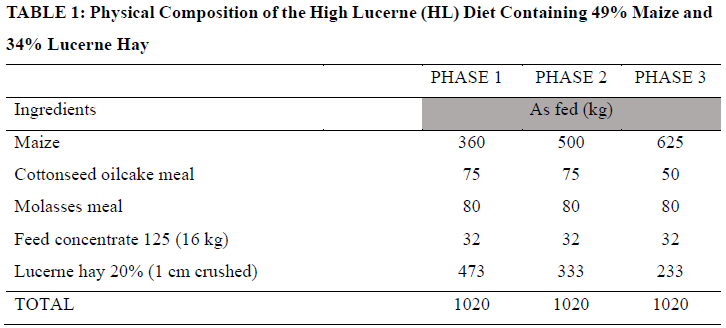
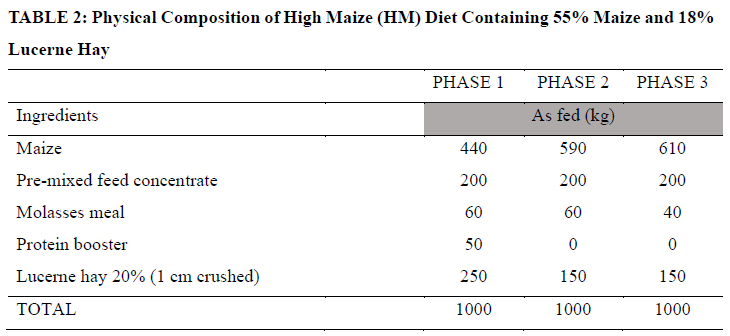
Research data were collected at a sheep feedlot located in the western region of the Free State province of South Africa. For this study, 484 Merino sheep were used. The 484 lambs were randomly divided into four groups based on initial weights in a four-way, completely randomised block design (Van de Vyver, Beukes, & Meeske, 2013). Van de Vyver et al. (2013) highlighted that the complete randomised design sampling technique allows the researcher to assign subjects to different treatment groups, which, in this instance, applies to the different feeding diets and weight groups used in this study. This method is particularly advantageous for experiments with a relatively significant number of treatments and units, such as this study. Randomised block design becomes inefficient if there is much variability among experimental units (stratified groups). Upon arrival at the feedlot, the animals were individually tagged, weighed, and sorted into two weight categories: heavy and light. The light and heavy groups' average weight per animal was approximately 25 kg and 35 kg, respectively. The heavy and light groups were sub-divided into two groups (four batches) to test two different feeds in both weight categories. Feeds differed concerning dietary ingredients. Feed with a higher maize level (HM) had 55% maize and 18% lucerne, while higher lucerne (HL) feed had less maize (49%) and almost double the amount of lucerne (34%). Heavy entry weight lambs (>34 kg) per feed were classified as HM1 and HL1, and light entry weight lambs (<26 kilograms) as HM2 and HL2. The four groups of lambs were placed in separate feeding pens where feeding took place ad libitum for 49 days. Lambs had free access to fresh feed and water daily. Each week's end, individual lamb weights were recorded to determine average daily gain (ADG). A feed conversion ratio (FCR) was calculated by dividing dry feed intake (DFI) by the ADG. Two days after being designated into groups, each animal was treated to prevent mortality among feeding groups. The lambs were fed formulated balanced diets, the physical compositions of which are shown in Tables 1 and 2.
A gross margin (GM) analysis was conducted to determine the effect of entry weight and variation in finishing diet on feedlot profitability. The GM analysis included the impact of weight and rations containing different levels of maize and lucerne hay. After completing the GM analysis, a sensitivity analysis was used to determine the GM per lamb at purchase and slaughter prices and the two diet components (maize and lucerne hay per ton). Average spot South African Future Exchange (SAFEX) maize and relative lucerne prices per ton of the past five years to date (20192023) were used in the sensitivity analysis. To determine feedlot profitability, market prices of feeder lambs as well as the A2/A3 carcass price of the past five years were also used to perform a sensitivity analysis of the GM of lambs entering the feedlot at different weight classes while consuming rations with variation in composition. Equation 1 was used to calculate the GM/lamb (Y):

Where:
Y= Gross margin (R)
A= Lamb purchase price (R)
B= Total income per lamb (R)
C=Feed cost/lamb over the period (R)
D=Labour/lamb over the period (R)
E= Medicinal cost/lamb over the period (R)
Equation 2 was used to calculate the lamb purchase price A (R):

Equation 3 was used to calculate the total income per lamb B (R):

Equation 4 was used to calculate the feeding cost C per lamb for the period:

Equation 5 was used to calculate the labour cost D:

3. RESULTS AND DISCUSSION
3.1. Weekly Lamb Growth
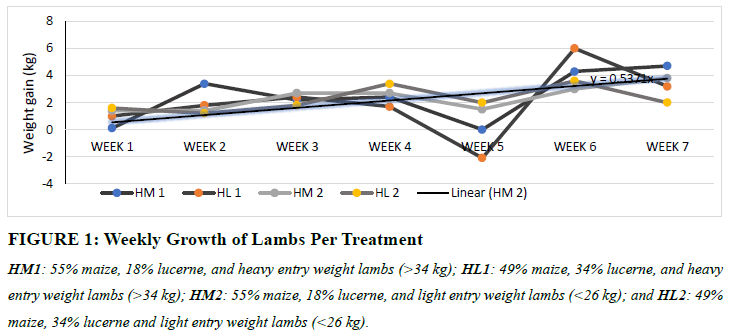
The growth rates of lambs were recorded weekly and are illustrated in Figure 1.
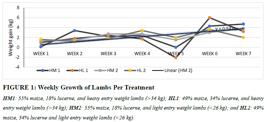
Weight gain patterns indicated that lambs weighing <26 kg gained an average of 1.3 kg compared to an increase of 1.7 kg by lambs weighing >34 kg. This validates that young lambs partition their daily feed intake towards skeletal and muscle development, while heavier or older lambs are nearing the end of their growth period and will partition most of their feed intake into body maintenance. Similarly, Brand, Van der Merwe, and Young (2017) found that initial body weight directly influences weight gain, and lambs that enter feedlots at a lower weight face adaptation and growth obstacles compared to lambs entering a higher weight. When plotting a (linear) line on the weekly growth chart, it was evident that lightweight lambs displayed a more linear growth pattern than heavy-weight lambs. A relatively consistent weight gain pattern per week among lightweight lambs in this study resembles the findings by Brand et al. (2001). Additionally, the HL1 group had the most fluctuating weekly weight gain pattern over the feeding period, with the most significant weight loss of 2.1 kg during the fifth week. At week five, lambs transitioned from phase 2 to phase 3 feeding, with phase 3 being the final finishing period during which wet weather conditions were experienced. Coetzee (2017) mentions that damp weather conditions with extremely high temperatures affect palatability and feed ration intake in feedlots, which is observed in this study. Moreover, slower growth and higher mortality rates prevail among younger or lighter lambs struggling to adapt to changed feeding patterns. This trend is specifically observed when lambs receive little to no pre-conditioning before being weaned and placed on a balanced diet in a feedlot setting. Overall, the highest total weight gained at the end of week seven was attained by the HM1 lambs (17 kg), recording a daily growth rate of 350 g per day while feeding on a ration containing more energy and lower roughage (55% maize and 18% lucerne hay). This group recorded the highest end weight and ADG at the end of the trial.
3.2. Lamb Feedlot Performance
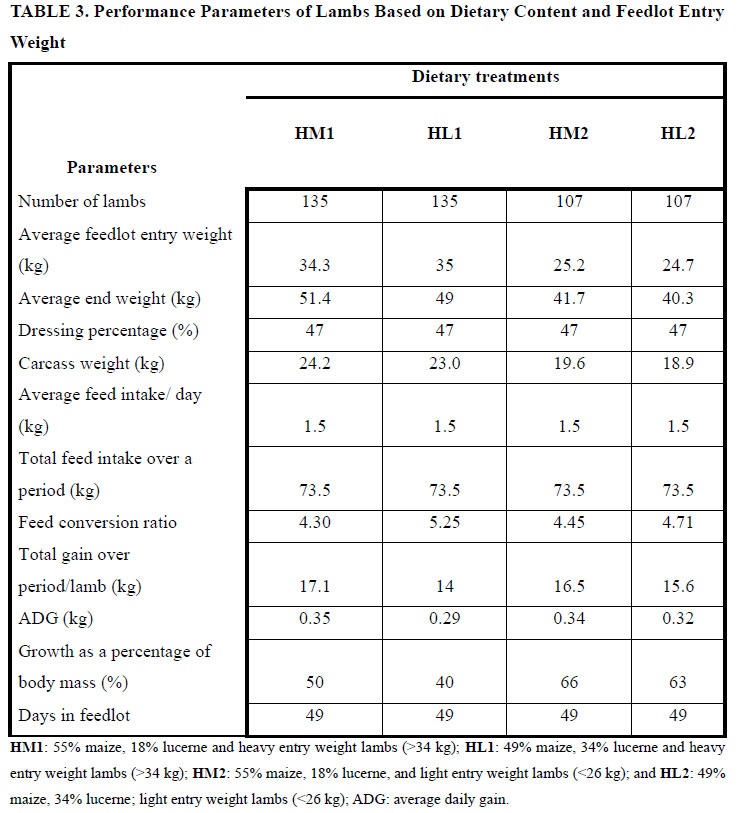
Management factors related to lamb performance characteristics in a feedlot include ADG, feed intake, FCR, and carcass yields (dressing percentage and carcass classification). The effect of these management factors on feedlot profitability was then investigated, and the results are given in Table 3.
A total of 486 lambs were used, and the average performance parameters were recorded throughout the entire feeding period. Lamb feedlot entry weight serves as a key contributor towards the efficacy of converting feed into carcass weight. It can indicate lamb performance and, ultimately, revenue generated per head. The first two groups (HM1 and HL1) were classified as heavy feedlot entry-weight lambs possessing an initial weight >33 kg (van der Merwe et al., 2020). Groups classified as light-entry weight lambs (HM2 and HL2) had an initial weight of <26 kg. Hue, Van, and Ledin (2008) indicated that it is paramount for feedlot managers to monitor the efficacy of lambs converting feed into body weight as it affects profits obtained. Increased FCR results in less revenue due to more feed consumption and less bodyweight gain for a heavier carcass. Thus, feed quality influences FCR, with animals receiving high-quality, balanced rations having lower FCRs than animals receiving inferior-quality feed. Regarding feed content, Feedipedia (2017) states that grains, particularly maize, have high levels of digestible energy (DE), which enhances body growth compared to roughage such as lucerne. The high grain (maize) content diets consumed by lambs in this study induce higher fat deposits on lamb carcasses. This emphasises that heavier feedlot lambs consuming feed rations with higher lucerne hay levels attain less weight over a given period.
In this study, lower weight gains by animals feeding on a high roughage diet correlate with the findings of Thomson et al. (2017). Moreover, there was a marginal difference in the ADG of lambs with the same dietary content (HM1 and HM2). Low-weight (HM2) and heavy-weight lambs (HM1) showed similar weight gains per day, emphasising the potential of lighter-weight lambs to convert feed to body weight efficiently. However, the ADG of lambs on the same diet of less maize and more roughage (HL1 and HL2) differed significantly. Lightweight lambs (<26 kg) showed more improved daily growth rates than heavy-weight lambs (>33 kg). A high daily growth rate indicates feed conversion efficiency, where animals convert input (feed) to output (live weight and profit).
3.3. Feedlot GM/Lamb
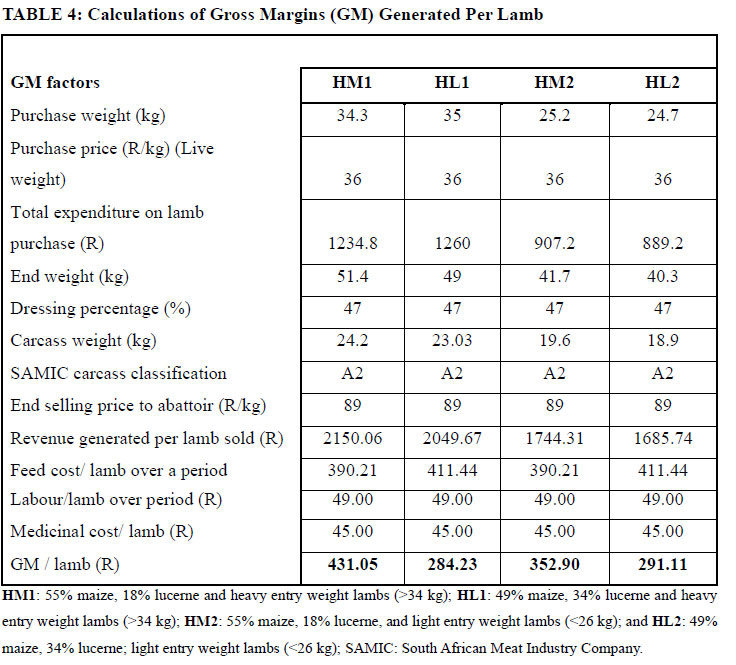
Gross margins are paramount to the financial sustainability of feedlots. Results of a GM analysis per feedlot entry weight and feeding ratio consumed are given in Table 4.
Feedlot performance indicators were used to calculate allocatable cost factors to assess the financial effect of initial feedlot entry weight and variation in dietary content. The monetary value spent on lambs upon purchase and the profitability of lambs have a linear relationship with a significant contribution from feedlot performance. Lighter animals fattened to meet market requirements are fed in feedlots to exploit these animals' rapid growth and favourable feed conversion. For this study, purchasing lambs with a heavier weight (>33 kg) contributed 71%-72% of the total costs. When lighter-weight lambs are purchased, purchase costs amount to 63%-65% of the overall costs to get lambs market-ready. In line with Ford (2011), relatively lower amounts are spent purchasing lighter lambs than heavier lambs for feedlot finishing. One of the aims of feed lotting is to buy animals with low body weights to produce carcasses with a higher value through cost-effective feeding (van der Merwe et al, 2020). For the HM1 and HL1 groups, feed cost contributed approximately 23% of the total cost. Within the HM2 and HL2 groups, feed cost contributed 28% and 30% towards the overall cost, respectively. Feeding rations with 49% maize and 34% lucerne resulted in increased feed cost per lamb compared to higher maize (55%) and a lower (18%) lucerne feed. The HM1 and HM2 lambs fed with higher maize levels had improved weight gains than those fed with higher lucerne levels within the respective weight categories. Overall, the highest GM was generated by feeding lambs with a higher maize content. The HM1 and HM2 groups generated GMs of R431.05 and R352.90 per sheep, respectively. Increasing the lucerne hay level and decreasing the maize content in feed rations resulted in a lower GM/lamb, irrespective of the initial entry weight. The decrease in GM associated with HL rations is subject to less body growth and the cost of the ration. Feeding with a 55% maize and 18% lucerne hay ration costs R390.21 per lamb while feeding a 49% maize and 34% lucerne hay ration costs R411.44 per lamb. Feeding the HL ration costs R21.23 more per lamb than the HM ration. When rations with higher lucerne hay levels are used, a management decision might be to feed lambs entering a feedlot with a lighter initial body weight. By doing that, higher GM is generated compared to feeding lambs with heavy bodyweights upon entering a feedlot. With an already higher feed cost, the HL ration should rather be fed to lambs weighing <26 kg than lambs with entry weights >34 kg. The dietary composition of feed contributes to profitability; thus, the market prices of the main ration ingredients must be considered.
3.4. The Effect of Fluctuations in Market Prices of Maize and Lucerne on Feedlot Profitability
Sensitivity analyses were conducted because feed costs were strongly dependent on the cost of the raw materials as they contributed to the feed conversion efficiency of lambs. Given the large maize and lucerne component in feedlot diets, feed costs are a direct function of the maize and lucerne price, subject to volatility. Besides the high feed cost (economic factor), management and support factors are essential in controlling feedlots' animal performance and financial outcomes. Average spot SAFEX maize and lucerne prices per ton used in the sensitivity analysis will enable feedlots to project the GM needed at various market prices of maize and lucerne hay so that effective management decisions can be made on optimal lamb feedlot entry weights as well as feed rations used during finishing.
3.4.1. Sensitivity Analysis on GMS at Maize and Lucerne Market Prices (Per Ton)
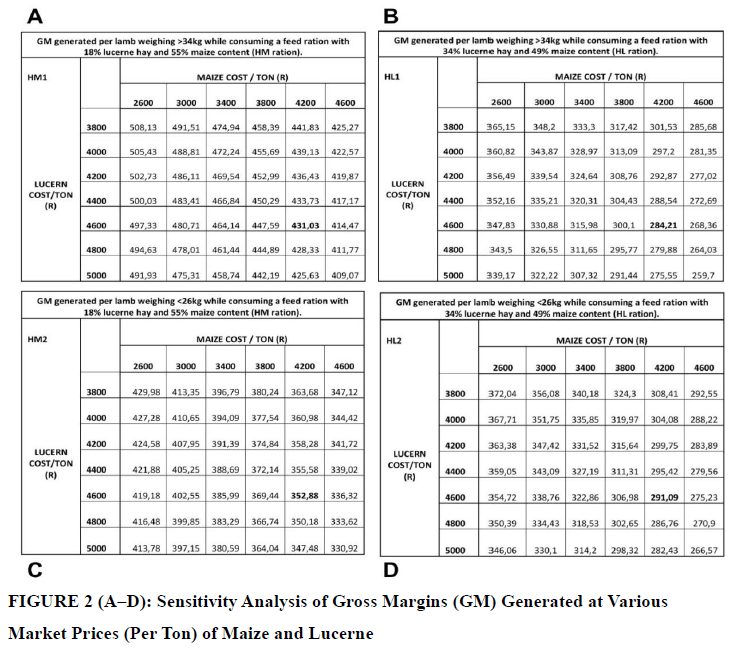
The sensitivity analysis of GM generated at various market prices (per ton) of maize and lucerne is given in Figure 2. Maize and lucerne are included in the ration cost, mainly when the ingredients are scarce. Li, Kebreab, and You (2022) stated that ration components' costs influenced ration cost and profitability and are, therefore, an outcome of ration cost and conversion to body weight. Higher feed costs can result from dietary content in feed rations. When the main components are scarce, a higher demand increases market and feed prices with lower profit margins. Management might include considering alternative rations that still yield positive financial results.
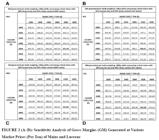
This study shows that the most financially efficient feedlot management strategy uses maize and lucerne as primary dietary components for heavier lambs and contains less legume hay or lucerne levels; the finding aligns with that of Que et al.(2019). Irrespective of the market prices of lucerne and maize, feeding heavier entry-weight lambs on a ration containing 34% lucerne hay and 49% maize is the least effective management strategy, as lower GMs are generated than lighter-weight lambs. When feeding the HL ration, managers should consider purchasing lightweight lambs (<26 kg), which will yield increased financial returns compared to feeding the same ration to heavyweight lambs (>35 kg) (Figure 2B). The lowest GM is generated at maize and lucerne market prices per ton when the lamb is >34 kg (Figure 2B) while consuming 49% maize and a 34% lucerne hay ration. An average increase of 54% in the market price (from the lowest to the highest) for both maize and lucerne prices results in approximately 30% decrease in GM per lamb of >34 kg when feeding the HL ration instead of the HM ration. These significant decreases in GM are factors to consider when deciding on optimal feeding rations and weight classes for finishing lambs.
Figure 2 (B, C, and D) shows that lighter entry-weight lambs generate higher GMs when consuming the HM ration than lambs of both weight classes consuming the HL ration. Mupfiga et al. (2019) mentioned that under ideal feedlot circumstances, lambs' initial body weight while being fed balanced feeds contributes to an increase in profit. The price volatility of feed cost introduces a market scenario where economic factors influence maize and lucerne prices to trade at higher prices of R4600 and R5000 per ton, respectively. The potential GM generated is influenced by an average increase of approximately 53% for these two main components in feedlot diets. Thus, feeding the HL ration to light-entry-weight lambs allows feedlots to generate 4% more in GM than feeding the same ration to heavier entry-weight lambs (Figure 2 B and C). With product price fluctuations, feedlots must predict potential GMs when feeding rations that contain maize and lucerne hay as primary components to lambs of various weight classes. Producers should consider the optimal weight of the lambs that should enter feedlots to ensure financial returns while considering the market price and availability of maize and lucerne hay. In addition, lambs' purchase and carcass prices directly influence feedlot profitability and optimal feeding weights must be determined to maximise profit at various prices.
3.4.2. Sensitivity Analysis of GMS for Various Feeder Lamb and Carcass Prices (R/Kg)
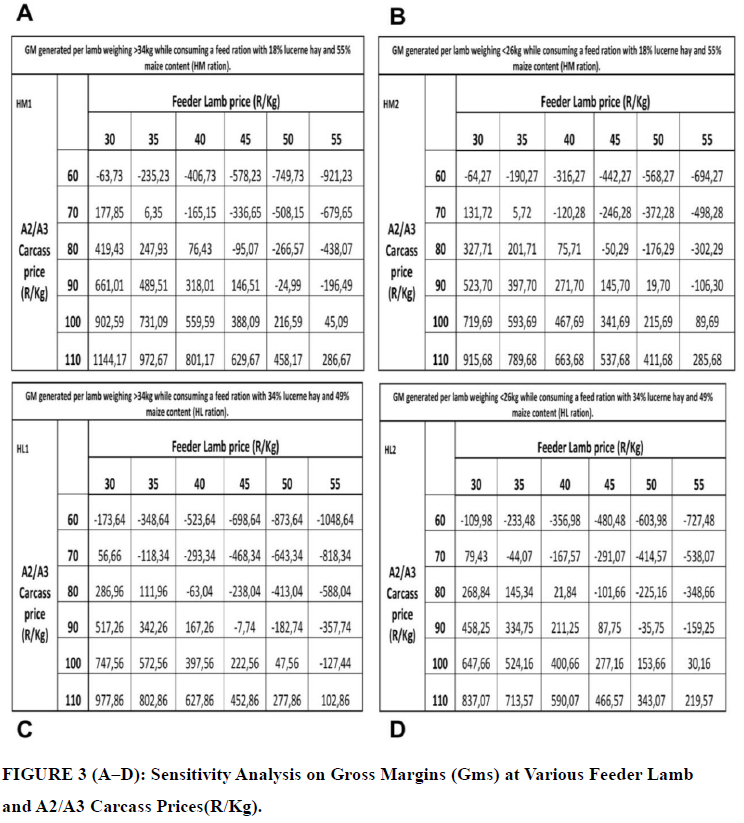
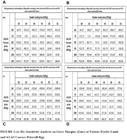
As a key contributor to the variable input cost in intensive feeding systems, feeder lamb prices experience constant fluctuations, influenced by demand and supply factors such as drought and disease outbreaks (Theron et al., 2023). Therefore, producers must manage the optimal weight at which lambs are purchased and fed to maximise profit amid market fluctuations. Fourie and Matli (2014) emphasised management and extension support systems for feedlot producers in South Africa, who need to adapt to changes in live purchase (per kg) and carcass price (per kg) for profitability. The results of this study indicate (Figure 3) that it is not financially viable to feed the HM or HL rations to lambs weighing either <26 kg or >34 kg, as negative GMs are generated when the carcass price is R60/kg per A2/A3 irrespective of the feeder lamb price per kg. These findings align with van der Merwe et al. (2020) findings. Positive GMs are observed (Figure 3A) when carcass prices increased to R70/kg while purchase prices traded at R30/kg. The highest GM in this scenario is generated by HM1, with the lowest GMs presented by the HL1 group. Purchasing lambs that enter the feedlot at a heavier weight while consuming the HM ration would be an improved management decision where positive returns per lamb will be obtained. Importantly, when the purchase price increased to R50/kg and the carcass price traded at R90/kg, feedlot producers should purchase lighter lambs (<26 kg) to feed the HM ration compared to feeding heavier lambs or opting for the HL, where negative GMs are yielded. A contributing factor is the relatively high purchase price of R50/kg (Theron, Brand, Cloete, Van Zyl & Strydom, 2023). Hence, the variable input cost increases, especially when heavier lambs are being purchased. Once the carcass price increases to R110/kg, and the feeder lamb price remains at R50-R55/kg, decisions should be adjusted by managers where heavier lambs should be purchased and fed with the HM ration, compared feeding lighter lambs or the HL ration. Increased carcass prices at slaughter, in this instance, compensate for the high purchase price, which ultimately generates positive GMs (Figure 3). Based on the findings in the sensitivity analysis, it is evident that in cases where external factors influence the market prices of feeder lambs as well as the A2/A3 carcass prices, management and extension support should be applied where the most effective ration (HM or HL) is fed to lambs purchased at optimal live weights for financial efficiency.
4. CONCLUSION AND RECOMMENDATIONS
4.1. Conclusion
Management of feedlots involves minimising the high input and capital costs of intensive systems, which decreases the risk of low profitability. Lamb entry weight and feed costs have a significant influence on feedlot profitability. In the context of profitability, this research concludes that the highest GM is generated by lambs possessing heavy entry weights while feeding on a higher grain and lower roughage content (55% maize and 18% lucerne hay). Lower GMs are generated when lambs feed on a ration with lower maize and higher lucerne hay content (49% maize and 34% lucerne hay), irrespective of the initial feedlot entry weight. Importantly, even lower entry-weight lambs generate a higher GM when feeding on a higher grain and lower roughage ratio. Considering the performance of lambs on feeding rations, the cost of the HM ration was relatively lower than the HL ration with lower maize and higher lucerne hay content (49% maize and 34% lucerne hay). When producers consider a feeding ration with a lower maize and a higher roughage content (49% maize and 34% lucerne hay), lambs with a light entry weight of <26 kg should be bought compared to heavy entry weight lambs (>33 kg). During price market volatility of lambs and feedlot diet components (maize and lucerne hay), precision feeding management decisions should be implemented to minimise negative GMs when market prices are unfavourable. With a low margin above lamb and feed price, managing the feed cost per lamb is necessary to ensure financial viability. Ultimately, management of input price sensitivity allows producers to adapt to volatile prices to be financially viable.
4.2. Extension Implications and Recommendations
Extension authorities should emphasise management practices in feedlots during drought, disease outbreaks such as Foot and Mouth Disease (FMD), and changes in governmental policies (animal transportation). These external factors directly influence the market prices of lambs, the dietary components of lambs in feedlots, and the subsequent profitability. Extension support for producers is paramount because livestock and feed prices are volatile. Producers should be assisted with precision management strategies where knowledge of optimal animal feedlot entry weights and efficient feeding rations should be conveyed to increase South African feedlots' financial sustainability. It is recommended that adaptation and resilience strategies of feedlots to market price fluctuations be investigated. This would determine whether South African feedlots and other value chain role-players are adaptable and resilient to extreme market price volatility. This would benefit from improved decision-making and adaptation techniques of feedlots to ensure continuous profitability in turbulent markets. Furthermore, it is recommended to explore different breeds with various maturing timelines, as this study used a singular Merino-type breed. A multi-breed research study would indicate various performance and financial outcomes from lambs, which could be used to devise different approaches to management and decision-making.
REFERENCES
- AYELE, S., URGE, M., ANUMUT, G. & YUSUF, M., 2019. Comparative slaughter performance and carcass quality of three Ethiopian fat-tailed hair sheep breeds supplemented with two levels of concentrate. Trop. Anim. He Prod., 51: 187-198.
- BUREAU OF FOOD AND AGRICULTURAL POLICY (BFAP)., 2014. BFAP Baseline Agricultural Outlook 2014-2023. Pretoria, South Africa.
- BRAND, T.S., VAN DER MERWE, G.D. & YOUNG, D., 2001. Full-fat canola as protein source in diets for finishing lambs. Small Rumin. Res., 41: 235-238.
- BRAND, T.S., VAN DER WESTHUIZEN, E.J., VAN DER MERWE, D.J. & HOFFMAN, L.C., 2017. Effect of days in feedlot on growth performance and carcass characteristics of Merino, South African Mutton Merino and Dorper lambs. S. Afr. J. Anim. Sci., 47(1): 27-33.
- CLAASEN, B., 2008. The effect of agricultural production system on the meat quality of Dorper lambs. Masters thesis, University of Stellenbosch, South Africa.
- COETZEE, J., 2017. Die Winsgewende Skaapboer. Stellenbosch: Jasper Coetzee Consulting.
- DU TOIT, R., 2017. The influence of R-Salbutamol on feedlot performance, carcass characteristics and meat quality in Dorper ram, wether and ewe lambs. Masters thesis, University of Stellenbosch, South Africa.
-
FOOD AND AGRICULTURE STATISTICS (FAOSTAT)., 2019. Available from http://www.fao.org/faostat/en/#data/RL.
» http://www.fao.org/faostat/en/#data/RL -
FEEDIPEDIA., 2017. Animal Feed Resources Information System. Available from https://www.feedipedia.org/.
» https://www.feedipedia.org/ - FORD, D., 2011. (As referenced by Oosthuizen, P. L. 2016) Lecture presented on Feedlot Industry Overview on 5 May 2011 for fourth-year Animal Science students. Department of Animal Science: University of Pretoria, Pretoria, South Africa.
- FOURIE, P.J. & MATLI, K.P.S., 2014. Promoting profitability and sustainability in the backgrounding of beef calves: the role of agricultural extension. Afr. J. Agric. Ext., 42(2): 115 - 126.
- HUE, K.T., VAN, D.T.T. & LEDIN, I., 2008. Effect of supplementing urea treated rice straw and molasses with different forage species on the performance of lambs. Small Rumin. Res., 78: 134-143.
- LI, J., KEBREAB, E. & YOU, F., 2022. The application of nonlinear programming on ration formulation for dairy cattle. J. Dairy Sci., 105(3): 1-10.
- MUPFIGA, S., CHENAIMOY, O. & KATIYATIYA, F., 2019. Meat production, feed and water efficiencies of selected South African sheep breeds. Small Rumin. Res., 214: 1-8.
- QUE, J., HSIAO, E.J., DEPETERS, D., ZACCARIA, R.L. & FADEL, J.G., 2019. A goal programming approach for balancing diet costs and feed water use under different environmental conditions. J. Dairy Sci., 102: 11504-11522.
- SPIES, D.S., 2011. Analysis and quantification of the South African red meat value chain. Doctoral dissertation, University of the Free State.
- THERON, P.G., BRAND, T.S., CLOETE, S.W.P., VAN ZYL, J.H.C. & STRYDOM, PE., 2023. Slaughter and carcass characteristics of cross- and purebred lambs finished in a pasture-based system. S. Afr. J. Anim. Sci, 53(3): 385-395.
- THOMSON, L., HUMPHRIES, D.J., KLIEM, K. I., DITTMANN, M.T. & REYNOLDS, C.K., 2017. Effects of replacing maize silage with lucerne silage and lucerne silage chop length on rumen function and milk fatty acid composition. S. Afr. J. Anim. Sci., 100: 7127-7138.
- TERBLANCHE, S., 2013. An economic analysis of an intensive sheep production system on cultivated pastures in South Africa, incorporating creep feeding- and accelerated breeding practices. Masters thesis, Nelson Mandela Metropolitan University, South Africa.
- VAN DER MERWE, D.A., BRAND T.S. & HOFFMAN L.C., 2020. Premium lamb production of South African sheep breed types under feedlot conditions. S. Afr. J. Anim. Sci., 50(4): 109-119.
- VAN DE VYVER, W.F.J., BEUKES, J.A. & MEESKE, R. 2013. Maize silage as a finisher feed for Merino lambs. S. Afr. J. Anim. Sci., 43(1): 112-115.
- WILDEUS, S.J., 2007. Growth, intake, diet digestibility, and nitrogen use in three hair sheep breeds fed alfalfa hay. Small Rumin. Res., 69(3): 65-72.