Fish Traders' Specifications for Buying Mozambique Tilapia (Oreochromis Mossambicus) Fish in Three Districts (Capricorn, Sekhukhune and Vhembe) of Limpopo Province
Abstract
It is believed that an increase in the market for freshwater aquaculture tilapia in South Africa can help to alleviate poverty and create employment opportunities. Previous studies focused to some extent on tilapia production (Phosa & Lethoko, 2018; Hlongwane, 2021; Moyo & Rapatsa, 2021). This study aimed to make a scientific contribution by exploring fish traders' specifications for buying tilapia fish using a demand and supply theory. A qualitative approach was used in the study to achieve the research objectives, and the data were analysed using a thematic analysis. Cronbach's alpha values were used to determine the reliability and validity of the data collection instrument. The study results showed that fish traders purchase frozen hake, followed by Mozambique tilapia (Oreochromis mossambicus), from fishermen on a weekly basis. This implies that there is no connection between fish traders and local fish farmers. The reason for buying from fishermen could be that the local farmers sell fresh fish, and that formal fish traders (retailers and supermarkets) prefer to purchase medium-sized frozen fish. While the findings provide valuable insights, the small sample size and regional focus limit generalisability. Formal fish traders (retailers and supermarkets) should approach local farmers to cover unsatisfied demand. This should be done through extension officers allocated to fish farmers. The reluctance of farmers to engage with traders may be linked to historical mistrust or a lack of support from agricultural extension services. Bridging this gap through training programmes or intermediaries could improve collaboration.
Demand and Supply; Fish Traders; Limpopo Province; O. Mossambicus; Specification
1. INTRODUCTION
Globally, tilapia has an active demand in both the food service and retail sectors (Food and Agriculture Organisation [FAO], 2022). Therefore, tilapia's reputation in tropical countries does not require serious promotion; the fish is satisfactorily supplied and is generally considered an enjoyable freshwater fish (FAO, 2014; Tapela, Britz & Rouhani, 2015). In China, the Republic of Korea, and Japan, demand exceeds supply. However, the shortage is more pronounced for large tilapia fillets, as producers had to harvest earlier than planned (FAO, 2022). Harvesting earlier may compromise the requirements of fish as needed by fish traders. Globally, regions such as Asia and Africa have a significant demand for tilapia due to its affordability and high protein value. However, in South Africa, the reliance on imports despite local production potential creates a unique market challenge (FAO, 2022).
In South Africa, domestic tilapia production falls short of meeting market demand, resulting in 85% of the supply being imported (Department of Agriculture, Forestry and Fisheries (DAFF), 2014) from other countries, such as China and the United States of America (USA), to fulfill market requirements. Despite the availability of over 300 registered inland dams for tilapia production in South Africa, 85% of tilapia is imported, mainly owing to local producers failing to meet formal market specifications (DAFF, 2014; Britz, 2015). The reliance on imports suggests a competitive disadvantage for local farmers, driven by factors such as inconsistent quality and limited production volumes. Addressing these issues could reduce the market's dependence on imports. The problem is that an adequate supply of quality tilapia stocks is not always available; the availability in supermarkets is limited (Van Rooyen, 2013; IDC, 2015; DAFF, 2018). This is a problem because fish traders rely on imports for trading tilapia instead of buying from local tilapia farmers. This paper reports on a study that aimed to understand fish traders' preferences regarding the size, form (e.g., frozen, fresh), and quality of Mozambique tilapia in Limpopo Province, and to utilise the findings to develop actionable recommendations for enhancing the supply chain between local farmers and formal fish markets. In South Africa, retailers play a significant role in actively marketing and expanding their range of fresh fish, as they are stimulating and addressing growing customer awareness and receptiveness to consuming fish (Britz, 2016). Britz (2016) reports that in-store promotion of fresh fish and making stock available of new products is complemented by its own branded, food-related magazine, customer involvement on social media platforms, consumer educational events, and presentations at customer-focused lifestyle and food expos. These strategies could increase tilapia consumption. The research carried out by Britz, Hara, Weyl, Tapela and Rouhani (2015) discovered that the Western Cape Department of Agriculture commissioned a project to evaluate the potential for semi-commercial or commercial fishing on public dams with a view to targeting the West African expatriate market for freshwater fish. This followed a realisation that a growing number of African countries' shops in cities such as Cape Town specialise in stocking food for foreigners from other African countries, including frozen, dried, or smoked fish (mostly tilapia) imported from other countries. This means that, in different African countries, the consumption of tilapia is much higher than in South Africa, and that it is a potential market for South African tilapia. Maebane, Manchidi and Chiloane-Phetla (2022) revealed the local, national, and export market potential for raw and processed tilapia products, which in turn affects the volumes of the product.
Many fish traders, namely, supermarkets, operate in malls in townships near tilapia farmers. If supermarkets were to buy from local farmers, this would improve the livelihoods of farmers and people in the surrounding communities. Tilapia is a cheap protein source and meets food security (Omeje, 2016). Smallholder farmers in South Africa are recognized as key contributors to rural development; however, their limited ability to access formal fish markets restricts their economic impact (Pienaar & Traub, 2015). Smallholding in aquaculture contributes to poverty reduction both directly and indirectly, particularly for rural communities, enhancing livelihoods, food security, and poverty reduction through mechanisms such as income generation, employment, and diversified farming practices (Asif et al., 2015; Bene, Arthur, & Norbury, 2016). Therefore, smallholder farms may contribute to employment creation, particularly in South Africa, where the unemployment rate increased by 1 percentage point from 37% to 38% between the fourth quarter of 2018 and the first quarter of 2019 (Statistics South Africa, 2019).
There is no link between small-scale farmers and retail outlets in Limpopo Province to support localisation (Limpopo Developmental Plan [LDP], 2021). Fincham (2013) and DAFF (2014) report that most farmers sell tilapia off their farms, to farm stalls and informal fish traders. Similarly, Tapela et al. (2015) found that farmers in Limpopo rely on informal markets along roadsides, at road intersections and within local communities. Limpopo, South Africa's northernmost province, borders Mozambique, Zimbabwe and Botswana. It also borders the Mpumalanga, Gauteng and North West provinces (LDP, 2021).
Limpopo ranks fifth in South Africa in both surface area and population, covering an area of 125 754 and being home to a population of 5 779 090 (LDP, 2021). The capital city is Polokwane (previously Pietersburg). Other major cities and towns include Bela-Bela (Warmbad), Lephalale (Ellisras), Makhado (Louis Trichardt), Musina (Messina), Thabazimbi and Tzaneen. Limpopo is divided into five district municipalities (Capricorn, Mopani, Sekhukhune, Vhembe and Waterberg), which are further subdivided into 22 local municipalities (LDP, 2021).
Limpopo Province shares international borders with the districts and provinces of three other countries: Botswana's central districts to the west and northwest, Zimbabwe's Matabeleland provinces to the north and northeast, and Mozambique's Gaza Province to the east of the province (LDP, 2021).
Limpopo Province is the primary link between South Africa and countries further afield in sub-Saharan Africa. On its southern flank, from east to west, the province shares borders with other South African provinces, namely, Mpumalanga, Gauteng, and North West (LDP, 2021). The N1 national highway is key to the Pretoria-Johannesburg urban complex.
This section reviews previous studies to illustrate the gap that this research fills. It begins with the background, followed by an overview of tilapia fish traders and a review of previous studies on tilapia fish traders.
2.1. Background
The theory of demand and supply is useful in explaining how prices and quantity traded are determined (Eastin & Arbogast, 2011; Mohr, Fourie & Associates, 2015). Demand refers to the volumes of a product or service that future customers are prepared to purchase at a given price over a specified period of time (Mohr et al, 2015). Conversely, supply refers to the willingness of sellers to offer a given quantity of goods or services for a given price per period (Eastin & Arbogast, 2011; Mohr et al., 2015). The volumes required in the market typically depend on the product price, which in turn depends on the average total cost, directly related to the supply quantity (Levi, Sabuco, & Sanjuan, 2018). The study applies demand and supply theory to analyse how trader preferences influence purchasing patterns and market dynamics.
2.2. Fish Traders of Tilapia
In South Africa, the fish market is shared by formal markets (restaurants and retail stores) and informal markets (spaza shops, fish markets and roadside markets) (Oyeleke, 2017). In South Africa and the Southern African Development Community (SADC), the informal sector is primarily used for the sale and purchase of food (Hara, Greenberg, Thow, Chimatiro & Du Toit, 2017). The sales include cross-border buying and selling of fish, which is dominated by small-scale traders, many of whom are women (Hara et al., 2017). A study by Hara et al. (2017) argues that the informal sector ensures that food arrives at most people in the correct state, form and price. The informal market is beneficial for selling small tilapia weighing between 150 and 300 grams (James, 2016). In the formal market, the low production of tilapia is considered a reason for the limited trading of this freshwater fish species (Oyeleke, 2017).
In South Africa, retailers play an important part in actively marketing and increasing their range of fresh fish. They stimulate and address growing awareness of customers and receptiveness to consuming fish (Britz, 2016). The latter scholar further reports that own brands, food-related magazines, customer involvement on social media platforms, consumer educational events and presentations at customer-focused lifestyle and food expos complement in-store promotion of fresh fish and making stock of new products available. These strategies could, therefore, increase tilapia consumption.
Britz (2016) maintains that the fresh product is well accepted in affluent sectors of market retail stores and businesses selling food. Market access is restricted by the size of the sector and low quantities, averaging less than 10 tons per producer. Achieving a market-related price would require significantly larger quantities and competitive advantages, such as value-added products, freshness, sustainability, certification, and quality. Fish traders in local communities are the most significant market, as the industry's low production cannot satisfy the requirements of formal markets (Van Rooyen, 2013; Industrial Development Corporation [IDC], 2015). A market would not exist for the fish if the volume supplied was insufficient, and the farmers would not increase production unless the market demand existed. Some supermarkets do stock tilapia but because an adequate supply of quality stock is not always available, the availability in supermarkets is limited (Van Rooyen, 2013).
Kahan (2012) contends that unsupportive laws and regulation (banking legislations, land tenure and ownership, trading rules, tax legislation and business legislations) are a few of the most usual constraints that support or hinder the growth of prosperous smallholder farms. Operation Phakisa (2014) found that the present rules and the manner of governing do not consider the aquaculture sector, and that there is slow and expensive implementation. The sector views bureaucracy as a hindering factor (Operation Phakisa, 2014). Moreover, Britz (2015) stresses that the Marine Living Resources Act (Act 13 of 1998) provided guidance on marine fishery reform, whereas the primary environmental acts controlling inland aquatic resources (the National Environmental Management Act, Act 107 of 1998; and the National Water Act, Act 36 of 1998) are quiet on inland fisheries. Only the overall principles for resource utilisation flowing from the importance of the Constitution and internationally acceptable standards for environmentally pleasant governance are made available.
The primary environmental Acts controlling inland aquatic resources (the National Environmental Management Act 107 of 1998, and the National Water Act 36 of 1998) are silent on inland fisheries. On 25 February 2022, the National Freshwater (Inland) Wild Capture Fisheries' Policy was gazetted (Republic of South Africa [RSA], 2022). The policy seeks to formalise the currently informal and unrecognised activities of small-scale fisheries and will provide an efficient regulatory regime for the inland fisheries sector. This is a welcome shift t and access rights, which includes the livelihoods, access rights, and recognition of inland fishers in the management of dams. It remains unclear who will be responsible for implementing this policy and to what extent the provincial departments will play a role in the implementation of the policy (Isaacs et al., 2022). It is unclear whether implementing the policy would confuse small-scale tilapia farmers and their decisions to produce more tilapia or increase their ponds. Despite that, information about the requirements of fish traders when buying tilapia could put tilapia farmers at ease.
2.3. Trader Specification
Asmah (2008) found that out of 90 outlets interviewed in Ghana, 83% had tilapia on their menu, serving it grilled, boiled or fried. Of these, 47% were restaurants, 22% were tilapia joints, and 31% were chop bars. More than 83% of the dealers interviewed bought their fish fresh. Of these, 79% sold it fresh, 5% fried, 2% grilled, another 2% salted and dried, 4% smoked, and the rest, 8%, sold it in various processed forms. Of the 17% that bought processed tilapia, the majority (93%) bought it salted or dried, 5% smoked, and 2% other processed forms, such as fried or fermented. Therefore, many customers evidently prefer fresh tilapia. Globally, FAO (2010) found that, of the fish destined for direct human consumption, live or fresh fish was the most preferred product, with a share of 49%, followed by frozen fish (25%), prepared or preserved fish (15%) and cured fish (11%). In South Africa, the IDC (2015) and DAFF (2018) found that fresh and frozen tilapia are preferred for consumption. Furthermore, Ogello, Outa and Ouma (2021) reveal that 57% of the fish traders sold imported fish, 27% from capture fisheries, while 16% sold fish from aquaculture facilities. This implies that the local production does not satisfy the demand.
2.4. Previous Studies on Tilapia Fish Traders
FAO (2022) found that the USA imports frozen tilapia. Furthermore, there is a huge unmet demand for local fresh fish, which is currently being met by imported frozen tilapia from China (Awuor et al., 2019; FAO, 2022). Bwanamudogo et al (2022) reveal that tilapia is frozen in most supermarkets in Malawi. Ogello et al. (2021) conducted a study to determine the socioeconomic effects of imported tilapia on the local fish market and value chain in Kisumu, Kenya. They revealed that 57% of the fish traders sell imported fish, 27% from capture fisheries, while 16% sell fish from aquaculture facilities. About 46% of the respondents have gained direct employment and improved socio-economic status owing to the imported fish, and 90% are women and young girls who are directly engaged in fish value addition and marketing. However, 51% of the respondents reported job losses and degraded socio-economic status owing to declining aquaculture and fishing activities, attributed to imported fish (Ogello et al., 2021). Although imports help meet a demand for tilapia in the country, people's livelihoods are compromised, especially in the communities where tilapia is produced and sold. The IDC (2015) investigated the potential of tilapia to be produced, processed, and exported to the southern African market. In 2013, the IDC (2015) determined that the local demand for tilapia in South Africa equalled 1491 tons, while local production satisfied 187 tons of this local demand (total output of 234 tons less 47 tons of exports), with imports satisfying 1304 tons. This implies that South African tilapia production does not meet local demand. Previous studies have explored tilapia production but have not adequately addressed trader-specific preferences, leaving a gap in understanding the market linkage between local farmers and formal retailers. Accordingly, this study bridges this gap by investigating the specifications of fish traders in Limpopo Province, providing insights that could enhance local market participation.
3. AIM AND OBJECTIVE OF THE RESEARCH
The primary objective of the study was to investigate and understand fish traders' preferences regarding size, form (e.g., frozen, fresh, and quality of Mozambique tilapia in Limpopo Province), to use the findings to develop actionable recommendations for enhancing the supply chain between local farmers and formal fish markets' purchasing decisions. The secondary objectives were formulated as follows: to apply demand and supply theory to analyse the factors influencing fish traders' purchasing decisions; to investigate region-specific factors influencing tilapia trade in Limpopo Province, considering its socio-economic and geographic context; and to explore how aligning fish traders' demands with local production capabilities could contribute to rural livelihoods and food security
The study made suggestions to assist formal fish traders (retailers and supermarkets) in understanding the requirements of the O. mossambicus industry. It developed recommendations to improve the trading of tilapia effectively. New entrepreneurial ventures and other stakeholders could benefit from this study before engaging with the Mozambique tilapia market or undertaking activities in agriculture. Policymakers and agricultural agencies can use these findings to design targeted interventions, such as value chain and fish farmer-trader communication networks. Lastly, this study can be utilised by business consultants to advise emerging fish traders before they start businesses in Mozambique tilapia trading. Demand for the O. mossambicus and specification for selling it could play a role in smallholder growth and poverty reduction. It contributes to the body of knowledge on freshwater aquaculture development in a developing economy that will contribute to meaningful job creation, food security, a sustainable and competitive sector, rural development and transformation in the country. The study further contributes significantly to demand and supply theory by examining fish traders' specifications for buying tilapia in the developing country of South Africa.
5. RESEARCH METHODOLOGY
For qualitative primary data collection, a semi-structured questionnaire was used with a few open-ended questions to guide further discussions during face-to-face interviews with the retailers, supermarkets, fresh produce market (FPM) and informal fish traders in Limpopo Province. Qualitative business research is referred to as research that addresses business objectives using techniques that allow the researcher to provide elaborate interpretations of market phenomena without depending on numerical measures (Zikmund, Babin, Carr, & Griffin, 2013). Qualitative research was useful in identifying the specifications for purchasing fish (the O. mossambicus). Interviews can be highly structured, semi-structured, open, and unstructured (Knott, Rao, Summers & Teeger, 2022). The decision to use one rather than another depends on the following:
• The researcher's knowledge and familiarity with the topic.
• The purpose of the interview (e.g., whether to confirm assumptions or collect new information).
• The nature and sensitivity of the topic (e.g., an individual's personal medical history).
• The actual respondent(s) (e.g., individuals who are victims of crime).
• The setting (e.g., a busy shopping centre) and
• The relation between the interviewer and interviewee (e.g., a psychologist and a patient).
The researcher used a semi-structured interview based on the setting to obtain participants' views and perceptions on specifications for buying tilapia. A semi-structured questionnaire is difficult to conduct, especially with retail managers, since they thought the researcher was an auditor or competitor checking their prices, products, and quality. It is time-consuming to sit down with respondents and conduct an open-ended interview. A semi-structured questionnaire could have been distributed through email for retail managers to read prior to the interviews.
Snowball was used to find out about stores that sell tilapia. Snowball sampling can be a useful way to research people with specific traits that might otherwise be difficult to identify, such as retailers. A total of 24 stores were identified. The following stores were identified for the first interviews: retailer, Polokwane (Capricorn District), supermarket, Polokwane (Capricorn District), and fresh produce market, Polokwane (Capricorn District). Then others followed; namely, supermarket, Polokwane (Capricorn District), fish & chips, Polokwane (Capricorn District), retailer, Tubatse (Sekhukhune District), supermarket, Tubatse (Sekhukhune District), supermarket, Tubatse (Sekhukhune District), supermarket, Seshego, Polokwane (Capricorn District), supermarket, Polokwane (Capricorn District), supermarket, Polokwane (Capricorn District), retailer, Thulamela (Vhembe District), retailer, Lebowakgomo (Capricorn District), informal fish trader (Capricorn district), informal fish trader, Phetwane (Sekhukhune District), informal fish trader (Capricorn District), informal fish trader, Polokwane (Capricorn District), supermarket, Seshego (Capricorn District) and fish food specialists (Limpopo, Gauteng and North West provinces). No traders from Mopani and Waterberg were interviewed. This was because the fish food specialists mentioned by three stores (retailers and supermarkets) serving these towns were interviewed. Fish food specialists assist Limpopo, Gauteng, and North West provinces with tilapia purchases. This means that retailers and supermarkets order tilapia from the fish food specialist, who is a fisherman.
After 20 interviews were completed, data saturation was reached because no new information was received from the respondents. The 20th interview was conducted with the fish food specialist used by retailers. He was a valuable source of information. This is because he is responsible for buying tilapia for three provinces. This means that Shoprite, Pick 'n Pay, and Spar order tilapia from Fisherman through the fish food specialist. The interviews with the fish food specialist, two informal fish traders, and one fresh produce market (FPM) were recorded. The other stores refused to be recorded.
The thematic analysis approach was used to derive categories and codes for the qualitative analysis. Thematic analysis is a method for analysing qualitative data that entails searching across a data set to identify, analyse, and report. It is a method used for describing data, but it also involves interpretation in selecting codes and constructing themes in the study. The qualitative data analysis in the study was conducted manually by the researcher, aided by word-processing software. For the open-ended questions, the data analysis steps suggested by Creswell (2014) were followed: organise the data for analysis; interpreting the data; begin to code all the data; use the coding process to produce a description of the setting, people and categories or themes for analysis; suggest how the description and themes are represented in the qualitative narrative and interpret.
Data and methodological triangulation were used to overcome potential biases and the sterility of a single-method approach (Collis & Hussey, 2014). In data triangulation, data are collected from multiple sources to identify common themes, ensuring that the information converges to support a particular hypothesis or theory (Leedy & Ormrod, 2014; Collis & Hussey, 2014), thereby enhancing the validity of the findings. This study's multiple sources were retailers, informal fish traders, and fish food specialists.
6. FINDINGS, DISCUSSIONS AND CONCLUSIONS
This section presents the study's findings in line with the research objectives.
6.1. Reliability and Validity
The reliability coefficient (Cronbach's alpha) for the items measured in the wholesalers' data set was 0.53. This value is below the prescribed value of 0.70 for an acceptable reliability coefficient. This coefficient may have been influenced downwards by the relatively smaller samples of wholesalers (n = 20). The semi-structured questionnaire was pilot tested. The result of the pilot study was that the semi-structured questionnaire measured what the researcher intended to measure. Moreover, the questions in the research questionnaire were formulated based on the literature review as well as validated questionnaires from previous studies of the O. mossambicus market by Asmah (2008), Mahlangu (2014) and Oyeleke (2017).
6.2. Fish Mostly Bought by the Traders
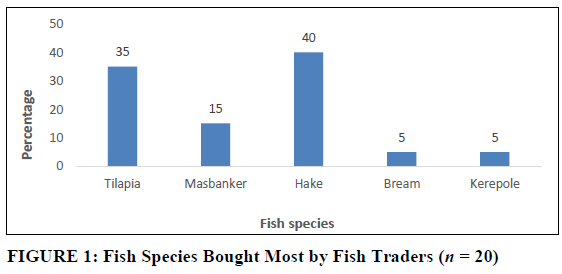
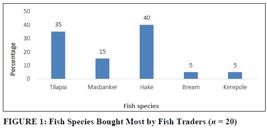
Concerning the type of fish species bought mainly by the 20 fish traders (Figure 1), 40% purchase hake and 35% O. mossambicus, followed by 15% that buy maasbanker. At the lower spectrum of the purchase thresholds are the bream and kerepole species. Fresh O. mossambicus is not a well-known product to most South African consumers, who are accustomed to hake (DAFF, 2018).
6.3. Suppliers of the Fish
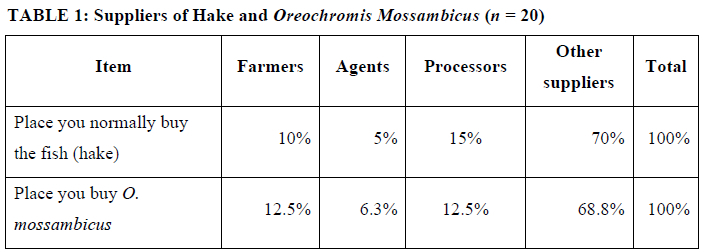
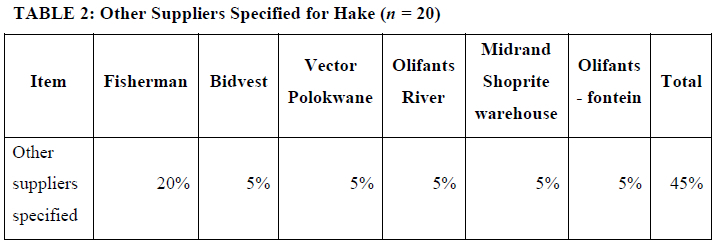
The fish traders were asked to indicate a supplier from where they buy hake and O. mossambicus (Table 1). The results reveal that fish traders buy hake mostly from other suppliers (70%), processors (15%) or farmers (10%). Only one (5%) buys from agents. Other suppliers that were specified are listed in Table 2.
Over two-thirds of the fish traders (68.8%) buy the O. mossambicus from other suppliers, 12% buy from farmers, 12% from processors and only 6.3% from agents. Other specified suppliers are DC Spare (main office), Tzaneen store, Boxer Meat Factory and Soutpansberg Koelkamers. The O. mossambicus farmers in Limpopo Province operate in rural areas and are geographically spread over various municipal districts.
The results showed that Fisherman (20%) dominates the other suppliers (Table 2), indicating that many traders purchase hake from Fisherman.
6.4. Traders Buying Oreochromis Mossambicus
The fish traders were asked to indicate "yes", "no", or "sometimes", whether they buy O. mossambicus. The results revealed that 80% of the fish traders buy O. mossambicus, and 20% do not. DAFF (2018) reported that fresh O. mossambicus products are well-received in more upmarket retailers and restaurants. Therefore, the market remains relatively small because of the low production volumes in South Africa.
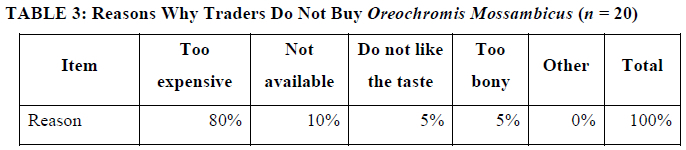
Fish traders who did not buy O. mossambicus were asked to give a reason (Table 3). The results revealed that O. mossambicus is considered to be too expensive (80%), followed by not available (10%) or do not like the taste (5%). A further 5% cited that it is too bony.
6.5. Frequency With Which Traders Buy Fish
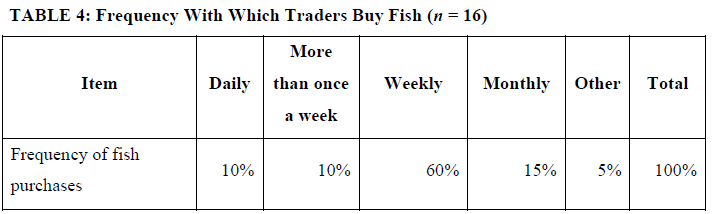
Concerning the frequency of purchasing fish (Table 4), most traders (60%) buy fish weekly. Others buy more frequently, 10% buy more than once a week, 10% buy daily, and about 15% buy monthly, meaning 80% buy at least once weekly. So, there is a market for fish in the traders' stores.
6.6. Frequency With Which Traders Buy Oreochromis Mossambicus
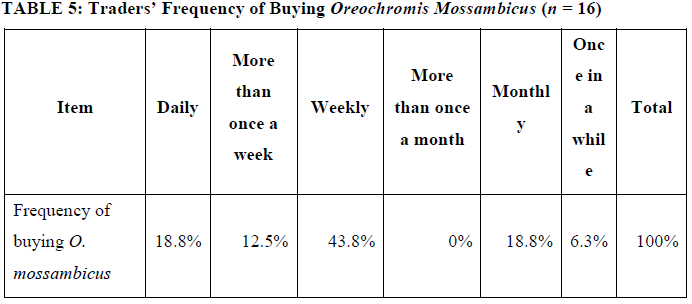
Concerning the frequency of buying O. mossambicus, 44% of the traders buy weekly, 19% buy daily, and 13% buy more than once a week (Table 5). The results are similar to those found by Oyeleke (2017), who showed that 85% of the retailers buy fish weekly, and 15% buy more than once a week. So, O. mossambicus is a commonly stocked food fish in aquaculture.
6.7. Specifications for Purchasing Oreochromis Mossambicus
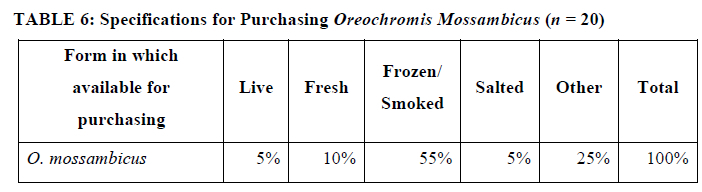
Of the 20 fish traders, 55% purchase O. mossambicus in frozen or smoked form, 10% buy it fresh, 5% buy it live, and 5% buy it salted (Table 6). Of the fish traders, 25% buy it in another form, but they did not specify what form. The preference for frozen fish may stem from logistical considerations, such as longer shelf life and ease of storage, which are crucial for formal retailers. Most fish traders are situated in urban areas. The IDC (2015) reported that tilapia is gutted and frozen for transport to market or wholesalers.
6.8. Size of Oreochromis Mossambicus Traders Buy
Of the 20 fish traders, 66.7% buy medium-sized fish (300 g), 26.7% purchase large-sized, and 6.7% buy small fish. The preference for medium-sized frozen fish aligns with demand theory, where traders prioritise more convenient and cost-effective products to sell, reflecting consumer purchasing behaviour. FAO (2017) reported that size-related preferences for tilapia are influenced by a market segmentation of consumers driven by the specific use of the fish. The size of the O. mossambicus being sold plays a significant role in the profitability of an operation. While plate-sized fish is generally more popular for the general consumer, growing tilapia to larger weights (300 g or more) is less profitable than selling it at smaller sizes (DAFF, 2018), which could be why fish traders buy medium-sized O. mossambicus. Since the traders are purchasing what the suppliers offer, these are the specifications they follow, given that they buy everything supplied to them, even in forms not specified by the respondents.
6.9. Stock of the Oreochromis Mossambicus Per Month
The 20 traders were asked to indicate the volume of the O. mossambicus they buy per month by entering the quantities in the categories (kg and tons). Of the 11 who responded, five purchased between 9 kg and 200 kg, followed by three who bought 300 kg per month and two who bought 500 kg. One trader buys about 1 856 kg per month. So, 11 fish traders buy 3 570 kg or 3.6 tons during the month. The Fish Food Specialist mentioned that he buys five tons of O. mossambicus weekly, which translates to approximately 20 tons per month. Therefore, the total tons demanded per year are 243.6 tons.
6.10. Capacity of Suppliers of Oreochromis Mossambicus
The 20 fish traders were asked to indicate whether the current O. mossambicus suppliers satisfy their demand, and only 50% of the respondents indicated that suppliers meet their demand. Respondents were further asked to indicate the number of O. mossambicus they need per month but do not receive from suppliers by entering the quantities in each category (kg and tons). About 33.3% entered 800 kg per month, while a further four each entered about 29 kg and 400 kg. The kg entered by traders were added together to make 1 629 kg. Therefore, 1.629 tons of O. mossambicus per year were not met by fish suppliers. The 1.629 tons could be the market niche for the O. mossambicus farmers in Limpopo. The results are similar to those found by IDC (2015), which showed that local demand for tilapia in South Africa equalled 1 491 tons in 2013, while local production satisfied 187 tons of this local demand (234 tons less 47 tons of exports), with imports meeting 1 304 tons.
7. CONCLUSION AND DISCUSSIONS
The study highlights a critical market niche for medium-sized frozen tilapia, which local farmers can fill by improving production and addressing trader specifications. These findings underscore the importance of aligning local supply with formal market demands to enhance rural livelihoods and food security. Moreover, these findings highlight the critical role of aligning local fish production with market demands to reduce reliance on imports and support sustainable rural livelihoods. While the study provides valuable insights, its findings are limited by the small sample size (n=20) and the exclusion of certain districts in Limpopo Province. Future research should aim to address these gaps. The traders' preference for frozen medium-sized tilapia illustrates demand theory, where convenience and marketability drive purchasing decisions.
The reluctance of farmers to engage with traders may be linked to historical mistrust or insufficient support from agricultural extension services. Bridging this gap through training programmes or intermediaries could improve collaboration. Formal fish traders (retailers and supermarkets) should approach local farmers to cover unsatisfied demand. This should be done through extension officers allocated to fish farmers. Fish farmers are scared to communicate with people they do not know, as they think that these people could be from the South African Police Service. Small-scale fisheries were legally recognised before; the lack of formal and legal recognition of public dams meant that such activities were frowned upon, and in most instances, criminalised. The reason could be uncertainties about the National Freshwater (Inland) Wild Capture Fisheries Policy, such as access rights and recognition of inland fisheries in managing dams. A permit is required to culture tilapia, but some tilapia farmers do not have permits.
8. PRACTICAL IMPLICATIONS
The Department of Agriculture should connect O. mossambicus farmers with formal markets. This would allow formal fish traders to specify their requirements when purchasing O. mossambicus. In contrast, O. mossambicus farmers would be certain about the availability of markets for their farms, thereby improving the volumes of frozen O. mossambicus and enhancing growth and sustainability. The connection should be done before the culturing period.
The results suggest that policymakers should invest in local processing facilities and training programs for farmers to meet the demand for frozen fish products, thereby reducing the reliance on imports.
9. FUTURE RESEARCH DIRECTIONS
While the findings provide valuable insights, the small sample size and regional focus limit generalisability. Future research should explore these dynamics in other provinces or include a larger sample to confirm observed trends. Future studies could explore consumer perspectives on tilapia quality and pricing, as well as the feasibility of scaling local production to meet trader demands. The study recommends that future research explore fish traders' views towards the quality of water and tilapia produced by local O. mossambicus farmers. In addition, perceived values of fish traders and customers, merits of a tilapia, and its ability to meet their needs and expectations, especially in comparison with its peers, should be studied in parts of South Africa and other countries.
10. ETHICAL COMPLIANCE
The College of Economic and Management Sciences (CEMS) provided ethical clearance on 13 July 2018. The ethical clearance certificate number is 2018 CEMS ESTTL 007.
REFERENCES
2. LITERATURE REVIEW
- ASIF, A.A., SAMAD, M.A., RAHMAN, M.H., FARID, M.A., YEASMIN, S.M. & RAHMAN, B.M.S., 2015. Economic conditions of fish fry and fingerling traders in greater Jessore region, Bangladesh. Int. J. Fish. Aquat. Stud., 2(4): 290-293.
- ASMAH, R., 2008. Development potential and financial viability of fish farming in Ghana. Doctoral thesis, Scotland: University of Stirling.
- AWUOR, F.J., OBIERO, K., MUNGUTI, J., OGINGA, J.O., KYULE, D., OPIYO, M.A. & OCHIEWO, J., 2019. Market linkages and distribution channels of cultured, captured and imported fish in Kenya. Aquac. Stud., 19(1): 57-67.
- BENE, C., ARTHUR, R. & NORBURY, H., 2016. Contribution of fisheries and aquaculture to food security and poverty reduction: assessing the current evidence. World Dev., 79: 177-196.
- BRITZ, P., 2015. The history of South African inland fisheries policy with governance recommendations for the democratic era. Water SA., 41(5): 624-632.
-
BRITZ, P.J., HARA, M.M., WEYL, O.L.F., TAPELA, B.N. & ROUHANI, Q.A., 2015. Scoping study on the development and sustainable utilisation of inland fisheries in South Africa. Available from https://www.researchgate.net/...Scoping_Study_on_the_Development_and_Sustainable
» https://www.researchgate.net/...Scoping_Study_on_the_Development_and_Sustainable -
BRITZ, P.J., 2016. Aquaculture review: South Africa. Available from www.saimi.co.za/.../Spotlight%20on%20World%20Aquaculture%202017
» www.saimi.co.za/.../Spotlight%20on%20World%20Aquaculture%202017 - BWANAMUDOGO, I., KAPUTE, F., LINA, A., MBALASSA, M., ZAABWE, T. & SINGINI, W., 2022. Quality of fresh frozen tilapia from selected supermarkets in Malawi. Afr. J. Food Agric. Nutr. Dev., 22(4): 20085-20101.
- COLLIS, J. & HUSSEY, R., 2014. Business research: a practical guide for undergraduate and postgraduate students (4th edition). Hampshire: Palgrave.
-
DAFF., 2014. Aquaculture yearbook. Available from www.investbuffalocity.com/system/...Aquaculture%20Yearbook%202014%20SA.pdf.
» www.investbuffalocity.com/system/...Aquaculture%20Yearbook%202014%20SA.pdf -
DAFF., 2018. Nile and Mozambique tilapia feasibility study. Available from www.nda.agric.za/.../fisheries/.../final%20Nile%and20%Mossambicus%20_Tilapia
» www.nda.agric.za/.../fisheries/.../final%20Nile%and20%Mossambicus%20_Tilapia -
EASTIN, R.V. & ARBOGAST, G.L., 2011. Demand and supply analysis: Introduction. Available from https://www.cfainstitute.org/.../prerequisile_economics_material%20-%20demand_and
» https://www.cfainstitute.org/.../prerequisile_economics_material%20-%20demand_and -
FAO., 2014. The state of world fisheries and aquaculture. Available from www.fao.org/3/a-i3720e.pdf
» www.fao.org/3/a-i3720e.pdf -
FAO., 2017. Social and economic performance of tilapia farming in Africa. Available from http://www.fao.org/3/a-i728e.pdf
» http://www.fao.org/3/a-i728e.pdf -
FAO., 2022. Globefish highlights international markets for fisheries and aquaculture products. Available from https://www.fao.org/3/cc1350en.pdf
» https://www.fao.org/3/cc1350en.pdf -
HARA, M., GREENBERG, S., THOW, A., CHIMATIRO, S. & DU TOIT., 2017. Trade and investment in fish and fish products between South Africa and the rest of SADC: Implications for food and nutrition security. Working paper 47. Institute for Poverty, Land and Agrarian Studies (PLAAS). Available from www.plaas.org.za/...pdf/WP47_Hara%20et%20al%20Trade%20and%20Investmern%
» www.plaas.org.za/...pdf/WP47_Hara%20et%20al%20Trade%20and%20Investmern% - HLONGWANE, K.C., 2021. Factors affecting tilapia production in Capricorn and Vhembe Districts in Limpopo, Province, South Africa. Doctoral thesis, University of Limpopo.
-
IDC., 2015. Research into the potentialfor the production, processing and export of tilapia for the southern Africa market. Available from https://www.economic.gov.za/...research/...idc-research-into-the-potential-for-the-productio
» https://www.economic.gov.za/...research/...idc-research-into-the-potential-for-the-productio -
ISAACS, M., HARA, M.M., DENNIS, T.L., ROUHANI, Q.A., MANNARINO, C. & JAFFER, N., 2022. A situational analysis of small-scale fisheries in South Africa: from vulnerability to viability. V2V working paper No. 2022-9. Available from https://www.masifundise.org/wp-content/uploads/2022/10/A-situational-Analysis-of-SSF-in-South_Africa_V2V-working-paper-No.-2022-9.pdf
» https://www.masifundise.org/wp-content/uploads/2022/10/A-situational-Analysis-of-SSF-in-South_Africa_V2V-working-paper-No.-2022-9.pdf -
JAMES, N., 2016. Selling your fish: which customers are best for you? Available from https://www.farmersweekly.co.za>Animals>Aquaculture
» https://www.farmersweekly.co.za>Animals>Aquaculture -
KAHAN., 2012. Entrepreneurship in farming. Available from www.fao.org/docrep/018/i3231e/i3231e.pdf
» www.fao.org/docrep/018/i3231e/i3231e.pdf - KNOTT, E., RAO, A.H., SUMMERS, K. & TEEGER, C., 2022. Interviews in the social sciences. Nat Rev Methods Primers., 2: 73.
-
LDP., 2021. Limpopo developmental plan 2020-2025. Available from https://www.limpopo.gov.za/Limpopo_Development_Plan_2020-2025.pdf
» https://www.limpopo.gov.za/Limpopo_Development_Plan_2020-2025.pdf - LEEDY, P.D. & ORMROD, J.E., 2014. Practical Research Planning and Design (10th edition). Upper Saddle River: Pearson.
- LEVI, A., SABUCO, J. & SANJUAN, M.A.F., 2018. Supply based on demand dynamical model. Commun Nonlinear Sci Number Simulat., 57: 402-414.
- MAEBANE, M., MANCHIDI, N. & CHILOANE-PHETLA, G., 2022. Market potential of freshwater fish farmers in Limpopo Province. Journal of Economics and Behavioral Studies, 14(2): 26-38.
- MAHLANGU, S.S., 2014. Production and commercialisation potential of indigenous leafy vegetables: case study of Capricorn District in the Limpopo Province, South Africa. Unpublished Master's dissertation, University of Limpopo.
- MOHR, P., FOURIE, L. & ASSOCIATES., 2015. Economics for South African students (5th edition). Pretoria: Van Schaik.
- MOYO, N.A. & RAPATSA, M.M., 2021. A review of the factors affecting tilapia aquaculture production in Southern Africa. Aquaculture., 535: 736386.
- OGELLO, E., OUTA, N. & OUMA, K., 2021. Socio-economic Implications of Imported Frozen Tilapia on the Local fish Production and Value Chain. Sci., 3(411): 87-91.
- OMEJE, V.O., 2016. Effect of pawpaw (Carica papaya) seed meal on the reproductive, endocrine and immune system of Mozambique tilapia (Oreochromis mossambicus). Doctoral thesis, Stellenbosch University.
-
OPERATION PHAKISA., 2014. Operation Phakisa: Unlocking the economic potential of South Africa's oceans. Available from www.operationphakisa.gov.za/.../aquaculture/.../OPOceans%20Aqua%20Executive%2.
» www.operationphakisa.gov.za/.../aquaculture/.../OPOceans%20Aqua%20Executive%2 - OYELEKE, S.B., 2017. Assessment of productivity and supply chain of aquaculture projects in Gauteng province for sustainable operation. Master's dissertation, University of South Africa.
- PHOSA, M.J. & LETHOKO, M.X., 2018. Contribution of small-scale fish farming subsector to rural income generation in Thulamela municipality, Limpopo province, South Africa. The 3rd Annual International Conference on Public Administration and Development Alternatives, Stellenbosch University, Saldahna Bay, South Africa, 04 - 06 July.
- PIENAAR, L. & TRAUB, L.N., 2015. Understanding the smallholder farmer in South Africa: Towards a sustainable livelihoods classification. Paper presented at the International Conference of Agriculture Economists, Milan, Italy, Universita Degli Studi D Milano 814 August.
- REPUBLIC OF SOUTH AFRICA., 2022. National Freshwater (inland) Wild Capture Fisheries Policy for South Africa. Republic of South Africa: Government Gazette.
-
STATISTICS SOUTH AFRICA., 2019. Quarterly labour force survey: 1st quarter 2019. Available from www.statssa.gov.za/publications/P0211/P02111stQuarter2019.pdf
» www.statssa.gov.za/publications/P0211/P02111stQuarter2019.pdf - TAPELA, B.N., BRITZ, P.N. & ROUHANI, Q.A., 2015 Scoping study on the development and sustainable utilisation of inland fisheries in South Africa. Case Studies of Small-scale Inland Fisheries., 2: 1-171.
-
VAN ROOYEN, L., 2013. Trials for the tilapia industry. Available from http://www.farmersweekly.co.za/animals/aquaculture/trials-for-the-tilapia-industry/
» http://www.farmersweekly.co.za/animals/aquaculture/trials-for-the-tilapia-industry/ - ZIKMUND, W.G., BABIN, B.J., CARR, J.C. & GRIFFIN, M., 2013. Business research methods. (9th edition). Mason: Thomson Learning South-Western.