Perception and Utilisation of Organic Farming Practices among Smallholder Farmers: Evidence from a Micro-Level Survey in Ehlanzeni District South Africa
Abstract
The study analysed the perception of organic farming practices among smallholder farmers in Mbombela, Mpumalanga, South Africa. An interview-administered questionnaire collected data from 80 randomly sampled smallholder farmers. The elicited data was descriptively analysed using percentages, averages, and ranks. In contrast, a multiple linear regression model was used to determine the socioeconomic factors that influence smallholder farmers' utilisation of organic farming practices. The findings revealed that although smallholder farmers were aware of organic agricultural methods, adopting organic practices is still yet to be widespread and optimal in the area. This is due to some severe challenges indicated by the respondents, including inadequate government support, the unpredictability of climate change, inadequate access to grants and credit facilities, inadequate collaboration and collective action among farmers, and inadequate access to extension services. Furthermore, the findings of the regression model revealed that formal education and organic farming training attendance were significant socioeconomic factors influencing smallholder farmer's utilisation of organic farming practices. Given the need to scale up the adoption of organic farming practices in the area, it was recommended that increased government support, adequate access to credit facilities and significant improvement and effectiveness of extension services in providing training and encouraging collective action among the smallholder farmers is required.
Smallholder farmers; Perception; Utilisation; Organic Farming
1. INTRODUCTION
Agriculture remains one of the most important sectors of the economy in many developing countries due to its overall contribution to the Gross Domestic Product and employment for most rural dwellers (Manida & Nedumaran, 2020). Smallholder agriculture in South Africa is perceived as a livelihood option to achieve poverty reduction and rural development goals (Ncube, 2017). Smallholder farmers' contribution to ensuring food security for the teeming world population is increasingly recognised as the global population is expected to reach 9.5 billion people by 2050 (Uhunamure et al., 2021). Therefore, the rapidly expanding world's populace has increased the use of technology, machineries and chemical inputs, generating several health and environmental concerns (Udeigwe et al., 2015). This has led to the increasing call for all categories of farmers, both commercial and smallholders, to use more efficient agricultural practices, one of which is the applicability of organic farming practices.
From the 1920s to the 1950s, the original idea of organic agriculture was advocated as a critique of the newly developing industrial food system (Seufert et al., 2017). According to Ahuja et al. (2020), organic farming practices generally involve biological, cultural, and mechanical practices to promote the cycling of on-farm resources, maintain ecological balance, and conserve biodiversity. Organic farming is the best way to mitigate the adverse effects of chemical farming practices (Meemken, 2018). It is aimed at environmentally friendly production by avoiding the use of synthetic fertilisers and pesticides and by a firm reliance on closed on-farm nutrient cycling, including biological nitrogen fixation and crop rotations, to support soil fertility by enhancing soil organic matter content (Leifeld, 2012; Janjhua et al., 2019). However, despite the advantages and prospects of organic farming practices, smallholder farmers face significant hurdles when attempting to transition to organic farming (Jouzi et al., 2017). The adoption of organic farming practices, especially among smallholder farmers, is associated with a lot of factors, which might include costs, farmers' innovation-averseness, access to appropriate training, access to relevant advisory services, government policies and availability of market outlets (Uhunamure et al., 2021). Smallholder farmers may hesitate to use new techniques, fearing a decreased yield if they use organic farming practices. Others are concerned about losing their profits since they rely on them for survival (Ullah et al., 2015). Thus, the need to promote the adoption of organic farming practices was recognised to potentially assist in mitigating some of the environmental impact and soil quality challenges without compromising food security and farm revenues.
Several previous documented research studies have focused on Recycling Agricultural Wastes and By-products (Diacono et al., 2019), conservation tillage and organic farming (Seitz et al., 2019), comparison between conventional and organic farming systems (Le Campion et al., 2019). Moreover, similar perception-related studies regarding converting to organic farming (Bouttes et al., 2018) found that transition to organic farming is a way to enhance their adaptive capacity in four ways: increasing professional satisfaction, stimulating learning, reducing risks, and enabling to maintain a family. However, scant empirical research, especially in the Mpumalanga province, has focused on the perception and extent of the utilisation of organic farming among smallholder farmers. Therefore, to fill this lacuna, the study attempted to proffer insight into the disposition of smallholder farmers to organic farming and the level of use so far. This will provide empirical information for governments, policymakers, extension advisory services and other relevant stakeholders on how to strategise and improve the application of organic farming practices in the area by providing solutions to the contextual factors peculiar to smallholder farmers. Furthermore, the study aligns with the Sustainable Development Goals (SDG 1, 2, 3 and 12) to end all forms of poverty and hunger, promoting good health and well-being by ensuring responsible consumption and production by 2030. Therefore, the study will pave the way for strategies and gaps that need to be filled in creating the right platforms to ensure effective service delivery by agricultural extension services.
To achieve the aim of the study, four research objectives guided the study: determine the perception of the smallholder farmer on organic farming practices, examine the degree of utilisation of organic farming implementation among smallholder farmers in the area, investigate the barriers that prevented the application of organic farming practices among the smallholder farmers, and determined the socioeconomic factors influencing the utilisation of organic farming practices.
2. METHODOLOGY
2.1.
Study AreaThe study was conducted in Mbombela (Nelspruit), which is a town in the Mpumalanga province of South Africa that is part of the Mbombela Local Municipality with a Latitude of -25.475298 and Longitude of 30.969416 (Hughes, 2018). Nelspruit has a sub-tropical climate, with an average annual precipitation of 764 mm, more than 85 percent of which falls during the summer (Murovhi & Materechera, 2015). Nelspruit, which literally means "Nels Stream," is located in the heart of the Lowveld on the banks of the Crocodile River (Rowe, 2020). The area's topography is relatively flat and has been used for agricultural purposes in the olden days and currently (Pelser, 2019). The place attracted high-profile traders and farmers due to the massive pure quality of the soil, sufficient irrigation water, and a smooth valley floor (Rowe, 2020). Nelspruit has become one of the biggest sources of tobacco, litchis, mangoes, avocados, and other fruits and vegetables (Rowe, 2020).
2.2.
Sampling Procedure and Sampling SizeQuantitative research was adopted in the study using a descriptive survey research design. The research design was employed following the lead of Olorunfemi (2018) and Omotayo et al. (2021), who also applied this design in a similar perception-related study. Based on the information from the Department of Agriculture, Rural Development, Land, and Environmental Affairs, the sample size used in the study numbered 80 smallholder farmers drawn from 1594 smallholder farmers (DARDLEA, 2022). Therefore, because of time and resource constraints, simple random sampling was used to select 5% of the smallholder crop farmers from the population.
2.3.
Data Collection and AnalysisA structured questionnaire was developed as the survey instrument to elicit data for the study. The collected data was then analysed using descriptive statistics such as frequency counts, percentages, means and ranks using IBM SPSS version 28. Furthermore, multiple linear regression adopting the ordinary least square approach was used as an inferential statistic to analyse the socioeconomic factors influencing smallholder farmers' utilisation of organic farming practices in the area. The respondents' socioeconomic characteristics were the independent and explanatory variables used in the regression model, while the computed smallholder perception on the effects of organic farming practices score of the respondents served as the dependent variable in the model.
2.4. Model Specification
2.4.1. Inferential Statistics
The multiple linear regression model was employed in the study due to its ability to use several independent or explanatory variables to determine the outcome of dependent variables that are continuously measured (Ijatuyi et al., 2022). The model was used to analyse the respondents' socioeconomic characteristics that significantly influence their utilisation of organic farming practices. Data concerning the respondents' perceptions on the effects of organic farming practices was assessed in terms of a five-point Likert Perception Scale rated as strongly disagree (1), disagree (2), undecided, agree (4), and strongly agree (5). Following the lead of Nyawo and Olorunfemi (2023), a composite score analysis was then used to compute individual utilisation scores for each respondent from the Likert scales. This computed utilisation index then served as a proxy for the farmers' utilisation, which was then fitted as the dependent variable in the multiple linear regression model.
The explicit form of the model can thus be given as:

Where:
Y is the farmer's utilisation score/index on organic farming practices.
X is a vector of hypothesised explanatory variables which included farmers' socioeconomic characteristics (age, gender, marital status, educational attainment, household size, farming experience and so on).
β is a vector of unknown parameters to be estimated and ε is independently and normally distributed random error term.
3. RESULTS AND DISCUSSION
3.1. Socioeconomic Characteristics of the Smallholder Farmers
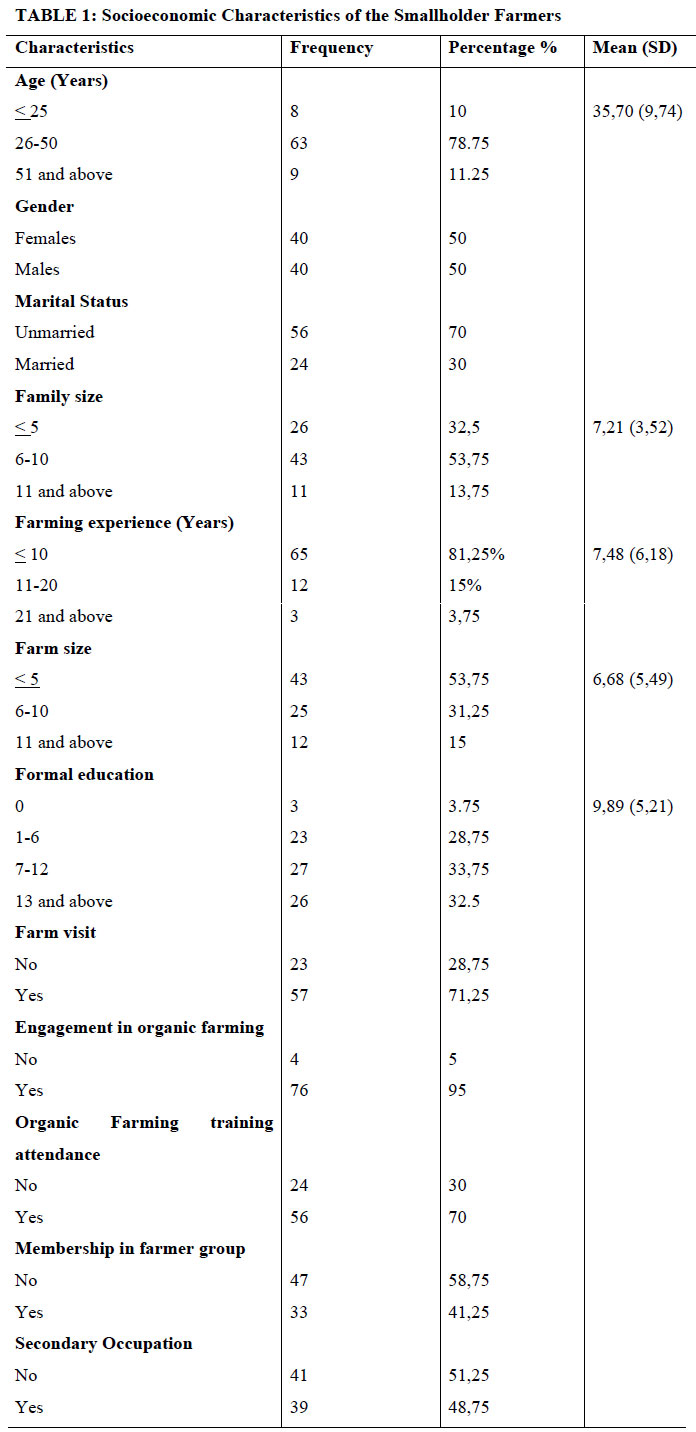
The results in Table 1 showed that the majority (78.75%) of smallholder farmers were between the ages of 26 and 50, 11,25% were above the age of 51, and just a few (10.0%) were under the age of 25 years. The smallholder farmers' average age of 35.70 years implies they are still in their youthful and productive years. This agrees with Ofuoku and Ekorhi-Robinson (2018), who postulated that younger farmers have sufficient energy for farming. The results also indicate an equal number of men (50.0%) and women (50.0%) participating in the area. This implies that both sexes have equal potential and can participate in agricultural enterprises successfully. This aligns with the government mandate for all agencies' budgets and policies to reflect gender equality (Lee, 2021). Additionally, the marital status shows that most respondents (70%) were unmarried, while 30% were married. This implies that the majority of the farmers do not have marital relationship ties and are more disposed to be able to make individual farm decisions without having to consult with their partners. Thus, single farmers are more likely than married farmers to engage in and adopt agricultural techniques.
Furthermore, Table 1 reveals that the overall mean household size in the study area was seven persons, with a standard deviation of 4 persons, and that more than half (53.75%) of smallholder farmers had families of 6-10 members, 32.6% had families of less than five members, and 13.75% had families of 11 members or more. An average household size of 7 persons indicates that smallholder farmers have dependents and responsibilities at home, and it is more likely that people rely on them. Kolleh (2016) opined that a large household size offers farmers greater access to family labour, which is expected to reduce farm costs and enhance maximum output.
The results in Table 1 also reveal that the majority of the smallholder farmers (81.25%) had farming experience of less than a decade (10) years, 15% had farming experience from 11 - 20 years, while a few 3.75% had farming experience of more than 21 years. The average mean farming experience of 7.48 years suggests that most farmers are still within their first decade of farming experience. Despite most farmers having minimal farming experience, further interaction with them during the data collection process demonstrated that they generally have a positive attitude toward engaging in agricultural activities. They also indicated their willingness to learn more and build on what they already knew to increase their intelligence level. Atube et al. (2021) state that the likelihood of using better farming methods, such as organic farm practices, rises with increased farming experience. This might be because experienced farmers have a plethora of local knowledge and information about the most effective agricultural strategies to apply.
Furthermore, Table 1 shows the results that more than half (53,75%) of smallholder farmers had farm size of less than 5 hectares, 31.25% had farm size of 6 -10 hectares, and a few (15.0%) of farmers had farm size of 11 and more hectares of land. The average overall mean farm size of 6.68 hectares indicates that the farmers in the area have pretty sizeable areas of farmland that they use for agricultural purposes, which, if properly managed, could contribute to sustainable and improved farmer livelihoods. Nnadozie et al. (2015) and Anigbogu et al. (2015) stated that the relationship between farm size and output implies that the size of the farm holding affects output; that is, the smaller the size of the farm, the smaller the production and invariably the farm income. Also, Oluwatayo (2019) stated that increased farm size increases farmers' likelihood of using innovative practical techniques and increasing yields.
Moreover, the results in Table 1 show that under two-thirds (62.5%) of smallholder farmers had formal education ranging from one to twelve years, with just a few (3.75%) having no formal education. The mean years of formal education in the area was 9 years, implying that the farmers have some level of exposure and knowledge that can enhance their use of organic farming practices. Simotwo et al. (2018) concurred and revealed that the respondents' access to education varied with their ages, with younger people having more education than older people. These circumstances could impact how quickly new farming technologies are adopted.
The results in Table 1 show that extension officers visited the majority (71,13%) of smallholder farmers to assist them with information on how to improve their cultivation. This suggests that most farmers will be exposed to information on innovative strategies, such as organic agricultural farming practices in the area. Furthermore, Table 1 also shows that the majority (95,0%) of smallholder farmers were already engaged in organic farming practices. This might be attributed to most farmers' exposure to agricultural extension services. However, just a few (5.0%) were not yet engaged in any form of organic farming practices, probably because they still lack information, as some farmers mentioned during the survey that they do not know much about organic farming practices.
Moreover, Table 1 shows that the majority (70.0%) of smallholder farmers have been exposed to one form of organic farming training, which also buttresses previous findings and provides a reason why the majority are already engaged in one form of organic farming practice or the other. This means that farmers' attendance aligns with their engagement in organic farming, proving that most people are practising some level of organic farming practices because they know about it. However, more knowledge might be required to increase their level of engagement in organic farming practices in the area.
The results in Table 1 further indicate that more than half (52,12%) of the farmers had no secondary occupation, meaning they derive most of their income from farming activities.
This agrees with Myeni et al. (2019), who states that due to the high unemployment rate, most South African rural populations rely primarily on agriculture for food security and subsistence.
3.2. Perceived Benefits of Organic Farming Practices Among Smallholder Farmers
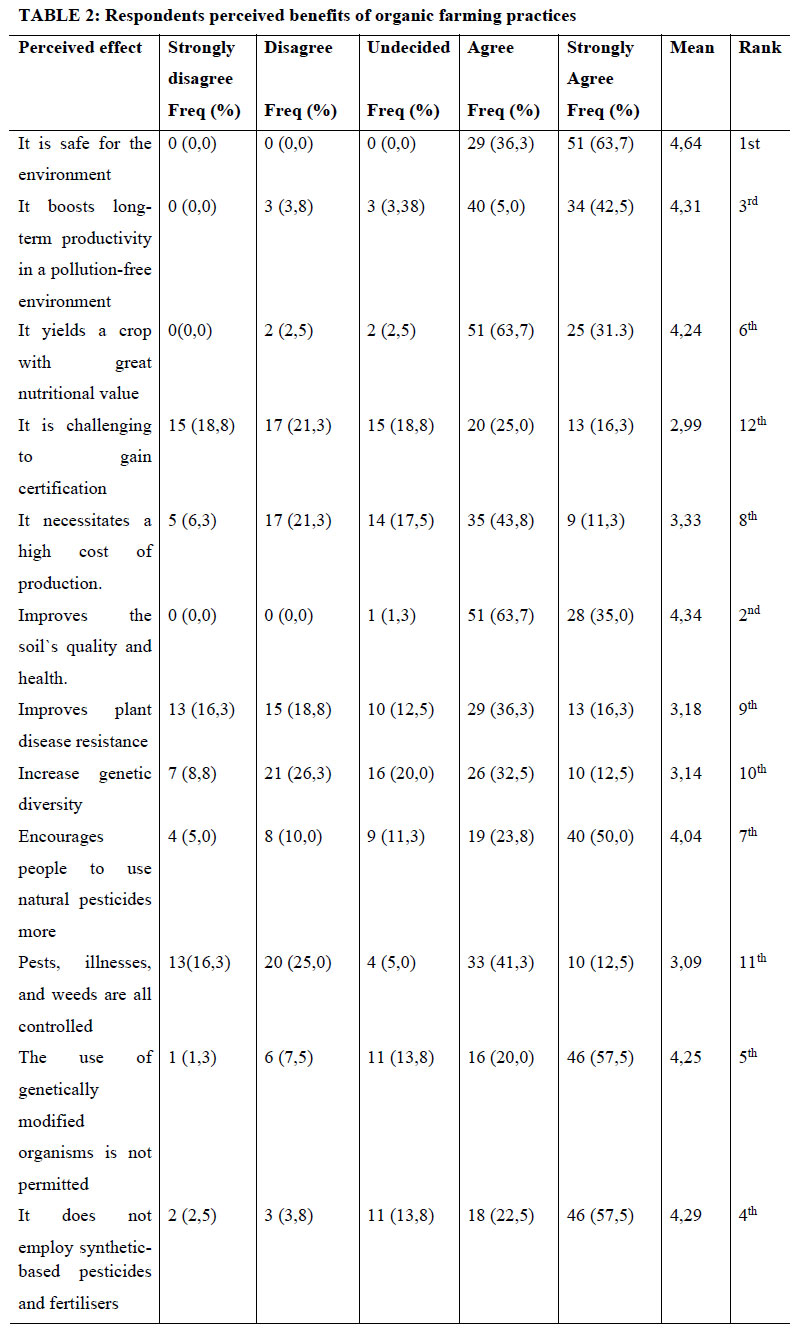
Using the mean value, the perception of smallholder farmers on the effects of organic farming practices was rated. Table 2 reveals that the smallholder farmers had a high and positive perception of the benefits and effects of organic farming practices. Some prominent statements they agreed to indicate their high level of perception were that it is safe for the environment (MS = 4,64), which ranked first. Other prominent statements highlighted by the farmers were, "Improves the soil's quality and health" (MS = 4,34) and boosts long-term productivity in a pollution-free environment (MS = 4,31). This implies that smallholder farmers believe that organic farming practices are safe for the environment. These results are in line with the findings of Singh (2021), who stated that organic farming aids in improving the fertility of the soil and the environment need to be nurtured as a resource to be husbanded for future generations.
Furthermore, it does not employ synthetic-based pesticides and fertilisers (4,29). This aligns with Thamaga-Chitja and Hendriks (2008), who reported that organic farmers discourage the use of synthetic pesticides or fertilisers. The use of genetically modified organisms is not permitted (4,25). According to Patidar and Patidar (2015), overusing chemical inputs over the past four decades has caused numerous hazards, including soil erosion, groundwater level contamination, soil salinisation, pollution from fertilisers and pesticides, genetic erosion, negative effects on the environment, decreased food quality, and increased cultivation costs. Overall, smallholder farmers have a good and correct perception of the use of organic farming practices; therefore, all relevant stakeholders should support and facilitate strategies to enhance the upscaling of its use in the area.
3.3. Utilisation of Organic Farming Practices among the farmers
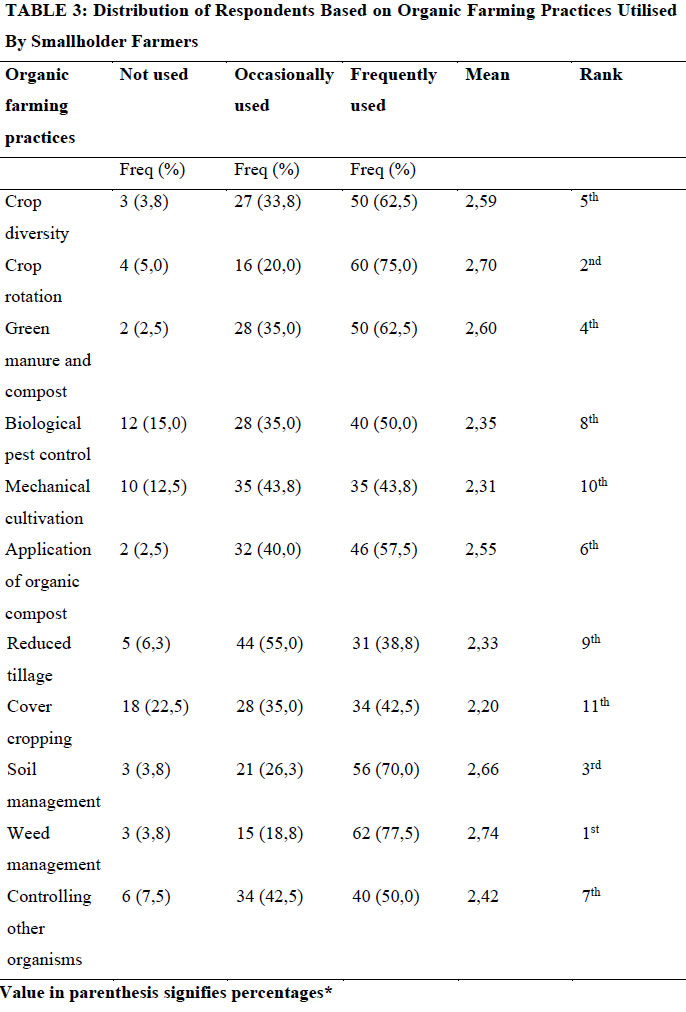
The list of organic farming techniques is ranked in order of severity using the mean score. The results in Table 3 show the respondent's mean score using a 3-point utilisation scale of frequently used (3), occasionally used (2) and not used (1). According to the results in Table 4, weed management was the most prominent practice among farmers in the area, ranking 1st with a mean score of 2.74. This implies that smallholder farmers use this practice more often since it helps crops grow properly. Some weeds consume more water and nutrients, which causes the target crop to perish due to a lack of necessary requirements. Tasks related to weed control can be made much easier and more feasible with the help of a well-thought-out strategic plan, which can also result in significant resource savings (time, effort, and money). Therefore, for weed management tactics to be successful enough to support lucrative and long-term cropping systems, they must be based on a strong foundation of sound agronomy (Peerzada et al., 2019).
Furthermore, Table 3 results reveal that the majority (MS = 2.66) of smallholder farmers used crop rotation, mainly because crop rotation helps to enhance soil quality, better distribution of nutrients in the soil and increases biological activity. (Gido et al., 2013) also postulated that crop rotation is a tried-and-true method for changing weather, crop, and field conditions. Crop rotation has been known for centuries to increase yield and plant health (Schöning et al., 2022).
Table 3 shows that the majority (MS = 2.60) of the farmers frequently used organic-related soil management practices. This implies that most smallholder farmers emphasised the importance of organic soil management, saying that healthier crops result from managing the soil. This result is in conformity with Shah and Wu's (2019) findings that agricultural scientists have known for a long time that good soil management methods are crucial for boosting the output of agricultural produce and reducing environmental pollution. Thus, it is important to adopt methods that prevent soil contamination and deterioration and preserve soil from erosion, directly contributing to a lack of available land.
Moreover, the results in Table 3 further indicate that under two-thirds (62,5%) of smallholder farmers indicated that they use green manure and compost (MS = 2.59) as regular applications that enhance soil structure and nutrients. Neto et al. (2020) pointed out that in addition to affecting the development and yield of crops, applying organic matter (OM) to the soil via compost or green manure for several years in a row also modifies the soil's chemical composition. Table 3 also indicates that under two-thirds (62.5%) of smallholder farmers utilise crop diversity (MS = 2.55). A study revealed that such practice may be used because it helps offset the other enterprise's generated income (Redlich et al., 2018).
3.4. Constraints Faced by Smallholder Farmers In Utilising
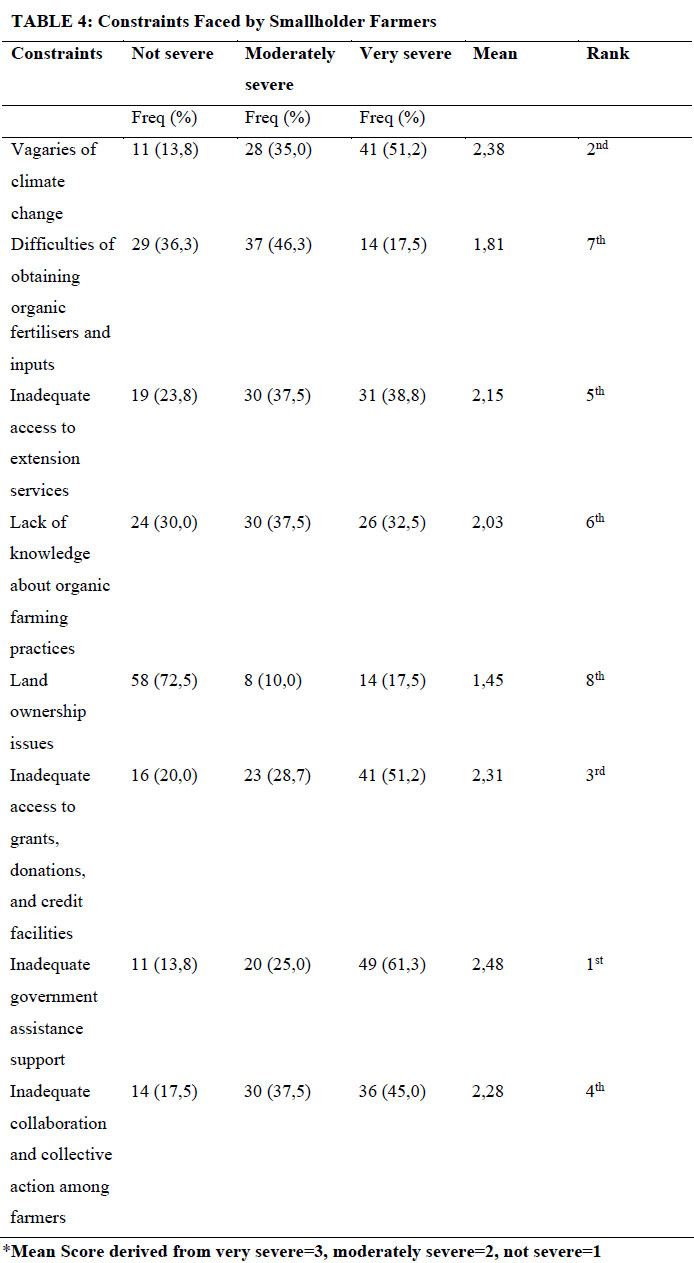
The results in Table 4 indicate the respondent's results where the mean score was derived from 3 3-point severity scale of very severe (3), moderately severe (2) and not severe (1). Using mean score to rank the constraints lists according to their order of severity, prominent constraints items indicated by members as severe challenges impeding smallholder farmers from adequately utilising organic farming practices were " inadequate government assistance support" (MS= 2,48), "Vagaries of climate change" (MS= 2,38), " inadequate access to grants, donations, and credit facilities" (MS=2,31), "inadequate collaboration and collective action among farmers" (MS= 2,28), "inadequate access to extension services (MS=2,15), and " lack of knowledge about organic farming practices" (MS= 2,03), ranked 1st,2nd,3rd,4th,5th, and 6th respectively.
The results in Table 4 reveal that inadequate government assistance support ranked as the (MS = 2.48) topmost severe constraint smallholder farmers face in their optimal utilisation of organic farming practices in the area. This clearly shows that most smallholder farmers are not receiving adequate support from the government. These results are supported by Sivaraj et al. (2017), who stated that smallholder farmers perceived a lack of government support for marketing organic produce as a major constraint. This is followed by the vagaries of climate change, which are the second most severe (MS = 2.38) constraints indicated, and both are related. The survey showed that farmers need assistance from the government since they encounter a lot of damage from high temperatures and other weather conditions that are not good for their cultivation. This agrees with Harvey et al. (2018), who revealed that a lot of smallholder farmers are struggling to cope with the effects of climate change, and the majority are already feeling the effects on crop yields, pest and disease incidence, revenue generation, and, in some cases, food insecurity.
The results from Table 4 revealed inadequate access to grants and credit facilities (MS = 2.31) was the third most severe constraint in the area, which may be due to a lack of expertise, particularly among those over the age of 51 who lack a strong educational foundation and are not receiving government extension services. This result collaborates with the findings of Soni et al. (2012), who reported that some constraints faced by smallholder farmers during the adoption of organic farming practices were lack of financial condition, availability of loans and lack of proper training at the grassroots level through agricultural extension services and establishing information networks amongst them. This is also related to the 4th severe constraint in the area, inadequate collaboration and collective action among farmers (MS = 2.28). This indicates that collaboration and collective action is lacking among farmers in the area. This implies that more needs to be done to encourage farmers in the area to work together in groups and cooperatives for increased output and income.
3.5. Farmers' Socioeconomic Factors Influencing Utilisation of Organic Farming Practices
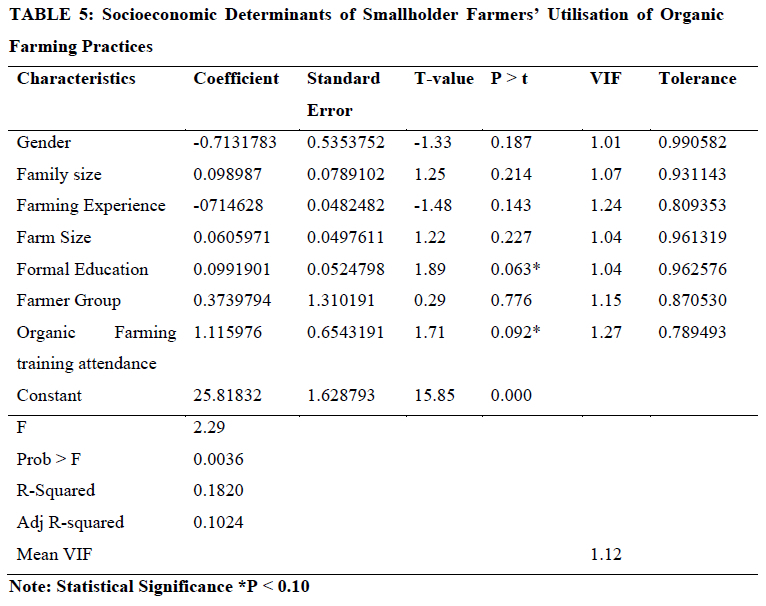
The results in Table 5 show smallholder farmers' socioeconomic determinants influencing the utilisation of organic farming practices using a multiple linear regression model. The results revealed that multicollinearity between the variables employed in the model was not a challenge. The Variance Inflation Factor (VIF) test for multicollinearity revealed that the computed mean VIF value was 1.12, and the tolerance values for the variables were also high. The model's adjusted R-squared was 0.1024, and the F-test statistic was 2.29, with a statistical significance of p < 0.01. This indicates that the model fits well and that the parameters are not statistically equal to zero. Two out of 7 independent variables fitted into the model were found to be significant determinants that influence the smallholder farmers' utilisation of organic farming practices. These significant socioeconomic factors include formal education (t=1.89, p<0.10) and organic farming training attendance (t=1. 71, p<0.10). The study results showed that the coefficient of formal education (0.0991901) of the smallholder farmers was statistically significant at p < 0.10 and positively influenced the utilisation of organic farming practices. This implies that farmers with access to formal education have better opportunities to enhance their understanding of possible positive effects. They are most likely to scale up the adoption of organic farming practices. This agrees with Myeni et al. (2019), who postulated that farmers with more formal education are more likely to adopt innovative sustainable agriculture management techniques such as organic farming practices. Furthermore, the coefficient of organic farming training attendance (1.115976) of the smallholder farmers was statistically significant at p < 0.10 and positively influenced the utilisation of organic farming practices. This implies that smallholders would have higher utilisation if they were aware and attended more training through agricultural advisory services to increase their knowledge of the benefits of organic farming, which, in turn, will lead to an improved livelihood, as opined by Altenbuchner et al., (2017), who stated that one of the important aspects of farmers' livelihoods is increased agricultural knowledge through training and extension services on organic farming.
4. CONCLUSION AND RECOMMENDATIONS
This study examined the perception and utilisation of organic farming practices among smallholder farmers in South Africa using Mpumalanga Province as a case study. The study's overall findings showed that smallholder farmers believe that organic farming practices are safe for the environment, improve soil quality and health, and boost long-term productivity in a pollution-free environment. Moreover, smallholder farmers were aware of organic agricultural methods, and the adoption of organic practices is still yet to be widespread and optimal in the area. This is due to severe challenges the study exposed, including inadequate government support, the unpredictability of climate change, inadequate access to grants, donations, and credit facilities, inadequate collaboration and collective action among farmers, and inadequate access to extension services. Furthermore, the study found that socioeconomic factors such as formal education and organic farming training attendance were significant determinants influencing smallholder farmers' utilisation of organic farming practices. Therefore, based on these findings, the study suggests that smallholder farmers could achieve sustainable cultivation and adopt organic farming practices. The study recommended that increased government support, adequate access to credit facilities and significant improvement and effectiveness of extension services in providing training and encouraging collective action among the smallholder farmers is required.
5. ACKNOWLEDGEMENTS
The authors acknowledge and thank the smallholder farmers who participated in this study.
REFERENCES
- AHUJA, I., DAUKSAS, E., REMME. J.F., RICHARDSEN, R. & RICHARDSEN, A., 2020. Fish and fish waste-based fertilisers in organic farming - With status in Norway: A review. Elsevier., 115(2020): 95-112.
- ALTENBUCHNER, C., VOGEL, S. & LARCHER, M., 2017. Effect of organic farming on the empowerment of women: A case study on the perception of female farmers in Odisha, India. Elsevier., 64(2017): 28-33.
- ANIGBOGU, T.U., AGBASI, O.E. & OKOLI, I.M., 2015. Socioeconomic factors influencing agricultural production among cooperative farmers in Anambra State, Nigeria. Int. J. Acad. Res. Econ. Manag. Sci., 4(3): 43-58.
- ATUBE, F., MALINGA, G.M., NYEKO, M., OKELLO, D.M., ALARAKOL, S.P. & OKELLO-UMA, I., 2021. Determinants of smallholder farmers' adaptation strategies to the effects of climate change: Evidence from northern Uganda. Agric. Food Secur., 10(1): 1-14.
- BOUTTES, M., DARNHOFER, I. & MARTIN, G., 2018. Converting to organic farming to enhance adaptive capacity. Springer., 9(2019): 235-247.
-
DIACONO, M., PERSIANI, A., TESTANT, E., MONTEMURRO, F. & CIACCIA, C., 2019. Recycling Agricultural Wastes and By-products in Organic Farming: Bio fertiliser Production, Yield Performance and Carbon Footprint Analysis. Sustainability., 11: 3824. doi:10.3390/su11143824
» https://doi.org/10.3390/su11143824 - GIDO, E.O., LAGAT, J.K., ITHINJI, G.K., MUTAI, B.K., SIBIKO, K.W. & MWANGI, J.K., 2013. Maize farmers perceptions towards organic soil management practices in Bungoma County, Kenya. Res. J. Environ. Earth Sci., 5(2): 41-48.
- HARVEY, C.A., SABORIO-RODRÍGUEZ, M., MARTINEZ-RODRÍGUEZ, M.R., VIGUERA, B., CHAIN-GUADARRAMA, A., VIGNOLA, R. & ALPIZAR, F., 2018. Climate change impacts and adaptation among smallholder farmers in Central America. Agriculture & Agric. FoodSecur., 7(1):1-20.
- HUGHES, P.J., 2018. Determination of the possible requirement for remediation of manganese-impacted groundwater at an industrial facility in Nelspruit. Doctoral dissertation, University of the Free State.
- IJATUYI, E.J., OLADELE, O.I., ABIOLU, O.A. & OMOTAYO, A.O., 2022. Socioeconomic determinants of female development in the rural Northwest province of South Africa. Sustainability., 14(1): 547.
- JANJHUA, Y., CHAUDHARY, R., MEHTA, P. & KUMAR, K., 2019. Determinants of farmer's attitude toward organic agriculture and barriers for converting to organic farming systems: Research insights. Int. J. Econ. Plants., 6(2): 97-103.
- JOUZI, Z., AZADI, H., TAHERI, F., ZARAFSHANI, K., GEBREHIWOT, K., VAN PASSEL, S. & LEBAILLY, P., 2017. Organic farming and small-scale farmers: Main opportunities and challenges. Ecol Econ., 132: 144-154.
- KOLLEH, R.R., 2016. Determinants of Farmers' Participation in Agricultural Production Cooperatives and Impact of Cooperative Membership on Farm Income in Liberia. Master's dissertation.
- LE CAMPION, A., OURY, F., HEUMEZ, E. & ROLLAND, B., 2019. Conventional versus organic farming systems: dissecting comparisons to improve cereal organic breeding strategies. Springer., 10(2020): 63-74.
- LEE, C.J., 2021. Gender-sensitivity in land management: Trajectory of housing, agriculture and land ownership in South Korea. In U.E. Chigbu (ed.), Land governance and gender: The tenure-gender nexus in land management and land policy. Wallingford UK: CABI, pp. 9199.
- LEIFELD, J., 2012. How sustainable is organic farming? Elsevier., 150(2012): 121- 122.
- MANIDA, M. & NEDUMARAN, G., 2020. Agriculture in India: Information about Indian Agriculture & Its Importance. Aegaeum Journal., 8(3): 729-736.
- MEEMKEN, E.M. & QAIM, M., 2018. Organic agriculture, food security, and the environment. Annu. Rev. Resour. Econ., 10: 39-63.
- MUROVHI, N.R. & MATERECHERA, S.A., 2015. Decomposition of subtropical fruit tree leaf litter at Nelspruit, South Africa. Commun. Soil Sci. Plant Anal., 46(7): 859-872.
- MYENI, L., MOELETSI, M., THAVHANA, M., RANDELA, M. & MOKOENA, L., 2019. Barriers affecting sustainable agricultural productivity of smallholder farmers in the Eastern Free State of South Africa. Sustainability., 11(11): 3003.
- NCUBE, B.L., 2017. Institutional support systems for small-scale farmers at new Forest Irrigation Scheme in Mpumalanga, South Africa: Constraints and opportunities. S Afr. Jnl. Agric. Ext., 45(2): 1- 13.
- NETO, M.L.R., ALMEIDA, H.G., ESMERALDO, J.D.A., NOBRE, C.B., PINHEIRO, W.R., DE OLIVEIRA, C.R.T., DA COSTA SOUSA, I., LIMA, O.M.M.L., LIMA, N.N.R., MOREIRA, M.M. & LIMA, C.K.T., 2020. When health professionals look death in the eye: The mental health of professionals who deal daily with the 2019 coronavirus outbreak. Psychiatry Research., 288: 112972.
- NNADOZIE, A.K.O., OYEDIRAN, A.G., NJOUKU, I.A. & OKOLI, K.G., 2015. Nigerian agricultural cooperatives and rural development in Ivo L.G.A., Ebonyi State, Nigeria. Global Journal Inc., 15(4): 1-10.
- NYAWO, P.H. & OLORUNFEMI, O.D., 2023. Perceived effectiveness of agricultural cooperatives by smallholder farmers: Evidence from micro-level survey in North-Eastern South Africa. Sustainability., 15(13): 10354.
- OFUOKU, A.U. & EKORHI-ROBINSON, O.I., 2018. Social inclusion of landless farmers in extension services in Delta State, Nigeria: Implications for agricultural development. Open Agriculture., 3(1): 226-235.
- OLORUNFEMI, O.D., 2018. Perceived Effects of Professionalization of Extension Services on Delivery by Public and Private Agents in Southwestern Nigeria. Doctoral Dissertation, North-West University, Potchefstroom, South Africa.
- OLUWATAYO, I.B., 2019. Vulnerability and adaptive strategies of smallholder farmers to seasonal fluctuations in production and marketing in southwest Nigeria. Clim. Dev., 11(8): 659-666.
- OMOTAYO, A.O., NDHLOVU, P.T., TSHWENE, S.C., OLAGUNJU, K.O. & AREMU, A.O., 2021. Determinants of household income and willingness to pay for indigenous plants in North-west Province, South Africa: A Two-Stage Heckman Approach. Sustainability., 13: 5458.
- PATIDAR, S. & PATIDAR, H., 2015. A Study of Perception of Farmers towards Organic Farming. Int. J. Appl. Innov. Eng. Manag., 4(3): 269-277.
- PEERZADA, A.M., BUKHARI, S.A.H., DAWOOD, M., NAWAZ, A., AHMAD, S. & ADKINS, S., 2019. Weed management for healthy crop production. In M. Hasanuzzaman (ed.), Agronomic Crops. Singapore: Springer, pp. 225-256.
-
PELSER, A.J., 2019. Basic HIA report for the proposed addendum to the existing Nelspruit quarry on the remaining extent of the farm. Available from https://sahris.sahra.org.za/sites/default/files/heritagereports/HIA%20REPORT%20LAFARGE%20NELSPRUIT%20QUARRY%20APAC01915.pdf
» https://sahris.sahra.org.za/sites/default/files/heritagereports/HIA%20REPORT%20LAFARGE%20NELSPRUIT%20QUARRY%20APAC01915.pdf - REDLICH, S., MARTIN, E.A., WENDE, B. & STEFFAN-DEWENTER, I., 2018. Landscape heterogeneity rather than crop diversity mediates bird diversity in agricultural landscapes. PLoS One., 13(8): e0200438.
-
ROWE, C., 2020. Letter of recommendation for the exemption from phase 1 archeological and heritage investigation for the clearance of 3Ha vegetation for Agricultural purposes on portion 35 of the farm Karino 134JU, Nelspruit Mpumalanga Province. Available from https://sahris.sahra.org.za/sites/default/files/additionaldocs/HIA%20KARINO%20exemption%20letter%20final.pdf
» https://sahris.sahra.org.za/sites/default/files/additionaldocs/HIA%20KARINO%20exemption%20letter%20final.pdf - SCHÖNING, J., WACHTER, P. & TRAUTZ, D., 2022. Crop Rotation and Management Tools for Every Farmer? The Current Status on Crop Rotation and Management Tools for Enabling Sustainable Agriculture Worldwide. Smart Agricultural Technology, p.100086.
- SEITZ, S., GOEBES, P., PUERTA, V.L., PEREIRA, E.I.P., WITTWER, R., SIX, J., VAN DER HEIJDEN, M.G.A. & SCHOLTEN, T., 2019. Conservation tillage and organic farming reduce soil erosion. Springer., 39(2019): 4.
- SEUFERT, v., RAMANKUTTY, N. & MAYERHOFER, T., 2017. What is this thing called organic? - How organic farming is codified in regulations. Elsevier., 68(2017): 10-20.
- SHAH, F. & WU, W., 2019. Soil and crop management strategies to ensure higher crop productivity within sustainable environments. Sustainability., 11(5): 1485.
- SIMOTWO, H.K., MIKALITSA, S.M. & WAMBUA, B.N., 2018. Climate change adaptive capacity and smallholder farming in Trans-Mara East sub-County, Kenya. Geoenvironmental Disasters., 5(1): 1-14.
- SINGH, M., 2021. Organic Farming for Sustainable Agriculture. Choudhary Publishing Media., 1(1): 1-9.
- SIVARAJ, P., PHILIP, H., CHINNADURAI, M., ASOKHAN, M. & SATHYAMOORTHI, K., 2017. Constraints and Suggestions of Certified Organic Farmers in Practicing Organic Farming in Western Zone of Tamil Nadu, India. Int.J.Curr.Microbiol.App.Sci., 6(3): 12701277.
- SONI, R.L., KOTHARI, G.L. & SINGH, R., 2012. Impact of training programmes on adoption of organic farming practices. Raj. J. Extn. Edu., 20: 148-151.
- THAMAGA-CHITJA, J. & HENDRIKS, S.L., 2008. Emerging issues in smallholder organic production and marketing in South Africa. Dev. South. Afr., 25(3): 317-326.
- UDEIGWE, T.K., TEBOH, J.M., EZE, P.N., STIETIYA, M.H., KUMAR, V., HENDRIX, J., MASCAGNI JR, H.J., YING, T. & KANDAKJI, T., 2015. Implications of leading crop production practices on environmental quality and human health. J. Environ Manage., 151: 267-279.
- UHUNAMURE, S.E., KOM, Z., SHALE, K., NETHENGWE, N.S. & STEYN, J., 2021. Perceptions of Smallholder Farmers towards Organic Farming in South Africa. Agriculture., 11(11): 1157.
- ULLAH, A., SHAH, S.N.M., ALI, A., NAZ, R., MAHAR, A. & KALHORO, S.A., 2015. Factors affecting the adoption of organic farming in Peshawar-Pakistan. Agric. Sci., 6(06): 587.