Livelihood Assets Influence on Rural Youth Participating in Support Initiatives to Enhance Agricultural Participation
Abstract
Government efforts to encourage youth participation in the agricultural sector through support initiatives have yet to realise the envisioned outcomes. With research primarily considering the factors influencing youth participation in the agricultural sector, involvement in agricultural support initiatives is rarely considered. The main aim of the research is to explore whether differences in access to assets within the Modified Sustainable Livelihood Framework influence youth participation in support initiatives. Data was collected between 2018 and 2021 from 369 randomly selectedyouth from QwaQwa and Thaba'Nchu in the Free State Province, South Africa. The regression results confirmed that participation in support initiatives is low. Already being involved in the sector, marital status, cooperative membership, and social grants were used for inputs as the exogenous factors and resilience and optimism as endogenous factors representing psychological capital were found to enhance participation in support initiatives. Youth need to draw on their endogenous capabilities to seek and access support initiatives while also seeking options to access livelihood assets. This will complement the efforts by governments and other institutions to enhance their participation in the sector. We recommend that policies consider that youth are not involved in the sector and have limited resource access. Secondly, the policies should motivate youth to achieve self-sustainability in their operations and not depend on unearned money such as grants.
Youth; Agricultural Development; Sustainable Livelihood; Psychological Capital; Agriculture
1. INTRODUCTION
Rural farmers usually farm on small pieces of land of about two to three hectares per family, if not less, and they mainly produce food for their household consumption, cultural reasons, and income (Naamwintome & Bagson, 2013). Rural farmers are considered old, non-productive, resistant to change, and backwards. They are willing to engage in farming owing to the households' food insecurity, which these older people are accustomed to (Nchabeleng, 2016). The rural farming sector is thus associated with older farmers. However, it is extensively highlighted that youth could play a dynamic role in rural development and agriculture (Pienaar, 2013). Nations could benefit from the opportunities youth can bring to the agriculture sector (Sikwela, 2013) and should thus be involved in this dynamic role. However, observations are that the youth are moving away from the rural areas and, consequently, the agricultural sector (Daudu et al., 2023). Migration is mostly to urban areas in search of less backbreaking or labour-intensive jobs (Woolard, 2013; Girdziute et al., 2022). This has led to lower youth participation in the agricultural sector, while poverty is increasing and income is decreasing (Zamxaka, 2015).
There has been a gradual decrease in the number of unemployed youth in South Africa, with 63.30% in the first quarter of 2021 (Trading Economics, 2021), to slightly lower for March 2023 at 62.1%. Despite the slight decrease, predictions forecast higher levels for the third quarter of 2023 at 66% (Trading Economics, 2023). This indicates that the youth are experiencing high levels of joblessness and have poor access to resources, which limits their opportunities to enhance their livelihoods. Agriculture is known to contribute towards a large part of livelihood development in most Sub-Saharan African (SSA) countries (Auta, Abdullahi & Nasiru, 2010), as the continuous growth of agriculture has led to a reduction of poverty in marginalised communities (Cheteni, 2016).
The South African public and private sectors have developed and implemented support initiatives in the agricultural sector aimed at helping different individuals and farmers, with some explicitly focusing on the youth. These initiatives include a broad spectrum of support programmes and training schemes that individuals can access, both general and others specifically focused on the agricultural sector. These initiatives were created and implemented to improve livelihoods by creating employment and improving food security, among other things. Support initiatives are tools for enhancing youth participation in agriculture and agricultural-related activities, which results in job creation and improved livelihoods (Pienaar, 2013). Support focusing on youth aims to encourage and expand their willingness and interest to participate in the agricultural sector, not only in farming (primary agriculture) but also along the value chain. However, the participation by the youth in these initiatives is low (Auta et al., 2010; Jammer, 2020; Henning, Jammer & Jordaan, 2022). This also contributes to low participation in agriculture, as some of the constraints that youth face, such as the lack of financial capital, land, and market access, hinder their active participation (Akpan et al., 2015).
Livelihood capital refers to assets present in or accessible to individuals that enhance their ability and capacity to participate in various activities (Baffoe & Matsuda, 2018) consisting of human, social, natural, financial, and physical assets (Udoh, Akpan & Uko, 2017; Yang et al., 2018). They form part of the Sustainable Livelihood Framework (SLF). Chipfupa (2017) stated that Psychological Capital (PsyCap) should be integrated into the SLF, as PsyCap represents how the mindset contributes to an individual's decision-making. PsyCap was therefore included as a sixth asset in an extension to the five livelihood assets by Chipfupa (2017) and is referred to as the Modified Sustainable Livelihood Framework (MSLF). PsyCap represents the personal psychological capacities and resources that guide individuals in conceptualising life experiences (Culbertson, Fullagar & Mills, 2010), and the addition concurs with research by Iwara et al. (2021) stating that more attention should be given towards endogenous factors of individuals. The mindsets of the youth have a significant influence on whether they participate in initiatives or agriculture. The access to and ownership of the assets included in the MSLF could contribute to the decision to join in support initiatives, ultimately enhancing youth participation in the agricultural sector.
While acknowledging that agriculture is an important sector in South Africa, involving youth in agriculture is paramount. The idea behind implementing the support initiatives is to recruit individuals, including the youth, to participate in these initiatives, ultimately increasing participation in agriculture and related activities (Adeyanju, 2019). This would assist in decreasing unemployment and increasing overall livelihoods and agricultural production (Mbanaso et al., 2013). According to Adeyanju (2019), youth participation in support initiatives is still stunted, even though support initiatives are envisioned as stepping stones for increasing youth participation in agriculture. The factors contributing to the low involvement in agricultural support initiatives include the youth's need for knowledge about and access to these support initiatives (Martey et al., 2013; Khapayi & Celliers, 2016). Livelihood assets and PsyCap play a role in household decision-making and engagement in household livelihood strategies. Support initiatives such as farmer days, workshops and mentorship programmes are consistently recommended as solutions and policy recommendations (Chipfupa, Tagwi & Wale, 2021; Bahta, 2022; Henning et al., 2022; Nyam et al., 2022) to enhance or improve participation in the agricultural sector.
The question should be asked whether the envisioned returns can be accomplished when the youth do not participate in the initiatives. Support initiatives can only enhance agricultural participation once there is increased involvement. The influence of support initiatives to enhance youth's access to resources and the consequent desired positive impact on participation in agriculture and related activities has been limited. Therefore, this research endeavours to determine the influence of factors associated with the MSLF on youth participation in agricultural support initiatives. To achieve the objective of the research, the PsyCap dimensions of youth first need to be determined. Secondly, the PsyCap dimensions are included as part of the MSLF as independent variables in a binary logistic regression model to assess their influence on youth participation in support initiatives.
2. MATERIALS AND METHODS
2.1. Study Area
The study was conducted in the Free State province of South Africa, considering two districts, Thaba' Nchu and QwaQwa. The research formed part of a larger project in which the study area selection was based on the predetermined main criteria requiring rain-fed agricultural areas to be included. Details on the selection process can be found in Henning et al. (2024); however, the main criteria were then followed by selecting areas where (a) youth face a high unemployment rate, (b) governmental extension officers are willing to assist in the project, (c) limited research is available on youth participation in dryland (rain-fed) farming, and (d) farming is conducted on a rain-fed basis. The Free State Province, the third largest province of South Africa, is in the centre of South Africa. The province has an area of 129 825 km2, with a population of 2 834 714 (5.1% of the South African population). The youth constitute almost a third of the population in South Africa. 4.7% of the youth reside in the Free State Province (Statistics South Africa, 2019). The language most spoken is Sesotho, followed by Afrikaans and IsiXhosa. The economy is mainly dominated by agriculture, mining, and manufacturing industries.
2.2.
Data2.2.1. Sampling
A random sampling method was used for data collection, focusing on individuals between 18 and 35. The sampling method allowed the researchers to randomly select individuals within the identified youth age group (Gujarati, 2003). For the research team to be able to meet with the youth, the extension officers in the study areas were approached to assist in setting up meeting points where the youth and the research group could get together for interviews. For the convenience of the research group and the youth, meeting points for interviews were communicated to the youth in advance by the extension officers. The enumerators for the study were available to assist youth respondents in translating English to their language to ensure a better understanding of the questions. The data was captured in Excel and cleaned, where respondents who did not meet the age criteria were disregarded. Only complete questionnaires were considered, leading to a data set comprising 369 respondents.
The Statistical Package for Social Science (SPSS) was used to analyse the data. The research procedure was conducted in three steps. Firstly, descriptive statistics were used to understand better the youth who participated in the survey. The second step was to measure their Psycap. A Principal Component Analysis (PCA) was undertaken to determine indicators representing youth's PsyCap. In the third step, the indicators were used as independent variables of the MSLF in the binary logistic regression to explore these factors' influence on youth's participation in support initiatives. Ethical clearance of the project was received from the University of the Free State under clearance number UFS-HSD2018/0947. Participation of all youth was voluntary and with written consent.
2.3.
Procedures2.3.1. Determining Psychological Capital Indicators
PCA is a multivariate technique used to analyse observations representing independent variables known to be inter-correlated (Phakathi, 2016). The PCA reduces the size of the data set into smaller dimensions while retaining important information. This means that the PCA takes large amounts of data and filters the data to remove insignificant variable data, leaving only the significant variables (Yeung & Ruzzo, 2001; Abdi & Williams, 2010). Certain steps are followed when performing a PCA. The first step is the generation of the correlation matrix from the variables. This is to examine the correlation between the variables in the analysis. The correlation matrix must have a minimum of three variables greater than 0.5 to continue with the PCA analysis (Nieuwoudt, Henning & Jordaan, 2017).
The second step in the analysis includes the Kaiser-Meyer-Olkin (KMO) and Bartlett Sphericity tests. KMO is the measure of the sampling adequacy, which should be greater than 0.5, while the Bartlett test of Sphericity should be less than the level of significance, 1%, for the research. The following step involves considering the anti-image matrices. On the diagonal line, all the correlation coefficients should be greater than 0.5, and variables that are less than 0.5 must be excluded to proceed with the PCA (Nieuwoudt et al., 2017).
Lastly, before the final determination of the components, commonalities are considered, where variables with commonalities of 0.5 or greater are seen as strong and are used to continue with the analysis (Nieuwoudt et al., 2017). Variables with commonalities of less than 0.5 are removed from further determinations. The eigenvalues of given variables calculate the generation of principal components. The correlation matrix and the relationship between variables determine eigenvalues. According to the Kaiser-Guttman Rule, determining the factors that must be included in the components is based on an expressed eigenvalue greater than one (Williams, Bown & Onsman, 2012). The varimax-rotated component matrix recognises complex structures through observation, making the solution more interpretable (Chipfupa, 2017). This stage involves examining components with eigenvalues equal to or greater than one and considering factor loadings of at least 0.4 in each component to explain the PCA results (Chipfupa, 2017).
2.3.2. Factors Influencing the Participation of Youth in Agricultural Support Initiatives
With the study's dependent variable being whether youth participate in support initiatives or not, a binary regression model is utilised, due to its simplicity to analyse the factors that influence youth participation in support initiatives. The binary logistic model is used when the dependent variable only has two possible responses: one (1) if the youth participated in agricultural support initiatives or zero (0) if otherwise (Gujarati, 2003). The dependent variable will be explored using a regression analysis, and the specified model equation (1) is as follows:

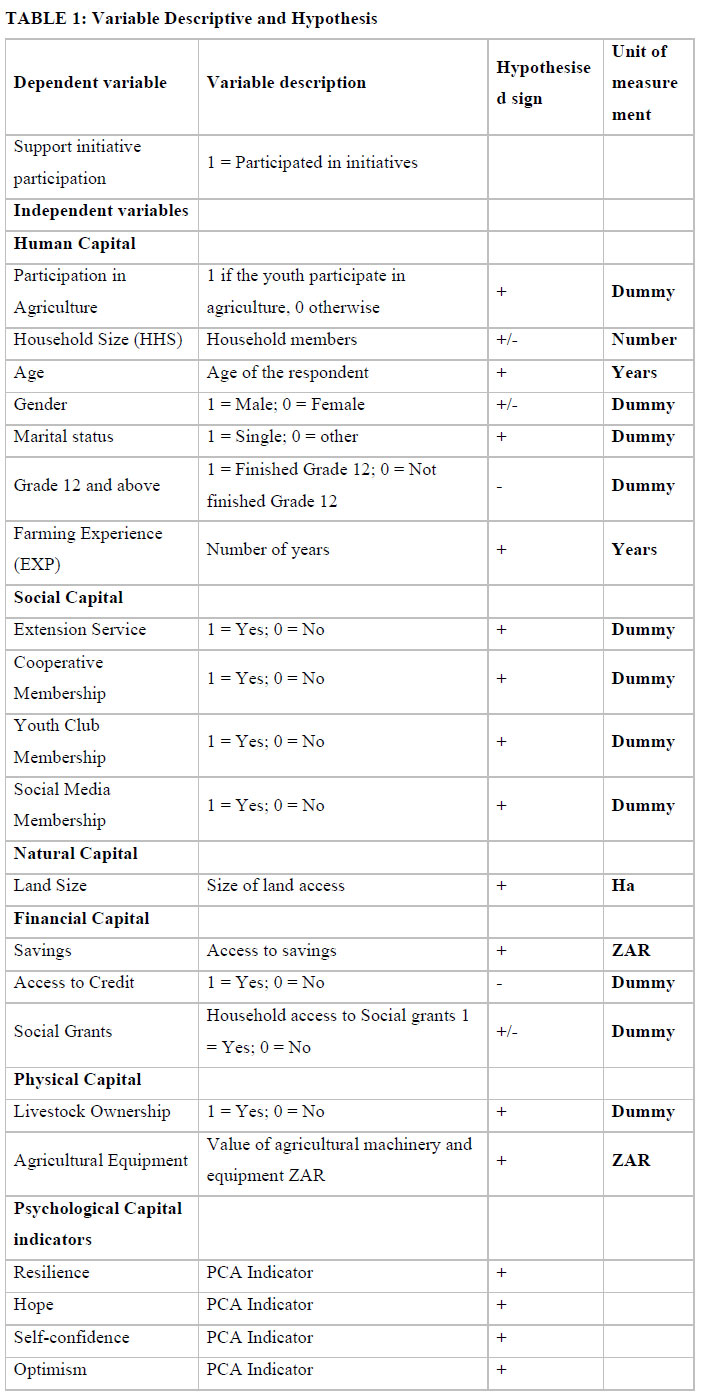
Support initiatives include agricultural support programmes and training, as well as financial, input, and equipment support. The dependent variable is based on two questions: "Have you received any farming or agricultural business-related short-term training?", and "Are you a beneficiary of any government youth/agricultural/rural development support programmes?" β0 is the coefficient (parameters) to be estimated, which measures the change in Y for a unit change in the explanatory variables, Xi represents the independent variables, and is the error term. The dependent and independent variables are reflected below in Table 1.
3. RESULTS
3.1. Descriptive Statistics
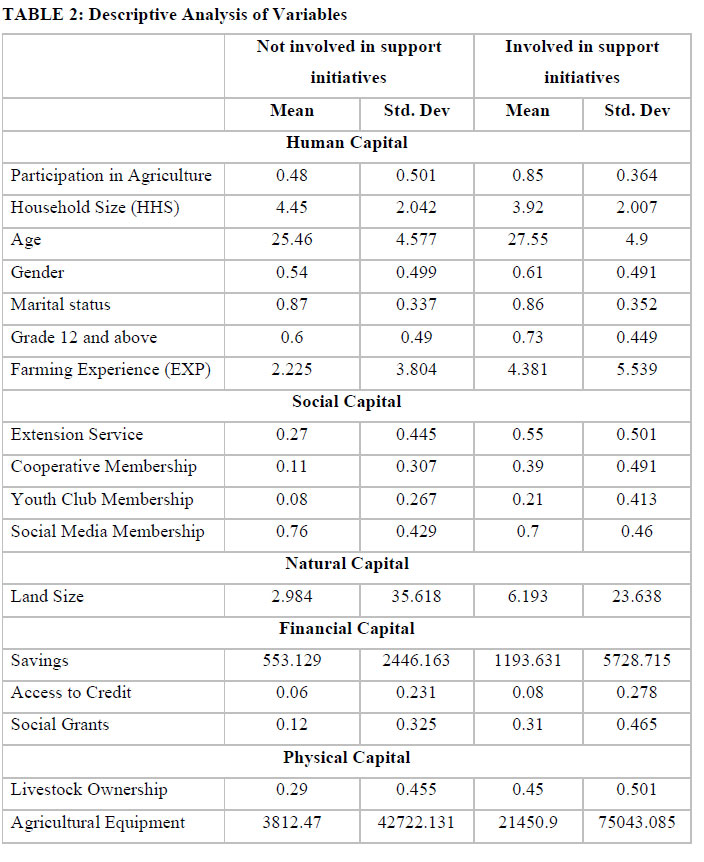
A total of 369 youth respondents were included in the research, comprising those participating in agricultural initiatives (84 or 23.2%) and those who had not participated in support initiatives (285 or 76.8%), as shown in Table 2. The participation statistics are consistent with and confirm previous indications of the low participation rate of youth in support initiatives (Jammer, 2020; Kising'u, 2016; Njenga, Mugo & Opiyo, 2013). Jammer (2020) reported a participation rate of 6% by respondents in government support programmes, while 12.9% had received training. An observation during the fieldwork for the research was that the youth's knowledge of the available support initiatives was limited. The importance of access to training as a support initiative is also emphasised in the research of Mkuna and Wale (2023). They found that 92% of their respondents required further training on their participation in agriculture.
Participation in agriculture was indicated to be full-time farming as an individual, part of a cooperative, or partially through family farming activities, and it was seen that 85% of the youth who had participated in support initiatives were also, at the time of the survey, participating in agricultural activities. However, the data shows that, of the youth who had not participated in support initiatives, only 48% were involved in agricultural activities. This illustrates that, in most cases, the youth who engage in and become beneficiaries of support initiatives are those involved in some form of agriculture.
The data shows that more males who were slightly older and from smaller households had participated in support initiatives. Most respondents who had participated in the research were single at the time of the survey. Most of the youth respondents had finished their schooling, indicating that the youth who had completed Grade 12 and/or furthered their education had been more involved in the support initiatives. Farming and agriculture-related experience (Exp) indicate that the youth participating in support initiatives had, on average, four years of experience in the agricultural sector, compared to the two years of experience of their counterparts who did not participate. The results could indicate that those involved for longer in the agricultural environment had seen or experienced the advantages of participating in these initiatives and continued to participate.
3.1.1. Social Capital
Extension services provide information and knowledge to farmers (AL-Sharafat, Altarawneh & Altahat, 2012); thus, they have an important role in providing access to and spreading information. The survey found that the youth who had participated in support initiatives also had contact with extension services (56%) compared to 27% of the youth who had not participated in support initiatives. This could indicate that communicating with extension officers or receiving extension services increases the chance of the youth participating in support initiatives.
The data reveals that 39% of the youth in a cooperative participated or were involved in support initiatives. This indicates that the youth who are members of cooperatives are more likely to participate in support initiatives. Mhembwe and Dube (2017) alluded that cooperatives allow individuals with the same goal to pool their resources to achieve the same goal. Being in a cooperative thus increases the possibility of youth gaining access to or owning livestock or land or starting with some form of production. It is, therefore, likely that the support initiatives will support the youth who are already engaged in agricultural activities.
Regarding youth club membership, only 21% of youth in youth clubs were currently participating in support initiatives at the time of the survey. In comparison, 7% of the youth in the youth clubs did not participate in support initiatives. These figures indicate that it is likely that the youth in youth clubs would participate, as opposed to those not in youth clubs. The variable for participating in social media shows that 70% of the youth would participate in support initiatives because of the general sharing of information and knowledge about the initiatives and agriculture. However, it is also indicated that 76% of youth participating in social media do not participate in support initiatives. This could result from youth lacking interest and knowledge about these initiatives. These social groups communicate and share knowledge and skills, increasing the possibility that the youth would seek and access support initiatives.
3.1.2. Financial Capital
Savings indicate the amount of money that the respondents can put aside and save for the future of their livelihoods or businesses. Savings can be done informally or formally (i.e., through financial institutions or stokvels). The data shows that an average of R1193.63 is saved by youth involved in support initiatives. In contrast, an average of R553.13 is saved by the youth who do not participate in support initiatives.
A small percentage of respondents were willing to take out a loan or credit, as only 8% took out a loan for those who participated in support initiatives, and only 6% of the non-participating youth participants. This indicates that most respondents participating in the initiatives were unwilling to take out credit or a loan and would participate in support initiatives instead. However, Etonihu (2010) states that it is difficult for the youth to access credit and loans due to their lack of collateral. Access to credit can impact the youth's ability to participate in support initiatives, as it could provide financial resources required to, for example, pay for transport to and from training.
An average of 30% of the youth who receive social grants and use the income for purchasing inputs participate in support initiatives, with only 11% not participating in support initiatives using social grants to buy inputs. These figures show that the respondents need assistance to continue their production activities. It also indicates that the youth view using social grants as an encouragement to access these initiatives. Mthethwa and Wale (2020) also state that despite the positive contribution of social grants, they also have a negative contribution towards societies by creating a possible entitlement and expectation, while there is also no actual means available to ensure the grants received are used for their intended purpose.
3.1.3. Natural Capital
Access and ownership of land are seen as one of the main factors that encourage youth to participate in agriculture and an essential factor that the support initiatives should provide (Kidido, Bugri & Kasanga, 2017). Youth who have participated in support initiatives had access to more land than those who have not participated previously in support initiatives. This shows that those youth who are participating are likely to need to access support initiatives to increase their production land capacity. It is expected that access to land could potentially influence youth participation in support initiatives.
3.1.4. Physical Capital
The data indicates that 45% of the youth who own livestock participate in support initiatives, while only 29% of the youth who own livestock do not participate in support initiatives. This reveals that youth with assets that can be used to improve their livelihoods are willing to participate in support initiatives to increase their income and reduce food insecurity.
The youth participating in support initiatives indicate access to or ownership of agricultural equipment with an average value of R 21 450.90. On the other hand, the youth who do not participate in agricultural support initiatives own or have access to agricultural equipment, with an average value of R 3 812.47. This indicates why it is necessary for those participating in initiatives to do so, as the equipment required for production is expensive. Some agricultural support initiatives support their recipients by providing equipment. The equipment reported by the youth included water tanks, trailers, planters, ploughs, and tractors.
3.2. Determining Youth Psychological Capital indicators
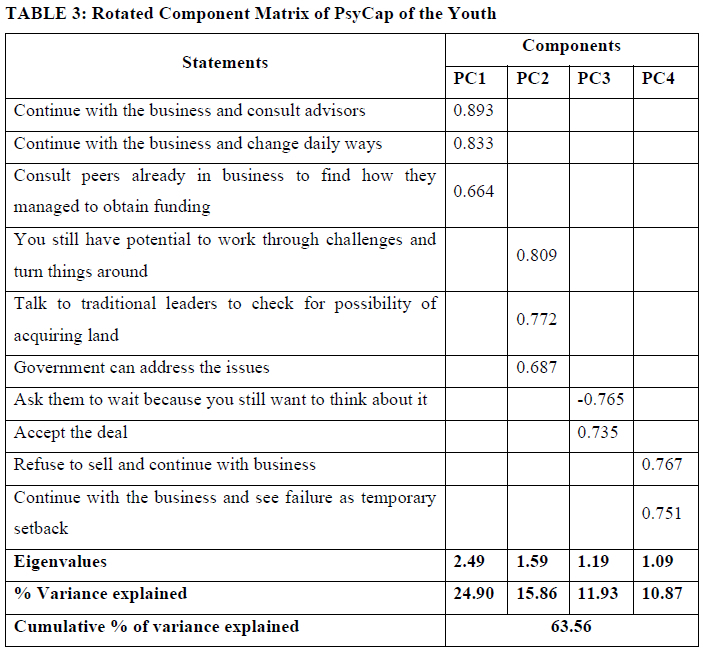
PsyCap is part of the MSLF, as Chipfupa suggested (2017). It is hypothesised that youth with higher levels of positive PsyCap have higher levels of participation in support initiatives. The PsyCap indicators were determined using a PCA and are represented by the obtained Principle Components (PCs), similar to the approach used by Chipfupa, Tagwi and Wale (2021). The PCA included Likert-scale responses (5-point) from eight questions, two each for Hope, Resilience, Self-efficacy and Optimism. Following the procedure explained in section 2.3.1, four components were extracted and retained using the eigenvalue rule. Given the eigenvalues rule of greater than one, the four extracted components explain 63.56% of the cumulative variance, as shown in Table 3. The PCA was found to be significant, as the KMO and the Bartlett Test of Sphericity were conducted, with the results showing that the KMO stands at 0.656 (66%), which is above the benchmark of 0.5. Therefore, the analysis can proceed, as the KMO complies with the PCA requirements. The Bartlett Test of Sphericity is significant, at a 1% significance level.
The first principal component (PC1) explains 24.90% of the variance and has an eigenvalue of 2.49. This component was named Resilience. These statements indicate respondents' willingness and strength to continue with their business, with consulting peers or advisors or without consulting peers or advisors, and to change their ways of running the business rather than giving up the business. Similar results were obtained by Madende et al. (2023) and Chipfupa and Tagwi (2021), who found youth to be resilient in the face of adversity in business. Resilient youth tend to continue participating in activities, even without immediate success. This indicates that the youth who are resilient enough will find ways and opportunities, such as support initiatives, that would enhance their chances of success. Thus, resilience could influence youth to participate in support initiatives by giving youth the impetus to reduce risk factors and seek a way to avoid or overcome the challenges they might face.
Component two (PC2) explains 15.86% of the variance, with an eigenvalue of 1.59. This component is renamed Hope. The component represents self-reliant youth who believe that the government and traditional leaders can address the problems of acquiring land and easing other constraints. These statements indicate that the respondents see ways of avoiding challenges to continue with the business. It is a mindset that youth have that support initiatives are available to assist them, and they can apply the initiatives to overcome their challenges.
Furthermore, the respondents hope the traditional leaders will assist with their challenges. The youth who are hopeful have a belief that the challenges they face can be resolved. Therefore, hope could influence youth to participate in the support initiatives, as it allows individuals to create new paths to goals and keeps them motivated to continue believing that they can achieve their goals. It can further be seen that hopeful youth are more encouraged to participate in initiatives to improve their livelihoods.
The third component (PC3) has a variance of 11.93% and an eigenvalue of 1.19. The statements show that self-efficacy increases the chances of an individual taking opportunities such as becoming a cooperative leader. This component indicates whether a youth would think about a discussion of accepting or rejecting the opportunity given. This suggests that the youth who believe in themselves can take on any challenge and overcome obstacles, leading to this component being named Self-confidence. This mindset shows that the youth who believe in themselves and their businesses would be influenced to enquire about and acquire support through support initiatives. Self-confidence influences participation in initiatives based on the youth's belief that they can carry out a course of action. It also encourages participation through performance-enhancing techniques.
The fourth component (PC4) explained 10.87% of the variance and had an eigenvalue of 1.09. The component was named Optimism. This implies accepting that there are times of failure, which could be temporary; instead of quitting and finding a new business, one can continue to anticipate positive outcomes. Although support initiatives might be available, the youth will not, in some cases, become beneficiaries of the initiatives, yet they still trust that they can be supported in the future. Furthermore, this indicates that the youth are optimistic and believe they can receive support from support initiatives. Optimism influences participation in support initiatives by enhancing an individual's self-esteem and giving encouragement to make difficult decisions. Optimistic youth have the attitude that their farms/businesses will succeed through participating in support initiatives.
3.3. Livelihood Assets and Psychological Capital Influence Towards Youth Participation in Agricultural Support Initiatives
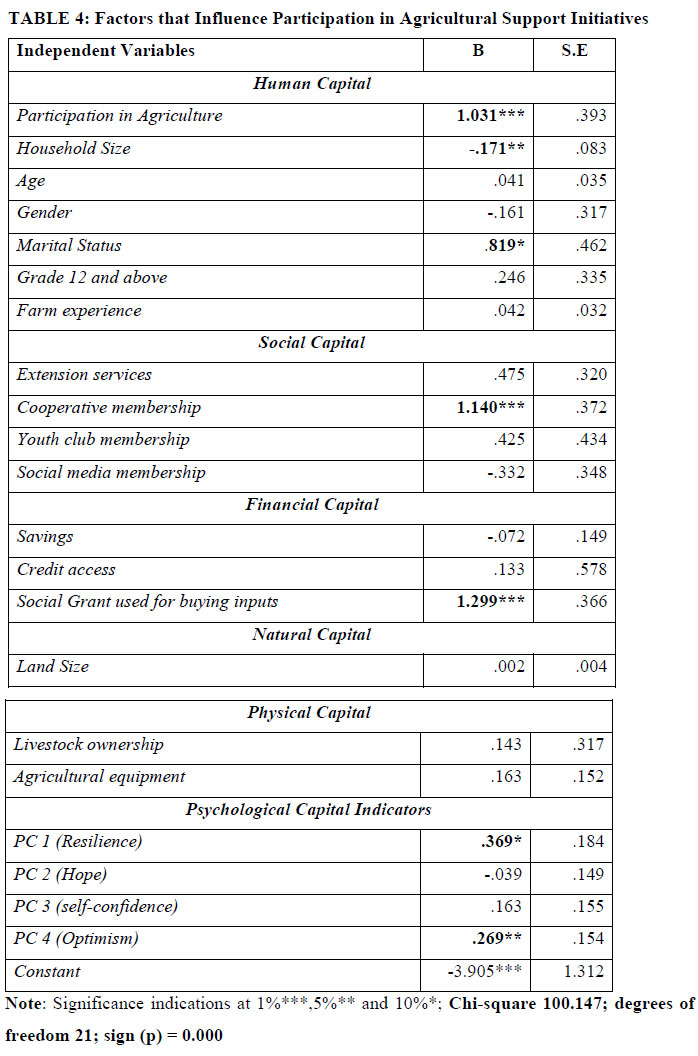
This study used a binary logit model to evaluate the influence of youths' access to assets within the MSLF towards participating in agricultural support initiatives. The results show that exogenous factors and endogenous factors are important to consider, supporting the notion of Iwara et al. (2021). For inputs, exogenous factors such as agricultural participation, household size, marital status, cooperative membership, and social grants were used. In contrast, endogenous factors, resilience, and optimism significantly influenced youth participation in support initiatives.
Agricultural participation was positively significant, at 1%, implying that youth already involved or participating in the sector are more likely to participate in support initiatives than those not currently involved. Those participating in agricultural activities are more likely to understand the importance of support initiatives. Prah et al. (2023) and Khoza et al. (2019) found a positive relationship between a farmer's experience in farming activities and participation in farmer support programmes. This is consistent with the hypothesis that youth are more likely to participate in the available support initiatives if they are already involved in the sector and have access to at least some agricultural resources. The youth participating in agriculture are more likely to search for and access support initiatives as they know the type of support (resources) and training required. The other aspect that could influence access to initiatives is the youth's communication with the local extension officers and networks. Although insignificant in the research, contact with extension services (0.475) suggests that regular contact with the services is required to attract youth to be involved in support initiatives. Frequent contact with extension bridges the information gaps on available support initiatives and can encourage participation (Prah et al., 2023). However, the support and training of the youth who do not participate in agriculture could differ from those who do, as these two distinct groups possess different attributes. These attributes range from experience, knowledge, mentorship, and general management skills. Therefore, support initiatives must also cater to youth not involved in agriculture, specifically regarding the relevant training and skills-transferring programmes.
Household size was negatively significant, at 5%. This indicates that youth from larger households are less likely to participate in agricultural support initiatives. Household heads are less likely to allow the youth to make decisions in larger households, including participating in agricultural support initiatives. The number of people dependent on the household head increases with the household size, reducing the influence of the youth in making decisions and thereby reducing their chances of participating in agricultural support initiatives. Smaller rural households are more likely to participate in agricultural support initiatives, as having a garden was identified as their primary source of income and a form of reducing food insecurity. A reason for this could be the need for more financial and other household resources to sustain themselves. Therefore, they opt for agriculture as a means of sustenance. However, this indicates the possibility of the household head being responsible for the decisions, limiting opportunities for youth respondents to introduce new ideas, such as participating in or seeking assistance from agricultural support initiatives. This finding contradicts Mogano's (2018) finding that greater households are more likely to access support initiatives. However, that study's focus was not only on youth. It focused on all ages (the average age was 62 years). This potentially indicates that youth from larger households are less likely to participate in the initiatives than older household members. This aspect should be further researched to ensure that the youth from all households, regardless of size, have access to and participate in the available agricultural support initiatives.
Marital status is positively significant, at a 10% level of significance. Single rural youth tend to have dependents that require them to inject support into the family using their income. Therefore, it suggests that single youth will be more likely to participate in agricultural support initiatives. However, Martey et al. (2013) argue that married household heads have more responsibilities, increasing their probability of participating in support initiatives. This could show that married youth are more likely to participate in support initiatives than those who are unmarried. A study by Martey et al. (2013) states that married individuals in households have more responsibilities, encouraging them to seek and participate in support initiatives to relieve the pressure, especially if they are keen on continuing to participate in agriculture.
Additionally, the financial security of a married household is crucial to them, and farming is perceived to achieve some level of security. Thus, households with married individuals would seek support initiatives to sustain their farming activities and achieve financial or food security. On the other hand, this study found that single youth are more likely to participate in support initiatives. It may be that single youth have similar responsibilities as married youth, such as sustaining the household's livelihood and caring for the family, and this may encourage youth to participate in support initiatives. There is also a possibility that single youth may have responsibilities that their income cannot adequately meet, which enables them to seek relief from the support initiatives. This is possibly the case when assuming that single youth are limited to one income for the household. Financial security is also important to households comprised of single individuals as they seek to remain financially stable. They also see farming as a tool for achieving this financial security, encouraging them to participate in support initiatives. The influence of marital status should thus be further considered in future research to clarify the relationship between marital status and participation in support initiatives.
Cooperative membership was positively significant (1%), implying that being part of a cooperative increases the possibility of accessing and receiving support from initiatives. This shows that the support initiatives are more likely to support cooperatives than individuals. A possible reason could be that the existing resources of cooperatives are pooled together, which creates greater access to aspects such as markets, financial institutions, and knowledge. This is supported by Sikwela and Mushunje (2013), who state that forming groups and creating cooperatives are vital to receiving aid faster than applying for support individually in South Africa and Sub-Saharan Africa. Also, support initiatives are mainly implemented for groups rather than individuals to manage transaction costs (Madende, Henning & Jordaan, 2023). This is consistent with Ortmann and King (2007), who state that cooperatives could be the instrument that would encourage youth to participate in support initiatives, specifically regarding training, which would be more beneficial for a group than an individual.
Conversely, youth not members of a cooperative would face the challenge of not having a formal structure through which to exchange information and knowledge about agriculture and, therefore, would have a lower prospect of accessing the support initiatives. Cooperatives could provide youth an advantage if they increase or enhance their participation in functional cooperatives to access support initiatives. Cooperatives are perceived to be more likely to achieve set goals than individuals, and therefore, cooperatives might be given preference for participating in support initiatives. Moreover, cooperatives are established as an initiative to help farmers overcome constraints, whereby they can show that they are willing to join forces to overcome potential challenges by pooling their resources (Ortmann & King, 2007). This, therefore, increases their possibility of being given preference for participating in support initiatives.
On the other hand, some disadvantages or problems identified by Ortmann and King (2007) might lead to cooperatives not being given preference for support initiatives. To illustrate, cooperatives in a state of internal conflict indicate a lack of unity among their members. This gives rise to the possibility that they would not be offered a place in support initiatives because of their internal conflict, which might arise due to older members not recognising younger individuals in the cooperative, leading to trust issues and, ultimately, withdrawal of the young members. The other disadvantage could be a negative track record of participation in support initiatives. This could be caused by their past misuse of resources and placing individual interests over the cooperative's interests. This raises the question of the role of cooperatives in attracting youth to participate in support initiatives and agriculture.
Social grants used to buy inputs were positively significant, at 1%. This result shows that households recognise social grants as a household income, which is unearned, according to Wale and Chipfupa (2018). These social grants are used to purchase agricultural inputs. This is consistent with August (2020), who stated that rural households use social grants to contribute to covering their farming costs. This indicates the need for support initiatives to be distributed to the youth dependent on social grants who are interested and willing to participate in agriculture and related activities. This further implies that the youth in households dependent on social grants are more likely to participate in support initiatives. Although many rural households depend on government social grants as a fixed income, they acknowledge that the social grants received are limited and cannot sustain all their food needs throughout the month. Therefore, they supplement their food supplies with food grown in their gardens, requiring support. In rural areas, social grants are linked to purchasing agricultural inputs, which is crucial to the success of agricultural activities. Thus, the youth from households dependent on social grants are more likely to seek support from the initiatives, as the social grants might be insufficient to cover the household needs and the needs of their agricultural activities, even though the social grants are a consistent source of income. Literature about the exact role that social grants play in the youth participating in support initiatives is scant. Therefore, the study could not investigate the exact topic in further detail. Nevertheless, Henning et al. (2022) found that youth from households receiving social grants are less likely to participate in the agricultural sector. Thus, Receiving grants could influence youths' willingness to participate in support initiatives and agriculture since the grants provide easy access to unearned money, as Wale and Chipfupa (2018) explained.
Resilience was positively significant, at 10%. These results are consistent with the expectation that youth who are resilient in the face of obstacles are more likely to participate in support initiatives. The youth who can continue with their businesses, even when facing setbacks, are willing to consult those with better knowledge, thereby increasing the chances of them receiving assistance from support initiatives. Moreover, the youth already involved in agriculture would be more likely to be interested and encouraged to apply for support, as they are more aware of past challenges and what they require to overcome those obstacles. Luthans and Youssef (2004) stated that resilience shows how one creates coping resources to manage trying situations successfully, and the resources that could be useful to them could include accessing and participating in support initiatives. There are some potential explanations for this. Resilient youth can overcome challenges and are flexible in seeking solutions, continuously seeking ways to get involved in support initiatives. In other words, they are more likely to use the support initiatives effectively, even amid challenges.
Additionally, resilient youth are flexible in their methods to succeed in their agricultural operations. These methods might range from seeking mentorship and expanding existing networks to constantly looking for relevant opportunities, increasing their chances of participating in support initiatives. Furthermore, resilient youth tend to participate in agriculture for longer, so they are likely to be preferred in support initiatives. This results in resilient youth being increasingly recognised by or involved in support initiatives.
A possible way to become resilient is to seek assistance from those who have overcome similar circumstances, who may thus provide the youth with assistance regarding any other challenges. In contrast, these results differ from those of Phakathi and Wale (2018), who argued that many rural farmers have high expectations of receiving handouts, resulting in them not trying to pursue the available opportunities. However, that study was not limited to youth, indicating that resilient youth could likely participate in support initiatives.
Optimism is positively significant, at a 5% level of significance. The result implies that the youth who are hopeful and confident about succeeding in the future are more likely to be willing to participate in support initiatives. This shows that, even if youth do not become beneficiaries of support initiatives, they stay positive and hopeful that, in the future, they will receive the support. As a result, they are persistent in seeking opportunities. Youth who are optimistic in search of opportunities become more exposed in terms of accessing information and networking with people who are exposed to the information and tend to be persistent even if they do not meet all the requirements of the support initiatives. These results are consistent with those of Etuk, Okorie, and Umoren (2018), whose findings indicate that a support programme improves self-belief and helps people stay optimistic.
Optimistic youth are more inclined to participate in support initiatives. This could be due to various reasons. For example, they should be hopeful and actively seek opportunities that increase their likelihood of receiving support. Additionally, their optimistic character exposes them to individuals and organisations with a broader network, enhancing their likelihood of gathering information about support initiatives. Since their optimistic nature allows them to expose themselves and their agricultural operations to a wider audience, the optimistic youth are more inclined to become members of associations. The increased exposure would benefit their growth, increasing their chances of engaging in support initiatives. As illustrated by Luthans et al. (2006), another aspect of optimistic youth is their persistent nature of being willing to participate in support initiatives, even though they do not meet the requirements for application. This also allows them to keep up with any changes (especially regarding the requirements) that may occur, thereby better positioning them to qualify for support later. Generally, optimism is a mindset that indicates how one reacts to failure and believes in achieving all their goals. These two mindsets play a key role in participation in support initiatives and participation in agriculture. These mindsets present a tool for the youth's decision-making (as explained above) that will encourage them to seek and access support initiatives.
4. CONCLUSIONS
Indications are that youth are not participating in support initiatives available to attract and enhance their participation in the agricultural sector. The study confirms this observation, as only 23.2% of the youth respondents participated in support initiatives. This aligns with Njenga et al. (2013) and Henning et al. (2022). Mkuna and Wale (2023) further indicated that smallholder farmers, who are part of support groups, depend on support programmes. The authors mentioned that although many of their respondents (90%) were part of water governance groups, 92% needed access to irrigation training. Support initiatives thus provide participants in the agricultural sector with important assistance in entering or maintaining their operations within the agricultural sector.
Results from the research showed that agricultural participation and access to certain resources are closely linked to accessing support initiatives. The results guide where efforts should be aimed to enhance or attract youth participation in the agricultural sector. Certain support initiatives precondition access to or ownership of resources such as land and financial capital to accept individuals or groups as beneficiaries of the initiatives. Thus, youth engaged in agriculture or related activities are more likely to participate in the available initiatives. This places the youth not involved in agriculture at a disadvantage as the limited participation in agricultural activities might be attributed to a lack of these preconditioned resources. Using agriculture for employment and poverty reduction is counterproductive if youths who are not involved are excluded from support initiatives. Therefore, these initiatives should also consider the youth not involved in the sector and their lack of resources, allowing them to access the much-needed support to engage in agricultural activities. This will enhance overall participation in the sector and reduce unemployment. There is a need for initiatives for youth who would like to start new endeavours in the agricultural sector and currently have minimal to no resources. Secondly, it is also suggested that the youth should not rely only on the support provided. Instead, they should take their future into their own hands, using their endogenous resources, and consider self-help strategies to access certain resources while complimenting their efforts with possible support from these initiatives. This could include showcasing the agricultural sector as an innovative, technological-driven sector with opportunities to establish its own businesses, as Girdziute et al. (2022) suggested.
Income and dependency are influential in affirming that large households are less likely to engage in support initiatives. To illustrate, previous research (e.g., Sinyolo, Mudhara & Wale, 2016) shows that larger households have the potential (given a good situation) to offer more resources in terms of income, reducing their need for support initiatives. One aspect being considered is the occupations of the various household members that contribute to the household size. It could prove detrimental to youth seeking support from the initiatives if they are in large households that consist of people who are unemployed or less interested in agriculture. If the opposite is true, the need for support initiatives also increases. Few studies have been found that explore household size in terms of the family dynamics that could influence the lower participation of large households in agricultural support initiatives. Therefore, it is imperative to understand whether household size impacts youth participating in support initiatives, as larger households also have the potential for more income from grants. Receiving grant money from households was found to contribute towards participating in support initiatives. This could be due to the youth from these households being aware of and using the unearned income to support their farming operations. As Wale and Chipfupa (2018) mentioned, unearned income could hinder enhancing participation in the agricultural sector. This is, however, also an aspect which requires further investigation. The findings from the research suggest interventions should be developed to specifically address the needs of youth not involved in the sector with limited access to resources. Secondly, the policies should motivate youth to achieve self-sustainability in their operations and not depend on unearned money such as grants. These will contribute towards achieving the overall objective of reducing youth unemployment through youth participation in the agricultural sector.
5. USE OF AI TOOLS DECLARATION
The authors declare they have not used Artificial Intelligence (AI) tools in creating this article.
7. INSTITUTIONAL REVIEW BOARD STATEMENT
The study protocol was approved by the Institutional Review Board (or Ethics Committee) of the University of the Free State (UFS-HSD 2018/0947).
8. INFORMED CONSENT STATEMENT
Informed consent was obtained from all subjects involved in the study.
The authors declare no conflict of interest.
6. ACKNOWLEDGEMENTS
This research was funded by the Water Research Commission (WRC) of South Africa and the Department of Agriculture, Land Reform and Rural Development (DALRRD), grant number K5/2789//4.
REFERENCES
- ABDI, H. & WILLIAMS, L.J., 2010. Principal Component Analysis. Wiley Interdisciplinary Reviews: Computational Statistics.
- ADEYANJU, D.F., 2019. Impact of agricultural training programmes on youth agripreneurship performance and empowerment in Nigeria. Master's thesis. University of Nairobi.
- AKPAN, S.B., PATRICK, I.V., JAMES, S.U. & AGOM, D.I., 2015. Determinants of decision and participation of rural youth in agricultural production: A case study of youth in southern region of Nigeria. Russ. J. Agric. Soc.Econ. Sci., 43(7): 35-48.
- AL-SHARAFAT, A., ALTARAWNEH, M. & ALTAHAT, E., 2012. Effectiveness of agricultural extension activities. Am J Agric Biol Sci., 7(2): 194-200.
- AUGUST, M.M., 2020. Youths' Aspirations and perceptions towards agricultural participation: A Case of Two Free State Regions. Master's thesis. University of the Free State, South Africa.
- AUTA, S., ABDULLAHI, Y. & NASIRU, M., 2010. Rural youths' participation in agriculture: Prospects, challenges and the implications for policy in Nigeria. J. Agric. Educ. Ext., 16(3): 297-307.
- BAFFOE, G. & MATSUDA, H., 2018. A perception-based estimation of the ecological impacts of livelihood activities: The case of rural Ghana. Ecol. Indic., 93: 424-433.
- BAHTA, Y.T., 2022. Social vulnerability to agricultural drought: Insights from Northern Cape, South Africa. Sci. Afr., 17: e01324.
- CHETENI, P., 2016. Youth participation in agriculture in the Nkonkobe District Municipality, South Africa. J Hum Ecol., 55(3): 207-213.
- CHIPFUPA, U., 2017. Entrepreneurial development pathways for smallholder irrigation farming in KwaZulu-Natal: typologies, aspirations and preferences. Doctoral dissertation. University of KwaZulu-Natal.
- CHIPFUPA, U. & TAGWI, A., 2021. Youth's participation in agriculture: A fallacy or achievable possibility? Evidence from Rural South Africa. S. Afr. J. Econ. Manag. Sci., 24(1): 1-12.
- CHIPFUPA, U., TAGWI, A. & WALE, E., 2021. Psychological capital and climate change adaptation: Empirical evidence from smallholder farmers in South Africa. Jamba: J. Disaster Risk Stud., 3(1): a1061.
- CULBERTSON, S.S, FULLAGAR, C.J. & MILLS, M.J., 2010. Feeling good and doing great: The relationship between psychological capital and well-being. J. Occup. Health Psychol., 15(4): 421.
- DAUDU, A.K., ABDOULAYE, T., BAMBA, Z., SHUAIB, S.B. & AWOTIDE, B.A. 2023. Does youth participation in the farming program impact farm productivity and household welfare? Evidence from Nigeria. Heliyon., 9(4).
- ETONIHU, I.K., 2010. Farmers' Accessibility to Agricultural Credit for Crop Production in Doma Local Government Area of Nasarawa State, Nigeria. Unpublished B. Agric Project, Faculty of Agriculture. Nasarawa State University, Keffi, Nigeria.
-
ETUK, U.R., OKORIE, N. & UMOREN, E., 2018. Analysis of youth participation in community development activities of West Africa agricultural productivity programme in Akwa Ibom State Nigeria. Niger. J. Rural. Social., 18(1). 10.22004/ag.econ.287617
» https://doi.org/10.22004/ag.econ.287617 - GIRDZIUTE, L., BESUSPARIENE, E., NAUSEDIENE, A., NOVIKOVA, A., LEPPALA, J. & JAKOB, M., 2022. Youth's (un) willingness to work in Agriculture Sector. Front Public Health., 10: 937657.
- GUJARATI, D., 2003. Basic econometrics. edn. New York: The McGrowth Hill Companies.
- HENNING, J.I.F., JAMMER, B.D. & JORDAAN, H., 2022. Youth participation in agriculture, accounting for entrepreneurial dimensions. South. Afr. J. Entrep. Small Bus. Manag., 14(1): 14.
- HENNING, J.I.F., JORDAAN, H., MADENDE, P., JAMMER, B.D., AUGUST, M.M. & SONGCA, S.S., 2024. Entrepreneurial development for establishing small farming businesses and employment by youth in rain-fed crop farming: Free State Province Case Study. WRC Report No. 2789/2/23.January 2024. Pretoria: Water Research Commission.
- HENNING, J.I.F., MATTHEWS, N., AUGUST, M. & MADENDE, P., 2022. Youths' perceptions and aspiration towards participating in the agricultural sector: A South African Case Study. Soc. Sci. (Basel)., 11(5): 215.
- IWARA, I.O., KILONZO, B.M., ZUWARIMWE, J. & NETSHANDAMA, V.O., 2021, 'Entrepreneurs' endogenous attributes necessary for small enterprise success in Vhembe Rural Areas, South Africa'. South. Afr.J. Entrep. Small Bus. Manag., 13(1): a331.
- JAMMER, B.D., 2020. Determining youth entrepreneurial competencies in two rural areas of the Free State Province. Master's thesis. University of the Free State, South Africa.
- KHAPAYI, M. & CELLIERS, P., 2016. Factors Limiting and Preventing Emerging Farmers to Progress to Commercial Agricultural Farming in the King William's Town Area of the Eastern Cape Province, South Africa. S. Afr. J.Agric. Ext., 44(1): 25-41.
- KHOZA, T.M., SENYOLO, G.M., MMBENGWA, V.M., SOUNDY, P. & SINNETT, D., 2019. Socio-Economic factors influencing smallholder farmers' decision to participate in agro- processing industry in Gauteng Province, South Africa. Cogent Soc. Sci., 5(1): 114.
- KIDIDO, J.K., BUGRI, J.T. & KASANGA, R.K., 2017. Dynamics of youth access to agricultural land under the customary tenure regime in the techiman traditional area of Ghana. Land Use Policy., 60: 254-266.
- KISING'U, J.M., 2016. Factors influencing youth participation in agricultural value chain projects in Kenya: A case of Kathiani Sub-county, Machakos County, Kenya. Master's thesis. University of Nairobi.
- LUTHANS, F. & YOUSSEF, C.M., 2004. Human, social, and now positive psychological capital management: Investing in people for competitive advantage. J. Organ. Dyn., 33(2): 143-160.
- LUTHANS, F., AVEY, J.B., AVOLIO, B.J., NORMAN, S.M. & COMBS, G.M., 2006. Psychological capital development: Toward a micro-intervention. J. Organ. Behav., 27(3): 387-393.
- MADENDE, P., HENNING, J.I.F. & JORDAAN, H., 2023. Accounting for heterogeneity among youth: A missing link in enhancing youth participation in agriculture-A South African Case Study. Sustain., 15(6): 4981.
- MARTEY, E., WIREDU, A.N., ASANTE, B.O., WILSON, K., ATTOH, D.C. & AL-HASSAN, R.M., 2013. Factors influencing participation in rice development projects: The case of smallholder rice farmers in Northern Ghana. UK: European Centre for Research Training and Development.
- MBANASO, E.O., AJAYI A.R., IRONKWE, A.G. & ONUNKA, N.A., 2013. Appraisal of young farmers' club programme in Abia State, Nigeria. J. Agric. and Social Res., 13(1): 31-38.
- MHEMBWE, S. & DUBE, E., 2017. The role of cooperatives in sustaining the livelihoods of rural communities: The case of rural cooperatives in Shurugwi District, Zimbabwe. Jamba: J. Disaster Risk Stud., 9(1): 1-9.
- MKUNA, E. & WALE, E., 2023. Smallholder Farmers' choice of irrigation systems: Empirical Evidence from Kwazulu-Natal, South Africa and its implications. Sci. Afr., 20: e01688.
- MOGANO, M.W., 2018. Socio-economic factors as determinants of access to input subsidy: The case of smallholder farmers of Polokwane Municipality. Master's thesis. University of the Free State, South Africa.
- MTHETHWA, S. & WALE, E., 2020. Household vulnerability to food insecurity in rural South Africa: Evidence from a nationally representative survey data. Int. J. Environ. Res. Public Health., 18(4): 1917.
- NAAMWINTOME, B.A. & BAGSON, E., 2013. Youth in agriculture: Prospects and challenges in the Sissala area of Ghana. Net Journals., 1(2): 60-68.
- NCHABELENG, M.J., 2016. Assessing the impact of the department of agriculture farm together programme on development and growth of selected agricultural cooperatives in Capricorn District Municipality in Limpopo Province. Master's thesis. University of Limpopo, South Africa.
- NIEUWOUDT, S., HENNING, J.I.F. & JORDAAN, H., 2017. Entrepreneurial competencies and financial performance of farmers in South Africa. S. Afr. J. Econ. Manag. Sci., 20(1): a1640.
-
NJENGA, P., MUGO, F. & OPIYO, R., 2013. Youth and women empowerment through agriculture in Kenya. Nairobi: Voluntary Service Overseas (VSO Jitolee). Available from: https://agritech.tnau.ac.in/ta/women_in_agri/pdf/articles/youth-and-women-empowerment-through-agriculture-2013.pdf.
» https://agritech.tnau.ac.in/ta/women_in_agri/pdf/articles/youth-and-women-empowerment-through-agriculture-2013.pdf - NYAM, Y.S., BAHTA, Y.T., ODUNIYI, O.S. & MATTHEWS, N., 2022. Smallholder sheep farmers' perception of production constraints and competitiveness strategies in South Africa. Sci. Afr., 16: e01192.
- ORTMANN, G.F. & KING, P., 2007. Agricultural cooperatives I: History, theory and problems. Agrekon., 46(1): 40-68.
- PHAKATHI, S. & WALE, E., 2018. Explaining variation in the economic value of irrigation water using psychological capital: A case study from Ndumo B and Makhathini, KwaZulu-Natal, South Africa. Water SA., 44(4): 664-673.
- PHAKATHI, S., 2016. Small-scale irrigation water use productivity and its role in diversifying rural livelihood options: Case Studies from Ndumo B and Makhathini Irrigation Schemes, KwaZulu-Natal, South Africa. Master's thesis. University of KwaZulu-Natal.
- PIENAAR, P.L., 2013. Typology of smallholder farming in South Africa's former homelands: Towards an appropriate classification system. Doctoral thesis. Stellenbosch University, South Africa.
- PRAH, S., ASANTE, B.O., AIDOO, R., MENSAH, J.O. & NIMOH, F., 2023. Impact of agricultural policy intervention on yield and profitability of maize farmers: The case of planting for food and jobs (PFJ) programme in Ghana. Cogent Food Agric., 9(1): 2249928.
- SIKWELA, M.M. & MUSHUNJE, A., 2013.The impact of farmer support programmes on household income and sustainability in smallholder production: A case study of Eastern Cape and KwaZulu-Natal, South Africa. Afr. J. Agric. Res., 8(21): 2502-2511.
- SIKWELA, M.M., 2013. The impact of farmer support programmes on market access of smallholder farmers in the Eastern Cape and KwaZulu-Natal Provinces, South Africa. Doctoral thesis. University of Fort Hare, Alice.
- SINYOLO, S., MUDHARA, M. & WALE, E., 2016. Assessing the impact of social grant-dependency on participation of KwaZulu-Natal rural households in farming: Application of the generalised propensity score method. J. Agric. Rural Dev. Trop. Subtrop., 118(2): 233-244.
-
STATISTICS SOUTH AFRICA., 2019. Mid-year Population Estimates. Available from: https://www.statssa.gov.za/publications/P0302/P03022019.pdf.
» https://www.statssa.gov.za/publications/P0302/P03022019.pdf -
TRADING ECONOMICS., 2021. South African Youth Unemployment Rate. Available from: radingeconomics.com/south-africa/youth-unemploymentrate#:~:text=Youth%20Unemployment%20Rate%20in%20South%20Africa%20averaged%2054.21%20percent%20from,the%20fourth%20quarter%20of%202014.
» radingeconomics.com/south-africa/youth-unemploymentrate#:~:text=Youth%20Unemployment%20Rate%20in%20South%20Africa%20averaged%2054.21%20percent%20from,the%20fourth%20quarter%20of%202014 -
TRADING ECONOMICS., 2023. South African Youth Unemployment Rate. Available from: https://tradingeconomics.com/south-africa/youth-unemployment-rate.
» https://tradingeconomics.com/south-africa/youth-unemployment-rate - UDOH, E.J., AKPAN, S.B. & UKO, E.F., 2017. Assessment of sustainable livelihood assets of farming households in Akwa Ibom State, Nigeria. J. Sustain. Dev., 10(4).
- WALE, E.Z. & CHIPFUPA, U., 2018. Appropriate entrepreneurial development paths for homestead food gardening and smallholder irrigation crop farming in KwaZulu-Natal Province. WRC Report No. 2278/1/18. Pretoria: Water Research Commission.
- WILLIAMS, B., BROWN, T. & ONSMAN, A., 2012. Exploratory factor analysis: A five-step guide for novices. Australas. J. Paramed., 8(3): 01.
- WOOLARD, I., 2013. The youth unemployment problem in South Africa within the international context. SALDRU, University of Cape Town.
- YANG, L., LIU, M., MIN, Q. & LI, W., 2018. Specialization or diversification? The situation and transition of households' livelihood in agricultural heritage systems. Int J Agric Sustain., 16(6): 455-471.
- YEUNG, K.Y. & RUZZO, W.L., 2001. Principal component analysis for clustering gene expression data. Bioinformatics., 17(9): 763-774.
- ZAMXAKA, X., 2015. Factors affecting participation rates in farming in the rural areas of South Africa. Case of Amathole District Municipality. Master's thesis. University of Fort Hare Alice, South Africa.