Determinants of Smallholder Farmers' Perceptions of Biochar: A Case Study for Okhahlamba Local Municipality
Abstract
Globally, biochar technology has gained recognition as a key tool in mitigating climate change and achieving food security. When farmers understand the benefits of biochar, they can adopt the technology and reap its potential benefits. Therefore, this study aimed to assess farmers' perceptions of biochar, including its production, agronomic benefits, climate change mitigation effects, and access to information using primary data from 265 smallholder farmers in the Okhahlamba Local Municipality. Principal component analysis and multiple regression models were employed to analyse the data. The study found that age, farm size, livestock size, access to extension services, number of schooling years, household size, principal occupation, cooperative membership, awareness of biochar, knowledge of biochar, and training were statistically significant determinants of perceptions of biochar technology. The study recommends the development of clear and accessible communication channels between researchers and farmers to convey the benefits of biochar technology. Cooperatives can play a vital role in bridging the gap in access to biochar information. Education and outreach programs can educate farmers about the production, usage, and potential positive effects of biochar technology. Further evidence of the benefits of the technology can contribute to the integration of biochar into agricultural, environmental, and sustainability policies and strategies, which can lead to production and food security among small-scale farmers.
Biochar; Principal Component Analysis; Multiple Regression Model; Sustainability; Okhahlamba Local Municipality
1. INTRODUCTION
Climate change and food security are some of the most pressing global issues. The former has an unfavourable impact on the latter (El Bilali et al., 2020). The core definition of food security is that food security exists when all people, at all times, have physical, social, and economic access to sufficient, safe, and nutritious food to meet their dietary needs and food preferences for an active and healthy life (Food and Agriculture Organisation [FAO], 2009). The extended version of food security integrates the evolving two dimensions of agency and resilience, highlighting that food security is not only about cost and affordability (access), utilisation, availability, and stability (FAO, 2024). Food security is at the core of the United Nations' (UN) Sustainable Development Goals (SDGs) for 2030. SDGs 1 and 2, "End poverty in all its forms everywhere," and "End hunger, achieve food security and improved nutrition and promote sustainable agriculture," respectively (UN, 2015).
Despite considerable efforts to achieve SDGs 1 and 2, food insecurity remains a challenging issue (FAO, 2024; El Bilali et al., 2020). Climate change is one of the major contributors to food insecurity. It directly impacts the degradation of natural resources such as land, water, and key production inputs (Cadro et al., 2019; Dimitrov, 2019). As climate change becomes prominent, soil degradation, floods that damage crops, and droughts become more pronounced. Climate change affects all dimensions of food security, as it undermines crop production and the productivity of fish and livestock. This effect is much more pronounced in Sub-Saharan Africa (SSA), where the world's most food-insecure live (Akinseye et al., 2020; Williams et al., 2018). The livelihoods of smallholder farmers, who have limited production resources, are exposed to various production risks, and depend heavily on agriculture for their livelihoods, are the most vulnerable (Maja & Ayano et al., 2021). The adverse effects of climate change are more precarious under rain-fed conditions due to the region's vulnerability to droughts (Muchuru & Nhamo, 2019).
Zougmoré et al. (2018) warn that without suitable measures to mitigate climate change, it will continue to affect agricultural yields and food security and contribute to SSA's already dire poverty levels. Caution has been raised regarding stringent climate change mitigation measures, as they may increase the SSA's food insecurity risk by indirectly affecting the prices and supply of agricultural commodities (Hasegawa et al., 2018). El Bilali et al. (2020) proposed that mitigation measures should strike a balance between socioeconomic development, including food security, and environmental conservation. In the same regard, Mnukwa et al. (2025) highlighted that food and agriculture must be central to global efforts to adapt to climate change through policies and actions that address vulnerabilities and risks and promote sustainable agricultural systems. Combating climate change through innovative solutions is imperative for ensuring food security. Biochar is one such method.
Biochar is a product made from the burning of waste materials of plant origin (wood, weeds, and crop residues) or any organic compound (animal wastes) through the pyrolysis process (Gebremedhin et al., 2015). Biochar is purposefully applied to soils to enhance their properties (Lehmann & Joseph, 2015). The carbonised material improves soil by converting waste agricultural materials into soil enhancers that can hold carbon, enabling soils to be more fertile and enhancing crop yields, livelihoods, and maintaining cropland diversity (Gebremedhin et al., 2015; Scholz et al., 2014). Biochar technology, as a soil ameliorant, offers plausible benefits for smallholder farmers. To adapt to climate change and improve food security, producers have adopted production systems that increase greenhouse gas emissions and compromise soil health (Maja & Ayano, 2021). Measures taken to ensure food security have exacerbated the problem of climate change. Biochar properties have the potential to mitigate climate change through carbon sequestration, amend soils, and assist in bringing them to optimum production, thereby potentially leading to higher primary productivity. The improved agricultural performance is likely to reduce economic pressure to convert native lands to agricultural production (Fidel et al., 2019). Biochar application in cropping can contribute to meeting SDGs 1 and 2. However, most research on biochar has focused on the biophysical aspects, such as its effects on yields and impact on carbon sequestration (Jeffery et al., 2015; Lehmann & Joseph, 2015).
There has been little research on the social acceptance of biochar among farmers and farmers' perceptions and knowledge of biochar globally. Farmers' perceptions of biochar determine whether they will adopt the technology. Thus, it directly affects the technology's potential to improve food security. Furthermore, the successful deployment of biochar depends on farmers' perceptions of the technology. Socioeconomic concerns exist regarding biochar, and its acceptance is limited. Some studies, such as Sherman (2022), Karim and Islam (2018), Latawiec et al. (2017), and Bjerregaard and Georg (2011), have assessed farmers' knowledge of biochar. These studies generally indicated that farmers have limited knowledge of biochar, attributed to their limited contact with extension services, which restricts farmers' access and exposure to the technology. Due to limited knowledge of biochar, its adoption was low in the study areas. Rogers et al. (2022), Mahmoud et al. (2021), and Sutradhar et al. (2021) assessed farmers' perceptions of biochar and showed that farmers had positive perceptions of it. The studies showed that farmers' socioeconomic characteristics influenced their perceptions of biochar. Social and cultural norms also influenced farmers' perceptions of biochar (Eltigani et al, 2022; Sutradhar et al, 2021).
In the case of South Africa, research has been conducted on the biophysical aspects of biochar (Sparrevik et al., 2015; Sika & Hardie, 2014; Sohi et al., 2009); however, socio-economic aspects, including farmers' perceptions of biochar, have not been assessed. Farmers' perceptions and understanding of the socioeconomic impacts of biochar are essential for adopting the technology (Latawiec et al., 2017). Farmers' perceptions are critical for adopting new technologies or innovations (Karim & Islam, 2018). The adoption rate depends on potential adopters' knowledge and perceptions of the product attributes (Mahmoud et al., 2021). Understanding potential adopters' perceptions and characteristics that influence their decision to adopt biochar is essential for successfully disseminating the technology in various socioeconomic settings and ensuring its long-term success.
This paper aims to contribute to the literature by assessing the perceptions of smallholder farmers regarding biochar. To the authors' knowledge, no other research in South Africa has investigated smallholder farmers' perceptions of biochar. Results from this study will highlight whether there is potential for a biochar market and whether farmers can produce it. The results will also contribute to informing strategies to support the production or adoption of biochar. Lastly, the findings will highlight farmers' knowledge and perceptions of biochar, how their perceptions affect adoption, and which factors determine their perceptions.
2. METHODOLOGY
2.1. Data Sampling Procedure
A sample selected using a random sampling technique collected data from smallholder households from the Emazizini, Amangwane, and Amaswazi communities in Okhahlamba Local Municipality (OLM). This sampling technique ensured that all households, not just those who had attended the biochar workshops, had an equal chance of being chosen. Although some smallholder farmers participated in biochar workshops, the sampling was open to all farmers, reducing selection bias and improving the generalisability of the results.
The biochar project was a field trial that involved the planting of maize at different input levels. Some plots included planting maize with biochar and fertiliser at various levels, planting using biochar and manure at multiple levels, planting using fertiliser only, planting using manure only, and growing using biochar only. A structured questionnaire, administered by trained enumerators, collected farmers' perceptions of biochar and their socioeconomic characteristics. This data collection was superior to focus groups, phone interviews, and email questionnaires as it allows for a faster response rate and more complete responses. Additionally, focus group discussions aim to gather data from a purposely selected group of individuals rather than from a statistically representative sample of a broader population (Bhandari & Hallowell, 2021). Moreover, it eliminates the inherent biases that arise from focus groups (Mukherjee et al., 2015).
The questionnaire was in isiZulu because most farmers understood the language better than English. A standardised questionnaire was used to collect data from all study areas, ensuring consistency in the information collected throughout the study. Data collected from smallholder farmers included their socioeconomic characteristics and household demographic information, such as the number of people living in the household, gender, and years of farming experience. Farmers answered questions about their knowledge and perceptions of various aspects of biochar, their contact with extension services, sources of information, feedstock utilisation, and access. Although a representative sample size of the population was 377, due to farmers' availability and willingness to participate, 265 households were interviewed. Since only available and willing farmers had their data collected, we acknowledge that this study may be prone to participation bias.
2.1.1. Sample Size Determination
In 2016, 29510 households lived in OLM (Municipalities South Africa, 2016). Approximately 21.6% of households in KZN were involved in some agricultural production activity during the reference period (Statistics South Africa, 2020). Of those engaged in farming, 38.6% are in crop farming. The study employed the Toro Yamane sample size formula to calculate a representative population sample size.
Equation
1 shows the Toro Yamane formula:

Where:
N= population size
e = error term
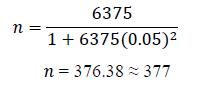
Therefore, a random sample of 377 households is sufficient to give the 95% confidence interval.
2.2. Principal Components Analysis
Principal Components Analysis is a method initially developed by Pearson (1901) and Hotelling (1933), with modifications by Jolliffe (2002). Principal Components Analysis (PCA) aims to reduce the dimensionality of multivariate data while retaining sufficient and relevant information in the dataset (Sewell, 2008; Jolliffe, 2002). Principal Components Analysis is a linear transformation that converts data to a new coordinate system, transforming the variables into linear functions of the original variables, which are uncorrelated (Sewell, 2008). Principal components (PCs) are arranged in descending order, so the first contains the most variation, and the last includes the least deviation (Jolliffe, 2002). Additionally, the measure to be maximised is the variance (Sewell, 2008). Principal Components Analysis produces independent, uncorrelated features of the data. The study respondents ranked their perceptions of biochar. A 5-point Likert scale (ranging from 1 to 5) was used, with 1 indicating "strongly disagree" and 5 indicating "strongly agree". The questionnaire had nineteen questions about farmers' perceptions of biochar technology. The participants were asked to rank their perceptions of the effects of climate change mitigation, production costs, agronomic benefits, and information about biochar. The 5-point Likert scale is essential as individuals may not feel the same way about a particular aspect of biochar. For example, one farmer may think that biochar production is time-consuming, but they may be satisfied with the yields realised. This means that farmers' perceptions are subjective. Principal components analysis was used to derive indices for farmers' perceptions of biochar. The generated indices were used as dependent variables in the multiple regression model to determine the factors influencing farmers' perceptions about biochar technology.
2.3. Multiple Regression Model
The generated PCs from the PCA were used as dependent variables in Equation 1 below:

Y*i is a latent variable representing the HGI index, X is a vector of explanatory variables, β is a vector of the estimated parameter coefficients, and ui is the vector of independently and normally distributed residuals with a common variance.
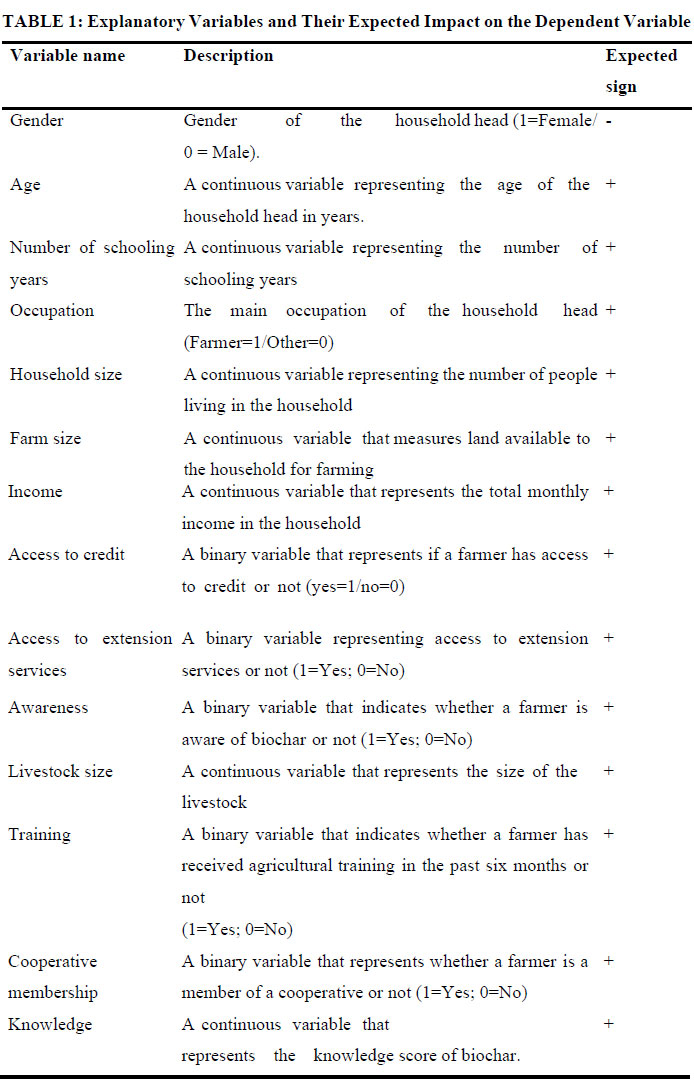
Table 1 explains the explanatory variables used in the regression models.
3. RESULTS AND DISCUSSION
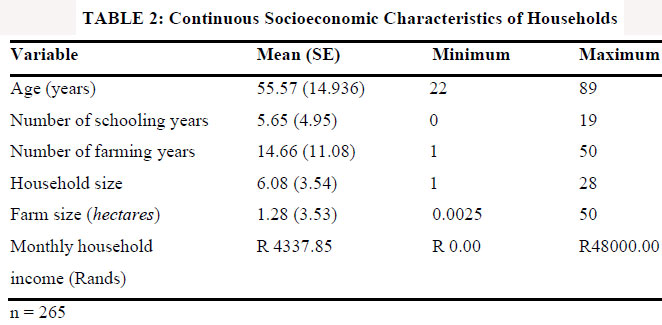
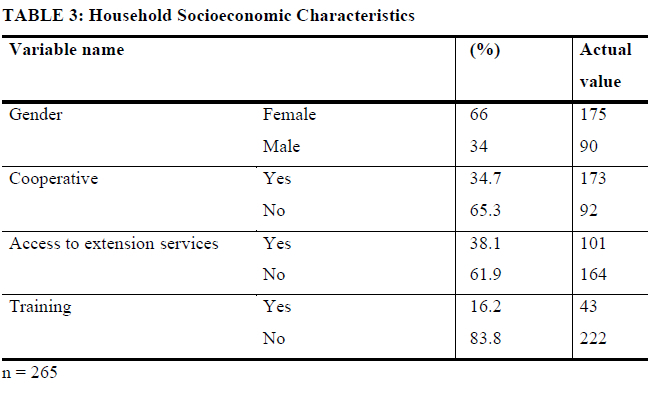
Descriptive statistics included percentages (%), standard deviations (SD), means, and maximum values. The study participants were primarily female household heads (66%), with 34% being male household heads. The average age of the household head was 55.57 years, the average number of schooling years was 5.65, and the average household had 6.08 people. The average number of farming years was 14.66, and the average farm size was 1.28 hectares. About 34.7% of the respondents were part of a cooperative, 38.1% had access to extension services, and 16.2% had received agricultural training in the past six months. Ongoing agricultural training can enhance farmers' openness to adopting new technologies and keep them up to date. Tables 2 and 3 present the descriptive statistics.
3.1. Principal Components Analysis of Farmers' Perceptions of Biochar
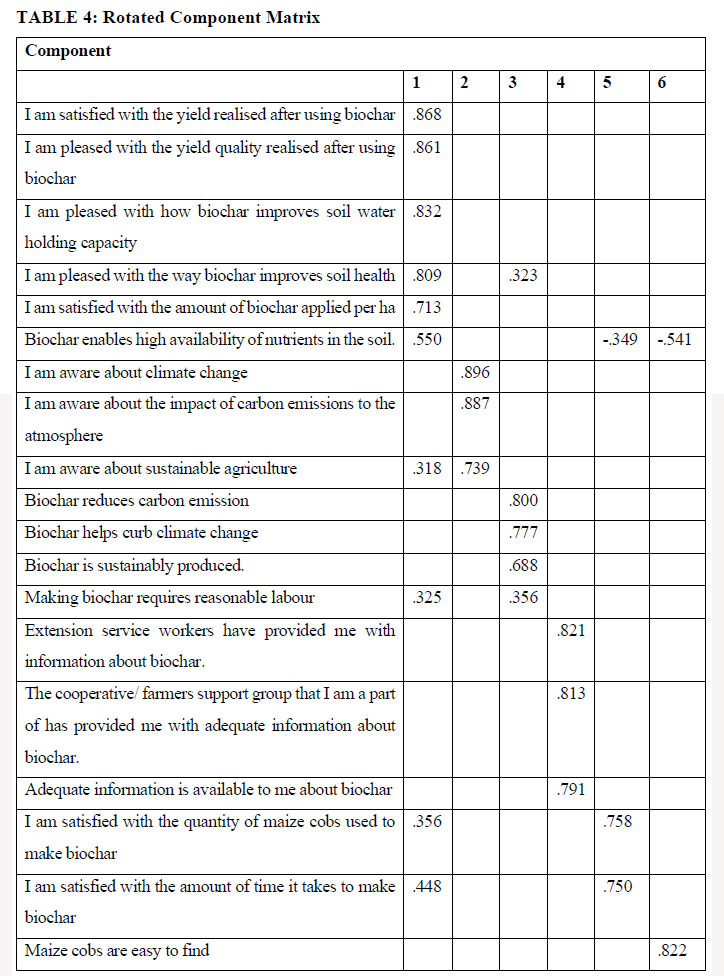
Farmers' perceptions of biochar were analysed using PCA. The Kaiser-Meyer-Olkin (KMO) measure of sampling adequacy was 0.846, indicating that factor analysis is suitable for the data. Bartlett's Test of Sphericity, which tests whether the correlation matrix deviates significantly from the identity matrix, was statistically significant, with a p-value of 0.000. The KMO and Bartlett's test showed that the study could use the dataset to analyse the principal components. The covariance matrix generated six principal components (PCs). This study utilised the covariance matrix and the varimax-rotated matrix. Varimax rotation is suitable if the variables are not correlated. Varimax rotation aims to redistribute factor loadings so that each variable loads meaningfully in only one factor. The rotation matrix reduces complexity and makes the structure simpler to interpret (Field, 2018). Furthermore, a non-rotated component matrix can lead to cross-loadings, making the interpretation of loadings difficult. The covariance matrix allowed for the extraction of six PCs. The first six PCs accounted for 73.75% of the variation. The Kaiser criterion retained six PCs because they had Eigenvalues of one and above, which provided a valuable interpretation of the principal components.
Due to the nature of the perception variables, the cut-off point for factor loadings was 0.3. PC 1, which accounts for 35% of the variation, is dominated by variables that represent the biochar's agronomic benefits. Hence, PC 1 is referred to as the agronomic benefits. PC 2, which accounts for 11% of the variation, is primarily driven by climate change variables. Therefore, it is referred to as climate change. Variables representing biochar's climate change mitigation effects dominated PC 3, accounting for 9.25% of the variation. As a result, PC 3 is referred to as climate change mitigation. Variables representing access to biochar information dominated PC 4 and explained 7.08% of the variation. Therefore, it is referred to as access to information. PC 5 explained 6.09% of the variation and consists of variables related to biochar production. As such, it is referred to as a production PC. Lastly, variables representing the availability of inputs to produce biochar dominated PC 6, explaining 5.27% of the variation. Therefore, the PC was labelled as having input availability.
3.2. Results of Factors That Influence Farmers' Perceptions of Biochar
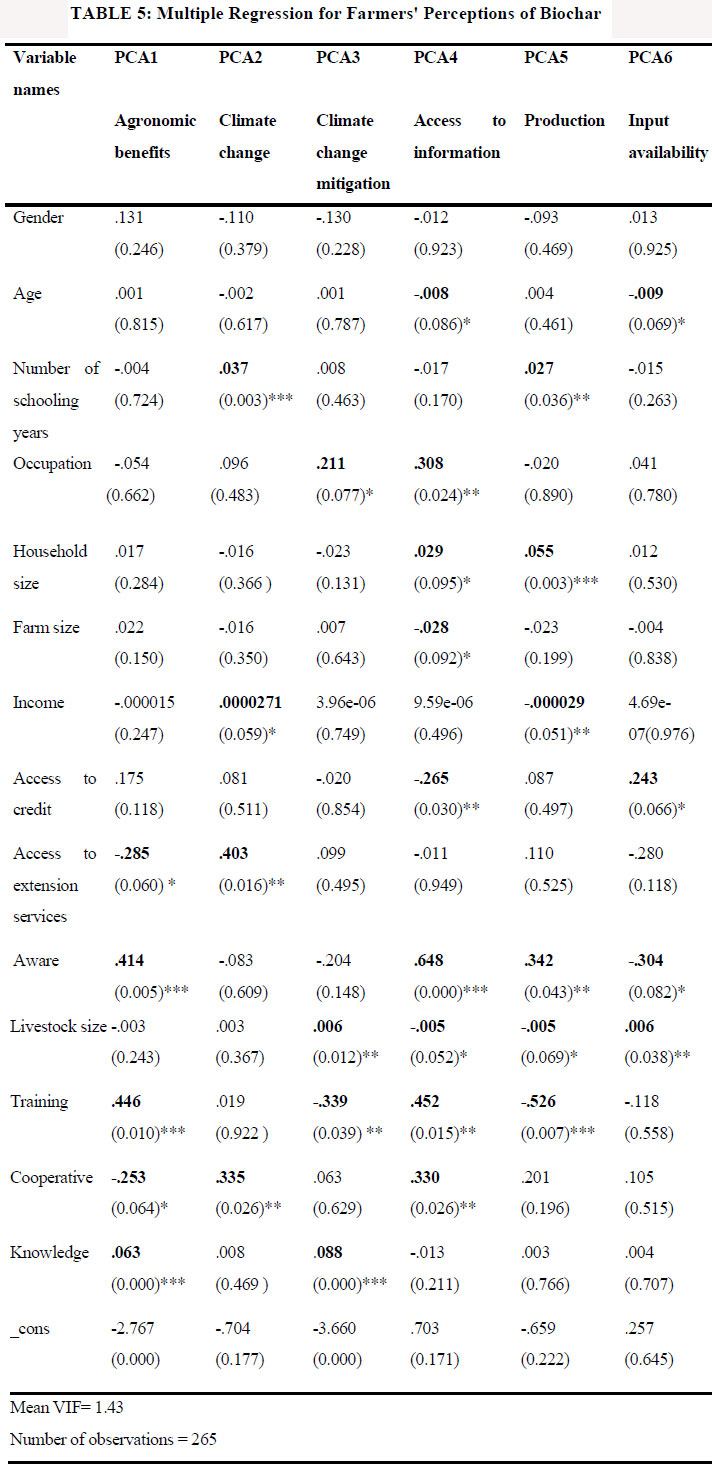
Table 5 presents the results of the multiple regression analysis for the determinants of the PC-derived composite indices of farmers' perceptions of biochar. The six PCs retained were used to generate indices as proxies of farmers' perceptions of agronomic benefits, climate change mitigation, access to information, production, and input availability. A Multicollinearity test showed that the variance inflation factor was 1.43, indicating no multicollinearity in the dataset. The results show that the age of the household head, number of schooling years, occupation, household size, farm size, income, access to credit, access to extension services, awareness, livestock size, training, cooperation, and knowledge are statistically significant determinants of farmers' perceptions of biochar.
3.2.1. Age of the Household Head
Contrary to expectations, the age of the household head was negative and statistically significant (p<0.1) regarding perceptions of access to information and input availability. These results differ from those of Carrer et al. (2017), who found that older farmers are more likely to adopt new technologies because the extensive knowledge they have acquired over time enables them to evaluate information more effectively than younger farmers. Smallholder farmers rely on and prefer information from farmer groups, farmer-to-farmer networks, and extension services as their primary information sources (Tamako et al., 2022; Mwangu, 2020). As a result, they get disappointed when they do not get information on biochar from these trusted sources (Makamane et al., 2025).
Information on biochar received by farmers could have been scientific, challenging to comprehend, and required more detailed explanations. The extension officers might not have disseminated the information due to a lack of knowledge. In agreement with this argument, Mwangu (2020) found that climate information shared with farmers was scientific, challenging to understand and therefore not valuable to the farmers. For these reasons, older farmers tend to gravitate towards indigenous knowledge (Melash et al., 2023).
The older farmers' dependence on indigenous knowledge may be the reason for their negative perceptions of access to information on biochar. Low levels of education among the respondents hinder their access to relevant information on biochar, thereby driving their dependence on indigenous knowledge. As a result, they rely on indigenous knowledge to withstand various agricultural challenges. Melash et al. (2023), Tamako et al. (2022) and Muyambo et al. (2017) found similar results. On the other hand, dissatisfaction with the availability of inputs for making biochar increases with age. In the study area, smallholder farmers rely on crop biomass as an energy source. As such, there is competition for inputs, resulting in trade-offs. Further, older farmers perceive searching for and collecting biomass biochar as laborious. Collecting biomass is physically strenuous and becomes increasingly difficult with age (Eltigani et al., 2022; Rahman et al., 2020; Mekonnen et al., 2017).
3.2.2. Number of Schooling Years
The number of schooling years is positively associated with climate change (p<0.01). This association aligns with prior expectations because higher education improves farmers' ability to analyse information. Farmers can understand and process information more effectively with additional years of schooling. Furthermore, they can better seek information because they know the right questions and who to ask (Acharya et al., 2023). Overall, education significantly impacts one's ability to obtain, process, and utilise information (Mottaleb, 2018). Moreover, knowledge of climate change improves farmers' willingness to adopt biochar technology (Sherman, 2020).
Education level also had a positive and statistically significant influence on biochar production (p < 0.05). This influence implies that more educated farmers are more satisfied with aspects of biochar production, including time and other production costs. The reason could be that more educated farmers can secure off-farm employment and earn higher incomes, which will enable them to introduce biochar technology (Ke et al., 2025). Therefore, they can bear the expenses that arise from adopting biochar technology, and they can substitute biomass with electricity as an energy source, or they may not be dependent on biomass as a primary energy source.
3.2.3. Occupation of the Household Head
The main occupation of the household head had a positive and statistically significant effect on the climate change mitigation effects of biochar (p<0.1) and access to information on biochar (p<0.05). Household heads whose primary occupation was farming were satisfied with the information they obtained about biochar and its effectiveness in mitigating climate change. Such heads of households could be satisfied because their main occupation is farming and thus dedicate most of their labour hours to agricultural activities.These activities include the time they set aside to search for information on biochar, which could occur through attending workshops, extension services and training. Thus, they increase their knowledge of biochar technology, eventually shaping their perceptions of the technology. Some authors, such as Zossou et al. (2020) and Makate et al. (2019), assert that knowledge of agricultural technologies increases when farming is the primary livelihood source, as farmers constantly seek ways to improve their businesses.
3.2.4. Household Size
Household size had a positive and significant influence on access to information about biochar (p < 0.05) and biochar production (p < 0.01). The effect of household size suggests that when more people live in a household, the level of satisfaction regarding information access on biochar technology is higher, as there is greater information sharing among more people. Moreover, with more people living in the household, there is a significant division of labour (Mumah et al., 2024), allowing for time to attend agricultural extension services and training on biochar. Access to extension services translates into getting knowledge of biochar technology.
A larger household size increases the availability of labour, given that the members are adults, which helps introduce technologies (Mwangi & Kariuki, 2015). A larger household size allows for the sharing of duties, thereby increasing labour availability for biochar production. Generally, there is no labour constraint in larger households, which means there is sufficient labour to gather inputs (biomass), produce, and apply biochar to the soil; hence, larger households have better perceptions of biochar production.
3.2.5. Farm Size
The coefficient for the effect of farm size on access to information on biochar was negative and statistically significant (p<0.1). The implication is that the larger the farm size, the less satisfied the farmer is with access to information on biochar. Access to information on biochar technology is vital to farmers with larger land sizes who continuously seek ways to improve productivity and efficiency to maximise their profits.
Access to information about biochar technology is critical for farmers' decision-making. Loki (2022) found that farmers with larger plots had more negative perceptions about public extension services. Extension services primarily provide information on biochar. Farmers with larger plots anticipate being regularly visited by extension officers. Additionally, they expect to be allocated more resources and receive preferential treatment per their farm size (Maake & Antwini, 2022).
3.2.6. Income
The coefficient estimate for income is positively associated with climate change and statistically significant (p<0.01). Higher-income households perceived themselves as having adequate knowledge of climate change and its adverse effects. Therefore, higher income enables households to reduce the transaction costs of searching for information on climate change, such as time and financial costs (Sinyolo, 2020).
Income has a statistically significant negative influence on perceptions of biochar production (p < 0.05). The implication is that higher-income households are not satisfied with biochar production, likely because they can afford the agricultural inputs required for farming. Therefore, they do not need to produce biochar to supplement fertiliser costs. As a result, their dissatisfaction with biochar is not due to cost constraints, but rather to a relative valuation of input options, demonstrating that affordability does not always equate to greater satisfaction and adoption. Anang and Zakariah (2022) found that higher-income farmers have the means to purchase chemical fertilisers.
3.2.7. Access to Credit
Contrary to expectations, access to credit was negatively associated with access to information on biochar and was statistically significant (p<0.05). The negative association suggests that farmers with access to credit are less satisfied with their access to information on biochar. These results suggest that, despite having financial means, the lack of access to information on biochar can still hinder farmers from making informed decisions. These results are contrary to those of Zulu et al. (2024). Lack of access to information on biochar is due to the fact that only a select number of farmers have previously participated in the biochar workshops held in the study area. Additionally, the unavailability of relevant bodies to consult about the technology may be a contributing factor.
Access to credit had a positive influence on input availability for biochar production. Farmers' access to credit enables them to hire labour to source the inputs required for biochar production. Additionally, they can substitute biomass, for example, cobs, with electricity or firewood as a source of energy. Similarly, Langyintuo (2020) and Ntshangase et al. (2018) found that access to credit increases farmers' ability to acquire inputs due to increased liquidity and increases the risk-bearing capacity of the farmer.
3.2.8. Access to Extension Services
Contrary to expectations, access to extension services was negatively related to the perceived agronomic benefits of biochar (p<0.1). The cause could be that farmers with access to extension services did not receive or had insufficient information on biochar. Realising the agronomic benefits of biochar technology requires a certain level of understanding (Latawiec et al., 2017), while the respondents possessed low education levels. There was also a mismatch between expected and observed outcomes.
A positive, statistically significant relationship exists between access to extension services and climate change (p<0.05), meaning that access to extension services positively affects farmers' knowledge of climate change and, thus, their perceptions. The reason could be that farmers with access to extension services have received information on climate change from extension officers. These results suggest that extension services have successfully conveyed information on climate change. These findings are similar to those of Workineh et al. (2020), who highlighted that access to extension services provides farmers with training and advisory services, which raise human capital and information access among farmers.
3.2.9. Awareness and Knowledge
Awareness was positively associated with biochar agronomic benefits (p<0.01), access to information on biochar (p<0.01), and biochar production (p<0.05). The positive association implies that farmers who were aware of biochar technology were satisfied with the agronomic benefits of biochar, as well as with the information provided on biochar and biochar production. Biochar awareness is crucial for biochar adoption, as it encourages farmers to seek more information on biochar technology (Kibue, 2018; Mallo & Espinoza, 2015).
Knowledge of biochar was positively and statistically significantly associated with the agronomic benefits of biochar (p < 0.01) and the climate change mitigation effects of biochar (p < 0.01). Farmers with a greater understanding of biochar tend to have more positive perceptions of its agronomic benefits and mitigation effects on climate change, which in turn shapes their confidence in the technology. These results are similar to those of Perrone et al. (2024). Farmers can appreciate the positive impact of biochar technology when they understand it well, including its climate change mitigation effects and agronomic benefits.
Awareness had a statistically significant negative influence on perceptions of input availability for biochar production (p < 0.10), indicating that farmers who are aware of biochar are less satisfied with the quantity of inputs required to produce it. The reason for the dissatisfaction with input availability for biochar production is that the study participants rely on biomass as an energy source, making it less available for biochar production. These results are similar to those of Rogers et al. (2022). Another reason is that increased awareness of biochar has led to a rise in demand for feedstock to produce biochar, resulting in constraints on feedstock availability.
3.2.10. Livestock Size
Livestock size had a positive and statistically significant relationship with the climate change mitigation effects of biochar (p < 0.05). Farmers with more livestock positively perceive biochar's climate change mitigation effects. Livestock size is a measure of wealth (Sinyolo, 2020). Therefore, wealthier farmers are more likely to possess knowledge of subjects that require a certain level of understanding, as they are in a better position to source information and bear the transaction costs associated with accessing information on climate change.
Le Hoang Nguyen et al. (2023) found that wealthier farmers could adopt new technologies because of their enhanced capacity to invest in new technologies. Investment in technologies also includes the costs associated with searching for information. Wealthier households can better analyse and apply information because of improved information access. Hence, their knowledge influences their perceptions.
A negative and statistically significant relationship exists between livestock size and access to information on biochar (p<0.1), meaning that farmers with livestock were not satisfied with the information they received from their knowledge sources about biochar. The finding could be due to wealthier farmers having more human capital due to their capacity to invest in transaction costs associated with technology adoption (Ali & Erenstein, 2017). With improved human capital, they can precisely know the quality of information they should receive from information sources (Maake & Antwi, 2022). However, those with more livestock may seek more information on livestock production than crop farming.
Livestock has a negative and statistically significant relationship with biochar production (p < 0.1), suggesting that farmers with more livestock are less satisfied with the production costs of biochar technology. The reason is that farmers with more livestock have allocated most of their land to their production and less to crop production. Therefore, most of their productive resources, including labour and time, are allocated to livestock production, rather than crop production. Due to the limited availability of productive resources, they may be unable to allocate them to biochar production. Livestock farmers may perceive limited benefits from using biochar. Livestock farmers allocated large portions of land to pastures.
As hypothesised, livestock positively and statistically significantly influenced input availability (p<0.05). Those with more livestock have better perceptions of input availability. The reason could be that wealth allows liquidity (Sinyolo, 2020). Hence, wealthier farmers can bear the costs associated with input acquisition for biochar production. Additionally, they can substitute biomass with electricity as an energy source. Furthermore, livestock farmers can assume the risk associated with biochar adoption.
3.2.11. Training
Training had a positive and statistically significant influence on the agronomic benefits of biochar (p < 0.01), suggesting that farmers who received training had better perceptions of biochar's agronomic benefits. Training enables farmers to obtain more information about technologies.
Training had a negative and statistically significant influence on biochar's climate change mitigation effects (p < 0.05). Those who have received training tend to perceive biochar's climate change mitigation effects negatively. It is possible that farmers did not receive enough information on the climate change mitigation effects of biochar, similar to the findings of Mwangu (2020).
The training coefficient had a positive and statistically significant effect on access to information on biochar technology (p < 0.05), indicating that farmers who have received training have greater access to biochar information. The reason could be that training exposes farmers to new technologies and improves their knowledge. Krah et al. (2019) found that training assists farmers with technical and technological aspects and strengthens extension services.
On the other hand, training had a negative and statistically significant impact on biochar production (p < 0.01). While training enhances farmers' knowledge of how to produce biochar, it also increases their understanding of its economics and logistics, such as the quantity of feedstock and the amount of human labour required. Subsequently, this leads to a more critical evaluation of whether the cost-effectiveness of biochar offsets its benefits. Consequently, trained farmers may consider biochar production economically burdensome, indicating that training has a negative and statistically significant impact on biochar production. Not only does training inform, but it also empowers farmers to accurately weigh the tradeoffs involved in adopting technology. Smallholder farmers in the study area depend on feedstock as the primary energy source. These results are similar to those of Eltigani et al. (2022) and Rogers et al. (2022). Farmers who have received training perceive that biochar production is too expensive, considering its benefits. These costs include trading biomass as an energy source. Farmers who receive training can weigh the costs and benefits associated with technology adoption.
3.2.12. Membership in a cooperative
Membership in a cooperative is negatively and statistically significantly associated with biochar agronomic benefits (p<0.1), indicating that farmers who are part of cooperatives are not satisfied with the agronomic benefits of biochar. Cooperatives are one of the modes of technology transfer. It is possible that cooperatives communicated inadequate information about biochar to farmers, in agreement with Mwangi et al. (2022). Another reason could be that biochar technology did not meet the farmer's expectations, given that substantial yield effects exist when biochar and fertilisers are combined. If applied alone, the biochar effect can only be seen from the second season onwards (Pandit et al., 2018).
Membership in a cooperative has a positive and statistically significant effect on the perception of climate change (p<0.05). Cooperative members have positive perceptions of climate change, meaning they are satisfied with their understanding. The finding supports the idea that cooperatives assist farmers in obtaining various related information (Ntshangase et al., 2018). A positive and statistically significant relationship exists between membership in a cooperative and access to information on biochar (p<0.05), meaning that cooperative members are satisfied with the information they have obtained about the technology. The findings are similar to Sinyolo (2020).
4. CONCLUSION AND RECOMMENDATIONS
Understanding farmers' perceptions is a prerequisite to deploying and successfully implementing biochar technology. This study assessed the factors that influence farmers' perceptions of biochar technology. It evaluated various aspects of the technology, including agronomic benefits, climate change mitigation effects, the availability and accessibility of information on the technology, and the production and availability of inputs for making biochar. The study found that farmers are generally satisfied with the agronomic benefits of the technology and its impact on climate change mitigation. On the contrary, farmers were not entirely satisfied with access to information on biochar production and the availability of inputs to produce biochar.
The study found that age, farm size, livestock size, access to extension services, number of schooling years, household size, principal occupation, cooperative membership, awareness of biochar, knowledge of biochar, and training were statistically significant determinants of perceptions of biochar technology. Socioeconomic factors, such as the number of schooling years, household size, principal occupation, cooperative membership, awareness, and knowledge of biochar, were associated with increased satisfaction with multiple aspects of the technology. Age, farm size, livestock size, and access to extension services were related to negative perceptions of the technology. Notably, gender had no statistically significant influence on perceptions of biochar. The results suggest that there is potential for a biochar market, and farmers can produce their own biochar if they are advised on alternative inputs to make biochar and are not limited to maize cobs, as it is a significant energy source.
The study recommends developing clear and accessible communication channels to effectively convey the benefits of biochar technology. Cooperatives can play a vital role in bridging the gap in access to biochar information. Education and outreach programs can effectively educate farmers about the production, usage, and potential positive effects of biochar technology. Field demonstrations of biochar products can effectively improve farmers' satisfaction with biochar production and input availability. These will provide an opportunity to advise farmers on alternative materials they can use to produce biochar, in addition to maize cobs, as well as effective biochar application rates. This practical experience can convince farmers to adopt the technology.
Researchers and NGOs should work closely with extension officers on the ground and with farmers, interacting with them more frequently to disseminate information on biochar and shape farmers' perceptions of the technology. Development agents should integrate biochar technology into agricultural, environmental and sustainability policies and strategies. Adopting this approach requires more evidence from research to support policies, showing the benefits of the technology in mitigating climate change and thereby contributing to production and food security among small-scale farmers.
Bandile TN Bhekiswayo conceived the study, materials, and analysis tools and wrote the paper. Maxwell Mudhara, Manana Mamabolo, and Muthulisi Siwela supervised the study and reviewed manuscript revisions.
7. DATA AVAILABILITY STATEMENT
Data is available on request due to privacy/ethical restrictions.
6. ACKNOWLEDGEMENTS
The study was part of a FOSC-initiated and funded project entitled 'Biochar Integration in Smallholder Cropping Systems-Economy, Food Product Value Chain, Climate Resilience and Soil Fertility (BICEPS).
REFERENCES
- ACHARYA, S., ACHARYA, SK., MANDAL, T.K., MOHANTY, B.K. & HAQUE, M., 2023. Information receiving behavior of farmers: the structural and functional analysis. Indian J. Ext. Educ., 59(3): 58-62.
- AKINSEYE, F.M., AJEIGBE, H.A., TRAORE, P.C., AGELE, S.O., ZEMADIM, B. & WHITBREAD, A., 2020. Improving sorghum productivity under changing climatic conditions: A modelling approach. Field Crops Res., 246: 107685.
- ALI, A. & ERENSTEIN, O., 2017. Assessing farmer use of climate change adaptation practices and impacts on food security and poverty in Pakistan. Clim. Risk Manag., 16: 183-194.
- ANANG, B.T. & ZAKARIAHK, A., 2022. Socioeconomic drivers of inoculant technology and chemical fertiliser utilisation among soybean farmers in the Tolon District of Ghana. Heliyon., 8(6).
- BHANDARI, S. & HALLOWELL, M.R., 2021. Identifying and controlling biases in expert-opinion research: Guidelines for variations of Delphi, nominal group technique, and focus groups. J. Manage. Eng., 37(3): 04021015.
-
BJERREGAARD, P.P. & GEORG, S., 2011. The social shaping of technology-A Case Study of Biochar in Denmark. A case study of the innovation journey of biochar in Denmark: Insights for business, researchers, investors and policy-makers. Master's Dissertation, Copenhagen Business School, Denmark. Available from http://studenttheses.cbs.dk/bitstream/handle/10417/1766/peter_poul_bjeraregaard.pdf7sequence=1
» http://studenttheses.cbs.dk/bitstream/handle/10417/1766/peter_poul_bjeraregaard.pdf7sequence=1 - CADRO, S., UZUNOVIC, M., CHERNI-CADRO, S. & ZUROVEC, J., 2019. Changes in the water balance of Bosnia and Herzegovina as a result of climate change. Agric. For., 65(3): 19-33.
- CARRER, M.J., DE SOUZA FILHO, H.M. & BATALHA, M.O., 2017. Factors influencing the adoption of Farm Management Information Systems (FMIS) by Brazilian citrus farmers. Comput. Electr. Agric., 138: 11-19.
- DIMITROV, B.G., 2019. Effects of climate change on women. Int. J. Multidiscip. Res., 4(5): 201-215.
- EL BILALI, H., BASSOLE, I.H.N., DAMBO, L. & BERJAN, S., 2020. Climate change and food security. Agric. For., 66(3): 197-210.
- ELTIGANI, A., OLSSON, A., KRAUSE, A., ERNEST, B., FRIDAHL, M., YANDA, P. & HANSSON, A., 2022. Exploring lessons from five years of biochar-producing cookstoves in the Kagera region, Tanzania. Energy Sustain. Dev., 71: 141-150.
- FIDEL, R.B., LAIRD, D.A. & PARKIN, T.B., 2019. Effect of biochar on soil greenhouse gas emissions at the laboratory and field scales. Soil Sys., 3(1): 8.
- FIELD, A., 2018. Discovering statistics using IBM SPSS statistics (5th edition). SAGE.
-
FOOD AND AGRICULTURE ORGANISATION OF THE UNITED NATIONS., 2009. 1.02 billion hungry. Available from http://www.fao.org/news/story/en/item/20568/icode/
» http://www.fao.org/news/story/en/item/20568/icode/ -
FOOD AND AGRICULTURE ORGANISATION OF THE UNITED NATIONS., 2024. The State of Food Security and Nutrition in the World 2024 - Financing to end hunger, food insecurity and malnutrition in all its forms. Rome. Available from https://openknowledge.fao.org/server/api/core/bitstreams/d5be2ffc-f191-411c-9fee-bb737411576d/content
» https://openknowledge.fao.org/server/api/core/bitstreams/d5be2ffc-f191-411c-9fee-bb737411576d/content - GEBREMEDHIN, G.H., BEREKET, H., DANIEL, B. & TESFAYE, B., 2015. Effect of biochar on yield and yield components of wheat and post-harvest soil properties in Tigray, Ethiopia. J Fertil Pestic., 6(2): 2-5.
- HASEGAWA, T., FUJIMORI, S., HAVLÍK, P., VALIN, H., BODIRSKY, B.L., DOELMAN, J.C., FELLMANN, T., KYLE, P., KOOPMAN, J.F., LOTZE-CAMPEN, H. & MASON-D'CROZ, D., 2018. Risk of increased food insecurity under stringent global climate change mitigation policy. Nat. Clim. Chang., 8(8): 699-703.
- HOTELLING, H., 1933. Analysis of a complex of statistical variables into principal components. J. Educ. Psychol., 24(6): 417.
- JEFFERY, S., MEINDERS, M.B., STOOF, C.R., BEZEMER, T.M., VAN DE VOORDE, T.F., MOMMER, L. & VAN GROENIGEN, J.W., 2015. Biochar application does not improve the soil hydrological function of a sandy soil. Geoderma., 251: 47-54.
- JOLLIFFE, I.T., 2002. Principal component analysis for special types of data. New York: Springer.
- KARIM, M.R. & ISLAM, M.M., 2018. Scope and constraints for biochar promotion for renewable clean energy, sustainable agriculture and climate change mitigation. Unpublished research report for the Akha-Biochar Project. Dhaka: The Christian Commission for Development in Bangladesh.
- KE, J., DAN, H., WANG, Q. & RAZZAQ, A., 2025. The role of off-farm employment in promoting sustainable farm development through integrated pest management technology adoption. Front. Sustain. Food Syst., 8: 1503951.
- KIBUE, G.W., 2018. Use of biochar for increased crop yields and reduced climate change impacts from agricultural ecosystems: Chinese farmers perception and adoption strategy. Afr. J. Agric. Res., 13(21): 1063-1070.
- KRAH, K., MICHELSON, H., PERGE, E. & JINDAL, R., 2019. Constraints to adopting soil fertility management practices in Malawi: A choice experiment approach. World Dev., 124:104651.
- LANGYINTUO, A., 2020. Smallholder farmers' access to inputs and finance in Africa. In S.G. Paloma, L. Riesgo & K. Louhichi (eds.), The role of smallholder farms in food and nutrition security. Springer, pp. 133-152.
- LATAWIEC, A.E., KRÓLCZYK, J.B., KUBOÑ, M., SZWEDZIAK, K., DROSIK, A., POLAÑCZYK, E., GROTKIEWICZ, K. & STRASSBURG, B.B., 2017. Willingness to adopt biochar in agriculture: The producer's perspective. Sustain., 9(4): 655.
- LE HOANG NGUYEN, L., HALIBAS, A. & QUANG NGUYEN, T., 2023. Determinants of precision agriculture technology adoption in developing countries: A review. J. Crop Improv., 37(1): 1-24.
- LEHMANN, J. & JOSEPH, S., 2015. Biochar for environmental management: An introduction. In J. Lehmann & S. Joseph (eds.), Biochar for environmental management: Science, Technology and Implementation. London: Routledge, pp. 1-13.
- LOKI, O., 2022. Farmers' perceptions towards privatisation of extension services in Eastern Cape and KwaZulu-Natal provinces of South Africa. J. Int. Agric. Ext. Educ., 29(4): 2753.
- MAAKE, M.M.S. & ANTWI, M.A., 2022. Farmer's perceptions of effectiveness of public agricultural extension services in South Africa: An exploratory analysis of associated factors. Agric. Food Secur., 11(1): 34.
- MAHMOUD, Y., NJENGA, M., SUNDBERG, C. & DE NOWINA, K.R., 2021. Soils, sinks, and smallholder farmers: Examining the benefits of biochar energy transitions in Kenya. Energy Res. Soc. Sci., 75: 102033.
- MAJA, M.M. & AYANO, S.F., 2021. The impact of population growth on natural resources and farmers' capacity to adapt to climate change in low-income countries. Earth Syst Environ., 5: 271-283.
- MAKAMANE, A., LOKI, O., SWANEPOEL, J., ZENDA, M. & VAN NIEKERK, J., 2025. Farmers' perceptions on the capacity of extension practitioners on climate change in the Eastern Cape Province of South Africa. Front. Clim., 7: 1534254.
- MAKATE, C., MAKATE, M., MANGO, N. & SIZIBA, S., 2019. Increasing resilience of smallholder farmers to climate change through multiple adoption of proven climate-smart agriculture innovations: Lessons from Southern Africa. J. Environ. Manag., 231: 858868.
- MALLO, M.F.L. & ESPINOZA, O., 2015. Awareness, perceptions and willingness to adopt cross-laminated timber by the architecture community in the United States. J Clean Prod., 94: 198-210.
- MEKONNEN, D., BRYAN, E., ALEMU, T. & RINGLER, C., 2017. Food versus fuel: Examining trade-offs in the allocation of biomass energy sources to domestic and productive uses in Ethiopia. Agric. Econ., 48(4): 425-435.
- MELASH, A.A., BOGALE, A.A., MIGBARU, A.T., CHAKILU, G.G., PERCZE, A., ÁBRAHÁM, É.B. & MENGISTU, D.K., 2023. Indigenous agricultural knowledge: A neglected human based resource for sustainable crop protection and production. Heliyon., 9(1).
-
MNUKWA, M.L., MDODA, L. & MUDHARA, M., 2025. Assessing the adoption and impact of climate-smart agricultural practices on smallholder maize farmers' livelihoods in Sub-Saharan Africa: A systematic review. Front. Sustain. Food Syst., 9. https://doi.org/10.3389/fsufs.2025.1543805
» https://doi.org/10.3389/fsufs.2025.1543805 - MOTTALEB, K.A., 2018. Perception and adoption of a new agricultural technology: Evidence from a developing country. Technol. Soc., 55: 126-135.
- MUCHURU, S. & NHAMO, G., 2019. A review of climate change adaptation measures in the African crop sector. Clim Dev., 11(10): 873-885.
- MUKHERJEE, N., HUGÉ, J., SUTHERLAND, W.J., MCNEILL, J., VAN OPSTAL, M., DAHDOUH-GUEBAS, F. & KOEDAM, N., 2015. The Delphi technique in ecology and biological conservation: Applications and guidelines. Methods Ecol. Evol., 6(9): 10971109.
- MUMAH, E., CHEN, Y., HONG, Y. & OKELLO, D., 2024. Machinery adoption and its effect on maise productivity among smallholder farmers in western Kenya: Evidence from the chisel harrow tillage practice. Res. World Agric. Econ., 5(1): 1-18.
-
MUNICIPALITIES SOUTH AFRICA., 2016. Okhahlamba Local Municipality (KZN235) Demographic Information. Available from https://municipalities.co.za/demographic/1104/okhahlamba-local-municipality
» https://municipalities.co.za/demographic/1104/okhahlamba-local-municipality - MUYAMBO, F., JORDAAN, A. & BAHTA, Y., 2017. The role of indigenous knowledge in drought risk reduction: A case of communal farmers in South Africa. Jamba-J Disaster Ris Stud., 9(1): 1-6.
- MWANGI, M. & KARIUKI, S., 2015. Factors determining adoption of new agricultural technology by smallholder farmers in developing countries. J. Econ. Sustain. Develop., 6(5): 208-217.
- MWANGI, S., KIRUI, B.K. & KIBUE, G.W., 2022. Awareness and perceptions of climate variability adaptation among forest-adjacent communities in Mau Forest, Kenya. East African Journal of Forestry and Agroforestry., 5(1): 302-329.
- MWANGU, A.R., 2020. Appraising climate services in Uganda: Impact on adaptation and mitigation of climate change. In W.L. Filho & D. Jacob (eds.), Handbook of Climate Services. Cham: Springer International Publishing, pp. 383-400.
- NTSHANGASE, N.L., MUROYIWA, B. & SIBANDA, M., 2018. Farmers' perceptions and factors influencing the adoption of no-till conservation agriculture by small-scale farmers in Zashuke, KwaZulu-Natal Province. Sustain., 10(2): 555.
- PANDIT, N.R., MULDER, J., HALE, S.E., ZIMMERMAN, A.R., PANDIT, B.H. & CORNELISSEN, G., 2018. Multi-year double cropping biochar field trials in Nepal: Finding the optimal biochar dose through agronomic trials and cost-benefit analysis. Sci. Total Environ., 637: 1333-1341.
- PEARSON, K., 1901. LIII. On lines and planes of closest fit to systems of points in space. Lond. Edinb. Dubl. Phil. Mag., 2(11): 559-572.
-
PERRONE, M., MAZZOCCHI, C., TOSCA, A. & VERGA, E., 2024. Farmers' Perception of biochar technology: Investigating drivers and barriers of technology adoption. IRIS Institutional Research Information System - AIR Archivio Istituzionale della Ricerca. Available from https://air.unimi.it/handle/2434/1071028
» https://air.unimi.it/handle/2434/1071028 - RAHMAN, M.S., HAQUE, M.E. & NOMAN, M.R.A.F., 2020. An overview of biochar production and biochar producing stoves in Bangladesh. Int. J. Sci. Manag. Stud., 14-31.
- ROGERS, P.M., FRIDAHL, M., YANDA, P., HANSSON, A., PAULINE, N. & HAIKOLA, S., 2022. Socioeconomic determinants for biochar deployment in the southern highlands of Tanzania. Energies., 15(1): 144.
- SCHOLZ, S.B., SEMBRES, T., ROBERTS, K., WHITMAN, T., WILSON, K. & LEHMANN, J., 2014. Biochar systems for smallholders in developing countries: Leveraging current knowledge and exploring future potential for climate-smart agriculture. Washington DC: The World Bank.
- SEWELL, M., 2008. Principal component analysis. London, UK: University College London.
- SHERMAN, C.D., 2022. Biochar: Practices, perspectives, and prospects in New York State agriculture. Albany: State University of New York.
- SIKA, M.P. & HARDIE, A.G., 2014. Effect of pine wood biochar on ammonium nitrate leaching and availability in a South African sandy soil. Eur. J. Soil Sci., 65(1): 113-119.
- SINYOLO, S., 2020. Technology adoption and household food security among rural households in South Africa: The role of improved maize varieties. Technol. Soc., 60: 101214.
- SOHI, S., LOPEZ-CAPEL, E., KRULL, E. & BOL, R., 2009. Biochar, climate change and soil: A review to guide future research. CSIRO Land and Water Science Report., 5(09): 17-31.
- SPARREVIK, M., ADAM, C., MARTINSEN, V. & CORNELISSEN, G., 2015. Emissions of gases and particles from charcoal/biochar production in rural areas using medium-sized traditional and improved "retort" kilns. Biomass and Bioenergy., 72: 65-73.
-
STATISTICS SOUTH AFRICA., 2016. Community Survey 2016 Agricultural households. Available from https://www.statssa.gov.za/publications/03-01-05/03-01-052016.pdf#:~:text=KwaZulu%2DNatal%20accounted%20for%2021%2C6%25%20of%20all%20households,male%20and%2010%2C1%25%20were%20female%20(Figure%202.4).
» https://www.statssa.gov.za/publications/03-01-05/03-01-052016.pdf#:~:text=KwaZulu%2DNatal%20accounted%20for%2021%2C6%25%20of%20all%20households,male%20and%2010%2C1%25%20were%20female%20(Figure%202.4) - SUTRADHAR, I., JACKSON-DEGRAFFENRIED, M., AKTER, S., MCMAHON, S.A., WAID, J.L., SCHMIDT, H.P., WENDT, A.S. & GABRYSCH, S., 2021. Introducing urine-enriched biochar-based fertiliser for vegetable production: Acceptability and results from rural Bangladesh. Environ Dev Sustain., 23(9): 12954-12975.
- TAMAKO, N., THAMAGA-CHITJA, J.M. & MUDHARA, M., 2022. Agricultural knowledge networks and their implications on food accessibility for smallholder farmers. J. Consum. Sci., 50: 27-46.
-
UNITED NATIONS., 2015. Transforming Our World: The 2030 Agenda for Sustainable Development. New York: Resolution adopted by the General Assembly on 25 September 2015. Available from https://documents-dds-ny.un.org/doc/UNDOC/GEN/N15/291/89/PDF/N1529189.pdf?OpenElement
» https://documents-dds-ny.un.org/doc/UNDOC/GEN/N15/291/89/PDF/N1529189.pdf?OpenElement - WILLIAMS, P.A., CRESPO, O., ABU, M. & SIMPSON, N.P., 2018. A systematic review of how vulnerability of smallholder agricultural systems to changing climate is assessed in Africa. Environ. Res. Lett., 13(10): 103004.
- WORKINEH, A., TAYECH, L. & EHITE, H.K., 2020. Agricultural technology adoption and its impact on smallholder farmers welfare in Ethiopia. Afr. J. Agric. Res., 15(3): 431-445.
- ZOSSOU, E., AROUNA, A., DIAGNE, A. & AGBOH-NOAMESHIE, R.A., 2020. Learning agriculture in rural areas: The drivers of knowledge acquisition and farming practices by rice farmers in West Africa. J. Agric. Educ. Ext., 26(3): 291-306.
- ZOUGMORÉ, R.B., PARTEY, S.T., OUÉDRAOGO, M., TORQUEBIAU, E. & CAMMPBELL, B.M., 2018. Facing climate variability in sub-Saharan Africa: analysis of climate-smart agriculture opportunities to manage climate-related risks. Cah. Agric., 27(3): 1-9.
- ZULU, N.S., HLATSHWAYO, S.I., OJO, T.O., SLOTOW, R., CELE, T. & NGIDI, M.S.C., 2024. The impact of credit accessibility and information communication technology on the income of small-scale sugarcane farmers in Ndwedwe Local Municipality, KwaZulu-Natal Province, South Africa. Front. Sustain. Food Syst., 8: 1392647.