Production Objectives, Selection and Culling Approach of Breeding Stock in Smallholder Goat Farming System in the Sedibeng District, Gauteng Province
Abstract
The study evaluated the production objectives, breeding selection, culling practices, and challenges faced by smallholder goat farmers in the Sedibeng district. The study included 56 actively engaged farmers selected through random sampling. Data was collected through a focus group meeting using a predetermined list of variables and Likert scales. An index and mean score were calculated to rank variables, determine the prioritised variables, and identify variables perceived to impact goat production. The study found that the top production objectives were the sale of goats, asset investment, and social/cultural events. Traits such as body size, twinning ability, kidding frequency, mothering ability, and coat colour were key factors in selecting breeding does. In contrast, body size, mating ability, and coat colour were important factors in choosing breeding bucks. Health issues, old age, poor fertility, and body condition were common reasons for culling breeding stock. Major constraints included feed shortages, uncontrolled breeding, disease prevalence, limited veterinary services, slow growth rates, low pregnancy rates, extended kidding intervals, low kidding rates, and high mortality rates among kids. To improve the health and productivity of smallholder goat farming systems, better management practices, access to resources, and appropriate training are essential.
Breeding Objectives; Selection Methods; Trait Preferences; Culling Criteria
1. INTRODUCTION
Goats are found worldwide due to their resilience, adaptability, and reproductive capabilities in harsh environments (Raheem et al., 2024; Lohani et al., 2021), making them an excellent choice for farmers with limited resources (Lohani et al., 2021). Goat production in Gauteng Province is a relatively small-scale farming activity, accounting for 0.4% of South Africa's goat production (DALRRD, 2022). However, it remains a significant commodity, as some smallholder farmers continue to practice it. Goat production plays a crucial role in enhancing the livelihoods of smallholder farming communities by providing meat, milk, manure, skin, cashmere, mohair, and generating income (Mataveia et al., 2021). Goats have a shorter reproductive cycle and are more prolific than cows (Webb & Mamabolo, 2004; Greyling, 2000), resulting in a higher number of offspring in a shorter period. This makes goat farming a profitable choice for smallholder farmers, as they can produce more animals and potentially earn a greater profit in a shorter time frame.
Goat meat, also known as chevon, is a healthier choice than other red meats due to its lean nature and lower fat, cholesterol, and saturated fatty acids (Mazhangara et al., 2019; Ivanović et al., 2016). This can help reduce the risk of heart disease and promote better cardiovascular health (Ivanović et al., 2016; Aghwan et al., 2014). Additionally, goat meat is a rich source of protein, vitamins, essential amino acids, and micronutrients, particularly iron, which is more abundant in goat meat than in pork, chicken, lamb, and beef (Forte et al., 2024; Mazhangara et al., 2019; Ivanović et al., 2016). The higher iron content makes it a valuable dietary option, especially for individuals at risk of iron deficiency.
Despite the positive aspects of goat farming, the productivity and profitability of smallholder farming systems remain low (Setoboli et al., 2025; Namonje-Kapembwa et al., 2022). Smallholder farmers need to maximise animal output to improve enterprise sustainability and profitability (Gitau et al., 2023). The low productivity and profitability of smallholder goat farming systems can be attributed to several factors, including limited access to resources, poor pasture quality and quantity, inadequate feed, high disease rates, inadequate veterinary care, and limited market opportunities (Ntshangase et al., 2021; Mayberry et al., 2018). Addressing these challenges is crucial to enhancing the viability of smallholder goat farming systems.
To enhance production efficiency in smallholder goat farming, it is essential to have a clear understanding of production objectives, breeding strategies, and the associated constraints. This information will help identify areas for improvement and determine the best approach to boost productivity. While research studies have been conducted on these topics, their findings are often limited to specific areas or regions (Tyasi et al., 2022; Mtshali et al., 2021) and may not be universally applicable. This study aimed to fill the gap in scientific data in the Sedibeng District by investigating production objectives, breeding selection, culling practices, and challenges encountered in smallholder goat farming systems in the Sedibeng District of the Gauteng province.
2. RESEARCH METHODOLOGY
2.1. Study Area
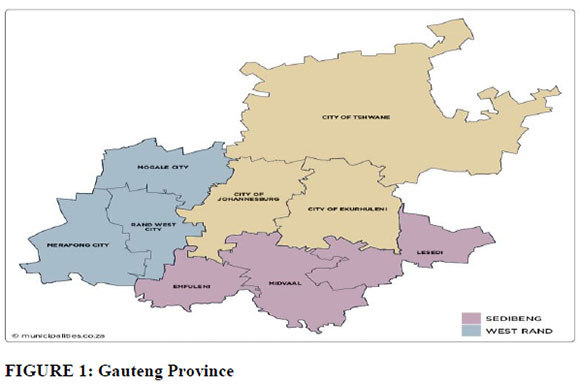
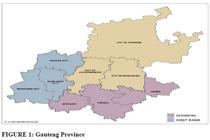
The study took place in the Sedibeng District Municipality (SDM), situated on the southern edge of the Gauteng province (Figure 1), bordering the provinces of the Free State, North West, and Mpumalanga. Sedibeng is mainly an urban municipality with some rural characteristics in certain areas. It has a high population density, industrial activities, and well-developed infrastructure, making it predominantly urban. Despite its significant role in local livelihoods and food security, the agriculture sector contributes the least to the regional economy. Sedibeng has a subtropical dry savanna climate, characterised by warm temperatures and high evaporation rates. The average annual rainfall is 600mm, while evaporation is around 1300mm. Rainfall is higher in summer (November to March) and lower in winter (June to August) (Jury, 2016). Sedibeng's biophysical environment is diverse and rich, featuring open grasslands, wetland ecosystems, and nature reserves such as Suikerbosrand. The Vaal River and Vaal Dam are vital sources of water for domestic, irrigation, and industrial use (SDM, 2023). The area was selected based on the presence of goat farming activities in the region, the willingness of goat farmers to participate, and the availability of a suitable database to be utilised.
2.2.
Study Population, Sampling and Sample SizeThe study population consisted of smallholder goat farmers in the Sedibeng district municipality. A database of 65 smallholder goat farmers was obtained from the Gauteng Department of Agriculture and Rural Development (GDARD) on April 4th, 2024, and was used as the population frame for the study. The database is regularly updated to include new farmers and remove those who are inactive or deceased, ensuring the accuracy of the data. The most recent update of the database was on January 18th, 2024. A simple random sampling approach was employed to minimize bias and ensure a representative sample, thereby enhancing the validity of the research findings. This method provided every individual with an equal opportunity to be selected, resulting in a study that more accurately represented the diversity of the entire population. The sample size of 56 goat farmers in the Sedibeng District was determined using the 7th version of the Raosoft software calculator with a 5% margin of error and 95% confidence level (Raosoft, 2004). This sample size represented 86% of the study population.
2.3.
Data Collection and AnalysisBefore data collection, a consultation meeting was held on June 7th, 2024, with three agricultural practitioners, an animal scientist, and 56 sampled smallholder goat farmers at the Sedibeng District Community Hall. The participation of agricultural practitioners and animal scientists was due to their responsibility for livestock commodities in the study area and their familiarity with the sampled farmers. The purpose of the meeting was to gather information to develop a final questionnaire. This led to the identification of production objectives, traits for selecting breeding does and bucks, reasons for culling, and production challenges faced by smallholder goat farmers, resulting in the creation of a predetermined list of variables for data collection.
A livestock commodity study group session was organised on August 14, 2024, at the Sedibeng District Community Hall. Fifty-six sampled farmers were invited to participate in the data collection process. The study's objectives were clearly explained, helping the farmers understand the research's purpose and enabling them to provide information to the best of their ability. Each farmer was presented with a predetermined list of questions to answer during the session. This structured, closed-ended questionnaire covered topics on various production objectives, traits commonly used for selecting breeding does and bucks, the reasons for culling breeding stock, and the production constraints faced by smallholder goat farmers. The predetermined list of questions included an option for additional variables that farmers considered important but were not included. However, none of the farmers provided any additional variables. The agricultural practitioners administered the questionnaire and requested farmers rate each production objective, trait for selecting breeding stock, and reason for culling it based on their farming practices using a 3-point Likert scale.
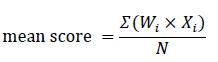
To quantify the level of importance, weights were assigned as follows: 2 for "very important" (VI), 1 for "important" (I), and 0 for "not important" (NI). An index was calculated to rank the variables based on their perceived level of importance. A mean score was used to determine the variables that should be prioritised to sustain production in smallholder goat farming systems. The mean score was calculated, and variables with a score of less than 1 for the production objective, trait for selecting breeding stock, and reason for culling were classified as low priority. Those with a score equal to or greater than 1 were defined as high priority. The challenges faced by smallholder goat producers were assessed using a 5-point Likert scale to determine the severity level of constraints. The weights assigned to the severity levels were as follows: 0 for insignificant constraints (IC), 1 for minor constraints (MC), 2 for moderate constraints (MOC), 3 for high constraints (HC), and 4 for extremely high constraints (EHC). An index was calculated to rank the constraints based on their perceived severity. The mean score was calculated, and constraints with a score of less than 2 were considered to have a low negative impact on productivity. Those with a score equal to or greater than 2 were considered to have a high negative impact on productivity. The decision to use a 3-point Likert scale for some questions and a 5-point Likert scale for others was based on the nature of the question and the range of possible responses. This approach was adopted to maintain simplicity, minimise confusion, and accurately capture the opinions of smallholder goat farmers without any compromises.
The index and mean score were calculated as follows:

Where:
Wi represented the weights assigned to the levels of importance or constraint severity levels. Xi represented the frequency of responses in each level of importance or constraint severity level for each tested variable.
Σ(Wi x Xi) represents the sum of the products of the weights and frequencies for all levels of importance or constraint severity levels.
Ti Ti represented the total number of responses recorded for all tested variables for each level of importance or constraint severity.
Σ (Τi x Wi) represents the sum of the products of the total responses and the weights for all levels of importance or constraint severity.
N represented the total number of respondents.
3. RESULTS
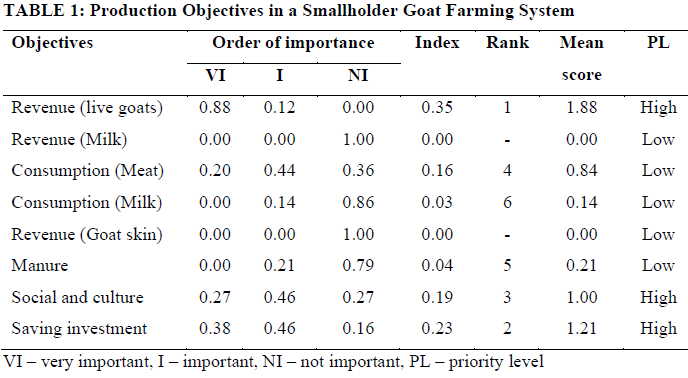
The results showed various production objectives in the smallholder goat farming system in the study area (Table 1). The primary production objective was to generate income by selling live goats. The second and third production objectives were to keep goats as a savings investment and to slaughter them for social and cultural events. Goat meat for household consumption was ranked fourth, while manure as an organic fertiliser was ranked fifth. Goat milk was the least important production objective for household consumption. The results also revealed that goat milk and skin were not considered important sources of income in the study area. The mean score identified the sale of goats, asset investment, and social and cultural events as the most prioritised production objectives in the study area.
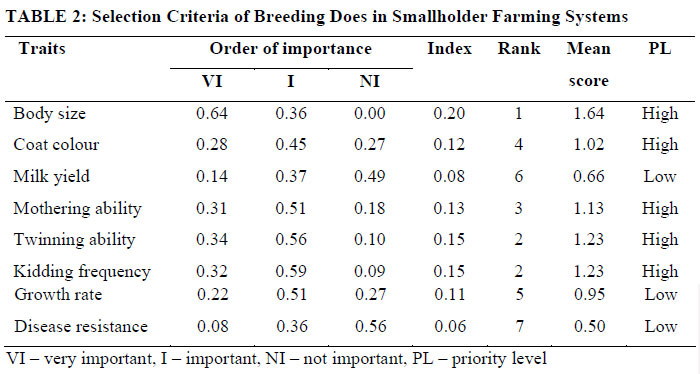
The selection criteria for breeding does in the study area are detailed in Table 2. Body size was the most crucial trait, followed by twinning ability and kidding frequency. Mothering ability, coat colour, and growth rate were ranked as the third, fourth, and fifth most important traits. Milk yield and disease resistance were ranked sixth and seventh, respectively. Overall, body size, twinning ability, kidding frequency, mothering ability, and coat colour were the most prioritised traits for choosing breeding does in the study area.
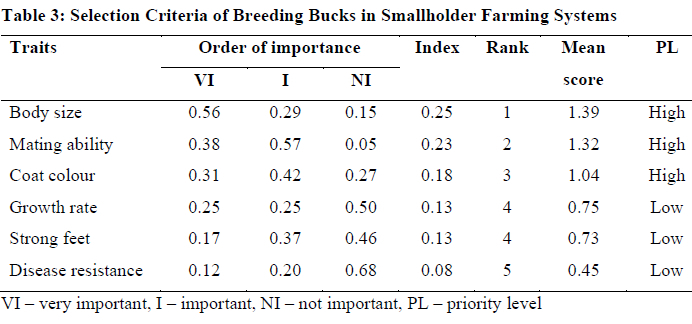
The results of selecting breeding bucks are summarised in Table 3. The top three most important traits for choosing breeding bucks were body size, mating ability, and coat colour. Growth rate and strong feet were also considered significant traits, ranking fourth. Disease resistance was ranked fifth. The study confirmed that body size, mating ability, and coat colour were key factors prioritised when selecting breeding bucks in the study area.
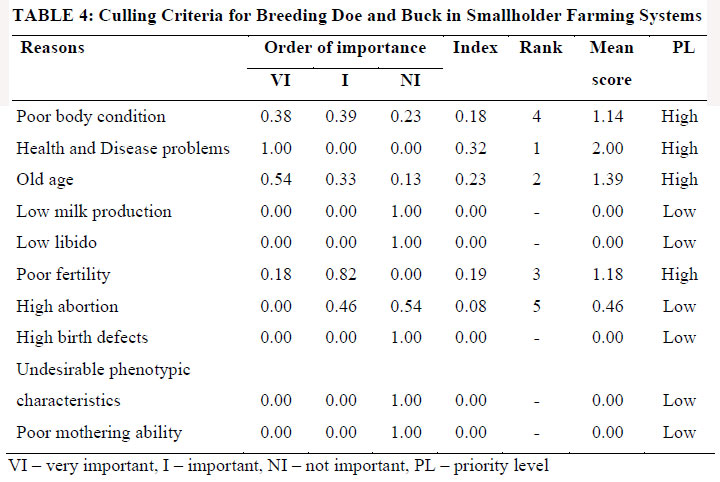
Table 4 presents the reasons for culling breeding stock in smallholder goat farming systems. Health and disease problems were ranked as the primary reason for culling, followed by old age and poor fertility. Poor body condition and a high rate of abortion were also significant factors for culling. However, low milk production, low libido, high birth defects, undesirable phenotypic characteristics, and poor mothering ability were not grounds for culling. Based on the mean score results, health issues, old age, poor fertility, and poor body condition were the main reasons for culling breeding stock in the study area.
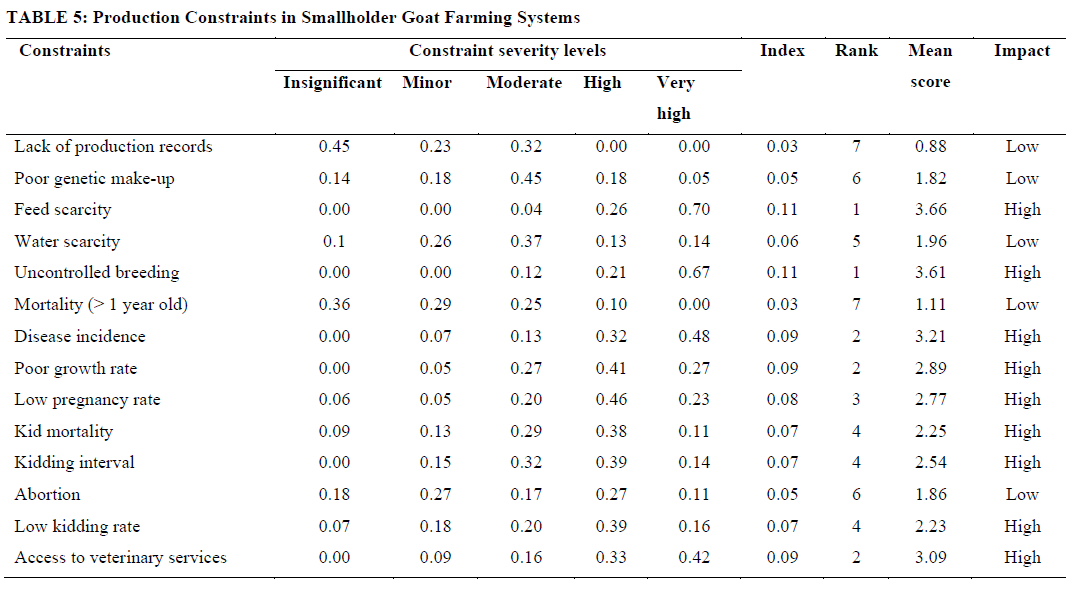
The production constraints in the study area are outlined in Table 5. The primary challenges included feed shortages and uncontrolled breeding. Disease prevalence, slow growth rates, and limited veterinary services were significant constraints to development. Low pregnancy rates, high kid mortality, extended kidding intervals, and low kidding rates were additional concerns. The use of inferior breeds and water scarcity were notable obstacles. Abortion rates, mortality of older goats, and lack of production records were considered less critical constraints. The main challenges perceived to have a detrimental impact on goat production in the study area, based on the mean score, were feed shortages, uncontrolled breeding, disease prevalence, limited veterinary services, slow growth rates, low pregnancy rates, extended kidding intervals, low kidding rates, and high kid mortality rates.
4. DISCUSSION
To improve production efficiency in smallholder goat farming systems, it is crucial to have a clear understanding of production objectives, breeding strategies, and the associated constraints. This information can help identify areas for improvement and determine the approach needed to increase productivity in resource-constrained environments.
4.1. Production Objectives
Having clearly defined production objectives is critical to ensure that the biological potential of the goats is maximised, and farm productivity and economic viability are enhanced. The most important production objectives in the smallholder goat farming system in the study area were the use of goats as a valuable source of income, acting as an asset for future use, and playing a significant role in social and cultural ceremonies. This highlights the significance of goat production in the rural economy and its contribution to the financial stability and the livelihoods of smallholder goat farmers. Previous studies have shown that goats in developing countries serve multiple purposes (Tyasi et al., 2022; Lohani & Bhandari, 2021; Mataveia et al., 2021; Mtshali et al., 2020). Therefore, economic and intangible objectives must be considered when planning a developmental program or strategy for smallholder goat farming systems.
The lack of consideration for goat milk as an income-generating opportunity may stem from a lack of awareness about its nutritional value, flavour, cultural taboos, traditional beliefs, and consumer preferences for cow milk, among other factors. Milk sales profitability depends on production capacity, which could be a limiting factor. According to Getaneh et al. (2016), the popularity of goat milk is compromised by certain cultural beliefs that associate goats with poverty, which in turn affects its consumption. However, goat milk is a rich source of calories, protein, fats, calcium, vitamin D, and phosphorus, making it a valuable nutritional resource (Chauhan et al., 2021; Getaneh et al., 2016). It contains more calcium, vitamin B6, and vitamin A than cow's milk (Getaneh et al., 2016), emphasising its health benefits. Recognising the health advantages of goat milk is essential for realising its potential as a profitable venture. However, even the most nutritious products may not yield significant financial returns without adequate production volumes, potentially hindering their pursuit as a business opportunity.
4.2.
Selection Criteria for Breeding Does and BucksAnimal breeding involves selectively mating animals to produce offspring with desired traits, aiming to enhance or maintain those traits in future generations. The selection process in the study area was subjective and not based on production records. This means that selected animals were not genetically superior, which could compromise production efficiency and the sustainability of the smallholder goat farming system. El-Raghi et al. (2021) suggest that the sustainable production of livestock farms relies heavily on effective management and informed decision-making. In smallholder farming systems, subjective breeding selection criteria or preference-based approaches are commonly used (Mathapo et al., 2025; Sheriff et al., 2014; Tyasi et al., 2022; Mtshali et al., 2020). This is due to the absence of performance records, which are important for genetic evaluation and reliable selection decisions, and the lack of basic training in animal breeding. This leads them to primarily rely on visual assessments of traits (Gizaw et al., 2022). These limitations hinder the ability to make well-informed breeding decisions because visual assessments alone may not accurately represent the animals' genetic potential. The key traits perceived as important for selecting breeding does were body size, kidding frequency, twinning ability, mothering ability, growth rate and coat colour. While milk yield and disease resistance were deemed less significant. Body size, mating ability, and coat colour were key factors considered when choosing breeding bucks for the study area. This is because animals with a large body size are normally sold at higher prices. Mating ability ensures successful reproduction, which is critical for the sustainability and profitability of a goat farming business. The importance of coat colour when selecting a doe or buck might have been influenced by the cultural belief and preference for a specific colour for social and cultural events. White goats are considered pure and often chosen for sacrificial rituals, cleansing ceremonies, and reconciliation with ancestors. On the other hand, black goats are avoided or not used for certain rituals due to their association with negative connotations. This suggests that specific coat colours may have symbolic meanings in the community.
4.3. Culling Criteria for Breeding Doe and Buck
Culling is a crucial management decision that significantly impacts production and profitability (El-Raghi et al., 2021). It entails removing animals from a herd due to undesirable traits or poor performance. This practice helps improve or maintain the overall quality and productivity of the herd, curb the spread of disease, and enhance the farm's profitability. According to Ahlman et al. (2011) and Weigel et al. (2003), culling is typically categorised as either voluntary, which is often a result of low production, or involuntary, which can be due to factors such as low reproduction rates or disease. The primary focus of culling in the study area was addressing health and disease issues. This was crucial for maintaining the herd's health and minimising animal suffering. Appropriate measures must be implemented to reduce involuntary culling, as a high rate of involuntary culling is indicative of inadequate production management. The negative impacts on the well-being of the animals threaten the production efficiency, sustainability, and profitability of smallholder goat farming businesses.
4.4. Constraints in Smallholder Goat Farming Systems
One of the primary challenges faced by smallholder goat farmers in this study was a shortage of feed. Seasonal variability, climate change, and poor veld management, among other factors, may contribute to feed shortage in smallholder goat farming systems (Kom et al., 2022; Yemane et al., 2020). This shortage poses a significant challenge for farmers in sustaining their livestock. Fortunately, during the wet season (November to March), there is typically an abundance of forage due to increased precipitation, which promotes plant growth (Yue et al., 2016). However, limited resources prevent smallholder goat farmers from implementing grazing management practices and preserving forages during times of abundance for use during dry periods. According to Kom et al. (2022), smallholder farmers who rely on natural resources are particularly vulnerable to the impacts of climate change, which can lead to feed shortages for their livestock. Therefore, poor nutrition can compromise animals' biological potential, resulting in poor body condition, slow growth, low production, and susceptibility to diseases.
Educating smallholder goat farmers on disease prevention is essential to ensure the health and well-being of their goats and potentially reduce the high incidence of diseases in the study area. By providing farmers with knowledge about disease prevention strategies, they can proactively protect their livestock. According to Cooke et al. (2024), improving the health and productivity of goats and herds can increase household income, food security, and nutritional resilience. This, in turn, leads to better economic returns for households and improved nutrition (Cooke et al., 2024). This approach benefits individual goats and enhances the overall productivity and sustainability of their farming practices. The issue of limited access to veterinary services is a serious concern that requires immediate attention. Provision of primary animal health care services is important for the survival of smallholder goat farmers, as they lack the financial means to afford private veterinary services.
Regular monitoring of production performances by critically evaluating reproductive parameters is essential to discover production deficiency, overall flock management, and health problems on time (Raheem et al., 2024). Farmers in the study area did not consider the absence of production records a significant issue. However, this lack of documentation could lead to delays in identifying production problems early and may affect the overall efficiency of goat farming in smallholder systems. Maintaining proper records and closely monitoring the flock would help prevent financial losses due to underperformance. Raheem et al. (2024) suggested that monitoring a goat flock's reproductive efficiency and productivity includes keeping track of important factors like age at puberty, age at first kidding, kidding interval, kid mortality rate, and litter size. Reproductive performance is a crucial factor in determining the efficiency of goat production (Delgadillo & Martin, 2015). The goat farmers in this study had problems with uncontrolled breeding, low fertility, poor growth rate, low pregnancy rate, extended kidding interval, and high kid mortality. The use of animals with poor genetic make-up might contribute to poor reproductive performance, even though farmers in this study did not consider that a serious challenge. The application of uncontrolled breeding takes away the most important production decision-making power that a livestock farmer has, which is to determine the appropriate breeding period that would work to their advantage. Additionally, it can lead to inbreeding. Therefore, optimising reproductive performance is crucial for smallholder goat farmers as it can significantly improve the sustainability and economic viability of goat farming.
5. CONCLUSION
Economic and intangible benefits are essential in smallholder goat farming systems. Economic benefits provide financial stability and sustainability for farmers, while intangible benefits, such as social and cultural ceremonies, are deeply ingrained in their belief system and should be valued. The study identified body size, kidding frequency, twinning ability, mothering ability, and growth rate as crucial traits for selecting breeding does. In contrast, coat colour, milk yield, and disease resistance were considered less important. When selecting breeding bucks, body size and mating ability were the primary factors considered in the study area. The main reasons for culling breeding stock were health issues, old age, poor fertility, and poor body condition. The main challenges in the study area included feed shortages, uncontrolled breeding, disease prevalence, limited veterinary services, slow growth rates, low pregnancy rates, extended kidding intervals, low kidding rates, and high kid mortality rates. These constraints hinder the productivity and sustainability of smallholder goat farming. Addressing them through improved management practices, access to resources, and appropriate training can enhance the overall health and productivity of smallholder goat farming systems. Therefore, even though goat production is not one of the prioritised commodities in the Gauteng province, it would be important for GDARD, as a custodian of agricultural development, to provide necessary support to goat producers.
6. ACKNOWLEDGEMENTS
The authors express their gratitude to the smallholder goat farmers in the Sedibeng District for their participation and valuable insights. They also thank the GDARD-Germiston region for providing farmers' data and acknowledge the agricultural practitioners for assisting with administering the questionnaires during data collection.
REFERENCES
- AGHWAN, Z., ALIMON, A., GOH, Y., NAKYINSIGE, K. & SAZILI A., 2014. Fatty acid profiles of supraspinatus, longissimus lumborum and semitendinosus muscles and serum in Kacang goats supplemented with inorganic selenium and iodine. Asian-Australas J Anim Sci., 27(4): 543-550.
- AHLMAN, T., BERGLUND, B., RYDHMER, L. & STRANDBERG, E., 2011. Culling reasons in organic and conventional dairy herds and genotype by environment interaction for longevity. J. Dairy Sci., 94(3): 1568-1575.
- CHAUHAN, S., POWAR, P. & MEHRA, R., 2021. A review on nutritional advantages and nutraceutical properties of cow and goat milk. Int. J. Appl. Res., 7(10): 101-105.
- COOKE, A.S., MACHEKANO, H., VENTURA-CORDERO, J., LOURO-LOPEZ, A., JOSEPH, V., GWIRIRI, L.C., TAKAHASHI, T., MORGAN, E.R., LEE, M.R.F. & NYAMUKONDIWA, C., 2024. Opportunities to improve goat production and food security in Botswana through forage nutrition and the use of supplemental feeds. Food Sec., 16: 607-622.
- DELGADILLO, J.A. & MARTIN, G.B., 2015. Alternative methods for control of reproduction in small ruminants: A focus on the needs of grazing industries, Anim Front., 5(1): 5765.
-
DEPARTMENT OF AGRICULTURE, LAND REFORM AND RURAL DEVELOPMENT (DALRRD)., 2022. A profile of the South African goat market value chain. Available from https://webapps1.daff.gov.za/
» https://webapps1.daff.gov.za/ - EL-RAGHI, A.A., HASSAN, M.A.E., EL-RATEL, I.T., HASHEM, N.M. & ABDELNOUR, S.A., 2021. Sustainable management of voluntary culling risk in Primiparous Zaraibi goats in Egypt: Roles of season and reproductive and milk production-related traits. Animals., 11(8): 2342.
- FORTE, L., DE PALO, P., NATRELLA, G., ALOIA, A. & MAGGIOLINO, A., 2024. Effects of dry and wet ageing on culled goat meat quality. Ital. J. Anim. Sci., 23(1): 693-706.
- GETANEH, G., MEBRAT, A., WUBIE, A. & KENDIE, H., 2016. Review on goat milk composition and its nutritive value. J Nutr Health Sci., 3(4): 401.
- GITAU, G.M., MAINA, O.I., NYAMBUNE, M.C. & VINCENT, M., 2023. Constraints and opportunities in smallholder dairy goat production systems in the tropics. J. Agric. Sci. Technol., 22(2): 83-99.
- GIZAW, S., ABEBE, A., GOSHME, S., GETACHEW, T., BISRAT, A., ABEBE, A.M. & BESUFIKAD, S., 2021. Evaluating the accuracy of smallholder farmers' sire identification for introducing genetic evaluation in community-based sheep breeding programs. Livest. Sci., 255: 104804.
- GREYLING, J.P.C., 2000. Reproduction traits in the Boer goat doe. Small Rumin. Res, 36(2): 171-177.
- IVANOVIĆ, S., PAVLOVIĆ, I. & PISINO, B., 2016. The quality of goat meat and its impact on Human health. Biotechnol. Anim. Husb, 32(2): 111-122.
- JURY, M.R., 2016. Climate influences on Vaal River flow. Water SA., 42(2): 232.
- KOM, Z., NETHENGWE, N.S., MPANDELI, N.S. & CHIKOORE, H., 2022. Determinants of small-scale farmers' choice and adaptive strategies in response to climatic shocks in Vhembe District, South Africa. GeoJournal., 87: 677-700.
- LOHANI, M. & BHANDARI, D., 2021. The importance of goats in the world. Pro. Agric. Workers J., (6)2: 4.
- MATAVEIA, G.A., VISSER, C. & SITOE A., 2021. Smallholder goat production in Southern Africa: A review. In S. Kukovics (ed.), Goat Science - Environment, Health and Economy. IntechOpen.
- MATHAPO, M.C., TYASI, T.L. & MUGWABANA, T.J., 2025. Breeding objectives and trait preferences of Nguni goat farmers in Limpopo province, South Africa. Trop Anim Health Prod., 57(49): 1-13.
- MAYBERRY, D., ASH, A., PRESTWIDGE, D. & HERRERO, M., 2018. Closing yield gaps in smallholder goat production systems in Ethiopia and India. Liv. Sci., 214: 238-244.
- MAZHANGARA, I.R., CHIVANDI, E., MUPANGWA, J.F. & MUCHENJE, V., 2019. The potential of goat meat in the red meat industry. Sustainability., 11(13): 3671.
- MTSHALI, T.F., MAPHOLI, O.N., NCUBE, K.T., DZOMBA, E.F., MATELELE, T.C., CHOKOE, T.C., MPHAHLELE, T.D., MUCHADEYI, F.C. & HADEBE, K., 2021. Goat farmers' production objectives and trait preferences in the North West province of South Africa: An approach to identify selection criteria for community-based breeding programs. Int. J. Livest. Prod., 12: 64 - 75.
- NAMONJE-KAPEMBWA, T., CHIWAWA, H. & SITKO, N., 2022. Analysis of goat production and marketing among smallholder farmers Zambia. Small Rumin. Res., 208: 106620.
- NTSHANGASE, M.Z., SANELISE, T., MOYO, B., MISERY, S. & VAN NIEKERK, J., 2021. Factors affecting household goat farmers' market participation and the extent of commercialization. In S. Kukovics (ed.), Goat Science - Environment, Health and Economy. IntechOpen.
- RAHEEM, K.A., BASIRU, A., RAJI, L.O. & ODETOKUN, I.A., 2024. Chapter 13 -Productive performance of goat. In T. Rana (ed.), Trends in clinical diseases, production and management of goats. Academic Press, pp. 163-177.
-
RAOSOFT., 2004. Sample size calculator. Available from www.raofoft.com/samplesize.html
» www.raofoft.com/samplesize.html -
SEDIBENG DISTRICT MUNICIPALITY (SDM)., 2023. Climate change adaptation plan: DraDraft 1. Green book adapting settlements for the future. Available from https://greenbook.co.za/documents/Sedibeng_AdaptationPlan_Aug2023.pdf
» https://greenbook.co.za/documents/Sedibeng_AdaptationPlan_Aug2023.pdf - SETOBOLI, T., TSHUMA, N. & SIBANDA, E., 2025. Viability of goat production and market participation: A comparative analysis of smallholder farmers in Gwanda District, Zimbabwe. Int. J. Soc. Sci. Res., VIII(XV): 244-251.
- SHERIFF, O., ZEWDIE, B. & HAMID, A., 2024. Understanding goat keepers' breeding objectives and selection criteria in northwestern Ethiopia: Application of participatory own-flock and group-animal ranking experiments. Cogent Food Agric., 10(1): 1-10.
- TYASI, T.L., NG'AMBI, J. & MOGASHOA, S., 2022. Breeding practices and trait preferences of goat keepers at Lepelle-Nkumpi Local Municipality, South Africa: Implications for the design of breeding programmes. Trop Anim Health Pro., 54(68): 19.
- WEBB, E.C. & MAMABOLO, M.J., 2004. Production and reproduction characteristics of South African indigenous goats in communal farming systems. S. Afr. J. Anim. Sci., 34(1): 236-239.
- WEIGEL, K.A., PALMER, R.W. & CARAVIELLO D.Z., 2003. Investigation of factors affecting voluntary and involuntary culling in expanding dairy herds in Wisconsin using survival analysis. J. Dairy Sci., 86: 1482-1486.
- YEMANE, G., MELESSE, A. & TAYE, M., 2020. Evaluation of production systems and husbandry practices of Ethiopian indigenous goats. J. Anim. Feed Res., 10(6): 268-277.
- YUE, X., ZHANG, T., ZHAO, X., LIU, X. & MA, Y., 2016. Effects of rainfall patterns on annual plants in Horqin Sandy Land, Inner Mongolia, China. J. Arid Land., 8: 389-398.