Examining the Sustainability of Precision Agriculture and the Role of Advisory Services in South Africa: An Integrative Review of Potentials, Challenges, And Strategies
Abstract
Precision agriculture adopts a transformative and distinct approach that aims to maintain symmetry between economic productivity and ecological welfare within the broader context of the agricultural sector. The conceptualisation and implementation of precision agriculture emerge as a propulsion in developed countries, whereas discussions have been minimal in developing countries such as South Africa. Agricultural extension as a conduit of agricultural development, transformation, and sustainability has been forthcoming in the policy framework that enables the adoption and implementation of precision agriculture. This paper examined the implementation, opportunities, adoption challenges, and promotion of precision agriculture through extension services in South Africa. The review focused on literature articles published between 2003 and 2022. This review manuscript retrieved 5612 articles, of which 123 were appraised and reviewed after screening for applicability and relevance. Moreover, grey literature was also meticulously selected and extensively reviewed. Joint Research Centre (JRC) of the European Commission, Food and Agriculture Organisation (FAO), United Nations Development Programme (UNDP), African Development Bank (AfDB), International Society for Precision Agriculture (ISPA), and Department of Agriculture, Forestry and Fisheries (DAFF) documents were used in this review. The review revealed that extension practitioners must be adequately trained in precision agriculture technology transfer and dissemination to efficiently render technology-related services to farmers. Moreover, the South African government should expedite a policy shift to address technology adoption gaps in precision agriculture. Finally, it concluded by expatriating that more research ought to be undertaken to explore and work out modalities for precision agriculture adoption and implementation in a broader context of the South African agricultural sector characteristics, dynamics, and scenarios.
Precision Agriculture; Technologies; Innovation; Agricultural Extension Services; Extension Practitioners; Productivity; Sustainability
1. INTRODUCTION
Precision agriculture is an integrated farm management technique that uses contemporary innovative technologies to accurately apply inputs according to the crop requirements to improve efficiency and productivity in a farming field (Yu & Van Biljon, 2021). Lowenberg-DeBoer and Erickson (2019) describe precision agriculture as an integral part of promoting sustainable agriculture as an innovative approach that balances increased productivity and conserving the environment. According to the International Society for Precision Agriculture (ISPA) (2021), the concept of precision agriculture is premised on the optimised farm systems and practices that allow for the temporal, spatial and individual data to be collected, analysed and processed to enhance productivity, quality, profitability and sustainability. Precision agriculture is distinct from other conventional farming approaches as it enables the specific application of fertilisers, herbicides, pesticides and other farming inputs to improve average yields (Mungarwal & Mehta, 2019).
Precision agriculture focuses on and customises a smaller portion of the farming field at a time to characterise its varying needs as-part of a larger farming field. The key enabling techniques and components of precision agriculture are bound by data that is obtained from yield monitors, remote sensors, robotics, unmanned aerial vehicles, global positioning systems, soil testing, variable rate technology, automated software and hardware, and control systems (Amrita Vishwa Vidyapeetham University, 2021).
As the world's population continues to increase and is expected to reach approximately 10 billion by the year 2050, the agricultural sector should innovate and acclimate to advanced technical food production measures to meet the food demand threshold (UNDP, 2021). The growth in the world's population requires innovative technological strategies to be adopted to increase food production (Mohammed & Abdulai, 2022).
According to Masere and Worth (2021), agricultural extension services have a fundamental role to play in dispensing new technologies and information from producers, technocrats, and researchers to farmers. However, for farmers to adequately receive technology and related information, particularly precision agriculture, Agholor (2019) posits that extension practitioners should be driven by self-efficacy, which is a concept based on the assessment of a person to fulfil a given task and be motivated to perform and produce satisfactory results. The ability of extension practitioners to impart knowledge and information related to precision agriculture and further facilitate its implementation may increase the probability of farmers adopting modern farming approaches. As denoted by Mapiye et al.(2021), poor remuneration and operational resources such as transport and tools of trade among extension practitioner affect-their ability to perform set duties and reduce morale. The greater the self-efficacy of an extension practitioner, the more capable, assertive and result-oriented they become (Agholor, 2019).
Since precision agriculture involves many technological approaches and tools, Masere and Worth (2021) found that myriad factors apart from agricultural extension influence the willingness to adopt new and advanced technologies among farmers. These factors range from ease of use, productivity improvement prospects, affordability, farmer demographics, perception, operating environment, availability, accessibility, and risks.
According to Walisinghe, Ratnasiri, Rohde and Guest (2017), agricultural extension has a fundamental and critical role to play in enabling access, adoption, and implementation of new technologies. The agricultural sector in South Africa remains an integral part of the country. According to the statistical quarter-on-quarter report produced by Stats SA (2022), the South African agricultural sector realised a growth of 0.5%, contributing to and bolstering the overall GDP increase of 1.6%. However, this growth indicates a decline from the 1.9% of the first quarter and the 1.4% of the final quarter of 2021. The fluctuation in the gross domestic product contribution of agriculture in the South African economy presents a gap that can be filled by smallholder farmers through modern innovations, such as precision agriculture, through the support of adequate and effective extension practitioners. According to Nkosi and Agholor (2021), it is an immediate necessity that extension practitioners are appropriately equipped with competencies and skills in the discipline of technology comprehension and dissemination to enable them to facilitate and implement new technology advancements for adoption to enhance agricultural productivity.
Based on this background, the review explores precision agriculture implementation in extension services in South Africa based on existing literature. The adopted specific objectives of this paper are to; (i) Examine the sustainability of precision agriculture in South Africa, (ii) Determine the opportunities of precision agriculture implementation for extension in South Africa, (iii) Assess precision agriculture adoption challenges to improve productivity in South Africa, (iv) Examine technology development of precision agriculture and their applicability, and (v) Explore the role of advisory services in enhancing precision agriculture in South Africa.
2. MATERIAL AND METHODS
The review paper adopted an integrative review method. The integrative literature review approach has a different purpose: to assess, critique, and synthesise research topics in a way that enables new perspectives to emerge (Snyder, 2019; Torraco, 2005). Scholarly peer-reviewed journals, institutional repositories, books, government gazettes, search engines such as Google Scholar (GS), ResearchGate, SciELO, ScienceDirect, MDPI, Elsevier, Springer Open Access, and Web of Science (WoS) were used to find relevant articles and gather information on the topic. Search terms and nomenclature such as precision agriculture, agricultural technology, innovation, agricultural extension services, extension practitioners, agricultural productivity, sustainability, and smallholder farmers were meticulously employed to find relevant literature and publications. The authors of this review adopted a literature search criterion that prioritised the following: (i) The strict use of scientific papers written only in English, (ii) Only precision agriculture and related technology contents were used to address the objectives of the review, (i) The review was researched based on reputable scientific papers, peer-reviewed journals and published literatures, (iv) The review was not only limited to scientific literature but extended to grey literature such as policy documents, working papers, government gazettes, white papers, conference presentations, technical reports and other official documents for diverse information.
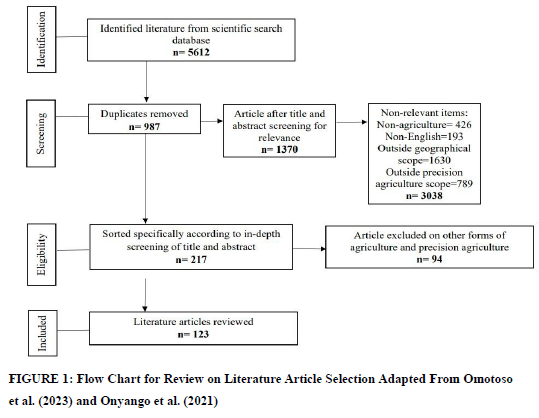
This review manuscript retrieved 5612 articles, of which 123 were appraised and reviewed after screening for applicability and relevance. The flow diagram labelled Figure 1 illustrates the quality assurance process undertaken in the title and abstract screening and selection procedure.
3.1. The Concept of Precision Agriculture
Precision agriculture is a farming system that improves crop yield and enhances management decisions by employing high and innovative technological advancements to analyse, interpret, and process data (Singh et al., 2020). The concept of precision agriculture has been received and adopted globally as an approach that reduces input costs, time, and labour-intensive methods, improves crop quality, increases yield production, and improves irrigation systems. It balances agricultural production activities and the environmental aspects while producing more food (Imperial College London, 2014). According to Mulla (2013), precision agriculture improves agricultural resource use efficiency using large amounts of data to optimise crop management strategies.
Ehlers (2019) posited that there are three main components of precision agriculture, the first being, database information, which contains the soil (structure, texture, nutrient and moisture), crop (plant population, insect or fungal infestation, nutrient status, weeds, stress, and yield), and climate (humidity, rainfall, temperature and wind velocity). The second component is the technological aspect, which comprises weather modelling, standardisation, remote sensors, robotics, unmanned aerial vehicles, global positioning systems, variable rate technology, and the Internet of Things. The last component is the management aspect, which deals with information management, decision support systems, and service providers.
In a historical context, precision agriculture as a concept of advanced technological systems to enhance crop productivity can be located as far back as the mid-1980s (Mulla, 2013). It was established and theorised with the inaugural use of sensors to measure and interpret soil organic matter. It gained momentum and popularity, expanded to satellite, and was further used to make input recommendations on fertilisers and soil pH. From 1990 and beyond, precision agriculture evolved into a useful farm management approach in present-day agriculture (Mulla & Khosla, 2015). Gebbers and Adamchuk (2010) postulated that in recent times, the advancement of precision agriculture has been predominantly in computer software, automated devices for fertiliser application, self-propelling farm machinery and on-field research for the management of production systems. According to Braun, Colangelo and Steckel (2018), modern technology developments should complement human technical skills to realise transformation within the agricultural sector.
3.2. Agricultural Advisory Services in South Africa
Agricultural extension service is perceived as an enabler of food security (Lukhalo & Zwane, ). It is a fundamental anchoring pillar of the South African agricultural sector (Nkosi & Agholor, 2021). Agricultural extension continues to be an integral factor in advancing agricultural development and sustainability (Anderson & Feder, 2007). It improves farmers' agricultural productivity by providing advisory services, skills, and knowledge (Ragasa, Ulimwengu, Randriamamonjy & Badibanga, 2016). According to Collett and Gale (2009), agricultural extension is mainly about helping farmers realise their actual farming and productivity level and potential by developing strategies to overcome and solve their problems. It has an immense role in disseminating information from researchers and developers to farmers, vice versa.
Koch and Terblanche (2013) posited that the main objective that guides the idea and principle of agricultural extension since its inception was to promote food security by empowering farmers to make their own decisions and improve existing farming approaches. Raidimi and Kabiti (2019) asserted that agricultural extension helps eradicate poverty by contributing to productivity and improving farmers' income. Agricultural extension is responsible for carrying farmers' hopes and aspirations in agricultural production, exchange, and distribution.
Historically, the South African agricultural sector has comprised commercial and emerging farmers. It has a dualistic approach to agricultural development (Worth, 2012). On apartheid racial preference, the commercial farmers received the best extension support while the majority, who were emerging and smallholder farmers, were neglected, subjugated, and suppressed (Loki, Aliber & Sikwela, 2021). The exclusion of the majority of smallholder farmers in mainstream extension and agriculture meant that these farmers continued to lack production means such as credit facilities, market access, land access, infrastructure, technology and policy favour (Koch, 2007).
The democratic breakthrough introduced a unitary and single public government agricultural extension system that is all-inclusive in its agricultural developmental agenda. This public extension service system brought with it a transformative agenda to uplift previously disadvantaged smallholder farmers to develop and transition towards the trajectory of commercialisation in the years to come (Nkosi & Agholor, 2021). However, agricultural extension in South Africa has faced service delivery challenges to smallholder farmers in recent years. These challenges have negatively impacted the abilities of smallholder farmers in terms of productivity levels, decision-making, innovation, and technology adoption (Agholor, 2014).
Amid all the contemporary challenges confronting extension services, Davis and Terblanche (2016) postulate that the South African extension practitioners are tasked with the role of discharging their responsibilities of transferring proven and recent scientific research, agricultural findings, knowledge, and skills through farmer education. In addressing the variety of issues facing extension, there is a need for an intensified collaborative synergy between extension work and research (van Niekerk et al., 2011). Agricultural extension services in South Africa require policy re-appraisals that will be transformative and biased towards the upliftment of productive smallholder farmers. As denoted by the International Fund for Agricultural Development (IFAD) (2013), about 80% of the food produced in underdeveloped countries is produced by smallholders.
3.3. Agricultural Extension in Promoting Precision Agriculture in South Africa
As an advanced approach to farming, precision agriculture is rarely a subject matter among resource-poor smallholder farmers (Mupambwa, Nciizah, Dube & Fanadzo, 2022). Consequently, agricultural extension as a conduit for pro-poor farmers promotes new and advanced technology across the broader spectrum of agricultural activities. Agricultural extension is fundamental in facilitating development through technology transfer and disseminating advanced agricultural farming systems. Koutsouris (2018) noted that technology transfer is a critical pillar and aspect of agricultural extension, involving the relay and spread of innovations and related expertise to farmers.
According to Robertson (2012), agricultural extension agents should be adequately equipped and knowledgeable on various agricultural disciplines to impart and persuade farmers to adopt and implement modern approaches to improve their farming productivity. The introduction of technology-related agricultural training courses and programs to farmers by extension officers has the potential of expanding and broadening their knowledge and awareness of the multifarious technology developments while influencing adoption (Altalb, Filipek & Skowron, 2015). In the case of precision agriculture, extension practitioners must be able to explain to farmers how the concept would apply to their local conditions.
Extension practitioners are responsible for creating awareness on innovation and technology among farmers and further persuading farmers of their importance and usefulness (Aremu, Kolo, Gana & Adelere, 2015). In the promotion of precision agriculture, extension practitioners must be able to interpret and unpack the positives of these new technologies in the form of a problem-solving approach to issues faced by farmers (Ann, 2013). Innovation and technological developments require extension practitioners to play a catalytic role in expediting the adoption rate.
3.4. Agricultural Advisory Services: Strategies to Enhance Precision Agriculture Implementation
Various agricultural extension models have been implemented in many countries to transform and improve farming in various communities (Torimiro & Igodan, 2019). Traditionally, the personal contact method, the group contact method and the mass contact method are the three primary methods of disseminating new technology and innovation to farmers using demonstrations (Kumar, Ramadas & Singh, 2018). Agricultural extension in South Africa requires reengineering and remodelling through e-extension to better service delivery systems (Yusuf, Popoola & Yusuf, 2022). According to Afzal, Al-Subaiee and Mirza (2016), e-extension approaches have a proven record of being successfully used in various countries to advance extension work.
To deliver extension, e-extension involves using information communication technology (ICT) such as videos, portals, applications, voice notes, SMS, WhatsApp, and social media platforms (Gichamba, Wagacha & Ochieng, 2017). Extension practitioners can use these digital platforms to enhance farmers' adoption and implementation of precision agriculture. Digitisation seems to be one of the most important mechanisms of delivering sound agricultural extension to farmers (FAO, 2020). The application of these technology advancements can enable extension practitioners to easily train, impart information, raise awareness, and transfer technology to farmers (Saravanan, Rasheed-Sulaiman, Davis, & Suchiradipta, 2015), with special reference to precision agriculture.
Agricultural extension is pivotal in agricultural development and transformation through technology transfer to farmers (Abdullah, 2021). Agricultural strategies to enhance precision agriculture implementation should be responsive to the contemporary conditions and socio-economic situations facing the farmers. According to Parvan (2011), an outcome-based approach resulting in the sustainability of farm management, an increase in productivity, and food quality influences farmers' decision to adopt innovations and technology. The strategies of extension services in disseminating technology in general and precision agriculture in particular ought to be evidence-based practice.
Using mobile phones by extension practitioners remains a relevant strategy to promote precision agriculture among farmers, as Fabregas, Kremer and Schilbach (2019) posited that farmers who received mobile phone recommendations on new agricultural practices are likely to adopt the proposed practice. Farm visits are also very important to facilitate a primitive engagement with precision agriculture-related developments. In enhancing precision agriculture among farmers, extension practitioners should be able to break down the concept of precision agriculture and its benefits, particularly among smallholder farmers.
3.5. Agricultural Transformation Agenda Policy on Extension in South Africa
South Africa has numerous transformative policy initiatives on agricultural extension to support the agricultural sector and farmers. According to Agholor and Lubisi (2020), the South African agricultural sector is driven and guided by statutory policies that include extension services, natural resources, technology, distinct labour patterns, and varying agricultural institutions. Various literature indicates that extension policy considers factors such as natural resources, population and environment in its legislation processes (Oladele, 2011).
The dawn of democracy introduced significant changes in policies that govern the agricultural sector with the establishment and development of the white paper on Agriculture (DAFF, 2012). The white paper on agriculture led to the introduction of the broadening access to agriculture thrust (BATAT), which was aimed at enabling inclusivity of farmers who were previously disadvantaged, excluded and underserved in terms of extension services, financial support, technology, markets, and human resource development (Cloete, Bahta, Marunga & Lombard, 2019). This policy empowered extension services in South Africa as a driver of agricultural transformation and protagonist of farmers' interests.
Numerous agricultural policies, acts, and strategies have been developed and implemented since the white paper on agriculture in 1995. According to DAFF (2012), these policies, acts and strategies include the Strategy for South African Agriculture (SSAA), the Comprehensive Agricultural Support Programme (CASP), the Land and Agrarian Reform Project (LARP), and the Comprehensive Rural Development Programme (CRDP). Agricultural extension service activities and programmes are guided and bound to be operationalised within the framework of these policies, acts, and strategies to improve and transform farmers' productivity, especially smallholder farmers.
With all the guiding policies, acts, and strategies, agricultural extension in South Africa continues to face challenges in adequately meeting and servicing the demands of farmers (Abdu-Raheem, 2014). According to William (2012), the ratio of an extension practitioner to farmers is 1:1878 for smallholder farmers and 1:21 for commercial farmers. Enabling policies on transformation and development remains the jurisdiction and competency of the national government, is operationalised at the provincial level, and further cascades downwards. An overarching national extension strategy may not be properly applicable in certain areas due to the varying dynamics of local communities. As noted by Masere (2015), a one-size-fits-all agricultural extension strategy may not be effective due to varied geographical locations. Agricultural extension policies should be developed to be specifically fit for purpose according to the specifications of a particular area to realise maximum impact and transformation.
3.6. Precision Agriculture and Adoption
Precision agriculture adoption has been relatively slow (Lowenberg-DeBoer & Erickson, 2019). There are limited studies that have been undertaken in an attempt to anticipate the willingness of farmers to adopt precision agriculture (Aubert, Schroeder & Grimaudo, 2012). According to Lowenberg-DeBoer and Erickson (2019), studies conducted on precision agriculture and adoption have not adequately explained or predicted national and regional trends of precision agriculture adoption. Keskin, Sehri and Sekerli (2018) posited that recent studies have attempted to provide an overarching perspective and overview on precision agriculture adoption. However, only a few studies have focused on precision agriculture adoption in developing countries.
According to Thompson, Bir, Widmar and Mintert (2018), research has revealed numerous factors influencing individual farmers to adopt precision agriculture. These factors include age, education level, farming experience, farm size, land tenure, irrigation, farm specialisation, computer literacy, debt to asset ratio, and perceived profitability of precision agriculture (Jacobs, van Tol & Du Preez, 2018). According to Busse et al. (2014), adopting new technological innovations is often driven by the quality of information and knowledge exchange offered to farmers.
The adoption of precision agriculture is a process that requires trial, observations, and experience to improve acceptance (Kernecker, Knierim & Wurbs, 2017). Precision agriculture adoption can be stimulated and expedited through access to credit. Land ownership patterns may influence the willingness to invest in technology, as farmers who own land are likely to adopt precision agriculture (Gao, Sun & Huang, 2017). Larger farms with high levels of awareness and that can absorb associated risks and costs are likely to adopt precision agriculture than smallholder farmers (Paustian & Theuvsen, 2017).
Literature indicates that attitude to risks is a critical factor in adopting new technologies in general (Yatribi, 2020). Risks associated with new technologies often channel farmers towards using farming tools that are at their disposal instead of investing in modern technology (Miller, Griffin, Ciampitti & Sharda, 2019). Barnes et al.(2019) further add that technology adoption must be commensurate with the economic returns on investments. The likelihood of scepticism about adopting is greater when the perceived economic returns are not adequately defined. Danso-Abbeam, Dagunga and Ehiakpor (2019) assert that household size influences the perception of adoption by farmers; the bigger the household size, the more likely it is that farmers will easily adopt technology. Precision agriculture adoption among farmers at various levels of agricultural production is a process that requires time and strategies in the promotion and facilitation process.
3.7. Precision Agriculture and its Applicability
Technological innovations and advancements in precision agriculture ought not only to be theoretically sound and convincing but also to be applicable in a real sense and feel to the field of agriculture. According to Adekunle (2013), precision agriculture is a proven and developmental technological advancement, but it is still only applied and limited to developed countries. Despite the slow progress in the adoption and implementation of precision agriculture in developing countries such as South Africa, the feasibility of application is possible in the ways mentioned below.
3.7.1. Applicability Through Practical and Smart Farming
From data information obtained from installed in-field sensors and smart equipment, data-controlled decisions are produced for optimised and improved farming (Javaid et al., 2022). Practical and innovative farming is further enabled through intra-technology connection of hardware and software of machines to improve communication towards achieving an automated and interconnected farming system (Bernhardt et al., 2021). The self-propelled robots as a feature of precision agriculture are applicable in manual activities of the farm that may be regarded as heavy duty such as moving large farming inputs such as fertilisers from one point to another, technical analysis and monitoring of crop and soil, and predicting the influence of climatic conditions and environmental factors on agricultural output (Despoudi, Spanaki, Rodriguez-Espindola and Zamani, 2021).
3.7.2. Applicability Through Understanding the Composition of the Soil
The application of drones, satellites and unmanned aerial vehicles allows farmers to assess and monitor crop health by collecting in-field real data and information of related crops using smartphones, laptops, and tablets (Popkova, 2022). This data can be further used to determine and predict how production output can be improved by making special, specific, and direct examination of what interventions and adjustments are required to distinct plots from planting to harvesting (Gheorghe et al., 2019). In this application of precision agriculture, farmers are presented with contemporary ways of understanding the composition of soil, nutrient status, and what measures can be applied to ensure maximum crop quality and yield.
3.7.3. Applicability in Terms of Precise Weather Tracking and Prediction
The weather is one of the most important factors in agriculture. Precise weather tracking and prediction entails the use of artificial intelligence, data mining and analysis, internet of things, robots and numerous technologies to assist farmers in establishing better and developing a farming schedule based on accurate weather interpretation (Lajoie-O'Malley, Bronson, Van Der Burg & Klerkx, 2020). Weather tracking and prediction enable farmers to take action to lessen the drastic effects of extreme events on their livelihoods. It also helps farmers reduce costs, prevent over- and under-irrigation, and produce higher crop yields. According to Xu, Wang, Zhu and Li (2020), precision agriculture technologies are important in managing fluctuating and varying weather conditions prompted by climate change through the use of automated greenhouses.
3.7.4. Applicability in Terms of Improved Farming Operations
Precision agriculture innovations such as big data can be used to analyse and interpret information received from other farms to improve their farming operations by benchmarking on required agricultural skills for improved yields yearly (Paraforos & Griepentrog, 2021). Precision agriculture enables farmers to migrate from outdated and costly diesel generators to modern, cost-effective, environmentally friendly green and renewable energy, such as solar panels and wind-powered turbines (de Oliveira & Corr"ea, 2020). Improving farming operations through big data offers farmers the required impetus and leverage to properly manage risks and engage in value-added agricultural processing (Cheng et al., 2021).
3.7.5. Applicability in Terms of Detecting Agricultural Uncertainties and Risks
The conception of precision agriculture and its technology was developed for the betterment of the conditions of farmers and to improve conventional agricultural methods to enhance productivity and income while conserving the environment. As a result, its technologies should be able to detect agricultural uncertainty and risks, and safeguard the production value system. According to Wahaishi and Aburukba (2021), using unmanned aerial vehicles and drones is applicable in a real sense to monitor crop development and requirements in real-time visibility while farmers continue to be engaged in other errands. Fountas et al. (2020) asserted that precision agriculture technologies lead to modernisation of the agricultural sector in which impoverished and underdeveloped farmers' income and production are increased while food cost decreases and nutrition is boosted.
3.8. Opportunities in Precision Agriculture Implementation
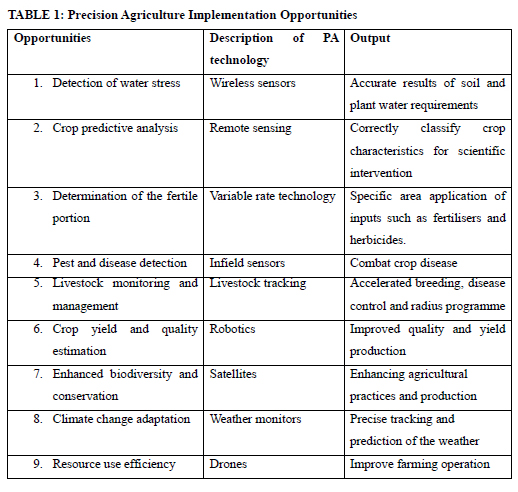
From Table 1, there is a clear indication that precision agriculture offers opportunities such as detection of water stress, crop predictive analysis, determination of land fertile portion, pest and disease detection, livestock monitoring and management, crop yield and quality estimation, enhanced biodiversity and conservation, climate change adaptation, and resource use efficiency. Technologies relating to precision agriculture, such as wireless sensors, remote sensing, variable rate technology, in-field sensors, livestock tracking, robotics, satellites, weather monitors and drones, are instrumental tools for realising the presented opportunities (Onyango et al., 2021). Based on the opportunities available for precision agriculture implementation and from the perspective that precision agriculture remains a concept in many developing countries (Alhassan et al., 2022), agricultural extension has an important role in farmer education, thereby ensuring that there is sufficient exploration, analysis and implementation of precision agriculture innovations and technologies.
3.9. Precision Agriculture and Sustainability
Precision agriculture and sustainability cannot be disentangled due to their common features (Bongiovanni & Lowenberg-DeBoer, 2004). Sustainable agriculture seeks to protect and improve ecological welfare and the global ecosystem while promoting human dignity by uplifting the socio-economic interests of local communities by adopting and using practices that are efficient, productive, and competitive (Sustainable Agriculture Initiative, 2003). Similarly, precision agriculture is an integral part of promoting sustainable agriculture as an innovative approach that balances increased productivity and conserving the environment (Lowenberg-DeBoer & Erickson, 2019). There is a complementary correlation between precision agriculture and sustainable agriculture, with a fundamental difference in innovation and technology.
For agriculture to be sustainable, modern farming practices that are socially viable, acceptable, and profitable should be employed with the numerous diverse challenges confronting the agricultural sector, ranging from the uncontrollably deteriorating climate to water pollution and shortage, manifestation of pests and diseases, and excessive soil erosion, among other factors (Bongiovanni & Lowenberg-DeBoer, 2004). There is an immediate need to adopt and implement precision agricultural technologies to promote sustainable agriculture. Katalin (2012) postulated that every technological development that promotes economic efficiency, conserves and reproduces natural resources is considered sustainable.
Precision agriculture and its technological advancements are characterised as sustainable due to the balance that they maintain between the environment and profit prospects. With information-based technology specific to crop management, precision agriculture allows farmers to reduce the application of chemicals by applying these chemicals precisely as and when the need arises, and at the correct rate and time, in the process promoting sustainable agriculture (Katalin, 2012).
3.10. Challenges Associated with Precision Agriculture Adoption
Precision agriculture requires extra investment, distinguished skills, expertise, and accuracy, and it is associated with many unknown factors (Katalin, 2012). According to Reichardt et al. (2009), studies reveal numerous challenges in precision agriculture implementation. The leading challenge is farmers' slow adoption of precision agriculture (Kutter, Tiemann, Siebert & Fountas, 2009). Developers and manufacturers of precision agriculture technologies need to produce less sophisticated, simpler, and convenient technologies to enable farmers to apply these technologies easily (Anaba, 2018).
Empirical findings of literature have identified low education level, farmers' attitudes, expertise, skills, information, high cost, usefulness, ease of use, impact of technology, and inadequate extension services as challenging factors that prohibit and slow down the adoption and implementation of precision agriculture (Joint Research Centre (JRC) of the European Commission, 2014). These findings are congruent with additions to the documented literature, reviewed by Tey & Brindal (2012), that eight category factor challenges influence farmers' adoption of precision agriculture. These factors are education and training, farmer demographics, time, technical, economic, political, environmental and data quality.
Kendall et al. (2017) posited that the perceived benefits and capacity among farmers remain a hindering factor to precision agriculture adoption. Boghossian et al. (2018) argue that professionals and researchers often do not fully understand or seriously treat the existing barriers to precision agriculture adoption and implementation. The adoption rate differs in South Africa; commercial farmers are more likely to adopt modern innovations than smallholder and emerging farmers (Nkosi & Agholor, 2021). According to the African Development Bank (AfDB) (2019), the adoption of technology at a faster rate among commercial farmers is due to financial access and capabilities through various production channels.
4. CONCLUSION AND RECOMMENDATIONS
Like in many developing countries, precision agriculture in South Africa is still in an inception phase. Agricultural extension has a crucial role in technology transfer and dissemination to farmers. Scientific literature findings indicate that agricultural extension in South Africa has not been able to fully implement technology transfer and dissemination to farmers due to incompatible imposed strategies on farmers. In the case of precision agriculture, extension practitioners are responsible for breaking down and demonstrating how these technological advancements will be applicable and solve the contemporary issues facing farmers. For farmers to accept, adopt and implement precision agriculture, extension practitioners must be able to unpack, clarify and outline the advantages and usefulness of these technological advancements.
Extension practitioners should take a catalytic role in expediting the adoption of innovations and technological advancements such as precision agriculture. Agricultural extension practitioners must be adequately capacitated and equipped in technology-related developments to effectively and efficiently render technology transfer to farmers. Precision agriculture is often perceived as having high investment costs, technical, and high maintenance. Expertise, education level, farmers' attitude, skills, cost, ease of use, usefulness, impact of technology and extension services influence the adoption and implementation of precision agriculture.
Farmers' in-field demonstrations, farm visits, trial and error sessions and technology-related support services are sacrosanct in dealing with farmers' perception of technology and increasing the probability of adoption and implementation. Agricultural extension in South Africa must establish a curriculum that includes precision agriculture and related technologies. Manufacturers and developers of precision agriculture-related technologies must consider farmers' various dynamics and scenarios when designing and making new technologies, considering factors such as affordability, land space, maintenance, operational manual, and sustainability.
The government needs to urgently enact policies to inculcate farmers on advanced technologies such as precision agriculture and further incentivise and subsidise farmers on these innovations and advancements. Educationally targeted collaborative efforts are required from the government, training institutions, and private agencies to raise awareness on the use of precision agriculture for local development. Lastly, further research is needed to discover how precision agriculture and related technologies can replace or complement in-use and conventional methods to improve productivity and maintain environmental sustainability.
REFERENCES
- ABDULLAH, A., MUSTABI, J., ASNAWI, A. & JAMIL, M.H., 2021. Strategy analysis of extension of performance in transfer of livestock technology innovation for farmer empowerment. Conf. Ser: Earth Environ. Sci., 886(1): 012002.
- ABDU-RAHEEM, K.A., 2014. Modelling effective and simultaneous promotion of food security and biodiversity conservation through agricultural extension activities. S. Afr. J. Agric. Ext., 42(2): 51-6.
- ADEKUNLE, I.O., 2013. Precision agriculture: Applicability and opportunities for Nigerian agriculture. Middle East J. Sci. Res., 13(9): 1230-1237.
- AFRICAN DEVELOPMENT BANK (AFDB)., 2019. Unlocking the potential of the fourth industrial revolution in Africa. Abidjan: African Development Bank.
- AFZAL, A., AL-SUBAIEE, F.S. & MIRZA, A.A., 2016. The attitudes of agricultural extension workers towards the use of e-extension for ensuring sustainability in the Kingdom of Saudi Arabia. Sustain., 8(10): 980-989.
- AGHOLOR, A., 2014. Analysis of decision making in smallholder irrigation practice: a case study of Shiloh and Zanyokwe irrigation schemes in central Eastern Cape, South Africa. Doctoral thesis. University of Fort Hare, Eastern Cape.
- AGHOLOR, I. & LUBISI, B., 2020. Agriculture policy: challenges, expropriation, and implication for agricultural extension in South Africa. Ponte., 76: 211-226.
- AGHOLOR. I.A., 2019. A review of extension self-efficacy: bases, features, goal realisation and implications for extensions. Afr. J. Agric. Ext., 47(2): 140-149.
- ALHASSAN, Y.J., ADEOYE, I.G., GBANA, D.S., CHARI, A. & ALEDARE, J.S., 2022. Exploring the role of agricultural extension agents as drivers in promoting the practice of precision farming for sustainable agricultural development in Nigeria. J. Agric. Res. Aquat. Sci, 2(2).
- ALTALB, A.T., FILIPEK. T. & SKOWRON P., 2015. The role of agricultural extension in the transfer and adoption of agricultural technologies. Asian J. Agric. Sci., 3(5): 500-507.
-
AMRITA VISHWA VIDYAPEETHAM UNIVERSITY., 2021. Precision farming as an answer to the climate change for successful agricultural production in India. Available from https://gradesfixer.com/free-essay-examples/precision-farming-as-an-answer-to-the-climate-change-for-successful-agricultural-production-in-india/
» https://gradesfixer.com/free-essay-examples/precision-farming-as-an-answer-to-the-climate-change-for-successful-agricultural-production-in-india/ - ANABA, I.B., 2018. An assessment of the impact of precision farming on economic efficiency, environmental sustainability and food security. Masters thesis, Tedam University of Technology and Applied Sciences.
- ANDERSON, J.R. & FEDER, G., 2007. Agricultural extension. In R. Evenson & P. Pingali (eds.), Handbook of agricultural economics. Elsevier, pp. 2343-2378.
- ANN, E., 2013. Extension agents access and utilization of information and communication technology in extension service delivery in South East Nigeria. J. Agric. Ext. Rural Dev., 5(11): 266-276.
- AREMU, P., KOLO, I., GANA, A. & ADELERE, F., 2015. The crucial role of extension workers in agricultural technologies transfer and adoption. GARJFST., 4(2): 014-018.
- AUBERT, B.A., SCHROEDER, A. & GRIMAUDO. J., 2012. IT as enabler of sustainable farming: An empirical analysis of farmers' adoption decision of precision agriculture technology. Decis. Support Syst., 54: 510-520.
- BARNES, A.P., SOTO, I., EORY, V., BECK, B., BALAFOUTIS, A., SÁNCHEZ, B., VANGEYTE, J., FOUNTAS, S., VAN DER WAL, T. & GÓMEZ-BARBERO, M., 2019. Exploring the adoption of precision agricultural technologies: A cross regional study of EU farmers. Land Use Policy., 80: 163-174.
- BERNHARDT, H., BOZKURT, M., BRUNSCH, R., COLANGELO, E., HERRMANN, A., HORSTMANN, J. & WESTERKAMP, C., 2021. Challenges for agriculture through industry. Agronomy., 11(10): 1935.
-
BOGHOSSIAN, A., LINSKY, S., BROWN, A., MUTSCHLER, P., ULICNY, B. & BARRETT, L., 2018. Threats to precision agriculture. Public-private analytic exchange program. Available from https://www.researchgate.net/publication/339052593_Threats_to_Precision_Agriculture_2018_Public-Private_Analytic_Exchange_Program_report
» https://www.researchgate.net/publication/339052593_Threats_to_Precision_Agriculture_2018_Public-Private_Analytic_Exchange_Program_report - BONGIOVANNI, R. & LOWENBERG-DEBOER, J., 2004. Precision Agriculture and Sustainability. Purdue: Kluwer Academic Publishers.
- BRAUN, A., COLANGELO, E. & STECKEL, T., 2018. Farming in the era of industry. Procedia CIRP., 72: 979-984.
- BUSSE, M., DOERNBERG, A., SIEBERT, R., KUNTOSCH, A., SCHWERDTNER, W., KONIG, B. & BOKELMANN, W., 2014. Innovation mechanisms in German precision farming. Precision Agric., 15(4): 403-426.
- CHENG, W.M., LIU, H.J., CHEN, R., CHANG, W.C., YUAN, J.J., CHEN, J. & JIANG, J., 2021. A real and novel smart agriculture implementation with IoT technology. Paper presented at the 9th International Conference on Orange Technology (ICOT), Tainan, Taiwan, 16-17 December, pp. 1-4.
- CLOETE, P., BAHTA, Y.T., MARUNGA, M. & LOMBARD, W.A., 2019. Perception and understanding of agricultural extension: perspective of farmers and public agricultural extension in Thaba Nchu. S. Afr. J. Agric. Ext., 47(3): 14-31.
- COLLETT, K. & GALE, C., 2009. Training for rural development: agricultural and enterprise skills for women smallholders. London, England: City and Guilds Centre for Skills Development Report.
- DANSO-ABBEAM, G., DAGUNGA, G. & EHIAKPOR, D.S., 2019. Adoption of Zai technology for soil fertility management: Evidence from the Upper East region, Ghana. J. Econ. Struct., 8(32).
- DAVIS, K.E. & TERBLANCHÉ, S.E., 2016. Challenges facing the agricultural extension landscape in South Africa, quo vadis?. S. Afr. J. Agric. Ext, 44(2): 231-247.
- DE OLIVEIRA, M.E. & CORREA, C.G., 2020. Virtual reality and augmented reality applications in agriculture: A literature review. Paper presented at the 22nd Symposium on Virtual and Augmented Reality, Porto de Galinhas, Brazil, 7-10 November, pp. 1-9.
- DEPARTMENT OF AGRICULTURE, FORESTRY AND FISHERIES (DAFF)., 2012. Agricultural extension in South Africa: Status quo report, discussion document.
- DESPOUDI, S., SPANAKI, K., RODRIGUEZ-ESPINDOLA, O. & ZAMANI, E.D., 2021. From industry 4.0 to agriculture 4.0. Cham: Palgrave Macmillan.
- EHLERS, L., 2019. Precision farming in South Africa. FERTASA Soil Fertility & Plant Nutrition Symposium, CSIR International Convention Centre, Pretoria, 18 September.
- FABREGAS, R., KREMER, M. & SCHILBACH, F., 2019. Realizing the potential of digital development: The case of agricultural advice. Science., 366(6471).
-
FOOD AND AGRICULTURE ORGANIZATION (FAO)., 2020. Extension and advisory services: at the frontline of the response to COVID-19 to ensure food security. Available from https://www.agrilinks.org/sites/default/files/resources/fao.
» https://www.agrilinks.org/sites/default/files/resources/fao - FOUNTAS, S., ESPEJO-GARCÍA, B., KASIMATI, A., MYLONAS, N. & DARRA, N., 2020. The future of digital agriculture: Technologies and opportunities. IT Prof., 22(1): 24-28.
- GAO, L., SUN, D. & HUANG, J., 2017. Impact of land tenure policy on agricultural investments in China: Evidence from a panel data study. China Economic Review., 45: 244-252.
- GEBBERS, R. & ADAMCHUK, V.I., 2010. Precision agriculture and food security. Science., 327(5967): 828- 831.
- GHEORGHE, G., MATEESCU, M., PERSU, C., CUJBESCU, D. & GAGEANU, I., 2019. Use of crop protection technologies according to Agriculture 4.0: A review. In Research People and Actual Tasks on Multidisciplinary Sciences: Fifth Conference, Lozenec, Bulgaria, 24-28 June, pp. 12-15.
- GICHAMBA, A., WAGACHA, P.W. & OCHIENG, D.O., 2017. An assessment of e-extension platforms in Kenya. IJISSET., 3(7): 36-40.
- INTERNATIONAL FUND FOR AGRICULTURAL DEVELOPMENT (IFAD)., 2013. Smallholders, food security, and the environment. Rome: IFAD.
-
IMPERIAL COLLEGE LONDON., 2014. No Ordinary Matter: conserving, restoring and enhancing Africa's soils. A Montpellier Panel Report. Available from https://ag4impact.org/news/no-ordinary-matter-conserving-restoring-and-enhancing-africas-soils-2014/
» https://ag4impact.org/news/no-ordinary-matter-conserving-restoring-and-enhancing-africas-soils-2014/ -
INTERNATIONAL SOCIETY FOR PRECISION AGRICULTURE (ISPA)., 2021. Precision agriculture definition. Available from https://ispag.org/about/definition.
» https://ispag.org/about/definition - JACOBS, A.J., VAN TOL, J.J. & DU PREEZ. C.C., 2018. Farmers perceptions of precision agriculture and the role of agricultural extension: A case study of crop farming in the Schweizer-Reneke region, South Africa. S. Afr. J. Agric. Ext., 46(2): 107-118.
- JAVAID, M., HALEEM, A., SINGH, R.P., SUMAN, R. & GONZALEZ, E.S., 2022. Understanding the adoption of Industry 4.0 technologies in improving environmental sustainability. Sustain. Operations Comput., 3: 203-217.
-
JOINT RESEARCH CENTRE OF THE EUROPEAN COMMISSION., 2014. Precision agriculture: An opportunity for EU farmers- potential support with the CAP 2014-2020. Available from https://www.europarl.europa.eu/thinktank/en/document/IPOL-AGRI_NT(2014)529049
» https://www.europarl.europa.eu/thinktank/en/document/IPOL-AGRI_NT(2014)529049 - KATALIN, T., 2012. Economic aspects of an agricultural innovation: Precision crop production. Appl. Stud. Agribus. Commer., 36: 19- 32.
- KENDALL, H., NAUGHTON, P., CLARK, B., TAYLOR, J., LI, Z. & ZHAO, C., 2017. Precision agriculture in China: Exploring awareness, understanding, attitudes and perceptions of agricultural experts and end-users in China. Adv. Anim. Biosci., 8(2): 703-707.
-
KERNECKER, M., KNIERIM, A. & WURBS. A., 2017. Deliverable 2.2: Report on farmers' needs, innovative ideas and interests. Smart AKIS, Smart Farming Thematic Network. Available from https://www.smart-akis.com
» https://www.smart-akis.com - KOCH, B.H., 2007. A story of agricultural extension in South Africa. S. Afr. J. Agric Ext., 41: 108.
- KOCH, B.H. & TERBLANCHÉ, S.E., 2013. An overview of agricultural extension in South Africa. S. Afr. J. Agric. Ext., 41: 107-117.
- KOUTSOURIS, A., 2018. Role of extension in agricultural technology transfer: A critical review. In N. Kalaitzandonakes, E.G. Carayannis, E. Grigoroudis & S. Rozakis (eds.), From agriscience to agribusiness: Theories, policies and practices in technology transfer and commercialisation. Cham: Springer, pp. 337-359.
- KUMAR, A., RAMADAS, S. & SINGH, S., 2018. Modern extension strategies to disseminate technological innovations and interventions in farmers' fields. In R. Sendhil, A. Kumar, A.K. Sharma, P. Jasrotia, O.P. Gupta, R.P. Meena, S. Singh & G.P. Singhpp (eds.), Strengthening value chain in wheat and barley for doubling farmers' income. DoE-DoA & FW and ICAR-IIWBR, pp. 115-123.
- KUTTER, T., TIEMANN, S., SIEBERT, R. & FOUNTAS, S., 2009. The role of communication and co-operation in the adoption of precision farming. Precision Agric., 12(1): 2-17.
- LAJOIE-O'MALLEY, A., BRONSON, K., VAN DER BURG, S. & KLERKX, L., 2020, The future of digital agriculture and sustainable food systems: An analysis of high-level policy documents. Ecosyst. Serv, 45(2020): 101183.
- LOKI, O., ALIBER, M. & SIKWELA, M., 2021. Assessment of socio-economic characteristics that dertemine farmers' access to agricultural extension services in Eastern Cape, South Africa. S. Afr. J. Agric. Ext., 49(1): 198-209.
- LOWENBERG-DEBOER, J. & ERICKSON, B.N., 2019. Setting the record straight on precision agriculture adoption. Agron. J., 111(4).
- LUKHALO, T.I. & ZWANE, E.M., 2022. Influence of budget allocation to implement the policy of extension and advisory services in South Africa. S. Afr. J. Agric. Ext., 50(1): 1-19.
- MAPIYE, O., MAKOMBE, G., MOLOTSI, A., DZAMA, K. & MAPIYE, C., 2021. Towards a revolutionised agricultural extension system for the sustainability of smallholder livestock production in developing countries: The potential role of ICTs. Sustain., 13: 58-68.
- MASERE, T.P. & WORTH, S., 2021. Influence of public agricultural extension on technology adoption by small-scale farmers in Zimbabwe. S. Afr. J. Agric. Ext., 49(2): 25-42.
- MASERE, T.P., 2015. An evaluation of the role of extension in adoption of new technology by small-scale resource-constrained farmers: A case of lower Gweru communal area, Zimbabwe. Doctoral thesis, University of KwaZulu-Natal, Pietermaritzburg.
- MILLER, N.J., GRIFFIN, T.W., CIAMPITTI, I.A. & SHARDA, A., 2019. Farm adoption of embodied knowledge and information intensive precision agriculture technology bundles. Precis. Agric, 20: 348-361.
- MOHAMMED, S. & ABDULAI, A., 2022. Impacts of extension dissemination and technology adoption on farmers' efficiency and welfare in Ghana: Evidence from legume inoculant technology. Front. Sustain. Food Syst., 6: 1025225.
- MULLA, D. & KHOSLA, R., 2015. Historical evolution and recent advances in precision farming. In R. Lal & B.A. Stewart (eds.j, Soil specific farming: Precision agriculture. Boca Raton: Taylor and Francis Publishing, pp. 1-36.
- MULLA, D.J., 2013. Twenty-five years of remote sensing in precision agriculture: Key advances and remaining knowledge gaps. Biosyst. Eng., 114(4): 358-371.
-
MUNGARWAL, A.K. & MEHTA, S.K., 2019. Why farmers today need to take up precision farming. Available from https://www.downtoearth.org.in/blog/agriculture/why-farmers-today-need-to-take-up-precision-farming-64659.
» https://www.downtoearth.org.in/blog/agriculture/why-farmers-today-need-to-take-up-precision-farming-64659 - MUPAMBWA, H., NCIIZAH, A., DUBE, E. & FANADZO, J.M., 2022. Precision Agriculture Under Arid Environments: Prospects for African Smallholder Farmers. In H.A. Mupambwa, A.D. Nciizah, P. Nyambo, B. Muchara & N.N. Gabriel (eds.), Food security for African smallholder farmers. Singapore: Springer, pp.113-127.
- NKOSI, M. & AGHOLOR, I.A., 2021, The fourth industrial revolution and its implications for agricultural advisory services in South Africa: A review. Turk. Online J. Qual. Inq., 12(7): 8691-8707.
- OLADELE, O.I., 2011. Agricultural extension policy: The missing link in innovations in extension and advisory services. Department of Agricultural Economics and Extension, North West University.
- OMOTOSO, A.B., LETSOALO, S., OLAGUNJU, K.O., TSHWENE, C.S. & OMOTAYO, A.O., 2023. Climate change and variability in sub-Saharan Africa: A systematic review of trends and impacts on agriculture. J Clean Prod., 414: 137487.
- ONYANGO, C.M., NYAGA, J.M., WETTERLIND, J., SÖDERSTRÖM, M. & PIIKKI, K., 2021. Precision agriculture for resource use efficiency in smallholder farming systems in Sub-Saharan Africa: A systematic review. Sustain., 13: 115.
- PARAFOROS, D.S. & GRIEPENTROG, H.W., 2021. Digital farming and field robotics: Internet of things, cloud computing, and big data. In M. Karkee & Q. Zhang (eds.), Fundamentals of agricultural and field robotics. Cham: Springer, pp. 365-385.
- PARVAN, A., 2011. Agricultural technology adoption issues for consideration when scaling-up. Cornell Policy Rev., 1: 495-504.
- PAUSTIAN, M. & THEUVSEN. L., 2017. Adoption of precision agriculture technologies by German crop farmers. Precis. Agric., 18: 701-716.
- POPKOVA, E.G., 2022, Vertical farms based on hydroponics, deep learning, and AI as smart innovation in agriculture. In E.G. Popkova & B.S. Sergi (eds.), Smart innovation in agriculture. Singapore: Springer, pp. 257-262.
- RAGASA, C., ULIMWENGU, J., RANDRIAMAMONJY, J. & BADIBANGA, T., 2016. Factors affecting performance of agricultural extension: Evidence from the Democratic Republic of Congo. J. of Agric. Edu. and Ext., 22(2): 113-143.
- RAIDIMI, E.N. & KABITI, H.M., 2019. Review of the role of agricultural extension and training in achieving sustainable food security: A case of South Africa. SA J. Agric. Ext., 47(3): 120-130.
- REICHARD, T.M., JURGENS, C., KLOBE, U., HUTER, J. & MOSER, K., 2009. Dissemination of precision farming in Germany and training activities. Precision Agric., 10: 525-545.
- ROBERTSON, A., 2012. Enabling agricultural extension for peace building. Washington: United States Institute of Peace.
- SARAVANAN, R., RASHEED-SULAIMAN, V., DAVIS, K. & SUCHIRADIPTA, B., 2015. Navigating ICTs for extension and advisory services. What works in rural advisory services?. Global Good Practice Notes. Lausanne, Switzerland: GFRAS.
- SAY, S.M., KESKIN, M., SEHRI, M. & SEKERLI, Y.E., 2018.Adoption of precision agriculture technologies in developed and developing countries. J.Sci. Technol., 8(1): 7-15.
- SINGH, P., PANDEY, P.C., PETROPOULOS, G.P., PAVLIDES, A., SRIVASTAVA, P.K., KOUTSIAS, K., DENG, K.A.K. & BAO, Y., 2020. Hyperspectral remote sensing in precision agriculture: Present status, challenges, and future trends. In P.C. Pandey, P.K. Srivastava, H. Balzter, B. Bhattacharya & G.P. Petropoulos (eds.), Hyperspectral remote sensing: Theory and applications. Elsevier, pp. 121-146.
- SNYDER, H., 2019. Literature review as a research methodology: An overview and guidelines. J. Bus. Res., 104: 333-339.
-
STATISTICS SOUTH AFRICA (STATSSA)., 2022. Economic growth performance figures. Available from https://www.statssa.gov.za.
» https://www.statssa.gov.za -
SUSTAINABLE AGRICULTURE INITIATIVE, 2003. Vision of the SAI platform, what is SAI Platform. Available from http://www.saiplatform.org/about-us/what-is/approach.htm.
» http://www.saiplatform.org/about-us/what-is/approach.htm - TEY, Y.S. & BRINDAL, M., 2012. Factors influencing the adoption of precision agricultural technologies: A review for policy implications. Precision Agric., 13(6): 713-730.
- THOMPSON, N., BIR, C., WIDMAR, D. & MINTERT. J., 2018. Farmer perceptions of precision agriculture benefits. J. Agric. Appl. Econ., 51: 142.
- TORIMIRO, D.O. & IGODAN, C.O., 2019. Global agricultural extension practices: Country by country approaches. Nova Science Publishing.
- TORRACO, R.J., 2005. Writing integrative literature reviews: Guidelines and examples. Hum. Resour. Dev. Rev. , 4: 356-367.
- UNDP., 2021. Global Centre for Technology, Innovation and Sustainable Development. Singapore.
- VAN NIEKERK, J.A., STROEBEL, A., WHITFIELD, K.P., SWANEPOEL, F.C.J. & VAN ROOYEN, C.J., 2011. Towards redesigning the agricultural extension service in South Africa: Views and proposals of extensionists in the Eastern Cape. S. Afr. J. Agric. Ext., 39(2): 57-68.
- WAHAISHI, A. & ABURUKBA, R., 2021, Wireless sensor network smart environment for precision agriculture: An agent-based architecture. In Y. Bi, S. Kapoor & R. Bhatia (eds.), Proceedings of SAI Intelligent Systems Conference. Cham: Springer, pp. 556-572.
- WALISINGHE, B., RATNASIRI, S., ROHDE, N. & GUEST, R., 2017. Does agricultural Extension promote technology adoption in Sri Lanka? Int. J. Soc. Econ., 44(12): 2173-2186.
- WILLIAM, R., 2012. The most powerful idea in the world: A story of steam, industry and invention. New York: Random House.
- WORTH, S.H., 2012, Agricultural extension in South Africa: Status Quo Report. Cape Town: Phuhlisani Solutions.
- XU, D., WANG, W., ZHU, L. & LI, R., 2020. Research status and prospect of blockchain technology in agriculture field. In W. Lu, Q. Wen, Y. Zhang, B. Lang, W. Wen, H. Yan, C. Li, L. Ding, R. Li & Y. Zhou (eds.), Cyber Security: Conference Proceedings. Singapore: Springer, pp. 86-93.
- YATRIBI. T., 2020. Factors affecting precision agriculture adoption: A systematic literature review. Econ., 8: 103-121.
-
YU, T. & VAN BILJOEN, J., 2021. Implementation of precision agriculture with Smart farming technologies. Available from https://arc.agric.za/Agricultural%20Sector%20News/Implementation%20of%20precision%20agriculture%20with%20smart%20farming%20technologies.pdf
» https://arc.agric.za/Agricultural%20Sector%20News/Implementation%20of%20precision%20agriculture%20with%20smart%20farming%20technologies.pdf - YUSUF, S.F.G., POPOOLA, O.O. & YUSUF, F.T.O., 2022. Harnessing the use of alternative media for South Africa's agricultural extension service delivery in the face of the COVID-19 global pandemic. S. Afr. J. Agric. Ext., 50(2): 137-155.