Climate Adaptive Extension Services and Resilience of Sorghum Farming Households in Semi-Arid Areas of Embu and Tharaka-Nithi Counties, Kenya
Abstract
Unpredictable weather events resulting from climate change have caused widespread destruction ofpeople, livestock, and property. To counteract these negative effects and help farmers mitigate the adverse impacts of climate change, climate-adaptive extension services (CAES) have been designed by institutions. The CAES helps farming households respond appropriately by making timely, informed decisions to mitigate the impacts of climate change and enhance resilience. The objective of the study was to determine the level of resilience among sorghum-farming households and the CAEs that enhance resilience in arid and semi-arid lands (ASALs) of Embu and Tharaka-Nithi Counties, Kenya. Primary data were collected from a sample of 426 sorghum-farming households using questionnaires. An ordered probit regression model was estimated in Stata to analyse the data. The results indicated low household resilience to climate change. Moreover, the results revealed that capacity building, information on climate-smart technologies, timely weather information, training, weather advisories, and diversified strategies were effective CAES that enhanced resilience. This information is crucial for policymakers to design ways to enhance the use of effective CAES and increase households ' resilience.
Climate Change; Climate Adaptive Extension Services; Resilience
1. INTRODUCTION
A major outstanding 21st-century global challenge is climate change, which has resulted in severe and devastating implications for human beings, economies, and natural ecosystems. Agriculture, being inherently sensitive to climatic variability, is among the most severely affected sectors (Holleman et al., 2020). Increasing temperatures, unpredictable rainfall patterns, extended droughts, and extreme, frequent weather events are disrupting crop growth cycles and reducing yields, posing serious threats to food security and heightening vulnerability-especially in arid and semi-arid regions (El Kenawy, 2024). Future projections suggest that rising temperatures and shifting precipitation patterns will persist, leading to further changes in agricultural zones and negatively impacting agricultural productivity and food and nutritional security (Holleman et al., 2020).
In response to evolving challenges, Osumba et al. (2021) state that agricultural extension services remain crucial for providing the knowledge, skills, and resources farmers need to adapt to climate change effectively. They highlight an integrated approach that offers valuable lessons for transforming extension systems and enhancing food security and resilience. Similarly, Gikunda et al. (2022) found a moderately positive correlation between the effectiveness of extension services and the adoption of climate-smart agriculture (CSA) practices. They suggest that increased dissemination of CSA practices by both public and private extension actors can lead to higher-quality advisory services, thereby improving farmers' uptake of these practices. Extension agents play a vital role in linking scientific research institutions with farming communities, thus facilitating the dissemination of climate-smart agricultural practices at the grassroots level (Davis et al., 2014). According to Ferdousi et al. (2024), extension services help bridge knowledge gaps by liaising with climate change actors and enhancing farmers' ability to respond to climate change impacts through targeted awareness and training in mitigation and adaptation strategies. The extension services are supposed to be tailored to improve farmers' resilience to climate-related challenges and to support the adoption of sustainable CSA. As Jha and Gupta (2021) highlight, the dissemination of services in agricultural extension plays an important role in enabling farmers to respond to changing climatic conditions. Furthermore, extension agents play a critical role in disseminating knowledge and helping farmers formulate effective adaptation plans (Calvel et al., 2020; Antwi-Agyei & Stringer, 2021).
According to Falsafi et al. (2022), extension systems are undergoing structural adjustments to become more responsive to climate change, thereby increasing productivity. A major challenge in this evolving context, as Raj and Garlapati (2020) note, lies in transitioning from the traditional model of delivering packaged technical advice to fostering farmers' ability to make informed, autonomous decisions through continuous education and training, thereby building resilience.
Resilience in individuals and communities involves their capacity to anticipate, prepare for, respond to, and recover from the negative impacts of climate variability and extreme weather events, while preserving or improving their core functions, structures, and overall well-being. Resilience is sustained by both adaptive capacity (the ability to make incremental adjustments) and transformative capacity (the capability to enact fundamental systemic changes when adaptation alone is inadequate) (Bowen et al., 2020). According to Gebre et al. (2023), adaptive strategies may include adjusting planting schedules to align with shifting rainfall patterns, adopting crop varieties that tolerate drought and flooding, and implementing water-harvesting techniques to manage limited water supplies. Additional practices such as diversifying crops and livestock, using weather forecasts for informed decision-making, and applying soil conservation methods help farmers mitigate risks and sustain productivity under climate stress. Transformative strategies may include revising land tenure systems to ensure secure access and encourage sustainable investment, improving natural resource management, building climate-change-resilient infrastructure, and implementing national policy reforms that integrate climate-smart agriculture into broader development frameworks (UNCCD & UNFCCC, 2023). Adaptive and transformative capacities work together to strengthen resilience-enabling systems to absorb immediate climate shocks while evolving to confront future challenges
Climate-adaptive extension services (CAES) play a pivotal role in enhancing the resilience of agricultural systems by delivering localised, climate-relevant knowledge, technologies, and institutional support. These services enable farmers to adopt suitable practices such as climate-resilient crops, soil and water management, and weather-informed decision-making, thereby boosting adaptive capacity. Beyond short-term adjustments, CAES also foster transformative capacity by promoting systemic changes such as agro-ecological transitions, livelihood diversification, and the empowerment of local governance structures. As emphasised by Gebre et al. (2023) and Raj & Garlapati (2020), CAES benefit not only individual farmers but also broader rural communities in coping with climate risks. Furthermore, Mustapha et al. (2024) highlights that resilience is most effectively strengthened through a combination of immediate and long-term strategies, implemented through inclusive, transparent stakeholder engagement. By bridging scientific innovation with local needs, CAES serves as a critical enabler of both adaptation and transformation in the face of climate change.
In India, Nannewar et al. (2023) noted that farmers accessing agrometeorological advisory services (AAS) realised higher yields of soya bean, pearl millet, and pigeon pea by 98, 318, and 233 kg ha-1, respectively, compared to non-users. This shows that farmers can also utilise available agrometeorological data to improve crop productivity. In Sub-Saharan Africa, farming households are employing diverse production practices, including sharing knowledge of climate-resilient crop varieties, growing drought-tolerant and early-maturing crops, and adopting changes in land management. Moreover, they practice crop diversification to adapt to climate change and thereby reduce its devastating effects (Antwi-Agyei & Nyantakyi-Frimpong, 2021). The CAES emphasises building the capacity of agricultural extension agents to communicate climate-related information and weather forecasts effectively. Consequently, this helps build agricultural systems that are resilient in supporting farmers' ability to counter the impacts of climate change.
In Ghana, Antwi-Agyei and Stringer (2021) identified communication skills and technical knowledge of CSA, such as conservation of soil moisture and the delivery of extension services using information and communication technologies (ICT), as crucial capacity-building needs for both extension agents and farmers to ensure the effective transfer of information related to climate change. Asare-Nuamah et al. (2019) noted that farmers can easily adapt to climate change through their linkages with relevant institutions to acquire appropriate inputs, technical advice, innovations, technologies, and skills and knowledge. For households to successfully adjust their systems to mitigate the impacts of climate change, accurate, timely information on climate variability, adaptation strategies, and their precise technical details is mandatory (Jha & Gupta, 2021). CAES notably underscores the crucial role of training in climate-smart agricultural practices, technology use, and skill acquisition to meet the constantly evolving needs of farmers as they adapt to climate change (Makuwerere, 2021).
Raj and Garlapati (2020) noted that effective extension services can promote coordinated learning among researchers, extension agents, and farmers, as well as deliver knowledge, technologies, and practices for climate adaptation tailored to regional requirements. Knowledge and competencies in climate responsiveness and sustainability need to be integrated into extension, training, and research. More importantly, there is a need to align extension services with the changing climate and to support extension agents in applying climate-adaptive practices in the local settings of farming households (Van Staden, 2020).
In Mauritania, Tarchiani et al. (2018) reported that the use of agrometeorological services between 2015 and 2016 augmented sorghum yields by 64%. Amwata et al. (2018) found that in eastern and southern African countries, yields increased by 5%- 75% using Climate Information Services (CIS). In Rwanda, East Africa, farmers who participated in climate services investments by the United States Agency for International Development (USAID) increased yields by 47% and crop income by 56% (Birachi et al., 2020). An increase in information about climate change and a higher number of visits by extension agents had a significant positive influence on the adoption of dairy climate-smart practices in Kenya, some of which have been least adopted (Mburu et al., 2024). In Kenya, as a developing country, CAES are crucial for household planning and decision-making to build resilience and safeguard households against climate change. This is crucial in attaining the Sustainable Development Goals (SDGs), especially SDG 3 on good health and well-being, SDG 1 on poverty reduction, SDG 2 on Zero Hunger, and SDG 15 on Life on land, as well as the Bottom-up Economic Transformation Agenda (BETA).
From the above literature, it is evident that CAES play a vital role in bolstering the resilience of agricultural systems. Aligned with the core objectives of CSA, the CAES functions as a critical conduit for translating scientific research and innovation into locally appropriate and sustainable agricultural practices. Despite their recognised importance, there is a notable gap in empirical research examining the actual role of CAES in building household resilience. There is limited evidence regarding the extent to which farming households access and use CAES, as well as the measurable impact of these services on their resilience and productivity. Furthermore, current levels of resilience among households in the study area remain undocumented. This lack of clarity and empirical data underscores a critical knowledge gap which this study seeks to address.
2. METHODOLOGY
2.1. Description of the Study Area
The study was conducted in 5 Sub-Counties, namely Mbeere South and Mbeere North in Embu County, and Tharaka South, Chiakariga, and Igambang'ombe in Tharaka Nithi County, Kenya. The combined area of the two counties is 3,895 square kilometres, with populations of approximately 454,162 and 121,796 households in Embu and Tharaka-Nithi, respectively (KNBS, 2019). Embu County is located between 0° 8' and 0° 50' South and 37° 3' and 37° 9' East, while Tharaka- Nithi County lies between 0° 7' and 0° 26' South and 37° 19' and 37° 46' East. The area receives low, unreliable, and poorly distributed rainfall of 500-800 mm annually, with a bimodal pattern. Long rains occur from March to June, while short rains commence from October and cease in December. They also lie within the lower midland and inner lowland agro-ecological zones, dominated by low, poorly distributed rainfall and infertile soils, resulting in low production potential, a characteristic of agro-climatic conditions in semi-arid regions (Ngetich et al., 2022; Kiprotich, 2024). The study area is within Arid and Semi-Arid Lands (ASALs) that frequently experience drought and receive low, unreliable, and poorly distributed rainfall (Ngetich et al., 2022). It is more suitable for crops such as green gram, sorghum, pigeon pea, cowpea, and chickpea, which are drought-resistant and ideal for indigenous livestock rearing (Kiboi et al., 2019). These conditions make the area ideal for researching climate-adaptive extension services, particularly among sorghum farmers, given the crop's resilience to harsh climates. Farmers in the region often face limited access to extension services, agricultural inputs, and modern technologies, while depending heavily on farming for their livelihoods (Atsiaya et al., 2023).
2.2. Research Design and Sample Size
A cross-sectional survey design was used because it allowed both quantitative and qualitative data to be collected at a single point in time and to describe, analyse, and interpret all variables under investigation (Connelly, 2016). The target population was 97,555 sorghum-farming households in the ASAL areas, with 67,867 households in the Mbeere region of Embu County and 29,688 households in Tharaka-Nithi County. The minimum number of households sampled was obtained using the formula developed by Cochran (1977), as follows:

Where; n represents the sample size, while z is the deviates at the confidence level of 95% equal to 1.96, additionally p gives the probability of success (0.5), while q (1-p) denotes the probability that failure can occur, while d is 0.05, which is the level of significance at 5%. The calculated sample size only reflects the minimum that can be sampled from the population, prompting the study to adjust it to 426 to reduce the margin of error and make the data more reliable.
2.3. Sampling Procedure and Household Distribution
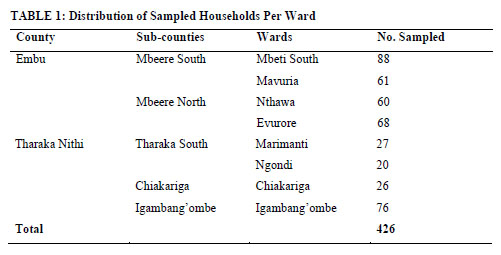
Table 1 shows the distribution of the sampled households per ward. Multi-stage sampling techniques were used, and a sample of 426 sorghum-farming households was randomly selected. Initially, 2 Sub-Counties (Mbeere South and Mbeere North) out of 3 in the ASALs of Embu County were selected. In Tharaka-Nithi, three Sub-Counties (Tharaka South, Chiakariga, and Igambang'ombe) were selected from the four Sub-Counties that lie within the ASALs in Tharaka-Nithi County. In the second stage, two wards were randomly selected per Sub-County (except in Chiakariga and Igambang'ombe, where each served as the Sub-County and the ward), yielding 8 Wards. The number of sampled households per Sub-County was obtained through proportionate sampling and was proportionately distributed across the location and, ultimately, across the sub-locations to form the sample frame.
In the third stage, two locations were randomly selected from each ward, for a total of 16 locations. From each location, two sub-locations were randomly selected in the fourth stage, yielding 32 Sub-locations used as the sample frame (Table 1). Proportionate to size procedure (similarly applied in the first stage) was used to obtain the households interviewed per sub-location, according to the formula below

Where M represents the number of households that grow sorghum interviewed in each sub-location, n = the number of households that grow sorghum in each sub- location and m = the number of households that grow sorghum in the thirty-two sub-locations. The primary data were collected using a semi-structured questionnaire. The data collected were qualitative and were analysed quantitatively using frequencies and percentages. Subsequently, an ordered probit model was employed to examine the determinants of household resilience.
2.4. Data Analysis
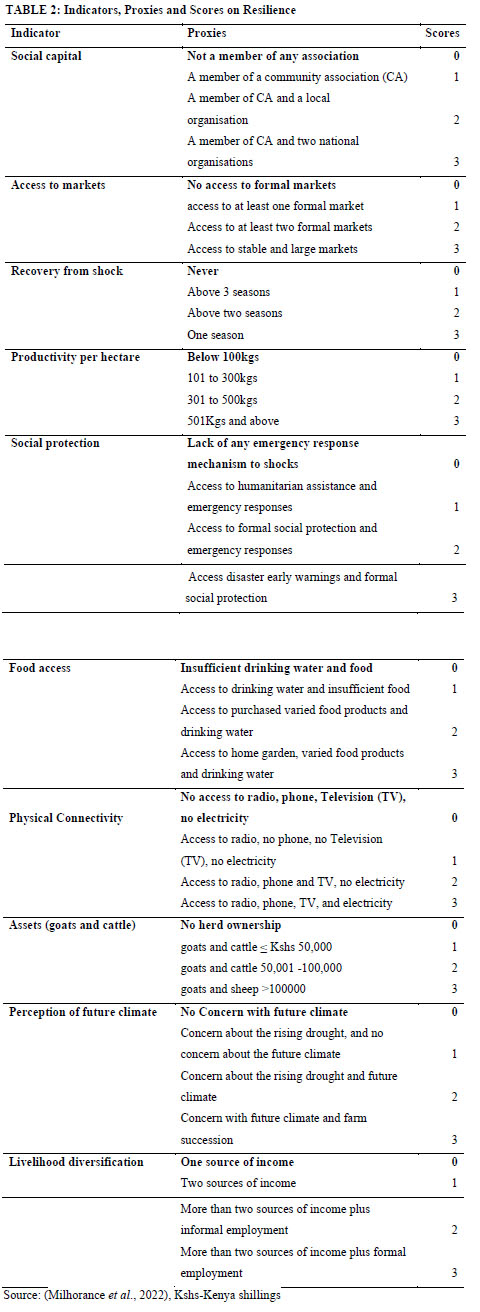
Table 2 presents the indicators, their proxies, and the scores used to measure household resilience, which was assessed using the Resilience Capacity Index (RCI) with 10 indicators. The indicators used were social capital, access to markets, food access, asset ownership, social safety mechanisms, livelihood diversification, perceptions of future climatic changes, sorghum productivity, physical connectivity, and the time taken to recover from a shock. Each indicator was assigned proxies to facilitate interpretation according to the qualitative interpretive scale. Resilience scores were obtained using a standard rating scale of 0 to 3, where 0 represents no resilience, 1 represents low, 2 represents medium, and 3 represents high, for all indicators. The arithmetic means of resilience scores for all variables was obtained. The scores ranged from 1 to 30. Resilience was categorised into four levels: no resilience, low resilience, medium resilience and high resilience represented by 0, 1, 2 and 3, respectively (Table 4) as applied by Cleves et al. (2022), Milhorance et al.and (2022).
Ordered Probit Regression was then employed to identify the specific CAEs influencing household resilience, following the studies by Alhassan (2020) and Oyetunde (2021). The ordered probit model is ideal for analysing the impact of CAES on resilience because it handles ordinal outcomes, such as low, medium, and high resilience, in which the intervals between categories may not be equal. The ordered probit model can include CAES as an independent variable. These CAES can be used to predict the likelihood that a group of farmers, a community, or a region will achieve different levels of resilience (e.g., low, medium, high). By incorporating adaptation strategies as independent variables, the model can assess how different strategies influence the probability of falling into a specific resilience category while controlling other factors such as socioeconomic conditions, infrastructure, and environmental variables. This allows for a more nuanced understanding of the most effective adaptation strategies in enhancing resilience. The resilience level was used as the dependent variable while the CAES were the independent variables. An ordered probit regression was used to examine the relationship between a single independent factor or a set of independent factors and an ordinal dependent variable. Notably, the Ordered Probit Regression model uses the independent variable values to estimate the probability of each level of the dependent variable. The Ordered Probit model specification is as follows:

Where y* represents an underlying and unobserved measure of the households' resilience, whereas B is a vector of the predictor variable, Ui stands for the random error term distributed generally with unit variance. Where the regressors x (CAES) station/normalisation for certain household J do not include an intercept, a low y* means resilience is low; for y* > 1, resilience tends to increase further; for y* > 2, resilience further increases, and this trend continues. Given certain categories m, the standard ordered probability model is given as below, where the probability of observing an outcome i corresponds to the following:

where ui is assumed to be normally distributed with a standard normal cumulative distribution function. Notably, the coefficients β1... ßk are jointly estimated with the cut points α1, α2 ...αk-1, where k represents the number of possible outcomes.
3. RESULTS
3.1. Descriptive Statistics of the Independent Variables
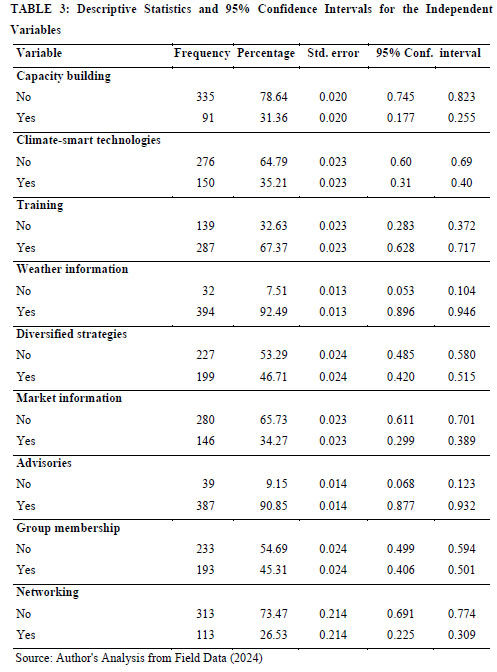
Table 3 shows the sample proportions at 95% confidence interval for the independent variables. These are the CAES, the independent variables in this study.
Regarding capacity building, the results indicate that more than three-quarters (78.64%) of the farmers did not participate in any capacity building, while less than a third (31.36%) did. The farmers who accessed information on climate-smart technologies were 64.79%, while slightly above a third (35.21%) received this crucial information. Regarding training, 67.37% of the farmers received training in farming, while 32.63% did not. The farmers who received weather information numbered 92.49%, while those who did not numbered 7.51%. Slightly more than half of the farmers (53.29%) had adopted diversified strategies, while less than half (46.71%) had not embraced diversification. Nearly two-thirds of the farmers (65.73%) received market information, while slightly above a third (34.27%) did not. A high percentage of the farmers (90.85%) received weather advisories, compared with a small number (9.15%) who did not access them. This implies that a large majority of farmers receive weather advisories, which equip them to respond to weather changes and enhance resilience. Regarding group membership, 54.69% belonged to community groups that promoted adaptation services against the impacts of climate change. This number is moderate and therefore creates numerous linkages between farmers and between farmers and organisations, which positively impacts resilience. Notably, 45.31% of farmers did not belong to any group, which may limit the exchange of crucial information on climate change, thereby reducing resilience. Regarding networking with other organisations that promote adaptation and mitigation measures against climate change, only 26.53% of the farmers were networked, while a large number, 73.47%, were not. This indicates that, with almost three-quarters of farmers not networked, they do not receive adequate and timely information to act appropriately and improve farmers' resilience. Such farmers remain at low levels of resilience.
3.2. Resilience of Sorghum Farming Households
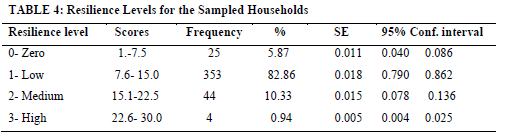
Table 4 presents the resilience categories of sorghum-farming households. Scores from the proxies for each indicator category were used to categorise households into resilience levels. The total resilience scores range from 1 to 30. There were four resilience levels obtained by grouping households based on scores from the ten (10) categories. Those who score 1 to 7.5 were grouped as Zero (0) resilience, 7.6 to 15 as low resilience, 15.1 to 22.5 as medium resilience, and 22 to 30 as high resilience. The majority (82.6%) of the sorghum farmers had low resilience to climate change impacts. A small number (10.33%) of the sorghum farmers had medium resilience. Some farmers (5.87%) had zero resilience, while those with high resilience were just a meagre 0.94%. The sum of the products of the frequencies in each resilience category and their corresponding resilience scores, divided by 426, resulted in a resilience level of 1.06338 for the sampled households. This indicated that sorghum farmers exhibited low resilience.
4. DISCUSSIONS
4.1. Influence of CAES on Resilience of Sorghum-Farming Households
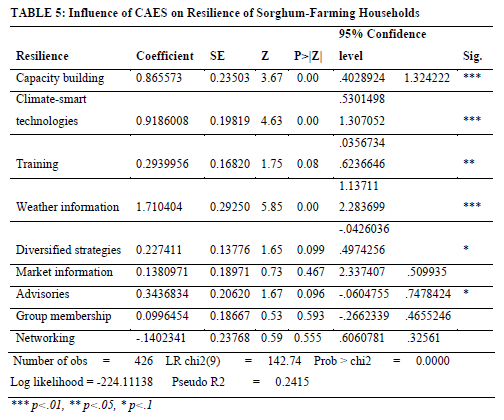
Table 5 presents the Ordered Probit Model results for CAES that influence the resilience of sorghum-farming households. The results indicate that capacity building (P=0.00), information on climate-smart technologies (P=0.00), weather information (P=0.00), training (P=0.08), weather advisories (P=0.096), and diversified strategies (P=0.099) had a significant positive influence on resilience.
Capacity building showed a positive coefficient and a p-value of 0.000, indicating it was highly significant at the 1% confidence level. This indicates that capacity building had a strong positive correlation with resilience. The underlying reason is that capacity building develops the communication and technical skills of extension agents and improves their knowledge of climate-smart agricultural interventions. More importantly, capacity building helps extension agents use technology to record the impacts of climate change in their areas of operation. Capacity building enhances understanding of the causes of climate change and its impacts, and subsequently provides farmers with appropriate advice on adaptation and mitigation strategies. The findings are consistent with the conclusions of Agyei and Stringer (2021), who asserted that the successful delivery of climate change-related extension services necessitates comprehensive capacity building for extension agents. This approach ultimately contributes to increased agricultural productivity and improved resilience. Their study noted that capacity needs include interpreting weather forecasts and developing technical skills to effectively transmit climate information to farmers during extension service delivery. Similarly, Ali et al. (2023) noted that capacity building for local communities is crucial for adopting diverse strategies to address the negative impacts of climate change.
Information on climate-smart technologies positively influenced resilience and was highly significant at the 1% level (p=0.00). This indicates that the delivery of climate-smart technologies to farmers was strongly and positively correlated with resilience. The probable reason is that when farmers acquire information about innovative technologies or techniques, such as drought-tolerant crop varieties, efficient water-use systems, water-harvesting practices, and soil and water conservation, there is a noticeable improvement in productivity and environmental conservation. The results are consistent with Kandegama et al. (2022), who reported that information on climate-smart technologies enables farmers to plant more effectively by choosing site-specific crop varieties, diversifying crops, integrating weather forecasting tools, and customising technologies and resource management, all of which are effective in developing climate resilience. Moreover, Sarma et al. (2024) noted that information on climate change technologies leads farmers to adopt farming practices that help them withstand and adapt to changing climatic conditions, primarily by integrating modern scientific advancements with traditional knowledge.
Weather information had a strong positive and significant influence on the resilience of sorghum-farming households at the 1% significance level, with a p-value of 0.00. This implies that an increase in weather information has a strong positive influence on resilience. The underlying reason is that increased weather information is crucial for raising awareness of the onset and cessation of rainfall, as well as its amount and intensity, which are important aspects of crop and livestock production. Equipped with this information, farmers select the most appropriate variety for the season and plant at the right time, thereby improving agricultural productivity. Weather and climate information have enormous potential to enhance resilience by enabling farmers to make informed decisions. This is achievable through the selection of suitable varieties, timely planting, varied sowing dates, high-yielding varieties, crop rotation, and soil and water conservation, all aimed at transforming farmers' livelihoods by improving productivity, nutritional security, and income (Thinda et al., 2020; Ouya et al., 2024). The results also concur with Ramborun et al. (2020), who reported that timely access to weather information enables farmers to make appropriate adaptation decisions to mitigate the effects of climate change. The results also align with Antwi-Agyei and Stringer (2021), who reported that the likelihood of farmers adopting knowledge-intensive adaptation strategies, such as crop insurance, water conservation, soil conservation, and growing horticultural crops, was positively influenced by access to timely climate information.
Training on climate change had a significant positive influence on the resilience of sorghum-farming households at the 5% significance level, with a p-value of 0.08. This indicates that an increase in farmer training has a moderately significant positive influence on resilience. This can be attributed to training, which increases awareness of the impacts of climate change and promotes the adoption of strategies to mitigate them, such as using climate-resilient crops, water harvesting, diversification, and soil and water conservation practices. The results are in agreement with Mahmood et al. (2020), who noted that climate-specific extension services, such as mobile communication technologies and training in the cultivation of climate-resilient crops, are crucial for ensuring the adoption of diverse adaptation measures to address climate change. Nor Diana et al. (2022) noted that training was one of the most crucial factors enabling Southeast Asian farmers to build on strategies necessary to adapt to the negative effects of climate change. Antwi-Agyei and Stringer (2021) revealed that training extension agents in developing field demonstration skills, information and communication technologies, project evaluation, and project monitoring was crucial for delivering necessary and timely extension advice to counter the impacts of climate change.
Weather advisories had a positive correlation with climate change and were significant at 10% with a P value of 0.096. This indicates that increased access to weather advisories has a weak but significant positive effect on resilience. The probable reason is that an increase in weather advisories enables farmers to be ready and responsive to the impacts of unpredictable climate change. Bal et al. (2021) reported that the provision of timely agrometeorological advisories and accurate weather forecasts is crucial for mitigating the negative impacts of extreme weather events. Medium-range weather forecasts are crucial for planning regular agricultural operations. Timely development of adaptation and mitigation measures boosts farmers' ability to address major issues related to weather variability and climate change that affect agricultural production. Timely advisories are crucial to avoiding losses that farmers would incur without them. Nowcast is the latest forecast issued by the India Meteorological Department to farmers to protect their high-value crops and livestock against lightning, hailstorms, and cloudbursts. Similarly, the importance of weather advisories, especially the Digital Climate Advisory Services (DCAS), cannot be overstated. Ferdinand et al. (2021) reported that DCAS, which includes radio, mobile applications, and online, digitally enabled platforms and services such as bulletins (for those unable to access digital technologies or are not digitally literate), support communication channels from one person to another, resulting in strong extension services effective in agriculture. The information contained in DCAS may include early warning advisories, weather forecasts, agro-climatic information, smart advisories (advice on crop varieties, appropriate inputs, and their application), and pest and disease management. Notably, in the United States of America (USA), weather advisories issued by the National Information Service (NIS) aim to help every citizen be prepared for and responsive to extreme weather and climate events, thereby becoming resilient. Providing timely forecasts and warnings is crucial for making life-saving decisions, protecting lives and property, and enhancing the development of nations' economies (Uccellini & Ten, 2019). Climate risks negatively affect lives, hinder economic activities, services, education, water supply and quality, and wreck infrastructure. To counteract the climate risks that emanate from climate change, an early warning system is fundamental to farmers' preparedness in building response mechanisms (Mugeere et al., 2021).
Diversified strategies had a positive and significant influence on the resilience of sorghum-farming households at the 10% significance level, with a p-value of 0.099. This suggests that an increase in diversified strategies has a weak but significant positive influence on resilience. The likely reason is that livelihood diversification in smallholder farming systems spreads risk, which improves farmers' potential to mitigate climate change impacts. Notably, in vulnerable settings, there exists a link between livelihood diversification strategies and climate resilience. Households that employ diversification strategies have higher resilience. The results concur with Mohammed et al. (2021), who found that strong climate change resilience was evident in households that employed both farm and non-farm diversification. In contrast, those who practised only farm diversification exhibited low resilience. Households that did not practice any diversification strategy had low resilience to climate change. Waha et al. (2018) noted that areas that receive average annual rainfall of 500-1000mm (the study area falls within this zone) and 17-22% rainfall variability had indicated great opportunities for livestock diversification, and additionally for food and cash crops. Their study found that diversification of livelihood strategies had a positive influence on food security and, hence, created higher resilience. Vernooy (2022) revealed that diversification as a livelihood strategy strengthened farmers' adaptive capacity, resulting in increased yields, increased household income through expanded marketing opportunities, reduced poverty, and improved nutritional and food security. Ochieng et al. (2020) noted that in semi-arid agricultural systems, crop diversification reduced household vulnerability to climate change. The study concluded that diversification, as a livelihood strategy, is sensible for households living in low-rainfall areas with warmer climates and frequent dry spells, resulting in uncertainties arising from climate change. On the contrary, Ugochukwu et al. (2019) argued that despite the positive results linked to diversification, many farmers were unable to achieve them due to poor, unreliable access to water, market instability, poor market access, high cost of inputs and limited government support.
5. CONCLUSION AND RECOMMENDATIONS
The CAES, namely capacity building, climate-smart technologies, weather information, training, weather advisories, and diversified strategies, had a significant positive statistical correlation with household resilience. There is a need to enhance capacity building to increase extension agents' knowledge of climate change, its causes, and impacts, and to develop the technological skills crucial for disseminating information related to climate change to farmers. The government can enhance access to information on climate-smart technologies through institutions and agencies aimed at increasing the adoption of these technologies. Weather stations should provide accurate, timely weather information and advisories that prepare farmers to respond to extreme weather events. Extension agents should promptly interpret and communicate weather information and advisories in ways that are meaningful to farmers in their local languages and through trusted community channels, helping them make informed decisions. The policymakers and decision-makers can achieve this through training extension agents to report on climate change impacts, weather forecast information, and the necessary adaptation and mitigation measures against climate change. The extension agents should educate farmers on the benefits of diversified livelihood strategies and offer affordable farm inputs to encourage diversification in both crops and livestock.
6. DISCLOSURE STATEMENT
All authors have no conflict of interest concerning their participation in the research and publication of this article.
The research was self-funded
9. CONSENT FOR PUBLICATION
There was consent from all the authors that this research work be published in SAJAE
7. ACKNOWLEDGEMENTS
All the authors appreciate the University of Embu for giving us the platform to conduct this study. Much gratitude is also extended to the agricultural officers, local administrators, and farmers for their willingness to provide the crucial information required for this study, and appreciation is equally extended to the enumerators for their devotion and commitment to ensuring the study's success.
REFERENCES
- ALHASSAN, H., 2020. Farm households' flood adaptation practices, resilience and food security in the Upper East region, Ghana. Heliyon., 6(6).
- ALI, A., KHAN, M.Z., KHAN, B. & ALI, G., 2023. Migration, remittances and climate resilience: Do financial literacy and disaster risk reduction orientation help to improve adaptive capacity in Pakistan? GeoJournal., 55(1): 595-611.
- AMWATA, D., OMONDI, P.O. & KITUYI, E., 2018. Uptake and use of climate information services to enhance agriculture and food production among smallholder farmers in Eastern and Southern Africa region. Int. J. Adv. Res., 6(5): 859.
- ANTWI-AGYEI, P. & NYANTAKYI-FRFMPONG, H., 2021. Evidence of climate change coping and adaptation practices by smallholder farmers in northern Ghana. Sustain., 13(3): 1308.
- ANTWI-AGYEI, P. & STRINGER, L.C., 2021. Improving the effectiveness of agricultural extension services in supporting farmers to adapt to climate change: Insights from northeastern Ghana. Clim. Risk Manag., 32: 100304.
- ASARE-NUAMAH, P., BOTCHWAY, E. & ONUMAH, J.A., 2019. Helping the helpless: Contribution of rural extension services to smallholder farmers' climate change adaptive capacity and adaptation in rural Ghana. Int. J. Rural Manag., 15(2): 244-268.
- ATSIAYA, G.O., GIDO, E.O. & WALUSE SIBIKO, K., 2023. Uptake of climate-smart agricultural practices among smallholder sorghum farmers in Busia County, Kenya. Cogent. FoodAgric, 9(1): 2204019.
- BAL, S.K., RAO, K.V., CHANDRAN, M.S., SASMAL, S.U.B.O.D.H. & SINGH, V.K., 2021. Weather forecast, agriculture contingency plan and agromet-advisory services for climate resilient agriculture. Indian J. Agron., 66: S1-S14.
- BIRACHI, E., KAGABO, D.M., HANSEN, J., MUTUA, M., MBUGUA, M., CHIPUTWA, B., ROSE, A. & SOLOMON, D., 2020. Rwanda climate services for agriculture: Evaluation of farmers' awareness, use and impacts. CCAFS Working Paper.
- BOWEN, T., DEL NINNO, C., ANDREWS, C., COLL-BLACK, S., JOHNSON, K., KAWASOE, Y., KRYEZIU, A., MAHER, B. & WILLIAMS, A., 2020. Adaptive social protection: building resilience to shocks. World Bank Publications.
- CALVEL, A., WERNER, M., VAN DEN HOMBERG, M., CABRERA FLAMINI, A., STREEFKERK, I., MITTAL, N., WHITFIELD, S., LANGTON VANYA, C. & BOYCE, C., 2020. Communication structures and decision-making cues and criteria to support effective drought warning in Central Malawi. Front. Clim., 2: 578327.
- CLEVES, A., YOUKHANA, E. & TORO, J., 2022. A Method to Assess Agroecosystem Resilience to Climate Variability. Sustain., 14: 8588.
- COCHRAN, W.G., 1977. Sampling techniques. John Wiley & Sons.
- CONNELLY, L.M., 2016. Cross-sectional survey research. Med surg nurs., 25(5).
- DAVIS, K., BABU, S.C. & BLOM, S., 2014. The role of extension and advisory services in building resilience of smallholder farmers (Vol. 13). IFPRI.
- EL KENAWY, A.M., 2024. Hydroclimatic extremes in arid and semi-arid regions: Status, challenges, and outlook. In A.M. El Kenawy, E.S.M. Robaa, M.M.M. Torab & M. Hereher (eds.), Hydroclimatic Extremes in the Middle East and North Africa. Elsevier, pp. 1-22.
- FALSAFI, P., BAIG, M.B., REED, M.R. & BEHNASSI, M., 2022. The nexus of climate change, food security, and agricultural extension in Islamic Republic of Iran. In M. Behnassi, M.B. Baig, M.T. Sraïri, A.A. Alsheikh & A.W.A.A. Risheh (eds.), Food Security and Climate-Smart Food Systems: Building Resilience for the Global South. Cham: Springer International Publishing, pp. 241-261.
- FERDINAND, T., ILLICK-FRANK, E., POSTEMA, L., STEPHENSON, J., ROSE, A., PETROVIC, D., MIGISHA, C., FARA, K., ZEBIAK, S., SIANTONAS, T. & PAVESE, N., 2021. A blueprint for digital climate-informed advisory services: Building the resilience of 300 million small-scale producers by 2030. Washington, DC: World Resources Institute.
- FERDOUSI, R., ISLAM, M.A. & UR RASHID, M.M., 2024. Role of Extension Service for Climate Change Adaptation in Agriculture: A Systematic Review for Developing Countries. J. Bangladesh Agric. Univ., 22(4): 490-496.
- GEBRE, G.G., AMEKAWA, Y. & FIKADU, A.A., 2023. Farmers' use of climate change adaptation strategies and their impacts on food security in Kenya. Clim. Risk Manag., 40: 100495.
- GIKUNDA, R., JEPKURUI, M., KIPTOO, S. & BAKER, M., 2022. Quality of climate-smart agricultural advice offered by private and public sectors extensionists in Mbeere North Sub-County, Kenya. Adv. Agric. Dev., 3(1): 32-42.
- HOLLEMAN, C., REMBOLD, F., CRESPO, O. & CONTI, V., 2020. The impact of climate variability and extremes on agriculture andfood security: An analysis of the evidence and case studies. Rome: FAO.
- JHA, C.K. & GUPTA, V., 2021. Do better agricultural extension and climate information sources enhance adaptive capacity? A micro-level assessment of farm households in rural India. Ecofeminism Clim. Chang., 2(2): 83-102.
- KANDEGAMA, W.M.W., RATHNAYAKE, R.M.P.J., BAIG, M.G. & MOHAMED BEHNASSI, M., 2022. Impacts of climate change on horticultural crop production in Sri Lanka and the potential of climate-smart agriculture in enhancing food security and resilience. In M. Behnassi, M.B. Baig, M.T. Sraïri, A.A. Alsheikh & A.W.A.A. Risheh (eds.), Food Security and Climate-Smart Food Systems: Building Resilience for the Global South. Cham: Springer International Publishing, 67-97.
- KIBOI, M.N., NGETICH, K.F., FLIESSBACH, A., MURIUKI, A. & MUGENDI, D.N., 2019. Soil fertility inputs and tillage influence on maize crop performance and soil water content in the Central Highlands of Kenya. Agric. Water Manage., 217: 316-331.
- KIPROTICH, S., 2024. Adoption, productivity and return on investment of integrated soil fertility management technologies among sorghum farmers in Tharaka-Nithi County, Kenya. Doctoral dissertation, UoEm.
- MAHMOOD, N., ARSHAD, M., KAECHELE, H., SHAHZAD, M.F., ULLAH, A. & MUELLER, K., 2020. Fatalism, climate resiliency training and farmers' adaptation responses: Implications for sustainable rainfed-wheat production in Pakistan. Sustain., 12(4): 1650.
- MAKUWERERE DUBE, L., 2021. Command agriculture and food security: An interrogation of state intervention in the post-fast track land redistribution era in Zimbabwe. J. Asian Afr. Stud, 56(7): 1626-1643.
- MBURU, M., MBURU, J., NYIKAL, R., MUGERA, A. & NDAMBI, A., 2024. Role of agricultural extension in learning for uptake and intensification of less-practiced dairy climate-smart practices in Kenya. Cogent Food Agrie, 10(1): 2330182.
- MILHORANCE, C., LE COQ, J.F., SABOURIN, E., ANDRIEU, N., MESQUITA, P., CAVALCANTE, L. & NOGUEIRA, D., 2022. A policy mix approach for assessing rural household resilience to climate shocks: Insights from Northeast Brazil. Int. J. Agric. Sustain., 20(4): 675-691.
- MUSTAPHA, S.B., TIMOTHY, E. & SHEHU, H., 2024. Emerging role of extension services in strengthening the capacity of farmers' resilience to climate change in Nigeria. J. Agric. Ext., 29(1): 95-11.
- NANNEWAR, R.G., KANITKAR, T. & SRIKANTH, R., 2023. Role of agrometeorological advisory services in enhancing food security and reducing vulnerability to climate change. WCAS, 15(4): 1013-1027.
- NGETICH, F.K., MAIRURA, F.S., MUSAFIRI, C.M., KIBOI, M.N. & SHISANYA, C.A., 2022. Smallholders' coping strategies in response to climate variability in semi-arid agro-ecozones of Upper Eastern Kenya. SSHO., 6(1): 100319.
- NOR DIANA, M.I., ZULKEPLI, N.A., SIWAR, C. & ZAINOL, M.R., 2022. Farmers' adaptation strategies to climate change in Southeast Asia: A systematic literature review. Sustain., 14(6): 3639.
- OCHIENG, J., KIRIMI, L., OCHIENG, D.O., NJAGY, T., MATHENGE, M., GITAU, R. & AYIEKO, M., 2020. Managing climate risk through crop diversification in rural Kenya. Clim. Change., 162: 1107-25.
-
UNCCD & UNFCCC., 2023. Land and the road to decarbonisation and resilience. Available from https://www.unccd.int/resources/brief/land-and-road-decarbonization-and-resilience
» https://www.unccd.int/resources/brief/land-and-road-decarbonization-and-resilience - UGOCHUKWU ONYENEKE, R., AUGUSTA NWAJIUBA, C., CHINONSO EMENEKWE, C., NWAJIUBA, A., JUDITH ONYENEKE, C., OHALETE, P. & IYKE UWAZIE, U., 2019. Climate change adaptation in Nigerian agricultural sector: A systematic review and resilience check of adaptation measures. AIMSAgric. Food., 4(4): 967-1006.
- OSUMBA, J.J., RECHA, J.W. & OROMA, G.W., 2021. Transforming agricultural extension service delivery through innovative bottom-up climate-resilient agribusiness farmer field schools. Sustain., 13(7): 3938.
- OUYA, F., LUTOMIA, C., MVUYIBWAMI, P., BYANDAGA, L., KAGABO, D. & NCHANJI, E., 2024. Shaping resilience: Gender insights on weather and climate information services in East Africa.
- RAJ, S. & GARLAPATI, S., 2020. Extension and advisory services for climate-smart agriculture. In V. Venkatramanan, S. Shah & R. Prasad (eds.), Global Climate Change: Resilient and Smart Agriculture. Singapore: Springer, pp. 273-299.
- RAMBORUN, V., FACKNATH, S. & LALLJEE, B., 2020. Moving toward sustainable agriculture through a better understanding of farmer perceptions and attitudes to cope with climate change. JAEE., 26(1): 37-57.
- SARMA, H.H., BORAH, S.K., DUTTA, N., SULTANA, N., NATH, H. & DAS, B.C., 2024. Innovative approaches for climate-resilient farming: strategies against environmental shifts and climate change. Int. J. Environ. Clim. Chang., 14(9): 217-241.
- STATISTICS, K.N., 2019. Kenya Population and Housing Census Results. Kenya Natl. Bur. Stat.
- THINDA, K.T., OGUNDEJI, A.A., BELLE, J.A. & OJO, T.O., 2020. Understanding the adoption of climate change adaptation strategies among smallholder farmers: Evidence from land reform beneficiaries in South Africa. Land Use Policy., 99: 104858.
- UCCELLINI, L.W. & TEN HOEVE, J.E., 2019. Evolving the National Weather Service to build a weather-ready nation: Connecting observations, forecasts, and warnings to decision-makers through impact-based decision support services. BAMS., 100(10): 1923-1942.
- VAN STADEN, W., 2020. Climate-smart innovation tool: An approach to review the climate responsiveness and innovation practices of agricultural curricula. S Afr. Jnl. Agric. Ext., 48(1): 42-54.
- VERNOOY, R., 2022. Does crop diversification lead to climate-related resilience? Improving the theory through insights on practice. Agroecol. Sustain. Food Syst., 46(6): 877-901.
- WAHA, K., VAN WIJK, M.T., FRITZ, S., SEE, L., THORNTON, P.K., WICHERN, J. & HERRERO, M., 2018. Agricultural diversification is an important strategy for achieving food security in Africa. Glob. Chang. Biol., 24: 3390-400.