Oral Health-Related Quality of Life (OHRQoL) of Oral Squamous Cell Carcinoma (OSCC) patients
Abstract
INTRODUCTION: Oral squamous cell carcinoma (OSCC) is a prevalent form of oral cancer, associated with high morbidity and mortality rates. Treatment often involves surgery, chemotherapy and radiotherapy, which can impact patients' quality of life (QoL) and oral health-related quality of life (OHRQoL). AIM AND OBJECTIVES: This study aimed to evaluate the OHRQoL of OSCC post-treatment, to inform comprehensive treatment plans that prioritize patients care and QoL improvement. STUDY DESIGN: A cross-sectional study was conducted in a tertiary hospital in Cape Town, South Africa. METHODS: 50 OSCC patients attending follow-up visits at least three months post-treatment were included. Data collection involved extracting oral cancer history and treatment data from hospital records, collecting demographic information, and administering the Oral Health Impact Profile (OHIP-14) questionnaire. RESULTS: The mean age of participants was 58.56 years, with a majority being male. The most common primary site of OSCC was the tongue, and the predominant cancer stage was IV. Most participants received a combination of radiation and surgery. The physical pain dimension was the primary contributor to deterioration of OHRQoL. CONCLUSIONS: The study highlights the need for improved strategies in diagnosis and management of OSCC patients, emphasizing early detection and treatment plan. The findings showcase the importance of addressing physical and functional aspects of treatment and rehabilitation to enhance the overall well-being of OSCC patients.
Oral Cancer; Oral Squamous Cell Carcinoma (OSCC); Oral Malignancy; Head and Neck Cancer; Quality of Life (QoL); Oral Health-Related Quality of Life (OHRQoL)
1. INTRODUCTION
Oral health extends beyond the mere absence of disease or impaired function, given that it includes a complex, multifaceted concept that involves various aetiological factors and dimensions.11
Among oral diseases, Oral cancer is most important in terms of high mortality and sever morbidity. It's ranked the 6th most prevalent cancer with Oral Squamous Cell Carcinoma (OSCC) being among the 10 most prevalent human malignancies.234567
Oral cancer is regarded as disease that is age-related with individuals who are 40-years and older contributing to 98% of all patients diagnosed,55
Early diagnosis is a crucial step in the treatment of cancer, depending on factors such as the site, stage, grade and metastasis, in addition to the patient's general health.3 8
Treatment of oral cancer is associated with physical and psychological challenges leading to a poor quality of life (QoL) and subsequently also a lower oral health-related quality of life (OHRQoL) of patients.3,6,8,9 The World Health Organization (WHO) define health as the following: "the complete state of physical, mental and social well-being and not just the absence of disease".10113 1213
Studies had found that oral cancer prevalence remains increasing on yearly,1415161718
Some of the issues of oral cancer that affect patients' QoL is pain, a dry mouth (xerostomia), altered taste, eating challenges and mucositis.66 6
Psychological impact of oral cancer and OSCC can be described as the traumatic experience that patients go through during diagnosis that leads to a tremendous amount of anxiety,19666 et al., found that OHRQoL predicted psychological illness including anxiety and depression on OSCC patients.2
The measurement of OHRQoL serves as a valuable tool in treatment planning allowing for the establishment of appropriate goals as well as clinical outcomes related to the patient's individual condition. This approach aims to describe the negative impact that cancer treatment can have on the QoL of affected individuals.20202112
Sischo and Broder highlighted that assessing OHRQoL can help identify a patient's strengths and weaknesses, informing the development of service programs. This information is particularly useful for planning and testing service programs, such as including psychological adjunct services in community-based projects if psychological deficits are identified in elderly patients.2012
Multi-item questionnaires are the most appropriate and accurate measuring method of OHRQoL1220121223 17,24
In conclusion, OSCC affects various aspects of patients' lives by having a major impact on oral functions such as speech, swallowing and chewing. It also alters patients' appearances in advanced stages and post-surgical treatment, resulting in psychological and social challenges. The aggressive treatment of OSCC, involving radiotherapy, surgical intervention and chemotherapy may lead to severe facial disfigurement, further exacerbating its impact on QoL and OHRQoL.
This study aimed to evaluate the OHRQoL of post-treatment OSCC patients, with the goal of assisting healthcare professionals and managers in developing comprehensive treatment plans that equally prioritize patient care and post-treatment QoL improvement.
2. METHODS
A cross-sectional study was done at a tertiary hospital in Cape Town, South Africa. The study population consisted of patients diagnosed with OSCC attending follow-up visits from April 28, 2021, to June 30, 2021 at a Radiation Oncology unit. Convenience sampling was employed, and the first 50 patients meeting the inclusion criteria and providing consent were included in the study.
Inclusion criteria included patients aged 18 years and above diagnosed with OSCC, attending follow-up visits scheduled at least three months after treatment. Patients diagnosed with oral pharyngeal carcinoma were excluded from the study.
Data collection involved the use of three parts delivered through one instrument. Firstly, a researcher-administered data collection sheet was utilized to extract oral cancer history and treatment data from patients' hospital records. The second part was a researcher-administered questionnaire designed to collect demographic information from participants. The third part involved completing the OHIP-14 form, a validated instrument for determining OHRQoL. While the English version was primarily used, translated versions in Afrikaans and IsiXhosa were utilized as needed.
Data captured from completed questionnaires were categorized and then transferred to an Excel 2010 spreadsheet for basic descriptive analysis. The database was then imported to STATA/IC 16 for more advanced statistical analyses. Correlations were determined by the independent t-test between two categorical variables, while the One-way ANOVA assessed correlations among more than two categorical variables, the Bonferroni correction served as a post hoc test. The Chi-square test examined associations with a significance level set at 0.05. Linear regression was applied to ascertain relationships between variables, with a significance cutoff at 0.01.
Ethical approval for the research study was obtained from the Biomedical Research Ethics Committee of the UWC (BM19/9/17). Participation was voluntary and anonymous and signed informed consent was obtained from each patient. Anonymity was secured by not using the participants' names on the questionnaires and were recorded with reference codes. The questionnaire completion process took place in a private room at the Department of Radiation Oncology. Permission was also obtained from the Head of Department. Signed informed consent had been obtained from all participants after they were fully informed of the aim, objectives and methodology of the study. Participants were able to ask questions and were informed that they could withdraw from the study at any stage.
3. RESULTS
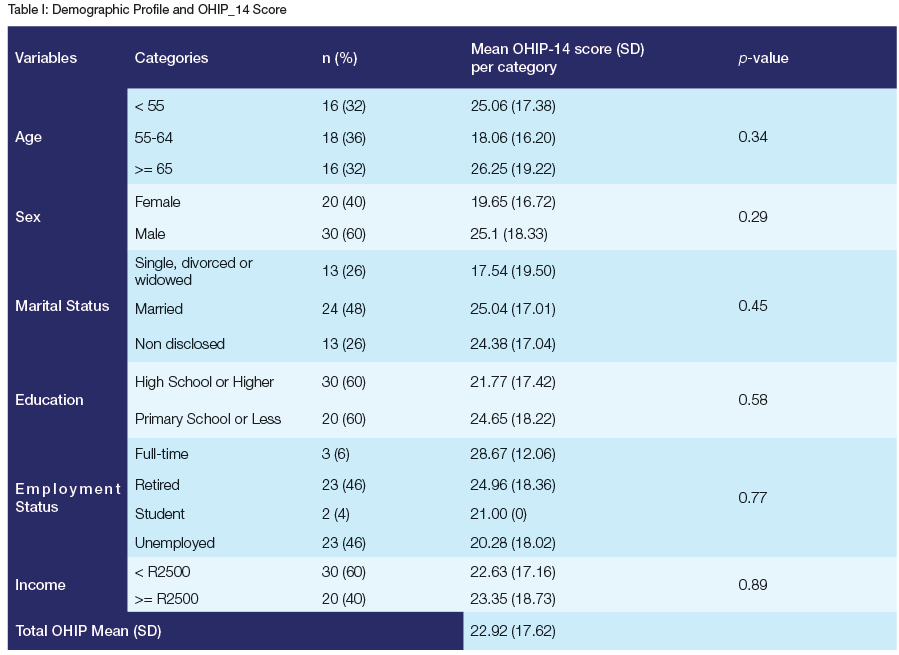
The study comprised a predominantly male participant group (60%), with a mean age for the overall sample at 58.56 years (SD = 10.55) (Table I). The mean age among men and women were 57.7 and 59.8 years, respectively. The majority of participants identified as pensioners (46%), and 60% had completed high school or attained higher education levels. Regarding marital status, 48% of the sample was married, 26% were single or divorced, or widowed, and the remaining participants chose not to disclose this information.
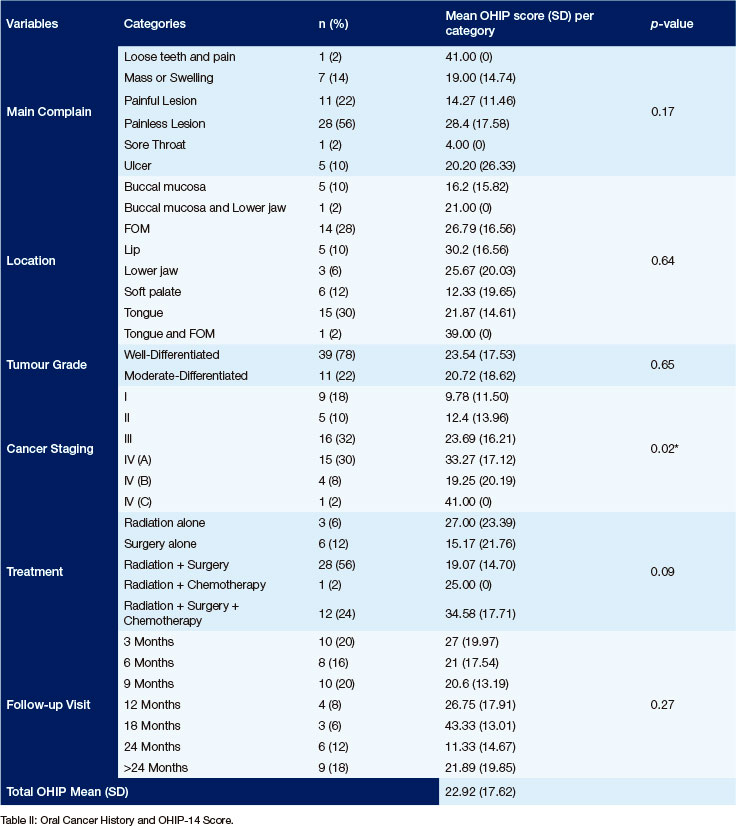
The reported primary site of OSCC was most frequently the tongue (30%), followed by the floor of the mouth (28%) (Table II). Other sites, including buccal mucosa, soft palate, mandible, lips, or combinations, were reported to a lesser extent. In terms of tumor grade, 78% had a well-differentiated grade, while the remainder had a moderate-differentiated grade. The predominant cancer stage was stage IV (40%), followed by stage III (32%), stage I (18%), and stage II (10%) (Table II). The majority of participants received a combination of radiation and surgical (56%) intervention, with other combinations involving radiation and chemotherapy, and radiation, surgery, and chemotherapy. Just less than half (40%) of participants attended their 3rd and 9th month follow-up visits (Table II).
The One-way ANOVA test was utilized to assess whether the OHIP-14 score differed across different categories for each variable. Post hoc tests using the Bonferroni correction were also conducted. The mean OHIP-14 score for participants was 22.9 (SD = 17.62). Descriptive statistics, including mean and standard deviation, for OHIP-14 scores in relation to demographic and oral cancer variables, are presented in Tables I and II. The level of statistical significance was established at p < 0.05.
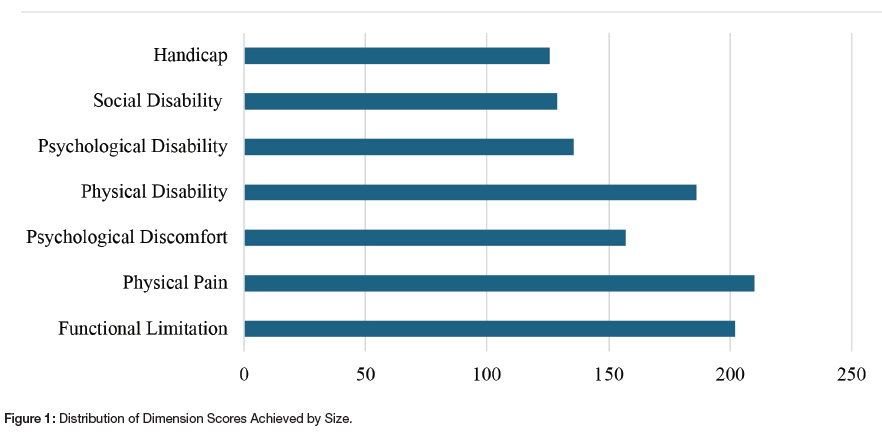
The OHIP-14 questionnaire comprises seven dimensions, with each two questions in order corresponding to one dimension. Each dimension score was added together for two questions forming it. Provided that the study sample size was 50, each one of the seven dimensions, could attain a possible value of 400 points for the entire sample. The physical pain dimension emerged as the primary contributor to the deterioration of OHRQoL in the study population, obtaining the highest score (210/400), followed by the physical disability (186/400), psychological discomfort (157/400) psychological disability (136/400), functional limitation dimension (202/400), and social disability (129/400). The lowest score was attained in the handicap dimension (126/400) (Figure 1).
4. DISCUSSION
The global concept of QoL involves various overlapping domains and has primarily been developed in medical research to gauge individuals' perceptions of overall well-being. There is a limited number of studies in the literature that specifically assess both QoL and OHRQoL for post-treatment oral cancer patients. This research gap underscores the need for more comprehensive investigations into the overall impact of oral cancer on patients' lives beyond clinical outcomes, emphasizing the importance of addressing patients' well-being as well as oral health-related quality of life.
The treatment of oral cancer is a challenging process that introduces various obstacles, ultimately deteriorating patients' overall QoL. Reflecting on these challenges enables physicians to better understand patients' perceptions and priorities, facilitating improved clinical judgment and treatment selection. To capture the intricacies of the oral cavity's impact, the construct of OHRQoL was specifically designed. Various tools measure OHRQoL, such as the University of Washington QoL scale, the European Organization for Research and Treatment of Cancer QoL Core Questionnaire 30 and the Oral Impact of Daily Performances, and OHIP (Oral Health Impact Profile). OHIP, which is most frequently used in oral cancer patients, provides a superior demonstration of changes in their QoL. Originally comprising 49 questions, however a more practical 14-question version was developed, proven to be valid, reliable, and sensitive to variations with consistent cross-cultural applicability.3
While some studies indicate a moderate impact of oral cancer on OHRQoL, this remains an area of research deserving more attention, particularly considering the vulnerability of individuals facing oral cancer. A study in the USA confirmed this matter as they reported that among Head and Neck cancer (HNC) patients including oral cancer, suicide incident is more than three times higher than in general population.25
Although many studies indicate that the QoL tends to return to its initial state following HNC treatment, so et al. propose that specific dimensions of treatment-related morbidity may persist up to 12 months post-treatment. This suggests the importance of preparing patients for the potential continuation of adverse symptoms and treatment side effects beyond the immediate post-treatment period.
In this research study we investigated OHRQoL of OSCC patients after they received various treatment modalities during separate follow-up visits The average age of our study cohort was 58.56, consistent with the prevalent occurrence of cancer in the geriatric demographic,5th decade.1et al. found no association between age and sex in OSCC cases (p > 0.05).27
Prior studies have highlighted the significance of socioeconomic status (SES) as a risk factor for oral cancer (1), emphasizing its role in predicting disease mortality and morbidity within this patient cohort. Consequently, SES is recognized as a crucial determinant influencing OHRQoL. In our investigation, 46% of the study participants were unemployed, and 60% reported a monthly household income below 2500 ZAR, collectively indicating a lower socioeconomic status among the majority. This aligns with the findings of Indrapriyadhrashini et al. and Khandekar et al., who observed that low SES may serve as a risk factor for suboptimal oral hygiene, thereby increasing the susceptibility to oral cancer (3,28). Moreover, individuals with lower education and income levels are more prone to engaging in behaviours such as alcohol consumption, smoking, and tobacco chewing, all recognized risk factors for oral cancer. In developing countries, low SES and income are associated with challenges in accessing healthcare facilities, contributing to delayed diagnosis of oral cancer and necessitating more aggressive treatments with poorer prognoses. Although the inverse relationship between education level and oral cancer is reported in the literature,3
The manifestation of OSCC varies based on factors such as cancer stage, location, and the type of affected tissue within the oral cavity. Articulating these experiences can be challenging for patients, leading to diverse descriptions. In our study, 56% of the participants characterized their OSCC as a painless lesion during the examination, while 22% perceived it as a painful lesion. Interestingly, some individuals could distinctly express their experiences, using terms such as ulcer, mass, or swelling to describe the nature of their condition.
The location of oral cancer appears to be influenced by various factors, including individual oral habits, diet and factors that cause an irritation. Indrapriyadharshini et al. conducted a study in India found that the most commonly reported site of OSCC was the buccal mucosa, primarily influenced by the prevalent tobacco-using habit in that region.3298et al., reported the tongue, retromolar region, and floor of the mouth with the highest probability of sites for oral cancer, reinforcing the consistency of our results with established patterns in the literature30
A primary reason for the late-stage diagnosis of oral cancer is the delay in seeking medical attention, as highlighted in previous research.2830 30et al., reported identical findings corroborating that, late reporting to health facilities is a frequent factor that led to late-stage diagnosis.3
In the present study, overall, 56% of patients received surgery and radiation as the primary form of treatment, while 24% received a treatment regimen comprising surgery, radiation, and chemotherapy, creating a total proportion of 80% in the study population. These findings are consistent with those presented by Stuani et al., in which 90% of their patients also belonged to these two treatment categories.
It's important to note that our study specifically focused on OSCC patients, whereas Stuani et al. included various types of HNC in their study population. The concentration of participants in these two treatment combinations in our study could be attributed to the fact that a significant proportion of our participants were diagnosed at late stages of oral cancer, necessitating aggressive and comprehensive therapeutic interventions.25
No demographic profile variable yielded statistically significant results concerning perceived OHRQoL. This outcome can be attributed to the predominant concentration of our study population within the geriatric group. In our study, the highest OHIP-14 scores, indicative of poorer OHRQoL, were observed among patients with OSCC affecting both the tongue and FOM. The serious damage of these anatomical structures significantly impacted speech, eating and function contributing to a diminished OHRQoL. While the literature lacks consensus on whether the location of oral cancer affects QoL.1818 18et al., participants in their 18th-month follow-up visit recorded the worst OHRQoL. This contradicts the notion that long-term survivors generally experience good QoL.30 25
This study's results should be interpreted considering several limitations. The cross-sectional study design employed precludes the establishment of causal inferences. Additionally, the limited participant selection from a single institution, coupled with the small sample size, introduces potential selection biases. Therefore, it is recommended to conduct studies on a larger scale and in diverse settings to enhance generalizability. Despite these limitations, this study offers valuable baseline health data on the OHRQoL of OSCC patients in a developing country.
Another limitation relates to the use of generic OHRQoL questionnaires. Although useful for comparing findings across different populations, these questionnaires may not entirely account for the impact solely attributed to oral cancer, leaving room for potential influence from other oral conditions. One potential means of overcoming this limitation is by employing oral cancer specific QoL measure.
Another limitation of the current study was the variation in treatment modalities and follow-up durations; the heterogeneity brings in several cause-and-effect relationships for a single outcome. The convenience sampling method employed in this study raised the potential for introducing selection bias, along with translation bias from the translation of questionnaires. To mitigate these biases, future research may utilize alternative sampling techniques and use piloted translated questionnaires to increase the validity and reliability of the research outcomes.
5. CONCLUSION
Implications of this research are the need for improved patient management and OSCC diagnosis strategies in Tygerberg Hospital. The late diagnosis recorded signifies a need to boost oral cancer screening programs, interventions to enhance awareness among patients, and improvements to expand access to health facilities. Early detection is crucial in improving patient outcomes as well as addressing the issues of late-stage cancer.
In addition, this study provides an summary of the demographic profile of people diagnosed with OSCC at Tygerberg Hospital, indicating that, the most common and susceptible population is elderly males. These findings can be used for planning more targeted interventions and support services accordingly.
Later stages of OSCC patients had worse OHRQoL compared to early stages, stressing the effects of disease progression on the QoL of patients. Additionally, those who underwent comprehensive treatment intervientions, involving surgery, radio therapy and chemotherapy, exhibited lower OHRQoL compared to those who underwent fewer modalities. This insight into the variations in OHRQoL based on treatment approaches can inform more targeted and patient-centered care strategies.
The study highlights specific dimensions of the OHIP-14 where patients experienced the greatest impact-physical pain, functional limitation, and physical disability. This emphasizes the importance of focusing on the physical-and functional characteristics of treatment options and rehabilitative processes to enhance the overall well-being of OSCC patients.
In conclusion, this study not only contributes valuable baseline information on the demographic profile and treatment history of oral cancer among patients at Tygerberg Hospital, but also emphasizes the pressing need for proactive measures in screening, awareness promotion, and healthcare accessibility to address the challenges associated with late-stage diagnoses and enhance patient outcomes.
6. REFERENCES
- 1. Abram MH. The Incidence ofOral and Oropharyngeal Cancer in South Africa forthe five year perod 1997-2001 (Doctoral dissertation, University of Pretoria).
- 2. Hassel AJ, Danner D, Freier K, Hofele C, Becker-Bikowski K, Engel M. Oral health- related quality of life and depression/anxiety in long-term recurrence-free patients after treatment for advanced oral squamous cell cancer. Journal of Cranio-Maxillofacial Surgery. 2012 Jun 1;40(4):e99-102.
- 3. I ndrapriyadharshini K, Madankumar PD, Karthikeyan GR. Oral health-related quality of life in patients treated for oral malignancy at Kanchipuram district, India: A cross-sectional study. Indian journal of cancer. 2017 Jan 1;54(1):11.
- 4. Hille J, Johnson NW. The burden of oral cancer in sub-Saharan Africa. Transl Res OralOncol. 2017;2:2057178X1772109.
- 5. Botha PJ, Schoonees A, Pontes CC. Mapping oral cancer research in South Africa. South African Dental Journal. 2018 Jul;73(6):384-94.
- 6. Moore KA, Ford PJ, Farah CS. Support needs and quality of life in oral cancer: a systematic review. International journal of dental hygiene. 2014 Feb;12(1):36-47.
- 7. Cawson RA, Odell EW, Porter S. Oral pathology and oral medicine. Edinburgh: Churchill Livingstone. 2002:216-7.
- 8. Scully C. Oral and Maxillofacial Medicine-E-Book: The Basis of Diagnosis and Treatment, ; Churchill Livingstone Elsevier: Edinburgh, UK, 2013.
- 9. Hassel AJ, Danner D, Freier K, Hofele C, Becker-Bikowski K, Engel M. Oral health- related quality of life and depression/anxiety in long-term recurrence-free patients after treatment for advanced oral squamous cell cancer. Journal of Cranio-Maxillofacial Surgery. 2012 Jun 1;40(4):e99-102.
- 10. WHO (World Health Organization). Constitution of the World Health Organization. Basic Documents. 45th edition Supplement. 2006.
- 11. Kuyken W. The World Health Organisation quality of life assessment (WHOQOL): position paper from the World Health Organisation. Soc Sci Med. 1995;41:1409-.
- 12. Klassen A, Wickert N, Tsangaris E, Klaassen R, Anthony S. Health-related quality of life. InCancer in Adolescents and Young Adults 2017 (pp. 735-747). Springer, Cham.
- 13. Al Shamrany M. Oral health-related quality of life: a broader perspective. EMHJ- Eastern Mediterranean Health Journal, 12 (6), 894-901, 2006. 2006.
- 14. Siegel R, Ma J, Zou Z, Jemal A. Cancer statistics, 2014. CA: a cancer journal for clinicians. 2014 Jan;64(1):9-29.
- 15. Jemal A, Bray F, Center MM, Ferlay J, Ward E, Forman D. Global cancer statistics. CA: a cancer journal for clinicians. 2011 Mar;61(2):69-90.
- 16. Bhalla A, Anup N, Bhalla AP, Singh SB, Gupta P, Bhalla S. Oral health related quality of life (OHRQOL) amongst head and neck cancer patients undergoing chemotherapy and radiotherapy at Sawi Mansingh Hospital Jaipur, India. Scholars Academic Journal of Biosciences. 2015;3(1A):3-12.
- 17. Barkokebas A, Silva IH, de Andrade SC, Carvalho AA, Gueiros LA, Paiva SM, Leao JC. Impact of oral mucositis on oral-health-related quality of life of patients diagnosed with cancer. Journal of oral pathology & medicine. 2015 Oct;44(9):746-51.
- 18. Barrios R, Bravo M, Gil-Montoya JA, Martínez-Lara I, García-Medina B, Tsakos G. Oral and general health-related quality of life in patients treated for oral cancer compared to control group. Health and quality of life outcomes. 2015 Dec;13(1):1-8.
- 19. Valdez JA, Brennan MT. Impact of oral cancer on quality of life. Dental Clinics. 2018 Jan 1;62(1):143-54.
- 20. Sischo L, Broder H. Oral health-related quality of life: what, why, how, and future implications. Journal of dental research. 2011 Nov;90(11):1264-70.
- 21. Al Shamrany M. Oral health-related quality of life: a broader perspective. EMHJ- Eastern Mediterranean Health Journal, 12 (6), 894-901, 2006. 2006.
- 22. Barrios R, Tsakos G, García-Medina B, Martínez-Lara I, Bravo M. Oral health-related quality of life and malnutrition in patients treated for oral cancer. Supportive Care in Cancer. 2014 Nov;22(11):2927-33.
- 23. Khalifa N, Allen PF, Abu-bakr NH, Abdel-Rahman ME. Psychometric properties and performance of the Oral Health Impact Profile (OHIP-14s-ar) among Sudanese adults. Journal of Oral Science. 2013;55(2):123-32.
- 24. Agrawal SK, Dahal S, Shrestha A, Bhagat TK. Assessment of oral health impact profile (OHIP- 14) among villagers of Jyamirgadi VDC, Nepal: a cross-sectional study. Eur J Biomed Pharm Sci. 2017;4(8):400-3.
- 25. Stuani VT, Santos PS, Damante CA, Zangrando MS, Greghi SL, Rezende ML, Sant'Ana AC. Oral health impact profile of head and neck cancer patients after or before oncologic treatment: an observational analytic case-control study. Supportive Care in Cancer. 2018 Jul;26(7):2185-9.
- 26. So WK, Chan RJ, Chan DN, Hughes BG, Chair SY, Choi KC, Chan CW. Quality-of- life among head and neck cancer survivors at one year after treatment-a systematic review. European journal of cancer. 2012 Oct 1;48(15):2391-408.
- 27. Karbach J, Al-Nawas B, Moergel M, Daubländer M. Oral health-related quality of life of patients with oral lichen planus, oral leukoplakia, or oral squamous cell carcinoma. Journal of Oral and Maxillofacial Surgery. 2014 Aug 1;72(8):1517-22.
- 28. Khandekar SP, Bagdey PS, Tiwari RR. Oral cancer and some epidemiological factors: A hospital based study. Indian J Community Med. 2006 Jul 1;31(3):157-9.
- 29. Singhania V, Jayade BV, Anehosur V, Gopalkrishnan K, Kumar N. Carcinoma of buccal mucosa: A site specific clinical audit. Indian journal of cancer. 2015 Oct 1;52(4):605.
- 30. Khandelwal A, Neeli A, Gadiyar A, Khandelwal A. Assessment of quality of life of patients 1-5 years after treatment for oral cancer. Indian Journal of Dental Research. 2017 Sep 1;28(5):538.