Oral Health and Sustainable Development Goals: Opportunities for interdisciplinary research at a dental school in South Africa
Abstract
INTRODUCTION: Oral health continues to be a neglected public health challenge, and is often perceived as a privilege rather than a fundamental right for most of the population. Sustainable Development Goals (SDG) create a foundation for a sustainable future for all, encompassing various fields, including the role of oral health in the human population. Dental research and education are crucial in undertaking challenges associated with promoting a sustainable future for the South African population. This effort requires support by interdisciplinary collaboration with relevant stakeholders across disciplines. Higher education institutions, such as the Faculty of Dentistry at the University of the Western Cape play a pivotal role in advancing SDG research by fostering innovation, cultivating interdisciplinary collaboration, and equipping future professionals with the knowledge and skills necessary to address complex sustainability challenges, ultimately contributing to improved oral health outcomes and overall well-being for the South African population. AIM AND OBJECTIVE: The aim of the project was to identify opportunities for interdisciplinary research at a dental school to further sustainable development goals. DESIGN: A quantitative approach was used. A retrospective records based study was conducted. METHODS: All DHET approved publications from the Faculty of Dentistry, UWC for the period 2013-2023 were analysed. The quantitative data generated through the SDG mapper were tabulated and visualized using simple bar charts and graphs. These visual tools facilitated a comparison between the research output's alignment with the SDG framework and South Africa's Decadal Plan, providing insights into both global and national contributions to sustainable development. Key performance indicators (KPIs) were also developed to measure the extent of the research's alignment with the SDGs. RESULTS: The analysis reveals that research conducted at the Faculty of Dentistry, UWC contributes to the following SDGs: SDG 3 (Good health and Well-being) , SDG 4 (Quality Education),SDG 9 (Industry, Innovation and Infrastructure),SDG,16 (Peace, justice and strong institutions. CONCLUSIONS: Although the research was linked to a range of SDG goals, the research was conducted by Dentistry staff and so, it suggests that there is opportunity to develop multidisciplinary research. Mechanisms which allow for collaboration across disciplines should be explored.
Sustainable Development Goals (SDGs); Oral Health; Interdisciplinary Research; Dental Education; Innovation in Dentistry
INTRODUCTION
It is estimated that 3.5 billion people suffer from oral diseases globally. These oral diseases including dental caries, periodontal disorders, edentulism, and cancer of the lips and oral cavity cause the greatest burden of oral diseases.12
Oral diseases are affected by the social determinants of health including access to safe water, hygiene, and sanitation. Similarly, strategies employed by industries such as sugar and tobacco products may affect the choices made by consumers which may affect their health.2
The Sustainable Development Goals are a set of 17 global goals established by the United Nations in 2015, aimed at addressing the world's most pressing challenges by 2030. These goals encompass a broad range of social, economic, and environmental issues, including poverty, hunger, health, education, gender equality, clean water, and climate action, among others. The SDGs promote a holistic approach to sustainable development, emphasizing the interconnectedness of global challenges and the need for collaborative action across all sectors of society. By encouraging countries and organizations to work towards these common objectives, the SDGs strive to create a more equitable, healthy, and sustainable world for current and future generations.
SDG Goal 3 focuses on health, ensures healthy lives and promotes well-being for all across all ages.343
Interdisciplinary research in dentistry presents a significant opportunity to advance SDGs, particularly in the domains of health, education, and innovation. Dentistry, by its nature, intersects with public health, biology, materials science, engineering, and social sciences , thereby creating opportunities for collaborative efforts aimed at achieving SDGs. 5-7 For instance, integrating dentistry with public health initiatives can promote SDG 3 (Good Health and Well-being) by addressing oral health disparities, which are often linked to broader social determinants of health.8
With the explosion and rapid uptake and development of digital dentistry, Artificial Intelligence (AI) and the use of technology to enhance dental education creates an opportunity to impact SDG 9 which focuses on Industry, innovation and infrastructure. Therefore, the integration of interdisciplinary research in dentistry is crucial for making substantial progress towards multiple SDGs, leveraging the unique contributions of various scientific disciplines to create holistic and sustainable solutions.
In response to these recommendations, dental research and education are crucial in undertaking challenges associated with promoting a sustainable future for the South African population. This effort requires support by interdisciplinary collaboration with relevant stakeholders across disciplines. Dental professionals must strive to partner with others outside the profession while recognising the contributions they can make even to the provision of dental services and care.39,10 Higher education institutions, such as the Faculty of Dentistry at UWC, play a pivotal role in advancing SDG research by fostering innovation, cultivating interdisciplinary collaboration, and equipping future professionals with the knowledge and skills necessary to address complex sustainability challenges, ultimately contributing to improved oral health outcomes and overall well-being for the South African population.
AIMThe aim of the project was to identify opportunities for interdisciplinary research at a dental school to further sustainable development goals.
OBJECTIVES• To identify the alignment of oral health research conducted at the Faculty of Dentistry, University of the Western Cape (UWC) with the SDGs
• To explore the potential for interdisciplinary research in the field of dentistry to contribute to the achievement of the SDGs.
• To evaluate the extent to which UWC's dental research can address global health challenges, particularly in under resourced regions such as South Africa, through the application of innovative and sustainable practices.
METHODOLOGY
This study undertook a comprehensive analysis of research outputs from the Faculty of Dentistry at the University of the Western Cape (UWC) over a ten-year period (2013-2023). The study formed part of a larger study approved by the Humanities and Social Science Research Ethics Committee of the University of the Western Cape (HS22/10/14). The primary data source consisted of all Department of Higher Education and Training (DHET)-approved publications uploaded to UWC's Converis research platform during this timeframe.
The quantitative data generated through the SDG mapper were tabulated and visualized using simple bar charts and graphs. These visual tools facilitated a comparison between the research output's alignment with the SDG framework and South Africa's Decadal Plan, providing insights into both global and national contributions to sustainable development. Key performance indicators (KPIs) were also developed to measure the extent of the research's alignment with the SDGs.
Validation
To ensure the validity of the findings, a peer review process was conducted with experts in the fields of public health, materials science, and dental education. Their feedback was used to refine the analysis and ensure the accuracy of the SDG alignment categorization. Additionally, the methodology and results were cross-verified with UWC's internal research committees to confirm that the data accurately reflected the institution's research output. By employing this methodology, the study offers a comprehensive understanding of how UWC's dental research aligns with global sustainability initiatives, providing a roadmap for future research efforts aimed at achieving the SDGs.
Categorisation and Processing Methodology/Overview
The method of categorisation and processing was done using a hybrid qualitative and quantitative approach to evaluate and rank the research projects according to their relevance to the various SDGs. A process of categorisation and evaluation was followed, which included data compilation, relevance ranking, scoring, sorting and results, and percentage composition. Each of the respective points will be briefly outlined.
Data Compilation
A draft list of research papers was compiled for the years 2013 to 2023 representing a total of 685 papers. The draft list was split into separate lists for each year and each record was assigned a project identity number for tracking and included information relating to the year, authors and project title. Following this, the lists were checked for correct categorisation by author and year, and duplicate values were removed. This resulted in a final total of 617 papers requiring further processing.
Relevance Ranking
The papers for each year were ranked qualitatively using an evaluation matrix to score their topic for a level of relevance to each of the 17 SDGs. Two researchers (YM & KP) were responsible for the initial ranking and a third researcher (RA) was consulted when there was disagreement or clarity needed. A relevance score was given based on each research paper's topic, as follows: 0 (not relevant); 1 (slightly relevant); 2 (moderately relevant); 3 (relevant); 4 (highly relevant); 5 (extremely relevant). These scoring values were chosen as they were in line with SDG evaluation scores used by other SDG research evaluation tools.11
Scoring
For each of the 17 SDGs the scores per SDG were added up and an average score, per SDG column, was calculated as the total value of the scores divided by the number of results in the column. For ease of further processing, and to remain relatable to the initial assessment scores, the average scores were then rounded to the nearest whole number. The same process was followed to calculate each of the respective years' results.
Sorting and Results
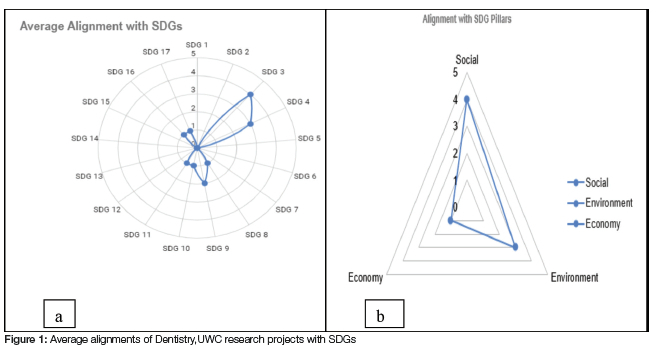
The average rounded scores were sorted from highest to lowest, showing the highest scoring SDGs at the top of the list with lowest scoring SDGs at the bottom. Results that had a final total of 0, for a particular SDG, were ignored. The results were also colour-coded by a final relevance score represented as red (5), pink (4), orange (3), yellow (2) green (1) and grey (0) to aid in the visual identification of their level of importance. The rounded average scores were used to display the results graphically, in the form of radar graphs, representing the visual weighting for the final ranked results; both in terms of the 17 SDGs and the SDG pillars. For the SDG pillars, the results were determined by assessing those SDGs that scored highest (maximum value) for each of the respective groupings pertaining to social (SDG 2, 3, 4, 5, 6, 8, 12, 17, 18), economic (SDG 9, 10, 11, 13) and environmental (SDG 7, 14, 15, 16) factors; as done in similar SDG evaluation tools.11
Percentage Composition
For additional insight into the ranked results, each results score was broken down further into a percentage matrix showing the weighting related to the percentage makeup of the various scores in determining the final value. This was calculated by counting the total number of times a relevance score was captured, ranging from 0 to 5, and then dividing each relevance score's count by the total number of assessed project records. This number was then multiplied by 100, to convert it to a percentage value, and rounded to 2 decimal places. The total percentage values were then added across all scored relevance values, to ensure they added up to 100%, as a check for correctness. Each year's records count was also cross-checked against the total of the overall added totals. This was done to ensure the correct number of filled totals corresponded to the total number of assessed records; as a further check for correctness. These calculations were done for each of the 17 SDGs. The results were then plotted as a matrix and colour-coded, from dark red (highest) to white (lowest), to visually display the highest to lowest values. The same was done for each of the separate years' results.
Results
The analysis of research conducted by the Faculty of Dentistry at the University of the Western Cape (UWC) between 2013 and 2023 reveals significant alignment with several SDGs. Figure 1 illustrates the alignment scores between UWC Dentistry's research priorities and the SDG's. The analysis reveals that the majority of UWC's dental research is aligned with SDG 3, focusing on improving public health outcomes (Figures: 1a, 1b). The Rounded Average for SDG 3 is 4, indicating a significant emphasis on addressing health disparities, improving access to dental care, and integrating oral health into broader public health frameworks. There is a strong alignment with SDG 4, particularly in dental education. UWC's contribution to SDG 4 highlights efforts to integrate sustainability principles into dental training, preparing students to tackle global health challenges through preventive care and addressing health inequities. The Rounded Average score for SDG 4 is 3, reflecting substantial contributions in this area.
The university's research in this area shows contributions to SDG 9, emphasizing innovations in dental technologies such as digital dentistry and AI. These technologies improve clinical efficiency and expand access to care, particularly in underserved regions. The Rounded Average score for SDG 9 is 2, indicating a moderate but important focus on advancing healthcare infrastructure.
DISCUSSION
Dentistry naturally intersects with public health, biology, materials science, and engineering, opening avenues for integrating oral health into larger sustainability goals. 68
Advances in dental materials and technologies contribute to SDG 12 (Responsible Consumption and Production) by promoting environmentally sustainable practices. The development of new materials and minimally invasive techniques not only minimizes the environmental impact of dental care but also aligns with global efforts to reduce waste and promote sustainable healthcare. In addition, digital dentistry aligns with SDG 9 by driving innovations in infrastructure and expanding access to care, particularly in remote and low-resource settings. These technologies improve clinical efficiency, enhance patient outcomes, and democratize access to oral healthcare by overcoming geographical and economic barriers.5
The potential for oral health to contribute to SDG 4 is evident in the evolution of dental education, where interdisciplinary collaboration between fields such as public health, engineering, and technology fosters innovative approaches to training future dental professionals. UWC's emphasis on integrating sustainability into dental curricula prepares graduates to address global health challenges beyond the clinic, including the promotion of preventive care and the reduction of health inequities. This approach not only equips students with the technical skills necessary for their profession but also cultivates a sense of social responsibility and a commitment to sustainable practices.
Interdisciplinary collaboration is an important feature in academia, which highlights the integration of theories and methods of several disciplines within the scientific field. This reflects in sustainability research, which underscores the multifaceted challenges as it relates to natural, social, and human sciences.1012
The dental faculty of UWC focuses on interdisciplinary research and international collaboration which contributes significantly to SDG 16 by fostering strong institutions and promoting equitable access to health services. By aligning research with international standards and building global partnerships, UWC positions itself as a leader in advocating for the recognition of oral health as a fundamental component of overall health. Reframing oral health as a human right is crucial for addressing existing inequalities in healthcare access, particularly in under-resourced communities, where oral diseases remain a significant yet preventable burden.
However, the integration of oral health into the SDGs faces several challenges, including the lack of explicit policy frameworks that prioritize oral health within national and global health agendas. 13
The intersection of oral health and the SDGs presents a vital yet underexplored opportunity, especially in South Africa where oral health is often side-lined in policy discussions.
Despite the absence of explicit references to oral health within the SDG framework, particularly in SDG 3 (Good Health and Well-being), the inclusion of oral health is critical to addressing broader health disparities. This research identifies the significant contributions that interdisciplinary research, particularly within the University of the Western Cape (UWC), can make to global health and sustainability.
One of the significant ways oral health research can contribute to the SDGs is through innovations in materials science. Sustainable dental materials, such as biodegradable composites, not only advance SDG 12 (Responsible Consumption and Production) but also reduce the environmental impact of dental practices.7514
Moreover, UWC's focus on interdisciplinary research contributes significantly to SDG 16 by fostering strong institutions and global partnerships. By aligning research with international standards and forging collaborations across borders, UWC positions itself as a leader in promoting peace and justice through equitable access to health services. Oral health, often perceived as a luxury, must be reframed as a human right to address the existing inequalities in healthcare access, particularly in under resourced communities.3
However, the integration of oral health into the SDGs remains limited by several challenges. One of the key limitations is the lack of explicit policy frameworks that prioritize oral health within national and global health agendas.1346
Aligning oral health with the SDGs requires a multifaceted and collaborative approach. UWC's commitment to interdisciplinary research offers a blueprint for how dental schools can contribute to sustainable development. By fostering innovation, enhancing education, and advocating for policy changes, the field of dentistry can play a pivotal role in achieving global health goals. Future research should continue to explore the integration of oral health into the SDG framework, with a focus on developing practical strategies that can be implemented at both local and global levels.
Conclusion
The alignment of oral health research with the SDGs represents an important step in addressing global health disparities and promoting interdisciplinary collaboration. This study demonstrates how the University of the Western Cape's research has contributed significantly to the SDGs, particularly SDG 3, SDG 4, SDG 9, and SDG 16. By integrating oral health research with public health, materials science, engineering, and education, UWC has shown that dentistry can play a critical role in achieving sustainable development.
The findings of this research underscore the importance of addressing oral health inequalities, particularly in underserved regions such as Africa, where oral health often remains a neglected priority. Furthermore, interdisciplinary research that incorporates sustainable dental materials, innovative educational approaches, and collaborative frameworks offers a model for how oral health can contribute to broader sustainability goals.
However, significant challenges remain, including the need for policy frameworks that prioritize oral health within national and international health strategies, as well as sustained investments in research infrastructure. Future efforts should continue to explore the integration of oral health into the SDG framework, focusing on practical, locally adaptable solutions that can be implemented in resource-limited settings.
By fostering innovation, enhancing education, and advocating for policy changes, dental schools and researchers can contribute to achieving global health goals and promoting a more equitable future for oral health care.
Conflicts of Interest
There are no applicable conflicts of interests for all authors.
BIBLIOGRAPHY
- 1. Bernabe E, Marcenes W, Abdulkader RS, Abreu LG, Afzal S, Alhalaiqa FN, et al. Trends in the global, regional, and national burden of oral conditions from 1990 to 2021: a systematic analysis for the Global Burden of Disease Study 2021. The Lancet. 2025 Mar 15;405(10482):897-910.
- 2. World Health Organisation. Global strategy and action plan on oral health 2023-2030. Geneva; 2024.
- 3. Ogunbodede EO. A Actualisation of the Sustainable Development Goals (SDGs): The Role of Dentistry. Niger J Dent Res. 2016;1(1):1-9.
- 4. Hugo FN, Kassebaum NJ, Marcenes W, Bernabé E. Role of Dentistry in Global Health: Challenges and Research Priorities. J Dent Res. 2021 July 1;100(7):681-5.
- 5. Ali S. The materials science imperative in meeting the Sustainable Development Goals. Nat Mater. 2018 Nov 23;17:1052-3.
- 6. Galvin S, Jurado CA, Afrashtehfar K. Interdisciplinary Approaches for Integrating Materials Science and Dentistry. Bioengineering. 2023;10(3):334.
- 7. Liu SJ. Biomaterials for dental technologies. J Polym Eng. 2014 May 1;34(3):201-201.
- 8. Faulks D. Oral health inequalities and disability: Closing the gap -. Community Dent Oral Epidemiol. 2023;51(4):621-6.
- 9. Fisher J, Berman R, Buse K, Doll B, Glick M, Metzl J, et al. Achieving Oral Health for All through Public Health Approaches, Interprofessional, and Transdisciplinary Education. NAM Perspect. 2023;10.31478/202302b.
- 10. Freeth R, Caniglia G. Learning to collaborate while collaborating: advancing interdisciplinary sustainability research. Sustain Sci. 2020 Jan;15(1):247-61.
-
11. Barimo J, O'Mahoney C, Mullally J, O'Hallaran J, Byrne E, Reidy D, et al. SDG Curriculum Toolkit. [Internet]. Univeristy College Cork,Ireland. 2023 [cited 2024 May 8]. Available from: https://www.ucc.ie/en/sdg-toolkit/teaching/tool/interactive-mapping/mapping_research
» https://www.ucc.ie/en/sdg-toolkit/teaching/tool/interactive-mapping/mapping_research - 12. Yu L, Yan Y, Li M. Does Interdisciplinary Research Lead to Higher Faculty Performance? Evidence from an Accelerated Research University in China. Sustainability. 2022 Oct 27;14(21):13977.
- 13. Watt RG, Daly B, Allison P, Macpherson LM, Venturelli R, Listl S, et al. Ending the neglect of global oral health: time for radical action. The Lancet. 2019;394(10194):261-72.
- 14. Surdu A, Foia CI, Luchian I, Trifan D, Budala DG, Scutariu MM, et al. Telemedicine and Digital Tools in Dentistry: Enhancing Diagnosis and Remote Patient Care. Medicina (Mex). 2025 Apr 30;61(5):826.