Dentists in the mirror of Dentists: A survey on peer assessment of dental ethics in Iran
Abstract
BACKGROUND: Dental Ethics is still in its infancy. More research investigating ethical issues in dental practice is required, and subjecting dentists to critique by their peers is one available strategy. METHODS: A prioritized list of ethical issues had been derived in a previous qualitative study aimed at examining the concerns of a group of Iranian dentists about ethical issues in dental practice. The current study used the most highly ranked issues to develop a series of ethical vignettes and accompanying questionnaire. Dentists were asked to rate each of four or five possible actions in response to every vignette, according to the expected prevalence of behaviour among Iranian dentists and its degree of ethical soundness. Two hundred and four Iranian dentists, predominantly general practitioners, participated in the study. RESULTS AND CONCLUSIONS: The three top themes, all directly related to clinical dental practice, were: not taking responsibility for one's errors, performing procedures without adequate competence, and over-treatment (or unnecessary treatment). Less important issues included: unprincipled behaviour towards disadvantaged patients, unprofessional discussion of a colleague's work, and inappropriate manners towards patients. The female respondents showed more concern regarding the prevalence of unethical behaviour of dental professionals than did their male peers.
INTRODUCTION
Ethics is an intrinsic component of dental practice.1 23 45678910,11 have presented a broad, although not exhaustive, list of ethical issues in dental practice.
However, dental ethics seems to be still in its infancy in many countries.1213 12
METHOD
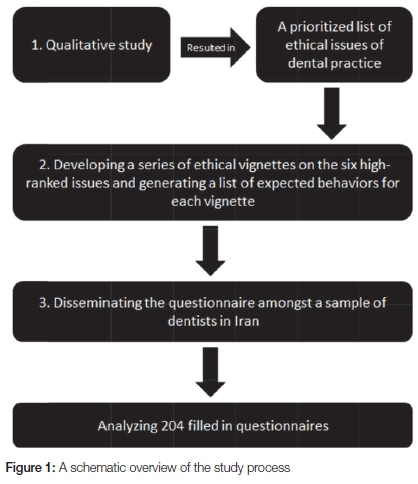
The present study assessed the judgment of a group of Iranian dentists in relation to some challenging ethical issues of dental practice in Iran. The primary research tool was a set of six vignettes designed to determine the ethical concerns of Iranian dentists. The opinions of 204 practicing dentists were obtained.
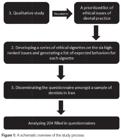
This is the second step of a dental-ethics multi-step project, employing a mix of different research methods (Figure 1). The first step had comprised qualitative enquiries and generated a prioritized list of 18 ethical issues of dentistry,14
A first draft of the vignettes was prepared based on the stories narrated by the dental specialists in the first study, on a review of published cases and other dental ethics scenarios, as well as on informal discussions and exploratory interviews with practicing dentists,
The vignettes were framed to have taken place in the private dental office of a hypothetical dentist, unfolding a possible problem that confronts him/her in the clinical relationship with his/her patients. In the original Persian format of the vignettes, the gender of the dentist was not stated. Recognising the low dental insurance coverage in Iran, the patients were all considered uninsured.
The vignettes were presented to a group of five general dentists, in order to generate a list of behaviours that Iranian dentists might actually consider in response to each vignette. The dentists were also asked to state what they thought would be the actual behaviours of typical Iranian practitioners in these situations. The process resulted in four or five options for each vignette, representative of the most likely responses of Iranian dentists in similar circumstances.
Twelve experts, including nine dental specialists and three general dentists, were requested to assess the vignettes for validity and to comment whether they were a good translation of the constructs. Additionally, each of these experts was asked to judge whether each vignette accurately reflected the attributed ethical issue, using a five-point LIKERT scale that ranged between "very low" to "very much". In an attempt to clarify the respondents' sense of the difference between law and ethics, the experts were asked to evaluate whether the behaviour of Iranian dentists encountering the described situation may be affected by any particular rule of law rather than ethics, again using the LIKERT scale.
All the vignettes fulfilled the criteria, confirming that each meaningfully reflected the related ethical issues.
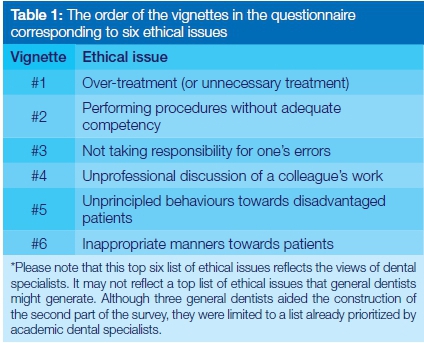
A test questionnaire containing six vignettes was then developed. Each was followed by four or five possible response options. The order of the vignettes within the questionnaire was assigned randomly (Table 1).
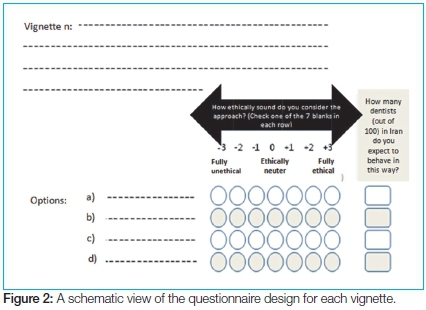
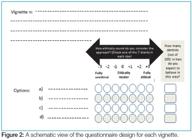
The respondents were asked to rate each option for every vignette, with respect to (1) their estimation of the prevalence of that behaviour among Iranian dentists (Among 100 national dentists, how many dentists behave in such a way, on average?), and (2) their judgment about the degree of ethically soundness of the behaviour (measured on a seven-point LIKERT scale, ranging from 'fully unethical' to 'fully ethical'. The neutral position was identified as 'ethically neutral'. Figure 2 represents a schematic view of the design of the questionnaire for each vignette.
Also included were demographic data on age, gender and location of the respondents, specialty status, and information about the size, type and location of the dental practice.
DATA COLLECTION AND ANALYSISData were collected by means of a posted self-administered questionnaire. Since there was no reliable data list of registered dentists in Iran,16
DATA ANALYSISA composite index of dentists' concern over the ethical impact of the six vignettes, namely "Relative Importance" (RI), was created by multiplying the perceived negative or positive effect by an estimate of how prevalent each practice was thought to be. RI was chosen to represent the degree to which unethical behaviour concerning an issue was considered frequent. Very negative but rare behaviours were judged to be similar in concern to somewhat negative but common behaviours.
The data were analyzed using SPSS for Windows, version 16.0. Descriptive statistics were used to summarise the demographic characteristics of the sample, while a t test and one-way variance analysis was used for the comparison of variables. The normality of the distribution of the vignettes' RI was tested and confirmed with a one-sample Kolmogorov-Smirnof test.
The research was conducted in accordance with the World Medical Association Declaration of Helsinki. The study was independently reviewed and approved by the Ethics Committee of Shahid Beheshti University of Medical Sciences, Tehran, Iran.
RESULTS
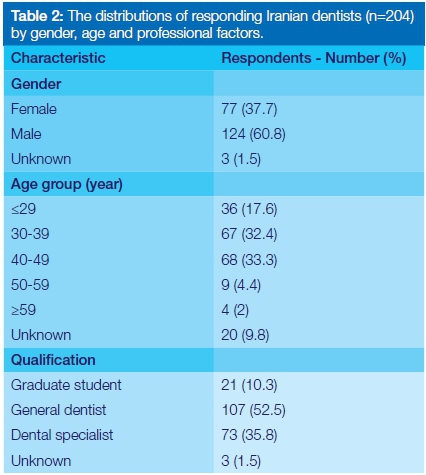
Responses were obtained from 204 dentists in various locations of Iran. While 145 respondents filled out the questionnaire completely, 59 completed only the columns related to their ethical judgment. The latter group were excluded for the calculation of relative importance (RI). The mean (SD) age of respondents was 37.73 (8.55) years, and ages ranged between 24 and 65. There were 77 (37.7%) female dentists in the sample and more than half of the participants (107) were general dentists, while the percentages of dental specialists and dental graduate residents were 35.8 and 10.3 respectively. The mean duration of respondents years of practicing as a dentist was 11.3 (SD= 7.5) and the majority of respondents (61.8%) stated that they had practiced in one of the big cities of Iran, where the population is more than one million. Table 2 shows the demographics of the responders, their academic qualification level and location of their dental practices.
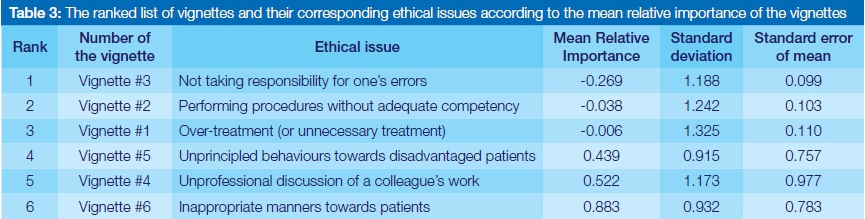
To compare the degree of significance of these six ethical issues, the RI for each vignette was calculated. A negative RI for a vignette meant that the respondents expressed serious concern about the prevalence of unethical behaviours in that situation. The lowest value for relative importance was -0.2687, for vignette number three, the issue of "not taking responsibility for one's errors". This ethical issue was rated as having the highest importance of the six ethical issues explored in this study. The prioritized list of the issues, based on the RI of the vignettes is shown in Table 3.
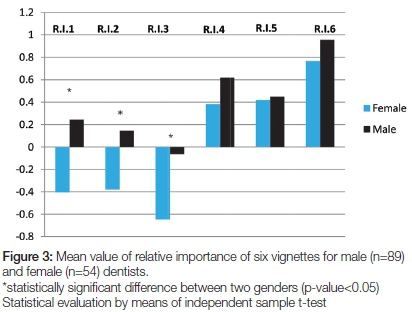
Male general dentists were the only subgroup whose perceived relative importance for all vignettes had a positive value. This indicates that Iranian male general dentists may have less concern about the frequency of unethical behaviour in the profession.
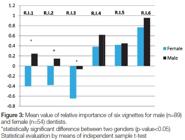
Female dentists in Iran rated the moral conduct of dental professionals lower than did their male dental colleagues. The difference is statistically significant (p<0.05) for the first three vignettes (Figure 3).
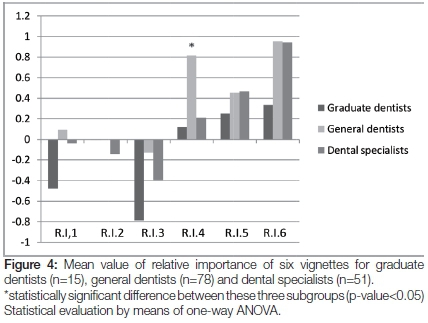
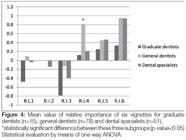
Overall, the RI of the vignettes was lower when rated by graduate dentists compared with general and specialist dentists. However, the difference was not statistically significant, with the exception of vignette number four (Figure 4). This suggests that Iranian dental residents, in comparison with practicing general or specialized dentists, appear to be more concerned about the unprofessional discussion of a colleague's work among Iranian dentists.
DISCUSSION
The results show that in this study, three situations, including not taking responsibility for one's errors, performing procedures without adequate competency, and over-treatment (or unnecessary treatment), are considered slight ethical hazards. Three other situations, involving relations with colleagues, attitude towards disadvantaged patients and inappropriate personal behaviour toward patients, were assessed to be ethically neutral. A distinction was made between these two groups of issues according to their relation to technical treatment. The perceived hazards of the first three issues are associated with clinical dental treatment and issues such as error, competence, and treatment planning. The other three issues, which were not regarded in this study as being as important as the former ones, are associated with the professional relationship between patients and colleagues, and with decision making in regard to financial matters.
These results could reflect what Ethics commonly means for Iranian dentists. The findings suggest that Iranian dentists prioritize the interpretation of ethics/morality through the lens of technical dental work and a concern for behaviours that dentists may have to justify to each other. They seem to be less apt to prioritize ethical issues involving professionalism, issues of oral health or financial matters.
This study was a pilot research effort in the field of empirical ethics. It aimed to explore actual moral beliefs, intuitions and expected behaviours in a group of dentists. It sought to characterize an underlying ethical reality that may be of concern to both the profession and society. While empirical ethics research is recognized in other fields to be important,17
These are important objectives needing further development if empirical-ethical studies are to advance.18
The burden of judgment in this study was on the participants and no ought-conclusion (i.e. what should we do?) was drawn from a set of is-premises (i.e. what do we do?). Therefore, the is-ought problem, which means making claims about what ought to be practiced on the basis of statements about what is,19
One important consideration in a survey on ethics is the need to recognize the tendency of respondents to answer questions in a manner that will be viewed favourably by others. This is the so-called social desirability bias.20
As shown in previous studies, the answers by dentists to questions in a questionnaire survey do not always reflect their real practices.21,22 For these reasons, the questions about an individual respondent's own behaviour were not included in the present questionnaire. This was done to minimize the influence of unreal self-reporting answers. Instead of designing questions that would aim to uncover from each respondent his/her own sense of their own or potential behavioural practices, with the survey sought to reveal each dentist's estimation of what percentage of their colleagues they perceived would behave in a specific way, when confronted with the situation described in each of the six vignettes.
The high dispersion of ethical judgments on some options of the questionnaire could indicate an opportunity for fruitful ethical discussions in dental schools and dental organizations about those six specific behaviours. These options simply reflect a series of ethical questions that a handful of academic dental specialists in Iran first thought were important. The participants in this study demonstrated a high level of non-agreement in terms of their ethical judgment. This disparity may warrant further consideration, firstly to determine if there is an ambiguity or vagueness in the descriptions, and second, to assess whether there are real differences in the ethical approach of dental professionals.
An attempt was made to obtain a range of possible responses. This variation was generated by applying a seven-point LIKERT scale. This range from unethical to fully ethical framed a forced ethical judgment framework for respondents to apply to each vignette and its response options. A zero-to-one-hundred scoring system was used to estimate the perceived frequency of that behaviour among Iranian dentists.
LIMITATIONS OF THE STUDYSince no reliable database of registered dentists in Iran was accessible,162324
CONCLUSION
The ethical issues about which dentists show greater concern are those more connected to the clinical aspects of dental practice. They include not taking responsibility for one's errors, performing procedures without adequate competency, and over-treatment (or unnecessary treatment). Important, but of less concern, were three other, and more general, ethical issues: unprincipled behaviours towards disadvantaged patients, unprofessional discussion of a colleague's work, and inappropriate manners towards patients. Overall, Iranian female dentists seem to be more concerned about the moral behaviour of dental professionals than their male peers.
Acknowledgments: This paper considerably benefitted from discussions with Dr Mohammad H. Khoshnevisan and Dr Arezoo Ebn Ahmady.
Conflict of interest: None declared
ACRONYMSRI: Relative Importance
References
- 1. Williams JR, FDI World Dental Federation. Dental Ethics Manual, Ferney - Voltaire, France, 2007.
- 2. Singh A. Professional duties of dentists. In: Lambden P, editor: Dental Law and Ethics. Abingdon: Radcliffe Med Pr, 2002;21-32.
- 3. Kress GC, Hasegawa Jr TK, Guo IY. A survey of ethical dilemmas and practical problems encountered by practicing dentists. J Am Dent Assoc. 1995;126(11):1554-62.
- 4. Ozar DT. Dentistry. In: Post SG, editor: Encyclopaedia of Bioethics, 3rd ed. New York: Macmillan, 2004;642-7.
- 5. Hasegawa Jr TK. Is mom" losing it"? Tex Dent J. 1993;110(9):17-8.
- 6. Hasegawa Jr TK, Matthews M, Peltier B. Transferring records of the demanding patient. Tex Dent J. 2005;122(7):683-5.
- 7. Ozar DT, Sokol DJ. Dental ethics at chairside: professional principles and practical applications. 2nd ed. Washington, DC: Georgetown UnivPr, 2002.
-
8. Rule JT, Veatch RM. Ethical Questions in Dentistry. 2nd ed. Chicago: Quintessence, 2004.
» 2 - 9. Naidoo S. Dental ethics case 1: What should I do when I suspect a child patient is being abused? SADJ. 2010;65(4):184.
- 10. Kress GC, Hasegawa Jr TK, Guo IY. A survey of ethical dilemmas and practical problems encountered by practicing dentists. J Am Dent Assoc. 1995;126(11):1554-62.
- 11. Porter SAT, Grey WL. Ethical dilemmas confronting dentists in Queensland, Australia. Aust Dent J. 2002;47(3):241-8.
- 12. Chambers DW. Finding our place in dental ethics. Pa Dent J. 2009;76(3):27-31.
- 13. Kazemian A, Berg I, Finkel C, Yazdani S, Zeilhofer HF, Juergens P, Reiter-Theil. How much dentists are ethically concerned about overtreatment; a vignette-based survey in Switzerland. BMC Med Ethics. BMC Med Ethics 2015 19;16:43.
- 14. Kazemian A, Yazdani S, Khoshnevisan MH, Ebn Ahmady A, Reiter-Theil S. Prioritization among ethical issues of dental practice in Iran. A modified nominal group study. Bioethica Forum. 2014;7(3):98-104.
- 15. Oppenheim AN. Questionnaire Design, Interviewing and Attitude Measurement. London: Continuum International Publishing Group Ltd; 2000.
- 16. Ghasemi H, Murtomaa H, Torabzadeh H, Vehkalahti MM. Knowledge of and attitudes towards preventive dental care among Iranian dentists. Eur J Dent. 2007;1(4):222-9.
- 17. Borry P, Schotsmans P, Dierickx K. Editorial: Empirical ethics: A challenge to bioethics. Med Health Care Philos. 2004;7:1-3.
- 18. Vries RD, Gordijn B. Empirical ethics and its alleged meta-ethical fallacies. Bioethics. 2009;23(4):193-201.
- 19. Chan S, Coggon J. Beyond the is/ought divide: studying the nature of the bioethical enterprise. Health Care Anal. 2013;21(1):1-5.
- 20. Sjöström O, Holst D. Validity of a questionnaire survey: response patterns in different subgroups and the effect of social desirability. Acta Odontol Scand. 2002; 60:136-40.
- 21. Kay EJ, Nuttall NM, Knill-Jones R. Restorative treatment thresholds and agreement in treatment decision-making. Community Dent Oral Epidemiol. 1992;20:265-8.
- 22. Mejàre I, Källesål C, Stenlund H. Incidence and progression of approximal caries from 11 to 22 years of age in Sweden: A prospective radiographic study. Caries Res. 1999;33:93-100.
- 23. Sjöström O, Holst D, Lind SO. Validity of a questionnaire survey: The role of non-response and incorrect answers. Acta Odontol Scand. 1999;57:242-6.
- 24. Helöe LA. Comparison of dental health data obtained from questionnaires, interviews and clinical examination. Scand J Dent Res. 1972;80:495-9.
Ali Kazemian
Department of Community Oral Health, School of Dentistry
Mashhad University of Medical Sciences
Mashhad, Iran
E-mail: