Maxillofacial Radiology 204
Yakoob
BChD, PDD (Maxillofacial and Oral Radiology), MSc (Maxillofacial and Oral Radiology), PGDip General Management (GIBS Pret). Department of Maxillofacial Pathology, School of Dentistry, University of Pretoria. ORCID: 0000-0003-1966-5574
CASE
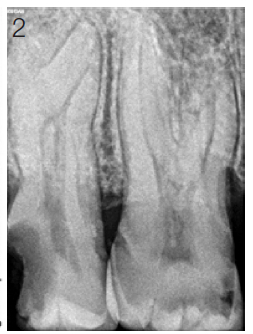
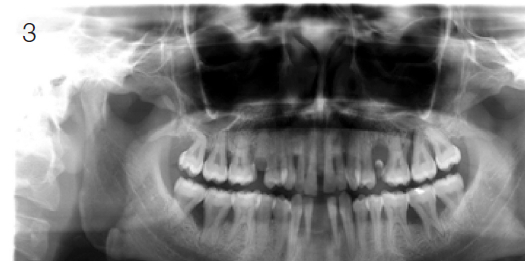
Below are four patients that presented to our facility for dental treatment. In all four patients, Taurodontism of varying degrees was noted as incidental findings.
INTERPRETATION
Taurodontism is characterised by an altered internal dental pulp morphology that results in an elongated pulp chamber of varying degrees1232 13Image 4 displays tooth 47 with a moderate form of pulpal enlargement and can therefore be classified as a mesotaurodont tooth. In hypertaurodon-tism, the pulp chamber enlargement reaches the apical area of the root. Images 1 (the posterior molar teeth), 2 and 3 (the posterior molar teeth) are examples of hypertauro-dontism. The prevalence of Taurodontism ranges amongst different population groups, with some studies reporting a prevelance of 46%.32,3 Taurodontism has been considered a marker for other non-syndromic abnormalities such as cleft lip and palate.1,3 Clinically a taurodont tooth will appear sound, but due to the altered root and pulp morphology there are risks associated. In affected teeth challenges may arise particularly during pulp therapy and root canal treatment due to the increased bleeding in the enlarged pulp and altered root canal configuration. As Taurodontism may be an indication of an underlying, undiagnosed genetic condition, it is important for general dentists to detect affected teeth and be aware of this phenomenon.3

Authors declaration
Funding: This research did not receive any specific grant from funding agencies in the public, commercial, or not-for-profit sectors.
Conflict of Interest: The authors declare that they have no conflict of interest.
Ethics approval: This study was approved by the University of Pretoria, Faculty of Health Sciences Research Ethics Committee (Reference no.: 543/2022). All procedures followed the ethical standards of the Helsinki Declaration of 1975, as revised in 2008.
REFERENCES
- 1. MacDonald D. Taurodontism. Vol. 36, Oral Radiology. Springer; 2020. p. 129-32.
-
2. Da Y, Wang C, Zhang L, Wang F, Sun H, Ma X, et al. High prevalence of taurodontism in North China and its relevant factors: a retrospective cohort study. Oral Radiol [Internet]. 2022 Jun 30;30:1-9. Available from: https://link.springer.com/10.1007/s11282-022-00630-1
» https://link.springer.com/10.1007/s11282-022-00630-1 - 3. Chetty M, Roomaney IA, Beighton P. Taurodontism in dental genetics. BDJ Open. 2021 Dec 1;7(1).
Z Yakoob
Department of Oral and Maxillofacial Pathology
University of Pretoria
E-mail: