An analysis of complaints against dentists made to the HPCSA: 2009-2023
Abstract
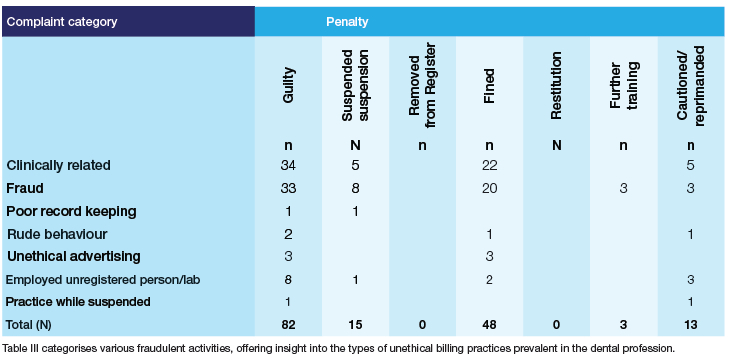
AIMS AND OBJECTIVES: The study aims to provide an updated description of HPCSA complaints against dentists. The objectives were to analyse the incidence, types and consequences of professional misconduct and unprofessional behaviour complaints against South African dentists from 2009-2023 DESIGN: A descriptive study design was employed, focusing on a retrospective analysis of publicly accessible complaint records METHODS: Publicly available online Health Professions Council of South Africa (HPCSA) records from 2009-2023 were analysed (www.hpcsa.co.za), categorising complaints based on ethical violations. Categories included clinical misconduct, fraud, record-keeping lapses, unprofessional conduct, unethical advertising, employing unregistered personnel or laboratories, poor infection control and practicing while suspended. Complaint nature, outcomes and penalties were quantitatively assessed, with qualitative descriptions of complaint types RESULTS: From 83 dentists included in HPCSA records, 82 were found guilty. Primary complaints were fraud 33/82 (40%), clinical negligence 32/82 (39%) and employing unregistered personnel or laboratories 8/82 (10%). Forty-four dentists received fines (53%) for clinical and 20/82 (24%) for fraud-related issues, while 15/82 (18%) were suspended and 13/82 (16%) were cautioned CONCLUSION: The findings offer crucial insights into the misconduct in public and private dental practices in South Africa, highlighting areas for improvement
INTRODUCTION
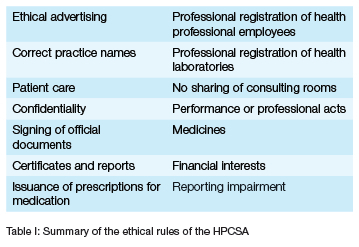
Recently, there has been an increasing trend of complaints made against health professionals in South Africa. Reasons cited for the rise in complaints include increasing awareness of patient rights and the proliferation of legal firms specialising in medical claims. The Health Professions Council of South Africa (HPCSA) was established through the Health Professions Act 56 of 1974 and serves as a regulatory body for health professions in the country, including dentists.12 2,3 Practitioners registered with the HPCSA must adhere to the Ethical Rules of Conduct which stipulate that the practitioner must act in the best interests of patients as part of their primary duty; they must respond appropriately to protect patients from risk or harm due to any reason; and they must report violations in circumstances where there is good reason to believe that the rights of a patient are being violated.4Table I).
These guidelines are vital for maintaining the integrity, professionalism and ethical standards of healthcare services.5116 121
According to the 2022 annual report, the HPCSA performed 2,727 compliance inspections with 25 operations carried out in conjunction with the South African Police Service (SAPS) and the South African Health Products Regulatory Authority (SAHPRA).11
Any natural or juristic person, group or professional body can lodge a complaint against a health professional with the HPCSA. However, only members of the public or healthcare practitioners can lodge complaints for unprofessional conduct by a person registered under the Health Professions Act.
Alternatively, for issues specifically related to dental services, the South African Dental Association (SADA) offers an ombudsman service. Complaints can be sent in writing to a designated email address, and complaints are handled via a free complaint resolution process.71,7 According to the HPCSA, this has resulted in cost savings generated for the organisation.1
Aims and objectives
The study aims to provide an updated description of HPCSA complaints against dentists. The objectives were to analyse the incidence, types and consequences of professional misconduct and unprofessional behaviour complaints against South African dentists from 2009-2023.
Methods
Publicly available records of the Health Professions Council of South Africa from the official website (www.hpcsa.co.za) were analysed and classified according to the ethical rules. The search was limited to dentists who received complaints against their names during a period of 14 years.
During the review process, two independent reviewers, experienced in dental public health, assessed the online of complaints published by the HPCSA. Both the nature and outcome of the complaints and penalties were quantified using simple, descriptive statistics. Complaints were categorised into six categories: Clinically Related Fraud, Poor Record Keeping, Rude Behaviour, Unethical Advertising, Employment of Unregistered Persons/Labs, and Practicing While Suspended. This classification was achieved through examination and consensus-building between the reviewers.
The reviewers carefully analysed each case, considering the nature and specifics of the complaints, and mapped them to the most appropriate category. This systematic approach ensured that each complaint was assessed fairly and accurately. Poor record keeping, for instance, was identified based on its impact on professional conduct and patient care, while rude behaviour was evaluated based on its deviation from expected professional and interpersonal standards.
Results
The time period under review was 2009-2023 (14 years). This is the maximum time that judgments are kept online by the HPSCA. There were 82 guilty charges against dentists, 2009-2023. Of the charges 34/82 (41%) were clinically related, 33/82 (40%) were related to fraud and 8/82 (10%) were related to employing an unregistered professional or laboratory. Other charges fell into categories of unethical advertising, rude behaviour, poor record keeping and practicing while under suspension. The penalties were 48/82 (58%) fines, 15/82 (18%) suspensions and 13/82 (16%) cautions or reprimands issued to the dentists found guilty. Table II categorises the nature of the complaints and delineates the disciplinary actions taken.
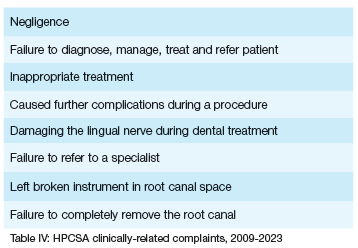
Table IV presents a list of clinically-related complaints handled by the HPCSA, 2009-2023. This table categorises various forms of clinical negligence and malpractice, offering a critical insight into common areas of concern in patient treatment and care.
DISCUSSION
The prevalence of professional body claims against dentists varies significantly across the globe, with distinct patterns observed in high-income countries compared to low- and middle-income countries. Globally, dental malpractice is notably prevalent in the private sector, reflecting perhaps the varied standards of care and regulatory oversight across different countries.89910
Another study in the Netherlands highlighted the personal and professional impact of complaints on dentists.11
In South Africa, a more detailed picture emerges. A 2011 paper found that charges were laid against 102/ approximately 4,153 (2%) dentists before 2009. The majority of complaints were also clinically-related followed by complaints of fraud. The penalties incurred include suspended suspensions, reprimands, further training and 1 removal from the health professions register.512
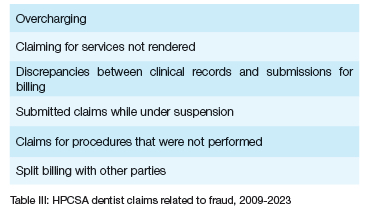
In the 2009-2023 HPCSA data, fraud-related complaints constitute a substantial 40% of the total cases. This high incidence aligns with global trends,13
When conducting a study on the analysis of complaints, using the HPCSA's publicly available complaints register, several limitations are noteworthy. The HPCSA register may not capture all complaints, especially those resolved informally or not officially reported. This can result in an underestimation of the actual number of complaints.5 14
There might be a reporting bias, as not all patients or peers are equally likely to file complaints. This can skew the data towards certain types of complaints or demographic groups.12 15
To decrease HPCSA complaints against dentists in South Africa, several recommendations can be considered. First, enhancing ethical training and continuing professional development is crucial. A study suggested the need for the HPCSA to re-evaluate the effectiveness of its ethical training programmes, implying that better training could lead to fewer complaints.165
Moreover, the mental health and wellbeing of dental professionals under investigation by the HPCSA should be given attention. The South African Dental Association (SADA) recognises the significant impact that HPCSA investigations can have on dental practitioners' mental health which can, in turn, affect their professional performance.171818 18
Finally, the process of lodging and handling complaints itself should be made more transparent and efficient. This includes ensuring that the perusal, analysis and categorisation of complaints are done fairly and in a timely manner, which can prevent the escalation of minor transgressions.6192
CONCLUSION
The analysis of complaints against oral health professionals at the HPCSA between 2009 and 2023 reveals significant insights into professional conduct and accountability within the dental profession. The findings underscore the importance of regulatory bodies such as the HPCSA in safeguarding public health and maintaining professional standards.
REFERENCES
-
1. HPCSA. Annual Report Health Professions Council of South Africa 2023. https://www.hpcsa.co.za/Content/upload/publlcatlons/annual_report/HPCSA_AR_2023.pdf
» https://www.hpcsa.co.za/Content/upload/publlcatlons/annual_report/HPCSA_AR_2023.pdf -
2. Hagemeister DT. Employer-generated complaints to the statutory registration authority: The regulatory framework for the supervision of employed health professionals in the South African public sector South African Journal of Bioethics and Law. 2018;11(1):11-4. https://www.ajol.info/index.php/sajbl/artide/view/175645
» https://www.ajol.info/index.php/sajbl/artide/view/175645 -
3. Spittal MJ, Studdert DM, Paterson R, Bismark MM. Outcomes of notifications to health practitioner boards: a retrospective cohort study. BMC Med. 2016;14(1):198. https://doi.org/10.1186/s12916-016-0748-6
» https://doi.org/10.1186/s12916-016-0748-6 -
4. McQuoid-Mason DJ. Medicine and the Law. South African Medical Journal. 2022:513-5. https://doi.org/10.7196/SAMJ.2022.v112i8.16707
» https://doi.org/10.7196/SAMJ.2022.v112i8.16707 -
5. Postma TC, van Wyk PJ, Heymans JH, White JG, Prinsloo PM. An analysis of complaints against oral health professionals charged with misconduct at the HPCSA: 2004-2009. Sadj. 2011;66(9):420-2, 4-5. https://pubmed.ncbi.nlm.nih.gov/23193872/
» https://pubmed.ncbi.nlm.nih.gov/23193872/ -
6. HPCSA. Legal and Regulatory Affairs - HPCSA 2019 [Available from: https://www.hpcsa.co.za/?contentId=0&menuSubId=19&actionName=Legal%20and%20Regulatory%20Affairs]
» https://www.hpcsa.co.za/?contentId=0&menuSubId=19&actionName=Legal%20and%20Regulatory%20Affairs -
7. Makhubele K. The SADA dental mediation (free and going online). South African Dental Journal. 2020;75(8):413-4. https://doi.org/10.17159/2519-0105/2020/v75no8a10576
» https://doi.org/10.17159/2519-0105/2020/v75no8a10576 -
8. Abomalik AM, Alsanea JA, Alkadhi OH. A retrospective assessment of the dental malpractice cases filed in Riyadh from 2009-2015. Journal of Family Medicine and Primary Care. 2022;11(6):2729-34. https://doi.org/10.4103/fmpc.jfmpc_2250_21
» https://doi.org/10.4103/fmpc.jfmpc_2250_21 -
9. Wu K-J, Chen Y-W, Chou C-C, Tseng C-F, Su F-Y Kuo MYP Court decisions in criminal proceedings for dental malpractice in Taiwan. Journal of the Formosan Medical Association. 2022;121(5):903-11. https://doi.org/10.1016/j.jfma.2021.09.023
» https://doi.org/10.1016/j.jfma.2021.09.023 -
10. Thomas L, Tibble H, Too LS, Hopcraft M, Bismark M. Complaints about dental practitioners: an analysis of 6 years of complaints about dentists, dental prosthetists, oral health therapists, dental therapists and dental hygienists in Australia. Aust. Dent. J. 2018;63(3):285-93. https://doi.org/10.1111/adj.12625
» https://doi.org/10.1111/adj.12625 -
11. Bruers JJ, van Dam BA, Gorter RC, Eijkman MA. The impact of a formal complaint on Dutch dentists' professional practice: a survey study. BMC Oral Health. 2016;16:1-9. https://bmcoralhealth.biomedcentral.com/artides/10.1186/s12903-016-0295-8
» https://bmcoralhealth.biomedcentral.com/artides/10.1186/s12903-016-0295-8 -
12. Makwakwa N, Motloba PD. Dental malpractice cases in South Africa (2007-2016). South African Dental Journal. 2019;74(6):310-5. http://dx.doi.org/10.17159/2519-0105/2019/v74no6a5
» http://dx.doi.org/10.17159/2519-0105/2019/v74no6a5 -
13. Dyck I, Morse A, Zingales L. How pervasive is corporate fraud? Rotman School of Management Working Paper. Review of Accounting Studies. 2021(2222608). https://doi.org/10.1007/s11142-022-09738-5
» https://doi.org/10.1007/s11142-022-09738-5 -
14. SADA. Dentist bringing malicious prosecution proceedings against patient. S. Afr. Dent. 2021;76(4):179-80. https://journals.assaf.org.za/index.php/sadj/artide/view/11472
» https://journals.assaf.org.za/index.php/sadj/artide/view/11472 -
15. HPCSA. HPCSA Complaints Process Explained 2023 [Available from: https://www.hpcsa-blogs.co.za/hpcsa-complaints-process-explained/]
» https://www.hpcsa-blogs.co.za/hpcsa-complaints-process-explained/ -
16. Nortjé N, Hoffmann WA. Professional consequence for dentists involved in unethical decision-making in South Africa. J. Forensic Odontostomatol. 2014;32(Suppl 1):22. https://pubmed.ncbi.nlm.nih.gov/25557412/
» https://pubmed.ncbi.nlm.nih.gov/25557412/ -
17. Makhubele K. A survey into the impact of HPCSA investigations on health practitioners' mental health. S. Afr. Dent. J. 2023;78(6):290-1. https://journals.assaf.org.za/index.php/sadj/artide/view/16903?artidesBySameAuthorPage=2
» https://journals.assaf.org.za/index.php/sadj/artide/view/16903?artidesBySameAuthorPage=2 -
18. Vrettos B. Communicate, collaborate and document: the pillars to avoid and manage complaints. SA Orthop. J. 2023;22(1):6-8. https://journals.co.za/doi/pdf/10.10520/ejc-mp_saoj-v22-n1-a2
» https://journals.co.za/doi/pdf/10.10520/ejc-mp_saoj-v22-n1-a2 -
19. Slabbert M, Labuschaigne M, Kwinda M. Inconsistent and Irregular Approaches in the Handling of Complaints by the Health Professions Council of South Africa: Haeck v Health Professions Council of South Africa (2021/11449)[2022] ZAGPJHC 690 (13 September 2022). https://www.safiii.org/za/cases/ZAGPJHC/2022/690.html
» https://www.safiii.org/za/cases/ZAGPJHC/2022/690.html

Author's contribution
1. TA Vedan, principal researcher - writing article (70%), data analysis (30%)
2. Haly Holmes - Writing article (15%))
3. GP Moodley, research assistant - writing article (30%), data collection and analysis (70%)
Declaration
The authors declare there are no conflicts of interest.