Assessing students' clinical time management performance: A case study
Abstract
INTRODUCTION: Student-centred clinical training forms part of the undergraduate training programmes in dental therapy and oral hygiene. Within this setting, students develop soft skills such as time management. However, it is unclear how these skills are assessed Aims and objectives: The study examined patient satisfaction related to students' time management in completing clinical procedures within an allocated training session at a higher education institution in South Africa. METHODS: A descriptive, cross-sectional survey using an adapted Dental Satisfaction Questionnaire (DSQ) collected data from 231 dental patients referred to the undergraduate student training clinic RESULTS: Only 68.8% of the patients strongly agreed that students completed their treatment during the appointment session. About 93.5% of the patients (n=216) indicated that students were punctual for their appointment. Almost 95.7% of patients (n=221) indicated that students explained each step of the treatment procedure to them. One central theme emerged: the perceived impact of time taken during sessions CONCLUSION: Patients were satisfied with the time students took to complete the clinical session. Patients' inputs could provide further insights into student-centred clinical training in the identified training programmes
Time management skills; patient satisfaction; clinical competency; dental therapy; oral hygiene; soft skills; competency-based curricula; experiential learning
INTRODUCTION
The goal of competency-based learning underpinned in dental training programmes is to support dental therapy and oral hygiene students into developing competencies aligned to the designed scope of practice for each identified dental professional.1-2 These undergraduate training programmes are developed using experiential teaching and learning pedagogy to drive learning outcomes.3 1,5,7 Competency is initially developed in the preclinical setting, where dental therapy and oral hygiene students train on simulators to learn basic technical skills to transition into the clinical environment.1,8 In student-centred clinical training, students complete a series of clinical procedures directly on patients aligned with service-based learning. Settings such as academic hospitals, community clinics, schools and other decentralised training sites provide opportunities for students to learn in real-world settings.4
These experiences could enhance patient-centred care, leading to the development of clinical competency.1,5,7-9,22-23 This could, in turn, culminate in the knowledge, vocational skills and values developed.1-2,5,7 However, a key issue raised in the literature has suggested that assessing competency remains complex and controversial within the framework of competency-based curricula.5-7 A growing trend in the literature has shed light on using patient satisfaction surveys to assess students' competency in dental training programmes.10-13 This paper reports patients' satisfaction with students' clinical time management performance at an identified clinical training site (Anonymous version). Dental therapy and oral hygiene training were introduced at the identified institution in the late 1970s to increase the number of dental professionals in the public health sector.26
The training has significantly evolved with expanding the scope of practices to allow graduates to work in a public or private dental setting. Both programmes are offered full time for three years. The curricula embed similarities in theoretical and practical modules, allowing dental therapy and oral hygiene students to undertake clinical-based training from the second to the end of the third year. Training sessions are structured in two-hour allocations at the training site, a Department of Health facility. The service-learning components underpinned in clinical modules enable students to work directly on patients under clinical instruction to accomplish pre-determined clinical requirements per dental procedure. Students are tasked to conduct a dental examination and diagnosis and devise a treatment plan for a patient.26
Time management remains crucial for dental therapy and oral hygiene students to develop in managing their clinical tasks and addressing the patient's main complaint within the clinical session. Moreover, students' time management competence assessed in dental therapy and oral hygiene training programmes remained unknown.11,14 Other studies assessed students' technical competence in mainstream dentistry.62,10-14,23 Therefore, given the limited published literature, this study aimed to examine patients' satisfaction with the time taken by second and third-year dental therapy and oral hygiene students to complete clinical procedures within an allocated training session.
METHODOLOGY
Study design
The study design was a case study that included a descriptive, cross-sectional survey used to collect data.
Study tool
The study tool was an adapted Dental Satisfaction Questionnaire (DSQ) version.16
Study participants
The study population were dental patients (18 years and above). The inclusion criteria included patients referred to the undergraduate student training clinic for dental treatment (dental prophylaxis, restorations or extractions). Children and adult patients who needed dental treatment beyond the students' practising scope or from the Department of Health dental staff were excluded. A total maximum sample size of n=231 patients was calculated by a statistician contracted to the study. The sample size determination formula: . Where Z is the upper point of the standard normal distribution, which is 1.96, d is a clinically acceptable margin of error, 5%, and P is the prevalence of patient satisfaction, 80%.15
Data collection
The study tool was piloted on participants (n=24) who met the study's inclusion and exclusion criteria. Research assistants were involved in the data collection process, which involved inviting, distributing and collecting data from participants who provided written consent at the end of the students' clinical sessions. The results gathered were excluded from the main study. Modifications were made for logistical data collection within the clinical setting. Data was collected from the March 25 to April 16 2024. Research assistants commenced primary data collection. The assistants coordinated, invited, distributed and collected data from participants who provided written consent. Participants took 5-10 minutes to complete a survey and insert it in the designated boxes provided. Data collection spanned from 23rd April to May to 30th of August 2024. The data was cleaned, counted, assigned with codes and captured electronically on a Microsoft Excel® spreadsheet (Windows 11 Version 2405). An independent checker verified data management.
Data analysis
The captured data were entered in the Statistical Package for the Social Sciences (SPSS) version 28 for analysis. Univariate descriptive statistics were used to report on the measures of central tendency and frequencies. The open-ended responses were analysed thematically. The dataset was read over three times to gain an overview and sense of familiarity. Initial codes were assigned to statements. This was an inductive approach, where codes were created according to the responses made and not extracted from the questions. The coded data was then grouped to search for emergent patterns. These patterns were categorised into themes. Themes, including subthemes, were redefined to provide answers to the open-ended questions.
Validity and reliability
This study's internal and external validity was achieved through the following efforts: professional guidance and mentorship from the research supervisor, the design and modifications made to the survey, the piloting of the study tool, the use of the probability sampling method, and the large sample size. Reliability was measured by Cronbach's alpha (27 items; α=.905), indicating a good score. The statistician and research supervisor validated the results, leading to credibility.
Ethical considerations
Ethical approval was in line with......(Anonymous version). ......to conduct this study. A language practitioner translated the study tool, information and consent form into isiZulu to ensure participants were comfortable with their language proficiency. Participants' names were not included and code names were assigned to report on quotations used. Patients' rights, confidentiality, trust and anonymity were upheld per the Department of Health policies and practices.
RESULTS
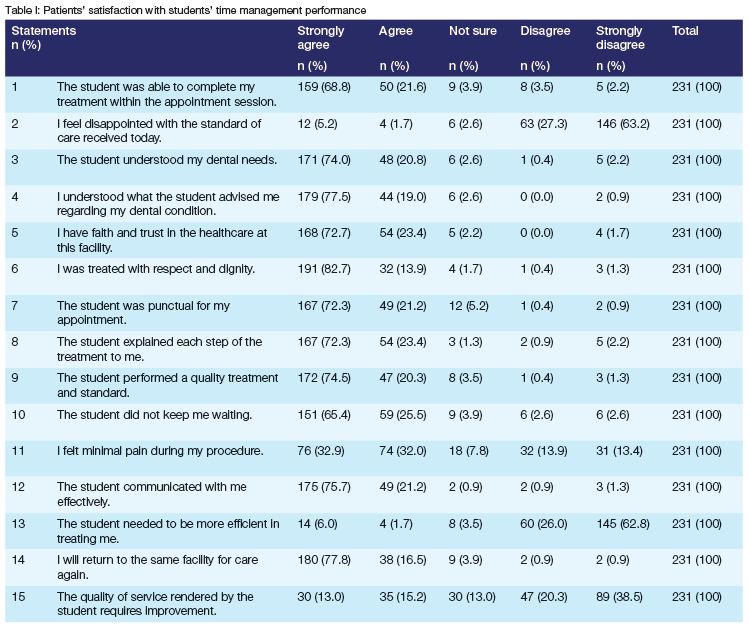
Two hundred and thirty-one participants completed the patient satisfaction survey, which yielded a response rate of 100%. While more than two-thirds of the participants (68.8%) strongly agreed that the student completed their treatment within the appointment session, only 2.6% of the participants strongly disagreed/disagreed that the student understood their dental needs. Most participants (96.1%) strongly agreed/agreed that they had faith and trust in the healthcare facility. Two hundred and sixteen participants (93.5%) indicated that the student was punctual for their appointment. Almost 95.7% of participants (n=221) indicated that the student explained each step of the treatment procedure to them. More than two-thirds of the participants (65.4%) strongly agreed that the students did not keep them waiting (Table I).
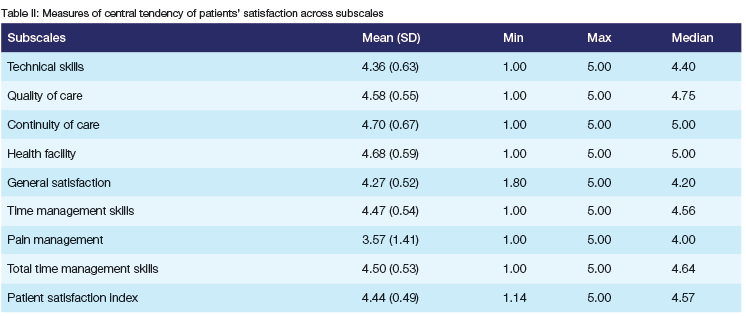
The highest satisfaction mean was achieved in the continuity of care (4.70), while the lowest mean score was noted in pain management (3.57). The total time management skills established a high mean (4.50) (Table II).
Analysis of the open-ended questions
One central theme arose from the analysis, followed by subsequent subthemes on patients' satisfaction with the time students took to render dental treatment efficiently within a clinical session of two hours.
Theme 1: The perceived impact of time taken during sessions
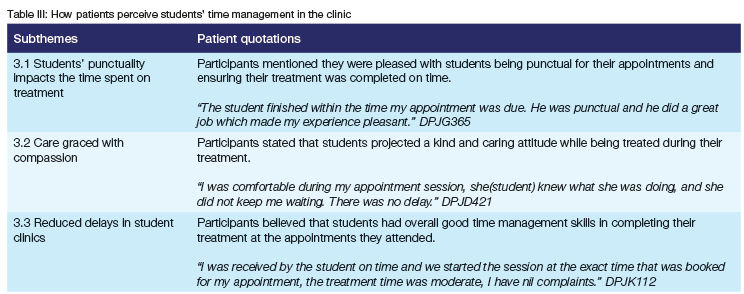
Participants expressed their satisfaction by relating their experiences to the time the students took to treat them during their clinical appointment sessions. They highlighted that those students displayed a standard of professionalism, respect and communication and valued their presence in providing dental care. Three subthemes are shown in Table III.
DISCUSSION
The present study examined patient satisfaction related to students' time management in undergraduate student-centred clinical training.
The study findings indicated that most patients (96.6%) agreed they were treated respectfully and with dignity during their clinical sessions. This implied that students professionally conducted themselves when working with patients. This finding is consistent with another report, in which dental students and interns treated 96.5% of participants from a polyclinic with respect.1718192011,14
More than half of the study sample (68.8%) strongly agreed that the students completed their treatment within the appointment session. This suggested that students efficiently provided dental care for their patients within the clinical session. This was supported by another study that found that 87% of patients were highly satisfied/ satisfied with the time taken to treat them.72122
Service-based learning can contribute to building students' clinical competency by gaining real-world experience.3,9 Through these experiences, students develop confidence in interacting with and treating patients to understand their dental needs better. As such, more than two-thirds of patients (74%) revealed that students understood their dental needs. This indicated that patients were satisfied with students' competence to devise a treatment plan that accommodated their needs.2419,23 One finding that stands out from the earlier results is that most patients (93.5%) agreed that the students were punctual for their appointment sessions. This finding is consistent with theme 3.1. These empirical findings infer that students' clinical time management performance is associated with them being punctual. This association underscores punctuality as one of the critical skills in time management required in clinical-based training. This was supported in another study that linked postgraduate students' punctuality to better time management skills. 25
Study strengths and limitations
This study used the Dental Satisfaction Questionnaire, a validated and reliable tool used mainly by international authors. In turn, the data obtained can be used to inform and initiate specific quality improvement projects to improve clinical training programmes. However, several limitations were noted in this study. The study focused on a single training site; thus, the findings are limited in generalisability. Patient demographics were not included in this study. Such data could have provided valuable insight into patient preferences based on sociodemographic profiling. The data was collected in the presence of students and could have introduced some bias based on providing socially desirable responses. The study did not include students' perspectives, including clinical supervisors.
CONCLUSION
Patients were satisfied with how students managed their time and conducted themselves in providing dental clinical care. The findings reported here shed new light on students' punctuality associated with their clinical time management performance. Patient feedback could add valuable insight into clinical training within the undergraduate programmes. It is recommended that dental training institutions consider punctuality as one indicator to evaluate time management skills in clinical assessment rubrics when assessing students' clinical competency. An allocation of time could be dedicated to the undergraduate dental curricula for patient feedback in clinical assessments to determine students' performance. The soft skills identified by participants, such as communication, respect, empathy, care and punctuality, apart from time management, should regularly be assessed to align with the skills and values defined in learning outcomes. This may lead to and strengthen patient-centred care within student-centred clinical training. The core competencies for all undergraduate clinical training programmes should be reviewed and, if necessary, include training in time management skills.
DECLARATIONEthical permission
(Anonymous version)
Funding
None.
Conflicts of interest
None.
Acknowledgements
In pursuit of this research study, the authors sincerely appreciate all participants, research assistants and stakeholders at the study site for their valuable contributions to this study.
REFERENCES
-
1. Marchan S, Coldero L, Smith WA. An evaluation of the relationship between clinical requirements and tests of competence in a competency-based curriculum in dentistry. BMC Medical Education 2023;23(585):1-5. https://doi.org/10.1186/s12909-023-04438-3
» https://doi.org/10.1186/s12909-023-04438-3 -
2. Chanthavisouk P, Ingleshwar A, Theis-Mahon N, Paulson DR. The oral health impact of dental hygiene and dental therapy populations: a systematic review. Journal of Evidence-Based Dental Practice 2024;24(1):101949-101949. https://doi.org/10.1016/.jebdp.2023.101949
» https://doi.org/10.1016/.jebdp.2023.101949 -
3. Pang L, Zhou Y Tao Y, et al. Correction: An experiential service-learning project on oral health examination and education. BMC Medical Education 2024;24(34):1-7. https://doi.org/10.1186/s12909-024-05112-y
» https://doi.org/10.1186/s12909-024-05112-y -
4. de Villiers M, van Schalkwyk S, Blitz J, et al. Decentralised training for medical students: a scoping review. BMC Medical Education 2017;17(196):1-13. https://doi.org/10.1186/s12909-017-1050-9
» https://doi.org/10.1186/s12909-017-1050-9 -
5. Adam RZ, Frantz JM, Maart RD. Dental educators' views and knowledge of competencies required within a competency framework. South African Dental Journal 2021;76(08):482-489. https://doi.org/10.17159/2519-0105/2021/v76no8a6
» https://doi.org/10.17159/2519-0105/2021/v76no8a6 -
6. Uoshima K, Akiba N, Nagasawa M. Technical skill training and assessment in dental education. Japanese Dental Science Review 2021;57:160-163. https://doi.org/10.1016/j.jdsr.2021.08.004
» https://doi.org/10.1016/j.jdsr.2021.08.004 -
7. Naidoo M, Brijlal P, Cader R, Gordon NA, Rayner CA, Viljoen K. Development of a competency-based clinical assessment instrument for exit level oral hygiene students at the University of Western Cape. BMC Oral Health 2022;22(452):1-10. https://doi.org/10.1186/s12903-022-02498-3
» https://doi.org/10.1186/s12903-022-02498-3 -
8. O'Brien BC, Reed DA. Exploring the intersections of education and healthcare delivery using a clinical learning environment framework. Journal of General Internal Medicine 2019;34(5):654-656. https://doi.org/10.1007/s11606-019-04929-4
» https://doi.org/10.1007/s11606-019-04929-4 -
9. Emrani M, Zohreh Khoshnood, Jamileh Farokhzadian, Sadeghi M. The effect of service-based learning on health education competencies of students in community health nursing internships. BMC Nursing 2024;23(138):1-8. https://doi.org/10.1186/s12912-024-01799-y
» https://doi.org/10.1186/s12912-024-01799-y -
10. Malau-Aduli BS. Patient involvement in assessment: How useful is it? Medical Education 2022;56(6):590-598. https://doi.org/10.1111/medu.14802
» https://doi.org/10.1111/medu.14802 -
11. Mohamed A, Abdullah D, Mohd Dom T. Soft skills of dental students' competence: what is important for patients and how do students fare? World Journal of Dentistry 2017;8(3):157-163. https://doi.org/10.5005/jp-journals-10015-1431
» https://doi.org/10.5005/jp-journals-10015-1431 -
12. Ghanem E, AlGhanem NA, AlFaraj ZS, et al. Patient satisfaction with dental services. Cureus 2023;15(11):1-9. https://doi.org/10.7759/cureus.49223
» https://doi.org/10.7759/cureus.49223 -
13. Leow HT, Liew SM. A cross-sectional study on patient satisfaction and its association with length of consultation at the University Malaya Medical Centre Primary Care Clinic. Malaysian Family Physician 2022;17(2):71-80. https://doi.org/10.51866/oa1339
» https://doi.org/10.51866/oa1339 -
14. Khajeghyasi RV, Liaghatdar MJ, Nili MR, Shirazi M. Ranking the soft skills of the dental profession based on the importance in job performance: A mixed method study in Isfahan and Mazandaran Universities of Medical Sciences. Dental Research Journal 2021;18(24):1-7. http://dx.doi.org/10.4103/1735-3327.313119
» http://dx.doi.org/10.4103/1735-3327.313119 - 15. Cochran WG. Sampling Techniques. John Wiley & Sons; 2007
-
16. Davies AR, Ware JE. Development of a dental satisfaction questionnaire for the Health insurance experiment [Internet]. RAND corporation; 1982. Available from: https://www.rand.org/pubs/reports/R2712.html
» https://www.rand.org/pubs/reports/R2712.html -
17. Balkaran R, Osoba T, Rafeek R. A Cross-sectional study of patients' satisfaction with dental care facilities: A survey of adult treatment at the University of the West Indies, School of Dentistry. The West Indian Medical Journal 2014;63(5):490-498. https://doi.org/10.7727/wimj.2013.197
» https://doi.org/10.7727/wimj.2013.197 -
18. Salim NA, Sallam M, Aldweik RH, Sawair F, Sharaireh AM, Alabed A. Rating communication skills in dental practice: the impact of different sociodemographic factors. BMC Medical Education 2023;23(1):1-13. https://doi.org/10.1186/s12909-023-04958-y
» https://doi.org/10.1186/s12909-023-04958-y -
19. Tripodi N, Cossar S, Davidson J, et al. Patient perceptions of allied health student communication and interpersonal skills: A cross-sectional study. Focus on health professional education: A Multi-Professional Journal 2021;22(3):18-32. https://doi.org/10.11157/fohpe.v22i3.454
» https://doi.org/10.11157/fohpe.v22i3.454 -
20. Demirdag S. Communication skills and time management as the predictors of student motivation. International Journal of Psychology and Educational Studies 2021;8(1):38-50. https://doi.org/10.17220/ijpes.2021.8.1.222
» https://doi.org/10.17220/ijpes.2021.8.1.222 -
21. Motloba PD, Ncube O, Makwakwa LN, Machete ML. Patient waiting time and satisfaction at a Tertiary Dental School. South African Dental Journal 2018;73(6):400-405. https://doi.org/10.17159/2519-0105/2018/v73no6a3
» https://doi.org/10.17159/2519-0105/2018/v73no6a3 -
22. Almutair A, Alroomy R, Almulhim B, et al. Patients' satisfaction regarding the dental treatment provided by educational dental school in Majmaah University. Pakistan Journal of Medical and Health Sciences 2021;15(9):3004-3008. https://doi.org/10.53350/pjmhs211593004
» https://doi.org/10.53350/pjmhs211593004 -
23. Kristensen CB, Asimakopoulou K, Scambler S. Enhancing patient-centred care in dentistry: A narrative review. British Medical Bulletin 2023;148(1): 79-88. https://doi.org/10.1093/bmb/ldad026
» https://doi.org/10.1093/bmb/ldad026 -
24. Ahmedani MS. Patients' satisfaction with dental treatment provided by undergraduate students of The College of Dentistry. Journal of Dental Reports 2022;3(1):1-11. https://doi.org/10.37191/mapsci-jdr-3(1)-019
» https://doi.org/10.37191/mapsci-jdr-3(1)-019 -
25. Gillani S, Sajjad T, Tayab F, Rao M, Rao M, Shams F. Impact of punctuality and regularity on learning behaviors and clinical skills in post-graduate residents at Nishtar hospital Multan. Biological and Clinical Sciences Research Journal 2024;2024(1):736-736. https://doi.org/10.54112/bcsrj.v2024i1.736
» https://doi.org/10.54112/bcsrj.v2024i1.736 - 26. College Handbook. KwaZulu-Natal. Identifled academic institution; 2023

Author's contribution
1. Dr Ashveer Gopie (60%)
2. Prof Shenuka Singh (40%)