Comparative evaluation of shear bond strength to dentin with three different aesthetic chemically bonded restorative materials - an In-vitro study
Abstract
INTRODUCTION: The use of glass ionomer cements (GIC) as a restorative material was limited to areas of low masticatory forces due to their low mechanical properties which were also affected by the powder/liquid mixing ratio of this material. Bond strength is important for the clinical success of adhesive material. The shear bond strength (SBS) is the maximum force that an adhesive joint can tolerate before fracture which is tested by SBS tests. The high bond strength helps the adhesive to resist stresses caused by resin contraction and forces for a longer time and thus prevents the problems of bond failure such as recurrent caries, tooth sensitivity and restoration failure. GIC as a restorative material has the capacity to release fluoride and shows good bonding ability. The use of GIC in anterior applications appears to be satisfactory, but they have limitations for use in permanent posterior teeth, particularly with regard to large restorations. Zirconia-reinforced GI (Zirconomer, Shofu Inc, Japan) is a new class of restorative material containing reinforced glass ionomer with special zirconia fillers that promises the strength and durability of amalgam with the protective benefits of glass ionomer while eliminating the hazards of mercury. Amalgomer CR (Advanced Health Care, Tonbridge, Kent, UK), a novel ceramic-reinforced GIC, was introduced, which combines the benefits of GIC with the high strength of ceramics. In the present study, shear bond strength to the dentin with Zirconomer, Amalgomer CR and Fuji type IX GIC (GC Tokyo) are compared. AIM: To evaluate the shear bond strength of three different aesthetic materials to dentin. METHODOLOGY: Thirty extracted human molar teeth were taken, cleaned, stored and the occlusal surfaces of the teeth were flattened with a straight fissured bur at a depth of three millimetres until dentin was exposed. Acrylic blocks were prepared by cold cure acrylic resin and the samples were embedded into the blocks and conditioning of dentin was done using dentin conditioner (GC Corporation Tokyo, Japan). Out of 30 dentin-exposed samples, 10 samples were restored with Zirconomer, the other 10 with Amalgomer CR and the remaining 10 with GIC respectively. All the specimens were transferred to the universal testing machine individually and subjected to shear bond strength analysis. RESULT: Statistical analysis was done for all three groups by using descriptive statistics that include one-way ANOVA and Tukey's multiple post hoc procedures for intergroup comparison. CONCLUSION: Zirconomer showed better shear bond strength than Amalgomer CR and GIC
Zirconomer; Amalgomer CR; glass ionomer cement; shear bond strength
INTRODUCTION
The most common cause of tooth loss is dental caries which impairs the structure and function of the particular tooth.1 2 3
Bond strength is one of the most important mechanical properties of a restorative material which restores the tooth structure in the posterior region.45789101112
Recently, a novel material called zirconia-reinforced glass ionomer cement was introduced which is also called "white amalgam" or "Zirconomer" and contains zirconium oxide, glass powder, tartaric acid (1-10%), polyacrylic acid (20-50%) and deionised water as its liquid.131415 16 17
There are many in vitro studies and clinical trials conducted on the compressive and flexural strength of these materials but very few studies were done on shear bond strength. So, in the present study, the shear bond strength of dentin with Zirconomer (Shofu, Japan), Amalgomer CR and glass ionomer cements (GC Corp)
MATERIALS AND METHODS
Sample collection
Inclusion criteria
Thirty caries-free upper and lower permanent human molars that were extracted for periodontal reasons were collected, cleaned and then stored in distilled water until used for the study.
Exclusion criteria
Teeth with previous restorations, visible cracks, decay, fracture, abrasion or structural deformities.
Sample preparation
Teeth were mounted on self-cure acrylic blocks by using metal molds to embed the root portion and to expose the crown portion only. Then 3mm of the coronal tooth structure was removed using a diamond abrasive to expose the occlusal dentine. (Figure 1a). Teeth were randomly divided into three groups of 10 specimens each and restored as follows: Group 1: Zirconomer (Zirconomer improved-Zirconia reinforced glass ionomer cement, Shofu, Japan) (n=10), Group 2: Amalgomer CR (n=10) and Group 3: Glass Ionomer Cement (GC Corporation, Tokyo, Japan) (n=10). Conditioning of dentin was done to all the samples using a dentin conditioner (GC Corporation Tokyo, Japan) that contained 10% polyacrylic acid for 10 seconds. The surface was rinsed thoroughly with water and then blotted with a cotton pellet to remove excess water. Powder and liquid were hand mixed until putty-like consistency in a ratio of 1:1 according to the manufacturer's instructions (Figure 1b,c)18 2Figure 1d).19
Experimental procedure
A universal testing machine was used to evaluate the shear bond strength, whereby the crosshead speed was 0.5mm/minute1Figure 1e).
RESULTS
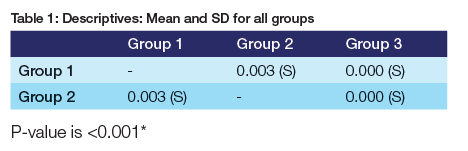
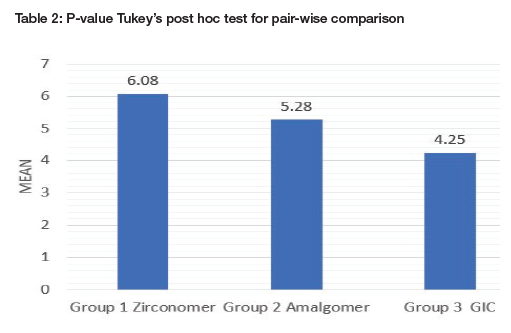
Data were analysed using SPSS Version 20.0 with descriptive statistics that include one-way ANOVA and Tukey's multiple post hoc procedures for intergroup comparison. Statistical analysis was done for evaluating the bond strength. Table 1 shows the mean and standard deviation of shear bond strength values of different experimental groups. Group 1 showed the highest shear bond strength followed by Groups 2 and 3 (Graph 1). In Table 2, the shear bond strength of Zirconomer to dentin showed a statistically significant difference with Amalgomer CR and GIC (p<0.001).
DISCUSSION
In the oral cavity, restorations undergo stress from masticatory forces producing different reactions that lead to deformation, which can ultimately compromise their durability over time.2021
Among various mechanical properties, the bond strength of restorative materials is important because it usually replaces a large bulk of tooth structure and should give enough strength to resist the intraoral masticatory forces.22
The clinical success of restorative materials depends on good adhesion with tooth surfaces and resistance to various dislodging forces acting within the oral cavity.2324192526
In the present study, Zirconomer showed better SBS than Amalgomer CR and GIC. Zirconomer possibly exhibited superior bond strength as the powder has various grain sizes and other ingredients such as yttrium oxide and alumina that are evenly dispersed throughout the substance. The material's porosity and translucency are influenced by the different grain sizes. This is in correspondence with the study done by Chalissery ef al.14 272829
In the present study, Amalgomer CR showed better SBS than GIC but less SBS than Zirconomer. According to S Srinivasa Murthy et al. ,3031
GIC showed less SBS than Zirconomer and Amalgomer CR because of its inferior mechanical properties such as low fracture toughness, tensile strength and brittleness when compared to other restorative materials and so it is better to avoid GIC in stress-bearing areas.232632183334
CONCLUSION
• Within the limitations of the in vitro study, all groups showed good shear bond strength with dentin.
• So, in comparison: Group 1 - Zirconomer showed the highest SBS followed by Group 2 - Amalgomer CR, and then with the least SBS is Group 3 - GIC.
Conflict of interest
None
ACKNOWLEDGMENTS
REFERENCES
-
1. Yu OY Lam WY-H, Wong AW-Y, Duangthip D, Chu C-H. Nonrestorative Management of Dental Caries. Dent. J.2021, 9, 121. https://doi.org/10.3390/dj9100121dentalcaries-ref -1
» https://doi.org/10.3390/dj9100121dentalcaries-ref -1 -
2. Bassir MM, Labibzadeh A, Mollaverdi F. The effect of amount of lost tooth structure and restorative technique on fracture resistance of endodontically treated premolars. J Conserv Dent. 2013 Sep;16(5):413-7. doi: 10.4103/0972-0707.117494
» https://doi.org/10.4103/0972-0707.117494 -
3. Sujith R, Yadav TG, Pitalia D, Babaji P, Apoorva K, Sharma A. Comparative Evaluation Of Mechanical And Microleakage Properties Of Cention-N, Composite, and Glass onomer Cement Restorative Materials. J Contemp Dent Pract. 2020;21:691-5. 10.5005/jp-journals-10024-2837
» https://doi.org/10.5005/jp-journals-10024-2837 -
4. Kim M, Jo D-W, Khalifah SA, Yu B, Hayashi M, Kim RH. Shear Bond Strength of Composite Diluted with Composite-Handling Agents on Dentin and Enamel. Polymers 2022, 14, 2665. https://doi.org/10.3390/polym14132665ref -4
» https://doi.org/10.3390/polym14132665ref -4 -
5. Tsujimoto A, Barkmeier WW, Fischer NG, Nojiri K, Nagura Y, Takamizawa T, Latta MA, Miazaki M. Wear Of Resin Composites: Current Insights Into Underlying Mechanisms, Evaluation Methods And Influential Factors. Jpn Dent Sci Rev. 2018;54:76-87. 10.1016/j.jdsr.2017.11.002
» https://doi.org/10.1016/j.jdsr.2017.11.002 -
6. Mazumdar P, Das A, Mandal D. Comparative Evaluation Of Bond Strength Of Composite Resin & Cention N to Enamel And Dentin With And Without Etching Under Universal Testing Machine. University J Dent Scie. 2018;4:1-6. https://old.amu.ac.in/pdf/dentjour/COMPARATIVE%20EVALUATION%20OF%20BOND.pdf
» https://old.amu.ac.in/pdf/dentjour/COMPARATIVE%20EVALUATION%20OF%20BOND.pdf -
7. Sikri VK. Color: Implications in dentistry. J Conserv Dent. 2010 Oct;13(4):249-55. doi: 10.4103/0972-0707.73381
» https://doi.org/10.4103/0972-0707.73381 -
8. Almuhaiza M. Glass-ionomer Cements in Restorative Dentistry: A Critical Appraisal. J Contemp Dent Pract. 2016 Apr 1;17(4):331-6. doi: 10.5005/jp-journals-10024-1850
» https://doi.org/10.5005/jp-journals-10024-1850 -
9. Bowen RL, Marjenhoff WA. Dental composites/glass ionomers: the materials. Adv Dent Res. 1992 Sep;6:44-9. 10.1177/08959374920060011601
» https://doi.org/10.1177/08959374920060011601 -
10. Hervás-García A, Martínez-Lozano MA, Cabanes-Vila J, Barjau-Escribano A, Fos-Galve P. Composite resins. A review of the materials and clinical indications. Med Oral Patol Oral Cir Bucal. 2006 Mar 1;11(2):E215-20. https://scielo.isciii.es/pdf/medicorpa/v11n2/en_23.pdf
» https://scielo.isciii.es/pdf/medicorpa/v11n2/en_23.pdf -
11. Ramasetty PA, Bhat KY Prasanna MK. (2014). Comparative evaluation of remineralization, fluoride release and physical properties of conventional GIC following incorporation of 1% and 2% zinc acetate: An in vitro study. International Journal of Oral Health Sciences. 2014:4(1). 10.4103/2231-6027.151613
» https://doi.org/10.4103/2231-6027.151613 -
12. Eligeti T, Dola B, Kamishetty S, Gaddala N, Swetha A, Bandari J. Comparative Evaluation of Shear Bond Strength of Cention N with Other Aesthetic Restorative Materials to Dentin: An in Vitro Study. Annals of the Romanian Society for Cell Biology. 2021;25(6):12707-14. https://annalsofrscb.ro/index.php/journal/article/view/7993
» https://annalsofrscb.ro/index.php/journal/article/view/7993 -
13. Kumari A, Singh N. A comparative evaluation of microleakage and dentin shear bond strength of three restorative materials. Biomater Investig Dent. 2022 Feb 10;9(1):1-9. doi: 10.1080/26415275.2022.2033623
» https://doi.org/10.1080/26415275.2022.2033623 -
14. Chalissery VP, Marwah N, Almuhaiza M, AlZailai AM, Chalisserry EP, Bhandi SH, Anil S. Study of the Mechanical Properties of the Novel Zirconia-reinforced Glass lonomer Cement. J Contemp Dent Pract. 2016;17(5):394-8. 10.5005/jp- journals-10024-1861
» https://doi.org/10.5005/jp- journals-10024-1861 - 15. Neveen M Ayad, Salwa A Elnogoly, Osama M Badie. An In-Vitro Study Of The Physico-Mechanical Properties Of A New Esthetic Restorative Versus Dental Amalgam. Rev. Clin. Pesq. Odontol. Curitiba. 2008; 4(3):137-44. 234076666_ An_In-Vitro_Study_of_the_PhysicoMechanical_Properties_of_a_New_Esthetic_Restorative_Versus_Dental_Amalgam
-
16. Prasada K, Vidhyadhara HT. Comparative Evaluation Of Sorption And Solubility Of Amalgomer Cr And Cention N Restorative Material - An In Vitro Study. International Journal Of Dentistry Research. 2020;5:122-5. 10.5005/jp-journals-10005-1407
» https://doi.org/10.5005/jp-journals-10005-1407 -
17. Kishor Sapkale K, Rucha Sane R, Bashir Ahmed SA. Comparative Evaluation of Dentin Bond Strength of Zirconomer, Conventional Glass Ionomer Cement, and Resin - Modified Glass Ionomer Cement - An in Vitro Study. International Journal of Science and Research. 2020;9(1):954-9. https://www.ijsr.net/archive/v9i1/ART20204186.pdf
» https://www.ijsr.net/archive/v9i1/ART20204186.pdf - 18. Nanavati K, Katge F, Krishna Chimata V, Pradhan D, Kamble A, Patil D. Comparative Evaluation of Shear Bond Strength of Bioactive Restorative Material, Zirconia Reinforced Glass Ionomer Cement and Conventional Glass Ionomer Cement to the Dentinal Surface of Primary Molars: an in vitro Study. J Dent Shiraz Univ Med Sci. December 2021; 22(4): 260-6
-
19. Naz F, et al. Comparative evaluation of mechanical and physical properties of a new bulk-fill alkasite with conventional restorative materials. Saudi Dental Journal (2020), https://doi.org/10.1016/j.sdentj.2020.04.01
» ), https://doi.org/10.1016/j.sdentj.2020.04.01 -
20. Riad MI, Badr SB, Ibrahim MA. Bond Performance of ceramic-modified Glass ionomer restorative. E.D.J. 2011;57:1-9. https://www.researchgate.net/publication/335631837_Bond_Performance_of_ceramic-modified_Glass_ionomer_restorative
» https://www.researchgate.net/publication/335631837_Bond_Performance_of_ceramic-modified_Glass_ionomer_restorative -
21. Iftikhar N, Devashish, Srivastava B, Gupta N, Ghambir N, Rashi-Singh. A Comparative Evaluation of Mechanical Properties of Four Different Restorative Materials: An In Vitro Study. Int J Clin Pediatr Dent. 2019;12(1):47-49. doi: 10.5005/ jp-journals-10005-1592
» https://doi.org/10.5005/ jp-journals-10005-1592 -
22. Patel MU, Punia SK, Bhat S, Singh G, Bhargava R, Goyal P, Oza S, Raiyani CM. An in vitro Evaluation of Microleakage of Posterior Teeth Restored with Amalgam, Composite and Zirconomer - A Stereomicroscopic Study. J Clin Diagn Res. 2015; 9: 65-7. 10.7860/JCDR/2015/13024.6225
» https://doi.org/10.7860/JCDR/2015/13024.6225 -
23. Somani R, Jaidka S, Singh DJ, Sibal GK. Comparative Evaluation of Shear Bond Strength of Various Glass Ionomer Cements to Dentin of Primary Teeth: An in vitro Study. Int J Clin Pediatr Dent. 2016 Jul-Sep;9(3):192-6. 10.5005/jp-journals-10005-1362
» https://doi.org/10.5005/jp-journals-10005-1362 - 24. Balagopal S, Nekkanti S, Kaur K. An In Vitro Evaluation of the Mechanical Properties and Fluoride-releasing Ability of a New Self-cure Filling Material. J Contemp Dent Pract. 2021 Feb 1;22(2):134-139
-
25. Sharma C, Kaur H, Aggarwal M, Jakhu S. Comparative Evaluation of Shear Bond Strength of Glass Ionomer Cement, Composite and Compomer in Primary Teeth: An In Vitro Study. 2023. ISSN:2753-9172 https://doi.org/10.58624/SVOADE.2023.04.0127
» https://doi.org/10.58624/SVOADE.2023.04.0127 -
26. Bhattacharya P, Naidu J, Tambakad PB. Comparative Evaluation Of Shear Bond Strength And Flexural Strength Of New Zirconia Reinforced Glass Ionomer Cement With Commonly Used Glass Ionomer Cements Used In Atraumatic Restorative Treatment: An In Vitro Study. J Oper Dent Endod. 2018;3:83-91. 10.5005/jp- journals-10047-0062
» https://doi.org/10.5005/jp- journals-10047-0062 -
27. Gu YW, Yap AUJ, Cheang P, Koh YL, Khor KA. Development of zirconia-glass ionomer cement composites. Journal of Non-Crystalline Solids. 2005;351(6-7):508-14. 10.1016/j.jnoncrysol.2005.01.045
» https://doi.org/10.1016/j.jnoncrysol.2005.01.045 -
28. Kawai Y, Uo M, Wang Y, Kono S, Ohnuki S, Watari F. Phase transformation of zirconia ceramics by hydrothermal degradation. Dent Mater J. 2011;30(3):286-92. doi: 10.4012/dmj.2010-175
» https://doi.org/10.4012/dmj.2010-175 -
29. Bhattacharya A, Vaidya S, Tomer AK, Raina AA. GIC at its best - A review on ceramic reinforced GIC. International Journal of Applied Dental Sciences. 2017; 3(4): 405408. https://www.oraljournal.com/pdf/2017/vol3issue4/PartF/3-4-59-261.pdf
» https://www.oraljournal.com/pdf/2017/vol3issue4/PartF/3-4-59-261.pdf -
30. Murthy SS, Murthy GS. Comparative Evaluation of Shear Bond Strength of Three Commercially Available Glass Ionomer Cements in Primary Teeth. J Int Oral Health. 2015;7(8):103-7. https://www.semanticscholar.org/paper/Comparative-Evaluation-of-Shear-Bond-Strength-of-in-Murthy-Murthy/79e5ae056bc95a4b1240159a537c2085a13460ec
» https://www.semanticscholar.org/paper/Comparative-Evaluation-of-Shear-Bond-Strength-of-in-Murthy-Murthy/79e5ae056bc95a4b1240159a537c2085a13460ec -
31. Swift EJ Jr. Effects of glass ionomers on recurrent caries. Oper Dent. 1989 Winter;14(1):40-3. https://pubmed.ncbi.nlm.nih.gov/2697861/
» https://pubmed.ncbi.nlm.nih.gov/2697861/ -
32. Berg JH. Glass ionomer cements. Pediatr Dent. 2002 Sep-Oct;24(5):430-8. https://www.aapd.org/globalassets/media/publications/archives/berg5-02.pdf
» https://www.aapd.org/globalassets/media/publications/archives/berg5-02.pdf -
33. Abdallah R, Abdelghany AM, Aref, N. "Does Modification of Amalgomer with Propolis Alter Its Physicomechanical Properties? An In Vitro Study", International Journal of Biomaterials, 2020, Article ID 3180879, 10 pages, 2020. https://www.hindawi.com/journals/ijbm/2020/3180879/
» https://www.hindawi.com/journals/ijbm/2020/3180879/ -
34. Gautam E, Somani R, Jaidka S, Hussain S. A comparative evaluation of compressive strength and antimicrobial efficacy of Fuji IX and Amalgomer CR: An in vitro study. J Oral Biol Craniofac Res. 2020;10(2):118-21. 10.1016/j.jobcr.2020.03.001
» https://doi.org/10.1016/j.jobcr.2020.03.001

Source(s) of support
None
Presentation at a meeting
None