Comparison between immediate and conventional implant loading for fixed and removable prosthesis: A Scoping review
Abstract
A comparison between immediate and early, versus conventional dental implant loading was explored for this scoping review. Identifying whether one loading protocol is superior to the other or if one offers more success with treatment and patient satisfaction can guide clinicians with choice of implant loading system. METHOD: An adapted version of the Arksey and O'Malley six step framework for scoping reviews was followed, and which includes identifying the research question, identifying the relevant studies, study selection, charting the data, collating, summarizing, and reporting the results and consultation. A literature search was conducted with refined eligibility criteria using scientific electronic databases such as PubMed, Springer, Cochraine library, Elsevier, Wiley, and Academia for the period ranging from 2002-2024. Data was synthesized, analyzed and narratively reported in themes. RESULTS: From the total number of records identified (N=190), only 35 full text articles were included for the qualitative synthesis. Factors such as survival and success rates of implants, marginal bone loss, esthetics and patient satisfaction are similar and comparable for immediate, early and conventional dental implant loading systems. The success with using these loading systems is dependent mainly on primary stability, implant stability quotient and the insertion torque value. CONCLUSION: This review provided evidence that immediate, early and conventional dental loading may be used as successful treatment options irrespective of whether a fixed or removable prostheses is placed.
immediate loading; early laoding; conventional loading; primary stability; implant success
INTRODUCTION
Edentulism poses an impact on oral and general health as well as quality of life as well, affecting not only mastication but affects the patient psychologically and socially.12-3 This is due to implants offering patients a better sense of confidence and quality of life, being a more predictable procedure with a higher success rate and relatively less complications compared to removable dentures.2
Researchers have identified many factors that are indicative of the successful performance of dental implants, one of which is biocompatibility.4-5 It does not only involve the compatibility of the material with the tissue but also the ability to perform a specific function meaning that biocompatibility is not only depedant on the physical, chemical and mechanical properties of the material but the application of the material as well. The biocomptibilty of the materials in dental implants is assessed by the interactions between the implant and the tissue and is used as a measure for osseointegration.
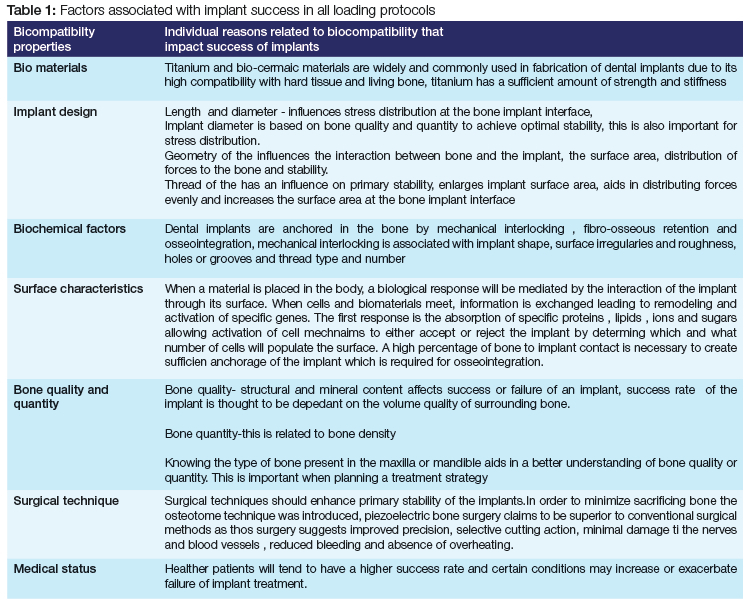
The other factors associated with implant success in all loading protocols identified in the literature include biomaterial composition, implant design, biochemical factors, surface characteristics and bone quantity and quality, surgical technique and the medical status of the patient which is described below in Table 1.4-5
Three different types of surgical implant loading systems used and described include:
i. Immediate loading (IL): designated as the process whereby a prosthesis is attached to the implant within 24 hours and it is a one stage surgical procedure,6-8
ii) Early loading (EL): referred to as the loading time when a prosthesis is attached within the 1 week and 2 months after implant placement,9-10 and
iii) Conventional or Delayed loading (CL or DL): which differs from both immediate and early loading as the prosthesis is only attached after a healing period of 3-6 months.6, 11
Patients view conventional loading as a disadvantage as treatment time is extended and patient discomfort is prolonged. Conventional loading is indictated dependent on the quality and quantity of bone, the number of implants required, the length of the implant and insertion value as this affects primary stability which is a measure of implant successit is also based on what the clinican decides is the best treatment strategy. It is a two-stage technique and the rationale for conventional loading is to ensure that the implant remains in an undisturbed environment throughout the healing phase.12
The structural and functional connection between the implant and bone, once loaded, is a measure of osseointegration.513
Stability of implants are addressed on 3 different levels:
Primary stability, which is dependent on mechanical engagement with compact bone is a key factor in the success when using the IL system,
Secondary stability offers biological stability through bone regeneration and remodeling and,
Tertiary stability is discussed as the maintenance of osseointegration.11, 14
Prosthetic factors for implant success are dependent on osseointegrated dental implants providing a stable base for restoration of function and esthetics in completely edentulous patients.15
Implant stability may be quantified which makes determining this oucome measurable. The insertion torque value (ITV) of implants, the resonance frequency analysis (RFA), and implant stability quotient (ISQ) measures different aspects of stability. ISQ measures the axial stability and ITV measures rotational stability of implants, and together these factors aid a better understanding of primary stability.16
Implant success rate ranges between 92-98% and implant loss ranges between 1-10% (56,57,58) but it is important to be aware of the types of complications which may occur with treatment and how the different forms of treatment or loading systems impact on this. Implant treatments, irrespective of which loading systems are used, are expensive procedures. Thus, failure of these can be very disheartening for the patient. Practitioners must therefore ensure patients are offered the treatment procedures with the best outcomes for placing implants. Therefore, the aim of this scoping review (ScR) was to compare immediate and early with conventional dental implant loading when a fixed or removable prosthesis is placed to assess which implant system is superior to the other independent on the occlusal scheme.
METHODOLOGY
This ScR was conducted using the adapted version of the Arksey and O'Malley six step framework which includes identifying the research question, searching for relevant studies, selecting the studies, charting the data, collating, summarizing, and reporting the results and consultation.17
Identification of the research question
The research question for this scoping review was as follows:
How do the procedures of immediate and early compare with conventional dental implant loading that is used on adults requiring implants for fixed or removable prostheses?
This question was formulated using the following guidelines:18
Population (P)- refers to the adult patient requiring implants,
Concept (C)- the dental implant loading protocol (immediate and early vs conventional) and
Context (C)- implants placed in the maxillary and/ or the mandibular arches globally.
The outcomes for the ScR were divided into:
primary which compares immediate and early to conventional dental implant loading
secondary which investigates implant stability, bone quality and quantity, marginal bone loss, clinical parameters, and patient satisfaction.
Identifying the relevant studies
A search strategy was developed and used in the following online databases PubMed, Elsievier , Springer, Wiley, Cochrane library and Academia. Keyword combinations and synonyms using Boolean operators were used to develop the following broad search strategy:
(Conventional implant loading OR delayed implant loading) AND (early implant loading) AND (immediate implant loading) AND (removable prostheses OR dentures) AND (fixed dental prothesis OR single crowns OR bridges) AND (marginal bone loss OR esthetics OR patient satisfaction OR bone quality OR bone quantity) AND (2002- June 2024 ).
Study selection
A 3-step screening process was utilized where titles and abstracts were initially screened independently by the two reviewers (CP and SK) and the relevant articles identified and included for full review. Mendeley, a reference management application system, was used for these steps: relevant articles were exported from databases and saved. Then, following the necessary steps, duplicates were eliminated via Mendeley, and abstracts and full text articles reviewed for inclusion.
With reference to the inclusion/ exclusion criteria set for this ScR, articles published in English during the period 2002-2024 and with different study designs (randomized or non-randomized controlled trials, surveys or observational studies) were considered. In addition, adult patients receiving a fixed or removable prosthesis with implants were included. All animal studies were excluded from this scoping review.
Charting the data
The principal researcher charted the data following the inclusion criteria from the included articles and based it on the source (authors, country, date published), methods (sample size, study designs), study details (number of implants, implant system, location of the implant, implant length type of fixed/ removable prosthesis), participant information, study outcomes, conclusion and limitations.
Collating, summarizing, and reporting the result
Themes, identified from the literature were created and results of the ScR synthesized accordingly and the outcomes were narratively reported.
Results
Ethics approval was obtained from the institutional ethics board, where it was considered as a low risk study (BMREC No: BM20/1/6).
Demographics of included publications
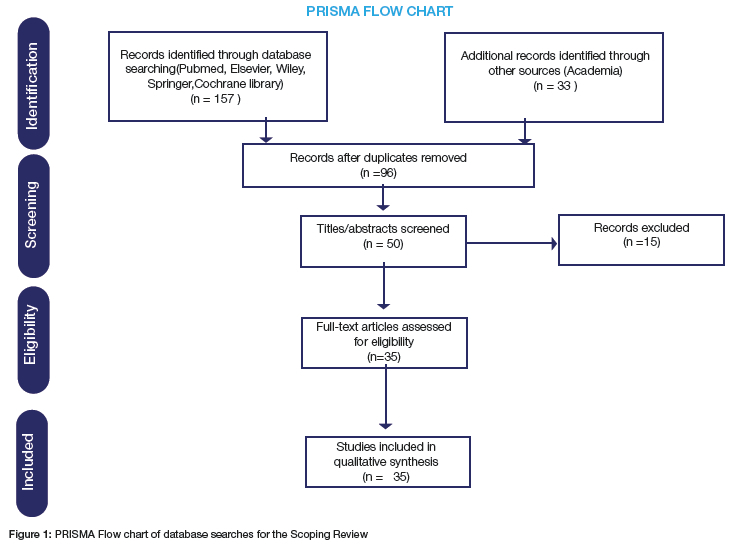
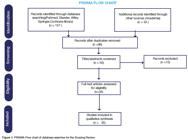
The databases search identified 118 pubmed, 15 Elsievier, 16 Wiley, 7 Springer , 33 Academia and 1 from the Cochrane library which resulted in190 records. Once duplications (N=94) were eliminated using Mendeley, the remaining 96 records' titles and abstracts were screened further using criteria set for inclusion. After elimination of the studies that did not meet the inclusion criteria, only 35 full-text records were identified as eligible for this ScR (Figure 1).
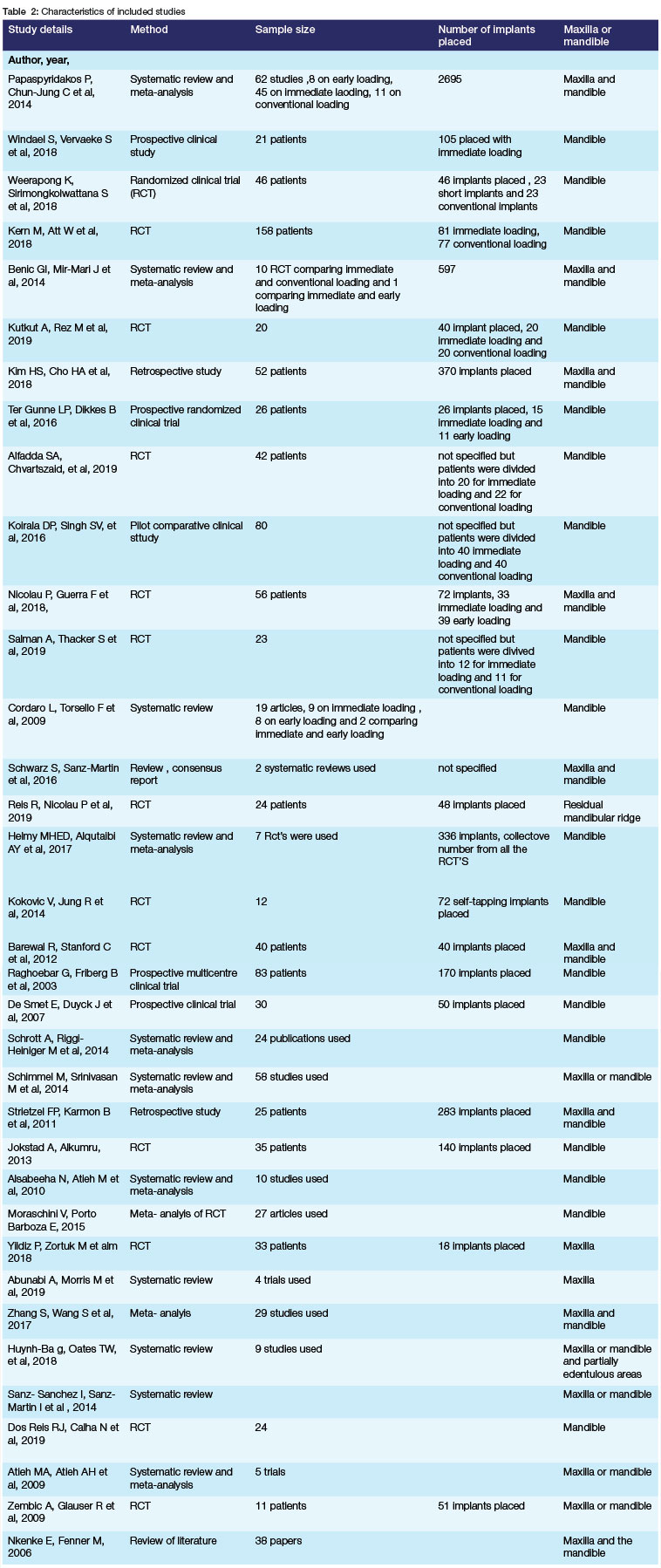
Characteristics of Included studies (Table 2)
Studies investigating the success and comparability of the different implant loading systems were conducted in different parts of the world as seen with all included studies. All included studies are tabulated in Table 2. Most studies (N=27) were completed in 1st world countries where implants are placed more often, and only one study was conducted in Africa.199, 14, 16, 20-37
Others were secondary studies, such as systematic reviews (SR) (N=7),1,10, 19, 38-41 and 3 were SRs with a meta-analysis,42-44 1 had completed a meta-analysis only,4546-47
The sample sizes varied per study in terms of number of patients, number of implants placed per jaw and number of jaws that were included in the study. Only 2 studies investigated placement of implants in the maxilla, and a few where implants were placed in both the mandible and maxilla (N=13).10,16,25,29,33-34,37,40-42,44-45,47 The majority (N=20) of records, however, discussed implants placed in the mandible only.9,14,19,20-24,27-28,30-32,35-36,38-39,43,46
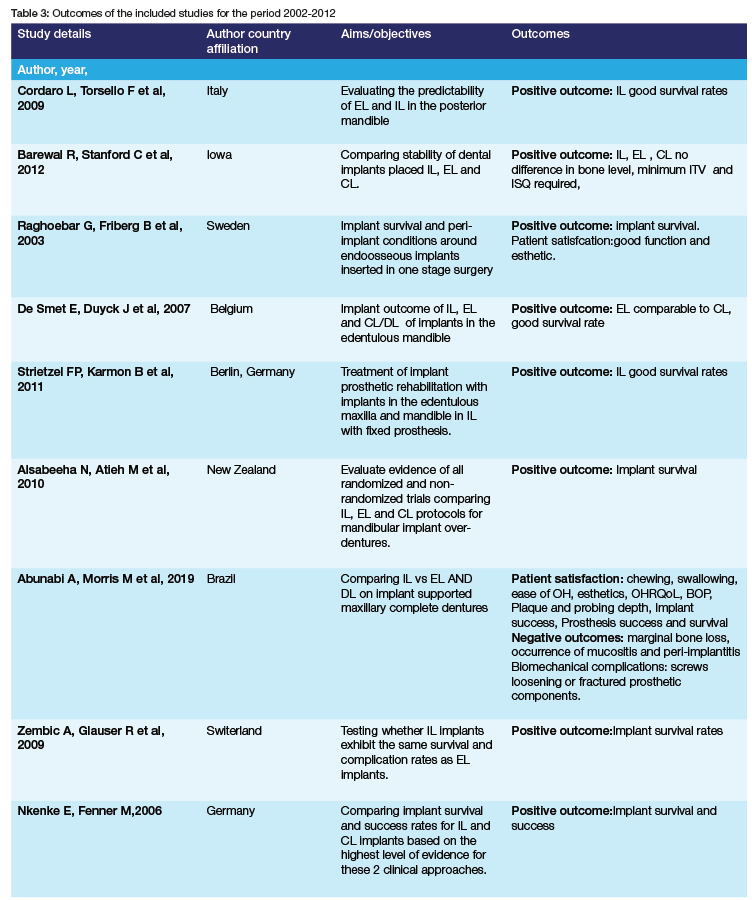
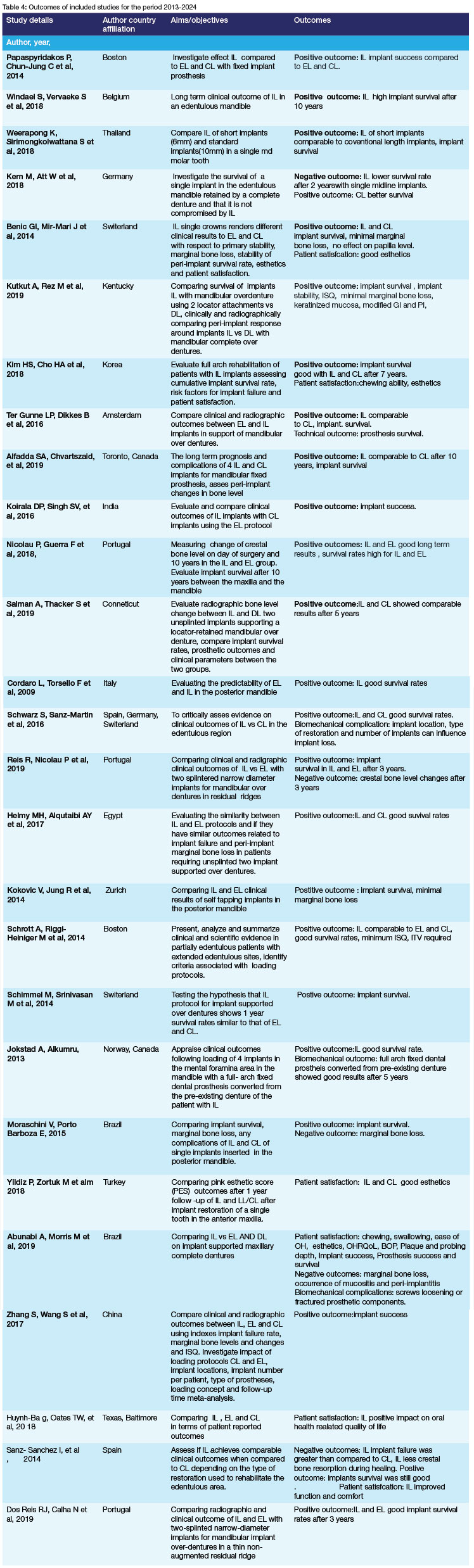
Outcomes of Included studies (Tables 3 and 4)
The outcomes are presented in themes which were decided based on information deemed most relevant to the subject at hand. These themes focused on all 3 dental loading protocols and factors contributing to implant success (implant stability, bone quality and quantity, marginal bone loss), patient satisfaction and esthetic outcomes. Results are tabulated into two decades (Tables 3 and 4). Table three includes outcomes from 2002- 2012 and table four includes outcomes from 2013-2024.
1. Dental loading protocols and implant success
The articles (N=35) included for this ScR compared IL to CL/ DL, EL to CL/ DL and all three (IL, EL, CL) loading protocols to understand what factors contributes to the success of implants placement and the method used to do this. A systematic review conducted by Abdunabi et al, 2019 compared IL to EL and CL on an implanted supported maxillary complete denture.1
Results from 2 different RCTs with a follow-up period of 10 years, indicated similar results as the study by Abdunabi et al (2019). The 1st RCT compared IL to CL of a mandibular implant supported fixed prosthesis and reported no differences between these 2 implant loading protocols.22
A 3-year follow-up study conducted by Ter Gunne et al (2018) compared clinical as well as radiographic outcomes between IL and CL implants in the support of a mandibular overdenture.99
Cordaro et al. conducted a systematic review evaluating the predictability of immediate loading (IL) and early loading (EL) protocols in the posterior mandible. The findings support the use of IL and EL protocols with microroughened dental implants in partially edentulous posterior mandibles, provided that modifying risk factors are absent. Clinical outcomes suggest that both protocols are viable within a 6-8 week healing period and can be applied successfully in most posterior mandibular cases, whether for single crowns or fixed dental prostheses. The review further reported no significant changes in peri-implant bone levels, indicating predictable stability of the peri-implant environment when these protocols are followed [46].
2. Clinical factors contributing to implant success
Factors contributing to implant success included primary stability, insertion torque, marginal bone loss, the number of implants inserted and the arch location of the implants.
An implant stability quotient (ISQ) clinically ranging between 55-80 is an indication of implant stability.23,49-50 A study conducted by Kim et al, 2018 evaluated cumulative survival rate (CSR) looking at risk factors for implant survival and patient satisfaction.333333
It was also identified that the ITV had to be within the range of 20-35Ncm for initial primary stability, to allow a stable platform for a prosthesis whether fixed or removable.21-22,35 This ITV and RFA gives a clinical, non-invasive measurement of implant and bone stiffness.16,48
In terms of marginal bone loss, included studies indicated that although there is a minor discrepancy there is no statistically significant difference between IL and CL implant systems.1,32,39 Mean marginal bone loss after 3 years was found to be 0.22mm, whilst the mean ITV at implant placement differed according to the bone type:
Type 1 bone is when bone is homogenous with very thick cortical bone and
Type 2 bone has a thick layer of cortical bone that surrounds a core of dense trabeculae bone and the ITV for both these types were 32Ncm,
Type 3 bone is described as having a thin layer of cortical bone with dense trabeulaue bone and has good strength its ITV is recorded as 17Ncm which is half the previous types whilst,
Type 4 bone has very thin corticol bone with low-density trabecular bone and is of poor strength with the lowest ITV at 10Ncm.16
This showed a significant difference in bone loss and that ITV is a good objective measure for bone type. The ITV for bone types 1 and 2 fit well within the recommended range and thus meet the standard required. Ideally, however, these bone types should also have a RFA of 60 before an implant is recommended to be placed.1,16,32,39 The initial high ITV preferred was >35Ncm and an ISQ value of > 60 before considering an implant for IL to EL protocols.1,16,32,39 It was also found that an ITV of 20 Ncm may be an important threshold determinant in IL of single tooth implants in the posterior region.16
3. Patient satisfaction and esthetics
The parameters used to asses patient satisfaction was comfort, esthetics, functionality and the ability to taste. A study by (Kim et al, 2018) evaluated implant success and patient satisfaction of IL systems in completely edentulous arches.33331,40 IL and immediate placement in a single tooth edentulous space seems to have a positive impact and these studies concluded that protocol selection is based on what the patients' preference is as well as the practitioner's skills.12533
Yildez, P et al, (2018) evaluated patient esthetics after 1 year with a small study sample (N=33) and compared IL (N=18 implants) to CL (N=15 implants) systems.262626
DISCUSSION
The research question for this scoping review was to compare immediate and early to conventional dental loading and the supporting evidence/ outcomes were quite clear about these being comparable. Findings observed in this review mirrors previous studies which examined the success of immediate and conventional dental implant loadings. Similarities were reported by the different researchers regarding the success of IL and CL or DL loading protocols.21-22,27,41,44,51
This Scoping Review (ScR) provided evidence that immediate, early, and conventional dental implant loading are all viable treatment options. This finding aligns with the existing literature on implant success and highlights key contributing factors, including implant design, the number of implants placed, biomechanical considerations, surface characteristics, and the quality and quantity of the bone, all of which play a critical role in treatment outcomes..4-5,52-53
Critical factors such as primary stability, implant stability quotient, bone quality and quantity in either dental arch, marginal bone loss, implant design and number of implants were irdentified as necessary for the survival and success of implants. Marginal bone loss (MBL) was included in the investigations for both IL and CL dental implants systems and recorded as a measurement of success. The outcomes of included studies were in agreement with these outcomes of stability and provided guidelines such as the range and values for ITV, RFA and ISQ to gauge for placing implants using IL and EL systems .21-23,35,49-50 Other researchers were also in agreement with these findings, indicating that if IL implants are placed, and primary stability or the ITV is greater than 30Ncm, success rates could be as excellent as 95%.22
Primary stability is highlighted by several researchers as the single most important factor relating to the success of the implant. This is in agreement with the evidence that states, to achieve optimal osseointegration functional loading should be done on an immobile implant, to determine primary stability in immediate dental loading.5426
Even though these two protocols showed that they are comparable, results of a study conducted by Kern et al, 2018 indicated that CL of dental implants is still the most used and offered dental loading protocol.2020,46 There was only one study indicating that failure with IL was greater than with CL.41
Regarding surface characteristics of an implant evidence supports loading of microroughened dental implants in the partially edentulous posterior mandible at 6-8 weeks in the absence of factors such as fresh extraction sockets, guided bone regeneration and short implants.46464621,16,46
Differences in CSR is dependent on the length of the implant which is associated with a higher survival rate and it is a measure of a reduction in bone stress irrespective of bone quality, but improving stability and thus success of implants placed.3333
CONCLUSION
Immediate, early and conventional dental loading can be used as successful and viable treatment options.
Survival and success rates, marginal bone loss, esthetics and patient satisfaction are similar and comparable in immediate, early and conventional dental implant loading whether there is a fixed or a removal prothesis.
Even though the literature span is over two decades there are no significant differences.
Limitations
The literarure for this scoping review was conducted between 2002-2024 so very little primary research was conducted and available thus a true measure of IL or EL systems outcomes were not available.
These studies used standard radiographs to measure marginal bone loss and no other advanced measurement such as Cone beam computed tomography (CBCT) was used. This could have affected the results provide with marginal bone loss.
Even though studies spoke briefly on the medical status of patients, there was evidence lacking on how this affects the success of implants placed and the different protocols as discussed. Certain medical conditions can affect the periodontium which could in effect affect the prognosis of the implant. Newer literature speaks a lot more what the long effect could be on the survival of the implant itself.
There are not many long-term follow-up studies (10 years or more), which could provide stronger evidence related to the success of implants or assessing factors such marginal bone loss possibly differing over time and assessing peri-implant soft tissue not just after 12 months. It is therefore suggested the short-term study results be interpreted with caution. Newer literature has a few more long term studies but is based more in immediate and conventional dental loading specifically.
Some of the sample sizes were small, or poorly reported and as such resulted in a cautious approach to interpreting the results.
Recommendations
Primary research investigating and producing new knowledge related to IL and EL systems .
Comparing marginal bone on standard radiographs and CBCT.
Conducting studies with larger samples and over a longer period and with clinical application.
Addressing more studies possibly based on the occlusal scheme.
CP: Contributed to Conception, Protocol, Data collection and Analysis and Manuscript preparation and manuscript finalization (65%)
SK: Contributed to Protocol, Data Analysis and Manuscript preparation and manuscript finalization (35%)
CONFLICT OF INTEREST
The authors declare no conflict of interest
FUNDING
No funding was applied for nor received for the research project. Research was presented at the AMER IADR, but no funding was requested.
DATA AVAILABILITY STATEMENT
1. The datasets generated during and/or analysed during the current study are available from the corresponding authors on reasonable request.
2. Data generated or analysed during this study are included in this published article.
REFERENCES
- 1. Abdunabi A, Morris M, Nader SA, De Souza. Impact of immediately loaded implant supported maxillary full-arch dental prostheses: a systematic review. J Appl Oral Sci. 2019, 27: e20180600
-
2. Khang Hong DG, Oh JH. Recent advances in dental implants. Maxillofac Plast Reconstr Surg. 2017, 39(1): 33. Published online 2017 Nov 5. doi: 10.1186/s40902-017-0132-2
» https://doi.org/10.1186/s40902-017-0132-2 -
3. Oshida Y, Tuna EB, Aktören O, Gençay K. Dental Implant Systems. Int. J. Mol.Sci. 2010, 11(4): pp.1580-1678. doi.org/10.3390/ijms11041580
» doi.org/10.3390/ijms11041580 -
4. Ratner BD. The biocompatibility of implant materials. Published in: Host Response to Biomaterials, 2015, Chapter 3: pp.37-51. Academic Press. https://doi.org/10.1016/B978-0-12-800196-7.00003-7
» https://doi.org/10.1016/B978-0-12-800196-7.00003-7 - 5. Gaviria L, Salcido JP, Guda T, Ong JL. Current trends in dental implants. J Korean Assoc Oral Maxillofac Surg. 2014, 40(2): pp. 50-60
-
6. Lee, J. H., Frias, V., Lee, K. W., & Wright, R. F. Effect of implant size and shape on implant success rates: a literature review. The Journal of prosthetic dentistry, 2005, 94(4): pp. 377-381. https://doi.org/10.1016/j.prosdent.2005.04.018
» https://doi.org/10.1016/j.prosdent.2005.04.018 - 7. Palmer R. Introduction to dental implants. British Dental Journal. 1999, 187: pp. 127-132
- 8. Gulsahi A. Bone Quality Assessment for Dental Implants, Implant Dentistry - The Most Promising Discipline of Dentistry, 2011, Prof. Ilser Turkyilmaz (Ed.), ISBN: 978-953-307-481-8, InTech
-
9. Ter Gunne, L. P., Dikkes, B., Wismeijer, D., & Hassan, B. Immediate and Early Loading of Two-Implant-Supported Mandibular Overdentures: Three-Year Report of Loading Results of a Single-Center Prospective Randomized Controlled Clinical Trial. The International journal of oral & maxillofacial implants, 2016, 31(5), 1110-1116. https://doi.org/10.11607/jomi.4561
» https://doi.org/10.11607/jomi.4561 -
10. Papaspyridakos, P. et al. 'Implant Loading Protocols for Edentulous Patients with Fixed Prostheses: A Systematic Review and Meta-Analysis', The International Journal of Oral & Maxillofacial Implants, 2014, 29(Supplement), pp. 256-270. doi: 10.11607/jomi.2014suppl.g4.3.
» https://doi.org/10.11607/jomi.2014suppl.g4.3 - 11. Tettamanti L, Andrisani C, Bassi MA, Vinci R, Silvestre-Rangil J, Tagliabue A. Immediate loading implants: review of the critical aspects. Oral Implantol, 2017, 27;10(2):pp.129-139.
-
12. Elias CN, Factors affecting the success of dental implants. Published in: Implant Dentistry - A Rapidly Evolving Practice. 2011. Pp.320-331(www.intechopen.com)
» www.intechopen.com - 13. Parithimarkalaignan S, Padmanabhan TV. Osseointegration:An Update. J Indian Prothodont Soc. 2013,13(1): pp. 2-6
-
14. Weerapong K, Sirimongkolwattana S, Sastraruji T, Khongkhunthian P. Comparative study of immediate loading on short dental implants and conventional dental implants in the posterior mandible: A randomized clinical trial. Int J Oral Maxillofac Implants 2019, 34(1): pp.141-149. doi: 10.11607/jomi.6732. Epub 2018 Dec 5. PMID: 30521662.
» https://doi.org/10.11607/jomi.6732 -
15. Montero J. A Review of the Major Prosthetic Factors Influencing the Prognosis of Implant Prosthodontics. Journal of clinical medicine, 2021, 10(4): 816. https://doi.org/10.3390/jcm10040816
» https://doi.org/10.3390/jcm10040816 -
16. Barewal, R. M., Stanford, C., & Weesner, T. C. A randomized controlled clinical trial comparing the effects of three loading protocols on dental implant stability. The International journal of oral & maxillofacial implants, 2012, 27(4): 945-956. http://www.ncbi.nlm.nih.gov/pubmed/22848898.
» http://www.ncbi.nlm.nih.gov/pubmed/22848898 -
17. Pham MT, Rajić A, Greig JD, Sargeant JM, Papadopoulos A, McEwen SA. A scoping review of scoping reviews: advancing the approach and enhancing the consistency. Res Synth Methods. 2014, 5(4): pp. 371-85. doi: 10.1002/jrsm.1123.
» https://doi.org/10.1002/jrsm.1123 - 18. Baumann. How to use the clinical medical subject headings (MeSH). International journal of Clinical Practice. 2016, 70(2): pp.171-174
-
19. Helmy, M. H. E. D. et al. 'Effect of implant loading protocols on failure and marginal bone loss with unsplinted two-implant-supported mandibular overdentures: systematic review and meta-analysis', International Journal of Oral and Maxillofacial Surgery, 2018, 47(5): pp. 642-650. https://doi.org/10.1016/j.ijom.2017.10.018
» https://doi.org/10.1016/j.ijom.2017.10.018 -
20. Kern, M. et al. 'Survival and Complications of Single Dental Implants in the Edentulous Mandible Following Immediate or Delayed Loading: A Randomized Controlled Clinical Trial', Journal of Dental Research, 2018, 97(2), pp. 163-170. doi: 10.1177/0022034517736063.
» https://doi.org/10.1177/0022034517736063 -
21. Kutkut, A. et al. 'Immediate loading of unsplinted implant retained mandibular overdenture: A randomized controlled clinical study', Journal of Oral Implantology, 2019, 45(5): pp. 378-389. doi: 10.1563/aaid-joi-D-18-00202.
» https://doi.org/10.1563/aaid-joi-D-18-00202 - 22. Alfadda SA, Chvartszaid D, Tulbah HI, Finer Y. Immediate versus conventional loading of mandibular implant-supported fixed prostheses in edentulous patients: 10-year report of a randomised controlled trial. Int J Oral Implantol. 2019,12(4): pp. 431-446.
-
23. Kokovic V, Jung R, Feloutzis A, Todorovic VS, Jurisic M, Hämmerle CH. Immediate vs. early loading of SLA implants in the posterior mandible: 5-year results of randomized controlled clinical trial. Clin Oral Implants Res. 2014, 25(2): pp.e114-9. doi: 10.1111/clr.12072. Epub 2012 Dec 21. PMID: 23278375.
» https://doi.org/10.1111/clr.12072 - 24. Dos Reis RJ, Calha N, Messias A, Guerra F, Nicolau P. Immediate vs early loading of mandibular overdentures 3-year follow-up of a RCT. Clinical oral implants research. 2019, (30): pp. 26-28.
-
25. Nicolau, P. et al. '10-year outcomes with immediate and early loaded implants with a chemically modified SLA surface', Quintessence International, 2019, 50(2): pp. 114-24. doi: 10.3290/j.qi.a41664.
» https://doi.org/10.3290/j.qi.a41664 -
26. Yildiz, P. et al. 'Esthetic outcomes after immediate and late implant loading for a single missing tooth in the anterior maxilla', Nigerian Journal of Clinical Practice, 2018, 21(9), pp. 1164-1170. doi: 10.4103/njcp.njcp_17_18
» https://doi.org/10.4103/njcp.njcp_17_18 -
27. Salman, A. et al. 'Immediate versus delayed loading of mandibular implant-retained overdentures: A 60-month follow-up of a randomized clinical trial', Journal of Clinical Periodontology, 2019, 46(8): pp. 863-871. doi: 10.1111/jcpe.13153.
» https://doi.org/10.1111/jcpe.13153 -
28. Jokstad, A. and Alkumru, H. 'Immediate function on the day of surgery compared with a delayed implant loading process in the mandible: A randomized clinical trial over 5 years', Clinical Oral Implants Research, 2014, 25(12): pp. 1325-1335. doi: 10.1111/clr.12279.
» https://doi.org/10.1111/clr.12279 - 29. Zembic ́ A, Glauser R, Khraisat A, Ha ̈mmerle CHF. Immediate vs. early loading of dental implants: 3-year results of a randomized controlled clinical trial. Clin. Oral Impl. Res. 2010, 21: 481-489. doi10.1111/j.1600-0501.2009.01898.x
-
30. Reis, R. J. A. Dos et al. 'Immediate vs early loading of mandibular overdentures - 3-year follow-up of a RCT', Clinical Oral Implants Research, 2019, pp. 29-29. doi: 10.1111/clr.47_13508.
» https://doi.org/10.1111/clr.47_13508 -
31. Windael, S. et al. 'Ten-year follow-up of dental implants used for immediate loading in the edentulous mandible: A prospective clinical study', Clinical Implant Dentistry and Related Research, 2018, 20(4): pp. 515-521. doi: 10.1111/cid.12612.
» https://doi.org/10.1111/cid.12612 - 32. De Smet E, Duyck J, Vander Sloten J, Jacobs R, Naert I. Timing of loading--immediate, early, or delayed--in the outcome of implants in the edentulous mandible: a prospective clinical trial. Int J Oral Maxillofac Implants. 2007, 22(4): pp. 580-594.
-
33. Kim, H. Sung et al. 'Implant survival and patient satisfaction in completely edentulous patients with immediate placement of implants: A retrospective study', BMC Oral Health, 2018, 18(1), pp. 1-9. doi: 10.1186/s12903-018-0669-1.
» https://doi.org/10.1186/s12903-018-0669-1 - 34. Strietzel FP, Karmon B, Lorean A, Fischer PP. Implant-prosthetic rehabilitation of the edentulous maxilla and mandible with immediately loaded implants: preliminary data from a retrospective study, considering time of implantation. Int J Oral Maxillofac Implants. 2011, 26(1): pp.139-147.
-
35. Koirala, D. P. et al. 'Early loading of delayed versus immediately placed implants in the anterior mandible: A pilot comparative clinical study', Journal of Prosthetic Dentistry, 2016, 116(3): pp. 340-345. doi: 10.1016/j.prosdent.2016.02.011.
» https://doi.org/10.1016/j.prosdent.2016.02.011 -
36. Raghoebar, G. M. et al. '3-Year prospective multicenter study on one-stage implant surgery and early loading in the edentulous mandible', Clinical Implant Dentistry and Related Research, 2003, 591): pp. 39-46. doi: 10.1111/j.1708-8208.2003.tb00180.x.
» https://doi.org/10.1111/j.1708-8208.2003.tb00180.x -
37. Schwarz F, Sanz-Martín I, Kern JS, Taylor T, Schaer A, Wolfart S, Sanz M. Loading protocols and implant supported restorations proposed for the rehabilitation of partially and fully edentulous jaws. Camlog Foundation Consensus Report. Clin Oral Implants Res. 2016, 27(8): pp. 988-92. doi: 10.1111/clr.12736. Epub 2016 Jan 8. PMID: 26748679; PMCID: PMC5064627.
» https://doi.org/10.1111/clr.12736 -
38. Schrott, A. et al. 'Implant Loading Protocols for Partially Edentulous Patients with Extended Edentulous Sites-A Systematic Review and Meta-Analysis', The International Journal of Oral & Maxillofacial Implants, 2014, 29(Supplement), pp. 239-255. doi: 10.11607/jomi.2014suppl.g4.2.
» https://doi.org/10.11607/jomi.2014suppl.g4.2 -
39. Alsabeeha, N., Atieh, M. and Payne, A. G. T. 'Loading protocols for mandibular implant overdentures: A systematic review with meta-analysis', Clinical Implant Dentistry and Related Research, 2010, 12(Suppl 1), e28-e38. https://doi.org/10.1111/j.1708-8208.2009.00152.x
» https://doi.org/10.1111/j.1708-8208.2009.00152.x -
40. Huynh-Ba, G. Oates, TW. and Williams, MAH. 'Immediate loading vs. early/conventional loading of immediately placed implants in partially edentulous patients from the patients' perspective: A systematic review', Clin Oral Implants Res, 2018, 29, pp. 255-269. doi: 10.1111/clr.13278.
» https://doi.org/10.1111/clr.13278 -
41. Sanz-Sanchez I, Sanz-Martın I, Figuero E, Sanz M. Clinical efficacy of immediate implant loading protocols compared to conventional loading depending on the type of the restoration: a systematic review. Clin. Oral Impl. Res. 00, 2014, 1-19. doi: 10.1111/clr.12428
» https://doi.org/10.1111/clr.12428 -
42. Benic, G., Mir-Mari, J. and Hämmerle, C. 'Loading Protocols for Single-Implant Crowns: A Systematic Review and Meta-Analysis', The International Journal of Oral & Maxillofacial Implants, 2014, Suppl 4: pp. 222-238. doi: 10.11607/jomi.2014suppl.g4.1.
» https://doi.org/10.11607/jomi.2014suppl.g4.1 -
43. Moraschini, V. and Porto Barboza, E. 'Immediate versus conventional loaded single implants in the posterior mandible: A meta-analysis of randomized controlled trials', International Journal of Oral and Maxillofacial Surgery, 2016, 7: pp. 85-92. doi: 10.1016/j.ijom.2015.07.014.
» https://doi.org/10.1016/j.ijom.2015.07.014 - 44. Atieh MA, Atieh AH, Payne AG, Duncan WJ. Immediate loading with single implant crowns: a systematic review and meta-analysis. Int J Prosthodont. 2009, 22(4):378-87. PMID: 19639076.
-
45. Zhang, S., Wang, S. and Song, Y. 'Immediate loading for implant restoration compared with early or conventional loading: A meta-analysis', Journal of Cranio-Maxillofacial Surgery, 2017, 5: pp. 793-803. doi: 10.1016/j.jcms.2016.05.002
» https://doi.org/10.1016/j.jcms.2016.05.002 - 46. Cordaro L, Torsello F, Roccuzzo M. Implant loading protocols for the partially edentulous posterior mandible. Int J Oral Maxillofac Implants. 2009;24 Suppl: pp. 158-168.
- 47. Nkenke E, Fenner M. Indications for immediate loading of implants and implant success. Clin. Oral Imp. Res. 17 (Suppl. 2), 2006: pp. 19-34
- 48. Schimmel, M. et al. 'Loading protocols for implant-supported overdentures in the edentulous jaw: a systematic review and meta-analysis', Int J Oral Maxillofac Implants, 2014, 29: pp. 271-286.
-
49. Sennerby, L. and Gottlow, J. Clinical outcomes of immediate/early loading of dental implants. A literature review of recent controlled prospective clinical studies. Australian Dental Journal 2008, 53 Suppl 1: pp. S82-S88. https://doi.org/10.1111/j.1834-7819.2008.00045.x
» https://doi.org/10.1111/j.1834-7819.2008.00045.x - 50. Bornstein MM, Hart CN, Halbritter SA, Morton D, Buser D. Early loading of non-submerged titanium implants with a chemically modified sand-blasted and acid-etched surface: 6-month results of a prospective case series study in the posterior mandible focusing on peri-implant crestal bone changes and implant stability quotient (ISQ) values. Clin Implant Dent Relat Res. 2009, 11(4): pp. 338-47
- 51. Chen J, Cai M, Yang J, Aldohohrah T, Wang. Immediate vs early or conventional loading dental implants with fixed: A Systematic review and meta-analysis of randomized controlled clinical trials. J Prosthetic Dent 2019, 122: pp. 516-36
-
52. Misch, Carl E. et al. Consensus Conference Panel Report: Crown-Height Space Guidelines for Implant Dentistry-Part 2. Implant Dentistry 2006, 15(2): pp. 113-121, DOI: 10.1097/01.id.0000217907.18396.18
» https://doi.org/10.1097/01.id.0000217907.18396.18 -
53. Morton D, Wismeijer D, Chen S, Hamilton A, Wittneben J, Casentini P, et al. Group 5 ITI Consensus Report: Implant placement and loading protocols. Clinical Oral Implants Research 2023, 34(526): pp. 349-356. https://doi.org/10.1111/clr.14137
» https://doi.org/10.1111/clr.14137 -
54. Gapski, R., Wang, H. L., Mascarenhas, P., and Lang, N. P. Critical review of immediate implant loading. Clinical oral implants research, 2003, 14(5): pp. 515-527. https://doi.org/10.1034/j.1600-0501.2003.00950.x
» https://doi.org/10.1034/j.1600-0501.2003.00950.x - 55. Esposito M, Hirsch J-M, Lekholm U, Thomsen P: Biological factors contributing to failures of osseointegrated oral implants. (II) Etiopathogenesis. Eur J Oral Sci 1998; 106: 721-764. © Eur J Oral Sci, 1998
- 56. Chrcanovic, B.R., Albrektsson, T. and Wennerberg, A., 2014. Reasons for failures of oral implants. Journal of oral rehabilitation, 41(6), pp.443-476.
- 57. Howe M.S, Keys W, Richards D., Long term(10- year) dental implant survival:A systematic review and sensitivity meta-analysis. Journal of Dentistry 84 (2019)9-21
- 58. Chatzopoulos G.S, Wolff L.F., Dental implant failure and factors associated with treatment outcome: A retrospective study. Journal of Stomatology oral and maxillofacial surgery 124(2023)101314
Celeste E. Palanyandi
Address, Turnberry Village, 9 Albatros Street, Haasendal, 7580
Email:

Authors contribution
1. Dr CE. Palanyand - Contributed to Conception, Protocol, Data collection and Analysis and Manuscript preparation and manuscript finalization (65%)
2. Prof SB Khan - Contributed to Protocol, Data Analysis and Manuscript preparation and manuscript finalization (35%)