Development of a framework for a dental curriculum to align to AfriMEDS Competency Framework through document analysis
Abstract
INTRODUCTION: In response to the adoption of the AfriMEDS competency framework by the HPCSA, all dental schools in South Africa were required to incorporate and implement these core competencies described in AfriMEDS within the undergraduate curricula. Due to the paucity of literature on how dental schools have implemented the AfriMEDS core competencies framework, an exploration of the latter is invaluable. The aim of the study was to develop an implementation framework to align the undergraduate dental curriculum at a dental school in South Africa to the AfriMEDS competency framework METHODS: Document analysis was used to develop the implementation framework to align the AfriMEDS competency framework. A two-layered approach was used; first, literature suggesting implementation strategies of CanMEDS assisted with the extraction of themes from the documents selected (best practice). For the second part of this framework development, the document analysis of the selected documents (curriculum mapping, focus group discussions and a systematic review) were conducted RESULTS: The following themes/categories emerged from the data: the AfriMEDS core competency framework; institutional framework; dental school/faculty; faculty development; teaching and learning; and curriculum. From these categories a proposed framework was developed that is dynamic and illustrates how processes, faculty development and curriculum impacts and informs teaching, learning and assessment Discussion and conclusion: From the results an implementation framework to align the undergraduate curriculum to the AfriMEDS core competency framework (similar to CanMEDS) was developed. This proposed implementation was deemed feasible. As CanMEDS was developed for specialist training in Canada, the authors suggest a review of these core competencies that would consider the context of South Africa and the specific dental discipline. It might be valuable to consider the decoloniality strategy when considering African dental graduate competencies.
INTRODUCTION
Background
Globally, competency-based education (CBE) is currently the appropriate and acceptable approach in dental education. Following the definition of the outcomes-based competencies required by a health professional, competency frameworks were developed. Competency-based frameworks offer structural, content- and process-based benefits. Perceived advantages of competency-based medical education (CBME) include increased transparency and accountability to all stakeholders with a shared set of expectations and a common language for education, assessment and regulation.1234
Concerns have been raised and challenges identified regarding the implementation of CBME, and thus caution is advised.115 5 6
Competencies for dental education
The clinical competency of a dental student cannot be determined by merely referring to the list of courses in the programme. Similarly, the respect and culture of inquiry essential for learning will be difficult to ascertain from a course list. The goal of a CBE model is to ensure students are able to demonstrate their knowledge, skills and values by means of reliable and measurable performance outcomes.7 8997
In 1994, most Canadian dental programmes adopted a national consensus document specifying competencies for a beginning dental practitioner.1010
The General Assembly of the Association for Dental Education in Europe (ADEE) approved competencies for the European dentist.999
- Professional attitude and behaviour
- Ethics and jurisprudence
- Communication
- Application of basic biological, medical, technical and clinical sciences
- Acquiring and using information
- Obtaining and recording a complete history of the patient's medical, oral, and dental state
- Decision-making, clinical reasoning and judgment
- Establishing and maintaining oral health
- Improving the oral health of individuals, families and groups in the community
It is apparent that there is some overlapping of the agreed or approved competencies globally, with the focus on practicing dentistry. The overlapping is aligned to the discipline and scope of practice of a general dentist. An important driver of the development of norms of competencies was the movement to CBE for dentistry. As highlighted, the development of these competencies was led and managed by global, region and country specific licensing or dental organisations. From the literature, the role of dental academia in the development of the competencies is not evident. If dental schools are responsible for ensuring dental graduates' competence at graduation, the involvement should be essential.
Following the definition of the outcomes-based competencies required from a health professional, competency frameworks were developed. Englander et al1112
AfriMEDS Core Competency Framework
In South Africa, the HPCSA developed specific dental graduate exit outcomes. The AfriMEDS Core Competency Framework was adopted in 2011 with permission from the CanMEDS Physician Competency Framework by the Undergraduate Education and Training Subcommittee (UET) of the Medical and Dental Professions Board (MDB) in collaboration with training institutions and the South African Committee of Medical and Dental Deans.313
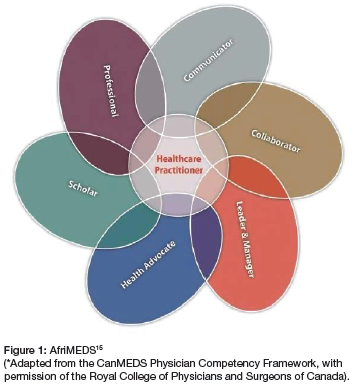
There are differences between the CanMEDS and AfriMEDS frameworks. In CanMEDS, the central role is coined as the candidate becoming an "Expert", while in the AfriMEDS context, the candidate becomes a "Healthcare Practitioner". The role of "Manager" in CanMEDS is expanded to include "Leader and Manager" in the AfriMEDS framework. It appears that the deconstruction of the roles "Expert" and "Manager" seemed to destabilise power-relations. Decolonisation acknowledges the inherent power relations in the production and dissemination of knowledge, and seeks to destabilise these, allowing new forms of knowledge which represent marginalised groups.13Figure 1) framework guides the accreditation process of all medical and dental schools in South Africa.3
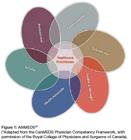
Biomedical theories of disease and treatment; concepts such as competencies, evidence-based medicine and acceptable professional activities; culturally mediated notions such as professionalism, communication skills and doctor-patient relationships; and even reflection, are often imposed on learners in or from the Global South.14
Of particular interest is that globally the CanMEDS core competency framework guides specialist and medical curricula. In contrast to this, the AfriMEDS core competency framework guides all medical and dental curricula in South Africa. Worldwide dental schools are underpinned by approved competencies or competency statements developed for specific contexts or countries, as referred to previously. As AfriMEDS was adopted from CanMEDS, concerns noted around the "artificial" division of roles as well as the implementation of the CanMEDS framework would need to be evaluated.
CanMEDS core competency framework implementation strategies and challenges
There was agreement that the CanMEDS roles are relevant to clinical practice. However, there were also reports of educators and doctors struggling to implement the roles in the daily practice of specific specialties.655
Outcome frameworks such as CanMEDS specify the destination but not the mode of delivery. In addition, no clear guidance on a specific teaching strategy is given for CBME.1216
One of the barriers to implementation has been the lack of a common language describing domains of competence in the health professions and the specific competencies that are critical to the formation and continuous development of physicians.1112
The adoption of a competency-based approach implies the need for faculty development in the principles and practice of criterion-based assessment (CBA). CBA is not unique to CBE, but it is integral to the notion of a competency framework.12161766 12
An overarching outcome framework allows a consistent approach to these challenges highlighted and the alignment of educational activities and objectives through the continuum of medical education.12186
AfriMEDS core competency framework in dental education
In response to the adoption of the AfriMEDS competency framework by the HPCSA, all dental schools in South Africa were required to incorporate and implement these core competencies described in AfriMEDS within the undergraduate curricula. Each of the four dental schools in South Africa have autonomy with regard to the core competencies implementation strategies within their undergraduate dental curriculum. Each of the dental schools is required to describe the implementation and translation of these AfriMEDS core competencies in their curriculum through the completion of the self-evaluation questionnaire as part of the accreditation process.
The core competencies were not clearly or consistently described in the curriculum and the implementation thereof was not evident. Evidence from previous accreditation reports suggests the translation of the AfriMEDS core competencies throughout the undergraduate dental curriculum were not explicitly described. Frank and Danoff5
MATERIALS AND METHODS
Document analysis was used to develop the implementation model to align the AfriMEDS competency framework. Document analysis is the systematic procedure of finding, selecting, reviewing and interpreting documents to uncover meaning and discover insights that are relevant to the research problem.192020
DATA COLLECTION PROCESS AND FRAMEWORK DEVELOPMENTThe process of document analysis involves skimming (superficial examination), reading (thorough examination) and interpretation. This iterative process combines elements of content analysis and thematic analysis.20
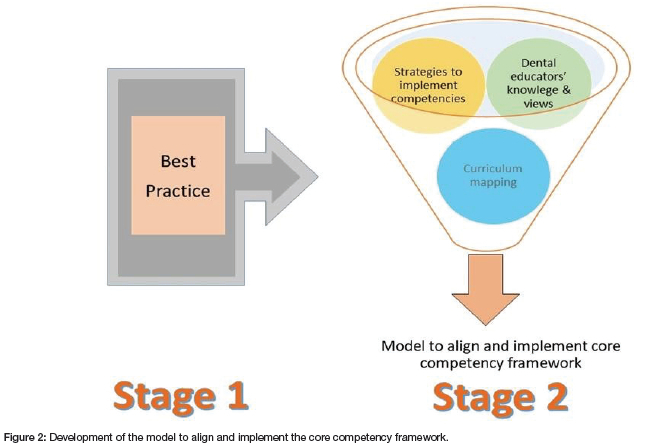
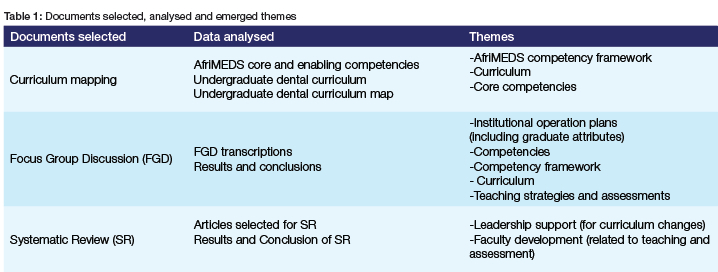
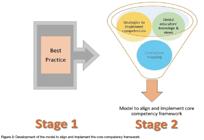
A two-layered approach was used to develop a framework to align and implement the AfriMEDS core competency framework. First, literature suggesting implementation strategies of CanMEDS5Figure 2. Standards for curriculum, teaching and assessment, faculty development, research and development, and outreach were suggested approaches for implementation of the CanMEDS competency framework.5 42121 20 Table 1 further below.
RESULTS
The following themes/categories emerged from the data: The AfriMEDS core competency framework; institutional framework; dental school/faculty; faculty development; teaching and learning; and curriculum. Table 1 illustrates how the categories aligned with the results, discussion and conclusion of each document source.
THEMES THAT EMERGED FROM THE DOCUMENT ANALYSISAfriMEDS core competency framework
From the previously discussed literature, external pressures from the HPCSA created a thrust for change to CBE. In addition, the HPCSA adopted the AfriMEDS core competency framework to provide guidance for the transition to CBE. As the AfriMEDS competency framework underpins the undergraduate dental curriculum, it needs to be included in the proposed framework for alignment and implementation of the AfriMEDS.
Institutional framework
Dental schools operate within a larger institutional landscape that also requires alignment to institutional specific frameworks. In the case of the University of the Western Cape (UWC), graduate attributes situated within the Institutional Operating Plan (IOP) and decolonisation of the curriculum, etc are external pressures that inform the undergraduate dental curriculum. For this reason, incorporation and alignment of the specific institutional framework is necessary in the dental curriculum.
Dental school/faculty
In response to external pressures, the leadership of the dental faculty needs to support this transition to CBE. For this, appropriate structures or committees are necessary vehicles to support and drive this change process. Support includes human resources, finances, policies and procedures that will govern the change process.
Faculty development
Faculty development related to CBE, as well as teaching, learning and assessment, is essential for dental educators as stakeholders in this successful transition to CBE. This agrees with Frank and Danoff521
Teaching and learning
In addition, the results from the FGDs suggest the usefulness of dental educators' views on competencies, with a further recommendation given for dental graduates' competencies to be reviewed frequently.21521
CurriculumCurriculum is the final part of the implementation strategy. With transitioning to CBE learning outcomes, teaching strategies and assessment should be aligned. As CBE focuses on outcomes, learner-centredness and abilities, it influences curriculum design.222121
DISCUSSION
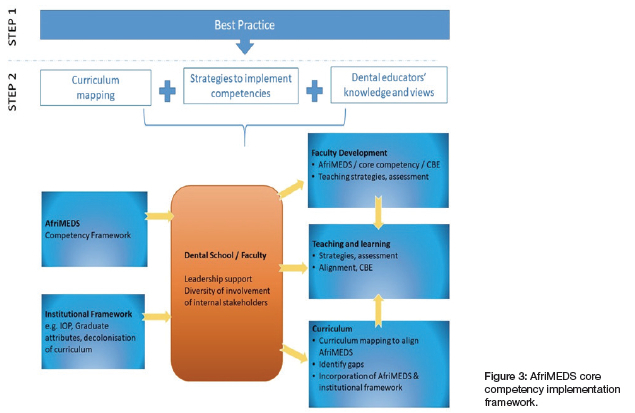
Figure 3 diagrammatically represents the proposed AfriMEDS core competency framework implementation model. This framework is dynamic and illustrates how processes, faculty development and curriculum impacts and informs teaching, learning and assessment.
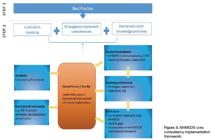
The aim of this study was to develop a framework to align and implement the AfriMEDS core competency framework into an undergraduate dental curriculum. Inclusion of the literature and results from the curriculum mapping, FGD and SR guided the document analysis process to develop the implementation framework (Figure 3) of the AfriMEDS core competency framework. In addition to being dynamic, the proposed model allows the institutional framework of the individual dental schools to impact the dental curriculum where relevant. Due to the urgency of the decolonisation of the curriculum in this institution in South Africa, this strategy needs to be considered in the implementation of the competency framework. In addition, this proposed framework allows seamless integration of the AfriMEDS core competency framework into the undergraduate dental curriculum. The implementation of this framework needs to be underpinned by a common understanding of the AfriMEDS core competency framework by all stakeholders (dental educators, programme directors and dental experts involved in accreditation processes).
An appropriate framework for aligning the AfriMEDS core competency framework was developed. However, the urgency of decoloniality within health professions education and the researchers' reflections added new dimensions to this research. In the first study that explored the setting of research priorities for health professions education in sub-Saharan Africa (SSA), one of the priorities was to
determine how to develop and implement curricula that are responsive to the health needs of SSA.23
CONCLUSION
A dynamic implementation framework was developed to align and implement AfriMEDS core competency framework to an undergraduate dental curriculum. Results from a Delphi follow-up study concluded that this framework was feasible to consider.2414
REFERENCES
-
1. Hawkins RE, Welcher CM, Holmboe ES, Kirk LM, Norcini JJ, Simons KB, Skochelak SE. Implementation of competencyxbased medical education: are we addressing the concerns and challenges? Med Educ. 2015;49(11):1086-102. doi: 10.1111/medu.12831
» https://doi.org/10.1111/medu.12831 -
2. Van Melle E, Frank JR, Holmboe ES, Dagnone D, Stockley D, Sherbino J. A core components framework for evaluating implementation of competency-based medical education programs. Acad Med. 2019;94:1002-9. https://doi.org/10.1097/ACM.0000000000002743
» https://doi.org/10.1097/ACM.0000000000002743 -
3. Van Heerden B. Effectively addressing the health needs of South Africa's population: The role of health professions education in the 21st century. S. Afr Med J. 2013;103:21-2. https://doi.org/10.7196/SAMJ.6463
» https://doi.org/10.7196/SAMJ.6463 -
4. Maart R, Adam R, Frantz J. Curriculum mapping: A tool to align competencies in a dental curriculum. AJHPE. 2021;13(2):99-104. doi: 10.7196/AJHPE.2021.v13i2.1257
» https://doi.org/10.7196/AJHPE.2021.v13i2.1257 -
5. Frank JR, Danoff D. The CanMEDS initiative: implementing an outcomes-based framework of physician competencies. Med Teach. 2007;29:642-7. https://doi.org/10.1080/01421590701746983
» https://doi.org/10.1080/01421590701746983 -
6. Van Der Lee N, Fokkema JPI, Westerman M, Driessen EW, Van Der Vleuten CP, Scherpbier AJ, Scheele F. The CanMEDS framework: Relevant but not quite the whole story. Med Teach. 2013;35:949-55. https://doi.org/10.3109/0142159X.2013.827329
» https://doi.org/10.3109/0142159X.2013.827329 -
7. Ditmyer M, Mobley C, Davenport W. Evaluation of an integrative model for professional development and research. JDE. 2014;78:368-79. doi: 10.1002/j.0022-0337.2014.78.3.tb05687.x
» https://doi.org/10.1002/j.0022-0337.2014.78.3.tb05687.x -
8. Yip H-K, Smales RJ. Review of competency-based education in dentistry. Br Dent J. 2000;189:324-6. doi: 10.1038/sj.bdj.4800758
» https://doi.org/10.1038/sj.bdj.4800758 -
9. Cowpe J, Plasschaert A, Harzer W, Vinkka-Puhakka H, Walmsley A. Profile and competences for the graduating European dentist - update 2009. Eur J Dent Educ. 2010;14:193-202. https://doi.org/10.1111/j.1600-0579.2009.00609.x
» https://doi.org/10.1111/j.1600-0579.2009.00609.x - 10. Gerrow J, Murphy J, Boyd M. Review and revision of the competencies for a beginning dental practitioner in Canada. JCDA. 2007;73(2):157-60
-
11. Englander R, Cameron T, Ballard A, Dodge J, Bull J, Aschenbrener C. Toward a common taxonomy of competency domains for the health professions and competencies for physicians. Acad Med. 2013;88:1088-94. doi: 10.1097/AMC.0b013e31829a3b2b
» https://doi.org/10.1097/AMC.0b013e31829a3b2b -
12. Harris P, Snell L, Talbot M, Harden RM. Competency-based medical education: Implications for undergraduate programs. Med Teach. 2010;32(8):646-50. https://doi.org/10.3109/0142159X.2010.500703
» https://doi.org/10.3109/0142159X.2010.500703 -
13. Begum N, Saini R. Decolonising the curriculum. Political Stud. Rev. 2019;17:196-201. https://doi.org/10.1177/1478929918808459
» https://doi.org/10.1177/1478929918808459 -
14. Naidu T. Southern exposure: levelling the Northern tilt in global medical and medical humanities education. Adv Health Sci Educ. 2021;26:739-752. Doi: 10.1007/s10459-020-09976-9
» https://doi.org/10.1007/s10459-020-09976-9 - 15. Frank JR. (Ed.). The CanMEDS Physician Competency Framework. Better standards, better physicians, better care. The Royal College of Physicians and Surgeons of Canada. 2005
-
16. Ten Cate O, Scheele F. Viewpoint: Competency-based postgraduate training: Can we bridge the gap between theory and clinical practice? Acad Med. 2007;82:542-7. doi:10.1097/AMC.0b013e31805559c7
» https://doi.org/10.1097/AMC.0b013e31805559c7 -
17. Chou S, Cole G, McLaughlin K, Lockyer J. CanMEDS evaluation in Canadian postgraduate training programmes: Tools used and programme director satisfaction. Med Educ. 2008;42:879-86. https://doi.org/10.1111/j.1365-2923.2008.03111.x
» https://doi.org/10.1111/j.1365-2923.2008.03111.x -
18. Porter AC. Measuring the content of instruction: Uses in research and practice. Educ Res J. 2002;31:3-14. https://doi.org/10.3102/0013189X031007003
» https://doi.org/10.3102/0013189X031007003 - 19. Rich JV. Do professions represent competence for entry-to-practice in similar ways? An exploration of competence frameworks through document analysis. JoSoTL. 2019;13:5
-
20. Bowen GA. Document analysis as a qualitative research method. Qual Res J. 2009;9:27-40. https://doi.org/10.3316/QRJ0902027
» https://doi.org/10.3316/QRJ0902027 -
21. Maart R, Adam R, Frantz J. Dental educators' views and knowledge of competencies required within a competency framework. S Afr Dent J. 2022;76:482-9. doi:10.17159/2519-0105/2021/v76no8a6
» https://doi.org/10.17159/2519-0105/2021/v76no8a6 -
22. Gruppen LD, Burkhardt JC, Fitzgerald JT, Funnell M, Haftel HM, Lypson ML, Vasquez JA. Competency-based education: Programme design and challenges to implementation. Med Educ. 2016;50(5):532-539. https://doi.org/10.1111/medu.12977
» https://doi.org/10.1111/medu.12977 - 23. Van Schalkwyk SC, Kiguli-Malwadde E, Budak JZ, Reid MJ, De Villiers MR. Identifying research priorities for health professions education research in sub-Saharan Africa using a modified Delphi method. BMC Med Educ. 2020;20(1):1-10
- 24. Maart RD, Adam RZ, Frantz JM. Exploring the feasibility of a framework to align a competency framework in a dental curriculum: a Delphi study. South African Dental Journal. 2022 Apr;77(3):147-54

Author's contribution
Ronel D Maart - principle author (50%)
Razia Z Adam - co-author (25%)
José M Frantz - co-author (25%)