Preventing crime and violence through work and wages: The impact of the Community Work Programme
The article offers an analysis of the potential impact of the Community Work Programme (CWP) on crime and violence. The CPW is a public employment programme that was formally established within the government in 2010. The CWP may have an impact on crime and violence through a number of different 'pathways'. One of these, the focus of this article, is through wages provided to the participants, 75% of whom are women. Notable here is the likely impact of these wages on the households of participants, including on their children and intimate partner relations. Whereas the CWP may have a beneficial impact on children in a household, there appears to be the potential that the CWP may aggravate the risk of violence, particularly for female participants who have unemployed partners. The article argues that if the crime prevention potential of the CWP is to be optimised, this motivates for providing 'gender training' to participants who may be at risk of intimate partner violence. In addition, limited male participation may reinforce a pattern of male exclusion, motivating for increasing the participation of men within the CWP.
Preventing crime and violence through work and wages: The impact of the Community Work Programme
David Bruce
Is a freelance researcher specialising in crime and criminal justice.
ABSTRACTThe article offers an analysis of the potential impact of the Community Work Programme (CWP) on crime and violence. The CPW is a public employment programme that was formally established within the government in 2010. The CWP may have an impact on crime and violence through a number of different 'pathways'. One of these, the focus of this article, is through wages provided to the participants, 75% of whom are women. Notable here is the likely impact of these wages on the households of participants, including on their children and intimate partner relations. Whereas the CWP may have a beneficial impact on children in a household, there appears to be the potential that the CWP may aggravate the risk of violence, particularly for female participants who have unemployed partners. The article argues that if the crime prevention potential of the CWP is to be optimised, this motivates for providing 'gender training' to participants who may be at risk of intimate partner violence. In addition, limited male participation may reinforce a pattern of male exclusion, motivating for increasing the participation of men within the CWP.
Public employment programmes (PEPs) have been established in many countries. Often called public works programmes, they are typically established as a response to high levels of poverty and unemployment. Historically the PEPs that are most well-known are the programmes that were established in the United States as part of the Roosevelt administration's New Deal during the years of the Great Depression of the 1930s.12
PEPs are established as a state response to poverty and unemployment. Their primary purpose is not to address crime or violence. Nevertheless, it is widely believed that job creation does reduce crime,3456
This article focuses on a specific South African PEP, the Community Work Programme (CWP). The possible impact of the CWP, on intimate partner violence, collective violence and crime more generally, has been raised by other authors.7
This article draws on material from research on the CWP undertaken by the Centre for the Study of Violence and Reconciliation. The research, carried out between August 2013 and March 2015, involved in-depth interviews with participants and community members at six CWP sites in Gauteng, the Western Cape and North West, as well as with other CWP role players, including representatives of national, provincial and local government, non-governmental organisations (NGOs) that have been appointed as CWP implementing agents, and policy experts with knowledge of the CWP.
The Community Work Programme
PEPs were first established by the post-apartheid government in the late 1990s. However, the most significant PEP, the Expanded Public Works Programme (EPWP), was officially launched in May 2004.89
The CWP was established in recognition of the fact that unemployment in South Africa is structural.10 This means that, even if there are consistent improvements in the South African economy, unemployment is likely to remain a major ongoing problem in the medium to long term. It also means that, as a result of the nature of the labour market, government programmes that provide people with work experience and skills will not automatically enable them to establish their own businesses or find employment.
Unlike the EPWP, the work opportunities in the CWP are not short-term. The idea that CWP participants may exit the CWP to take up work opportunities or establish their own businesses is regarded favourably, and the CWP does indeed enhance the ability of some participants to do this.1112
The CWP also has a number of other features that distinguish it from the EPWP, and from many other PEPs internationally.13 The CWP was initiated as a pilot programme in 2007. Since 2010 it has been located in the Department of Cooperative Governance and Traditional Affairs (COGTA).141516
The CWP and crime and violence prevention
Questions relating to the impact of the CWP on violence were previously raised in a paper about one of the pilot sites that was established in North West province. This paper concluded that the CWP had played a decisive role in preventing conflict and violence in that community.1718
We can think about the potential impact of the CWP on crime and violence at each site in terms of the 'nett' or cumulative effect of a number of different 'pathways'. These include:
- The impact of the 'useful work' activities that CWP participants perform. A core part of the CWP framework is that it should do 'useful work', which is defined as that which contributes 'to the public good, community goods or social services'.192021SACQ 51, a special edition on primary violence prevention.)
- Impact at the level of 'community' (sometimes also called 'neighbourhood effects').22232425
- The CPW is a government programme in which major public resources are invested. In this respect therefore, the CWP increases the risk of crime and the abuse of public resources, whether this is in the form of the theft of CWP equipment, corruption by employees, or the manipulation of the CWP by politicians in the service of systems of patronage. The 'nett' impact of the CWP on crime will therefore also be influenced by the degree to which the CWP has effective integrity systems, such as systems of financial management, as well as by the willingness and ability of CWP personnel to withstand inappropriate political interference.
This article focuses on a fourth 'pathway': the impact of the CWP as a mass employment programme that offers large numbers of people work and wages. Once established at a site, the CWP can be regarded as a local institution that forms part of the mix of institutions - hospitals, schools, formal or informal businesses, etc. - in that area. In common with many of these institutions, the CWP provides regular and ongoing work and income to people within the area. Due to the fact that it employs in the region of 1 000, and sometimes more, people at a site, the number of people employed by the CWP is often much greater than the number employed by other institutions in the area.
If it is true that providing people with employment and an income contributes to reducing crime and violence, it might be assumed that the CWP, as a programme that provides these opportunities 'at scale' in the areas in which it is established, will contribute to reducing crime and violence in a significant way. However, in assessing whether this is the case it is necessary to recognise that these job opportunities are largely accessed by women rather than by young men, who tend to be the main participants in crime and violence.26
In examining questions about the impact of the CWP on violence, the article does not assume that crime and violence are uniform phenomena. The main forms of crime or violence referred to in this article are property crime and intimate partner (domestic) violence against women.
The income 'safety net' provided by the CWP
Though the CWP also has broader 'community development' objectives, its core objective is to provide an income 'safety net' to the 'poorest of the poor'.2728
The CWP enables participants to depend on a small but stable income and use the additional time they have to engage in other income-earning activity, or to look for other work. Incomes from the CWP may be used to supplement social grants, which, subject to a means test, are available inter alia to mothers or other primary caregivers of children under the age of 18, people with disabilities, and elderly people. In addition, the intention behind the CWP is to extend state support beyond the ranks of those who are eligible for social grants, and in so doing to compensate for the 'lack of social protection interventions that target the working age poor'.29
The profile of participants in the CWP
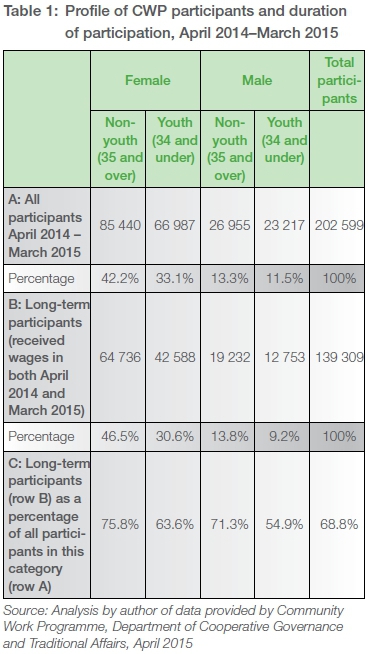
The areas in which the CWP has been established are characterised by high levels of unemployment.30 However, not all unemployed people want to work in the CWP. A consistent pattern across CWP sites in different regions is that women of 35 and over constitute the largest group of participants. As reflected in row A of Table 1, in January 2015 women in this age group accounted for 42% of all participants nationally. Women between the ages of 18-34 constitute the second biggest group of participants, accounting for 33% of participants. After these two groups men of 35 and over typically account for the third biggest group, with young men being the least likely to participate.
The demand for positions in the CWP appears to be much higher among women over the age of 35 than among younger women. A similar pattern also applies to older men, who outnumber younger men. This runs contrary to what might be expected, since youth unemployment in South Africa is exceptionally high.31Table 1), young men are less likely than any of the other groups to remain in the CWP for extended periods of time. Almost half (45%) of young men who were in the CWP had been in the programme for less than a year. It seems reasonable to assume that the reasons for people leaving include relocating, finding better job opportunities, and that they 'don't like the CWP'.32
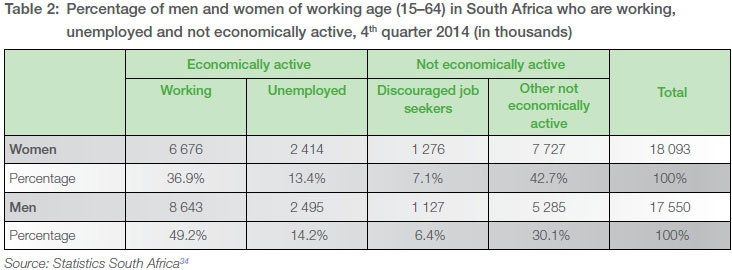
Could the reason for the differences between levels of female and male participation in the CWP be that more women are unemployed? In the fourth quarter of 2014, 49.2% of men were classified as employed, as opposed to 36.9% of women (Table 2). However, statistics on people looking for work, who are classified as unemployed, and 'discouraged job seekers' who have not recently taken active steps to look for work,33
As can be seen in Table 2, the number of women in the combined 'unemployed' and 'discouraged' categories (3 690 000) only marginally exceeds the number of men (3 622 000). It is only when both the 'unemployed' and the 'not economically active' categories are added together that the number of women significantly exceeds the number of men. If the 'unemployed' and the 'not economically active' are added together, women make up roughly 56% and men 44% of this population of 20 324 000 people. If levels of participation in the CWP were similar to the gender profile of the latter group of people then the differences within the CWP would presumably reflect this 56% to 44% ratio, rather than the 75% women to 25% men ratio currently reflected in the CWP.
Gender and age-related factors impacting on participation in the CWP
The above statistics suggest that there are other gender and age-related factors that have an impact on the demand for positions in the CWP. Research at CWP sites carried out during 2013 and 2014 indicates that there are an inter-connected set of factors that are relevant to understanding this. A widespread perception among female participants was that women have a greater sense of responsibility to provide for children and other family members than men do. Many women are motivated to take on work in the CWP, despite the low wages, in order to be able to care for children - often using this to supplement the government child support grant (CSG).
When children cry because they want food they cry to their mothers and we feel the pain if we cannot provide for them. As a mother it's even more difficult when you are raising children alone with no help from the father of your children and you are forced to work in order to provide for them. ... I have no support at all from the family of my late husband and rely on the grant I receive from government. It's difficult because the grant is very small so with the CWP money I am able to make ends meet.35
One explanation for the low levels of participation by men was that that they were irresponsible or lazy. Some female interviewees at CWP sites and at least one government official suggested that the lack of interest in the programme could essentially be attributed to laziness.3637
Wages are obviously also a factor affecting participation in the CWP. Especially when women receive one or more CSGs, the money that they get from the CWP contributes to a modest, but more satisfactory income. For men, on the other hand, the CWP wages are likely to be their only state-provided income. Paradoxically, some interviewees suggested that it was partly their sense of responsibility to their families that led men to reject CWP opportunities, as the CWP income alone would not enable them to provide for their families.
R540, No! No! Thinking that he is supposed to support children, three children, he also has to maintain himself. That R500 is little for him. But one thing for sure, a woman can do a lot with that R500. I think that is the reason. He says R500 is little, it cannot maintain my children.38
The majority of men moved out because they need other jobs. [This is because] men need more money to feed the family. A woman does not care. As long she supports her children she does not have a problem, she is going to stay there. She [also] gets extra support from the social grants, but a man cannot live on that little money [he only gets from CWP]. He has to go back to the house and buy groceries for the children.39
Nevertheless, the reluctance of unemployed men, and particularly young men, to take up positions in the CWP remains puzzling. Besides the fact that men are generally not eligible for social grants,4041
It appears that concerns about social status, reflecting the links between gender, work and personal identity, may go some way towards explaining this anomaly. One feature of the CWP at many sites is that a significant proportion of participants do work that involves cleaning streets and other public areas, including places that have been used as dumping grounds. Even though CWP work may be fairly diverse, the aspect of CWP work that is physically most visible to other community members is often cleaning work. Within many households, work of this kind is typically performed by women.42
This is borne out by the the number of men participating in other EPWP programmes. Even though EPWP wage rates are the same as those for the CWP, the proportion of men in the infrastructure sector (49%) and environment sector (47%) is relatively large. These sectors are likely to involve much more work that is considered traditionally masculine. On the other hand, in the 'social sector', which involves more 'care' type activities, men make up only 15% of participants.43
In the research at CWP sites, male reluctance to participate in the CWP was often viewed as reflecting a male view that they would be lowering themselves by participating in the CWP; a view referred to as 'pride'.
There are more women than men in this project because women are used to house work and cleaning and they love working. Men are very few in this project because of pride. Men have pride even when they have nothing. Men will be very shy to work the kind of work we do in the CWP like cleaning the streets and cleaning the schools.44
I think men have pride as there are lots of men who are unemployed and they say the money is too little. Women have no option because they have kids that they have to support. Unemployed men do not want to join because the money is very little although they too have the same responsibilities to raise their children. Men generally do not want to work for little money, they want more money even when they do not have the qualification or the experience.45
Some interviewees expressed a concern that they would be ridiculed by others if they joined the CWP, with participation in the CWP signifying that they have 'given up' on making something more of their lives.
What will my peers say when they see me wearing the orange overall and cleaning the streets of Kagiso? Maybe I can do this type of a job in another township but never in Kagiso where I live. I will be a laughing stock among my peers and my community. This is not the type of work to be done by young people. If I had to do this job it means that I will be surrendering in life that I have failed and reached a dead end. This is not an inspiring job even for us who are unemployed. How do I work the whole day for just R60 per day? It's crazy and I don't think that it is worth my effort, although I am unemployed.46
Women were seen as more willing to put their 'pride' to one side, in the interests of supporting their families.
Men do not want to be seen doing that in most cases. They think that if I am going to go to the street and do that thing, I might be seen as being down and out. But he cannot bring any income to the house. What I can tell you is that I have seen that women do not have pride because they want their kids to eat. But men do not care. I can tell you - that is why they say a woman holds a knife at its sharpest point. That is what those women are doing at the ground.47
One body of work that may shed light on this phenomenon focuses on young men's apparent need to position themselves 'within gender and age hierarchies' in order to achieve recognition as men.485051
Implications for the status of women and men in poor communities
Since women are generally recognised as the 'primary caregiver' of their children, 96% of recipients525354
Due to the fact that they are generally not recipients of the CSG, or any other grant, most unemployed men fall outside of the safety net provided by the system of social grants. The irony then is that many men seem to exclude themselves from the CWP, in part because participation in the CWP is seen to adversely impact on their ability to achieve or maintain the status of being men. This in turn reinforces their disempowered and marginal position. Arguably, therefore, a major impact of CWP wages is to further consolidate the dynamic, created by the CSG, in which women are able to play the role of economic providers, while men's position of exclusion remains largely unaffected.
The impact of stable household income on childhood risk factors
As has been established above, participants in the CWP, most of whom are women, receive incomes which, while relatively low, are nevertheless 'regular and predictable'.55
- Reducing the economic uncertainty, and thus the emotional stress, that poor families are subjected to. Both poverty and economic instability may contribute to emotional stress.5657
- Enabling mothers or parents to maintain a relatively high level of supervision over their children,since they live and work in the same community. They might not be able to 'keep an eye' on their children while at work, but it means that the time they spend away from home is not extended by travelling. 'Poor parental supervision is usually the strongest and most replicable predictor of offending',5859
- Getting CWP participants to work alongside other community members. This increases their range of social ties with people within their communities,60 and is likely to increase their access to, and ability to mobilise, social support through their links with people in similar circumstances (social capital). The access that people have to family and other social networks of support may have positive implications for child-rearing, although this will depend on the quality of these relationships.61
Unemployment 'leads to a lack of structure in people's lives, and to isolation and exclusion from the wider community'.6263
The argument that CWP wages, and other benefits of participating in the CWP, will contribute to a reduction in some of the childhood risk factors for crime and violence, therefore makes good sense. However, this argument also needs to take account of the impact of CWP wages on gender power relations in poor households.
Intimate partner violence
There is extensive international literature on the relationship between women's employment (and economic empowerment generally), and the risk of domestic violence. Some authors suggest that increases in women's income (or other resources), particularly where this exceeds the income or resources of their male partners, will increase their risk of victimisation, since they are seen to threaten the status of their male partners.646567
Nevertheless, some of the literature does indicate that when women work while their male partners are unemployed, the risk of violence to the female partner increases.6869
The potentially beneficial impact of CWP wages in providing more stable incomes for poor households therefore needs to be juxtaposed against the possibility that the CWP, as it is currently operating, may exacerbate the risk of domestic violence and conflict in the home.70717273
One programme that has produced positive results in reducing intimate partner violence in South Africa is the Intervention with Microfinance for AIDS and Gender Equity (IMAGE). In addition to providing microfinance to female participants, the intervention also offers women participants training sessions that cover gender roles, cultural beliefs, relationships, communication, domestic violence, and HIV infection. Qualitative data suggests that the reductions in intimate partner violence achieved by the programme resulted from a range of responses, including 'enabl[ing] women to challenge the acceptability of such violence, expect and receive better treatment from partners, leave violent relationships and give material and moral support to those experiencing abuse'.74
Involvement of young men in crime and violence
Research shows that greater employment does reduce levels of crime, particularly property crime. But it is primarily by increasing the employment of young men, particularly those who are 'low skilled', that levels of property crime are reduced.7576
It is believed that another benefit of employment is that it builds social bonds and can thereby strengthen informal social control that serves as a deterrent to participation in crime.777879
Thus, attracting more young men into the CWP, on its own, may not be sufficient to discourage participation in crime. It may also be necessary for those in the CWP to address questions about how best to work with the notion of 'masculinity'.80
Conclusion: strengthening the impact of CWP wages on crime and violence
The CWP was not established to reduce or prevent crime. And although crime and violence prevention is an important social objective, it is not intrinsically more important than providing an income safety net to unemployed people.81
Nevertheless, since the CWP may contribute to reducing crime and violence, it is important to consider how it might do so. This article argues that one mechanism through which the CWP is likely to contribute to crime prevention is through supporting mothers in creating more stable and nurturing home environments. This needs to be balanced against the possible increased risk of IPV resulting from the impact of CWP wages on gender power relations in the home. One way in which the crime and violence prevention benefits of CWP work and wages may be increased is by combining the programmes with 'gender training', similar to that offered in the IMAGE programme, to help women more effectively negotiate their status as the main economic providers in their homes.
Still, the low levels of male participation in the CWP will have to be addressed if the CWP is to promote community development in a holistic way. Even though it seems that men have chosen to exclude themselves from the CWP, structural marginalisation of young men, and men more generally, typically translates into adverse behaviour that has disadvantages for women and communities. As a result, the community development objectives of the CWP can probably better be promoted by including men and women, old and young, more equally within the programme.
These conclusions point to the need for organisations involved in crime and violence prevention, including the prevention of gender-based violence, and youth development organisations to partner with and support the CWP in achieving its crime and violence prevention potential.
NotesThe article is based on research carried out by the Centre for the Study of Violence and Reconciliation in terms of a grant from the International Development Research Centre. Hugo van der Merwe, Malose Langa, Themba Masuku, Fairuz Mullagee, Jasmina Brankovic, Zukiswa Khalipha and Kindisa Ngubeni have all been part of and contributed to this project. Thanks are also due to three anonymous reviewers, as well as Chandré Gould, for comments on earlier drafts
References
-
1 New Deal, Wikipedia, website, http://en.wikipedia.org/wiki/New_Deal (accessed 9 April 2015).
» http://en.wikipedia.org/wiki/New_Deal -
2 Maikel Lieuw-Kie-Song et al., Towards the right to work: innovations in public employment programmes (IPEP), Geneva: International Labour Organization (ILO), 2010, http://www.ilo.org/employment/Whatwedo/Publications/working-papers/WCMS_158483/lang--en/index.htm (accessed 14 January 2015).
» http://www.ilo.org/employment/Whatwedo/Publications/working-papers/WCMS_158483/lang--en/index.htm -
3 L Randall Wray, The Employer of Last Resort Programme: could it work for developing countries?, Geneva: ILO, 2007, 3, http://www.ilo.org/public/english/employment/download/elm/elm07-5.pdf (accessed 16 January 2015).
» http://www.ilo.org/public/english/employment/download/elm/elm07-5.pdf - 4 In this article the terms 'crime' and 'violence' are understood as overlapping but not synonymous. The forms of violence that this article is concerned with are generally defined as crimes in South African law. However, some forms of crime that are discussed, such as theft or housebreaking, are 'property crimes' that do not involve interpersonal violence.
- 5 Bill Dixon, Development, crime prevention and social policy in post-apartheid South Africa, Critical Social Policy, 26:1, 2006, 169-91.
-
6 Centre for Democratising Information, The South African community capability study: the context of public primary education and the community work programme, http://www.tips.org.za/files/u72/community_work_programme_education_report.pdf (accessed 9 April 2015).
» http://www.tips.org.za/files/u72/community_work_programme_education_report.pdf - 7 Malose Langa, Bokfontein: the nations are amazed, in Karl von Holdt et al. (eds), The smoke that calls: insurgent citizenship, collective violence and the struggle for a place in the new South Africa, Johannesburg: Centre for the Study of Violence and Reconciliation & Society Work and Development Institute, 2011.
-
Kate Philip, The transformative potentia of public employment programmes, Cape Town: UCT Graduate School of Development Policy and Practise, 2013, 24-25, http://www.gsdpp.uct.ac.za/research-and-publications/occasional-paper-series.htm (accessed 9 April 2015).
» http://www.gsdpp.uct.ac.za/research-and-publications/occasional-paper-series.htm -
8 Department of Public Works, Expanded Public Works programme five-year report 2004/05 - 2008/09: reaching the one million target, Pretoria: Department of Public Works, 2009, http://www.epwp.gov.za/documents/Cross_Cutting/Monitoring%20and%20Evaluation/EPWP_ Five_Year _Report.pdf, (accessed 9 April 2015).
» http://www.epwp.gov.za/documents/Cross_Cutting/Monitoring%20and%20Evaluation/EPWP_ Five_Year _Report.pdf -
9 Kate Philip, The Community Work Programme: building a society that works, Geneva: ILO, 2013, 12, http://www.ilo.org/employment/Whatwedo/Publications/working-papers/WCMS_223866/lang--en/index.htm (accessed 15 January 2015).
» http://www.ilo.org/employment/Whatwedo/Publications/working-papers/WCMS_223866/lang--en/index.htm - 10 Kate Philip, Inequality and economic marginalisation: how the structure of the economy impacts on opportunities on the margins, Law, Democracy & Development, 14:1, 2010, 1-28, 12.
- 11 Kate Philip, The Community Work Programme: building a society that works, Geneva: ILO, 2013, 33-34;
- Malose Langa, Draft report on CWP in Orange Farm, Centre for the Study of Violence and Reconciliation, 2014.
- 12 There is substantial variation among different EPWP projects in terms of how the duration and intensity (as defined by number of days per week) of work is defined.
- 13 Gavin Anderson and Peter Alexander, The Community Work Programme: potential and disappointment, Transformation, 2015 (forthcoming).
-
14 The EPWP is the responsibility of the Department of Public Works, although it has different 'sectors', some of which fall under other departments. The CWP is located under COGTA, due to the fact that it is supposed to work closely with local government.
» http://www.fin24.com/Economy/SA-youth-unemployment-3rd-highest-in-world-20140120 -
15 Analysis by author of data provided by Community Work Programme, Department of Cooperative Governance and Traditional Affairs, April 2015.
» http://www.statssa.gov.za/publications/P0211/P02114thQuarter2014.pdf -
16 Pravin Gordhan, 2014 budget speech, 26 February 2014, http://www.treasury.gov.za/documents/national%20budget/2014/speech/speech.pdf (accessed 14 January 2015).
» http://www.globalhealthaction.net/index.php/gha/article/view/23676/pdf_1 - 17 Malose Langa, Bokfontein: the nations are amazed, in Karl von Holdt et al. (eds), The smoke that calls: insurgent citizenship, collective violence and the struggle for a place in the new South Africa, Johannesburg: Centre for the Study of Violence and Reconciliation & Society Work and Development Institute, 2011;
- Malose Langa and Karl von Holdt, Bokfontein amazes the nations: Community Work Programme (CWP) heals a traumatised community, in Devan Pillay et al. (eds), New South African review 2, Johannesburg: Wits University Press, 2011.
- 18 Kate Philip, The transformative potential of public employment programmes, Cape Town: UCT Graduate School of Development Policy and Practise, 2013, 24-25.
- 19 Department of Cooperative Governance, Community Work Programme: implementation manual, Pretoria: Department of Cooperative Governance, July 2011, 19.
- 20 Malose Langa and Karl von Holdt, Bokfontein amazes the nations: Community Work Programme (CWP) heals a traumatised community, in Devan Pillay et al. (eds), New South African review 2, Johannesburg: Wits University Press, 2011.
- 21 Adam Crawford, Crime prevention and community safety, in Mike Maguire, Rod Morgan and Robert Reiner (eds), The Oxford handbook of criminology, 4th ed., Oxford: Oxford University Press, 2007, 866-909, 870.
- 22 Robert J Sampson, Jeffrey D Morenoff and Thomas Gannon- Rowley, Assessing neighbourhood effects: social processes and new directions in research, Annua Review of Sociology, 28:1, 2002, 443-78.
- 23 Kate Philip, The Community Work Programme: building a society that works, Geneva: ILO, 2013, 10.
- 24 Malose Langa and Karl von Holdt, Bokfontein amazes the nations: Community Work Programme (CWP) heals a traumatised community, in Devan Pillay et al. (eds), New South African review 2, Johannesburg: Wits University Press, 2011.
- 25 Robert Sampson, The place of context: a theory and strategy for criminology's hard problems, Criminology, 51:1, 2013, 1-31, 20-21.
- Frances Heidensohn and Loraine Gelthorpe, Gender and crime, in Mike Maguire, Rod Morgan and Robert Reiner (eds), The Oxford handbook of criminology, 4th ed., Oxford: Oxford University Press, 2007, 381-420, 391.
- 27 Department of Cooperative Governance, Community Work Programme: implementation manual, 8.
-
28 Daily wages in the CWP are comparable to some minimum wages. For instance, the minimum wage for domestic workers working fewer than 27 hours per week outside of metropolitan areas is R10.98, which comes to R87.84 for an eight-hour day. The South African Labour Guide, New minimum wages: domestic workers: 01 December 2014 until 30 November 2015, http://www.labourguide.co.za/most-recent/1964-new-minimum-wages-domestic-workers-01-december-2014-until-30-november-2015 (accessed 9 April 2015). The wage rate for the National Rural Employment Guarantee Scheme in India was set at 174 rupees per day in April 2013, which works out at R34 per day at an exchange rate of 5.19 Indian rupees to the rand. Nagesh Prabhu, MNREGA wage rate hiked to Rs. 174 a day, The Hindu, 15 May 2013, http://www.thehindu.com/news/national/karnataka/mnrega-wage-rate-hiked-to-rs-174-a-day/article4715162.ece (accessed 9 April 2015).
» https://openknowledge.worldbank.org/bitstream/handle/10986/9247/WDR2011_0022. pdf?sequence=1 - 29 Community Work Programme (CWP): institutional review -background notes extract, 2012, 10.
-
30 Department of Cooperative Governance, Communities at work: Community Work Programme 2010/2011, 2011, 4, http://www.tips.org.za/files/cwp_report_2010_2011_downsized_for_emailing.pdf (accessed 9 April 2015).
» http://www.tips.org.za/files/cwp_report_2010_2011_downsized_for_emailing.pdf - 32 Interview with implementing agent staff member, 27 February 2015.
- 34 The table is compiled on the basis of data provided in ibid., 2-3.
- 35 Interview with a female CWP participant, 4 September 2013, in Themba Masuku, Malose Langa and David Bruce, Draft report on the CWP in Kagiso, Centre for the Study of Violence and Reconciliation, 2013, 56.
- 36 Interview with a COGTA official, 12 March 2015.
- 37 Interview with implementing agent staff member, 17 February 2015; interview with policy expert, 23 February 2015; interview with senior government official, 26 February 2015.
- 38 Group interview with CWP participants, 2013, in Themba Masuku, Malose Langa and David Bruce, Draft report on the CWP in Kagiso, Centre for the Study of Violence and Reconciliation, 2013, 59.
- 39 Focus group interviews with CWP coordinators, 10 April 2014, in Malose Langa, Draft report on the CWP in Orange Farm, Centre for the Study of Violence and Reconciliation, 37.
- 40 This applies unless they are disabled, elderly or eligible for the CSG as the primary caregiver.
-
42 Leila Patel et al., The gender dynamics and impact of the child support grant in Doornkop, Soweto, Centre for Social Development in Africa, Research Report, 2012, 23, http://www.uj.ac.za/EN/Faculties/humanities/Research-Centres/csda/publications/Documents/The%20Gender%20Dynamics%20and%20Impact% 20of%20the %20Child%20Support%20Grant%20in%20Doornkop,%20Soweto.pdf (accessed 9 April 2015).
» http://www.uj.ac.za/EN/Faculties/humanities/Research-Centres/csda/publications/Documents/The%20Gender%20Dynamics%20and%20Impact% 20of%20the %20Child%20Support%20Grant%20in%20Doornkop,%20Soweto.pdf -
43 Department of Public Works, Expanded Public Works Programme, quarterly report: annexures A-E, report for the period 1 April - 30 September financial year 2012/13, http://www.epwp.gov.za/Downloads/Q2%202012-13_Annexure_A-E.pdf (accessed 7 April 2015).
» http://www.epwp.gov.za/Downloads/Q2%202012-13_Annexure_A-E.pdf - 44 Group interview with CWP participants, 2013, in Themba Masuku, Malose Langa and David Bruce, Draft report on the CWP in Kagiso, Centre for the Study of Violence and Reconciliation, 2013, 57.
- 45 Interview with a female participant, 30 September 2013, in Themba Masuku, Malose Langa and David Bruce, Draft report on the CWP in Kagiso, Centre for the Study of Violence and Reconciliation, 2013, 57.
- 46 Group interview with young men, 1 November 2013, in Themba Masuku, Malose Langa and David Bruce, Draft report on the CWP in Kagiso, Centre for the Study of Violence and Reconciliation, 2013, 58.
- 47 Group interview with CWP participants, 2013, in Themba Masuku, Malose Langa and David Bruce, Draft report on the CWP in Kagiso, Centre for the Study of Violence and Reconciliation, 2013, 57.
- 48 Andrew Gibbs, Yandisa Sikweyiya and Rachel Jewkes, 'Men value their dignity': securing respect and identity construction in urban informal settlements in South Africa, Global Health Action, 2014, 3.
-
See also Malose Langa, 'Crime does not pay': contradictions and internal tensions in promoting non-violent masculinities amongst adolescent boys in Alexandra Township, South Africa, in Chandre Gould (ed.), National and international perspectives on crime and policing, Pretoria: Institute for Security Studies (ISS), 2011, http://www.issafrica.org/uploads/2010IntCrimeConfWeb.pdf (accessed 9 April 2015).
» http://www.issafrica.org/uploads/2010IntCrimeConfWeb.pdf - 49 Mark Hunter, Love in the time of AIDS: inequality, gender, and rights in South Africa, Durban: University of KwaZulu-Natal Press; 2010,
- cited in Andrew Gibbs, Yandisa Sikweyiya and Rachel Jewkes, 'Men value their dignity': securing respect and identity construction in urban informal settlements in South Africa, Global Health Action, 2014, 2.
- 50 Andrew Gibbs, Yandisa Sikweyiya and Rachel Jewkes, 'Men value their dignity': securing respect and identity construction in urban informal settlements in South Africa, Global Health Action, 2014, 2.
- 51 Malose Langa, 'Crime does not pay': contradictions and internal tensions in promoting non-violent masculinities amongst adolescent boys in Alexandra Township, South Africa, in Chandre Gould (ed.), National and internationa perspectives on crime and policing, Pretoria: ISS, 2011.
- 52 Leila Patel et al., The gender dynamics and impact of the child support grant in Doornkop, Soweto, Centre for Social Development in Africa, Research Report, 2012, 4.
-
53 South African Social Security Agency, Statistical report 2 of 2015, 23 March 2015, http://www.sassa.gov.za/index.php/knowledge-centre/statistical-reports (accessed 7 April 2015).
» http://www.sassa.gov.za/index.php/knowledge-centre/statistical-reports -
54 Department of Social Development, South African Social Security Agency and UNICEF, Child support grant evaluation 2010: qualitative research report, Pretoria: UNICEF South Africa, 2011, 40-50, http://www.unicef.org/southafrica/SAF_resources_csg2012book.pdf (accessed 9 April 2015).
» http://www.unicef.org/southafrica/SAF_resources_csg2012book.pdf - 55 Kate Philip, The Community Work Programme: building a society that works, Geneva: ILO, 2013, 15.
- 56 GH Elder et al., Inner-city parents under economic pressure: perspectives on the strategies of parenting, Journal of Marriage and Family, 57:3, 1995, 771-84.
- 57 Ibid.
- 58 David Farrington, Childhood risk factors and risk-focused prevention, in Mike Maguire, Rod Morgan and Robert Reiner (eds), The Oxford handbook of criminology, 4th ed., Oxford: Oxford University Press, 2007, 602-640, 615.
-
59 P Burton, L Leoschut and A Bonora, Walking the tightrope: youth resilience to crime in South Africa, Cape Town: Centre for Justice and Crime Prevention, 2009, 29-40, http://www.cjcp.org.za/uploads/2/7/8/4/2784546/monograph_5_-_walking_the_tightrope_-_youth_resiliency_to_crime.pdf (accessed 9 April 2015).
» http://www.cjcp.org.za/uploads/2/7/8/4/2784546/monograph_5_-_walking_the_tightrope_-_youth_resiliency_to_crime.pdf -
60 Shamima Vawda et al., The South African community capability study: The Community Work Programme, Centre for Democratising Information, 2013, 64, http://www.tips.org.za/files/u72/cdi_community_capability_study_2013.pdf (accessed 17 January 2015).
» http://www.tips.org.za/files/u72/cdi_community_capability_study_2013.pdf - 61 GH Elder et al., Inner-city parents under economic pressure: perspectives on the strategies of parenting, Journal of Marriage and Family, 57:3, 1995, 780.
- 62 Kate Philip, Towards a right to work: the rationale for an employment guarantee in South Africa, paper presented at the Conference on Inequality and Structural Poverty in South Africa: Towards Inclusive Growth and Development, Johannesburg, 20 September 2010, 17.
- 63 Ibid., 21.
- 64 Seema Vyas and Charlotte Watts, How does economic empowerment affect women's risk of intimate partner violence in low and middle income countries? A systematic review of published evidence, Journal of Internationa Development, 21:5, 2009, 577-602, 578.
-
See also Emma Fulu, Alice Kerr- Wilson and James Lang, What works to prevent violence against women and girls? Evidence review of interventions to prevent violence against women and girls, Department for International Development, 2014, http://r4d.dfid.gov.uk/pdf/outputs/VAWG/What_Works_Inception_Report_June_2014_AnnexF_ WG23_pape r_prevention_interventions.pdf (accessed 12 May 2015).
» http://r4d.dfid.gov.uk/pdf/outputs/VAWG/What_Works_Inception_Report_June_2014_AnnexF_ WG23_pape r_prevention_interventions.pdf - 65 Seema Vyas and Charlotte Watts, How does economic empowerment affect women's risk of intimate partner violence in low and middle income countries? A systematic review of published evidence, Journal of International Development, 21:5, 2009, 579.
- 66 Ibid., 596.
-
67 Gustavo J Bobonis and Roberto Castro, The role of conditional cash transfers in reducing spousal abuse in Mexico: short-term vs. long-term effects, Computing in the Humanities and Social Sciences, University of Toronto, 2010, http://homes.chass.utoronto.ca/~bobonis/BC_dviolence2_mar10.pdf (accessed 12 May 2015).
» http://homes.chass.utoronto.ca/~bobonis/BC_dviolence2_mar10.pdf - 69 Katherine Wood and Rachel Jewkes, 'Dangerous' love: reflections on violence among Xhosa township youth, in Robert Morrell (ed.), Changing men in Southern Africa, Pietermaritzburg: University of Natal Press, 2001, 317-36;
- Andrew Gibbs, Yandisa Sikweyiya and Rachel Jewkes, 'Men value their dignity': securing respect and identity construction in urban informal settlements in South Africa, Global Health Action, 2014.
- 70 Kate Philip, The transformative potential of public employment programmes, Cape Town: UCT Graduate School of Development Policy and Practise, 2013, 24.
- 71 Lynda Warren Dodd, Therapeutic groupwork with young children and mothers who have experienced domestic abuse, Educational Psychology in Practice, 25:1, 2009, 21-36, 23.
- 73 Malose Langa, Draft report on CWP in Orange Farm, Centre for the Study of Violence and Reconciliation, 2015.
- 74 J Kim et al., Understanding the impact of a microfinance-based intervention on women's empowerment and the reduction of intimate partner violence in South Africa, American Journal of Public Health, 97:10, 2007, 1794-1802, 1798.
-
75 David Mustard, How do labor markets affect crime? New evidence on an old puzzle, Institute for the Study of Labor (IZA), Discussion Paper, 2010, 22, 25, http://papers.ssrn.com/sol3/papers.cfm?abstract_id=1584187 (accessed 16 January 2015).
» http://papers.ssrn.com/sol3/papers.cfm?abstract_id=1584187 - 76 Ibid.
- emphasis in original.