Improving the efficiency of evidence-based interventions: The strengths and limitations of randomised controlled trials
Globally, randomised controlled trials (RCTs) are increasingly seen as the gold standard of programme evaluation, representing the best way to determine whether new interventions are effective - but they are not without limitations. In this article, we discuss the phases of scientific discovery and the research standards that are necessary before scaling up interventions. We also outline the core characteristics of RCTs, such as randomisation, efficacy and effectiveness, and discuss the benefits of using the RCT as the standard of intervention evaluation. We discuss how 'realist' evaluation contributes to what policymakers need to know in order to make a decision about an evaluation and alternatives to the RCT, such as stepped wedge, regression discontinuity, non-randomised cohort, and time series designs.
Improving the efficiency of evidence-based interventions: The strengths and limitations of randomised controlled trials
Mark TomlinsonI; Catherine L WardII; Marguerite MarlowI
IDepartment of Psychology, Stellenbosch University.
IIDepartment of Psychology and the Safety and Violence Initiative, University of Cape Town
Globally, randomised controlled trials (RCTs) are increasingly seen as the gold standard of programme evaluation, representing the best way to determine whether new interventions are effective - but they are not without limitations. In this article, we discuss the phases of scientific discovery and the research standards that are necessary before scaling up interventions. We also outline the core characteristics of RCTs, such as randomisation, efficacy and effectiveness, and discuss the benefits of using the RCT as the standard of intervention evaluation. We discuss how 'realist' evaluation contributes to what policymakers need to know in order to make a decision about an evaluation and alternatives to the RCT, such as stepped wedge, regression discontinuity, non-randomised cohort, and time series designs.
Evidence-based medicine aims to make clinical practice more scientific and empirically grounded in order to achieve safer, more consistent and cost-effective care.12
Globally, randomised controlled trials (RCTs) are increasingly seen as the gold standard of programme evaluation, representing the best way to determine whether new interventions are effective.3,45
In this article, we discuss the phases of scientific discovery and the research standards that some argue are necessary before scaling up interventions. We also outline the core characteristics of RCTs, such as randomisation, efficacy and effectiveness, and discuss the benefits of using the RCT as the standard of intervention evaluation. Finally, we will juxtapose this with a discussion of the limitations of RCT and how other methods can be used as a way of testing interventions.
How and why is evidence built?
Efficacy and effectiveness
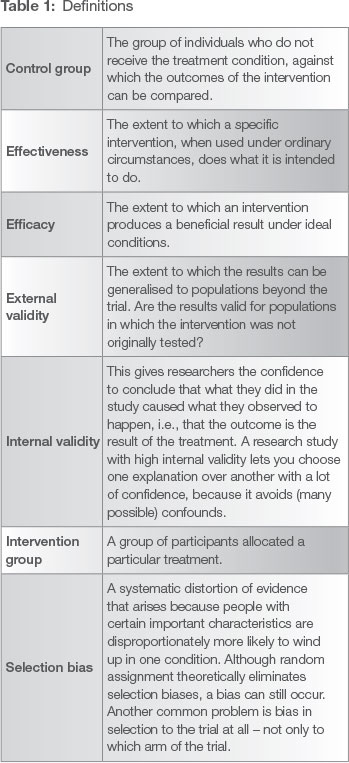
If policymakers propose to invest in a violence prevention intervention (a parenting programme, a life skills curriculum, reducing access to alcohol)6internal validity (see Table 1 for a summary of definitions). Internal validity is the extent to which bias and confounding variables that may unintentionally affect the results are kept to a minimum in the conduct of a trial. Efficacy trials emphasise internal validity, and answer the question: 'Does this intervention work under optimal conditions?'
Effectiveness trials, by contrast, answer a different question: 'Does this intervention work under "real world" conditions?'7
Efficacy and effectiveness exist on a continuum. Taking part in research often involves procedures and commitments that are different from routine practice. It may not be possible for an intervention delivered under carefully controlled research conditions to be replicated under routine conditions. This presents a challenge to evaluating the impact of large-scale public health programmes.89
Generalisability
Related to issues of efficacy and effectiveness, another important question is whether the intervention will work with a different group of people. If a parenting programme was tested in Soweto with Setswana speakers, will it also work with isiZulu speakers in Ixopo, and Afrikaans speakers in Eldorado Park? This question - one of external validity, or generalisability - is crucial if policymakers wish to roll the programme out widely (see Box 1). If it was established as effective in one place, will it remain effective when taken to other places?
Efficacy and effectiveness are linked to the concept of generalisability. When a trial is conducted in an ideal setting with all factors and variables being controlled (as far as is possible) by the researcher, it may lack a measure of generalisability. Characteristics of those enrolled in a study (e.g. sex, age, severity of the disease, racial groups) are primary factors in generalisability.10
Geographic settings (urban versus rural) and health care systems can also be significant factors,11 particularly when something more complex than a drug (e.g. screening programmes, behavioural therapy) is being tested. Multiple factors determine the external validity (i.e. generalisability or applicability) of studies, including of RCTs: characteristics of those taking part in the programme and in the study, the problem under investigation, costs, compliance, co-morbidities and concomitant interventions. Also, certain aspects of study design -eligibility criteria, study duration, mode of intervention, outcomes, adverse events assessment, or type of statistical analysis - greatly influence the degree of generalisability.12
Phases of scientific discovery
For scientific evidence to be useful to policymakers, they need to distinguish which research and types of evidence will be most useful to them, which means understanding how new interventions are developed and taken to scale. Thornicroft and colleagues13
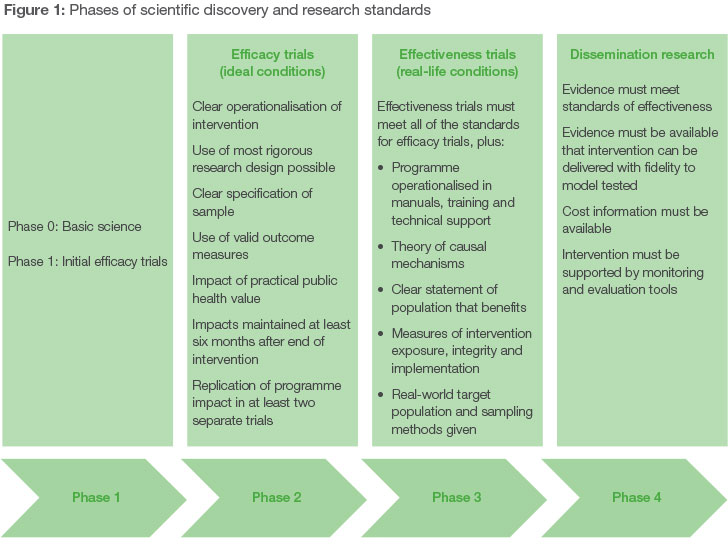
The starting point for any scientific discovery (Phase 0) is exploring relevant theories, generating hypotheses about how interventions might work, and conducting fundamental epidemiological research to understand factors driving the problem. These understandings can then be transferred to develop interventions. Phase 1 includes early studies that aim to identify key components of an intervention. In Phase 2, investigators include efficacy studies (usually an RCT) that assess whether the intervention is effective under ideal conditions.14(Phase 3). These studies may be implemented in target populations over a longer time period to identify other effects. Scaling up interventions that are scientifically proven and applicable to the everyday procedures of violence prevention practice can be challenging, and form Phase 4.
These Ave phases work together with standards set by the Institute of Medicine,1516Figure 1 for a summary of these stages).
In addition, policymakers need to make decisions about how to weigh the evidence when considering implementation.1819
- Adequacy evidence - was the intervention implemented and found to be successful?
- Plausibility evidence - were the changes found in adequacy evidence shown to not be due to other influences?
- Probability evidence - were the changes observed not due to chance? For probability evidence, RCTs are needed.
Why randomised controlled trials, and where do they fit in?
RCTs are most successful in achieving high levels of internal validity and are thus considered the standard method for efficacy and effectiveness trials.20control group (i.e. those who do not receive the intervention) are randomly assigned to those groups (hence randomised controlled trial). With a sufficiently large sample, randomisation ensures fair distribution of the problem and related characteristics across the two groups. This capacity of RCTs to ensure a fair comparison between intervention and control groups is a particular strength, as it allows the most accurate possible estimate of what would have happened if the intervention group had not received the intervention.2122
However, randomisation may face opposition from policymakers and practitioners, who may believe in the value of an intervention for certain individuals or groups, often regardless of its actual evidence base, and therefore oppose random allocation.2324252627
In the case of difficulties with, or objections to, individual randomisation, one possible solution is to use a cluster RCT, with the group (cluster) rather than the individual as the unit of randomisation. Members of a cluster (e.g., village, clinic, community) who might naturally influence one another or be affected as a group by prevailing conditions are clustered together and then randomised.28
RCTs are one of the most reliable methods of determining the effects of a treatment, because they are high in internal validity. However, they - like other trial designs that are used under very particular conditions - are not necessarily high in external validity. For instance, RCTs are often conducted with specific types of people under highly controlled conditions, and making inferences to the wider population may be difficult.2930313233
Other limitations of RCTs are that they are time-and energy-intensive as well as expensive, and may not be feasible for all interventions or settings. These threats to external validity limit the potential generalisation of the research results, an important consideration given the increasing emphasis on the translation of research results into practice.34
One common response to this is to try to have tests of programmes explicitly examine 'what works for whom, in what circumstances, in what respects and how', an approach called 'realist evaluation'.35 This makes sure that the mechanisms that actually produced the change are clearly specified and consistent with the best available scientific theory and evidence, providing policymakers with the very detailed and practical understanding of a programme that is necessary before deciding whether that programme may be suitable for their context or not.36
Case study: Box 1
Cognitive therapy-based intervention using community health workers (Pakistan)
Rahman and colleagues implemented a cognitive behavioural intervention in which local health workers, known as Lady Health Workers, delivered a mental health intervention component.373839
Alternatives to the RCT
Aside from external validity, there are many other reasons why an RCT might not be the best method to assess intervention effectiveness. Reasons might include the following: when the impact is likely to be large, making randomisation potentially unethical; when the timing of the impact is likely to be long, making follow-up and assessment too expensive; or in a situation where a national roll-out of an intervention (such as in the Integrated Management of Childhood Illness [IMCI]) has already occurred, because a policy (or ideological) decision has been made about implementing a particular intervention.40 In these cases, random allocation may not be possible. But there are alternatives, for instance:
- In consultation with policymakers, it might be possible to use a 'stepped-wedge' design, where implementing the intervention in certain areas is delayed - here the order of receiving the intervention is randomised.
- In some cases, there may be a clear cut-off that defines who gets the programme and who does not. For instance, the government may decide that only those whose household income is below a certain level will get the programme. Bonell and colleagues argue that in cases such as this a 'regression-discontinuity' analysis can be used, which examines the association between the outcome of the intervention and the measure of need.4143
- Another alternative design is what is known as non-random quantitative assignment of treatment.4445
- A similar design is a non-randomised cohort study where two groups are followed over time with baseline assessments, intervention is delivered to one group and not the other, and follow-up interviews are conducted to assess outcome. In this case two neighbourhoods can be chosen and matched as closely as possible. Without randomisation, ascribing change solely to the intervention is difficult, but if changes are in the hypothesised direction, policymakers might have sufficient evidence of effectiveness to implement.
- A final option is a repeated cross-sectional survey (or interrupted time series), which permits the evaluation of secular trends.4647
The point is that programmes that are to be rolled out widely (and where people cannot be randomised) must still be evaluated, using the best possible research design.
Scale-up and 'when is there enough evidence'
Attempts have been made to rank the levels of evidence in order to assist policymakers in making decisions about evidence-based policy and practice. Within this framework the design and conduct of the research is categorised in terms of strength of evidence. In one of the most widely-used frameworks, there are Ave levels of evidence.484950
Weaker evaluations mean that there is less chance that programmes will be effective when implemented widely and under real-world conditions. In addition, even implementing an established programme with a strong evidence base in a new setting runs the risk of changing some of the fundamental characteristics that led to programme success in the earlier settings (see Box 2). For this reason, every programme, no matter how strong its evidence base, should be evaluated when it is moved to a new setting.5152
Case study: Box 2
Nutrition and psychosocial stimulation and mental development of stunted children (Jamaica)
Grantham-McGregor and colleagues implemented an intervention study of nutritional supplementation and psychosocial stimulation of stunted children.535455
Conclusions
Where does this leave policymakers? There are several principles to apply. Firstly, if a meta-analysis finds that a programme is effective, it is likely to be a good investment. At that point, experts should be commissioned to ensure cultural acceptability in the new setting, and to evaluate it - preferably using an RCT, to ensure good estimation of effect. Secondly, if there is no meta-analysis, one might commission experts to conduct one if enough RCTs testing the programme have been carried out. Thirdly, if a programme has shown promise in one RCT or in other forms of evaluation, conduct at least two RCTs before considering rolling the programme out. Programmes that are grounded in strong theory and have clear manuals to guide them are more likely to be effective than those that do not meet these criteria.5758
In this article we have argued that policymakers should consider evaluation of programmes an essential investment, as part of their responsibility to taxpayers, to ensure that public funds are wisely invested. We have discussed how RCTs are very powerful designs but may not always be possible, and have a number of limitations. Given this, we have suggested a number of alternative designs and approaches to evaluation that can help policymakers decide on which programmes might work best, and how to assess them in new settings. That policymakers should draw on the strongest possible evidence, and that programmes should be monitored and evaluated, are, however, beyond question.
NotesReferences
- 1 C Pope, Resisting evidence: the study of evidence-based medicine as a contemporary social movement, Health, 7:3, 2003, 267-282.
- 2 T Greenhalgh et al, Evidence based medicine: a movement in crisis?, BMJ, 348, 2014, g3725.
- 3 DT Campbell and JJ Russo, Social experimentation, Thousand Oaks: Sage, 1999.
- 4 WR Shadish, TD Cook and DT Campbell, Experimental and quasi-experimental designs for generalized causal inference, Boston: Houghton Mifflin, 2002.
- 5 CP Bonell et al, Alternatives to randomisation in the evaluation of public health interventions: design challenges and solutions, J Epidemiol Community Health, 65:7, 2011, 582-7.
-
6 See the World Health Organization's series of briefings on the evidence for effective violence prevention interventions: World Health Organization (WHO), Violence prevention: he evidence, Geneva: WHO, 2009, http://www.who.int/violence_injury_prevention/violence/4th_milestones_meeting/publications/en/.
» http://www.who.int/violence_injury_prevention/violence/4th_milestones_meeting/publications/en/ - 7 M Godwin et al, Pragmatic controlled clinical trials in primary care: the struggle between external and internal validity, BMC Medical Research Methodology, 3:1, 2003, 28.
- 8 CG Victora, J-P Habicht and J Bryce, Evidence-based public health: moving beyond randomized trials, Journal Information, 94:3, 2004.
- 9 L Rosen et al, In defense of the randomized controlled trial for health promotion research, American Journal of Public Health, 96:7, 2006, 1181;
- S Tilford, Evidence-based health promotion, Health Education Research, 15:6, 2000, 659-663;
- SG West et al, Alternatives to the randomized controlled trial, American Journal of Public Health, 98, 2008, 1359-1366;
- M Slade and S Priebe, Are randomised controlled trials the only gold that glitters?, The British Journal of Psychiatry, 179:4, 2001, 286-287.
- 10 G Gartlehner et al, Criteria for distinguishing effectiveness from efficacy trials in systematic reviews, Rockville: Agency for Healthcare Research and Quality, 2006.
- 11 PM Rothwell, External validity of randomised controlled trials: 'to whom do the results of this trial apply?', The Lancet, 365:9453, 2005, 82-93.
- 12 G Gartlehner et al, Criteria for distinguishing effectiveness from efficacy trials in systematic reviews, Rockville: Agency for Healthcare Research and Quality, 2006.
- 13 G Thornicroft, H Lempp and M Tansella, The place of implementation science in the translational medicine continuum, Psychological Medicine, 41:10, 2011, 2015-2021.
- 14 NC Campbell et al, Designing and evaluating complex interventions to improve health care, BMJ, 334:7591, 2007, 455-459.
- 15 PJ Mrazek and RJ Haggerty, Reducing risks for mental disorders: frontiers for preventive intervention research, Washington DC: Committee on Prevention of Mental Disorders, Institute of Medicine, 1994.
- 16 BR Flay et al, Standards of evidence: criteria for efficacy, effectiveness and dissemination, Prev Sci, 6:3, 2005, 151-75;
- G Thornicroft, H Lempp and M Tansella, The place of implementation science in the translational medicine continuum, Psychol Med, 41:10, 2011, 2015-21;
- DL Olds, L Sadler and H Kitzman, Programs for parents of infants and toddlers: recent evidence from randomized trials, J Child Psychol Psychiatry, 48:3-4, 2007, 355-91.
- 17 DL Olds, L Sadler and H Kitzman, Programs for parents of infants and toddlers: recent evidence from randomized trials, J Child Psychol Psychiatry, 48:3-4, 2007, 355-91;
- BR Flay et al, Standards of evidence: criteria for efficacy, effectiveness and dissemination, Prev Sci, 6:3, 2005, 151-75;
- M Tomlinson et al, Scaling up Health: where is the evidence?, PLoS Med, 10:2, 2013, e1001382;
- G Thornicroft, H Lempp and M Tansella, The place of implementation science in the translational medicine continuum, Psychol Med, 41:10, 2011, 2015-21.
- 18 DA Ross et al, The weight of evidence: a method for assessing the strength of evidence on the effectiveness of HIV prevention interventions among young people, in DA Ross, B Dick and J Ferguson (eds.), Preventing HIV/AIDS in young people: a systematic review of the evidence from developing countries, Geneva: WHO, 2006, 79-102.
- 19 CG Victora, JP Habicht and J Bryce, Evidence-based public health: moving beyond randomized trials, Am J Public Health, 2004, 400-5;
- JP Habicht, CG Victora and JP Vaughan, Evaluation designs for adequacy, plausibility and probability of public health programme performance and impact, Int J Epidemiol, 28:1, 1999, 10-8.
- 20 CG Victora, J-P Habicht and J Bryce, Evidence-based public health: moving beyond randomized trials, Journal Information, 94:3, 2004.
- 21 CP Bonell et al, Alternatives to randomisation in the evaluation of public health interventions: design challenges and solutions, J Epidemiol Community Health, 65:7, 2011, 582-7.
- 22 Ibid.
- 23 Ibid.
- 24 JR Mertens et al, Effectiveness of nurse-practitioner-delivered brief motivational intervention for young adult alcohol and drug use in primary care in South Africa: a randomized clinical trial, Alcohol and Alcoholism, 49:4, 2014, 430-38.
- 25 S Birkeland, E Murphy-Graham and CH Weiss, Good reasons for ignoring good evaluation: the case of the drug abuse resistance education (D.A.R.E.) program, Evaluation and Program Planning, 28, 2005, 247-56.
- 26 A Petrosino, C Turpin-Petrosino and J Buehler, Scared straight and other juvenile awareness programs for preventing juvenile delinquency: a systematic review of the randomized experimental evidence, Annals of the American Academy of Political and Social Science, 589, 2003, 41-62.
- 27 L Rosen et al, In defense of the randomized controlled trial for health promotion research, American Journal of Public Health, 96:7, 2006, 1181.
- 28 Ibid.
- 29 Ibid.
- 30 CP Gross et al, Reporting the recruitment process in clinical trials: who are these patients and how did they get there?, Annals of Internal Medicine, 137:1, 2002, 10-16.
- 31 D Nutbeam, Evaluating health promotion - progress, problems and solutions, Health Promotion International, 13:1, 1998, 27-44.
- 32 PM Rothwell, External validity of randomised controlled trials: 'To whom do the results of this trial apply?', The Lancet, 365:9453, 2005, 82-93.
- 33 CG Victora, J-P Habicht and J Bryce, Evidence-based public health: moving beyond randomized trials, Journal Information, 94:3, 2004.
- 34 SG West et al, Alternatives to the randomized controlled trial, American Journal of Public Health, 98, 2008, 1359-1366.
- 35 R Pawson et al, Realist review - a new method of systematic review designed for complex policy interventions, J Health Serv Res Policy, 10:1, 2005, 21-34.
- 36 Ibid.
- 37 A Rahman et al, Cognitive behaviour therapy-based intervention by community health workers for mothers with depression and their infants in rural Pakistan: a cluster- randomised controlled trial, The Lancet, 372:9642, 2008, 902-9.
- 38 C Lund et al, PRIME: a programme to reduce the treatment gap for mental disorders in five low- and middle-income countries, PLoS Med, 9:12, 2012, e1001359.
- 39 K Daniels et al, Research supervision of community peer counsellors for infant feeding in South Africa: an exploratory qualitative study, Human Resources for Health, 8:6, 2010.
- 40 CP Bonell et al, Alternatives to randomisation in the evaluation of public health interventions: design challenges and solutions, J Epidemiol Community Health, 65:7, 2011, 582-7.
- 41 Ibid.
- 42 WT Gormley Jr et al, The effects of universal pre-K on cognitive development, Dev Psychol, 41:6, 2005, 872-84.
- 43 Ibid.
- 44 SG West et al, Alternatives to the randomized controlled trial, Am J Public Health, 98:8, 2008, 1359-66.
- 45 Ibid.
- 46 CP Bonell et al, Alternatives to randomisation in the evaluation of public health interventions: design challenges and solutions, J Epidemiol Community Health, 65:7, 2011, 582-7.
- 47 KM Hennigan et al, Impact of the introduction of television on crime in the United States: empirical findings and theoretical implications, Journal of Personality and Social Psychology, 42:3, 1982, 461-477.
- 48 PB Burns, RJ Rohrich and KC Chung, The levels of evidence and their role in evidence-based medicine, Plastic and Reconstructive Surgery, 128:1, 2011, 305.
-
49 Oxford Centre for Evidence-Based Medicine (OCEBM) Levels of Evidence Working Group, The Oxford 2011 levelsof evidence, OCEBM, 2011, http://www.cebm.net/index.aspx?o=5653.
» http://www.cebm.net/index.aspx?o=5653 - 50 DL Olds, L Sadler and H Kitzman, Programs for parents of infants and toddlers: recent evidence from randomized trials, J Child Psychol Psychiatry, 48:3-4, 2007, 355-91.
- 53 SM Grantham-McGregor et al, Nutritional supplementation, psychosocial stimulation, and mental development of stunted children: the Jamaican study, Lancet, 338:8758, 1991, 1-5.
- 54 Ibid.
- 55 S Grantham-McGregor et al, Developmental potential in the first 5 years for children in developing countries, The Lancet, 369:9555, 2007, 60-70.
- 56 P Gertler et al, Labor market returns to an early childhood stimulation intervention in Jamaica, Science, 344:6187, 2014, 998-1001.
- 57 BR Flay et al, Standards of evidence: criteria for efficacy, effectiveness and dissemination, Prev Sci, 6:3, 2005, 151-75.
- 58 JL Aber et al, Cluster randomized trial of a large-scale education initiative in the Democratic Republic of the Congo: baseline findings and lessons, paper presented at Society for Research on Educational Effectiveness Spring 2012 Conference, Washington DC, 9 March 2012.