Evaporation from a Water Surface Exposed to the Natural Environment
Abstract
The problem of evaporation from a heated horizontal water surface that is exposed to the natural environment is analysed. An approximate equation is deduced that predicts the turbulent convection mass transfer or evaporation rate for cases where the water temperature is higher than that of the ambient air.
Introduction
At the time of writing exactly 200 years ago, i.e. 1802, Dalton's classical paper was published entitled "Experimental essays on the constitution of mixed gases; on the force of steam or vapour from water and other liquids in different temperatures, both in a Torricellian vacuum and in air; on evaporation and on the expansion of gas by heat". In this paper Dalton stated that the rate of evaporation from a water surface is proportional to the difference in vapour pressure at the surface of the water and that in the surrounding air, and furthermore that the wind speed affects this proportionality. Subsequently numerous researchers investigated the problem of evaporation on the basis of Dalton's model. A recent critical and comprehensive review of many of the equations employed to predict evaporation rates from water surfaces is presented by Sartori2
Analysis
In the following analysis an approximate equation is deduced that predicts the convective mass transfer or evaporation rate from a horizontal water surface exposed to the natural environment. Initially the transfer rate due to natural convection only is deduced and the equation is then extended to make provision for windy (forced convection) conditions.
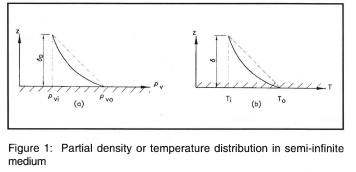
Consider a stationary semi-infinite fluid (binary mixture consisting of air and water vapour) in which the concentration or partial density ρvi of the species of interest (water vapour) is initially uniform. Beginning with the time t=0, the partial vapour density at the z = 0 boundary or surface is maintained at a greater level ρvo as shown in figure 1(a)
Water vapour will diffuse into the semi-infinite medium to form a concentration boundary layer, the thickness of which increases with time.
The mathematical equation of time dependent diffusion in a binary mixture, expressed in terms of the molar concentration c is as follows:

The diffusion flux is driven solely by the concentration gradient strictly in an isothermal and isobaric medium. Nevertheless, equation (1) is a good approximation in the present non-isothermal system, where concentration gradients are usually superimposed on temperature gradients. For the present problem the concentration c can be replaced by the partial water vapour density ρv such that equation (1) becomes

Since changes in Kelvin temperature are relatively small the diffusion coefficient can be assumed to be constant.
This equation is analogous to the time-dependent equation for conduction into a semi-infinite body i.e.

If the temperature of a semi-infinite solid is initially uniform at Ti and a sudden increase in temperature to To occurs at z = 0 as shown in figure 1(b), Schneider3
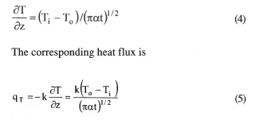
An effective heat transfer coefficient can be expressed in terms of this heat flux i.e.

Similarly, by solving equation (3) for the case where the semi-infinite solid at an initial uniform temperature Ti is suddenly exposed to a constant surface heat flux qq, the latter can, according to Holman4oq as

The corresponding effective heat transfer coefficient is defined as

It follows from equations (6) and (8) that for the same temperature difference i.e. for
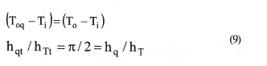
Due to the analogy between mass and heat transfer the solution of equation (2) gives the following relations corresponding to equations (4) to (9) respectively:
If the initial partial density at z = 0 is suddenly increased to ρvo
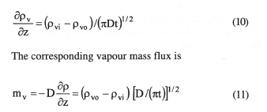
An effective mass transfer coefficient can be expressed in terms of this mass flux i.e.

If vapour is generated uniformly at a rate mvm at z=0, this mass flux can be expressed in terms of an effective partial vapour density ρvom to give analogous to equation (7)

The corresponding effective mass transfer coefficient is defined as

It follows from equations (12) and (14) that for the same effective difference in partial density i.e. for

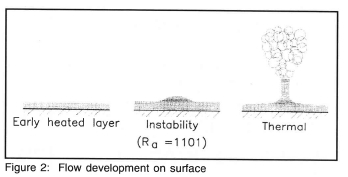
These latter equations are applicable in the region of early developing concentration distribution in a semi-infinite region of air exposed to a water or wet surface. According to Merker5 > 1101, unstable conditions prevail with the result that water vapour is transported upwards away from the wetted surface by means of "thermals" as shown in figure 2.
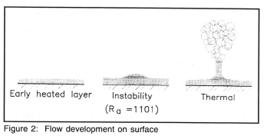
The generation of such thermals is periodic in time, and both spatial frequency and rate of production are found to increase with an increase in heating rate.
For an analysis of the initial developing concentration of vapour partial density distribution near the suddenly wetted surface at z = 0, consider figure 1(a).
The approximate magnitude of the curvature of the partial density profile is the same as the change in slope dpv/∂z across the relatively small concentration layer thickness or height δD i.e.

Figure 1(a) suggests the following partial density gradient scales:
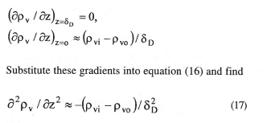
The approximate magnitude of the term on the right-hand side of equation (2) can be deduced by arguing that the average partial density of the δD-thick region increases from the initial value ρvi by a value of (ρvo - ρvi)/2 during the time interval of length t.
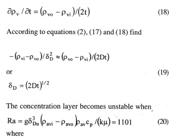
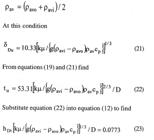
The average mass transfer coefficient during the period t is found by integrating equation (12) i.e.
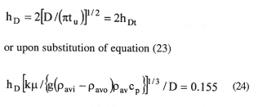
If the surface generates vapour at a uniform rate it follows from equation (15) that
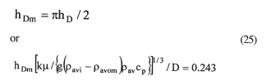
It is stressed that these equations are only applicable to the first phase of the heat transfer process and do not include the second phase during which thermals exist. No simple analytical approach is possible during this latter phase, although the mean mass transfer coefficient during the breakdown of the concentration layer will probably not differ much from the first phase. This would mean that the mean mass transfer coefficient over the cycle of conduction layer growth and breakdown is of approximately the same value as that obtained during the first phase of the cycle.
By following a procedure similar to the above, the analogous problem of heat transfer during natural convection above a heated horizontal surface for a constant surface temperature of To can be analysed to find according to Kröger8

and for the case of uniform heat flux q
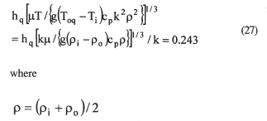
Note the similarity between equations (24) (25) and (26) (27) respectively. These equations are applicable to natural convection mass and heat transfer respectively.
During windy periods (forced convection) the transfer coefficients generally increase with increasing wind speed. According to the Reynolds-Colburn analogy and the analogy between mass and heat transfer, the following relations exist (see Holman4
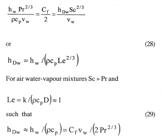
For Le = 1 find D=k/(ρcp). Substitute this into equation (24), to find together with equation (29) the rate of evaporation from a horizontal wetted surface at a uniform partial vapour pressure ρvo.
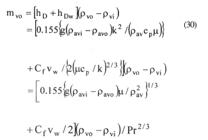
If the vapour is generated uniformly at z = 0 find the rate of evaporation by adding equations (25) and (29).


The dimensionless mass transfer coefficient corresponding to equation (31) is
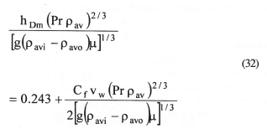
The effective friction coefficient Cf depends on wind velocity, surface roughness and heat and mass transfer rates, and must be determined experimentally.
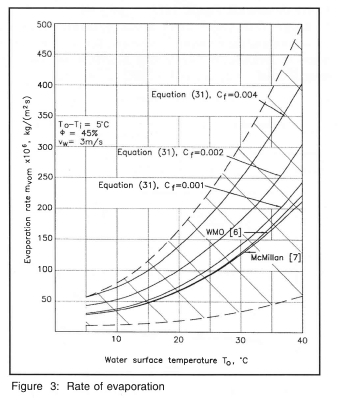
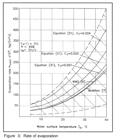
Sartori2figure 3. In figure 3 the rate of evaporation is shown as a function of wetted surface temperature To and ambient air temperatures Ti = To - 5, a relative humidity of φ = 45 per cent and a wind speed of vw =3 m/s at about 1m above the wetted surface. Sartori2 67figure 3. Equation (31) is also shown in figure 3 for an ambient pressure of p = 1052f.
Conclusion
Many horizontal natural water or wetted surfaces having a relatively low thermal conductivity and exposed to solar radiation, transfer both mass and heat to the natural environment.
Under these conditions the rate of evaporation at the wetted surface will be determined primarily by the heat flux due to solar radiation and should thus be evaluated according to equation (31) for cases where ρavi > ρavo. Although equation (31) is an approximation it is based on a sound theoretical approach. In this equation the effective friction coefficient Cf must be determined experimentally for a wind velocity measured at a particular height near the wetted surface.
References
- 1. Dalton, J., Experimental essays on the constitution of mixed gases on the force of steam or vapour from water and other liquids in different temperatures both in a Torricellian vacuum and in air; on evaporation and on the expansion of gases by heat, Mem. Manchester Liter, and Phil. Soc. 5-11, 1802, pp. 535 - 602.
- 2. Sartori, E., A critical review on equations employed for the calculation of the evaporation rate from free water surfaces, Solar Energy, 68 (1), 2000, pp. 77 - 89.
- 3. Schneider, P.J., Conduction Heat Transfer, Addison- Wesley Publ. Co. Inc., Reading, Mass, 1955.
- 4. Holman, J. P., Heat Transfer, McGraw Hill Book Co., New York, 1986.
- 5. Merker, G.P., Konvektiewe Wärmeübertragung, Springer-Verlag, Berlin, 1987.
- 6. WMO - World Meteorological Organization, Measurement and estimation of evaporation and evapotranspiration. In Tech. Rep., 83, Working Group on Evaporation Measurement, Geneva, 1966, p. 92.
- 7. McMillan, W., Heat dispersal - Lake Trawsfynyd cooling studies, Symposium on Freshwater Biology and Electrical Power Generation, Part 1, 1971, pp. 41 - 80.
- 8. Kröger, D. G., Convection heat transfer between a horizontal surface and the natural environment, South African Institution of Mechanical Engineering Research and Development Journal, 18(3), November 2002, pp. 49 - 53.