Application of maintenance partnering in South African manufacturing industries
Abstract
Global competition is putting pressure on companies to review their business operations, such as maintenance, for business survival. This review resulted in strategies such as utilising contractors to supplement internal maintenance staff in carrying out maintenance work. However, this traditional client-contractor relation has been found detrimental to improving the effectiveness of maintenance management. Recent developments in maintenance management have identified maintenance partnering as an alternative strategy to the traditional approach to meet the challenges brought by global competition. Maintenance partnering allows all parties to work together with common objectives and shared risks. This paper discusses the results of an investigation into the experience of South African manufacturing industries regarding maintenance partnering. Factors such as top management support, common goals and relationship building were identified as critical for successful partnering. The benefits and disadvantages of maintenance partnering were also identified.
Introduction
The maintenance function within many business enterprises is becoming more important as the technical systems currently in use are nearing the end of their design life. Examples are a number of the coal-fired power stations, petrochemical refineries, and smelters. These systems are large and complex and some of them are more than 30 years old. Increased age inevitably leads to increased maintenance intervention to counter the effects of decreasing reliability due to wear-out of equipment.
Maintenance management is a relatively new discipline and many options are being explored and researched to optimise the planning and organisation of the maintenance department in companies that operate large systems. When a proper maintenance plan has been formulated -stating which preventative maintenance tasks should be performed, which types of skills are required to perform the tasks, and the duration of such tasks - an organisational structure should be formulated next. The organisation structure is then populated with the right people to perform the maintenance tasks.
For many decades, the dominant organisational principle was to maintain a fairly large complement of maintenance workers to respond to requests for maintenance within a short time period. Only sophisticated maintenance tasks, that required special equipment or skills, were usually outsourced. The global trend has now changed to outsourcing of more maintenance tasks with fewer in-house maintenance workers. Maintenance partnering is one form of outsourcing that has as a goal the establishment of a mutual relationship between the company and the maintenance service provider. The goal of this research was to investigate the current situation in the Gauteng region of South Africa in terms of the success of partnering agreements. A survey was performed in the Gauteng region to obtain specific information on partnering in maintenance. Relevant literature was scanned on partnering practices in maintenance, but only a limited number of papers have been published on this environment, whilst literature on partnering in general is readily available.
Research methodology
A descriptive survey method, as part of a qualitative research approach, was adopted to gather information for the research. The objective of the survey was to establish the application of maintenance partnering agreements compared with traditional client-contractor relations. A further objective was to establish the key factors that are required to shift from the traditional approach towards a full maintenance partnering relationship.
Information was gathered from service receivers (customers) and suppliers (contractors) to obtain their views on maintenance partnering. Therefore two types of self-completing questionnaires were developed; one for customers and the other for contractors. Most of the questions were multiple-choice, allowing statistical analysis of the data. However there were open-ended questions that required written textual responses, which were then manually processed. The survey was limited to manufacturing companies in the Gauteng area.
The sample size for both groups was 50 questionnaires each. The following issues had to be addressed when compiling the questionnaire:
the number and structure of maintenance partnering agreements in place;
- the drivers for implementation of maintenance partnering;
- the period maintenance partnering had been used;
- the performance measurements in place;
- the attitude of companies towards maintenance partnering; and
- the views of customers compared to those of contractors.
Historical review of maintenance
Over the past 50 years, maintenance has changed drastically, due to a huge increase in the number and variety of physical assets throughout the world that need to be maintained. Similarly, other environmental changes, such as globalisation of the market economy, have had a significant impact on how maintenance of plant equipment is managed.
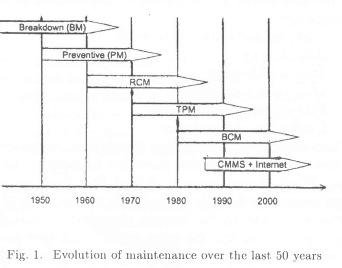
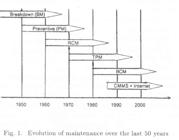
These changes have resulted in a rapidly growing awareness of the connection between product quality and maintenance and increased pressure to achieve high plant availability at minimum costs. Maintenance managers have to adopt completely new ways of thinking. The evolution of maintenance through the last 50 years was summarised by Pradhan1 as indicated in Fig. 1.
Period before 1950
In the period up to World War II, the technical systems (assets) were relatively simple in design and wear-out was predictable. The prevention of failures was not really practised, and the skill level was lower than it is today. The general maintenance approach was breakdown maintenance.
Period between 1950 and 1960
The large number of systems used during World War II caused operators and maintainers to review the maintenance approach and drastic changes occurred. Wartime pressures increased the demand for goods of all kinds while the supply of maintenance resources (people, spares and tools) decreased. The technical systems also became more complex. As this dependence grew, downtime came into sharper focus. This led to the idea that equipment failures could and should be prevented, hence the concept of planned and preventive maintenance (PM).
Period between 1960 and 1970
The cost of maintenance started to rise sharply relative to other operating costs due to less value added by PM and continued unplanned maintenance. Consequently, reliability and availability became key issues. This led to the evolution of reliability centred maintenance (RCM).
Moubray2 defined RCM strategy as a process used to determine the maintenance requirements of any physical asset in its operating context. RCM is a systematic process used to optimise reliability and associated maintenance tactics with respect to operational requirements.
Period between 1970 and 1980
Previously developed maintenance strategies often resulted in machines being over-serviced in an attempt to improve production. This was attributed to a lack of involvement of all parties directly affecting machine performance. This led to the evolution of total productive maintenance (TPM), which allowed operators to carry out some of the routine maintenance tasks because they were close to the machines.
Nakajima3 defined TPM as a strategy for achieving productive maintenance efficiency through a comprehensive system based on respect for individuals and total employee participation. The main issue about TPM is to encourage employees such as operators getting involved in the routine maintenance.
Period between 1980 and 1990
Maintenance remains one of the very few business areas where a significant increase to company profits can be achieved. These factors led to the development of the business-centred maintenance (BCM) approach. Kelly4 defined BCM as a strategy utilising business and management principles for effective maintenance management. It follows that a management process firstly defines the function of the department, and secondly the objectives are set, based on the environment and other factors. Finally resources are organised to match the anticipated workload and control measures are put in place to accomplish the set objectives and provide corrective actions. The maintenance manager is expected to utilise these common management practices applied by organisations to increase shareholder value.
Period between 1990 and 2000
Maintenance managers started to realise that the performance of plant equipment does not lie solely with the focus on the equipment itself, but a systems approach towards maintenance management should be adopted. All the factors, technical and economical, that could have an impact on the effectiveness of maintenance must be analysed. The application of information systems and the Internet greatly improved the effectiveness of maintenance organisations.
Current Reality in Maintenance
The maintenance manager has, at his disposal, tools such as the strategic management process to define long-term management of the maintenance function. Pearce & Robinson5 defined strategic management as the set of decisions and actions that result in the formulation and implementation of the plans designed to achieve a company's objectives.
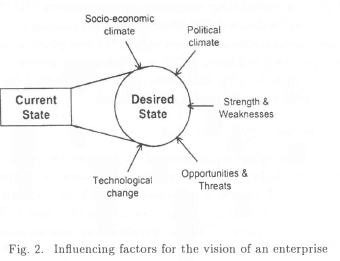
The current state of maintenance must be understood first before any goals can be set. The next step is to define the desired position of the maintenance department based on its current state. For instance, the vision of the maintenance department could be to achieve high plant availability at the lowest operating cost within the manufacturing industry of similar operation and size. Several environmental factors need to be taken into account to achieve this goal. The factors that need to be considered are illustrated in Fig. 2.

Given the strategic management model of Pearce & Robinson,5- maintenance could select a business strategy from a number of available grand strategies for the success of its business. Pearce & Robinson5 defined grand strategy as a comprehensive general approach that guides a firm's major actions. It indicates the time period over which long-range objectives could be met.
Typical grand strategies of particular interest to any maintenance department could be j oint ventures, strategic alliances, consortia, turnaround, etc. The grand strategy relevant to this research is strategic alliances in the form of maintenance partnering between a customer and service provider.
Partnering as a competitive strategy
What is a partnering?
Rothery & Robertson6 defined partnering as "a long-term strategy to achieve higher performance and/or lower costs through joint, mutually dependent, actions of independent organisations". Partnering is about sharing risks and rewards, achieving common goals, and operating in mutual dependency. The element of risk sharing and mutually agreed objectives makes partnership strikingly different from the traditional customer- supplier relationship. It takes time to develop such a relationship.
Bennett & Jayes7 supported this view and stated that "mutual objectives, agreed method of problem resolution and active search for continuous measurable improvements are the cornerstone to partnering". The features of partnerships are:
- Common and shared objectives
- Risk sharing
- Trust and honesty
- Long-term commitment
- Performance-related target
- Continuous improvement
Partnering is about a mindset change from managing activities to managing results through a long-term relationship. When the attention is shifted from how issues to what issues, the focus is more closely on the needs of the business and less on its internal operational constraints. The suppliers become the other partner and they get involved in bringing forward creative ideas, new ways of doing things, new technologies and approaches. Their maintenance experience, after all, comes from doing the work for several customers.
Why seek partnering?
Historically, the owner hired a general contractor, selected through a competitive bid process, to carry out maintenance repair work. However, this traditional client-contractor relation has been found very expensive and detrimental to improving the effectiveness of plant equipment.
The objectives of the two parties are not mutual in that customers want maximum work at minimum price, whilst contractors want minimum work at maximum price. This situation is definitely not conducive to increased plant performance, productivity or company profit.
However, with partnering, all parties work together, recognise and respect individual areas of expertise, and an environment of openness and trust is created. Consequently, productivity will increase while operating costs continue to decrease (due to smaller workforce, fewer maintenance costs, etc.).
Corbett8 said that if you choose to do something yourself, you should be better at it than the best company your competitor could hire to do it for them. If not, then you are sacrificing competitive edge, which few can afford to do for long. Clearly, maintenance partnering allows the customer to leverage the skills level of the contractor to increase business performance.
Business functions to consider for partnering
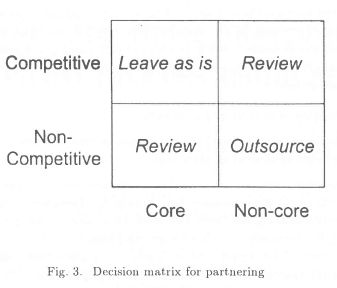
The conventional wisdom regarding partnering decision states that you should outsource your "non-core" business activities. However, deciding on what is non-core is not simple either. The value chain process defined by Porter9 could be utilised to establish the business's core functions and support functions. A better approach for deciding on the candidate for partnering was proposed by Dunn.10 This looks at the decision in terms of a two-by-two matrix, as shown Fig. 3.
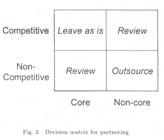
In Fig. 3, the partnering decision is considered along two dimensions. The first one, Core-Non-core, considers how important the activity proposed for partnering is to the organisation in achieving a long-term, strategic, competitive advantage in its chosen marketplace. In terms of maintenance, this will clearly vary from organisation to organisation, depending on the industry that it competes in, and its chosen strategy for competing in that industry.
The second dimension, Competitive-Non-competitive, relates to how competitively the function being considered for outsourcing is currently being performed in comparison to the external competitive marketplace.
Putting the two elements together provides four possible outcomes:
1. Those functions that are of strategic importance to the firm, and which are currently being performed competitively. The status quo should be retained.
2. Those functions that are of strategic importance to the firm, but which are not currently being performed competitively with the external marketplace need careful consideration. They could be re-engineered to ensure that they are performed competitively. Another possibility is to outsource the function in the short term, but in the long term, the function should be retained in-house.
3. Those functions that are not of strategic importance to the firm, and which are not currently being performed competitively with the external marketplace, should be outsourced. There is little value in investing in improving this function.
4. The final combination, those functions that are not of strategic importance to the firm, but which are being performed competitively with the external marketplace is more interesting. A number of options exist for this function, including
selling the function as a going concern
- extending the function to provide services to external customers
- outsourcing the function, or
- raising the profile of the function and turning it into a source of strategic competitive advantage.
The approach suggested by Dunn10 does not support outsourcing core processes of the business. This is not entirely correct as both non-core and core business elements could be candidates for outsourcing. If the value chain analysis as proposed by Porter9 highlights one core area as not being handled effectively by the company, the grand strategy from the strategic management model could indicate this as an area for partnering to create a competitive edge, without losing control of the function.
Areas of maintenance to consider for partnering
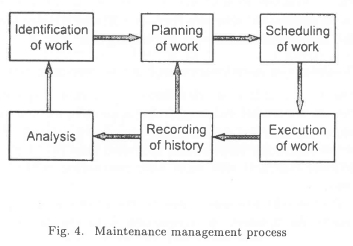
An important consideration in making the maintenance outsourcing decision is what aspects of maintenance to outsource. It is important to look at the maintenance management process, as shown in Fig. 4, in deciding what part of maintenance to outsource.
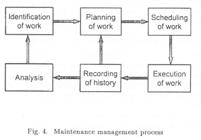
The traditional approach used by many organisations is to employ a contractor to perform all of the above activities with the exception of the analysis and work identification steps. The contractor is permitted to plan and schedule his own work, and decide how and when work is to be done, but the organisation retains control over what is to be done.
The approach requires the customer to have competent maintenance people who will be able to analyse and identify effective maintenance strategies for increased plant availability and reliability at minimum costs.
Another approach is to outsource all of the above steps, thus giving control over the development of equipment maintenance strategies to the contractor. In this instance, the contract must be structured around the achievement of desired outcomes in terms of equipment performance, with the contractor being given latitude to achieve this to the best of his ability.
This represents a true maintenance partnering arrangement if combined with the correct type of contract structure. There are advantages and disadvantages to each approach, and the most appropriate approach will depend on the client's particular situation.
Types of partnering
According to Nicholas,11 the types of partnerships are outlined in the form of alternative contract payment structures selected. These include:
Fixed price. All work is performed at a fixed price, based on a competitive bidding process.
Fixed price incentive fee. Work is carried out at a target price based on profit incentive. Although it says fixed price, in reality it is not true due to the incentive scheme which will make the price variable.
Variable price. In this case the price varies depending on the scope of work.
Cost plus fee. In this case the costs are reimbursed and at the same time the fee paid is based on an incentive scheme or fixed fee.
Price ceiling incentive. The price paid is purely based on performance targets, but limited to a certain ceiling value.
Each of these price structures represents a different level of risk sharing between the contractor and the customer, and a number of considerations will need to be made in determining the most appropriate payment structure. These include:
- the extent to which an objective assessment of the contract performance is possible;
- the ease with which realistic targets can be set for contractor performance;
- the administrative effort involved with each payment option; and
- the degree of certainty with which the desired contract outcomes can be specified
Transition arrangements may be put in place to gradually transfer the payment structure from one method to another over time, as a greater degree of certainty over the requirements of the contract, and more accurate knowledge of target levels of performance is established.
Results of survey
Response rate
The number of completed questionnaires was 22 for customers and 16 for contractors, representing a response rate of 44% and 32%, respectively. Considering the difficulty in getting responses for this type of research, this response rate was considered adequate to draw valid conclusions.
Respondents per industry category
All the customer respondents work for companies with more than 100 employees, representing large organisations. The contractors showed an even distribution between small (< 50 employees), medium (between 50 and 100 employees) and large organisations (> 100 employees).
Breakdown of maintenance contract per industry category
The survey indicated that sixteen customer respondents still use the traditional contracting approach, while six have contracts that are maintenance partnering related. Eight of the contractor respondents indicated that they have traditional contracts and eight have partnering related contracts.
Contractors are used more in the chemical and power generation industry in comparison with the fast-moving consumer goods industry. This could be attributed to the fact that most of the former have capital intensive plants and maintenance work is carried out during long annual outages requiring a substantial amount of personnel over that period.
Maintenance contract structure
This area investigated the inception period, duration of the contract and pricing structure.
Inception period. Two of the customer respondents have been using maintenance partnering for between 5 and 10 years, three have been involved in maintenance partnering for between 2 and 5 years, and one for between 1 and 2 years. This implies that many companies have only recently started to utilise maintenance partnering, but there is an increasing trend. Another important observation is that the traditional contracting approach has been used for longer than 10 years, which was expected.
Duration of contract. The feedback revealed that all the traditional contracts have a duration of less than 1 year. Those using maintenance partnering mostly indicated a duration of 3 to 5 years, while very few had a duration exceeding 5 years.
Pricing structure. It was interesting to note that of the six customers using maintenance partnering, four were not linked to performance measurements and the pricing structure was based on fixed costs.
The explanation given is that it is difficult to set an objective incentive scheme with equitable performance targets due to lack of accurate historical information.
However, the majority of respondents mentioned that they are considering the introduction of an incentive scheme in their contracts. Typical performance measurements used were:
- equipment availability
- cost reduction
- mean time to repair (MTTR)
- frequency of breakdowns
- recurrence of failures
- reliability (MTBF)
- safety record
Comments were also made that the measures in place must be simple, realistic and audit able.
Reasons for maintenance partnering
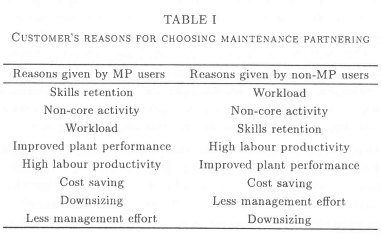
The reasons provided by customers for forming maintenance partnering are listed in Table I, in order of priority.
There is a close correlation in the responses from those using and not using maintenance partnering. Contractor skill retention, non-core activity and workload came out as the top three reasons. Cost saving, downsizing and less management effort were mentioned as the least important reason.
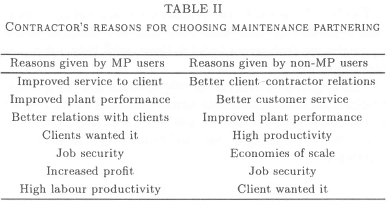
The reasons provided by contractors for forming maintenance partnering are listed in Table II, in order of priority.
As for contractors, both users and non-users of maintenance partnering agreement selected better customer service, improved plant performance and bet ter client-contractor relations as the top three reasons. However, there was no correlation at the bottom of the list.
Benefits of maintenance partnering
In general, respondents indicated that they derived the following benefits from utilising maintenance partnering:
- Better focus on core activity
- Better plant performance
- Stable workforce
- Sustained shareholder profit
- Regular income
Problems experienced
The following problems were experienced during the implementation phase.
Poor trust. It was difficult for the parties to trust each other in the initial stage of the contract. A number of respondents explained that there was lack of willingness, at all organisational levels, to share confidential information for fear of being exploited. This barrier made it difficult to work together as a team and see each other as 'partners'. Most respondents admitted that they underestimated the magnitude of the mind shift required.
Staff change. This was highlighted as the most sensitive barrier as it directly affected staff employed by the customer. This, at worst, could be seen in the same context as the impact due to retrenchment on employees. Issues that the parties needed to deal with were (i) do we shift employees to other plant areas, (ii) will the contractor take over surplus staff, or (iii) will employees be retrenched.
Actual cost not known. This affected different companies to varying degrees. In general, the problem was mainly attributed to the way respondents allocated their cost activities. If the real cost to maintenance equipment is not known, it becomes difficult to evaluate whether maintenance partnering is cost effective or counter productive. Objective performance measurements are also difficult to set.
Role clarity. The respondents stated that if the boundaries are not explicit when the agreement is set up, it may create conflict later on due to confusion relating to what role each party must play. The consequence of this role clarity is disparity in expectations from each other.
Key factors for successful implementation
There was a good correlation in the feedback received from customers and contractors. The respondents identified the following factors as essential towards successful implementation of maintenance partnering:
Contractor expertise. Customers indicated that they feel more comfortable with a contractor experienced in this type of contracts, otherwise the results take time to be realised. The other element highlighted is that contractors must be reputable in their field of expertise.
Clear and common goals. The respondents highlighted that it is imperative that bot! rtners have specific and common objectives to ensure a successful partnership.
Relationship building. Respondents commented that the partners must focus on building the relationship from the onset. This will improve the trust element sooner.
Management support. It was highlighted that without this, the contract is a waste of time.
Known contractor. There was a general feeling that forming a partnership with a contractor whom the customer had used before reduced the risk of failure. This was against the background that both parties had worked with each other before and therefore did not have to start from scratch to build the relationship.
Level of satisfaction. All the respondents using maintenance partnering agreements indicated that they had a better relationship with their partners. Interestingly the contractors were more positive about the traditional relationship compared with customers.
View regarding partnering
The survey indicated that four of the customer respondents using maintenance partnering were still committed to maintenance partnering and believed it has definite benefits, whilst two said they had not seen any benefits so far, and therefore had mixed feelings about it. They highlighted the huge initial cost each party has to pay and the time it takes to get the return on investment as concerns at this stage.
Twelve of the customer respondents not using maintenance partnering said that they had not thought about maintenance partnering, whilst three said they were considering using it.
The majority of contractor respondents not using maintenance partnering said they would prefer to use it, but the customers were reluctant to use it. It seems that contractors are more willing to use maintenance partnering than customers.
Discussion of Results
General observations
It was evident from the results that the application of maintenance partnering is not new to South Africa and has been practised for more than five years. Most companies, which participated in the survey, have been using maintenance partnering for not more than five years. There is therefore still a large opportunity for growth in the utilisation of maintenance partnering.
Another observation was the frequent involvement of contractors in maintenance partnering compared with customers. This could be attributed to pressure on contractors to use strategies that will secure jobs for a longer period, hence support for maintenance partnering due to its long-term commitment. This was supported by the finding that most contractors preferred contracts with at least five years duration whilst customers preferred contracts with three years duration.
It was interesting to note that most maintenance partnering agreements are fixed based, and there is less focus in linking them to performance measurements. This is against the spirit of entering into maintenance partnering in the first place, as illustrated by the literature study. The good news is that there is willingness from both parties to link contracts to performance.
Both customers and contractors confirmed improved relationship after moving away from the traditional approach, further supporting the results of the literature study. Most of the maintenance partnering users were very positive about its impact on their business and expressed enthusiasm to continue with it in the future. Again, contractors showed more willingness to use maintenance partnering compared with customers.
Critical factors
The study revealed a number of critical factors, which must be taken into account when considering maintenance partnering. The failure of some maintenance partnering agreements tried by companies was mainly attributed to the lack of consideration of the following factors:
Top management support. Top management commitment and support is needed to implement the changes that are necessary for the relationship to succeed.
Common and clearly defined goals. The parties involved in partnering have to make sure that the goals are clearly defined and that a win-win formula is created. Partnerships where different objectives and goals prevail result in misunderstanding and mismatched expectations, eventually leading to the partnership failure.
Long term, risk sharing. To increase the chances of success, the partnership has to be based on a risk sharing and long-term commitment, with typically five years horizon. The extent of risk will be determined by the type of contract structure selected by the parties.
Relationship building. Due to the long-term nature of this agreement, it is important for parties to build a healthy relationship which will enhance communication and cooperation between the parties. Experience has also proved that people who have a better relationship tend to work together more effectively and successfully compared with those who do not focus on relationship building.
This will also have a positive impact on the trust between the parties, hence a willingness to share confidential information. However, the relationship cannot be managed through a contract that defines in detail everything that can and will happen. Relationships are far more integrated. The relationship must be surrounded by a cohesive management system with organisational links at all levels.
Effective performance measures. There must be specific performance measures defined in terms of outcomes rather than inputs. They must also be realistic in order to be effective. This will require flexibility in the contract to set up achievable targets and must be done over time, again emphasising the long-term nature of maintenance partnering.
Long term plant health. If the contract does not last until the end of the useful life of the plant, measures must be put in place to ensure that the maintenance carried out does not negatively influence the long-term plant health.
The above represent some of the factors that must be considered when partnering. Other factors that may be considered are: staff changes, which part of maintenance to consider for partnering, insurance of plant equipment, handling of consequential plant damage, materials management, and computerised maintenance management systems.
Benefits offered by maintenance partnering
The following benefits are offered by maintenance partnering.
High profit for contractor and high received value to customers. With a long-term commitment, the contractor is guaranteed regular income over a longer period. This, together with a highly motivated staff and a financial stake in the business, will encourage the contractor to perform better for increased profit. On the other hand, the customer will see improved plant performance, resulting in less downtime and possibly reduced maintenance costs.
High productivity. A highly motivated maintenance staff, given a challenge to do what they do best (i.e. maintenance), will become more productive. Knowing that they have a long-term contract will also make the workforce more stable. The other issue is that the customer is bound to benefit from the contractor's vast experience and knowledge gained from maintaining similar plants.
Downsizing. Global competition is seen as one of the major drivers of outsourcing. Maintenance partnering allows companies to reduce their staff complement, and hence impact positively on operating costs.
Mutual objectives. By virtue of being partners, contractors and customers will have objectives that are mutually agreed between the two parties. The parties will work together, recognise and respect individual areas of expertise, and create an environment of openness and trust, impacting positively on the relationship.
Focus on core activity. Corbett8 stated that if you choose to do something yourself, you should be better at it than the best company your competitor can hire to do it for them. If not, then you are sacrificing competitive edge, which few can afford to do for long. This statement is very valid in that maintenance partnering allows customers to focus their time and internal resources on their core competences, while leaving other (e.g. maintenance) activities to those who perform them more competitively.
Disadvantages of maintenance partnering
Despite the benefits listed above, there are a number of disadvantages that must be taken into account if maintenance partnering is considered.
Benefits take time to realise. Most of the agreements in place have shown significant expenditure and little return during the early stage of the contract. This is attributed to spending money on plant equipment that may have been neglected, or the contractor may need sufficient time to familiarise himself with the customer's plant, processes, procedures, etc. The first year or two may show increased costs and no improvement in plant performance. Partnering requires patience to achieve results.
Cost establishment. The maintenance cost must be established to evaluate the benefit of maintenance partnering. This may not be easy, depending on the manner in which companies have collected their costs.
Staff change. The biggest constraint that customers have to deal with is what to do about the staff members who used to perform maintenance. This could be complicated by a unionised South African environment with a high unemployment rate and poor economic growth.
Loss of skills. If the partnership is not successful or the marriage faces divorce, the customer may not have internal skills readily available to fill the gap. To train new people will take time and may be detrimental to the performance of the plant. This problem applies to contractor staff as well. The customer might enter into partnership because of the expertise which the contractor has. However, should the contractor lose such expertise because of people leaving, this could be detrimental to the customer's business performance.
Partner selection. It is obviously easier to select a partner that the customer has used before. However, there are other issues involved as well. Does the contractor have experience with this type of contract? What is the reputation of the contractor in the industry? How strong is the contractor financially? How competitive is the contractor in terms of pricing and service level?
Open book approach. As both parties are now partners, it would be expected that both must be willing to open their books (e.g. financial records, etc.) to each other. A high level of trust between the plant owner and contractor must be established to create this new paradigm.
Conclusions
The major focus of this particular research was establishing the extent of application of maintenance partnering within South African manufacturing industries. The concept has been applied in South Africa for just over five years. Increased productivity, improved bottom line, and downsizing are some of the tangible benefits derived from having maintenance partnering in place. However, these benefits take time to realise, hence the relationship must be long-term.
There must be top management support, mutually agreed goals, risk sharing, and relationship building for the relationship to succeed.
The following aspects could be considered for future research in the field of maintenance partnering, which is growing in South Africa:
- the application of engineering management tools to evaluate and manage the risk associated with maintenance partnering strategy
- determination of a systematic method to set realistic and equitable performance targets
- change agencies required for managing transition from the traditional approach towards maintenance partnering
In closing, as more and more companies feel the pressure of global competition, many will turn to strategies such as maintenance partnering for a competitive edge or, at worst, for business survival.
Final version January 2002