A Shook Tube Driven Transonic Wind Tunnel
Abstract
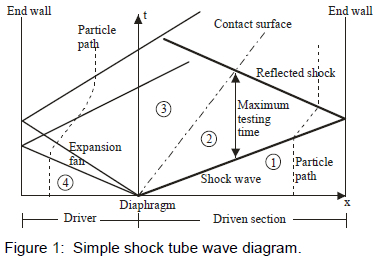
A small transonic wind tunnel was designed, constructed and calibrated in order to provide a tool for the study and demonstration of transonic flow phenomena. The wind tunnel makes use of flow properties following the propagation of a shock wave along a tube in order to create the transonic flow. This is in contrast to conventional transonic facilities which are supplied from a reservoir or compressor through a nozzle. An RAE2822 aerofoil was used as the test piece due to the large amount of aerodynamic data available on it, especially in the transonic flow region, thus making it an excellent tool for validation. In addition, numerical simulations were conducted for comparison with the experiments. The short duration test time, which is determined by the tube length, was found to be adequate for establishing semi-steady state flow for a range of transonic flow Mach numbers. The results obtained experimentally compare well to results obtained numerically. The need for the addition of sophisticated instrumentation is identified.
 Thumbnail
 Thumbnail
 Thumbnail
 Thumbnail
 Thumbnail
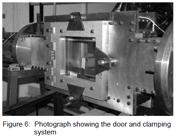 Thumbnail
 Thumbnail
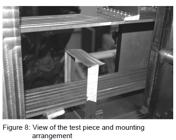 Thumbnail
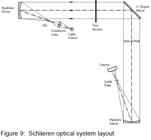 Thumbnail
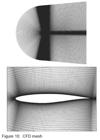 Thumbnail
 Thumbnail
 Thumbnail
 Thumbnail
 Thumbnail
 Thumbnail
 Thumbnail