The Application of HVAF for Thermal Spraying of Hard Coatings
Abstract
For protection against wear or for improving tribological properties, components are coated with hard coatings, of which WC-Co is the most common material. Another advantage of WC-Co is that it also protects the base material against corrosion. This is, for example, used in coating of aircraft landing gears. Hard coatings, such as WC-Co are typically thermally sprayed using the high velocity oxy fuel (HVOF) process, which produces dense and hard coatings because of high particle velocities obtained in the supersonic jet. However, it is also recognised that excessive oxidisation of WC-Co due to high combustion temperatures is the largest drawback of the HVOF method. The alternative to HVOF is the high velocity air fuel (HVAF) process, which utilises air for combustion and, therefore, has lower combustion temperatures. Previously, attempts were made to use HVAF for thermal spraying of hard coatings. However, due to relatively high operating costs of the process and complex system designs, HVAF did not find wide application in industry up to now. This paper describes a HVAF thermal spray system, which is used for thermal spraying of hard coatings. The obtained WC-Co coatings were evaluated using optical and scanning electron microscopy (SEM), X-ray diffraction (XRD) and Vickers micro hardness measurements. The quality of thermal sprayed hard coatings shows that the developed HVAF system can be an alternative to the existing HVOF in terms of quality and operating costs.
1. Introduction
The most common thermal spray technique for WC-Co coatings is HVOF, while other techniques include Plasma and cold spray. High temperatures generated in HVOF have always been a concern with regard to quality of WC-Co coatings as reported in a number of studies1-5. Often in coatings obtained with HVOF and Plasma, as a result high temperature, WC grains decompose into the brittle phase W2C, as well as other phases, such as WO3, CoWO4, and Co3W3C, which reduce the coating quality.
There have been attempts to reduce HVOF combustion process temperatures or to apply the cold spray process for deposition of WC-Co coatings. The low temperature HVOF (LTHVOF) process was recently reported, in which an additional amount of nitrogen is injected into the combustion zone in order to reduce the temperature of combustion6. Effective application of cold spray for spraying of WC-Co powders is difficult to achieve with conventional size powders due to the high mass and low ductility of WC, which result in the critical particle velocity not being reached7. Hence, the main drawback of cold spray is that only nano-sized powders can be sprayed effectively and high costs, which make cold spray economically unviable in many applications, especially in comparison with HVOF.
For a decade, attempts have been made to spray WC-Co coatings using HVAF systems, such as the AeroSpray gun and the Praxair AF-3300 HVAF system, which are built on the principle of the Browning's burner8-11. The main drawback of these HVAF systems is that they require a large compressor (70 kW) to produce a 4.2 m3/min air flow rate at a 1.02 MPa pressure, as well as 24 l/min of liquid fuel, which make the process quite expensive to run12. Another drawback of the reported HVAF systems using liquid fuel is that they require gaseous fuel for the start-up as the fuel/air mixture is difficult to ignite complicating the system design and operation.
In the proposed design, the spray powder is injected axially through the combustion zone to allow powder particles to gain the most kinetic energy as they are carried by the gas flow through the highest acceleration zone of the nozzle, which is within approximately 50 mm from the nozzle throat, yet producing coatings without decomposing and/or oxidation of WC and Co. In contrast, in most HVOF systems and in the Praxair HVAF gun, spraying powder is injected radially into the flow after the nozzle throat, creating turbulence in the flow and causing uneven wear of nozzles. In addition, the accelerating nozzle has to be longer to allow for particle acceleration and heat absorption.
2. Description of the HVAF System
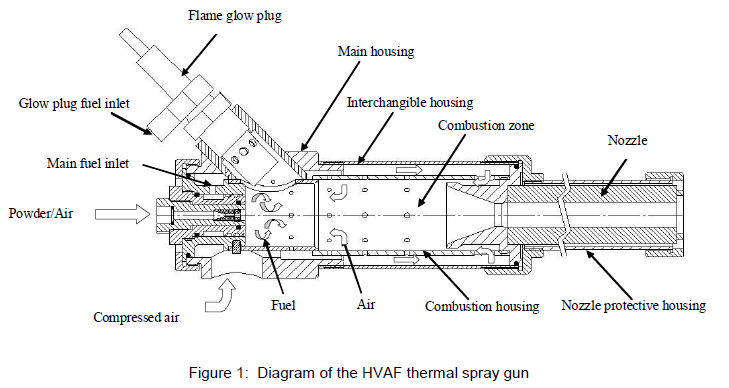
The developed HVAF thermal spray system consists of a thermal gun, a powder feeder and a compressor with an after cooler. The HVAF thermal gun utilizes the air regenerating system suggested by Horton13. The HVAF system can be used for thermal spraying of powders and wires, which are fed axially through the rear of the gun (figure 1)14, 15. Depending on the type of spraying material, the HVAF thermal gun is fitted with different feeding units, housings and accelerating nozzles. The HVAF process parameters are also adjusted according to the type of spray material. The HVAF process runs on paraffin Jet A-1 and air, supplied from a conventional size compressor of 22 kW allowing easy spraying on-site. There is no special requirement for the quality of compressed air - a basic water trap is sufficient for the main air supply. Since the temperature of HVAF combustion is relatively low, 1800 °C15, there is no need for nitrogen to shield coating materials. Hence, compressed air that is used as the powder carrier gas, which is dried by an after cooler (refrigerant drying) before being supplied to the powder feeder.
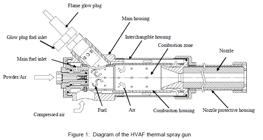
In the HVAF thermal gun, the fuel/air mixture is ignited by means of an automotive flame glow plug, which significantly simplifies the overall system design. The flame glow plug provides a simple and reliable start-up of the system using fuel, air and 12-24 V DC current.
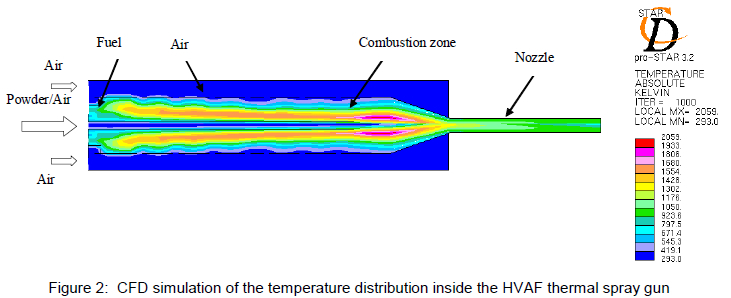
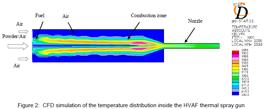
The combustion process inside of the thermal gun was simulated using computational fluid dynamics (CFD) analysis. The CFD simulation results of the temperature distribution of the combustion process, shown in figure 2, indicate combustion temperatures similar to those reported in literature15. The length of the spray nozzle, which is important for achieving sufficient premelting of the powder binder in order to produce dense thermal sprayed coatings, was determined experimentally as 200 mm for the WC-Co powder used.
3. Experimental Procedure
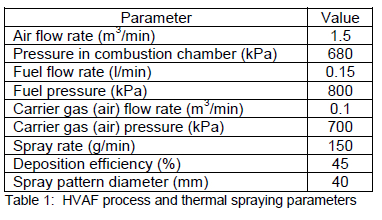
WC-Co coatings were deposited on EN3B steel flat and round samples for various tests. The samples were grit blasted using 50-mesh alumina grit and preheated prior to spraying. Spraying powder was TAFA 1343 WC-17Co powder with a particle size of 325-mesh. Thermal spraying was performed with a 0.1 m/s traverse speed and a 250 mm spray distance, which was determined experimentally. The accelerating nozzle was made of Inconel 600 having a 12 mm throat diameter and a 200 mm long straight bore. The thermal gun operating parameters, as well as the obtained thermal spraying characteristics, are shown in table 1.
4. Results and Discussion
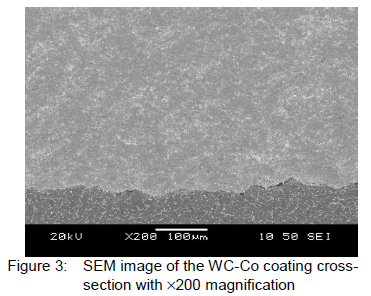
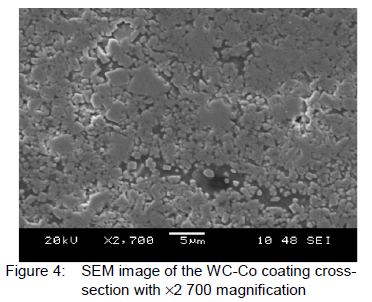
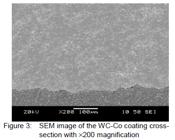
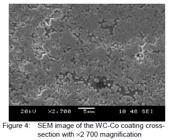
The cross-sectional samples of the sprayed coatings were prepared metallographically after embedding the samples in epoxy resin. The sections were coated with thin gold films prior to the SEM observations. The characterization of microstructure of the coatings was examined through scanning electron microscopy (SEM) coupled with energy dispersion spectroscopy (EDS) using a Philips XL30 electron microscope. A SEM micrograph (figure 3) of the cross-section of the WC-17Co coating at x200 magnification shows a dense and homogenous structure without inclusions or pores. At a higher magnification, figure 4, the grey WC grains of 1-5 in dimensions and the Co matrix of dark colour can be observed. The WC grains appear to be in a solid state without dissolving or deforming of grains, possibly due to low gas temperatures. This is an indication that decomposition of WC does not take place, while melting of the binder phase can be observed in the coating morphology. The micro Vickers hardness of the thermal sprayed WC-17Co coatings was 1200-1300 HV300, which is similar for coatings reported for HVOF.
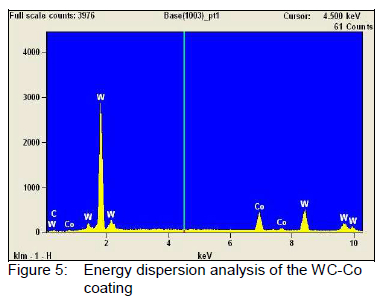
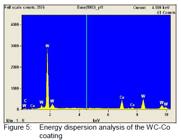
The results of phase identification of the coating by the EDS analysis in SEM shows the same phase composition as the feedstock material (figure 5). The coating is free from oxides as shown. The presence of small quantities of carbon (less than 3 %) and gold can be attributed to the molding and coating materials used for the sample preparation. The absence of oxides in the coating, confirmed by the EDS analysis, indicates that the combustion gas temperature generated by the HVAF thermal spray system does not cause oxidation of the WC or Co phases.
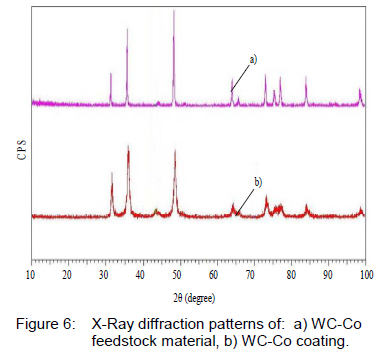
X-ray diffraction was carried out on a Bruker AXS X-ray diffractometer D8 with CuKa radiation operating at 40 kV and 20 mA. The results of XRD analyses of the feedstock material and the WC-Co coating presented in figure 6 show no phase changes indicating that the crystallinity of WC-Co does not change in the thermal spraying process.
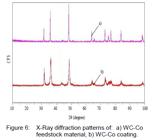
Brittle phases of WC typically found in coatings obtained with HVOF, such as W2C, WO3, CoWO4, or Co3W3C were not detected in the HVAF sprayed coatings, which is attributed to the low gas temperatures of HVAF.
5. Conclusion
The main advantage of the developed system is that it is considerably more cost effective than HVOF and other HVAF systems as it runs on low volumes of compressed air and liquid fuel and produces high quality WC-Co coatings at competitive rates. The HVAF system can be used for spraying on-site, which is important for many industrial applications. In addition, reliable ignition is achieved using the flame glow plug operating on the same fuel and hence simplifying the overall system design. The HVAF thermal gun does not require water cooling, which is another advantage of the developed system in terms of costs.
The HVAF system was applied for thermal spraying of hard coatings using WC-17Co powder with a particle size of 325-mesh. The coatings were analysed using SEM, EDS and XRD. The coatings obtained have high density, low porosity and homogenous structure, which is identical to the spray powder composition. The coating micro hardness is 1200-1300 HV300, which is similar to reported for HVOF and Plasma WC sprayed coatings. The HVAF sprayed coatings are without brittle and oxidized phases, which are attributed to low gas temperatures.
A spray rate of up to 150 g/min and a deposition efficiency of 45 % were achieved, showing that HVAF is a relatively efficient process. A coating thickness of a single pass with a 0.1 m/s traverse speed was 15-20 μm, and the spray pattern diameter was 40 mm. Thick coatings, above 3 mm, were obtained by adding subsequent layers of sprayed material.
A relatively long spray distance of 250 mm together with low combustion gas temperatures result in moderate heating up of the substrate and thus allow continuous thermal spraying without a need for interrupted cooling such as in the case of HVOF spraying.
1. Hangong W and Liuying W, Thermal spraying-application and development trends, Proceedings of the 2005 International Thermal Spray Conference, Basel, Switzerland, ASM International, 2-4 May 2005, on CD-ROM.
2. Valarezo A, Choi WB, Gouldstone A and Sampath S, Correlation between process maps of HVOF-sprayed WC-Co coating and wear resistance, Proceedings of the 2006 International Thermal Spray Conference, Seattle, Washington, USA, ASM International, 15-18 May 2006, on CD-ROM.
3. Shipway PH, McCartney DG and Sudaprasert T, HVOF spraying of WC-Co coatings with liquid-fuelled and gas-fuelled systems: competing mechanisms of structural degradation, Proceedings of the 2005 International Thermal Spray Conference, Basel, Switzerland, ASM International, 2-4 May 2005, on CD-ROM.
4. Berger L-M, Zieris R and Saaro S, Dresden, Oxidation of HVOF-sprayed hardmetal coatings, Proceedings of the 2005 International Thermal Spray Conference, May 2-4 2005, Basel, Switzerland, ASM International, on CD-ROM.
5. Wielage B, Wank A, Pokhmurska H, Friesen E, Grund T and Schwenk A, Correlation of microstructure with abrasion and oscillating wear resistance of thermal spray coatings, Proceedings of the 2005 International Thermal Spray Conference, Basel, Switzerland, ASM International, 2-4 May 2005, on CD-ROM.
6. Zha H, Wang BZ and Xu K, The Microstructure and property of LT HVOF sprayed copper coatings, Proceedings of the 2005 International Thermal Spray Conference, Basel, Switzerland, ASM International, 2-4 May 2005, on CD-ROM.
7. Kim HJ, Hwang SY and Lee CH, Pohang/ROK, Characterization of nano WC-Co coatings produced by dynamic powder, Proceedings of the 2005 International Thermal Spray Conference, Basel, Switzerland, ASM International, 2-4 May 2005, on CD-ROM.
8. Browning JA, Method and apparatus for impacting at high velocity against a surface to be treated, US Patent No. 2990653, 4 July 1961.
6. Acknowledgments
The project was financed in part by the National Research Foundation of South Africa. The author would like to thank Prof A. Els-Botes and Dr H. Lombard for their assistance with the microstructure analysis.
References
- 9. Jacobs L, Hyland MM and De Bonte M, Comparative Study of WC-Cermet coatings sprayed via the HVOF and the HVAF processes, Journal of Thermal Spray Technology, 1998, 7 (2), 213-218.
- 10. Jacobs L, Hyland MM and De Bonte M, Study of the influence of microstructural properties on the sliding-wear behavior of HVOF and HVAF sprayed WC-cermet coatings, Journal of Thermal Spray Technology, 1999, 8 (1), 125-132.
- 11. Verstak A and Baranovski V, AC-HVAF Sprayed Tungsten Carbide: Properties and Application, Proceedings of the 2006 International Thermal Spray Conference, Seattle, Washington, USA, ASM International, 15-18 May, 2006, on CD-ROM.
- 12. The AF-3300 HVAF system, Technical Data Bulletin, http://www.tafa.com, 5 June 2000.
- 13. Horton WB, Apparatus for producing a flame jet by combustion counter flow reactants, US Patent No. 3363661, 16 January 1968.
- 14. Gorlach IA, A new method for thermal spraying of Zn-Al coatings, ThinFilms 2008, 4th International Conference on Technological Advances of Thin Films & Surface Coatings, Singapore, 13-16 July 2008, on CD-ROM,
- 15. Gorlach IA, Modelling of an efficient nozzle geometry for thermo-abrasive blasting, R&D Journal of the SAIMechE, 2006, 22 (1), 11-20.
Accepted 18 December 2009