Probabilistic Uncertainty Identification Modelling in USV Obstacle Detection
Abstract
Uncertainty and false alarms exist in the operational environment of autonomous marine robots. This paper presents the investigations on obstacle detection and avoidance model of an autonomous marine vehicle using ultrasonic sensors and probabilistic techniques in uncertainty identification in the development of an unmanned surface vehicle (USV). Probabilistic techniques were used in modelling the realistic environmental uncertainties of the autonomous marine vehicle. Coherence and non-coherence of sonar signals were investigated and its functions simplified to address the deterministic and un-deterministic modelling variables that were identified in the realistic domain of the USV. The results obtained from the models were adapted into the control algorithm of the USV to reduce the uncertainties present in the guidance and control of the USV.
Sonar; Probability; USV; Uncertainty; Obstacle Detection
1. Introduction
The development of marine robots has its focus on different types of missions [1] which range from carrying payloads, warfare, surveillance, to search and rescue activities. These types of autonomous marine robots are at different developmental stages in various research centres [2] such as the Defence Advanced Research Projects Agency (DARPA), REFAEL Armament Development Authority, Elbit Systems, Systems Centre San Diego (SPAWAR), General Dynamics Robotic Systems and Marine and Industrial Analysis Research Group (MIDAS) [3]. The importance of autonomous marine robots for military applications and commercial applications has driven the various aspects of autonomous marine vehicle development to a state that is appreciable to the common man. In recent years, obstacle avoidance has become an area of research interest in marine vehicle autonomous motion [4]. Marine robots operate in an environment that is inherent with uncertainties. The uncertainties are as a result of the way the environment is perceived and modelled. In as much as stability of marine vehicle is of paramount importance, its autonomous motion is highly dependent on the obstacle avoidance architecture and motion planning strategy [5]. Different sensory architecture provides information on different levels and it is classified into a hierarchy of importance in facilitating the autonomous motion of the marine vehicle [6]. Single sensory architectures are limited in their capacity to provide complete information and interpret known and unknown autonomous motion environments. This capacity limitation has introduced limitations on attempts to model the autonomous motion environment using a single data source from the environment. Different imaging sensors provide navigation map and path, obstacle detection and avoidance for autonomous robots. The sole function of these sensors is to provide marine robots a means of detecting other vessels, humans, aquatic animals, entering into and finding their way around their environments [7]. Visibility conditions are usually not in favour of autonomous motion of marine robots as their operational environments are usually poorly illuminated. The poor robot motion path illuminations are as a result of changes in day and night visibility conditions. Changes in weather pattern and characteristics such as rain, fog, snow and cyclones inhibit the visual perception of marine robots. In spite of the various efforts which are put in place to arrest the uncertainties that exist as a function of changes in environmental conditions, the data acquired from a single sensor in a multisensory architecture is partial and uncertain and may be geometrically incomparable with another sensor's data. It is a known fact that a multisensory architecture is capable of resolving the difficulties that are faced in using a single sensory system for mobile robot obstacle detection and navigation [8].
Sonar and ultrasonic systems are capable of detecting both stationary and moving targets at different proximities. The sonar cross section (SCS) and the signal-to-noise ratio (SNR) are functions of the probability of detection of the sonar system. The sonic system used in the modelling the marine vehicle obstacle detection system produces continuous wave which is software controlled. The sonar is a common sensor in the field of robotics used for obstacle detection [7]. Its advantage lies in the fact that it is not affected by any visual restrictions that may be present in the marine vehicle environment. The sonar has a disadvantage in that it receives echoes reflected from surfaces or from similar devices. The limitation results in poor resolution and accuracy of received data. The continuous wave in conjunction with millimetre-wave (MMW) characteristic function was used in the model development [11]. The millimetre-wave configuration allows the sonic system to have fine resolution for target detection within short ranges and also for stationary target detection. The use of embedded systems in acquiring data from sonar is used resolve the problem in that the firing sequence of the sonar are managed internally using software techniques[15].
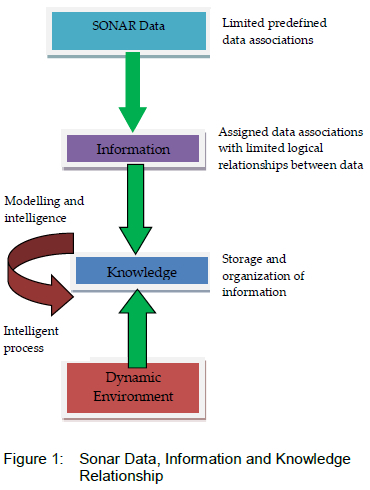
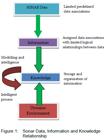
The automation of marine vehicles and obstacle detection has been reported in various studies: In [17], the use of a speed controller and nozzle controller incorporated in a fuzzy controller was proposed in changing the USV angle of divergence while avoiding obstacles. The use of USB camera vision to track and avoid obstacles while guiding automated vehicles was reported in [18]. Gal in [19] used probabilistic velocity obstacle technique derived from ocean wave velocity in determining an optimal motion planning for USV. The use of probability Hypothesis Density Bayes filter was proposed in [20] for USV multi-target tracking. The use of monocular vision and stereo vision were proposed in [21] for USV real-time obstacle detection. The various studies showed that there are different possibilities which can be implemented in a USV obstacle detection algorithm. Marine vehicle autonomous motion key property was identified as the effects of uncertainty and its characteristic association with unmanned surface vehicle navigation in the presence of multiple targets. The contributions made included the identification and modelling of uncertainty in the autonomous motion of the USV. False targets, limited range resolution and changing environmental conditions affected the acquiring, interpretation and usage of sonar data. The emanating model can be ambiguous, inaccurate and inconsistent with the real world information. The accurate interpretation of sensory data, information and knowledge was a determining factor in the efficiency of the obstacle detection and avoidance architecture. The Sensory knowledge of the USV provided the capacity to use information found within the dynamic environment of the USV and it is environment dependent as it requires the understanding and the derivation of intelligent information procedures [5]. The inappropriate use of sensory knowledge on autonomous marine navigation can result to fatal consequences. Information and knowledge in marine vehicle autonomous motion formed the integral part of the marine vehicle autonomous motion cognition process. Figure 1 [9] illustrates the relationship that exists between sonar sensory data, information and knowledge. The resolution and reliability of perception in obstacle avoidance models of the USV are adversely affected by the sonar propagation characteristics. Eclectic sonar beams have grater effects and they merge echoes of multiple targets. The presence of false targets is introduced through the use of side lobe which can be included in the design of sonar system and it increases the complexities that are associated with false targets thereby degrading the performance of the scanning angle of the sonar as its gain is adjusted or changes. The combined limitations found in these sensors created the fundamental problem of incompleteness and the direct consequence resulted in uncertainty present in autonomous navigation system.
In this paper, we describe the probabilistic uncertainty identification from a sonar obstacle detection model. The system model comprises of five ultrasonic sonars used for autonomous navigation of an unmanned surface vehicle (USV). The modelling of the marine vehicle obstacle architecture encompassed the uncertainty that is experienced in marine vehicle autonomous motion, the autonomous decision making algorithm of the marine vehicle and the probabilistic characteristic nature of the autonomous motion of the marine vehicle. The sonar system is arranged such that it can provide data on obstacles that are in the far-field region and also provides data on obstacles that are in the near-field region. The detection of near-field and far-field obstacles is crucial to the successful completion of autonomous motion mission of a marine vehicle. Sensor development and integration into autonomous and intelligent systems affects the overall performance of the autonomous system. As such, the ability of the sonar and ultrasonic sensors to detect targets at considerable range with perfect resolution and accuracy is the ideal that was sought after in the development and implementation of the sonar obstacle detection architecture.
2. The Methodology
The use of probabilistic techniques in modelling the realistic environmental domains of the autonomous marine vehicle was proposed. The USV functions required that simplifications be made to contain the deterministic and un-deterministic modelling variables that were identified in the realistic domain. We used preliminary data as it provided clues as to what is expected from the sensors in modelling the obstacle detection and avoidance architecture. The hidden variables which were reflected in the modelling process were contained in the raw data as measured from the ultrasonic sensors and they showed the various complexities that existed between the unmanned surface vehicle and the environment. Probabilistic methods were used to determine the coherent view on the performance of the intelligent system embedded in the obstacle avoidance structure especially in the presence of partial or uncertain data. The inclusion of the unique probabilistic method provided the ability to process and analyse the sonar data within context-sensitive views which were required to facilitate the computation of context dependencies that were manipulated by local propagation of the sonar data [10].
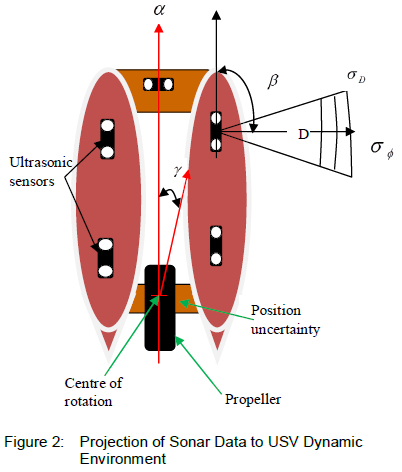
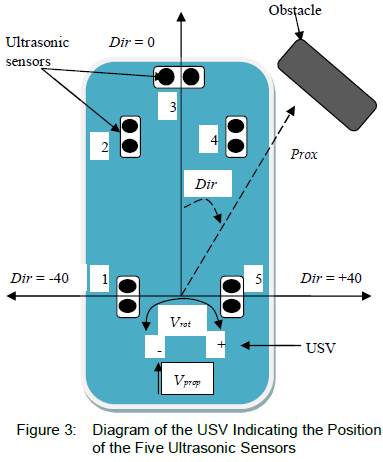
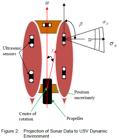
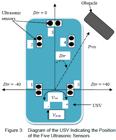
The dynamic environment illustrated in figure 2 and 3 was modelled and represented in the obstacle detection architecture through the use of the five ultrasonic sensors. The raw range data acquired from the sonar were used as the starting points for reactive obstacle detection and avoidance systems for targets within the near-field region of the USV. The position and orientation of the USV are illustrated in figure 2 and were defined as follows:
2.1 Modelling Obstacle Detection with Sonar
r: The distance from the USV origin to the ultrasonic sensor,
γ: The angle from the USV axis to the ultrasonic sensor,
β: The orientation of the ultrasonic sensor with respect to the USV.
The autonomous control algorithm of the USV was developed using the data from the sonar while data from the sonar was used to project the distance D, for each of the
ultrasonic sensors to the external frame of reference of the USV (xs,ys) while incorporating the position of the USV (x,y,α) as illustrated in figure 2. The dynamic environment was modelled using equations 1 and 2.

The angles a, β and γ were approximated; hence an absolute angle φ for the sonar was defined as:

Echoes from the ultrasonic range finders within an arc shaped region were defined by the USV uncertainty region, σφ and uncertainty distance, σd and were approximated in the Cartesian coordinates as represented in equation 4

The transformation of the system covariance from circular to Cartesian coordinates was illustrated as:

The transformation of the uncertainty region having an elliptical profile to Cartesian coordinates was given by:

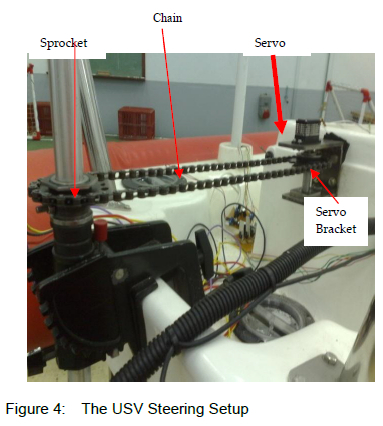
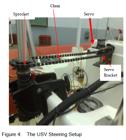
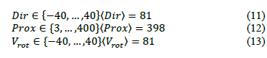
The crucial point to note in this model is that the criterion required for sonar uncertainty in the USV local modelling was that the uncertainty be larger than any true errors that may be associated with the data. Each of the measured data from the ultrasonic sensors was represented as Xs, ys and Cs expressed in the dynamic environment of the USV. In modelling the movement of the unmanned surface vehicle, the Bayesian programme was formulated using the Generic Bayesian Program (GBP) [11] for autonomous motion. The GBP was used to model and develop the near-field obstacle avoidance algorithm. The ultrasonic sensors returned values that were between 3 cm and 400cm. These values were stored in variable P1, P2, P3, P4 and P5. The USV was controlled through a servo motor attached to the rudder shown in figure 4. The forward motion of the USV was controlled through the propeller. The values for the rudder and propeller were stored in variables Mservo and Mpropeller respectively. These variables were used to derive three extra variables (Dir, Prox) and Vrot. Dir which represented the approximate bearing of targets from the USV with values ranging from -40 to +40 in degrees. Prox represented the approximate distance of the closest target between 3 cm and 400cm. These gave rise to the following models illustrated in equations 7 and 8. While keeping the variable OceanSurf constant, Vrot took values ranging from -40 to +40. The setup is illustrated in figure 3.
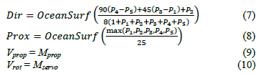
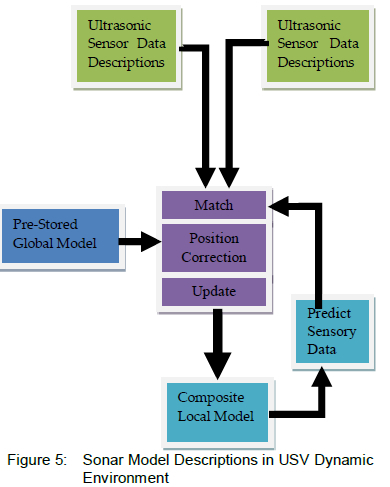
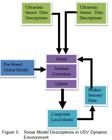
The model definitions which were implemented on the USV are summarised as follows in equations 11, 12 and 13. This is illustrated in figure 5.
2.2 Obstacle Detection/Avoidance Algorithm
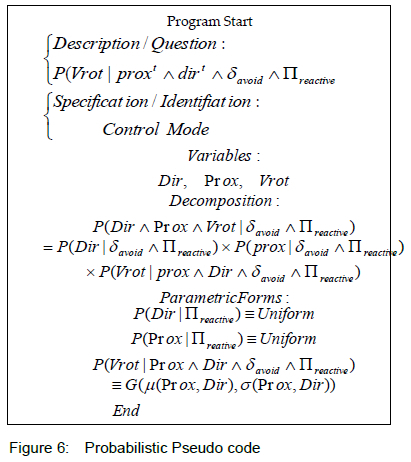
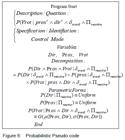
The probabilistic algorithm as described in the methodology section and implemented in USV obstacle detection program is given figure 6 [22]:
2.2 System normalization with the CW radar
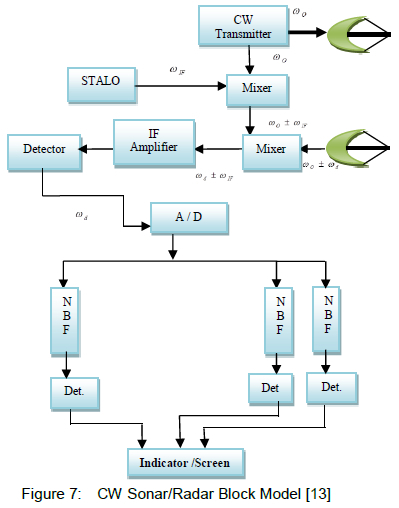
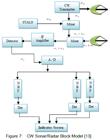
Furuno marine radar was used as a control in modelling the obstacle detection and avoidance sonar system. The radar system generated continuous wave (CW) forms and has a resolution range of 16 meters with a minimum range of 22 meters. The bearing discrimination is 6.7 degrees, bearing accuracy is within 1 degree, the horizontal beam width is less than 6.2 degrees, the vertical beam width is 25 degrees, the side-lobe attenuation is less than -20dB, the transceiver frequency is 9410MHz in X-band. It has a peak power output of 2.2 kW with an intermediate frequency of 60MHz. The front receiver has a bandwidth of 15MHz short pulse and 5 MHz medium and long pulse. The CW sonar system extracted the radial velocity of the targets within the dynamic environment of the USV by measuring the difference in frequencies of the reflected signals. Interruptions on the continuous emission of sonar signals were avoided by using the inbuilt software controlled system as illustrated in figure 7. The sonar detection model in the dynamic environment included the sonar echo signal s(t), additive zero mean Gaussian noise n(t), variance ψ2, band pass filter IF signal v(t) and the threshold value Vt. The threshold value was the basis and hypotheses from which the radar obstacle detection and avoidance decisions were made. Similar variables can also be used for the radar system in providing system check for the sonar system.

The threshold hypotheses were illustrated as:

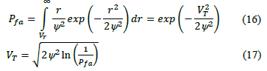
The sonar false alarm was also investigated. It is the sonar probability of detection within the given dynamic environment of the USV and it is maximised for each probability of false alarm given that there is a target in the environment in the presence of noise. The probability of false alarm Pfa was defined as the probability that a group of targets R, in the dynamic environment of the USV having the signal r(t) will exceed the threshold voltage in the presence of noise alone at any given sonar scan [12]. This was expressed as:
The probability of detecting targets given that the signal from the sonar has a sinusoidal wave from with amplitude A and power, A2/2 has a signal-to-noise ratio (SNR) expressed as:

The probability of detection expressed as:
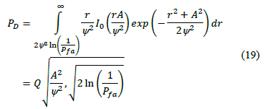
where Q is known as Marcum's Q-function [13, 14] and expressed as:

Where I0 represents the in-phase radar frequency presented as the modified Bessel Function of the zero order [16]:
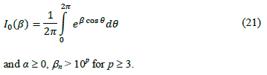
The probability of detection is then approximated [15] as:

The complementary error function erfc is expressed as:

2.3 Signal Pulse Integration
For a single san of the sonar, several pulses were reflected during the detection of a target within the dynamic environment of the USV. The addition reflected pulses returned by a given target during the single scan of the sonar increases the sonar system sensitivity or signal-to noise ratio (SNR) which is the Pulse Repetition Frequency (PRF) of the sonar. The number of pulses returned by a given obstacle is expressed as [13]:

Where θa is the azimuth antenna beam width, Tsc is the sonar scan time and fr is the sonar PRF. The number of reflected pulses from a given target is expressed as:

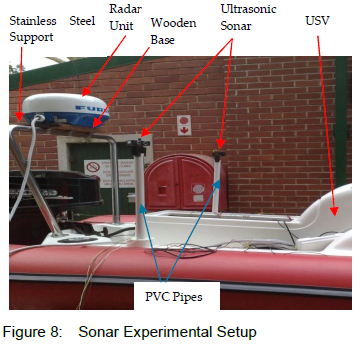
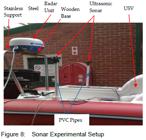
Where θscan is the sonar antenna scan rate in degrees per second. Pulse integration is the process of integrating sonar target returns from many reflected pulses. The integration of the reflected pulses can be coherent or non-coherent. Coherency refers to the ability of the sonar to measure accurately received signal phase [16]. Coherent integration of pulses also known as pre-detection integration is the process whereby the sonar phase relationships that exist between the pulses are preserved. Non-coherent pulse integration also known as post-detection integration is the process whereby the sonar phase relations are destroyed [13]. We designed the experiment to investigate the performance of the sonar system during the development of the autonomous navigation of the unmanned surface vehicle (USV) shown in figure 8. A total of five ultrasonic sensors were fitted to the USV. Two ultrasonic sensors were fitted on each side of the USV and one was fitted in front of the USV. The FURUNO radar unit was placed at the back of the USV so as to maintain the stability of the marine vehicle.
3. Results and Discussion
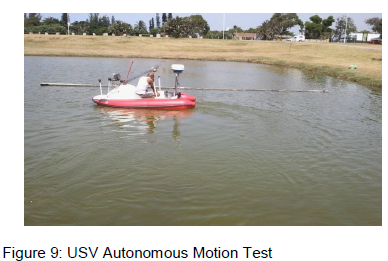
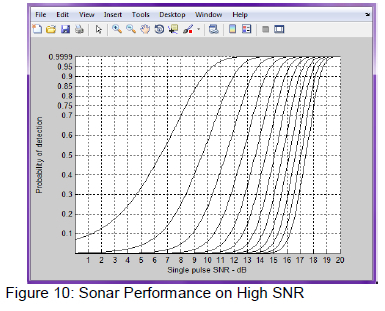
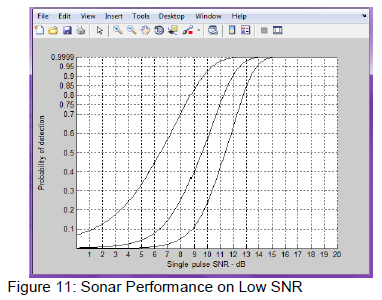
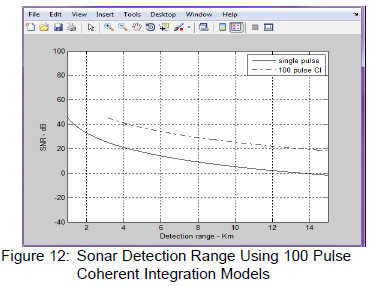
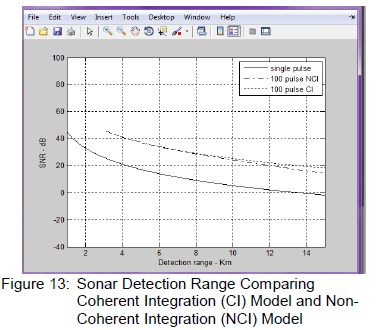
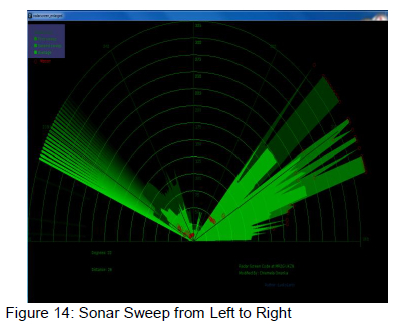
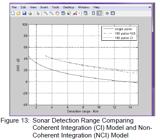
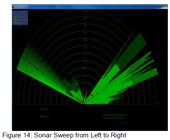
The sonar model for the obstacle detection architecture was investigated using MATLAB, Processing and Arduino software and tested on the USV as shown in figure 9. The simulations were carried out to investigate the probability of detection for the sonar system, probability of false alarm and the sonar detection range. The sonar probability of detection performed better as the SNR for the single pulse sonar system was reduced from 24 to 6 in figure 10 in comparison to figure 11. This implied that the probability of false alarm increased from 10-12 to 10-3. From the results data for example, a probability of detection Pd = 0.7 and Pfa = 10-2 required a minimum single pulse SNR of 8dB to accomplish the task of detecting targets within the dynamic environment of the USV. These results are illustrated in figures 10 and 11. The results from the sonar detection range investigations using pulse coherent integration model and non-coherent pulse integration model are shown in figures 12 and 13. The results from data acquired from the sonar architecture are depicted in figure 14. The green shades in figure 14 shows the distance in centimetres of targets from the USV. The red circles also indicate similar target proximity of target s from the USV.
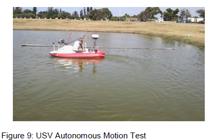
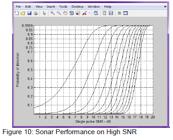
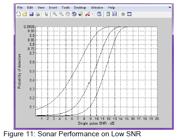
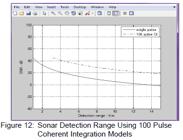
The obstacle detection modelling process provided the description of the raw data acquired from the sensors as illustrated in figure 3. The model served to filter sensor noise by detecting range data that were mutually consistent. The sonar model provided constraints to which the position and orientation estimation of the USV were constrained to. The model also provided obstacle constancy at the level that described the geometric characteristics of the dynamic environment. The obstacle constancy of the model enabled the USV to effectively react to targets and events without requesting their symbolic interpretation. The USV was tested as shown in figure 9 to consolidate the models, simulations and actual detections that were obtained during the tests. The probability of detection shown in Fig. 10 and figure 11 is a function of probability of false alarm as indicated in equation 19. The probability of detection was computed continuously using a recursive algorithm that implemented equations 19 and 20 until βn > 10p for some exponent value p ≥ 3. The accuracy of the algorithm was improved as the value of P increased. The presence of false alarm in the algorithm increased the sensitivity of the sonar system to small changes in the threshold value of the system. Increasing the threshold value decreased the radar maximum detection range. The choice of acceptable threshold value was chosen to match the sonar operational mode. In implementing coherent pulse integration, a perfect integrator which implied 100% efficiency was introduced and included in the model setup. At the integration of np pulses as illustrated in figure 12, the SNR was improved by the same margin as the number pulse integration.
Coherent integration loss will only occur when the integration process is implemented at non-optimum state. This condition may exist as a result of target fluctuation, changes in signal path propagation or sonar local oscillator. The non-coherent integration was investigated after an envelope detector process or post-detection process. The non-coherent integration was less efficient in target detection because the gain is always less than the number of non-coherently integrated pulses. This was compared with the performance of the coherent pulse integration illustrated in figure 13. The sonar coherency was achieved and implemented through the use of a stable local oscillator (STALO) as illustrated in figure 7. The sonar screen shown in figure 14 was used primarily used to monitor targets within the dynamic environment of the USV and to navigate the USV through a pre-defined motion path. The sonar architecture scanned the near-field environment and returns the proximity data in real-time. The sonar screen also facilitated the performance monitoring for the sonar obstacle detection and avoidance model.
4. Conclusion
The realisation that uncertainties and exceptions exist in the modelling of the obstacle detection and avoidance architecture of the autonomous marine vehicle provided ways in which the uncertainties and exceptions were summarized in the development of the USV. In summarising the uncertainties and exceptions, the propositions that were provided in the models were assigned numerical measures of uncertainty and were combined to attain realisable results. The probabilistic technique implemented in the sonar obstacle detection model, created the basis required for coherent prescriptions in choosing adequate motion actions and efficient reliable motion choices that were made by the USV.
The integration of reflected pulses in the sonar detection model increased the detection range for a single pulse when the same SNR is implemented in the model. The data obtained from the sonar model was used in the development of the control, guidance and navigation system of the USV. The implementation of the model provided a performance monitoring technique for the autonomous motion of the USV. The development of efficient obstacle detection and avoidance architecture as implemented in the use of a sonar multisensory system in the USV provided the necessary guidance and control options for the development of efficient navigation algorithms for the autonomous motion of the marine vehicle. The sonar coherency allowed for accurate measurement of the received signal from the sonar. The requirements for maintaining and updating each transmitted pulse phase and the coherency of the sonar was very challenging and costly and as such non-coherent integration was implemented in the sonar system.
The results from the models were adapted into the control algorithm of the USV to reduce the uncertainties present in the guidance and control of the USV while improving the obstacle detection and avoidance capacity of the USV especially in the near field-region up to 500 cm from the USV. Approximations which were derived from the obstacle detection models were used in fine-tuning the control algorithm of the USV.
1.Veers J and Bertram V, Development of the USV Multi-Mission Surface Vehicle III, 5th International Conference on Computer Applications and Information Technology in Maritime Industries (COMPIT), Leiden, 2006, 345-355.
2.Brizzolara R, ONR Unmanned Sea Surface Vehicle (USSV), http://www.onr.navy.mil/~/media/Files, 2010.
3.Bertram V, Unmanned Surface Vehicles-A Survey, Skibsteknisk Selskab, Copenhagen, Denmark, 2008.
4.Radix Marine, The Growing US Market for Unmanned Surface Vehicles (USVs), www.radixmarine.com/PDFs, 2003.
5.Allen PK and Bajcsy R, Two Sensors are Better than One: Example of Vision and Touch, Third International Symposium on Robotics Research, MIT Press, 1986.
References
- 6. Richardson JM and Marsh KA, Fusion of Multisensor Data, International Journal of Robotics Research, 1988, 7(6), 78-96.
- 7. Zhen J, Arjuna B and Subhash C, Sensor Fusion-Based Visual Target Tracking for Autonomous Vehicles with the Out-of-Sequence Measurement Solution. Robotics and Autonomous Systems, 2008, 56(2), 157-176.
- 8. Majura SF, Damion DD, Shi D and Collins EG, Robot Navigation in Very Cluttered Environments by Preference-Based Fuzzy Behaviours, Robotics and Autonomous Systems, 2008, 56(3) 231-246.
- 9. GeeWah N, Fusion Systems for Intelligent Processing, In GeeWah N, Intelligent Systems-Fusion, Tracking and Control, Research Studies Press, Baldock UK, 2003, 79-107.
- 10. Pearl J, Probabilistic Reasoning in Intelligent Systems, Morgan & Kaufman, San Mateo, 1988.
- 11. Bessiere P and Lebeltel O, Basic Concepts of Bayesian Programming. In Bessiere P, Christian L and Roland S, Probabilistic Reasoning and Decision Making in Sensory-Motor Systems, Springer-Berlin, Heidelberg, 2008, 19-48.
- 12. Foessel A, Scene Modeling from Motion-free Radar Sensing. PhD Thesis, Robotics Institute, Carnegie Mellon University, USA, 2002.
- 13. Mahafza BR and Elsherbeni AZ, Matlab Simulations for Radar Systems Design, CRC Press, Boca Raton, FL, 2004.
- 14. Pari S, A new Method of Calculating the Generalised Q-Function, IEEE Transaction on Information Theory, 1980, 26(1), 121-124.
- 15. North DO, An Analysis of the Factors which Determine Signal/Noise Discrimination in Pulsed Carried Systems, Proceedings of the IEEE, 1963, 51(7) 1015-1027.
- 16. Mahafza BR, Radar Systems Analysis and Design Using MATLAB, CRC Press, Boca Raton, FL, 2000.
- 17. Xiaowei Q, Guang R, Jin Y and Aiping Z, The Simulation for Autonomous Navigation of Water-jet-propelled Unmanned Surface Vehicle, IEEE 3rd International Conference on Measuring Technology and Mechatronics Automation (ICMTMA), Shangshai, 2011, 945-948.
- 18. Sabikan S, Sulaiman M, Salim SNS and Miskon MF, Track and Obstacle Detection with USB Camera for Vision-based Automated Guided Vehicle http://myweb.utem.edu.my/myweb/fahmimiskon, 2007.
- 19. Gal O, Unified Approch of Unmanned Surafce Vehicle Navigation in Presence of Waves " Journal of Robotics, 2011.
- 20. Gal O and Zeitouni E, Tracking Objects Using PHD filter for USV Autonomous Capabilities, Robotic Sailing 2012, Springer, Berlin, 2013, 3-12.
- 21. Wang H, Wei Z, Wang S, Ow CS, Ho KT, Feng B, and Lubing Z, Real-time Obstacle Detection for Unmanned Surface Vehicle, IEEE Defense Science Research Conference and Expo, Singapore, 2011, 1-4.
Revised form 15 April 2013
Accepted 13 May 2013