The Performance of High-pressure Steam Boilers as a Function of Coal Composition
Abstract
This article deals with the influence of lignite and other low-rank coals on the heat transfer and the conversions taking place in large coal-fired steam boilers. The lower heating value of the investigated coal ranged from 9 to 10 MJ/kg with 20 % ash and about 38 % moisture. Our analysis of the energy conversions is mainly concerned with the heat loss due to the exhaust flue gas. Changes in the composition of coal are reflected in the quality of the processes expressed as the efficiency of the boiler and the unit and in the quantity of power needed for the operation of the power plant. On the basis of measurements on power plant units our attention was focused on the influence of moisture, hydrogen, ash and sulphur changes in the coal. The heat loss and the other performances of the boiler due to the exhaust flue gas are determined in relation to the efficiency of the steam boiler and the power plant unit.
Introduction
Changes in the composition of coal are not only reflected in changes to the boiler's specific consumption but also in the quality of the processes taking place in the power plant unit. So, while striving to produce power at the lowest possible cost, the quality - the composition of the coal-becomes an important parameter. The composition of coal can be described with a simple analysis of five characteristics: total moisture, air-dried moisture, volatile matter, ash and fixed carbon, or a more sophisticated analysis that involves determining the elemental composition of the organic fraction in addition to the ash and moisture content of the coal. The basic data to provide a coal-quality specification are heating value, moisture, ash and sulphur content. A review of lignite specifications and the influence of lignite composition on the combustion process in the boiler and the related effects on overall power plant performance was presented in Oman2,3 and Skorpuska4. The effects in the boiler can be described as immediate and indirect. For instance, the immediate effects of ash content and ash composition are a lower heating value and consequently a larger mass flow of coal, as well as fouling, slagging, abrasion, erosion and corrosion; while the indirect influences are reflected in the amount of power consumption required for coal grinding, gas cleaning, transportation of the coal and ash and also in heat losses from the boiler and in the overall efficiency of the unit. The influence of moisture in the coal is also complex. The origin of the water-steam in the flue gas, which has an important influence on the value of the flue-gas loss, is twofold. The first is the mass fraction of water in the coal that is related to the inherent and surface moisture, and the second is that which originates from the combustion of the hydrogen in the coal. The surface moisture of the coal is converted to vapour during milling and forms part of the coal-air mixture in the feed system, Skorpuska4. The vapour then enters the furnace, where it can cause a delay in coal ignition, an increase in the flame length and a change in the optical properties of the flame. This effect is important for coals with higher moisture contents. The inherent moisture has a direct influence on coal ignition while the release of the volatiles from the coal particles cannot start prior to the evaporation of the moisture. To prevent any delay in volatilisation for coals with a high inherent moisture content the mill's air inlet temperature should be increased.
In this paper theoretical examinations are compared with the results of measurements on two units at the Šoštanj power plant, Slovenia. The treated coal was lignite, dug from the nearby Velenje coal mine, with lower heating values ranging from 9 and 10 MJ/kg, and ash contents of about 20 % and moisture contents of about 38%. The power plant has five units, the examined units were unit 4 with 275 M We and unit 5 with 345 MWe, both with a pulverised coal firing system.
The Fuel Specifications
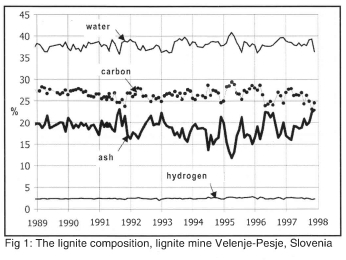
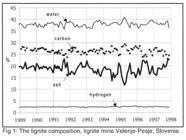
The fuel used in the examined power plant is yellow-brown lignite with a wooden structure, extracted from the nearby Velenje mine. The lignite composition, guaranteed by the coal supplier, had the following properties: lower heating value 9200 kJ/kg, total moisture 38 %, ash content 20 % and ultimate analysis: S, 1.4 %; C, 27.1 %; H2,2.1 %; O2,11.0 %; and N2, 0.4 %. The water, ash, carbon and hydrogen content of the coal used in the Šoštanj power plant in the period 1989-98 is presented in Fig 1.
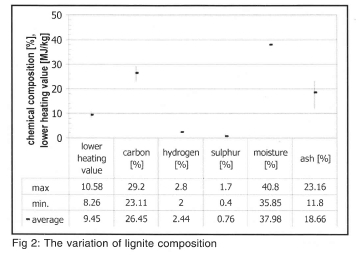
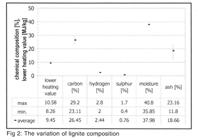
The variations in the composition and the lower heating value of the lignite are presented in Fig 2. The extremes and the average values for each parameter are also indicated.
Boiler Efficiency and Losses
Direct losses
The first-law thermal efficiency of the boiler is calculated on the basis of the heat losses that occur during boiler operation at a constant load, DIN 19421. The individual loss is defined as the ratio of the unutilised or lost heat flow  X and the heat flow supplied to the boiler by means of fuel
 F. Our earlier study, by Oman2, suggested that the boiler efficiency is affected predominantly by the heat loss due to the exhaust flue gas lGwhich is the highest and gives us an order of magnitude value for the boiler efficiency. The empiric equation, Oman2, for calculating the loss due to the exhaust wet flue-gas yields:

The advantage of this equation is that all the parameters that influence the loss value are clearly evident. It is obvious that the influential parameters in the equation that depend on the composition of the coal are: lower heating value, stoichiometric amount of dry air, mass fraction of ash in the coal and the fraction of moisture in the flue gas. The parameters that are not directly dependent on the composition of the coal are: the temperature of the exhaust flue gas and the excess air quotient. Ash is the residue remaining after complete combustion of the coal, and the excess air quotient is defined as the ratio of actually used combustion air and the theoretical amount of air needed for burning a mass unit of the fuel. The water-steam mn, in the flue gas, equation (1), has two sources, the mass fraction of total moisture in the coal and the mass fraction of hydrogen in the coal:

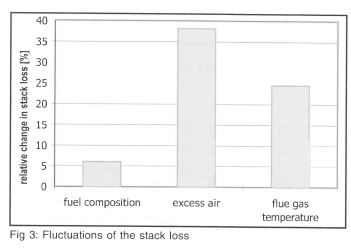
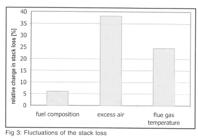
It should be pointed out that for lignite the factors that depend on the composition of the coal have a weak influence on the value of the heat lost by the exhaust flue gas. Fig 3 shows the ranges of possible fluctuations of the stack loss for three cases: changes to the lignite composition, excess air and the exhaust flue-gas temperature. Among them the influence of the lignite composition on the stack loss is the weakest, a change in the temperature and change to the actually used mass flow of combustion air have a much stronger influence.
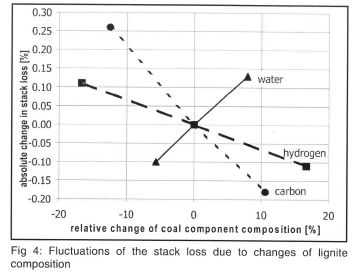
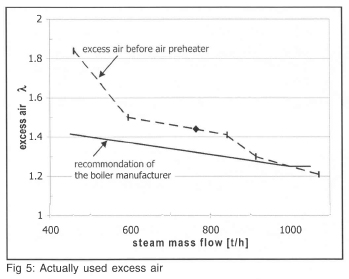
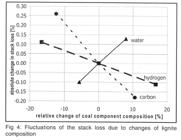
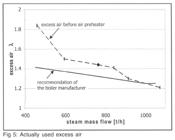
The impact of the different components of the lignite on stack losses is very varied. For instance, while an increase in the carbon or hydrogen content decreases the losses, an increase in the moisture, causes losses to increase, Fig 4. The level of losses due to the heat associated with water vapour in the flue gas is, for lignite, up to 20 %. Although there are only a few percents of hydrogen in the lignite, its influence on heat loss is significant. For instance, with 5 % hydrogen and 50 % moisture in the coal the portion of water vapour in the flue gases which results from the combustion of hydrogen is bigger than the portion that results from coal moisture. Calculations show, Oman2, that over 60% of the heat loss due to exhaust flue gas is connected with the amount of nitrogen and carbon dioxide that originates from the theoretically required quantity of combustion air. Rationalisation by decreasing the mass of the flue gas and consequently the stack loss is thus only possible on less than 40% of the mass flow of flue gas leaving the boiler. This part belongs to the excess air and water vapour. The operating conditions for power plants in connection with the actual excess air are frequently very different in comparison with theoretically desired values or values recommended by the boiler manufacturer. While the quantity of excess air has the most important influence on the value of the stack loss the actually used excess air needs to be frequently supervised by independent measurement. As an illustration, Fig 5 represents the actual state of operation on unit 5 at Šoštanj power plant. The consequence of the catch state is an increase in the stack loss due to an increase in the amount of excess air, as presented in Fig 3.
Indirect losses
The composition of the coal has a strong effect on the electrical power needed for the operation of the boiler auxiliaries and the combustion by-products, processing and handling. The power used for these power consumers can be considered as an indirect loss that increases the specific power consumption of the unit and reduces the free electrical power. In coal-fired power plants there are two important power consumers that are the most dependent on coal composition: the coal pulverising equipment Ppe and the device for flue-gas desulphurisation Pfgd. The useful electrical power of the unit is thus the power at the generator terminals Pg reduced by the power consumption of the unit Poc:

Here, Poth stands for the power consumption of all the other consumers in the unit.
The results of the measurements on unit 4 show that the power needed for lignite grinding represents 12% to 14% of the unit's own power consumption and could increase by as much as 1 MW if the portion of ash in the lignite increases by 4%. For unit 4 each 1% change in the amount of ash alters the energy yield of the unit by 0.1%.
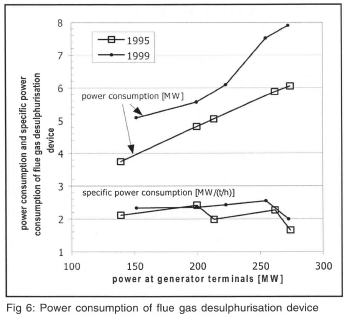
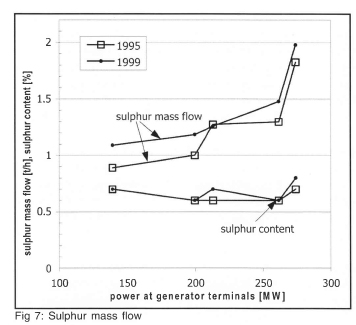
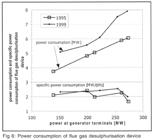
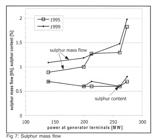
The power needed for the flue-gas desulphurisation depends mostly on the type and the system of the device. Unit 4 has a wet flue-gas desulphurisation (FGD) system which is placed on the cold part of the flue-gas tract after the electrostatic precipitator. The measurements on this unit showed that the power consumption of the FGD device with 95% efficiency is between 2% and 3% of the produced electrical power. For the same load on the unit the difference in power consumption is caused by the different quantities of sulphur that have to be removed from the flue gases. The reason for the increase in the sulphur mass flow through the FGD device is the increasing sulphur content in the lignite or the increasing lignite mass flow for an unchanged content of sulphur. The mass flow of the fuel will increase if the heating value of coal decreases - more ash or moisture and less combustible matter in the lignite. The results of the measurements of power consumption of the FGD system on unit 4 performed in the years 1995 and 1999 are presented in Fig 6 and Fig 7. It is evident that although the sulphur content of the lignite and the specific power consumption of the FGD system remained almost equal, the power consumption of the FGD system in 1999 was greater. The reason is the increased mass flow of the sulphur through the flue-gas system as a result of the lower heating value of the lignite.
Disguised losses
There are some disguised effects on the efficiency of the steam boiler and the power plant performances caused by a variation in the lignite composition.
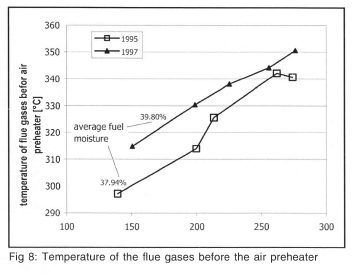
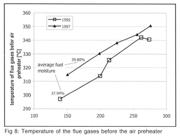
The increase in the overall coal moisture enlarges the flue-gas volume flow, which leads to a reduction in the flame temperature in the furnace. Consequently, the heat flow carried by radiation into the evaporator becomes smaller. On the other hand, the moisture in the lignite that enters the furnace can cause a delay in lignite ignition, an increase in the flame length and a change to the optical properties of the flame. Because of the selective emisivity of water molecules an increase in the partial pressure of the water molecules in flame increases the emission coefficient of the flame. The overall effect of increasing the flame volume and emisivity and decreasing its temperature is usually a smaller radiative heat flux to the evaporator in the furnace. As a consequence, the heat flux that remains for convective heat transfer in the convective part of the boiler is greater. This effect causes the higher temperatures of the flue gases leaving the furnace as well as the higher temperatures in the cold part of the boiler. The consequence is an increasing heat loss due to exhausted flue gases, Oman3. The situation is clear in Fig 8, where apart of results of the comparative measurements in 1995 and 1997 is presented. During both measurements the operation mode and the parameters of the unit were the same, only the composition of the coal (in particular the moisture) was different. For lignite with a higher moisture content the radiative heat transfer in the furnace was reduced, the temperatures of the flue gas at the entrance of the convective part of the boiler increased and they remained higher until they reached the air preheater at the cold end of the boiler.
Conclusions
This article deals with the influence of lignite and low-rank coal compositions on the conversions and heat transfer taking place in large coal-fired steam boilers. The changes in the composition of the coal are reflected not only in changes to the boiler efficiency and the overall quality of the processes in the power plant unit, but also in the emission requirements the boiler must meet. Accordingly, while striving to produce power at the lowest cost possible, the composition of coal, which is reflected as coal quality, becomes an important parameter.
The basis of the analyses presented in this paper is the first-law thermal efficiency of the boiler. The efficiency is expressed as heat losses, mainly with the value of the heat flux of flue gas lost up the stack. The losses in the steam boiler that are affected by coal composition can be classified as: direct, indirect and secondary or disguised losses. To determine these losses the principal data of coal composition needed are: heating value, moisture, ash, sulphur, carbon and hydrogen content. Among the direct losses the loss of heat due to exhaust flue gas, also called stack loss, is the biggest. We showed that the changes in coal composition can cause relatively small changes in the stack loss. Much more influential parameters are the quantity of excess air and the temperature of the exhausted flue gas.
The indirect losses are all the electrical power needed for the operation of auxiliary installations at the power plant. Here, the power required for coal grinding and the power for the desulphurisation system are the most important.
The results point out the weak influence of ash content on heat transfer in the boiler. More significant is its influence on the unit's power consumption and the handling costs. More important effects on boiler efficiency include the alteration of the moisture content of the lignite. The water vapour in the flue gases resulting from the total moisture and hydrogen content in the lignite causes heat losses with the exhausted flue-gas flow and indirect losses in the form of an increase in the power consumption for grinding and transportation of the lignite with higher moisture contents. The changes to the moisture content of the lignite also influence the conditions of the radiative heat transfer in the furnace and consequently the convective heat transfer. The result of these changes is a variation in both the exhaust flue-gas temperature and the boiler efficiency.
Sulphur, in any form, is not welcome in coal, primarily because of the huge costs of desulphurisation. The measurements show that for a unit of about 300 MWe power the consumption of the desulphurisation device is between 2% and 3% of the produced electric power. This share depends on the mass flow of sulphur in the treated flue gas.
The fact is that the influence of the lignite composition on the performance of the steam boilers is reflected more through the consumption of electric power than through the heat losses.
That means, that even the changes in the lignite composition which cause small changes to the boiler efficiency can cause significant changes to the power plant efficiency.
1. Deutsche Norm DIN 1942. Abnahme - versuchen an Dampferzeugern. VDI-Dampferzeugerregeln, Februar 1994.
References
- 2. Oman J, SenegacnikA, Dejanovic B Influence of lignite composition on thermal power plant performance, Part 1: Theoretical survey. Energy Conversion and Management, 2001, Vol.42, Pergamon, pp. 251-263.
- 3. Oman J, SenegacnikA, Dejanovic B, Influence of lignite composition on thermal power plant performance, Part 2: Results of test. Energy Conversion and Management, 2001, Vol.42, Pergamon, pp. 265-277.