Fuel Properties and Engine Performance of Kenyan and Tanzanian Jatropha Biodiesel
Abstract
Jatropha curcas oil was extracted from jatropha seeds of Kenyan and Tanzanian origin. Biodiesel was then produced by two step acid-base catalytic transesterification process due to the amount of free fatty acids (FFA) in the oil. Physicochemical properties of the produced biodiesel were tested according to international standards and were found to be different according to the source of biodiesel, though both were still within the requirements. Engine performance tests were carried out in an Audi, 1.9 litres, turbocharged direct injection, compression ignition engine at different loads. The biodiesels from different regions were found to have different engine performance behaviours, thus it was concluded that different regions produce fuel of different characteristics.
Fatty acids; fuel origin; Kenya; Tanzania
1. Introduction
1.1
BiodieselBiodiesel, a mixture of mono alkyl esters of long chain fatty acids, is derived from renewable lipid feedstock, such as vegetable oil or animal fat. Biodiesel can be used in diesel engines without major modifications. It is becoming one of the fastest growing fuels in the global fuel market. It offers many advantages such as; it is renewable, energy efficient, nontoxic, sulfur free, biodegradable, causes cleaner combustion (i.e. less smoke emissions) and reduces global warming gas emissions. Biodiesel as a fuel is important especially in the rural areas of developing countries where there is vast unutilized land and lack of modern forms of energy. Very little research has been conducted on biodiesel production and tests from agricultural African countries. All liquid fuels are imported into the country, which is expensive and consume a big percentage of the country's foreign exchange.
1.2
Biodiesel propertiesIt is a known fact that the type of biodiesel produced from the vegetable oil depends on the type of the vegetable oil and its geographical location. For instance, several researchers found that jatropha oil produces superior biodiesel compared to many other non-edible feedstocks1-3. On the geographical location front, many researchers observed different characteristics in biodiesel produced in the same way, from similar plants but from different regions. Lalas and Tsaknis4 compared the characteristics of oils from Moringa Oleífera of Indian origin and Kenyan (Mbololo) origin. This article clearly shows that even though the oil extraction and processing procedure were exactly the same, their properties differ due to the difference in the regions where they hail from. Therefore, all oils depend more on the regions they are planted rather than the species of the vegetation, most probably because of the differing environmental conditions.
Similarly, there has been research on Jatropha curcas with the same result. Emil et al.5 in their research, compared jatropha seed oil from Malaysia, Indonesia and Thailand which was produced in the same way and using the same facilities. From their results, the physicochemical characteristics of the oil produced were very different. All the properties, i.e. % free fatty acids (FFA), iodine value, saponification value, oil content and density were different from each region. Lu et al.6 produced biodiesel from jatropha oil of Chinese origin but from different regions. In their research, they observed that the properties of crude jatropha oils vary as per their origins. They stated that, because fatty acid contents in the crude jatropha oil affect the biodiesel production process and the biodiesel fuel properties, jatropha from different origin have different fatty acid content and this ends up with biodiesel of different properties. In the same context, Foidl et al.7 produced jatropha oil from seeds which hail from Cape Verde and Nacaragua. The seeds were processed in a similar manner. The oils were produced using the same equipment and in a similar environment. Still, the properties and content characteristics of the produced oils were different. The difference was conspicuous starting from the composition of the dried seeds to the saponification number, viscosity, % FFA and iodine number.
1.3 Aim of this study
Therefore, plants from different regions produce oil with characters which vary by wide margins. It is therefore very important to study the potential, the characteristics and the operation of biodiesel from a plant e.g. jatropha, situated in a certain region. In this study, biodiesel was produced from jatropha oil of two neighbouring countries and their characteristics compared in terms of fuel properties and engine performance. Both biodiesels were produced in the same laboratory, using the same chemicals and equipments. With interests from developed countries e.g. United States of America and United Kingdom, and also from fast developing countries e.g. China, for agricultural land to develop fuel generating plants like jatropha, this study can be used to make informed decisions on regions to invest.
2. Materials and Equipment
2.1
MaterialsTwo samples of Jatropha curcas oil were supplied from Kenya (jatropha A) and Tanzania (jatropha B) respectively. The oils were produced from the seeds by the same mechanical oil extraction method. The chemicals used were analytical reagents; potassium hydroxide and methanol, at 85 % and 99.5 % purity respectively, and were out-sourced from local suppliers. The FFA were determined by using the simple titration method as per literature8.
2.2
Biodiesel production processThe transesterification process was preferred for biodiesel production in this study, where the experiments were conducted using beakers as reactors. The reaction beaker was placed on a thermostatically controlled heating plate equipped with a magnetic stirrer whose maximum heating capacity is 420 °C and maximum agitation is 2000 rpm. A thermometer was fixed by the use of a retort stand and immersed in the beaker for verifying the temperature of the heating plate.
The free fatty acid content of jatropha oils in this study were initially found to be 5.6 % for jatropha A and 5.8 % for jatropha B. An acid esterification process followed by the transesterification method was then used to prepare the Jatropha curcas methyl esters (JCME). The acid pre-treatment process was intended to convert the free fatty acid to esters using an acid catalyst (H2SO4) to reduce the free fatty acid concentration of the oil to below 1 %. The acid catalyst (w/w of oil: 0.5 % H2SO4) and 6:1 methanol/oil molar ratio was used and the mixture stirred at 500 rpm for 1 hour at 50 °C, then after settling, the pre-treated oil was collected and purified9. After acid esterification, the transesterification was carried out at the following standard conditions: 6:1 methanol/oil molar ratio (mol/mol), 1.0 wt % potassium hydroxide, 55-60 °C reaction temperature, 400 rpm agitation speed and 60 minutes reaction time10. After the reaction and settling, the biodiesel (methyl esters) was collected and purified from all impurities. The final product, that is the biodiesel, formed as a clear, light yellow liquid.
2.3
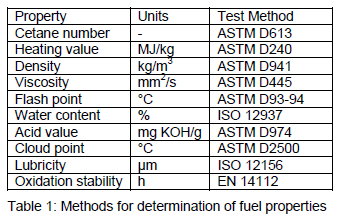
Fuel properties measurementFuel properties of the samples were tested according to the standards recorded in Table 1. The fatty acid composition of biodiesel was analyzed by using a gas chromatography (GC) mass spectroscopy (Agilent6890N) coupled to an inert mass-selective detector (Agilent 5973). The percentage composition of the individual components was obtained from electronic integration measurements using flame ionization detection. All relative percentages determined by GC for each fatty acid sample are the mean of three runs.
2.4 Engine tests equipment
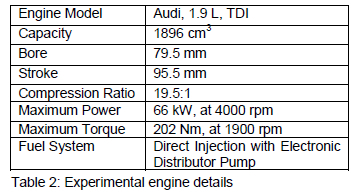
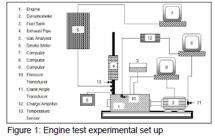
An Audi, 1.9 L, turbocharged direct injection (TDI) compression ignition (CI) engine was used in this study for engine performance. It is a four-stroke, four-cylinder, water cooled diesel engine. Table 2 records the engine's technical specifications.
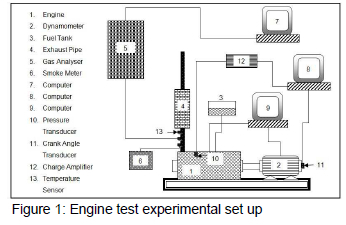
Figure 1 depicts the equipment connections for the engine test. The engine (1) was coupled with a dynamometer (2) to provide brake load, while the engine throttling and dynamometer settings were controlled by a computer (9). Fuel was introduced from a fuel tank (3) equipped with flow measurement system. During fuel switching, the fuel tank was drained from the engine fuel filter, new fuel was introduced into the tank until the fuel filter was full, and the engine was then started and allowed to run for a few minutes to clear fuel lines and stabilize. The engine was run at 3000 rpm for all tests. Each experiment was done at least twice and the average of the results (which differ by less than 5 %) taken.
2. Results and Discussion
3.1 Fatty acid composition
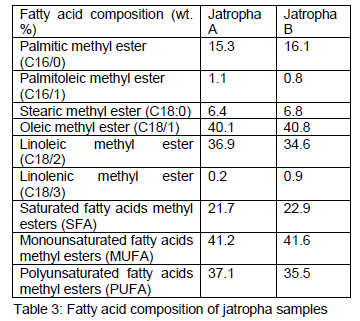
The fatty acid profiles are the major indicators of the properties of any biodiesel. In this work, biodiesel from Jatropha curcas (jatropha A and B) had a fatty acid composition as depicted in table 3. As seen, the profiles for the two biodiesel are different. The composition of the fatty acids affects various properties of biodiesel, such as oxidation stability, low temperature flow properties and lubricity.
3.2
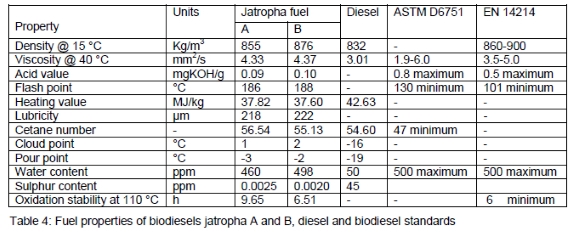
Fuel propertiesTable 4 summarizes the properties of methyl esters from the oils. These properties indicate the suitability of methyl esters in this study for being used as an alternative fuel for diesel engines. Properties of the methyl ester from the oil were found to be in the limits of biodiesel standards (ASTM D6751 and EN 14214) though different from each other. The properties of fossil diesel are included for comparison purposes.
3.3
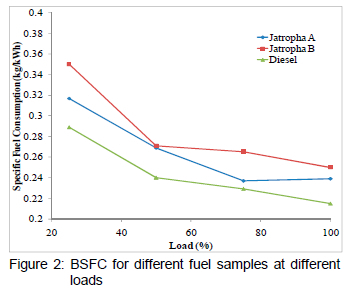
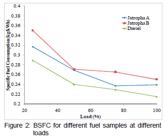
Brake specific fuel consumptionFigure 2 illustrates the brake specific fuel consumption (BSFC) of the fuel samples tested with respect to different loads. It is defined as the fuel consumption rate divided by its corresponding engine power output. It can be observed that BSFC decreases as the load increases for all fuel samples. This could be caused by the increased air pressure at higher loads; the air pressure in the intake manifold increases as the load increases owing to the increased power of the turbocharger (high exhaust gas volume, flow and temperature) hence the reduced amount of fuel per unit power produced. From the results it was observed that jatropha A had low BSFC, at all loads. The higher BSFC of jatropha B means that more fuel was consumed and less power was produced. This was expected because of the lower heating value (HV) of jatropha B compared to jatropha A, at the same time, their high density also contributed to high BSFC because fuel injection systems operate on a fuel-volume basis, a fuel with higher density will result in delivery of greater mass than a fuel with low density values. At 50 % load however, their BSFC was approximately equal, probably because of their respective intrinsic oxygen content improved combustion. Again, fossil diesel was included for comparison purposes and as expected, it had the lowest BSFC. Further results are provided in appendix A.
3.4 Exhaust gas temperature
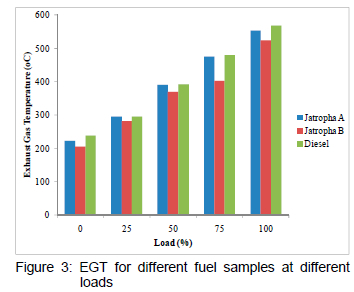
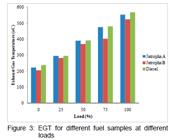
Figure 3 depicts the variation of exhaust gas temperature (EGT) versus loads for test fuels. The EGT increases with increasing load. The EGT of jatropha B was lower than that of jatropha A. The EGT of jatropha A was in turn lower compared to that of diesel. This might be attributed to the heating value of the fuels. The higher the heating value, the higher the exhaust temperature and vice versa.
3.5 Carbon, hydrogen and oxygen content
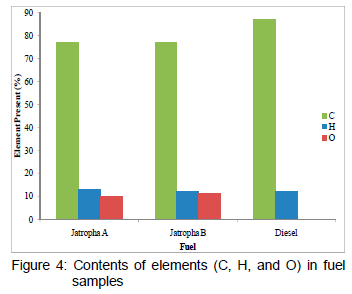
Figure 4 depicts the major elements carbon, hydrogen and oxygen (C, H and O) contained in fuel samples. It can be observed from the figure that C is the most dominant element in the fuel samples, with the same amount being observed in the jatropha samples. The amount of H contained is fairly similar for all samples, with jatropha A recording the highest content. Diesel fuel contains the highest C while jatropha B has highest O content.
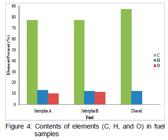
Oxygen is an important element in combustion in that its content influences the stoichiometric air-fuel ratio during the combustion process. A correct amount of in-bound oxygen in a fuel contributes to its better combustion. High cetane number and presence of intrinsic oxygen in the fuel could result in emission reduction because more complete combustion will consume more of the ignitable mixture formed in the combustion chamber hence carbon monoxide and hydrocarbon emissions will be reduced.
3.6 Discussion
A good explanation of why different regions produce jatropha oil with differing properties was given by Zhang et al}1, where, while studying the genetics of the plant, they discovered that due to specific habitat environment with different altitude and latitudes, the plant tends to adapt thus changing its characteristics in the process. They further explained that these geographic environments have different ecological factors that result in exposure of the plants to quite different habitat environment selection pressure, eventually leading to genetic differentiation among plants from different regions. The same results were also observed by Kaushik et al.12 in their genetic study of seed traits and oil content of Jatropha from different locations in India. Kaushik et al. explained that the variation in jatropha seed with respect to their morphological characters could be due to the fact that the species grows over a wide range of rainfall, temperature and soil type. Another study by Ovando-Medina et al.13 also concluded that jatropha trees differ according to their geographical origin. This study, which was conducted on trees from different regions in Mexico, indicated a correlation between chemical and geographical distance. The same observations were realized by Popluechai et al.14 where jatropha oil from different parts of the world (Africa, Asia and South America) exhibited different genetical and physicochemical characteristics. So, different regions with different geographical and environmental conditions will definitely produce trees with different characteristics.
3. Conclusions
Two samples of Jatropha curcas oil were processed to their methyl esters through two step acid-alkaline catalytic transesterification process. The produced biodiesel were compared in terms of their respective fuel properties and engine performance. Fossil diesel properties were included because it is a known and model fuel. It was observed that the produced biodiesel had different properties, a result related to the respective geographical location of the original oil. Different geographical locations produce plants of varying characteristics because of differing ecological and environmental conditions which produce diverse and dissimilar genetic characteristics in the plants as they adapt to these locations.
References
- 1. Makkar HPS and Becker K, Jatropha curcas, a promising crop for the generation of biodiesel and value-added coproducts. European Journal of Lipid Science and Technology, 2009, 111, page 15.
- 2. Treese JV, Li Y, Wang Q and Moore K, Jatropha Curcas Cultivation and Use as a Biodiesel Feedstock, University of Florida Report, 2010, 24 pages.
- 3. Pramanik K, Properties and use of Jatropha curcas oil and diesel fuel blends in compression ignition engine, Renewable Energy, 2003, 28(2), 239-248.
-
5. Emil A, Yaakob Z, Kumar MS, Jahim J and Salimon J, Comparative evaluation of physicochemical properties of jatropha seed oil from Malaysia, Indonesia and Thailand, Journal of the American Oil Chemists ' Society, 6 January 2010, 87(6), 689-695, DOI:10.1007/s11746-009-1537-6.
» https://doi.org/10.1007/s11746-009-1537-6 - 6. Lu H, Liu Y, Zhou H, Yang Y, Chen M and Liang B, Production of biodiesel from Jatropha curcas L. oil, Computers and Chemical Engineering, 2009, 33, 1091-1096.
-
7. Foidl N, Foidl G, Sanchez M, Mittelbach M and Hackel S, Jatropha curcas L. as a source for the production of biofuel in Nicaragua, Bioresource Technology, 1996, 58(1), 77-82, DOI:10.1016/S0960-8524(96)00111-3.
» https://doi.org/10.1016/S0960-8524(96)00111-3 - 8. Knothe G, Van Gerpen JH and Krahl J, The Biodiesel Handbook, AOCS Press 286, Champaign, Illionois, 2005.
- 9. Ramadhas AS, Jayaraj S and Muraleedharan C, Biodiesel production from FFA rubber seed oil, Fuel, 2005, 84(4), 335-340.
- 10. Rashid U, Anwar F, Moser BR and Knothe G, Moringa oleifera oil: A possible source of biodiesel, Bioresource Technology, 2008. 99(17), 8175-8179.
- 11. Zhang Z, Guo X, Liu B, Tang L and Chen F, Genetic diversity and genetic relationship of Jatropha curcas between China and Southeast Asian revealed by amplified fragment length polymorphisms, African Journal of Biotechnology, 2011, 10(15), 2825-2832.
- 12. Kaushik N, Kumar K, Kumar S, Kaushik N and Roy S, Genetic variability and divergence studies in seed traits and oil content of Jatropha (Jatropha curcas L.) accessions, Biomass and Bioenergy, 2007, 31(7), 497-502.
- 13. Ovando-Medina I, Espinosa-Garcia, Nunez-Farfan J and Salvador-Figueroa M, Genetic variation in Mexican Jatropha curcas L. estimated with deed oil fatty acids, Journal of Oleo Science, 2011, 60(6), 301-311.
Revised form 5 October 2012
Accepted 20 November 2012
APPENDIX A
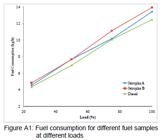
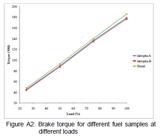
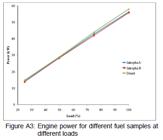
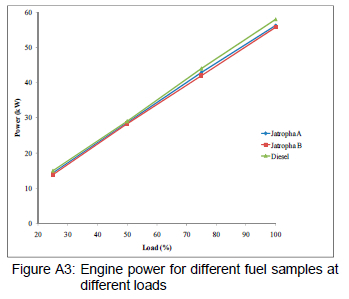
The following figures (A1 and A2) serve as an additionalj record of the experimental data.