Solar collector performance
Abstract
In this investigation, the temperatures of the insulated collector plate and glass cover of a horizontal solar collector were measured and compared to theoretically predicted values for different ambient conditions. By employing an appropriate equation for the prediction of the heat transfer between the cover and the natural environment, good agreement was obtained between the theoretically predicted and experimentally measured values.
Introduction
It is interesting to note that although excellent books and a mass of literature on the theory concerning the performance of all types of solar collectors are available, no reference could be found of the simplest horizontal collector, consisting of an insulated horizontal square plate covered by a single glass sheet, which is supported by insulated side walls, where the experimentally measured plate surface and cover temperatures were compared to theoretically predicted values for a particular solar radiation and other given ambient conditions.
If an analysis had been conducted and the calculated plate temperature had been in agreement with the measured value, this would have been fortuitous since no reliable equation for the prediction of the heat transfer rate between the cover and the natural environment was, until recently, available to make such a prediction possible.
Recent work1 presented an equation with which the effective heat transfer (both convection and radiation) from a glass cover to the ambience can be predicted for a particular collector geometry (similar to the present collector), i.e.
In this equation it was assumed that the Kelvin sky temperature is given approximately by Tsky = 0.0552Ta1·5. This relation was considered to be reasonably accurate under relatively dry clear sky conditions. Since we were interested in an accurate prediction of the effective heat transfer from the glass surface and not the individual effects, i.e. convective heat transfer (natural and forced) and radiation heat transfer, uncertainties in the individual terms of the above equation were not critical (the combination of the terms is important).
In this investigation the glass cover and plate temperatures of a simple solar collector were measured and were found to be in good agreement with theoretically predicted values.
Apparatus
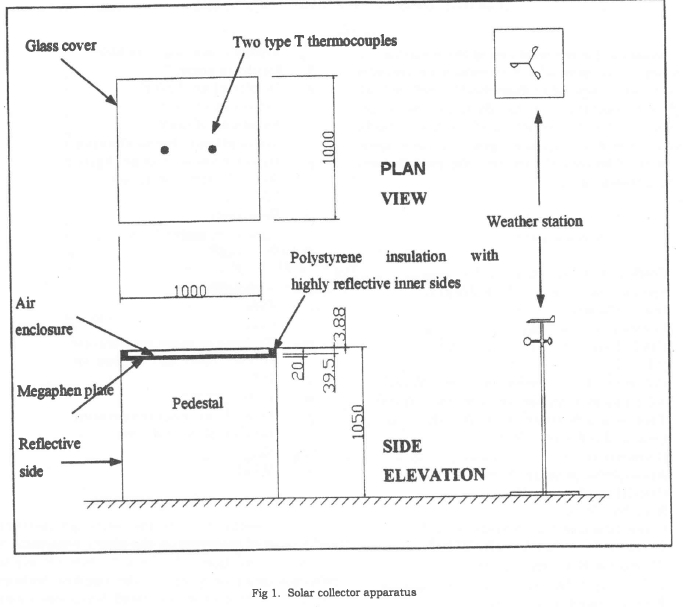
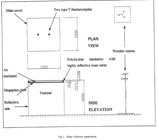
The experimental solar collector, as shown in Fig. 1, consisted of a horizontal 1 m χ 1 m square glass cover with a thickness of 3.88 mm. The base of the solar collector consisted of a 20 mm thick insulated (megaphen with kp = 0.015 W/mK) black plate (ap = 0.9) located 39.5 mm below the glass cover. The sides of the collector consisted of 50 mm thick polystyrene sheets with the inside surfaces covered by a highly reflective layer of aluminium foil (a « ε - 0.1). A square pedestal supported the collector having highly reflective sides, at an elevation of 1.05 m above ground level. Plate and cover temperatures were measured with the aid of type-T thermocouples (two thermocouples on each surface). The ambient conditions (temperature and wind) were obtained from a Davis weather station located near the apparatus as shown in Fig. 1, while the total incident solar radiation was measured with the aid of a Kipp and Zonen solar sensor placed on top of the glass cover. The test facility was located 100 m above sea level at 33.98°S latitude and 18.85°E longitude.
Analysis
The objective of this study was to compare the experimentally measured glass cover and plate temperatures of a solar collector with theoretically predicted values for different ambient conditions.
To analyse the problem, consider the solar collector (shown in Fig. 1) that was subjected to a solar radiation of

where Ihb and Ihd are the beam and diffuse solar radiation on a horizontal surface, respectively.
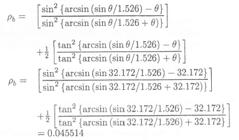
A part of the beam radiation is reflected at the collector cover (Duffle and Beekman2). For a refraction index of η = 1.526 the reflection at the upper surface of the glass cover is
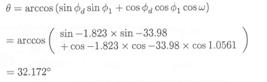
where the zenith or beam incidence angle θ is determined from the relation
where
Φd = declination i.e. the angular position of the sun at solar noon with respect to the plane of the equator (North positive), degrees
Φ1 = latitude (North positive), degrees
ω = hour angle degrees, solar noon being zero and each hour equalling 15° of longitude with mornings positive and afternoons negative, e.g. ω = +15° for llh00 and -37.5° for 14h30.
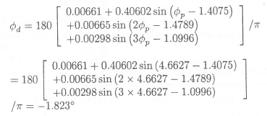
The declination angle is given by
where Φρ is the annual phase angle given by
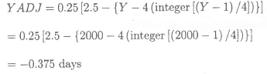
In equation (5) DOY is the day of the year, where 1 January is the first day of the year and Y ADJ is the leap year adjustment which is given by
where Y is the particular year. The integer function rounds off the calculated value towards the lower integer value.
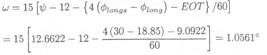
The hour angle ω is determined according to the following equation
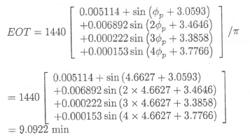
The equation of time (EOT), expressed in minutes, is given by
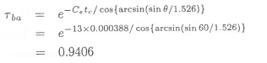
For diffuse radiation, employ equation (2) with θ = 60°,2 to find the reflectivity pd = 0.09346. The beam transmittance considering only absorption through the glass cover is given by
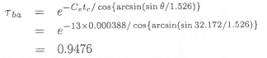
where Ce. is the extinction coefficient and tc is the thickness of the glass cover.
The transmittance of diffuse radiation considering only absorptance, τdα, is the same as that for τbα at θ = 60°.
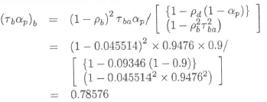
Ultimately the fraction of solar beam radiation absorbed by the plate is given by2,3
where ap is the solar absorptance of the plate.
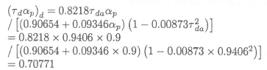
Similarly the fraction of diffuse radiation absorbed by the plate is
Rearranging the previous equation, the absorbed plate diffuse radiation becomes
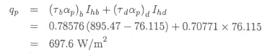
The net solar radiation per unit area absorbed by the plate is therefore
Since the base plate and the sides of the collector were well insulated, conduction losses can be neglected. Radiative exchange with the highly reflective sides of the collector can also be ignored.
With these assumptions the energy balance applicable to the surface of the plate is
where the convective heat transfer from the plate to the air is
If the plate is the warmer of the two surfaces, the convective heat transfer from the air is given by4
where kpc is the thermal conductivity of the air at (Tp + Tc)/2 and ta is the distance between cover and the plate. This equation is valid for Rayleigh numbers ranging from 0 to 108. The Rayleigh number is
where all the air properties are evaluated at the mean air temperatures (Tp + Tc)/2.
The radiative heat exchange between the plate and cover is given by
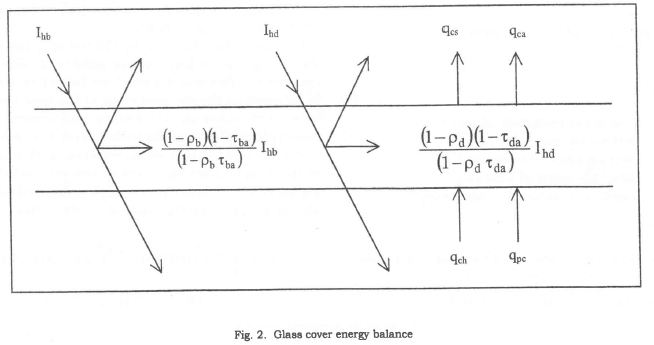
The steady state energy (this was essentially the case at solar noon) applicable to the glass cover control volume, shown in Fig. 2, is
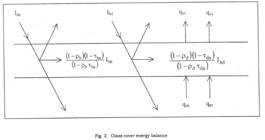
where temperature gradients in the glass are neglected.
For steady state conditions (see Fig. 2) the convective heat transfer from the air below the cover to the cover is the same as the convective heat transfer from the plate to the air, i.e.

The heat loss from the upper surface of this particular collector geometry to the ambience is given by1
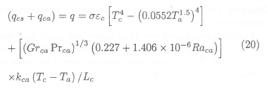
By solving equations (13) and (18) simultaneously, the cover and plate temperatures of the solar collector can be predicted for given ambient conditions.
Results and conclusion
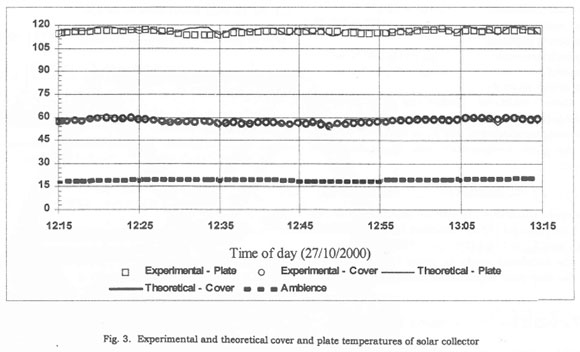
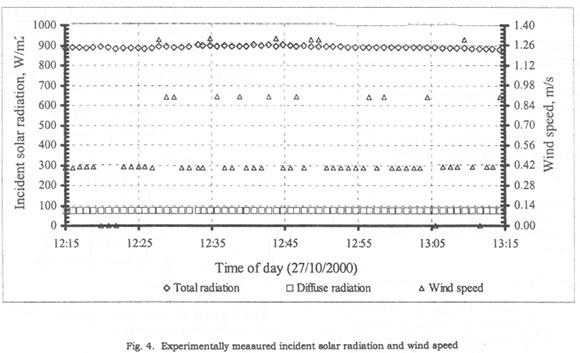
The results of measurements conducted during midday when essentially steady state conditions prevail are shown in Figs. 3 and 4. A numerical example, in which cover and plate temperatures are predicted theoretically at a time during this period, is presented in the Appendix.
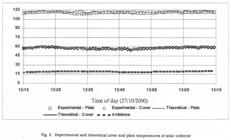
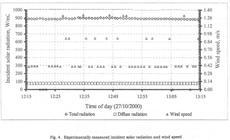
The agreement between the measured temperatures (Tc and Tp) and the predicted values is very good. This suggests that the theoretical approach and the equations used make it possible to predict the performance of this type of collector to a high degree of accuracy.
References
- [1] Lombaard IF &: Kroger DG. Heat transfer between a horizontal flat surface and the natural environment. R&D Journal, 2001,17, pp.47-52.
- [2] Duifie JA & Beekman WA. Solar Engineering of Thermal Processes, 2nd edn. Wiley Interscience, New York, 1991.
- [3] Modest MF. Radiative Heat Transfer, 3rd edn. New York, 1993.
- [4] Hollands KGT, Unny te, Raithby GG & Konicek L. Free convection heat transfer across inclined air layers. J. of Heat Transfer. 1976, 98, pp.189-193.
Final version September 2002
Appendix: Numerical example
A solar collector test was conducted at 12h39:44 (ψ = 12.6622 hours after midnight) local time on 27 October 2000 (DOY = 271st day of the year) at the Solar Energy Laboratory of the University of Stellenbosch, South Africa, located on latitude φ1 - -33.98° (South) and Φlong = 18.85° (East). The South African standard meridian is Φlongs = 30° (East).
The collector specifications are as follows (see Fig. 1): Length of collector side (square) Lc = l m
Glass cover thickness tc = 3.88 mm
Height of air layer tair - 39.5 mm
between plate and cover
Long-wave emissivity of glass ec = 0.88
Extinction coefficient of glass Ce = 13 m-1
Refractive index of glass nc = 1.526
Long-wave emissivity of plate ep - 0.9
Solar absorptivity of plate ap = 0.9
Ambient conditions are as follows:
Total incident solar radiation Ih = 895.47 W/m2
Diffuse solar radiation Ihd - 76.115 W/m2
Ambient temperature Ta = 19.1°C = 292.25 K (1.05 m above ground)
Atmospheric pressure pa = 101049 N/m2
Wind speed vw = 0.9 m/s
(1.05 m above ground)
For the above conditions, predict the glass cover and the plate temperatures (during the particular test the measured glass cover temperature was Tc = 56.537°C (329.687 K) while the plate temperature was Tp = 115.448°C (388.598 K)).
Solution
In this sample calculation it will be shown that the energy equations (13) and (8) are satisfied for Tc = 56.690°C (329.840 K) and Tp = 115.482°C (388.632 K).
To find the incidence angle as given by equation (3), determine the leap year adjustment according to equation (6).
with the integer function yielding a value of 499.
With this value find the annual phase angle according to equation (5).
Substitute the value for φ into equation (4) to find the declination angle
Substitute the phase angle into the equation of time (8)
Using the value obtained for the equation of time value, the hour angle can be determined according to equation (7), for 12.6622 hours after midnight
Substitute Φd and ω into equation (3) to find the beam incidence angle
Therefore the beam reflection from the upper surface of the glass according to equation (2) is
Substitute the beam incidence angle into equation (9) and find that the beam transmittance due to absorptance
The diffuse incidence angle is taken as 60°. Therefore the diffuse transmittance due to absorptance is found to be
The fraction of solar beam radiation absorbed by the plate is according to equation (10)
while the fraction of diffuse solar energy absorbed by the plate is according to equation (11)
Using the predicted plate and cover temperatures, the thermophysical properties and the Rayleigh number of the entrapped air are evaluated at a mean cover-plate temperature Tpc = (Tp + Tc)/2 = (388.632 + 329.84)/2 = 359.23K.
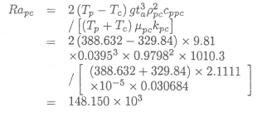
At this temperature find the air density ppc = 0.9798 kg/m3, the specific heat capacity cppc = 1010.3 J/kg.K, the thermal conductivity kpc = 0.030684 W/m.K and the dynamic viscosity μνα = 2.1111 χ 10~5 kg/m.s.
The Rayleigh number from equation (16) is
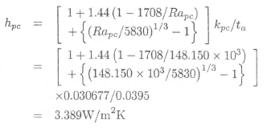
Substitute this value for the Rayleigh number into equation (15) and find the heat transfer coefficient
From equation (12) it follows that the left-hand side of equation (13) yields a value of
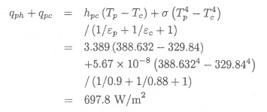
and the right-hand side of equation (13), according to equation (14) and (17), gives
Hence, the plate energy equation for the solar collector is satisfied.
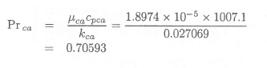
To evaluate the energy equation (18) applicable to the glass cover employ the predicted cover temperature Tc to find the thermophysical properties and dimensionless Prandtl, Grashof and Reynolds numbers of the air, at a mean air-cover temperature Tac = (Tc + Ta)/2 = (329.84 + 292.25)/2 = 311.05 K. At this temperature the density of the air is pca = 1.13162 kg/m3, the specific heat cpca = 1007.1 J/kg.K, the thermal conductivity kca = 0.027069 W/m.K , the dynamic viscosity μαα = 1.8974 χ 10-5 kg/m.s and the Prandtl number is
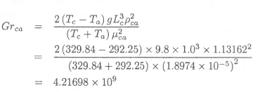
The Grashof number is given by
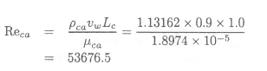
while the Reynolds number is
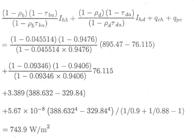
Substitute the previously determined glass solar characteristics into the left-hand side of equation (18) and find -
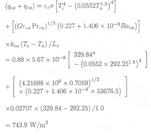
Upon substituting the above values for the Prandtl, Grashof and Reynolds numbers into equation (20), the right-hand side of equation (18) yields a value of
As in the case of the solar collector plate, it is shown that the predicted temperatures satisfy the cover energy equation for the simple collector.