Performance and Emissions Aspects of a Compression Ignition Engine Fuelled on Ethanol
Introduction
When alcohol fuels are used as a replacement for diesel oil, some means of initiating the combustion is necessary. In the work presented here dimethyl ether (DME) was used as an ignition promoter.
The results obtained with methanol as the main fuel have been reported, and the benefits gained by the use of this fuel are noteworthy1,2,3. It has been shown that the performance achieved with methanol fuelling is comparable to that of diesel fuelling, there was a near absence of smoke, as indicated by a smoke meter, and that NOx, CO and THC emissions were lower across the load range.
The research has now been extended to ethanol as the main fuel. Ethanol's cetane number and the calorific value are both higher than those of methanol. When, however, ethanol is used as a main fuel some form of ignition promoter or engine modification is required. The latter includes a higher compression ratio or the inclusion of a glow plug4,5,6.
The aims of this work are to compare some performance indicators and exhaust emissions of a compression ignition engine fuelled on diesel and then on ethanol with dimethyl ether as an ignition promoter.
Experimental Setup and Procedure
Engine and Instrumentation
The research was performed on a two-cylinder, direct-injection, water-cooled, fourstroke compression ignition engine, coupled to an eddy current dynamometer. Dimethyl ether was supplied to the engine through the air intake manifold, and was fed to each cylinder separately.
Data recorded included combustion chamber pressure, fuel line pressure, crank angle, top dead centre, engine speed, fuel and airflow rates, various temperatures and atmospheric pressure.
An exhaust emission system was used to monitor and record oxides of nitrogen, total hydrocarbons and carbon monoxide. A Hartridge smoke meter was used to measure opacity when using diesel as a fuel.
Test Procedure
A set of tests was initially performed on diesel oil to serve as a reference. All tests were performed at the midrange constant speed of 1500 rev/min, while the load was increased, in stages, until the smoke level exceeded 75 Hartridge Smoke Units (HSU). The tests were repeated with ethanol/DME fuelling.
Results and Discussion
Performance
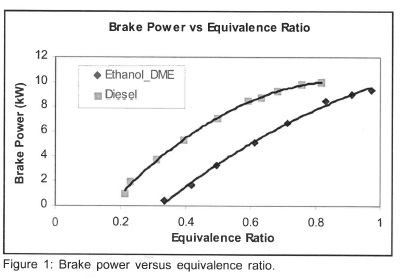
Figure 1 shows the graph of brake power versus equivalence ratio for both diesel and ethanol/dimethyl ether fuelling. In both instances the power increases with increasing equivalence ratio, with maximum power reached with ethanol fuelling being some 8% less than that achieved in the corresponding diesel test. Since the calorific values of both ethanol and dimethyl ether are about two thirds that of diesel oil, to achieve the same power, an increase in the quantity of ethanol/dimethyl ether can be expected.
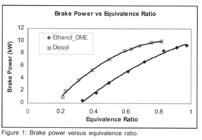
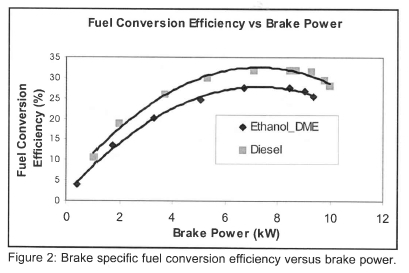
Figure 2 shows brake specific fuel conversion efficiency against brake power. The trends are as expected for both fuelling systems, where the efficiency increases with load. The maximum efficiency reached with diesel fuelling is some 32% at 7,5 kW, while that achieved with ethanol/dimethyl ether is only some 4% less than that of diesel fuelling, at some 7,2 kW.
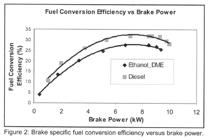
Diesel fuelling results in a higher efficiency than ethanol/ dimethyl ether fuelling. An improvement could be expected if engine settings were varied and the resulting effect studied. An additional reason for this lower efficiency is that dimethyl ether is aspirated with the intake air and starts combusting during the compression stroke before ethanol is injected into the combustion chamber. Therefore energy release occurs before top dead centre, resulting in a certain amount of negative work being done8,3.
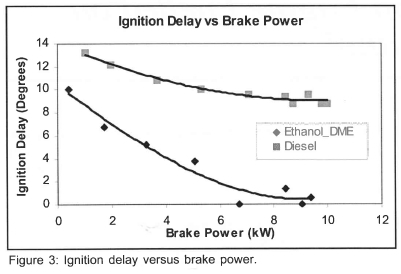
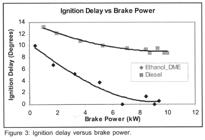
Ignition delay plotted against brake power is shown in figure 3. Diesel fuelling shows an ignition delay trend, which decreases with increasing load, as expected9. This occurs as a result of the increasing combustion chamber temperature as the load is increased. The ignition delay for ethanol/dimethyl ether fuelling is shorter than that of diesel fuelling. As indicated above, dimethyl ether releases energy before top dead centre, with the result that ethanol is injected in a high temperature environment, thus evaporating rapidly. At the higher loads, the combustion chamber temperature increases with the result that as ethanol is injected, it burns at the nozzle. This results in a zero ignition delay.
Emissions
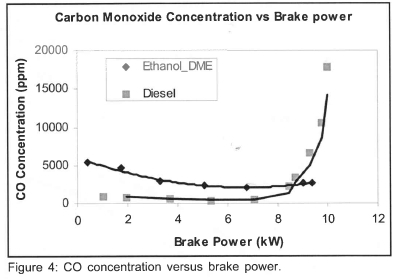
The concentration of CO versus brake power for both fuelling methods is shown in Figure 4. CO concentration for diesel fuelling shows its expected trend starting low at low loads and reaching a minimum value at the same load where the brake specific fuel conversion efficiency is at a maximum. This is followed by an increase in concentration as the efficiency decreases. In the case of ethanol/dimethyl ether fuelling, the CO concentration shows a steady decrease with increasing load, with the minimum concentration occurring at the same power output as that for maximum efficiency. CO emissions are influenced by the air-fuel ratio10,11.
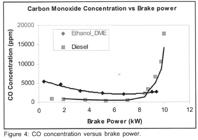
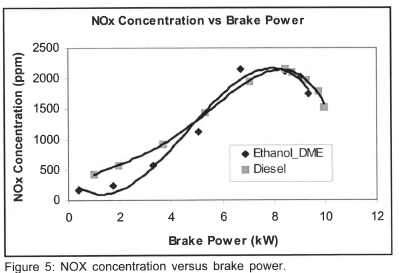
Figure 5 shows the concentration of NOx versus brake power. Once again, the concentration of NOx with diesel fuelling does, as expected, increase with load. Since high temperatures favour the formation of NOx, as the load is increased, the combustion chamber temperature also increases.
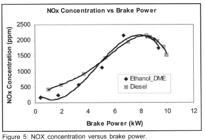
NOx emissions for ethanol are less than those of diesel, up to about 4,5 kW, and again after some 7,5 kW. The concentrations reach a maximum with both fuelling methods, and then decrease. This occurs even though the combustion chamber temperature increases with increasing load. However, the chemical rates at which nitrous oxides form are non-linear functions of temperature10. Hence the concentrations of NOx fall off somewhat despite the increasing temperature. Similar trends were reported in6.
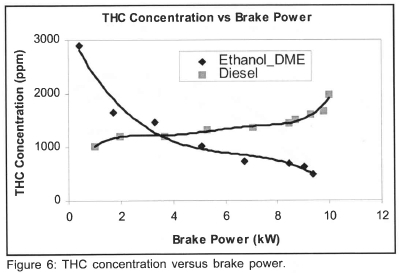
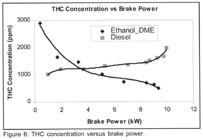
An important benefit of this fuelling system is seen in the THC emissions, as shown in figure 6. The concentrations for diesel fuelling and those of ethanol/dimethyl ether fuelling show an opposing trend. At low loads, the concentrations with ethanol/dimethyl ether fuelling are higher than those of diesel fuelling. However, these decrease rapidly to about half those of diesel fuelling at the load corresponding to the maximum efficiency. Reductions in THC concentrations were also noted by6,11.
Conclusions
The results achieved show that the power output of the engine was similar with both fuelling methods. However, a better fuel conversion efficiency was achieved with diesel fuelling.
With ethanol dimethyl ether fuelling NOx emissions were less than those of diesel fuelling, particularly at low and high loads. Although the CO concentration was somewhat higher initially, with ethanol/dimethyl ether fuelling, it steadily decreased with increasing load. THC was reduced by up to 50% at the higher loads.
References
- 1. Gaspari R & Cipolat D. Preliminary emissions analysis of a methanol/dimethyl ether fuelled compression ignition engine. R & D Journal, 13, pp. 1-7, 1997.
- 2. Cipolat D & Bhana N. A brief comparison of the performance of a compression ignition engine fuelled on methanol/dimethyl ether and diesel. R & D Journal, 14, pp. 37-42, 1998.