Social support and coping in adults with type 2 diabetes
Abstract
BACKGROUND: The diagnosis of diabetes has been described as a lifelong psychological burden on the patient and his or her family. Social support plays a pivotal role in patients with diabetes and is important in enabling them to cope effectively with the disease. There is a dearth of research on social support and coping in patients with diabetes in South Africa. OBJECTIVES: The aim of this study was to explore whether patients with poor perceived social support have lower levels of well-being and coping than patients with good social support. METHOD: A cross-sectional study was conducted at both public and private facilities on the north coast of KwaZulu-Natal, South Africa. The Diabetes Care Profile (DCP), the General Health Questionnaire (GHQ), the Social Support Questionnaire (SSQ) and the WHO-5 Well-being Index (WHO-5) were administered to 401 participants. RESULTS: The findings indicate that there is an inverse relationship between social support and coping, which suggests that an increase in social support is associated with a decrease in emotional distress. There was a small positive correlation between the SSQ and the WHO-5, which suggests participants who had good support endorsed better levels of well-being. Although participants indicated that they were satisfied with their level of support, they had poor coping as indicated by the high mean score on the GHQ and the high HbA1c level. There was a small positive correlation between GHQ and HbA1c. There was no association between social support and HbA1c. CONCLUSION: Social support is important in helping the patient with diabetes cope with the disease and to improve adherence to treatment. Health care providers should take cognisance of psychosocial factors in the treatment regime of the patient. Family members should be educated about diabetes, the importance of adherence and long-term complications of the disease.
Background
The diagnosis of diabetes has been described as a lifelong psychological burden on the person and his or her family.123,4,5,6,78968,9
According to Grey,1010,111212,1313
In South Africa, 2.3 million people are estimated to be living with diabetes, with 1.39 million people who have not yet been diagnosed.1415
Despite the abundance of international research on social support and coping in patients with diabetes, there is a dearth of such research in South Africa. The aim of this study was to explore whether patients with poor perceived social support have lower levels of well-being and coping than patients with good social support locally.
Method
Participants were recruited from two public health facilities and five private medical practices on the north coast of KwaZulu-Natal. The method used in this explorative study is similar to that used in other studies.16,17
Participants
Patients who were 18 years and older had a diagnosis of type 2 diabetes for more than six months and who were able to speak English or isiZulu fluently were invited to participate in the study. The total sample consisted of 401 participants, 200 from the private health sector and 201 from the public health sector.
Procedure
Trained research assistants who were fluent in both English and isiZulu explained the study to patients who were awaiting their regular appointments. Participation was voluntary, and those who met the inclusion criteria were invited to complete the questionnaires. After patients signed informed consent forms, questionnaires were administered to the participants in the language of their choice.
Instruments
A questionnaire comprising a demographic section and four instruments was completed by the participants. Participants who had difficulty completing the questionnaires were helped by the trained research assistants. The average time to complete the questionnaires was 45-60 min.
The Diabetes Care Profile (DCP), developed by the Michigan Diabetes and Research Centre,18181819
The General Health Questionnaire (GHQ-28), developed by Goldberg, is a 28-item measure of emotional distress.2021
The Social Support Questionnaire (SSQ), developed by Pillay,2222
The WHO-5 has five items and covers positive mood (good spirits; relaxation), vitality (being active; waking up fresh and rested) and general interests (being interested in things).23
Where necessary, the questionnaires were translated into isiZulu by an accredited isiZulu translator and were back-translated into English by an isiZulu educator.
Data analysis
All analyses were performed using SPSS version 24.24M) and standard deviations (s.d.). Medians and interquartile ranges were used for variables that were highly skewed or had significant outliers. Categorical and ordinal variables were summarised using proportions and percentages. Proportions were compared using Pearson's chi-square test or Fisher's exact test, as appropriate. Pearson's correlation coefficient was used to measure the linear dependence between WHO-5 and SSQ scales. Canonical correlation analysis (CCA) was used to examine the relationship between linear combinations of SSQ variables and linear combinations of GHQ variables.
Ethical consideration
The Biomedical Ethical Research Committee of the University of KwaZulu-Natal granted ethics approval. Consent was obtained from the managers of the public facilities and the Provincial Department of Health. Research assistants explained to patients that participation was voluntary and had no bearing on their treatment.
Results
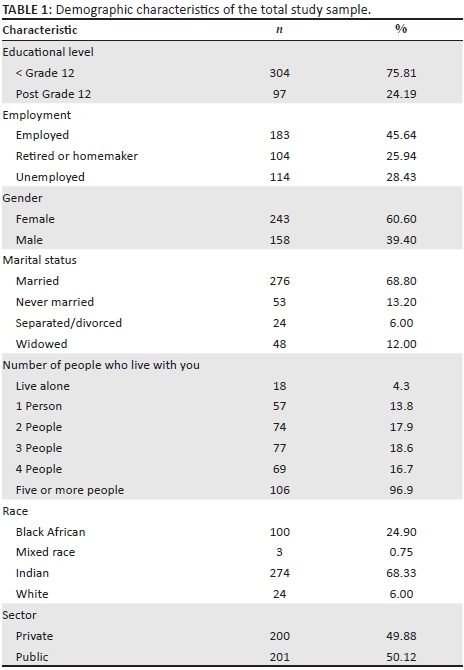
Table 1 shows the demographic characteristics of the sample. More than a quarter of the sample were unemployed 114 (28.43%), while 304 (75.81%) had an educational level of below Grade 12. A majority of the patients were female (243; 60.60%), with 276 (68.80%) reporting that they were married and 106 (96.90%) indicating that they lived with five or more people. In terms of ethnic groups, 100 (24.90%) were Black African, three (0.75%) were mixed race, 274 (68.33%) were Indian and 24 (6.00%) were White. There were 200 (49.88%) patients from the private sector and 201 (50.12%) patients from the public sector.
The mean age of the study sample was 53.70 years (s.d. = 10.7). The average HbA1ca was 12.02% (s.d. = 5.00), which is higher than the generally accepted norm of 7% or lower.1
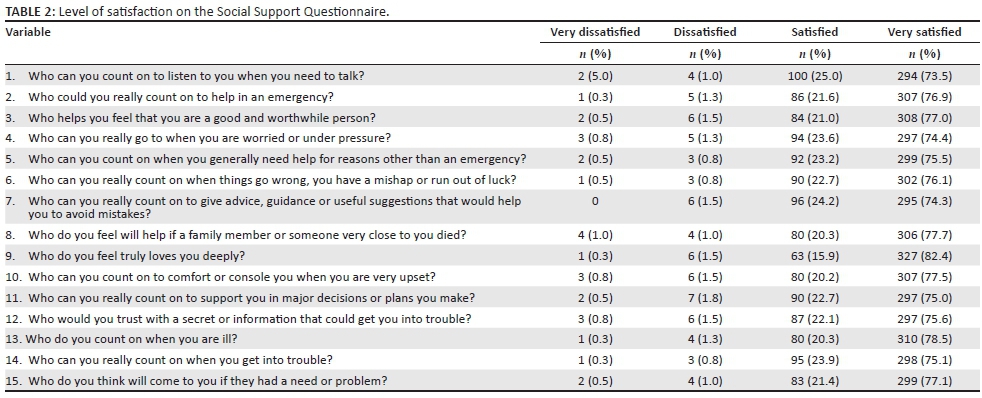
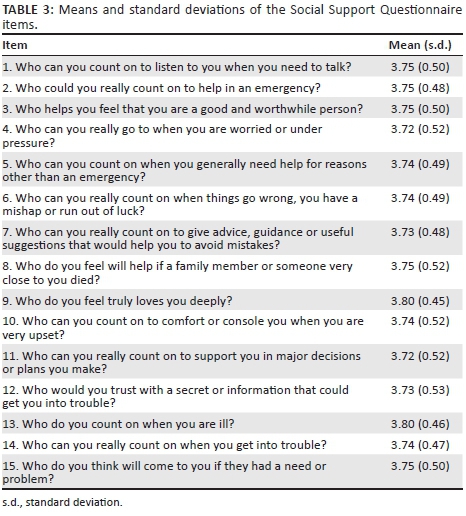
The level of satisfaction with social support as measured by the SSQ is shown in Table 2. Most of the participants were very satisfied with the level of support that they received. Most of the participants (327; 82.40%) endorsed the item that they were very satisfied with the person who truly loves them and with the support that they receive when they are ill (310; 78.50%). The means and standard deviations of the SSQ are presented in Table 3.
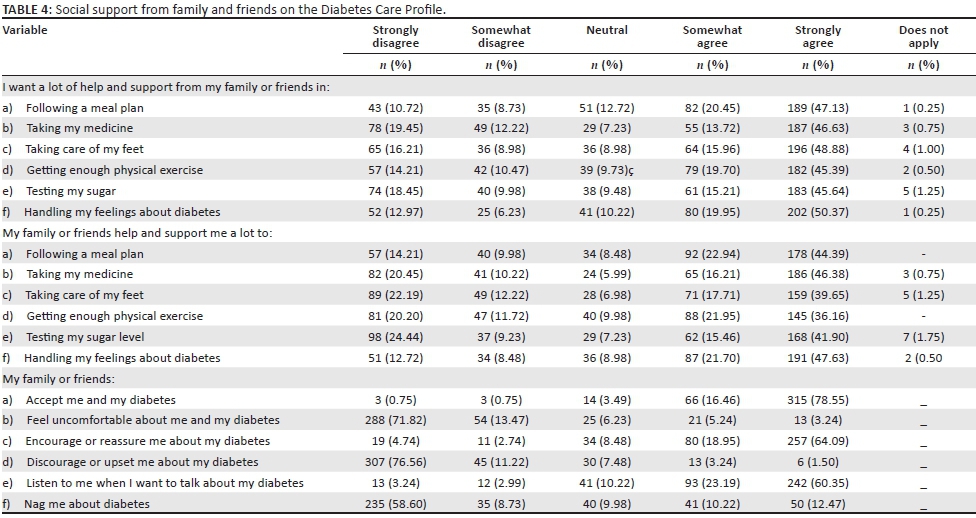
Patients' social support from family and friends as measured by the DCP is shown in Table 4. Just under half of the patients felt that they wanted a lot of help and support in following a meal plan (189; 47.10%), taking medicine (187; 46.63%), taking care of their feet (196; 48.88%), getting enough physical exercise (182; 45.39%) and testing sugar levels (183; 45.64%). Half of the patients (202; 50.37%) indicated that they want a lot of help and support in handling their feelings about diabetes. Most of the patients indicated that family and friends do help and support them in the abovementioned activities and (191; 47.63%) received help and support in handling their feelings about diabetes. Most of the patients felt that their family and friends accepted them as a patient with diabetes (315; 78.55%), received encouragement about living with diabetes (257; 64.09%) and felt that their family and friends listened to them when they wanted to talk about diabetes (242; 60.35%). A small percentage (50; 12.47%) felt that their family or friends nagged them about diabetes.
On the SSQ, the majority of the patients endorsed their spouse as providing the main social support. The DCP yielded similar results with patients indicating that most help in caring for their diabetes came from their spouse (197; 49.13%) and other family members (121; 30.17%). Thirty-seven patients (9.23%) indicated that the doctor helped most with diabetes.
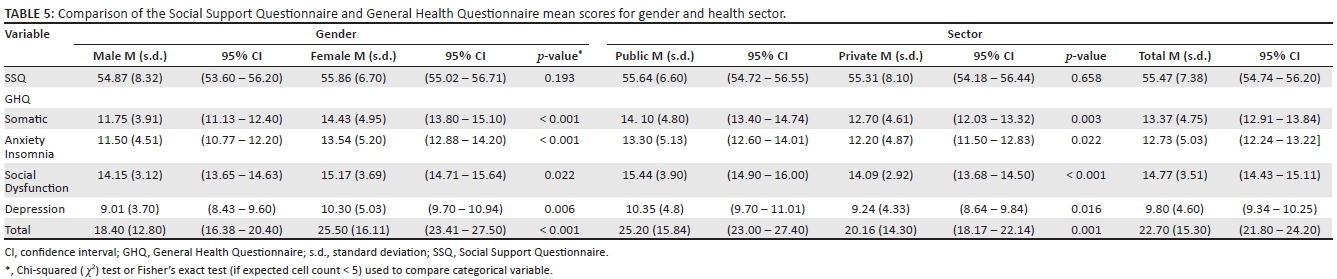
Mean scores comparisons of the SSQ and GHQ by gender and health sectors are displayed in Table 5. The difference in mean scores between women (M = 55.86; s.d. = 6.70) and men (M = 54.87; s.d. = 8.32) was not statistically significant. There was also no statistically significant difference between the public and private health care sectors with mean scores of (M = 55.64; s.d. = 6.60) and (M = 55.31; s.d. = 8.10), respectively. On the GHQ, 159 (40%) participants reported elevated somatic symptoms, 149 (37.16%) had high levels of anxiety, 290 (72.32%) reported high levels of social dysfunction and 78 (19%) had severe depressive symptoms. Women (M = 25.50; s.d. = 16.11) had significantly higher mean GHQ scores compared with men (M = 18.40; s.d. = 12.80). The public sector mean GHQ score (M = 25.20; s.d. = 15.84) was significantly higher than that of the private sector (M = 20.16; s.d. = 14.30). The total GHQ mean score (M = 22.70; s.d. = 15.30) was elevated, indicating distress and difficulty in coping.
A canonical correlation was used to identify and measure the associations between multiple SSQ and GHQ variables. The null hypothesis of the canonical correlation was that there is no linear correlation between the support (SSQ) and coping (GHQ) variables. The null hypothesis that social support variables are independent from the coping variables is tested using Wilks's lambda. For this study, the Wilks's lambda results were: Λ = 0.78759; F = 1.46332; df = 60; p < 0.013. In general, Wilks's lambda is the opposite of the R-squared, where a near zero indicates that there was a significant difference between SSQ and the GHQ (p < 0.014), which suggests that there is a significant relationship between social support and coping. The null hypothesis that there is no relationship between the two sets of variables is rejected; therefore, it can be concluded that the two sets of variables are dependent. The Pearson product-moment correlation coefficient was used to measure the strength of linear association between individual SSQ (social support) and GHQ (coping) variables. There was a small negative correlation between the two variables (r = -0.099, N = 401, p < 0.05), with high levels of support associated with a decrease in coping.
A univariate analysis of variance was used, to explore which support items were significant and had a significant effect on coping. The following items were significant: 'Who can you count on to listen to you when you need to talk?' (p < 0.025); 'Who can you really count on to give advice, guidance or useful suggestions that would help you to avoid mistakes?' (p < 0.004), 'Who do you feel truly loves you deeply?' (p < 0.030), 'Who can you count on to comfort or console you when you are very upset?' (p < 0.003) and 'Who can you really count on when you get into trouble?' (p < 0.033).
The relationship between the WHO-5 and the SSQ scales was investigated using Pearson's correlation coefficient. There was a small statistically significant (p < 0.01) positive correlation between the scales (ρ = +0.14) which suggests participants who had good support reported better levels of well-being. Three items on the SSQ showed statistical significance (p < 0.05). These items were: 'Who could you really count on to help in an emergency?' (p < 0.036), 'Who can you really count on to give advice, guidance or useful suggestions that would help you to avoid mistakes?' (p < 0.035); and 'Who do you feel will help if a family member or someone close to you died?' (p < 0.037).
In terms of ethnic groups, the following results were found: there was a strong negative correlation between social support and coping in the White ethnic group (r = -0.58, n = 24, p < 0.01), with high levels of support associated with decreased symptoms of emotional distress (which indicates better coping). There was a small positive correlation between social support and coping in the Black ethnic group (r = 0.124, n = 100, p = 0.219). There was a medium negative correlation in the Indian ethnic group (r = -0.34, n = 273, p = 0.580). There was no statistical significance in either group.
The linear correlation between HbA1c and social support was not statistically significant (r = 0.051, N = 401, p < 0.335). This indicates that there is no association between glycaemic control and social support. There was a statistically significant, but small positive correlation between HbA1c and coping (r = 0.17, N = 401, p < 0.001), with an increase in HbA1c levels associated with an increase in emotional distress.
Discussion
The findings indicate an inverse relationship between social support and coping, which suggests that an increase in social support is associated with a decrease in emotional distress. Participants who reported high levels of social support had better well-being levels. There was a small positive correlation between GHQ and HbA1c. Women and patients who attended public sector health facilities indicated poor coping.
The inverse relationship between social support and coping indicates that increased social support is associated with decreased emotional distress. Specific emotional support was associated with decreased emotional distress. Participants who endorsed high levels of social support had better levels of well-being. This is in keeping with a local study which had similar findings.25
Participants from both the private and the public sectors were satisfied with the level of support that they received. In this sample, most participants lived with five or more people, and the majority were married. The majority of patients indicated that most support came from their spouse or other family members. This is in agreement with the literature that shows that family support plays a vital role in the management of diabetes62627
Most participants reported that they needed help with diet, medicine and exercise. Participants also indicated that they receive practical support, such as with diet and exercise, from family and friends. These findings were similar to a study conducted by Oftedal522,282914
Although the White ethnic group sample number was small, they reported high levels of social support which was associated with decreased levels of emotional distress and better coping. Historically in South Africa, the White ethnic group had better access to specialised health care compared to other ethnic groups.30,313132
In this study, both men and women indicated that they were satisfied with the level of support they received, which is contrary to other studies which found that women had lower levels of support compared with men.33,3433,3534,3636
There was no association between HbA1c and social support. Studies are not clear about social support and diabetes control. Some studies show that poor social support is strongly associated with poor diabetes control11,2825,37138394041
Diabetes is a demanding disease, which involves lifestyle changes in terms of diet, exercise and adherence to medication. Patients can feel 'burned out' and overwhelmed by these demands,4243,4443,4543
Patients from the public sector had a high mean score on the GHQ scale, which indicates poor coping. Having a chronic disease means attending health care services often; therefore, health care practitioners become a source of support and play a critical role in the management of diabetes.4647488,48
The facts are reasonably well presented but there is little interrogation of the results including poor comparison of literature to either support or refute claims.
Conclusion
This study supports the findings of the growing body of literature which emphasises the need for, and the importance of, social support in helping the patient with diabetes cope with the disease and to improve adherence to treatment. Health care providers need to take cognisance of psychosocial factors in the treatment regime of the patient. The mental health practitioner should form part of the multidisciplinary team involved in type 2 diabetes management to facilitate support groups for family members and provide interventions for both the patient with diabetes and their families. Policy guidelines should include the family as a part of the treatment plan for the patient with diabetes.
Limitations
A limitation of this study is the cross-sectional design. Surveys and questionnaires carry a huge amount of research bias. While this was an exploratory study, future studies to investigate the link between social support and coping in diabetes should use more rigorous methods. Furthermore, some of the ethnic groups' samples sizes were small and, therefore, results cannot be generalised.
This study was funded by the National Research Foundation (NRF) and the University of KwaZulu-Natal.
Competing interests
The authors declare that they have no financial or personal relationships that may have inappropriately influenced them in writing this article.
Authors' contributions
S.R. collected all data and together with B.J.P. designed the project. In addition, B.J.P. made conceptual contributions, supervised the study and contributed to the writing and editing of the article. W.S. undertook and supervised the statistical analysis and write-up of the statistical results.
Acknowledgements
The authors would like to thank Stanger Hospital, the KwaDukuza Clinic, the Ballito Medical Centre and the private medical practices who gave them permission to conduct the research at their facilities. They would also like to thank all the patients for participating in this study.
References
-
1.International Diabetes Federation. Global guideline for type 2 diabetes [homepage on the Internet]. 2012 [cited 2016 Sep 25]. Available from: https://www.idf.org/sites/default/files/IDF%20T2DM%Guideline.pdf
» https://www.idf.org/sites/default/files/IDF%20T2DM%Guideline.pdf -
2. World Health Organization. Global report on diabetes [homepage on the Internet]. 2016 [cited 2016 Sep 25]. Available from: http://apps.who.int/iris/bitstream/10665/204871/1/9789241565257_eng.pdf
» http://apps.who.int/iris/bitstream/10665/204871/1/9789241565257_eng.pdf - 3. Keogh KM, Smith SM, White P, et al. Psychological family intervention for poorly controlled type 2 diabetes. Am J Manag Care. 2011;17(2):105-113.
- 4. Tol A, Baghbanian A, Rahimi A, Shojaeizadeh D, Mohebbi B, Majlessi F. The relationship between perceived social support from family and diabetes control among patients with diabetes type 1 and type 2. J Diabetes Metab Disord. 2011;10:1-8.
-
5. Oftedal B. Perceived support from family and friends among adults with type 2 diabetes. Eur Diabetes Nurs. 2014;11(2):43-48. https://doi.org/10.1002/edn.247
» https://doi.org/10.1002/edn.247 -
6. Rintala TM, Jaatinen P, Paavilainen EÅ-KP. Interrelation between adult persons with diabetes and their family: A systematic review of the literature. J Fam Nurs. 2013;19(1):3-28. https://doi.org/10.1177/1074840712471899
» https://doi.org/10.1177/1074840712471899 - 7. Karlsen B, Idsoe T, Hanestad BR, Murberg T, Bru E. Perceptions of support, diabetes-related coping and psychological well-being in adults with type 1 and type 2 diabetes. Psychol Health Med. 2004;9(1):53-70.
- 8. Goetz K, Szecseny J, Campbell S, et al. The importance of social support for people with type 2 diabetes: A qualitative study with general practitioners, practice nurses and patients. Psychosoc Med. 2012;9:1-9.
- 9. Figueira ALG, Boas LCGV, De Freitas MCF, Foss MC, Pace AE. Perception of social support by individuals with diabetes mellitus and foot ulcers. Acta Paul Enferm. 2012;25(Special Issue 1):20-26.
- 10. Grey M. Coping and diabetes. Diabetes Spectrum. 2000;13(3):167.
-
11. Chida Y, Hamer M. An association of adverse psychosocial factors with diabetes mellitus: A meta-analytic review of longitudinal cohort studies. Diabetologia. 2008;51(12):2168-2178. https://doi.org/10.1007/s00125-008-1154-1
» https://doi.org/10.1007/s00125-008-1154-1 -
12. Elliott TR, Shewchuk RM, Miller DM, Richards JS. Profiles in problem solving: Psychological well-being and distress among persons with diabetes mellitus. J Clin Psychol Med Settings. 2001;8(4):283-291. https://doi.org/10.1023/A:1011920914079
» https://doi.org/10.1023/A:1011920914079 - 13. Karlsen B, Bru E. Coping styles among adults with type 1 and type 2 diabetes. Psychol Health Med. 2002;7(3):245-259.
-
14. International Diabetes Federation. IDF diabetes atlas [homepage on the Internet]. 7th ed. 2015 [cited 25 Sep 2016]. Available from: http://www.idf.org/idf-diabetes-atlas-seventh-edition
» http://www.idf.org/idf-diabetes-atlas-seventh-edition -
15. Statistics South Africa. Mortality and causes of death in South Africa, 2014: Findings from death notification [homepage on the Internet]. 2015 [cited 25 Sep 2016]. Available from: http://www.statssa.gov.za/publications/P03093/P030932014.pdf
» http://www.statssa.gov.za/publications/P03093/P030932014.pdf -
16. Karlsen B, Oftedal B, Bru E. The relationship between clinical indicators, coping styles, perceived support and diabetes-related distress among adults with type 2 diabetes. J Adv Nurs. 2012;68(2):391-401. https://doi.org/10.1111/j.1365-2648.2011.05751.x
» https://doi.org/10.1111/j.1365-2648.2011.05751.x -
17. Hara Y, Hisatomi M, Ito H, Nakao M, Tsuboi K, Ishihara Y. Effects of gender, age, family support, and treatment on perceived stress and coping of patients with type 2 diabetes mellitus. Biopsychosoc Med. 2014;8:16. https://doi.org/10.1186/1751-0759-8-16
» https://doi.org/10.1186/1751-0759-8-16 -
18. Fitzgerald JT, Davis WK, Connell CM, Hess GE, Funnell MM, Hiss RG. Development and validation of the diabetes care profile. Eval Health Prof. 1996;19:208-230. https://doi.org/10.1177/016327879601900205
» https://doi.org/10.1177/016327879601900205 -
19. Fitzgerald JT, Anderson RM, Gruppen LD, et al. The reliability of the diabetes care profile for African Americans. Eval Health Prof. 1998;21(1):52-65. https://doi.org/10.1177/016327879802100103
» https://doi.org/10.1177/016327879802100103 -
20. Sterling M. General Health Questionnaire-28 (GHQ-28). J Physiother. 2011;57:259. https://doi.org/10.1016/S1836-9553(11)70060-1
» https://doi.org/10.1016/S1836-9553(11)70060-1 -
21. Jackson C. The general health questionnaire. Occup Med. 2006;57(1):79. https://doi.org/10.1093/occmed/kql169
» https://doi.org/10.1093/occmed/kql169 - 22. Pillay BJ. A study of the relation between health attitudes, values and beliefs and health seeking behaviour with special reference to a representative sample of Black South Africans [unpublished PHD-MED thesis]. Durban, University of KwaZulu- Natal; 1993.
-
23. World Health Organization. Use of wellbeing measures in primary health care/The DepCare project [homepage on the Internet]. 1998 [cited 25 Sep 2016]. Available from: http://www.euro.who.int/__data/assets/pdf_file/0016/130750/E60246.pdf
» http://www.euro.who.int/__data/assets/pdf_file/0016/130750/E60246.pdf - 24. IBM Corp. IBM SPSS Statistics for Windows, Version 24. Armonk, NY: IBM Corp; 2016.
-
25. Westaway MS, Seager JR, Rheeder P, Van Zyl DG. The effects of social support on health, well-being and management of diabetes mellitus: A black South African perspective. Ethn Health. 2005;10(1):73-89. https://doi.org/10.1080/1355785052000323047
» https://doi.org/10.1080/1355785052000323047 - 26. Albright TL, Parchman M, Burge SK. Predictors of self-care behaviours in adults with type 2 diabetes: An RRNeST study. Fam Med. 2001;33(5):354-360.
-
27. Litman TJ. The family as a basic unit in health and medical care: A social-behavioural overview. Soc Sci Med. 1974;8(9-10):287-304. https://doi.org/10.1016/0037-7856(74)90072-9
» https://doi.org/10.1016/0037-7856(74)90072-9 - 28. DiMatteo MR. Social support and patient adherence to medical treatment: A meta-analysis. Health Psychol. 2004;23(2):207-218.
-
29. Gonzalez JS, Esbitt SA, Schneider HE, Osborne PJ, Kupperman EG. Psychological issues in adults with type 2 diabetes. In: Pagoto S, editor. Psychological co-morbidities of physical illness: A behavioral medicine perspective. New York: Springer, 2011; p. 73-122. https://doi.org/10.1007/978-1-4419-0029-6_2
» https://doi.org/10.1007/978-1-4419-0029-6_2 -
30. Pillay BJ. A model of help-seeking behaviour for urban blacks. S Afri J Psychol. 1996;26(1):4-9. https://doi.org/10.1177/008124639602600102
» https://doi.org/10.1177/008124639602600102 -
31. Van der Hoeven M, Kruger A, Greeff M. Differences in health care seeking behaviour between rural and urban communities in South Africa. Int J Equity Health. 2012;11:31. https://doi.org/10.1186/1475-9276-11-31
» https://doi.org/10.1186/1475-9276-11-31 -
32. Steyn K, Fourie J, Temple N. Chronic diseases of lifestyle in South Africa: 1995-2005. Technical report [homepage on the Internet]. Cape Town: South African Medical Research Council; 2006 [cited 2016 Aug 30]. Available from: www.mrc.ac.za/chronic/cdl1995-2005.pdf
» www.mrc.ac.za/chronic/cdl1995-2005.pdf -
33. Chiu CJ, Wray LA. Gender differences in functional limitations in adults living with type 2 diabetes: Biobehavioral and psychosocial mediators. Ann Behav Med. 2011;41(1):71-82. https://doi.org/10.1007/s12160-010-9226-0
» https://doi.org/10.1007/s12160-010-9226-0 -
34. Penckofer S, Ferrans CE, Velsor-Friedrich B, Savoy S. The psychological impact of living with diabetes: Women's day-to-day experiences. Diabetes Educ. 2007;33(4):680-690. https://doi.org/10.1177/0145721707304079
» https://doi.org/10.1177/0145721707304079 - 35. Madhu K, Sridha GR. Coping with diabetes: A paradigm for coping with a chronic illness. Int J Diabetes Dev Ctries. 2001;21:103-111.
-
36. Mendenhall E, Norris SA. When HIV is ordinary and diabetes new: Remaking suffering in a South African township. Glob Public Health. 2015;10(4):449-462. https://doi.org/10.1080/17441692.2014.998698
» https://doi.org/10.1080/17441692.2014.998698 -
37. Trief PM, Grant W, Elbert K, Weinstock RS. Family environment, glycemic control, and the psychosocial adaptation of adults with diabetes. Diabetes Care. 1998;21(2):241-245. https://doi.org/10.2337/diacare.21.2.241
» https://doi.org/10.2337/diacare.21.2.241 -
38. Björntorp P. Body fat distribution, insulin resistance, and metabolic diseases. Nutrition. 1997;13(9):795-803. https://doi.org/10.1016/S0899-9007(97)00191-3
» https://doi.org/10.1016/S0899-9007(97)00191-3 - 39. Cohen S, Syme SL. Social support and health. San Franciso, CA: Academic Press; 1985.
-
40. Kovacs Burns K, Nicolucci A, Holt RIG, et al. Diabetes attitudes, wishes and needs second study (DAWN2™): Cross-national benchmarking indicators for family members living with people with diabetes. Diabet Med. 2013;30(7):778-788. https://doi.org/10.1111/dme.12239
» https://doi.org/10.1111/dme.12239 -
41. Scollan-Koliopoulos M. Consideration for legacies about diabetes and self-care for the family with a multigenerational occurrence of type 2 diabetes. Nurs Health Sci. 2004;6:223-237. https://doi.org/10.1111/j.1442-2018.2004.00196.x
» https://doi.org/10.1111/j.1442-2018.2004.00196.x -
42. Polonsky WH. Emotional and quality of life aspects of diabetes management. Curr Diab Rep. 2002;2:153-159. https://doi.org/10.1007/s11892-002-0075-5
» https://doi.org/10.1007/s11892-002-0075-5 -
43. Fisher L, Mullan JT, Arean P, Glasgow RE, Hessler D, Masharani U. Diabetes distress but not clinical depression or depressive symptoms is associated with glycemic control in both cross-sectional and longitudinal analyses. Diabetes Care. 2010;33(1):23-28. https://doi.org/10.2337/dc09-1238
» https://doi.org/10.2337/dc09-1238 -
44. Ramkisson S, Pillay BJ, Sartorius B. Diabetes distress and related factors in South African adults with type 2 diabetes. J Endocrinol Metabol Diabetes S Afr. 2016;21(2):35-39. https://doi.org/10.1080/16089677.2016.1205822
» https://doi.org/10.1080/16089677.2016.1205822 -
45. Strandberg RB, Graue M, Wentzel-Larsen T, Peyrot M, Rokne B. Relationships of diabetes-specific emotional distress, depression, anxiety, and overall well-being with HbA1c in adult persons with type 1 diabetes. J Psychosom Res. 2014;77(3):174-179. https://doi.org/10.1016/j.jpsychores.2014.06.015
» https://doi.org/10.1016/j.jpsychores.2014.06.015 -
46. Kadirvelu A, Sadasivan S, Ng SH. Social support in type II diabetes care: A case of too little, too late. Diabetes Metab Syndr Obes. 2012;5:407-417. https://doi.org/10.2147/DMSO.S37183
» https://doi.org/10.2147/DMSO.S37183 -
47. Westaway MS, Rheeder P, Van Zyl DG, Seager JR. Interpersonal and organizational dimensions of patients satisfaction: The moderating effects of health status. Int J Qual Health Care. 2003;15(4):337-344. https://doi.org/10.1093/intqhc/mzg042
» https://doi.org/10.1093/intqhc/mzg042 -
48. Oftedal B, Karlsen B, Bru E. Perceived support from healthcare practitioners among adults with type 2 diabetes. J Adv Nurs. 2010;66(7):1500-1509. https://doi.org/10.1111/j.1365-2648.2010.05329.x
» https://doi.org/10.1111/j.1365-2648.2010.05329.x

Accepted: 09 Apr. 2017
Published: 31 July 2017