The completeness of adverse drug reaction reports in South Africa: An analysis in VigiBase®
Abstract
BACKGROUND: Spontaneous reporting is regarded as a cornerstone of pharmacovigilance (PV) but presents many limitations, including varying quality and completeness of information, which is essential for causality assessment AIM: This study aimed to evaluate the completeness of adverse drug reaction (ADR) reports in South Africa based on the vigiGrade completeness score SETTING: The South African Health Products Regulatory Authority (SAHPRA METHODS: A cross-sectional, descriptive study of all reports received by SAHPRA and submitted to VigiBase® in 2017 was conducted. A report with a vigiGrade score > 0.8 is considered well-documented RESULTS: The mean completeness score for the 8438 reports received was 0.456 (s.d. = 0.221). Only 11.3% of reports had a completeness score > 0.8. The completeness of reports submitted by consumers professionals did not significantly differ from reports by physicians, pharmacists or other healthcare professionals (d ≤ 0.2). Reports of reactions that resulted in death (M = 0.572, s.e. = 0.007), disability (M = 0.491, s.e. 0.033) or were life threatening (M = 0.474, s.e. = 0.013) had a medium to large practically significant effect (0.5 ≥ d ≤ 0.8) on the completeness score compared with reports of congenital anomaly (M = 0.348, s.e. = 0.089 CONCLUSION: The completeness of reports submitted by consumers is comparable to those submitted by healthcare professionals. The completeness of reports was low and multiple measures to improve reporting are recommended CONTRIBUTION: This study describes the completeness of ADR reports in South Africa and the results can be used to improve training
pharmacovigilance; adverse drug reactions; reports; completeness; South Africa; individual case safety report
Introduction
Pharmacovigilance (PV) is defined as 'the science and activities relating to the detection, assessment, understanding and prevention of adverse drug reactions (ADRs) or other drug-related problems'.12344
Even though spontaneous reporting is a cornerstone of PV, with many significant strengths, including early detection of safety alerts, it also has many limitations. These limitations include low reporting rates, varying quality, completeness and accuracy of the provided information.567
In 1965, the English epidemiologist Sir Austin Bradford Hill (1897-1991) established a group of minimal criteria necessary to provide adequate evidence of a causal relationship between incidence and a consequence. The Bradford Hill criteria, also known as Hill's criteria for causation, assess causality from multiple information sources using the following parameters: 'strength of association, temporality, consistency, theoretical plausibility, coherence, specificity in the causes, dose-response relationship, experimental evidence and analogy'.8
Bergvall et al. have further indicated that the important information required for causality assessment leading to signal detection includes time-to-onset of the ADR, patient age and sex, outcome and indication for treatment.9
Durrieu et al. revealed that only 12.7% of reports submitted by general practitioners were classified as well-documented and concluded that it is essential to promote quality data to optimise signal detection.1011
The Uppsala Monitoring Centre (UMC), the World Health Organization (WHO) collaborating centre for international drug monitoring, is responsible for signal detection and dissemination of drug safety issues. Therefore, the UMC holds and maintains the VigiBase® (Uppsala, Monitoring Centre, Uppsalla, Sweden), the WHO global database of individual case safety reports (ICSRs).12,13
Following the low levels of completeness of ICSRs submitted by regulatory authorities to VigiBase®, a tool used to measure the level of completeness of ICSRs in VigiBase®, known as vigiGrade, was developed by the UMC.9,14 The Uppsala Monitoring Centre automatically calculates the vigiGrade completeness score for each report committed to VigiBase® and reports with a completeness score > 0.8 are considered well-documented.9® (Uppsala Monitoring Centre, Uppsala, Sweden), the search and analysis software that enables exploration of VigiBase®. Bergvall et al. have reported an average completeness score of 0.45 for all reports in VigiBase®, while only 13% of the reports were considered well-documented.9915®. No study has been conducted to evaluate the completeness of South African ADR reports submitted to VigiBase®. During 2015, SAHPRA acquired the VigiFlow® system (Uppsala Monitoring Centre, Uppsala, Sweden), which supports the domestic collection and processing of ICSRs, before being committed to the VigiBase®. It was used as a pilot project during the year 2016. The year 2017 was the 1st year in which all ADR reports received by the SAHPRA were entered into the system. This study was undertaken between 2018 and 2021 and during study protocol development in 2018 and data analysis in 2019 only the 2017 data were available for analysis.
Adverse drug reactions can be reported to SAHPRA on the ADRs & Quality Problem Reporting Form (yellow form), Council for International Organizations of Medical Sciences (CIOMS) form, the Adverse Events Following Immunisation (AEFI) form, and other forms used in South African public health programmes. Reports can also be submitted via the Med Safety App, e-reporting portal on the SAHPRA website, email or telephonically via a hotline. This study aims to evaluate the completeness of reports submitted to SAHPRA and committed to VigiBase® for the year 2017 based on the vigiGrade completeness score.
Research methods and design
Study design
A cross-sectional, descriptive study of all ICSRs received by the SAHPRA and submitted to VigiBase® during 2017 was conducted.
Setting
The study was conducted in the Pharmacovigilance Unit of the SAHPRA.
Study population
Adverse drug reaction reports were captured into the VigiFlow® system, which supports the domestic collection and processing of ICSRs, before being committed to the VigiBase®. For MAHs, reporting of serious ADRs is mandatory, and these reports should be sent to SAHPRA within 15 calendar days of receipt.16® exports do not indicate the sender of the report (i.e. MAHs, clinical trials, HCPs or non-HCPs) or the report reporting method (e.g. Med Safety App, e-reporting or paper form).
Data collection
The ICSRs were extracted from VigiBase® on 11 June 2019 with the search and analysis software known as VigiLyze®. VigiLyze® exports contain information about each case report as well as complete information on medications and the ADR. Demographic variables of the patients included age and sex. Age groups: neonates (0-27 days), infants (28 days - 23 months), children (2-11 years), adolescents (12-18 years), adults (19-64 years) and elderly (> 65 years). The country of origin for all reports analysed was South Africa.
The seriousness of the reactions was classified as resulting in death, life-threatening, disabling, hospitalisation or prolongation of hospitalisation, congenital anomaly and other medically important event. The outcome of the reaction was categorised as died, recovered, not recovered, recovering and unknown.
The suspect and concomitant medicines were classified according to the Anatomical Therapeutic Chemical (ATC) classification system,17®) preferred term and System Organ Class.18
The start date of the drug and the onset date of the reaction were used to calculate the time-to-onset of the reaction. The completeness score for each report is calculated by UMC and can be viewed in VigiLyze®. The vigiGrade completeness score is restricted to important information for causality assessment and is expected to be present on most reports.9
[E]ssential (information without which reliable causality assessment is impossible), important (information without which reliable causality assessment is very difficult), and supportive (information that is valuable but without which reliable causality assessment can still be performed).9
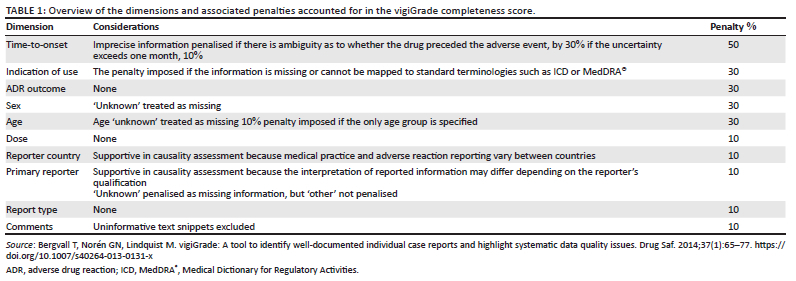
If a dimension is not reported, the completeness score suffers a penalty. Imprecise information is penalised less compared with the total omission of information. The more important the information is in the clinical assessment of a drug reaction relation, the higher the penalty factor.9C) starts at 1 for reports containing all important variables for causality assessment. The vigiGrade penalties are defined as indicated in Table 1.9
vigiGrade classifies a report with a final score of C ≥ 0.8 as well-documented.99C) in categories < 0.5, 0.5 ≥ 0.8 and > 0.8 has been reported.
Data analysis
The Medical Dictionary for Regulatory Activities (MedDRA® version 22.0) de-duplicated data set was exported to Microsoft Excel and was analysed using the Statistical Package for Social Sciences (SPSS®) version 25.0.19d was calculated as a measure of effect size. Cohen's d guideline: small effect ≤ 0.2; medium effect > 0.2 and < 0.5; large effect ≥ 0.5 and < 0.8; practical significant ≥ 0.8.
Ethical approval
This study was approved by the North-West University Health Research Ethics Committee (No. NWU-00012-19-S1) and goodwill permission was obtained from the South African Health Products Regulatory Authority (SAHPRA). This study was performed in line with the principles of the Declaration of Helsinki.
Results
South African Health Products Regulatory Authority received 8438 ICSRs that were committed to VigiBase® from 01 January 2017 to 01 December 2017. These reports contained 29 826 drug reaction pairs, of which 20 438 were for suspected medicines and 9388 for concomitant medicines. The mean vigiGrade completeness score for the 8438 reports was 0.456 (s.d. = 0.221). As a result of the multiaxiality of MedDRA® (The International Council for Harmonisation of Technical Requirements for Pharmaceuticals for human use [ICH], Herndon, Virgina, United States of America), reports can contain more than one suspect or concomitant medicine or more than one reaction.
Incomplete data fields
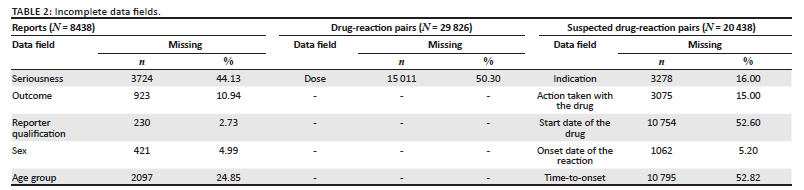
Table 2 displays the frequencies and percentages of incomplete data fields. Variables that are valuable for causality assessment and penalised if absent for vigiGrade completeness score calculation are indicated.
Time-to-onset of the ADR, which is a crucial factor needed for causality assessment, could not be calculated for 52.82% (n = 10795) of suspected drug-reaction pairs. The vigiGrade completeness score applies a 50% penalty if time-to-onset is missing in the report. The ADR outcome was missing on 10.94% (n = 923) of the reports and suffered a 30% vigiGrade penalty. Where the event outcome was reported, it was reported as unknown on 63.32% (n = 5343) of the reports. The indication for using the suspected drugs was missing on 16% (n = 3278) of reports, resulting in a 30% vigiGrade penalty. Among the 8348 reports analysed, the age and sex were incomplete in 2097 (24.8%) and 421 (4.9%) reports, respectively, and suffered a 30% vigiGrade penalty. The drug dose was incomplete for 50.30% (n = 15 011) of the drug-reaction pairs and suffered a 10% penalty. Concerning 'action taken with the drug', 15% (n = 3075) of reports did not have this variable completed.
Reporter categories
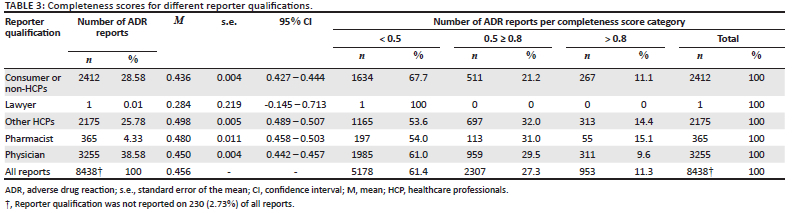
Table 3 indicates the number of reports and the mean completeness scores for the reports submitted by each reporter category, according to their qualifications. Reporter qualification was not indicated in 230 (2.73%) reports received.
Reports were submitted by physicians (38.58%; n = 3 255), consumers or non-HCPs (28.58%; n = 2412), other HCPs (25.78%; n = 2175), pharmacists (4.33%; n = 365) and one lawyer (0.01%; n = 1). The mean completeness scores for the different reporter categories varied between M = 0.284, s.e. = 0.219 for the lawyer and M = 0.498; s.e. = 0.005 for other HCPs. The one-way ANOVA test showed a statistically significant difference in the completeness scores between reporter categories, F (5, 8432) = 38.738, p ≤ 0.001. The completeness score of reports submitted by pharmacists and other HCPs showed practically significant differences compared with the lawyer (d ≥ 0.8). Reports that did not indicate the reporter qualification suffered a 10% vigiGrade penalty and had a medium to large practically significant effect (0.5 ≥ d ≤ 0.8). The completeness of reports submitted by consumers or non-HCPs did not significantly differ compared with reports submitted by physicians, pharmacists or other HCPs (d ≤ 0.2). Only 953 (11.3%) of the reports received had a completeness score C > 0.8 and can be classified as well-documented and 5178 (61.4%) of the reports received a completeness score C < 0.5.
Demographics of patients
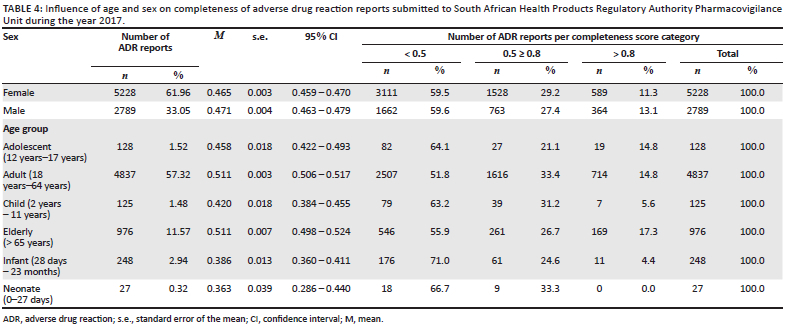
More reports were received for females (61.96%, n = 5228) than for males (33.05%, n = 2789) (Table 4). Sex was not indicated on 421 (4.9%) of the reports. The one-way ANOVA test showed a statistically significant difference in the completeness scores between sexes F (2, 8435) = 195.983, p ≤ 0.001. The difference between the completeness scores for males (M = 0.471, s.e. = 0.004) and females (M = 0.465, s.e. = 0.003) had no practical significance d ≤ 0.2. Reports that did not indicate the sex of the patient (4.99%, n = 421) suffered a 30% vigiGrade penalty and therefore had a large practically significant effect on the completeness score of the report compared with males and females (d ≥ 0.8).
There was a statistically significant difference in the completeness scores of reports received from patients of different age categories (F [6, 8431] = 245.27, p ≤ 0.001). A total of 57.32% (n = 4837) and 11.57% (n = 976) of the reports received were for adult and elderly patients, respectively. The age of the patient was missing on 24.85% (n = 2097) of the reports and suffered a 30% vigiGrade penalty. It had a large practically significant effect if the age of the patient was missing (d ≥ 0.8). The completeness scores of reports of adult (M = 0.511, s.e. = 0.03) and elderly (M = 0.511, s.e. = 0.007) patients were higher than for infants (M = 0.386, s.e. = 0.013) and neonates (M = 0.363, s.e. = 0.039) and the differences in the mean completeness score have a medium to large practical effect (0.5 ≥ d ≤ 0.8).
Seriousness of the reports
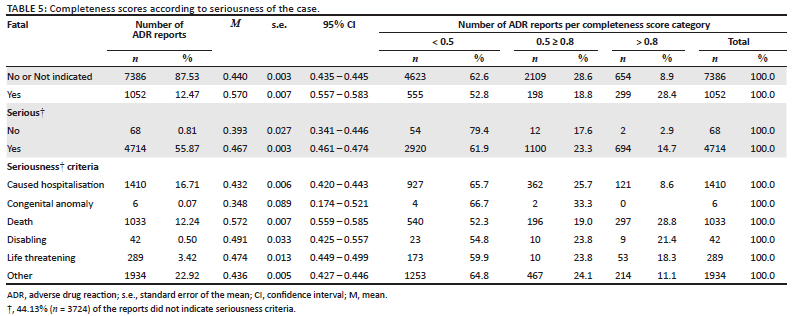
The suspected reaction was reported as fatal in 12.47% (n = 1052) (Table 5) and serious in 55.87% (n = 4714) of the reports. There was a statistically significant difference in the completeness of reports with fatal suspected reactions compared with those with non-fatal suspected reactions (F [1, 8436] = 329.429, p ≤ 0.001). Where the reactions were fatal (M = 0.570, s.e. = 0.003) compared with non-fatal or not indicated (M = 0.440, s.e. = 0.007) it had a medium to large practically significant effect (0.5 ≥ d ≤ 0.8) on the completeness score of the report. The vigiGrade completeness score of 28.4% (n = 299) of the reports where the reactions were fatal was > 0.8 and can be classified as well-documented.
From Table 5, completeness of ADR reports submitted to the authority is linked to the seriousness of the event. There was a statistically significant difference in the completeness scores according to the different seriousness criteria (F [6, 8431] = 58.526, p ≤ 0.001). Reports with suspected reactions that resulted in death (M = 0.572, s.e. = 0.007), disability (M = 0.491, s.e. = 0.033) or were life threatening (M = 0.474, s.e. = 0.013) had a medium to large practically significant effect (0.5 ≥ d ≤ 0.8) compared with reports with suspected reactions of congenital anomaly (M = 0.348, s.e. = 0.089). Amongst the reports with suspected reactions that caused death, 28.8% (n = 297) were well-documented (vigiGrade completeness score > 0.8). None of the congenital anomaly reports met the well-documented criteria.
Outcome
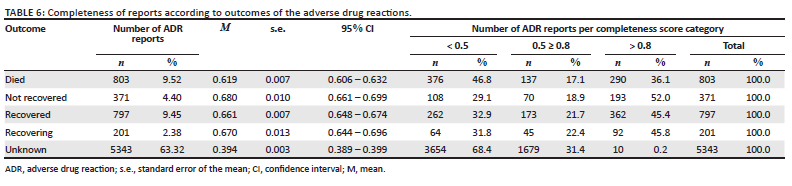
Table 6 contains the frequencies and completeness of ADR according to different outcomes.
The one-way ANOVA test showed a statistically significant difference in the completeness score for reports with different outcomes F (5, 8432) = 624.42, p < 0.001. The outcome of the ADR was missing in 10.94% (n = 923) of the reports and suffered a 30% vigiGrade penalty. This had a practically significant effect (d ≥ 0.8) on the mean completeness score when compared with reports where the outcome of the ADR was specified. On 63.32% (n = 5343) of the reports, the outcome was classified as unknown, and there was a large, practically significant difference (d ≥ 0.8) between the mean completeness score for reports that were classified as unknown (M = 0.394, s.e. = 0.003), compared with all the other outcome categories.
Anatomical Therapeutic Chemical classes
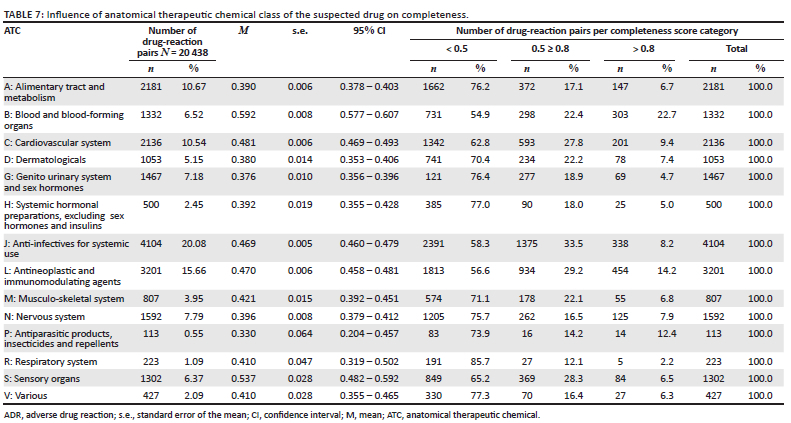
The reports contained 20 438 different suspected drug-reaction pairs for drugs belonging to different ATC classes (Table 7).
There was a statistically significant difference in the completeness score for reports according to the different ATC classes of the suspected drugs F (13, 8424) = 48.727, p ≤ 0.001. Reports containing suspected drugs that belong to ATC Class B (blood and blood-forming products) had the highest mean completeness score (M = 0.592, s.e. = 0.008), and there was a practically significant difference between the completeness score of Class B compared with Classes D, G, H, M, N, P, R and V (d ≥ 0.8).
Discussion
Lack of essential information in ADR reports has been an obstacle in the quality management of signal detection, rendering ADR reports futile.7,10 Several tools have been developed and used to measure and enhance the completeness of ADR reports. These include the vigiGrade completeness score, EudraVigilance feedback report, clinical documentation tool, and the quality of ADR reports algorithm.9,20 In this study, the authors used the vigiGrade completeness score to assess the completeness of ADR reports received by the SAHPRA during 2017, as it is the tool that was designed to measure the level of clinically relevant information in ICSRs in VigiBase®. The main use of vigiGrade is to communicate data quality to member countries of the WHO-PIDM.21
Our results indicated that only 11.3% (n = 953) of the reports analyzed are considered to be well-documented (C > 0.8). This is in line with the findings of Bergvall et al., who used VigiGrade to calculate the completeness score for 3.3 million reports in VigiBase® between 2007 and 2012 and found that only 13% of global reports in VigiBase® were considered well-documented and achieved a completeness score > 0.8.99
Completeness of reports for different categories of primary reporters
Physicians reported the most (38.6%), followed by consumers or non-HCPs (28.6%) and other HCPs (25.78%), while pharmacists submitted only 4.3% of reports. Aagaard et al. reported that 75% of reports came from physicians compared with 13% and 11% for other HCPs and consumers, respectively.2223p ≤ 0.001; d ≤ 0.2). This indicates that the completeness of reports from consumers is comparable to those submitted by HCPs. Rolfes et al. had previously indicated that HCPs and consumers reported clinical information on a comparable level.24
Missing information in the case reports
Time-to-onset is considered the most essential information in causality assessment because it indicates the temporal relation between the reaction and the suspect drug. Therefore, its omission in the reports accounts for a 50% vigiGrade penalty. The crucial information to calculate the time-to-onset of the reaction was not provided for 52.8% of the drug-reaction pairs, which means it is impossible to evaluate the causal relationship between the drug and the reaction and possibly detect safety signals from these reports. These findings correspond with a study conducted on the Japanese Adverse Event Report database using VigiGrade® in which time-to-onset could not be calculated in 41.2% cases received from the pharmaceutical companies.25262728
Information regarding the dose of the medicines was missing in 50.3% of cases, while indication for the suspect drugs was missing in 16% of the drug-reaction pairs. As highlighted by Brajovic et al., knowing the reason for taking the suspect drug is an important factor in determining the significance of the reaction.27
Action taken with the suspect drug was missing in 15% of drug-reaction pairs, while 10.9% of reports did not report the outcome of the reaction. Where the outcome was reported, it was classified as unknown on 63.32% of the reports. There was a practically significant difference between mean completeness scores of reports that indicated outcome as unknown or missing compared with reports with other outcome categories (d ≥ 0.8). If the outcome is not specified on reports or is reported as unknown, HCPs do not follow up with patients who suffer ADRs. The outcome information is one of the fundamental parameters used in causality assessment.9
This study revealed that 55.9% of the reactions were serious, of which 12.5% were fatal. This corresponds with a Danish study, which indicated that 52% of their reports were serious.2210p < 0.001; 0.5 ≥ d ≤ 0.8). This indicates that reporters are more concerned about serious reactions, ensuring that reports concerning these reactions are well-documented. Serious cases are often hospitalised, and it is expect that they will have better follow-up and that reporters will have more complete records available while reporting.
A statistically significant difference in completeness score for reports of different ATC classes (p < 0.001) was observed. Suspect drugs belonging to ATC class B (blood and blood-forming products) contributed 6.5% of the total number of drugs reported and had the highest mean completeness score of 0.59 compared with the other groups (p ≤ 0.001); (d ≥ 0.8). Blood and blood-forming agents are used to treat life-threatening medical conditions such as stroke, which may explain why these reports have a higher completeness score than other ATC classes. This may further strengthen the association between the seriousness of the reaction and the completeness of the report.
Age and sex are considered important parameters in causality assessment because they indicate whether the suspect drug was prescribed appropriately or not. We found that the completeness score of reports improved with age, similar to a study conducted on the Saudi Food and Drug Authority PV system.29p < 0.001; 0.5 ≥ d ≤ 0.8). This might be because adults and elderly patients can clearly explain their experiences compared with infants and neonates who rely on the caregiver. Furthermore, 52% of the reports were for adults, followed by elderly patients with 11%, while reports for infants and neonates were about 3% and less than 1%, respectively. Increasing co-morbidities and polypharmacy may have contributed to an increased number of reports received for adults and elderly patients.
Strengths and limitations
This was the first study that has been conducted to evaluate the completeness of South African ADR reports submitted to VigiBase®. It is important that HCPs are made aware of the completeness of reports and how it impacts the ability of the SAHPRA to conduct causality assessment and detect signals to ultimately improve patient safety. The results of this study can be utilised to improve training of reporters and technical staff who work in the PV unit and are responsible for data capturing and data verification.
However, the present results are only for reports received in a 1-year study period, and it is not intended to be generalised beyond South Africa. A follow-up study should be conducted to evaluate ADR reporting trends over time. The completeness score of each report is calculated automatically. Therefore, a limitation of this study is that it could not be assessed, which specific information was missing on the reports submitted by different HCPs categories. This study used data downloaded from the VigiBase®, and it does not indicate the sender of the report (i.e. MAHs, clinical trials, HCPs or non-HCPs) or the report reporting method (e.g. Med Safety App, e-reporting or paper form). The authors were, therefore, unable to assess the completeness by the sender of the reports. The preferred method to report could also not be determined from the data. A more in-depth analysis could be performed to distinguish the proportion of missing information according to sender and primary reporter and to compare the completeness of ADR reports between MAHs and HCPs.
Conclusion
This study's analysis indicates that the completeness of ADR reports submitted to SAHPRA is low and requires immediate intervention to improve the quality of reports. It was found that the completeness of reports submitted by consumers is comparable to those submitted by HCPs, which confirms that consumers have a potential role to play within PV. It is therefore imperative that consumer reporting is encouraged, explored and supported in the country. Multiple measures to improve ADR reporting and quality are recommended, particularly for HCPs. These may include using digital reporting tools or EHRS and increasing awareness for HCPs and the public on ADR reporting and reporting quality. The inclusion of a section in the PIL explaining how and where to submit an ADR is also recommended.
Competing interests
M.F.M. is the manager of the Pharmacovigilance Unit of the South African Health Products Regulatory Authority. To ensure objectivity, all data analyses were performed by the Statistical Consultation Services of the North-West University. M.S.L. and H.S. declare that they have no conflict of interest.
Authors' contributions
M.F.M., M.S.L. and H.S. were involved in the study design, implementation of the research, data interpretation and writing of the manuscript.
Funding information
This research received no specific grant from any funding agency in the public, commercial or not-for-profit sectors.
Data availability
The data that support the findings of this study are available on request from the corresponding author, H.S.
Disclaimer
The views and opinions expressed in this article are those of the authors and do not necessarily reflect the official policy or position of any affiliated agency of the authors.
Acknowledgements
Data from the WHO Collaborating Centre for International Drug Monitoring were used. The authors are indebted to the South African Health Products Regulatory Authority for contributing data to the WHO International Drug Monitoring Programme. The authors would like to acknowledge Prof. Suria Ellis from the North-West University Statistical Consultation Service who analysed the data. They would also like to acknowledge Mrs. Helena Hoffman who assisted with editing of references.
References
-
1. World Health Organization. The importance of pharmacovigilance: Safety monitoring of medicinal products [homepage on the Internet]. Geneva: World Health Organization; 2002 [cited 2021 Oct 27]. Available from: https://apps.who.int/iris/handle/10665/42493
» https://apps.who.int/iris/handle/10665/42493 -
2. Impicciatore P, Mucci M. Completeness of published case reports on suspected adverse drug reactions. Drug Saf. 2010;33(9):765-773. https://doi.org/10.2165/11537500-000000000-00000
» https://doi.org/10.2165/11537500-000000000-00000 -
3. Moore TJ, Singh S, Furberg CD. The FDA and new safety warnings. Arch Intern Med. 2012;172(1):78-80. https://doi.org/10.1001/archinternmed.2011.618
» https://doi.org/10.1001/archinternmed.2011.618 -
4. Lester J, Neyarapally GA, Lipowski E, Graham CF, Hall M, Dal Pan G. Evaluation of FDA safety-related drug label changes in 2010. Pharmacoepidemiol Drug Saf. 2013;22(3):302-305. https://doi.org/10.1002/pds.3395
» https://doi.org/10.1002/pds.3395 -
5. Stephenson WP, Hauben M. Data mining for signals in spontaneous reporting databases: Proceed with caution. Pharmacoepidemiol Drug Saf. 2007;16(4): 359-365. https://doi.org/10.1002/pds.1323
» https://doi.org/10.1002/pds.1323 -
6. Rehan H, Chopra D, Kakkar AK. Physician's guide to pharmacovigilance: Terminology and causality assessment. Eur J Intern Med. 2009;20(1):3-8. https://doi.org/10.1016/j.ejim.2008.04.019
» https://doi.org/10.1016/j.ejim.2008.04.019 -
7. Plessis L, Gómez A, García N, Cereza G, Figueras A. Lack of essential information in spontaneous reports of adverse drug reactions in Catalonia: A restraint to the potentiality for signal detection. Eur J Clin Pharmacol. 2017;73(6):751-758. https://doi.org/10.1007/s00228-017-2223-5
» https://doi.org/10.1007/s00228-017-2223-5 -
8. Naidu RP. Causality assessment: A brief insight into practices in pharmaceutical industry. Perspect Clin Res. 2013;4(4):233-236. https://doi.org/10.4103/2229-3485.120173
» https://doi.org/10.4103/2229-3485.120173 -
9. Bergvall T, Norén GN, Lindquist M. vigiGrade: A tool to identify well-documented individual case reports and highlight systematic data quality issues. Drug Saf. 2014;37(1):65-77. https://doi.org/10.1007/s40264-013-0131-x
» https://doi.org/10.1007/s40264-013-0131-x -
10. Durrieu G, Jacquot J, Mège M, et al. Completeness of spontaneous adverse drug reaction reports sent by general practitioners to a regional pharmacovigilance centre: A descriptive study. Drug Saf. 2016;39(12):1189-1195. https://doi.org/10.1007/s40264-016-0463-4
» https://doi.org/10.1007/s40264-016-0463-4 -
11. Sánchez-Sánchez B, Altagracia-Martínez M, Kravzov-Jinich J, Moreno-Bonett C, Vázquez-Moreno E, Martínez-Núñez JM. Evaluation of completeness of suspected adverse drug reaction reports submitted to the Mexican National Pharmacovigilance Centre. Drug Saf. 2012;35(10):837-844. https://doi.org/10.1007/BF03261979
» https://doi.org/10.1007/BF03261979 -
12. Hugman B. From the Uppsala monitoring centre. A review of viewpoint part 1 and part 2. Drug Saf. 2005;28:645-646. https://doi.org/10.2165/00002018-200528070-00006
» https://doi.org/10.2165/00002018-200528070-00006 -
13. Lindquist M. VigiBase, the WHO Global ICSR Database System: Basic facts. Drug Inf J. 2008;42(5):409-419. https://doi.org/10.1177/009286150804200501
» https://doi.org/10.1177/009286150804200501 -
14. Pande S. Causality or relatedness assessment in adverse drug reaction and its relevance in dermatology. Indian J Dermatol. 2018;63(1):18-21. https://doi.org/10.4103/ijd.ijd_579_17
» https://doi.org/10.4103/ijd.ijd_579_17 -
15. Mehta U, Dheda M, Steel G, et al. Strengthening pharmacovigilance in South Africa. S Afr Med J. 2014;104(2):104-106. https://doi.org.10.7196/SAMJ.7517
» https://doi.org.10.7196/SAMJ.7517 -
16. SAHPRA (South African Health Products Regulatory Authority). Post-marketing reporting of adverse drug reactions to human medicines in South Africa [homepage on the Internet]. 2020 [cited 2020 Nov 05]. Available from: https://www.sahpra.org.za/wp-content/uploads/2020/03/2.33_ADR_reporting_postmarketing_v6_Jan2020.pdf
» https://www.sahpra.org.za/wp-content/uploads/2020/03/2.33_ADR_reporting_postmarketing_v6_Jan2020.pdf -
17. WHO Collaborating Centre for Drug Statistics Methodology. ATC structure and principles [homepage on the Internet]. 2018 [cited 2020 Dec 01]. Available from: https://www.whocc.no/atc/structure_and_principles/
» https://www.whocc.no/atc/structure_and_principles/ -
18. MedDRA® (Medical Dictionary for Regulatory Activities). MedDRA® hierarchy [homepage on the Internet]. 2020 [cited 2020 Nov 21]. Available from: https://www.meddra.org/how-to-use/basics/hierarchy
» https://www.meddra.org/how-to-use/basics/hierarchy - 19. IBM Corp. IBM SPSS Statistics for Windows. 25th ed. IBM Corp: Chicago, IL; 2019.
-
20. Mahajan M, Thatte U, Gogtay N, Deshpande S. An analysis of completeness and quality of adverse drug reaction reports at an adverse drug reaction monitoring centre in Western India. Perspect Clin Res. 2018;9(3):123-126. https://doi.org/10.4103/picr.PICR_105_17
» https://doi.org/10.4103/picr.PICR_105_17 -
21. Uppsala Monitoring Centre. VigiMethods [homepage on the Internet]. 2021 [cited 2022 July 28]. Available from: https://who-umc.org/research/vigimethods/
» https://who-umc.org/research/vigimethods/ -
22. Aagaard L, Nielsen LH, Hansen EH. Consumer reporting of adverse drug reactions. Drug Saf. 2009;32(11):1067-1074. https://doi.org/10.2165/11316680-000000000-00000
» https://doi.org/10.2165/11316680-000000000-00000 -
23. Thiessard F, Roux E, Miremont-Salamé G, et al. Trends in spontaneous adverse drug reaction reports to the French pharmacovigilance system (1986-2001). Drug Saf. 2005;28(8):731-740. https://doi.org/10.2165/00002018-200528080-00007
» https://doi.org/10.2165/00002018-200528080-00007 -
24. Rolfes L, Van Hunsel F, Van der Linden L, Taxis K, Van Puijenbroek E. The quality of clinical information in adverse drug reaction reports by patients and healthcare professionals: A retrospective comparative analysis. Drug Saf. 2017;40(7):607-614. https://doi.org/10.1007/s40264-017-0530-5
» https://doi.org/10.1007/s40264-017-0530-5 -
25. Tsuchiya M, Obara T, Miyazaki M, Noda A, Takamura C, Mano N. The quality assessment of the Japanese adverse drug event report database using vigiGrade. Int J Clin Pharm. 2020;42(2):728-736. https://doi.org/10.1007/s11096-020-00969-7
» https://doi.org/10.1007/s11096-020-00969-7 -
26. Khalil H, Leversha A, Khalil V. Drug allergy documentation-time for a change? Int J Clin Pharm. 2011;33(4):610-613. https://doi.org/10.1007/s11096-011-9525-y
» https://doi.org/10.1007/s11096-011-9525-y -
27. Brajovic S, Piazza-Hepp T, Swartz L, Dal Pan G. Quality assessment of spontaneous triggered adverse event reports received by the Food and Drug Administration. Pharmacoepidemiol Drug Saf. 2012;21(6):565-570. https://doi.org/10.1002/pds.3223
» https://doi.org/10.1002/pds.3223 -
28. Katurura MC, Cilliers L. Electronic health record system in the public health care sector of South Africa: A systematic literature review. Afr J Prim Health Care Fam Med. 2018;10(1):1-8. https://doi.org/10.4102/phcfm.v10i1.1746
» https://doi.org/10.4102/phcfm.v10i1.1746 -
29. Alshammari TM, Al-Kathiri WaH, Louet HL, Aljadhey HS. Completeness of adverse drug reactions reports of the Saudi adverse event reporting system. Saudi Med J. 2015;36(7):821-828. https://doi.org/10.15537/smj.2015.7.11751
» https://doi.org/10.15537/smj.2015.7.11751

Accepted: 07 Aug. 2022
Published: 18 Jan. 2023