Strengthening African health systems through outreach and support and values-driven leadership
Abstract
Healthcare systems are complex adaptive systems, requiring a change in leadership style, from the traditional model to collaborative, values-driven leadership (VDL). Family physicians are well positioned to facilitate integration and coordination between levels of care, across specialties and within teams, in partnership with local and district management team members. This short report describes a leadership innovation experience in a rural South African district, where a VDL course was introduced in a district health context to build on a strong tradition of relationship-centred outreach and support aimed at creating a learning health system. The authors reflect on the contribution of family physicians to strengthen team-based capacity building, care coordination and a learning culture aimed at quality improvement from the perspectives of the regional and district hospital environments. A values-based leadership style will enable family physicians to strengthen team-relationships and create organisational environments, which support shared learning and quality improvement approaches. Ultimately this approach should lead to improved health systems.
Leadership; values; learning culture; family medicine; family physicians; outreach and support; healthcare teams; health systems
Introduction
Globally, healthcare organisations have been recognised as complex adaptive systems where traditional leadership models of command and control thinking have shifted towards a collaborative approach.112345,6
Family physicians (FPs) are well positioned to lead in the current healthcare environment, as their generalist training and experience enable them to deal with undifferentiated illness and uncertainty, particularly within the primary health care (PHC) environment.4,7 Collaborative leadership between FPs and local managers has been showcased in South Africa (SA), where a supportive environment can enable healthcare workers and the quality of their work to flourish.8,9 The coronavirus disease 2019 (COVID-19) pandemic has challenged FPs to extend their leadership roles further in a climate of uncertainty and to navigate complexity without compromising values.10
Context
The Garden Route district in SA serves 600 000 people through PHC clinics, eight district hospitals, including Riversdale and Mossel Bay hospitals and the George regional referral hospital. It is a rural area with vast distances between facilities, causing many healthcare workers to work in relative isolation. This has health system implications for capacity building and development of healthcare workers, communication and coordination of patient care. As FM was recognised as a specialty in 2007, decentralised postgraduate training strengthened the rural platform through registrars in training and the appointment of one trained FP per subdistrict (a geographic area containing a district hospital and PHC clinics). These FPs lead the local health team in close collaboration with the clinical and medical managers of the subdistrict.
Outreach and support
The benefits of outreach and support (O&S) from the regional hospital specialists to district hospitals and PHC clinics has been recognised.1111
Values-driven leadership
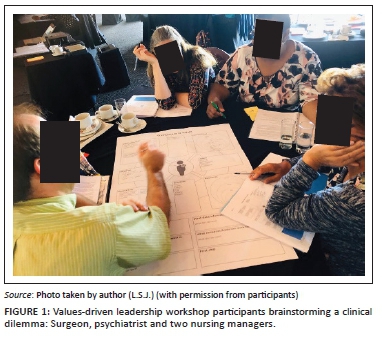
Consequently, an initiative called VDL was introduced in 2019 as a collaboration between the University of Stellenbosch Business School (USB) and the Department of Health. Four weekend workshops were conducted, each with 16-20 participants, for a total of 70 people representing seven hospitals across the region. Participants included doctors, nurses, pharmacists, occupational therapists, physiotherapists, student interns and hospital administrators. Most were in middle or senior management positions or front-line team leaders. Group demographics were diverse and inclusive of gender, race and language. These workshops were facilitated by a consultant at the USB, as well as the medical manager and the head of FM at the regional hospital. Participants brought real health system dilemmas, such as difficulty to refer a patient from a district to the regional hospital and the workshops. Through a process of active listening, appreciative enquiry, various exercises and games, an understanding developed of how VDL drives decisions, policies and culture. Participants were empowered to rescript their thinking and speak out (see Figure 1).
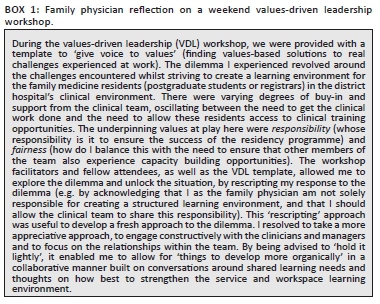
This innovation has enabled integrative thinking, established new relationships and broken down silos and hierarchies in the health system, by making explicit the shared values of care, compassion, accountability, integrity, respect and responsiveness. During 2020, with the disruption of the COVID-19 pandemic, face-to-face workshops were replaced with monthly discussions around ethical issues in the workplace via online Microsoft (MS) Teams conversations between district and regional hospitals. Research, measuring the impact of the VDL initiative is ongoing, with initial results 1 year later showing the value of understanding the 'me-we-all of us' perspective.7,12 In other words, participants began to understand how individual actions are determined by underlying values and how these values drive professional practice within their team and ultimately influence the health system. This happened through processes of active, respectful listening and relationship building. Finally, a sense of how individual leadership and teamwork fitted into the health system emerged. Box 1 provides an example of a weekend workshop participant's reflection.
Discussion
Through the VDL programme FM is playing an active role to help create a culture of learning and reflection in the health system. The weekend workshops and monthly MS Team meetings have allowed relationships to strengthen, communications to improve and appreciation of the value of various team members to grow. Family physicians and health managers who live according to the principles of FM have enabled traditional hierarchical and mechanistic organisational culture to slowly transform.7,13 These processes made people more aware of alignment between their personal values and behaviour and organisational values and behaviour (processes, rules and procedures). Dilemmas were resolved by being clearer about alignment or non-alignment with values that were more clearly articulated, and therefore were easier to solve. The end result of leadership capacity building within various health teams through the VDL programme and relationship building between people in different subdistricts through O&S is improved coordination of care for patients.3
The contribution of FM to the health system may be found in the following themes: as capacity builders, the FPs at George and Mossel Bay hospitals collaborated closely with the local medical and clinical managers to facilitate the capacity development of healthcare workers in the district health system. The years of relationship building during O&S, and recently through the VDL workshops across subdistricts, have enabled communication to become respectful, caring and responsive to the real needs of patients and providers. The FPs are in a unique position to consider the whole health system, as the discipline cares transversally for patients and staff across the platform from PHC to district hospital and to every clinical discipline in the regional hospital.8
The FP positioned at the regional hospital, where specialist care is predominantly structured in siloed departments, delivers transversal roles, including those being responsible for clinical governance and capacity building, coordinating services that are relevant to all departments and therefore owned by none. At George Hospital, the FM Department has been instrumental in the development of the antibiotic stewardship programme,1415
It is within these roles of the FP where good communication skills and collaborative teamwork within the complexity of the health system create a different experience of patient care, which reflects in patient satisfaction and community trust in the health service. Because FPs function in more than one clinical domain, with a number of roles beyond that of being a clinician, their integrative role can often be mistaken for assimilation into the main clinical disciplines or simply role confusion. It remains a challenge to maintain identity as FPs, whilst leading collaboratively through integrated patient care within a complex health system. Here the roles of the FP in the district hospital, where there are no clinical departments, are arguably simpler, but not less challenging, as has been described previously.16
Conclusion
A targeted values-based leadership training intervention helped to strengthen the relationships between healthcare workers and managers at different care levels within a shared geographic space, formed over years of outreach and support by specialists, including FPs. A values-based leadership style will enable FPs to strengthen team-relationships and create organisational environments, which support shared learning and quality improvement approaches. Ultimately this approach should lead to improved health systems.
Competing interests
The authors declare that they have no financial or personal relationships that may have inappropriately influenced them in writing this article.
Authors' contributions
L.S.J. conceptualised the article and wrote the first draft. K.B.v.P., Z.N. and G.v.T. contributed towards subsequent drafts. All authors contributed to and approved the final version of the manuscript.
Ethical considerations
This article followed all ethical standards for research without direct contact with human or animal subjects.
Funding information
No grant from any funding agency in the public, commercial or not-for-profit sectors was received.
Data availability
Data sharing is not applicable to this article as no new data were created or analysed.
Disclaimer
The views and opinions expressed in this article are those of the authors and do not necessarily reflect the official policy or position of any affiliated agency of the authors.
Acknowledgements
The authors would like to thank the clinical and medical managers who have made outreach and support and leadership training possible. They also acknowledge Prof. Arnold Smit for his role in leading the VDL workshops.
References
-
1. Plsek PE, Wilson T. Complexity, leadership, and management in healthcare organisations. BMJ. 2001;323:746-749. https://doi.org/10.1136/bmj.323.7315.746
» https://doi.org/10.1136/bmj.323.7315.746 - 2. Hurley T. Collaborative leadership - Engaging collective intelligence to achieve results across organisational boundaries. White Paper. Oxford: Oxford Leadership; October 2011.
-
3. Faith KE. The role of values-based leadership in sustaining a culture of caring. Healthcare Management Forum. 2013;26(1):6-10. https://doi.org/10.1016/j.hcmf.2012.07.001
» https://doi.org/10.1016/j.hcmf.2012.07.001 -
4. Herbert CP. Perspectives in primary care: Values-driven leadership is essential in health care. Ann Fam Med. 2015;13(6):512-513. https://doi.org/10.1370/afm.1877
» https://doi.org/10.1370/afm.1877 -
5. Herbert CP, Best A. It's a matter of values: Partnership for innovative change. Healthcare Papers. 2011;11(2):31-37. https://doi.org/10.12927/hcpap.2011.22436
» https://doi.org/10.12927/hcpap.2011.22436 -
6. Weller J, Boyd M, Cumin D. Teams, tribes and patient safety: Overcoming barriers to effective teamwork in healthcare. Postgraduate Med J. 2014;90(1061):149-154. https://doi.org/10.1136/postgradmedj-2012-131168
» https://doi.org/10.1136/postgradmedj-2012-131168 -
7. Mash R, Blitz J, Malan Z, Von Pressentin K. Leadership and governance: Learning outcomes and competencies required of the family physician in the district health system. SA Fam Pract. 2016;58(6):232-235. https://doi.org/10.1080/20786190.2016.1148338
» https://doi.org/10.1080/20786190.2016.1148338 -
8. Von Pressentin K, Mash R, Baldwin-Ragaven L, Botha R, Govender I, Steinberg WJ. The bird's-eye perspective: How do district health managers experience the impact of family physicians within the South African district health system? A qualitative study. SA Fam Pract. 2018;60(1):13-20. https://doi.org/10.4102/safp.v60i1.4844
» https://doi.org/10.4102/safp.v60i1.4844 -
9. Von Pressentin KB, Mash RJ, Baldwin-Ragaven L, et al. The perceived impact of family physicians on the district health system in South Africa: A cross-sectional survey. BMC Fam Pract. 2018;19(1):24. https://doi.org/10.1186/s12875-018-0710-0
» https://doi.org/10.1186/s12875-018-0710-0 -
10. Jenkins L, Von Pressentin K, Naidoo K, Schaefer R. The evolving role of family physicians during the coronavirus disease 2019 crisis: An appreciative reflection. Afr J Prim Health Care Fam Med. 2020;12(1):1-4. https://doi.org/10.4102/phcfm.v12i1.2478
» https://doi.org/10.4102/phcfm.v12i1.2478 -
11. Schoevers J, Jenkins L. Factors influencing specialist outreach and support services to rural populations in the Eden and Central Karoo districts of the Western Cape. Afr J Prim Health Care Fam Med. 2015;7(1):1-9. https://doi.org/10.4102/phcfm.v7i1.750
» https://doi.org/10.4102/phcfm.v7i1.750 -
12. Globally Responsible Leadership Initiative. Global responsibilities [homepage on the Internet]. [cited 2021 May 21]. Available from: https://grli.org/about/global-responsibility/
» https://grli.org/about/global-responsibility/ -
13. Mash B, Edwards J. Creating a learning environment in your practice or facility. SA Fam Pract. 2020;62(1):a5166. https://doi.org/10.4102/safp.v62i1.5166
» https://doi.org/10.4102/safp.v62i1.5166 -
14. Junaid E, Jenkins L, Swanepoel H, et al. Antimicrobial stewardship in a rural regional hospital-growing a positive culture. S Afr Med J. 2018;108(7):546-550. https://doi.org/10.7196/SAMJ.2018.v108i7.13149
» https://doi.org/10.7196/SAMJ.2018.v108i7.13149 -
15. O'Brien V, Jenkins LS, Munnings M, et al. Palliative care made visible: Developing a rural model for the Western Cape Province, South Africa. Afr J Prm Health Care Fam Med. 2019;11(1):a2147. https://doi.org/10.4102/phcfm.v11i1.2147
» https://doi.org/10.4102/phcfm.v11i1.2147 - 16. Mash R, Von Pressentin KB. Strengthening the district health system through family physicians. S Afr Health Rev. 2018(1):33-39.

Accepted: 24 June 2021
Published: 06 Sept. 2021