Adaptation and validation of the Ugandan Primary Care Assessment Tool
Abstract
BACKGROUND: Health systems based on primary health care (PHC) have better outcomes at lower cost. Such health systems need regular performance assessment for quality improvement and maintenance. In many low- and middle-income countries (LMICs), there are no electronic databases for routine monitoring. There is an urgent need for valid and reliable tools to measure PHC performance AIM: This study aimed to adapt and validate the Primary Care Assessment Tool (PCAT) in the Ugandan context SETTING: The experts that participated in the Delphi process were recruited from almost all over the country METHODS: The study utilised a Delphi process with a panel of 20 experts (14 district health officers, 4 academics in primary care and 2 ministry of health [MOH] technical staff) who responded to iterative rounds of questionnaires in order to reach consensus (defined as > 70% agreement RESULTS: Consensus was reached after two rounds of the Delphi. In round one, four items in the comprehensiveness domain (services available) were removed and five items needed rephrasing. A new domain on person-centredness with 13 items was suggested. In round two, the new domain with each and every single one of its items and the items for rephrasing all achieved consensus. The final Ugandan version of the PCAT (UG-PCAT) has 12 domains and 91 items CONCLUSION: The South African Primary Care Assessment Tool (ZA PCAT) was adapted and validated with an additional domain on person-centredness to measure primary care performance in the Ugandan context, and can now be used to measure the quality of core functions of primary care in Uganda CONTRIBUTION: The PCAT could fulfil the need for such a tool in a wider LMIC context. The UG-PCAT will be used to measure the quality of these core functions in Uganda and to assist with the improvement of PHC
primary health care; primary care; Primary Care Assessment Tool; primary health care performance; coordination; comprehensiveness; continuity; person-centredness
Introduction
Health systems based on primary health care (PHC), with well-established and functioning primary care, have better health outcomes at lower cost.1,2,3 The declaration of Alma Ata in 1978 was the first global consensus to articulate the role of PHC in health systems with an ambitious goal of 'Achieving Health for All' by the year 2000.45
The World Health Report 2008, 'PHC Now More than Ever', emphasised people-centred health services that are responsive to the needs of people and communities.678,9 Strong PHC systems must have high quality primary care, whose performance should be continuously monitored for improvement. Therefore, valid and reliable tools are needed to measure primary care performance to identify performance gaps which can then be targeted for improvement.
The global need to measure the performance of PHC has led to the development and validation of several tools and frameworks, which include the Primary Care Assessment Tool (PCAT),10111213141516,17 Such tools should effectively measure the core functions of primary care through patient surveys as recommended by WHO.18
There is need for robust evidence to guide primary care policy and resource allocation, particularly in low- and middle-income countries (LMICs) struggling with weak health systems. Most studies on PHC have focused on policy, payment systems, workforce, community engagement, frameworks for performance management, provider competence, provider motivation, provider-patient relationships, and person-centredness as well as comprehensiveness of care.192015
Countries with well-established health information systems and large electronic databases can more easily monitor the performance of their primary care systems. This is not so easy in LMICs, where there are often no electronic medical records and minimal routinely collected electronic data. In LMICs, routine health information systems have been implemented to collect health information at regular intervals.212210
The PCAT has been used in several regions of the world to assess the quality of PHC services and some core primary care functions.17
Research methods and design
Study design
The Delphi technique, with a panel of experts, was used to adapt and validate the South African Primary Care Assessment Tool (ZA PCAT) for the Ugandan context.
Setting
In Uganda, primary care is provided through the DHS that is composed of the Village Health Team (VHT) at level I, followed by different levels of Health Centres (from levels II to IV), all operating under the Health Sub-District (HSD) leadership and governance. The general hospital then forms the apex of the DHS for these primary care facilities. The Ministry of Health (MOH) formulates PHC policies and provides stewardship on their implementation and overall functioning of the health system. Primary care providers include nurses, midwives, dispensers, clinical officers (mid-level clinicians) and non-specialist doctors referred to as medical officers. Due to the scarcity of doctors, primary care services are mainly provided by clinical officers, nurses and midwives, with support from community health workers. This primary care system lacks gatekeeping and therefore is characterised by patients bypassing the lower-level health facilities to seek care in hospitals and specialised centres.
Selection of the expert panel
A panel of 30 experts was purposively selected as recommended in literature.23
The South African Primary Care Assessment Tool
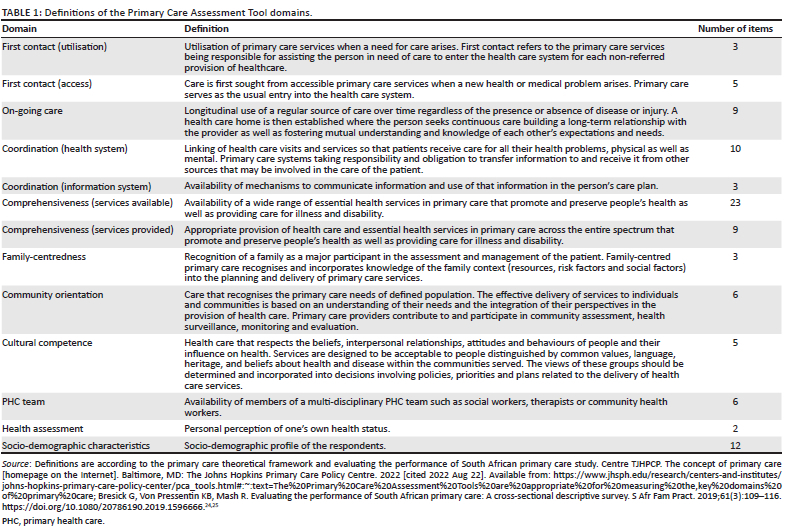
The South African version of the PCAT (ZA PCAT) measured 11 primary care domains (Table 1) with 82 items. The tool had an additional three domains on the extent of affiliation to the primary care facility (6 items), self-assessment of overall health status (2 items), and respondents' socio-demographic characteristics (12 items). Each item in the main domains was scored on a 4-point Likert scale (4 - definitely, 3 - probably, 2 - probably not and 1 - definitely not). Each item also has an additional option of 'not sure/don't remember'.
Consensus definition and achievement
Consensus was pre-defined as 70% agreement among the experts and four rounds were planned as follows:
Round 1: The questionnaire was sent to the panel by email and a follow up telephone call prompted them to complete it. For each item, two questions were asked: (1) whether the topic addressed in the item was relevant to the Ugandan context and therefore should be kept, and if not relevant, then the experts were asked to explain why and suggest an equivalent replacement item, and (2) whether relevant items were phrased appropriately and if not, to suggest alternative wording. Experts were also asked to confirm the relevance of the domains and to suggest any new domains or items.
Round 2: The items for which consensus was not achieved in round 1, together with any new suggested domains or items, and any suggested rephrasing of items were compiled into a new questionnaire. This questionnaire was again emailed to the panel. Any qualitative feedback and percentage scores for the items from round 1 were also included. The experts were asked to provide further feedback on these items. At the end of each section, the experts were again asked to give any additional qualitative feedback and to suggest any new domains and/or items relevant to the Ugandan context.
Round 3: This was planned in the same way as round 2.
Round 4: A face-to-face workshop was planned for the panel to reach a final decision on any items that did not achieve consensus in rounds 1-3. The nominal group technique (NGT) was identified as a useful process that could be used in the workshop.
Ethical considerations
This study was approved by the Health Research Ethics Committee at Stellenbosch and the Makerere University School of Medicine Research and Ethics Committee. Written informed consent was sought from the experts before their participation in the Delphi process. The experts were informed that their participation was voluntary and that they can withdraw their participation at any stage of the process with no negative consequences. S20/04/103 and REC REF 2020-164. 26 May 2020 and 15 September 2020.
Results
The final panel that actually engaged with the Delphi process consisted of seven family physicians, seven district health officers, four primary care academics, and two MOH technical staff in the directorate of clinical services. All 20 experts completed two rounds of the Delphi process, after which consensus was achieved on all domains and items.
Round 1
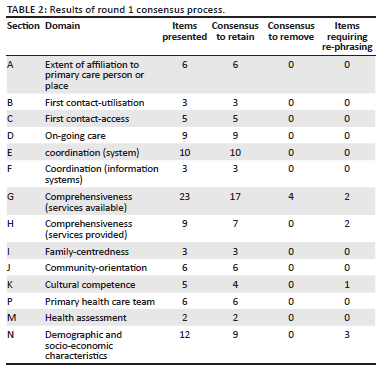
The consensus of the panel was to retain all 11 domains. Within these domains, consensus for retention was achieved for 73 items. There was consensus to remove the following four items from the domain of comprehensiveness (services available):
Checking to see if anyone in your family qualifies for any social grants, for example, old age pension, child support grant, disability, TB.
Suggestions for nursing home care for someone in your family.
Help with food supplements such as Ensure or food parcels.
Access to termination of pregnancy services at or via your facility, if required.
Eight items required re-phrasing from the socio-demographic characteristics, comprehensiveness, and cultural competence domains (Table 2).
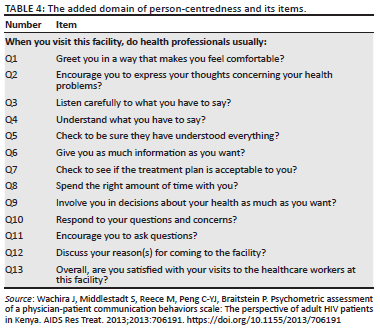
Two expert panel members suggested an additional new domain 'person-centredness' and also suggested 13 items for the new domain based on a literature.26
Round 2
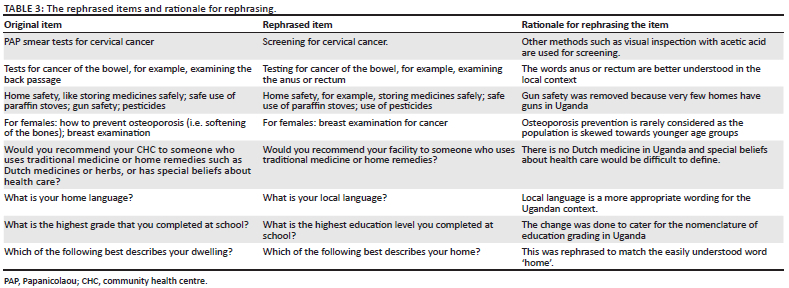
Table 3 and Table 4 show the results of round 2. Table 3 shows items that were rephrased and on which the panel reached consensus in round 2.
The new domain person-centredness with all its items achieved consensus when presented to the panel of experts (Table 4). The 3rd and 4th rounds of Delphi were not done because all domains and items achieved consensus for inclusion in rounds 1 and 2. The final Ugandan version of PCAT (UG-PCAT) (published as a supplement to this article) has 12 domains and 91 items.
Discussion
The UG-PCAT was adapted and validated through a 2-round Delphi despite the originally planned four rounds and an NGT. Four items were removed, six items were re-phrased, and a new domain on person-centredness with 13 items was added. The UG-PCAT is therefore very similar to the ZA-PCAT, and this may be a reflection of the broad similarities in context. The removed items, in the domain of comprehensive services available, reflect a different model of care, which does not include such services. This is because of the differences in approach to social services and legality of termination of pregnancy. Eight items were rephrased to suit the Ugandan vocabulary, culture and context.
Termination of pregnancy is illegal in Uganda and is only done for medical indications when three senior doctors agree.2728
Adaptation and validation of PCAT tools has previously been done using panels of experts comprising primary care practitioners, family physicians, policymakers, health system managers, and in some cases health consumer organisations and patients' representatives.29,30,31 This same approach was used with the experts assessing the content validity of domains and items rather than the construct validity. This approach of using multiple stakeholders caters for all perspectives within the complexity of primary care delivery. The process has usually involved a series of Delphi rounds with some including the NGT to achieve final consensus.30,31 This was not necessary in this study, maybe because the process in South Africa had already adapted the PCAT into the African context. Some authors have also utilised focus groups particularly for the rephrasing of items.31
The Kenyan version (KE-PCAT), also adapted from the ZA PCAT, is similar to the UG-PCAT with only three items removed and two rephrased.32
The original PCAT and the ZA-PCAT measure the core primary care functions of first contact access, continuity, comprehensiveness and coordination, but not person-centredness. Addition of the person-centredness domain to the UG-PCAT allows it to measure all the core functions as recently defined by the WHO.1826
The UG-PCAT is quite lengthy compared to other versions and requires significant time to complete. This may compromise the feasibility of its use, particularly in busy primary care settings. However, it may also be possible to exclude the domains on teamwork, cultural competence, family-orientation and community-orientation, if the tool is streamlined to measure only the core functions of primary care as per the WHO measurement framework.18
The process of adaptation and validation of the ZA-PCAT in Malawi involved exploratory factor analysis (EFA) with significant exclusion of both domains and items.30
Limitations
It is important to note that the PCAT does not necessarily measure what is important to the patients or users of health services, but their perception of the quality of primary care services. Therefore, other tools will be required to be responsive to patient satisfaction with services.
Recommendations and implications
The UG-PCAT can now be used to measure the core functions of primary care in Uganda. The researchers plan to implement this within the rural Tororo district and investigate whether the measurements assist the district health services to improve quality of service delivery. Other researchers in the Ugandan context can also use the UG-PCAT.
Although all the domains were retained in this version of the UG-PCAT, it makes sense to focus on the domains that measure the core primary care functions as defined by the new WHO measurement framework.18
Thought should be given to the creation of a PCAT tool that can be used across multiple countries in the region or even for sub-Saharan Africa as a whole. The South African, Kenyan and Ugandan versions of the PCAT are sufficiently similar to enable this.
Other versions of the PCAT (the managers' and providers' versions) should also be adapted and validated for use in the Ugandan context. These will help to comprehensively measure the performance of primary care from the perspectives of other key stakeholders in the delivery of quality primary care.
Conclusion
The users' version of the ZA-PCAT was adapted and validated to measure primary care performance in the Ugandan context. A new domain on person-centredness was added. The UG-PCAT is now able to measure the core functions of primary care as per the new WHO measurement framework. The PCAT could fulfil the need for such a tool in a wider LMIC context. The UG-PCAT will be used to measure the quality of these core functions in Uganda and to assist with the improvement of PHC.
Competing interests
The authors declare that they have no financial or personal relationships that may have inappropriately influenced them in writing this article.
Authors' contributions
I.K.B. conceptualised the idea, collected the data, and wrote the draft manuscript. R.M. supervised the writing of the research proposal, data collection, and reviewed the final manuscript. Both I.K.B. and R.M. analysed the data together and reviewed the final manuscript.
Funding information
This work was funded by the Global Family Medicine Foundation (GFF) Canada. However, the authors acknowledge that the opinions, findings, and conclusions or recommendations reported in this article are those of the authors and that GFF accepts no liability whatsoever in this regard.
Data availability
Data are available upon reasonable request from I.K.B, the corresponding author.
Disclaimer
The views and opinions expressed in this article are those of the authors and do not necessarily reflect the official policy or position of any affiliated agency of the authors, and the publisher.
Acknowledgements
The authors are grateful to the experts who participated in the Delphi process.
References
-
1. Macinko J, Starfield B, Shi L. The contribution of primary care systems to health outcomes within Organization for Economic Cooperation and Development (OECD) countries, 1970-1998. Health Serv Res. 2003;38(3):831-865. https://doi.org/10.1111/1475-6773.00149
» https://doi.org/10.1111/1475-6773.00149 -
2. Shi L. The relationship between primary care and life chances. J Health Care Poor Underserved. 1992;3(2):321-335. https://doi.org/10.1353/hpu.2010.0460
» https://doi.org/10.1353/hpu.2010.0460 - 3. Franks P, Fiscella K. Primary care physicians and specialists as personal physicians. Health care expenditures and mortality experience. J Fam Pract. 1998;47(2):105-109.
-
4. World Health Organization. Declaration of Alma-Ata [homepage on the Internet]. Geneva: WHO. 1978 [cited 2022 Jan 20]. Available from: https://www.who.int/publications/almaata_declaration_en.pdf
» https://www.who.int/publications/almaata_declaration_en.pdf - 5. World Health Organization. The International Bank for R, Development/The World B. Tracking universal health coverage: 2017 global monitoring report: Executive summary. Geneva: World Health Organization; 2017.
- 6. Van Lerberghe W. The world health report 2008: Primary health care: Now more than ever. Geneva: World Health Organization; 2008.
-
7. World Health Organization. Declaration of Astana [homepage on the Internet]. 2018 [cited 2022 Feb 07]. Available from: https://www.who.int/docs/default-source/primary-health/declaration/gcphc-declaration.pdf
» https://www.who.int/docs/default-source/primary-health/declaration/gcphc-declaration.pdf -
8. World Health Organization. A vision for primary health care in the 21st century [homepage on the Internet]. 2018 [cited 2022 Feb 07]. Available from: https://www.who.int/docs/default-source/primary-health/vision.pdf
» https://www.who.int/docs/default-source/primary-health/vision.pdf - 9. World Health Organization. Operational framework for primary health care: Transforming vision into action. Geneva: World Health Organisation; 2020.
-
10. Shi L, Starfield B, Xu J. Validating the adult Primary Care Assessment Tool. J Fam Pract. 2001;50(2):161. https://doi.org/10.1037/t77102-000
» https://doi.org/10.1037/t77102-000 -
11. Roland M. Linking physicians' pay to the quality of care - A major experiment in the United Kingdom. N Engl J Med. 2004;351(14):1448-1454. https://doi.org/10.1056/NEJMhpr041294
» https://doi.org/10.1056/NEJMhpr041294 -
12. Bitton A, Ratcliffe HL, Veillard JH, et al. Primary health care as a foundation for strengthening health systems in low- and middle-income countries. J Gen Intern Med. 2017;32(5):566-571. https://doi.org/10.1007/s11606-016-3898-5
» https://doi.org/10.1007/s11606-016-3898-5 - 13. Kringos DS, Boerma WG, Hutchinson A, Saltman RB, World Health Organization. Building primary care in a changing Europe. World Health Organization. Regional Office for Europe; 2015.
-
14. Etz RS, Zyzanski SJ, Gonzalez MM, Reves SR, O'Neal JP, Stange KC. A new comprehensive measure of high-value aspects of primary care. Ann Fam Med. 2019;17(3):221-230. https://doi.org/10.1370/afm.2393
» https://doi.org/10.1370/afm.2393 -
15. World Health Organization. Operational framework for primary health care [homepage on the Internet]. Geneva: WHO; 2020 [cited 2022 Aug 19]. Available from: https://www.who.int/publications/i/item/9789240017832
» https://www.who.int/publications/i/item/9789240017832 -
16. Bresick GF, Sayed A-R, Le Grange C, Bhagwan S, Manga N, Hellenberg D. Western Cape Primary Care Assessment Tool (PCAT) study: Measuring primary care organisation and performance in the Western Cape Province, South Africa (2013). Afr J Prim Health Care Fam Med. 2016;8(1):e1-e12. https://doi.org/10.4102/phcfm.v8i1.1057
» https://doi.org/10.4102/phcfm.v8i1.1057 -
17. D'Avila OP, Pinto LF, Hauser L, Gonçalves MR, Harzheim E. The use of the Primary Care Assessment Tool (PCAT): An integrative review and proposed update. Cien Saude Colet. 2017;22(3):855-865. https://doi.org/10.1590/1413-81232017223.03312016
» https://doi.org/10.1590/1413-81232017223.03312016 -
18. World Health Organization. Primary health care measurement framework and indicators: Monitoring health systems through a primary health care lens [homepage on the Internet]. Geneva: WHO; 2022 [cited 2022 Mar 25]. Available from: https://www.who.int/publications/i/item/9789240044210
» https://www.who.int/publications/i/item/9789240044210 -
19. Bitton A, Fifield J, Ratcliffe H, et al. Primary healthcare system performance in low-income and middle-income countries: A scoping review of the evidence from 2010 to 2017. BMJ Global Health. 2019;4(Suppl 8):e001551. https://doi.org/10.1136/bmjgh-2019-001551
» https://doi.org/10.1136/bmjgh-2019-001551 - 20. Lanzara C, Stewart E, Gutierrez D, Hatt L. Taking stock of the global primary health care measurement landscape. 2020.
- 21. Hotchkiss DR, Diana ML, Fleischman Foreit KG. How can routine health information systems improve health systems functioning in low- and middle-income countries? Assessing the evidence base. In: Menachemi N, Singh S, editors. Health information technology in the international context. Advances in health care management. Vol. 12. Bingley: Emerald Group Publishing Limited, 2012; p. 25-58.
-
22. Hung YW, Hoxha K, Irwin BR, Law MR, Grépin KA. Using routine health information data for research in low- and middle-income countries: A systematic review. BMC Health Serv Res. 2020;20(1):790. https://doi.org/10.1186/s12913-020-05660-1
» https://doi.org/10.1186/s12913-020-05660-1 -
23. De Villiers MR, De Villiers PJT, Kent AP. The Delphi technique in health sciences education research. Med Teach. 2005;27(7):639-643. https://doi.org/10.1080/13611260500069947
» https://doi.org/10.1080/13611260500069947 -
24. Centre TJHPCP. The concept of primary care [homepage on the Internet]. Baltimore, MD: The Johns Hopkins Primary Care Policy Centre. 2022 [cited 2022 Aug 22]. Available from: https://www.jhsph.edu/research/centers-and-institutes/johns-hopkins-primary-care-policy-center/pca_tools.html#:~:text=The%20Primary%20Care%20Assessment%20Tools%20are%20appropriate%20for%20measuring%20the,key%20domains%20of%20primary%20care
» https://www.jhsph.edu/research/centers-and-institutes/johns-hopkins-primary-care-policy-center/pca_tools.html#:~:text=The%20Primary%20Care%20Assessment%20Tools%20are%20appropriate%20for%20measuring%20the,key%20domains%20of%20primary%20care -
25. Bresick G, Von Pressentin KB, Mash R. Evaluating the performance of South African primary care: A cross-sectional descriptive survey. S Afr Fam Pract. 2019;61(3):109-116. https://doi.org/10.1080/20786190.2019.1596666
» https://doi.org/10.1080/20786190.2019.1596666 -
26. Wachira J, Middlestadt S, Reece M, Peng C-YJ, Braitstein P. Psychometric assessment of a physician-patient communication behaviors scale: The perspective of adult HIV patients in Kenya. AIDS Res Treat. 2013;2013:706191. https://doi.org/10.1155/2013/706191
» https://doi.org/10.1155/2013/706191 -
27. Moore AM, Kibombo R, Cats-Baril D. Ugandan opinion-leaders' knowledge and perceptions of unsafe abortion. Health Pol Plan. 2013;29(7):893-901. https://doi.org/10.1093/heapol/czt070
» https://doi.org/10.1093/heapol/czt070 -
28. Nathan I, Benon M. COVID-19 relief food distribution: Impact and lessons for Uganda. Pan Afr Med J. 2020;35(Suppl 2):142. https://doi.org/10.11604/pamj.supp.2020.35.2.24214
» https://doi.org/10.11604/pamj.supp.2020.35.2.24214 -
29. Wang W, Haggerty J. Development of Primary Care Assessment Tool-adult version in Tibet: Implication for low- and middle-income countries. Prim Health Care Res Dev. 2019;20:e94. https://doi.org/10.1017/S1463423619000239
» https://doi.org/10.1017/S1463423619000239 -
30. Dullie L, Meland E, Hetlevik Ø, Mildestvedt T, Gjesdal S. Development and validation of a Malawian version of the Primary Care Assessment Tool. BMC Fam Pract. 2018;19(1):63. https://doi.org/10.1186/s12875-018-0763-0
» https://doi.org/10.1186/s12875-018-0763-0 -
31. Bresick G, Sayed A-R, Le Grange C, Bhagwan S, Manga N. Adaptation and cross-cultural validation of the United States Primary Care Assessment Tool (expanded version) for use in South Africa. Afr J Prim Health Care Fam Med. 2015;7(1):e1-e11. https://doi.org/10.4102/phcfm.v7i1.783
» https://doi.org/10.4102/phcfm.v7i1.783 -
32. Mohamoud G, Mash R. The quality of primary care performance in private sector facilities in Nairobi, Kenya: A cross-sectional descriptive survey. BMC Prim Care. 2022;23(1):120. https://doi.org/10.1186/s12875-022-01700-3
» https://doi.org/10.1186/s12875-022-01700-3

Accepted: 01 Nov. 2022
Published: 19 Jan. 2023
Research Project Registration:
Project Number: 14845