Contribution of the Nelson R. Mandela School of Medicine to a socially accountable health workforce
Abstract
BACKGROUND: A socially accountable health professional education curriculum aims to produce fit-for-purpose graduates to work in areas of need. 'Fit-for-purpose' can be assessed by monitoring graduate practice attributes. AIM: The aim of this article was to identify whether graduates of 'fit-for-purpose' programmes are socially accountable. SETTING: The setting for this project was all 37 district hospitals in the KwaZulu-Natal province in Durban, South Africa. METHODS: We surveyed healthcare professionals working at district hospitals in the KwaZulu-Natal province. We compared four social accountability indicators identified by the Training for Health Network Framework, comparing medical doctors educated at the Nelson R. Mandela School of Medicine (NRMSM) with medical doctors educated at other South African and non-South African medical schools. In addition, we explored medical doctors' characteristics and reasons for leaving or staying at district hospitals. RESULTS: The pursuit of specialisation or skills development were identified as reasons for leaving in the next 5 years. Although one-third of all medical doctors reported an intention to stay, graduates from non-South African schools remained working at a district hospital longer than graduates of NRMSM or other South African schools and they held a majority of leadership positions. Across all schools, graduates who worked at the district hospital longer than 5 years cited remaining close to family and enjoyment of the work and lifestyle as motivating factors. CONCLUSION: Using a social accountability approach, this research assists in identifying areas of improvement in workforce development. Tracking what medical doctors do and where they work after graduation is important to ensure that medical schools are meeting their social accountability mandate to meet community needs.
physician workforce; social accountability; physician recruitment; physician retention; district hospitals
Background
The World Health Organization (WHO) recognises significant global challenges in recruiting and retaining medical doctors for rural and remote locations.1234,56,789,10,11
There have been a number of initiatives to address the staffing challenges in rural and underserved areas in SA, such as loan repayment options that have had an impact on the staffing of rural facilities.12,131413,15
International experience from the Training for Health Equity Network (THEnet), an international collaboration of 13 health professional schools pursuing social accountability mandates,16
The obligation to orient education, research, and service activities towards priority health concerns of the local community, the region and/or nation (schools) one has a mandate to serve. These priorities are jointly defined by government, health service organizations, and the public.17
Fit-for-purpose graduates are trained technically, socially and culturally to meet the health and social needs of the communities they serve. One method 'fit-for-purpose' can be assessed is by monitoring the location where graduates practice. We selected HCPs working at district hospitals within the KwaZulu-Natal (KZN) province for this study. District hospitals deliver basic health services to a largely economically disadvantaged and marginalised population in developing countries. In fact:
The district health system (DHS) is often seen as the means of achieving an equitable, efficient and effective health system based on the principles of the Primary Health Care (PHC) approach. This is because a main strength of the health district model is the combination of strong values - equity, efficacy, efficiency, autonomy and solidarity with conceptual neatness and operational relevance.18
Staffing of DHS is crucial for health service delivery within a well-functioning equitable healthcare system.
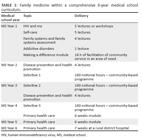
The Nelson R. Mandela School of Medicine (NRMSM) is part of the University of KwaZulu-Natal (UKZN) in Durban, SA. It is one of SA's nine health professional schools and is based in the province of KZN, the second largest province in SA.19,2021Box 1). While there are many factors that impact retention of healthcare workers in rural areas,2223

The aim of this article was to compare the 'fit-for-purpose' attributes of those educated at the NRMSM with those educated at other institutions using select social accountability indicators from THEnet framework. It also aimed to identify the characteristics and perspectives of doctors who chose to stay in or leave public service, specifically at district hospitals, which care for underserved populations.
Methods
In this study, we analysed secondary data. The primary data were collected as part of a broader project on health professional staffing at district hospitals in KZN province. Briefly, Ross et al.25N = 231).
Indicators
Four indicators from the THEnet Social Accountability Framework23
For descriptive purposes, we grouped the responses of medical doctors according to the schools from which they were qualified and assigned them into three categories: NRMSM, South African schools excluding NRMSM and other schools outside of SA.
We asked the participants to identify and rank as primary, secondary or tertiary their reasons for staying at a district hospital. They chose from five options commonly identified in the literature as reasons for staying for a long term in a position.12,26
One of THEnet indicators for social accountability of graduates is the number and proportion of graduates in healthcare leadership roles. In SA, there are six titles given to medical doctors. We defined participants based on the following positions: chief medical officer, medical manager, consultant and clinical manager as holding leadership roles.
Statistical analysis
Data generated from the original survey included closed- and open-ended questions. Researchers at NRMSM entered the survey data into a Microsoft Excel (2016) spreadsheet and provided a copy to investigators at the University of New Mexico, School of Medicine in Albuquerque, NM, United States (US).272829
Ethical considerations
The Biomedical Research and Ethics Committee of the University of KwaZulu-Natal approved the study design (BE 330/16). Each participant provided written informed consent prior to participation in the study.
Results
Sample demographic characteristics
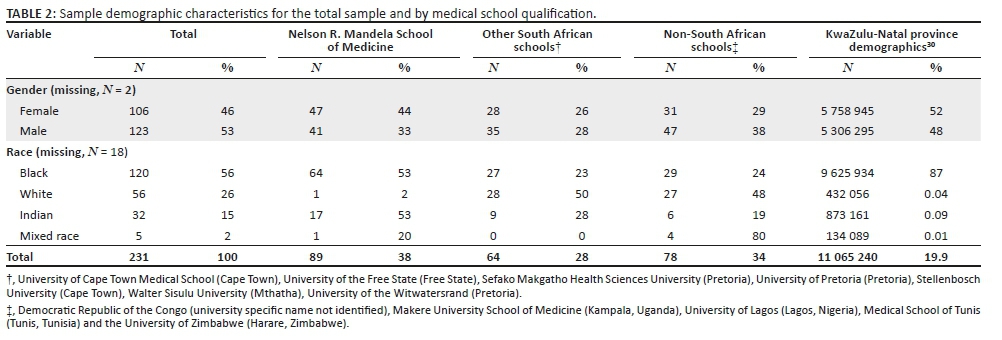
Responses were received from 231 medical doctors (representing a 45% response rate), including 89 (38%) NRMSM graduates, 64 (28%) other South African medical schools and 78 (34%) from non-South African medical schools. Graduates represented seven South African schools (non-NRMSM), five schools on the African continent and 10 schools from non-African countries. Slightly less than half (46%) of the participants were identified as females. The median age of the participants was 31 years, with a range of 24-67 years. Outliers were those aged 55 years and above (N = 14). Male participants were significantly older than female participants (the male participants' median age was 35 years and the female participants' median age was 29 years, p < 0.0001). The age of NRMSM students was similar to the other graduates (p < 0.0001). The majority of participants were identified as black people (56%), followed by white people (26%), Indians (15%) and mixed race people (2%). (see Table 2)
Intention to stay and bursary obligation
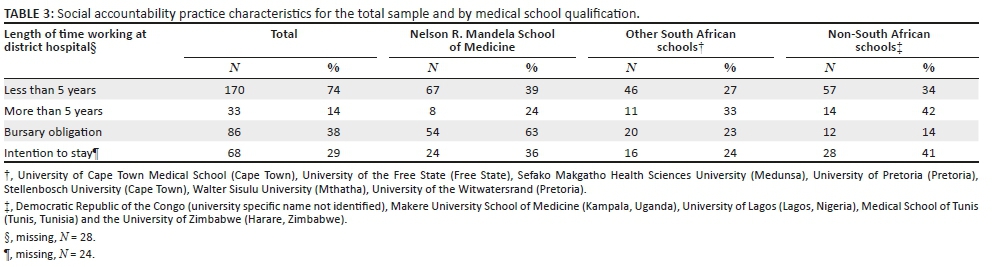
Only one-third (33%) of all medical doctors reported an intention to stay (N = 68). For NRMSM graduates, the percentage was similar (35%, N = 24, p < 0.3320). About one-third of all medical doctors (N = 86, 38%) reported receiving a bursary obligation. Bursary obligation varied by school, with the majority (63%) held by NRMSM graduates, 23% by other South African schools and 14% by non-South African schools (p < 0.0001). Of those reporting a bursary obligation, 86% (N = 74) answered questions regarding where they qualified from and whether they intended to leave their post within the next 5 years. About one-quarter (26%) of respondents with a bursary obligation reported an intention to stay after 5 years. Intention to stay did not vary across the schools (NRMSM, 30%; other South African schools, 28%; non-South African schools, 39%) (p = 0.351). (see Table 3)
Who stays and why?
Fulfilling a community service obligation was the most commonly cited reason for working at a district hospital (N = 70, 33%), followed by enjoyment of work and lifestyle (N = 58, 27%) and being close to family (N = 31, 15%). We observed variation in the ranking by school. A formal payback commitment in the form of a bursary obligation or community service requirement was the primary reason for both NRMSM and other South African graduates, indicating that they would remain at the district hospital, while enjoyment of the work and lifestyle was the primary driver for students from non-South African schools. We were also curious about a subset of respondents who have stayed in district hospitals for more than 5 years. Remaining close to family (33%) and enjoyment of the work and lifestyle (33%) were the most commonly cited reasons for staying for both male and female students across all medical schools.
Among all the respondents, there were no clear patterns between age, gender and intention to stay (p = 0.0001 FET [Fisher's exact test]). A small number of female respondents (N = 5), but no men, identified family as a reason for leaving. Female respondents cited either a community service (n = 38, 54%) or a bursary commitment (N = 12, 57%) as reasons for staying, while men cited enjoyment of the work and lifestyle (N = 41, 72%) and being close to family (N = 32, 68%) as the main retention reasons.
We also looked at race as a potential factor for staying. There were 64 respondents who answered about where they qualified from, their race and stated that they did not intend to leave their post. Slightly more than half (N = 33, 51%) were black people, followed by white people (N = 18, 28%), Indians (N = 10, 16%) and mixed race people (N = 3, 5%). With regard to those qualified from NRMSM, results varied slightly, with 65% (N = 13) of black people intending to stay, followed by Indians (N = 7, 30%) and mixed race people (N = 1, 4%). No white people stated that they intended to stay.
For all schools, the pursuit of specialisation or skills development was the main reason for leaving within the next 5 years (N = 66, 47%). Nelson R. Mandela School of Medicine graduates, intending to leave their current position, were consistent with graduates from other schools, with 44% indicating specialisation and skills development as the primary reason for intention to leave (p = 0.0001).
Leadership roles
A small proportion of respondents (16%, N = 33) held leadership roles within the district hospitals. Nearly half (48%) of the leaders qualified from non-South African schools, 27% from NRMSM and 24% from other South African schools (p = 0.1598).
A greater proportion of respondents with more than 5 years of experience are in leadership positions (38%) as compared to those with less experience (11%) (p = 0.0005). Leaders with more than 5 years of experience did not vary by school.
Discussion
In this article, we compared 'fit-for-purpose' attributes of those educated at the NRMSM and who are receiving incentives for working in underserved communities with those educated at other institutions. While medical doctors who qualified from the NRMSM are progressing towards meeting community needs, there remains room for improvement. Overall, 29% (26/89) of NRMSM graduates have a mandated obligation to work at a district hospital because of community service, but only 27% (24/89) indicated a willingness to stay at a District Hospital (DH). This would suggest that training at NRMSM may be effective in meeting short-term staffing needs, but this is not a long-term strategy if graduates are unwilling to stay beyond their obligated term. To provide insight into this dynamic, we compared graduates using select social accountability indicators from the THEnet framework, including medical doctors who are demographically similar to the population served, who remain working with assigned communities 5 years after graduation, and who pursue further specialisation and take on leadership roles.23
The Nelson R. Mandela School of Medicine mirrors the population served in terms of age and gender, but not ethnicity. It is a measure of social accountability to have a workforce that is representative of the population served.3132Table 2).301410
Nelson R. Mandela School of Medicine graduates are the least likely to stay longer term. Only 14% of the 231 medical doctors surveyed were working at district hospitals 5 years after graduation. Graduates from NRMSM are less likely to stay beyond 5 years than graduates from non-South African schools. Bursary obligations and compulsory community service after graduation were the most common reason for working at a district hospital and may be effective human resource recruitment strategies, but they are mostly short-term methods. While prior research has shown that financial incentives impact decisions for rural placement,2610,22
While many NRMSM graduates stated that they planned to leave the DH to pursue a specialisation, the extent to which they do so is unclear. Intention to stay after the obligation was fulfilled did not differ for NRMSM graduates in comparison to other graduates. When we looked at the question, 'do you plan on leaving your post?', 40% of NRMSM students responded affirmatively, with 44% indicating that they were leaving to pursue an additional specialisation. The THEnet considers further specialisation to be an indicator of social accountability even if medical doctors ultimately go into private practice if it is pursued in order to address the needs of community and health workforce. However, there is currently no method at the NRMSM or other medical schools in South Africa for tracking what graduates do when they leave. Motivation for pursuing a specialisation and where they practice post-specialisation is an area of further study. Prior research has shown that a desire for specialisation impacts one's intention to work in rural areas. Specifically medical doctors report that rural assignments come with a lack of access to continuing education and professional development opportunities,10,22,3322
Nelson R. Mandela School of Medicine graduates and those from other South African schools were less likely to be in leadership positions at the DH compared to those from non-South African schools. The THEnet considers the number of graduates in healthcare leadership roles as an important indicator of social accountability because they are in a position to influence the health system reform.2334,35,36
New graduates are difficult to retain in the public sector;1437
Rourke outlined four strategies that schools can undertake to meet societal obligations, one which is pertinent for this study: 'Produce graduates with the appropriate knowledge, skills, and interest who will practice how and where needed in the medical school's region/nation'.382339the communities they serve.
Family medicine specialists are perfectly positioned to lead this change as they are trained to address not only the health needs of the individual, but also the health needs of the community. These specialists are expert generalists who are trained to care for the majority of health problems seen in both clinics and district hospitals. The NRMSM has a strong emphasis on community immersion through the FM, but the results of this study suggest the need for greater emphasis on the overall curriculum content. This requires embedding the curriculum with socially accountable values and shifting from traditional learning that focuses exclusively on the individual biomedical model of disease to one that promotes social accountability. A socially accountable health professional curriculum is geared towards transformational learning to produce graduates with competencies to address priority health needs in the communities they serve. In a comprehensive systematic review of US primary care practice location, multiple factors were identified as predictors of practice in rural or underserved areas.40rural, underserved, primary care and family medicine. Similar curriculum elements aimed at improving recruitment and retention of medical doctors to underserved areas, in particular rural areas, may be relevant to South Africa.41
Limitations of the study
The focus of this study was on district hospitals only, which did not capture whether graduates are working in other underserved facilities. Data represented most but not all district hospitals and just under half of eligible medical doctors (44%) responded. In addition, some respondents had answers that were difficult to interpret. For example, when asked 'what is your reason for leaving your post?', some stated 'travel', which could mean travel makes the workplace undesirable or that they want to spend time traveling rather than working. Some respondents cited 'training' as a reason for leaving, which could mean that they want to pursue additional training on their own or training in the work environment which is not sufficient. While understanding the specifics may not significantly change the results, they could add evidence for future policy, education and workplace recommendations. Another limitation is that the specific curricular details of the non-NRMSM schools represented in this study are unknown.
Conclusion
An expected return on investment in medical education, from a societal standpoint, is future access to clinicians who are not only technically competent but also 'fit-for-purpose', that is, they are able to meet the needs of the communities in which they train, learn and serve. Although the annual intake of NRMSM students mirrors the ethnic and gender demography of the population in the KZN province, the medical doctor workforce in KZN district hospitals is not ethnically reflective of the population served. The healthcare system must recruit and retain young and ethnically diverse health professionals, not only for continuity of care but also for ensuring adequate access to care within the population served. It is encouraging that graduates desire to pursue further specialisation, but without a means to track what graduates do afterwards, we are not able to conclusively state this as a socially accountable indicator. To assist in evaluating progress towards social accountability, future research should determine whether graduates returning to the KZN province after achieving their specialisation choose to practice in other underserved areas. Other areas of future research will look at analysing specific components of NRMSM, including practice intentions of medical students at different points in their education. Findings from these studies will contribute to the development of South African, in particular, NRMSM's, education programmes and the goals of achieving health equity through education, research and services responsive to community priorities.
Competing interests
The authors declare that they have no financial or personal relationships that may have inappropriately influenced them in writing this article.
Authors' contributions
A.R. led the design of the study and collected the data. A.C.E. led the analysis and interpretation of the data and the writing of the article. All authors contributed to the analysis, synthesis, writing and editing of the article.
Acknowledgements
References
-
1.WHO. Increasing access to health workers in remote and rural areas through improved retention [homepage on the Internet]. WHO. [cited 2018 Apr 04]. Available from: http://www.who.int/hrh/retention/guidelines/en/
» http://www.who.int/hrh/retention/guidelines/en/ -
2.16059_Global strategy, Workforce 2030_Revised spread 4&5_For Printing.pdf - global_strategy2030en-printversion.pdf. [cited 2017 June 02]. Available from: http://www.who.int/hrh/resources/global_strategy2030en-printversion.pdf
» http://www.who.int/hrh/resources/global_strategy2030en-printversion.pdf -
3.Ataguba JE-O, McIntyre D. Who benefits from health services in South Africa? Health Econ Policy Law. 2013;8:21-46. https://doi.org/10.1017/S1744133112000060
» https://doi.org/10.1017/S1744133112000060 -
4.Langa R, Strydom J. The rural health advocacy project [homepage on the Internet]. [cited 2017 June 06]. Available from: http://www.rhap.org.za
» http://www.rhap.org.za -
5.Versteeg M, Du Toit L, Couper I. Building consensus on key priorities for rural health care in South Africa using the Delphi technique. Glob Health Action. 2013;6:19522. https://doi.org/10.3402/gha.v6i0.19522
» https://doi.org/10.3402/gha.v6i0.19522 -
6.National Department of Health. Human Resources for Health for South Africa 2030 | Health Systems Trust [homepage on the Internet]. Health Systems Trust. [cited 2017 June 06]. Available from: http://www.hst.org.za/publications/human-resources-health-south-africa-2030
» http://www.hst.org.za/publications/human-resources-health-south-africa-2030 -
7.The Global Tug-of-War for Health Care Workers [homepage on the Internet]. [cited 2017 June 6]. Available from: migrationpolicy.org, http://www.migrationpolicy.org/article/global-tug-war-health-care-workers
» migrationpolicy.org -
8.Human resources for health: Challenges facing sub-Saharan Africa [homepage on the Internet]. Heard. [cited 2017 June 02]. Available from: http://www.heard.org.za/publications-post/human-resources-for-health-challenges-facing-sub-saharan-africa-2/
» http://www.heard.org.za/publications-post/human-resources-for-health-challenges-facing-sub-saharan-africa-2/ -
9.Marmot M, Bell R. Fair society, healthy lives. PubMed - NCBI. [cited 25 Sept 2017]. Available from: Available from: https://www.ncbi.nlm.nih.gov/pubmed/22784581
» https://www.ncbi.nlm.nih.gov/pubmed/22784581 -
10.Strasser R, Kam SM, Regalado SM. Rural Health Care access and policy in developing countries. Annu Rev Public Health. 2016;37:395-412. https://doi.org/10.1146/annurev-publhealth-032315-021507
» https://doi.org/10.1146/annurev-publhealth-032315-021507 -
11.Braveman P, Tarimo E. Social inequalities in health within countries: Not only an issue for affluent nations. Soc Sci Med. 2002;54:1621-1635. https://doi.org/10.1016/S0277-9536(01)00331-8
» https://doi.org/10.1016/S0277-9536(01)00331-8 -
12.Mbemba GIC, Gagnon M-P, Hamelin-Brabant L. Factors influencing recruitment and retention of healthcare workers in rural and remote areas in developed and developing countries: An overview. J Public Health Africa. 2016;7:565. https://doi.org/10.4081/jphia.2016.565
» https://doi.org/10.4081/jphia.2016.565 -
13.Mburu G, George G. Determining the efficacy of national strategies aimed at addressing the challenges facing health personnel working in rural areas in KwaZulu-Natal, South Africa. Afr J Prim Health Care Fam Med. 2017;9:1355. https://doi.org/10.4102/phcfm.v9i1.1355
» https://doi.org/10.4102/phcfm.v9i1.1355 -
14.Van Rensburg HCJ. South Africa's protracted struggle for equal distribution and equitable access - Still not there. Hum Resour Health. 2014;12:26. https://doi.org/10.1186/1478-4491-12-26
» https://doi.org/10.1186/1478-4491-12-26 -
15.Hatcher AM, Onah M, Kornik S, et al. Placement, support, and retention of health professionals: National, cross-sectional findings from medical and dental community service officers in South Africa. Hum Resour Health. 2014;12:14. https://doi.org/10.1186/1478-4491-12-14
» https://doi.org/10.1186/1478-4491-12-14 -
16.Reeve C, Woolley T, Ross SJ, et al. The impact of socially-accountable health professional education: A systematic review of the literature. Med Teach. 2017;39:67-73. https://doi.org/10.1080/0142159X.2016.1231914
» https://doi.org/10.1080/0142159X.2016.1231914 -
17.Boelen C, Heck JE, Health WHOD of D of HR for. Defining and measuring the social accountability of medical schools [homepage on the Internet]. [cited 2017 May 23]. Available from: http://www.who.int/iris/handle/10665/59441
» http://www.who.int/iris/handle/10665/59441 -
18.Fusheini A, Eyles J. Achieving universal health coverage in South Africa through a district health system approach: Conflicting ideologies of health care provision. BMC Health Serv Res. 2016;16:558. https://doi.org/10.1186/s12913-016-1797-4
» https://doi.org/10.1186/s12913-016-1797-4 -
19.Professional Boards - HPCSA [homepage on the Internet]. [cited 2017 June 02]. Available from: http://www.hpcsa.co.za/PBMedicalDental/Education
» http://www.hpcsa.co.za/PBMedicalDental/Education -
20.Marriages and Divorces, 2005 - Report-03-01-352007.pdf [homepage on the Internet]. [cited 2017 Sept 07]. Available from: http://www.statssa.gov.za/publications/Report-03-01-35/Report-03-01-352007.pdf
» http://www.statssa.gov.za/publications/Report-03-01-35/Report-03-01-352007.pdf -
21.Introduction - College of Health Sciences [homepage on the Internet]. [cited 2018 Sept 11]. Available from: https://chs.ukzn.ac.za/introduction/
» https://chs.ukzn.ac.za/introduction/ -
22.Jenkins LS, Gunst C, Blitz J, et al. What keeps health professionals working in rural district hospitals in South Africa? Afr J Prim Health Care Fam Med. 2015;7. https://doi.org/10.4102/phcfm.v7i1.805
» https://doi.org/10.4102/phcfm.v7i1.805 -
23.Larkins SL, Preston R, Matte MC, et al. Measuring social accountability in health professional education: Development and international pilot testing of an evaluation framework. Med Teach. 2013;35:32-45. https://doi.org/10.3109/0142159X.2012.731106
» https://doi.org/10.3109/0142159X.2012.731106 -
24.Knight ES, Ross JA, Mahomed O. Developing primary health care and public health competencies in undergraduate medical students. South Afr Fam Pract. 2017;59:103-109. https://doi.org/10.1080/20786190.2016.1272229
» https://doi.org/10.1080/20786190.2016.1272229 -
25.Ross A, Gumede D, Mianda S. Staffing levels at KwaZulu-Natal district hospitals: Is the University of KwaZulu-Natal training for the needs of the province? South Afr Fam Pract. 2018;60:58-62. https://doi.org/10.1080/20786190.2017.1386900
» https://doi.org/10.1080/20786190.2017.1386900 -
26.Odom WK, Ryan G, Ramey R, et al. Recruiting and retaining primary care physicians in urban underserved communities: The importance of having a mission to serve. Am J Public Health. 2010;100:2168-2175. https://doi.org/10.2105/AJPH.2009.181669
» https://doi.org/10.2105/AJPH.2009.181669 -
27.School of Medicine - The University of New Mexico [homepage on the Internet]. [cited 2018 Nov 7]. Available from: https://som.unm.edu/
» https://som.unm.edu/ -
28.Harris PA, Taylor R, Thielke R, et al. Research electronic data capture (REDCap) - A metadata-driven methodology and workflow process for providing translational research informatics support. J Biomed Inform. 2009;42:377-381. https://doi.org/10.1016/j.jbi.2008.08.010
» https://doi.org/10.1016/j.jbi.2008.08.010 - 29.SAS Institute Inc. SAS 9.4 Companion for Windows. 5th ed. Cary, NC: SAS Institute Inc; 2016.
- 30.Microsoft Word - (NT 30-06-2016) RELEASE for CS 2016 _Statistical releas_1 July 2016.docx - South Africa Community Survey 2016. [cited 2017 June 02]. Available from: file:///C:/Users/aclithero/AppData/Roaming/Mozilla/Firefox/Profiles/ fn088tj3.default/zotero/storage/ 686RMGBG/South%20Africa%20Community%20Survey%202016.pdf
-
31.THEnet - Training for Health Equity Network - Section 3: What Do We Do? [cited 2016 Nov 9]. Available from: http://thenetcommunity.org/social-af-section-3/
» http://thenetcommunity.org/social-af-section-3/ -
32.Wayne SJ, Kalishman S, Jerabek RN, et al. Early predictors of physiciansʼ practice in medically underserved communities: A 12-year follow-up study of University of New Mexico School of Medicine Graduates: Acad Med. 2010;85:S13-S16. https://doi.org/10.1097/ACM.0b013e3181ed1bee
» https://doi.org/10.1097/ACM.0b013e3181ed1bee -
33.Strasser R, Neusy A-J. Context counts: Training health workers in and for rural and remote areas. Bull World Health Organ. 2010;88:777-782. https://doi.org/10.2471/BLT.09.072462
» https://doi.org/10.2471/BLT.09.072462 -
34.Souba W, Souba M. How effective leaders harness the future. Acad Med. 2018;93:166-171. https://doi.org/10.1097/ACM.0000000000001955
» https://doi.org/10.1097/ACM.0000000000001955 -
35.Blumenthal DM, Bernard K, Bohnen J, et al. Addressing the Leadership Gap in Medicine: Residentsʼ Need for Systematic Leadership Development Training. Acad Med. 2012;87:513-522. https://doi.org/10.1097/ACM.0b013e31824a0c47
» https://doi.org/10.1097/ACM.0b013e31824a0c47 -
36.Goldstein AO, Calleson D, Bearman R, et al. Teaching advanced leadership skills in community service (ALSCS) to medical students. Acad Med. 2009;84:754-764. https://doi.org/10.1097/ACM.0b013e3181a40660
» https://doi.org/10.1097/ACM.0b013e3181a40660 -
37.Woollard RF. Caring for a common future: Medical schools' social accountability. Med Educ. 2006;40:301-313. https://doi.org/10.1111/j.1365-2929.2006.02416.x
» https://doi.org/10.1111/j.1365-2929.2006.02416.x -
38.Rourke JM. AM Last page: Social accountability of medical schools. Acad Med. 2013;88:430. https://doi.org/10.1097/ACM.0b013e3182864f8c
» https://doi.org/10.1097/ACM.0b013e3182864f8c -
39.Framework - What difference do we make? THEnet: The training for Health Equity Network. [cited 2017 Sept 01]. Available from: https://thenetcommunity.org/what-difference-do-we-make/
» https://thenetcommunity.org/what-difference-do-we-make/ -
40.Goodfellow A, Ulloa JG, Dowling PT, et al. Predictors of primary care physician practice location in underserved urban or rural areas in the United States: A systematic literature review. Acad Med J Assoc Am Med Coll. 2016;91:1313-1321. https://doi.org/10.1097/ACM.0000000000001203
» https://doi.org/10.1097/ACM.0000000000001203 -
41.Strasser R. Rural health around the world: Challenges and solutions. PubMed - NCBI. [cited 2018 Apr 6]. Available from: https://www.ncbi.nlm.nih.gov/pubmed/12876121
» https://www.ncbi.nlm.nih.gov/pubmed/12876121
Accepted: 09 Nov. 2018
Published: 23 Apr. 2019