Primary care nurses' preparedness for COVID-19 in the Western Cape province, South Africa
Abstract
INTRODUCTION: The novel coronavirus 2019 or COVID-19 pandemic has brought about a global public health crisis. Primary care (PC) nurses render first line care, or refer for more specialised servicesAIM: To investigate the preparedness of PC nurses for COVID-19 in the Western CapeSETTING: The Western Cape province of South AfricaMETHODS: We administered an online survey, with closed and open-ended questions, to 83 Stellenbosch University postgraduate PC nursing students and alumni working in the Western Cape, between 03 July and 01 September 2020RESULTS: The results indicated that 43.3% of participants were confident about the infection, prevention, and control (IPC) training they received and 56.7% felt prepared to provide direct care to suspected cases of COVID-19. Primary care nurses were more comfortable to triage (78.3%) than to manage persons with COVID-19 (42.2%), indicating that they may not be functioning to the full capacity of their education and training. Adequate infrastructure was reported by less than a third of the participants (30.1%) and 59.1% reported that personal protective equipment (PPE) was always available. Primary care nurses needed support in coping with stress (57.8%) although few (14.5%) reported access to mental health servicesCONCLUSION: Primary care nurses were not prepared optimally for the COVID-19 pandemic. Challenges included adequate training, infrastructure, the availability of personal protective equipment, COVID-19 testing of health care workers and management support. Primary care nurses need comprehensive support to manage stress and anxiety
COVID-19; primary care; nurses; preparedness; Western Cape
Introduction
The novel coronavirus (Severe Acute Respiratory Syndrome [SARS]-Cov-2) or coronavirus disease 2019 (COVID-19) pandemic has brought about a global public health crisis.12
The South African healthcare system offers a range of preventative and curative services at PC level, including chronic care to address the quadruple burden of disease.31,4
To minimise the spread of COVID-19, routine droplet and contact precautions, environmental hygiene and overall infection prevention and control precautions are needed. Recommendations on workplace preparedness state that healthcare workers who are exposed to possible or known COVID-19 cases are classified as having a high exposure risk.51
In April 2020, the Infectious Diseases Society of South Africa published a COVID-19 Primary Care Preparedness Guide.6617
It is likely that nursing curricula do not cover pandemic preparedness adequately, as this pandemic is the first experienced on such a scale, the previous ones (e.g. Middle East Respiratory Syndrome [MERS] and SARS) not reaching such global proportions. Although general disaster management is addressed in all postgraduate diploma in nursing programmes at Stellenbosch University, existing general guidelines, and those discussed in curricula for the safety of healthcare workers during a pandemic, are not comprehensive and precise.48
Research on the experiences of frontline healthcare workers, such as PC nurses, in the early phases of a pandemic is crucial to inform strategies to ensure better support and future planning. For example, during the early phases of the 2009 H1N1 pandemic, a quantitative study in England found that some healthcare workers had negative attitudes towards taking antivirals and receiving influenza vaccinations.91,9 Other concerns include childcare responsibilities and dependents requiring their care and support.10
The impact of COVID-19 on the Nursing and Midwifery workforce study (ICON) in the United Kingdom found that of 2600 nurses who responded, 92% were worried about risks to family members and 74% felt their own health was at risk.1111
The aim of this study was to investigate the preparedness of PC nurses for COVID-19 in the Western Cape province, South Africa.
Methodology
Design
A quantitative descriptive research design was used. We conducted an online survey using RedCap that was sent to Stellenbosch University's postgraduate diploma in PC nursing students and alumni.
Setting
The Department of Nursing and Midwifery at Stellenbosch University is responsible for the postgraduate training of PC nurses. The students come from various urban and rural districts in the Western Cape. These students and alumni were the most accessible population to perform a rapid assessment of the current situation.
Instrument
The questionnaire was developed by the research team and was based on the literature, 'The impact of COVID-19 on the nursing and midwifery workforce study (ICON)', questions for this specific category of healthcare worker11
Four experts, including health service managers and academics involved in planning for the COVID-19 pandemic in the Western Cape, reviewed the questionnaire to establish face validity and assessed the alignment between the research objectives and the questions. Reliability analysis of the two Likert-scale questions related to confidence in training and preparedness indicated a Cronbach's alpha of 0.7. The three Likert-scale questions related to stress and worry about COVID-19 had a Cronbach's alpha of 0.75, indicating an acceptable reliability.
Population and sample selection
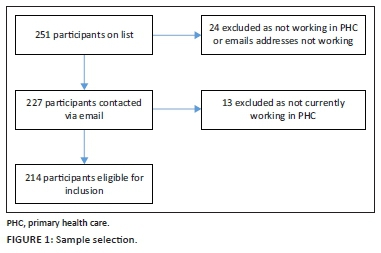
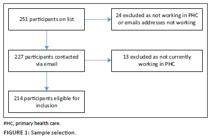
Current PC nursing students (year 2020) and students from the years 2017-2019 were included (N = 251) in the study. Figure 1 depicts the study sample.
Pilot test
We conducted a pilot test of the questionnaire on 12 conveniently selected PC nurses of the 2016 student cohort. The purpose of the pilot test was to determine if the questions were clear. We contacted the participants after they completed the questionnaire online via WhatsApp to enquire if they experienced any difficulty completing the questionnaire and to obtain feedback. Minor changes were made following the pilot test and the responses from the pilot test were not included in the main study.
Data collection
Once institutional permission was obtained, an email with a link to the online consent form and questionnaire was sent to all the eligible students and alumni. Follow-up emails were sent via RedCap to remind participants to complete the questionnaires. Participants who did not respond after several reminders received a courtesy WhatsApp message to ask them if they were aware of the survey, in an attempt to increase the response rate and representativeness of the study results. This did not compromise confidentiality, as RedCap only indicated which respondents did not respond; the participants' identities are not linked to their responses. The electronic link was open from 03 July 2020 to 01 September 2020, although the majority of the participants completed the questionnaires between 03 July 2020 and 31 July 2020.
Participants who completed the questionnaire were entered into a lucky draw to win a gift voucher to the value of R1000.00. This incentive was introduced in an attempt to increase the participant response rate.
Data analysis
Data were analysed descriptively and summarised in frequency tables or graphs. Inferential statistics included differences between urban and rural districts and participant responses, using the chi-square test. Content analysis12
Ethical considerations
We considered the ethics and practicalities of duty of care during pandemics.13
Ethical approval was obtained from the Health Research Ethics Committee at Stellenbosch University (clearance no. N20/04/015_COVID-19) and institutional permission was obtained to access the students' contact details. This research was of minimal risk as all data collection occurred online and did not compromise the health of any participants or researchers. We specifically kept the questionnaire short so that it did not require too much time from the participants who may be providing essential services. Participants agreed to participate after reading an online participant information leaflet.
Results
Demographic information
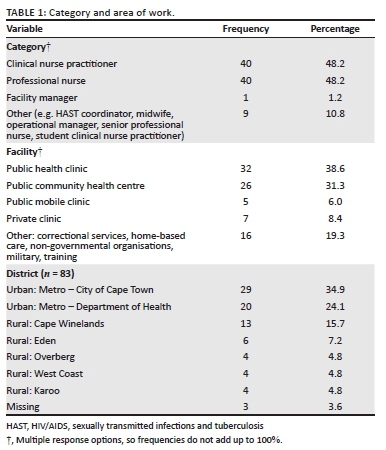
The final sample included 83 participants (83/214, 38.7%). The mean age of the participants was 37.8 years (standard deviation [s.d.] 7.3 years), with a mean number of years working in Primary Health Care (PHC) of 5.4 (s.d. 4.8). Of the sample, 85.5% (71) were female participants and the majority (69, 83.1%) indicated that their highest qualification was a postgraduate diploma in nursing. Table 1 indicates the category and area of work. Most of the participants (49, 59%) worked in urban districts. The majority worked in public health facilities (63, 75.9%).
Training and attitudes
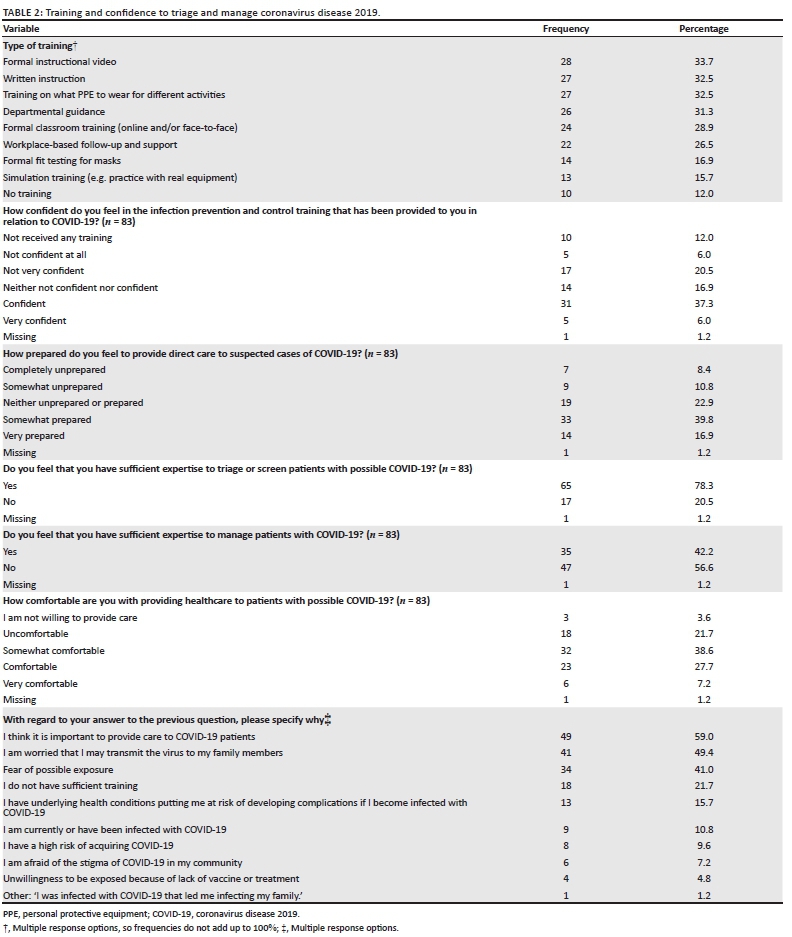
In response to questions on training to triage and manage COVID-19, some participants indicated that they received no training (n = 10, 12.0%). The most common training method was an instructional video (n = 28, 33.7%) (see Table 2). Less than half of the participants (n = 36, 43.3%) felt confident or very confident about the IPC training received in relation to COVID-19 and just more than half (n = 47, 56.7%) felt somewhat or very prepared to provide care. More participants indicated having the necessary expertise to triage patients with COVID-19 (n = 65, 78.3%) than to manage persons with COVID-19 (n = 35, 42.2%).
Very few participants (n = 3, 3.6%) indicated that they were not willing to provide care to persons with COVID-19, whilst 34.9% (n = 29) were comfortable or very comfortable to provide care. More than half of the participants reported that it is important to provide care to persons with COVID-19 (n = 49, 59.0%). Discomfort mostly related to being worried about family members (n = 41, 49.4%), fear of exposure (n = 34, 41.0%) and having underlying health conditions (n = 13, 15.7%).
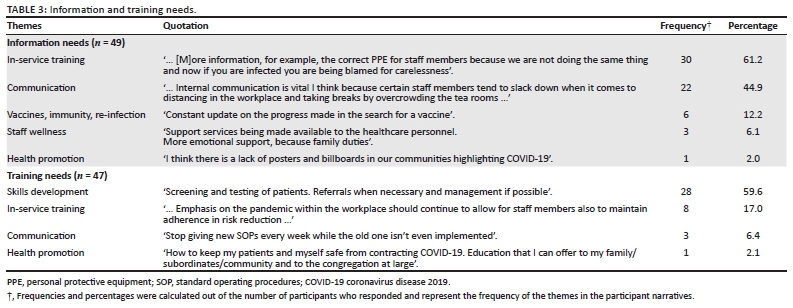
We used two open-ended questions to ask participants about their information and training needs. Table 3 summarises the themes identified.
Guidelines
The majority of participants had access to guidelines on triaging and managing COVID-19 (n = 71, 5.5%) and access to the use of PPE (n = 72, 86.7%). Guidelines that were the most often used were the Practical Approach to Care Kit (n = 56, 67.5%) and the Western Cape Department of Health guidelines (n = 44, 53%). A large majority of participants reported that they followed the guidelines (n = 76, 91.6%) and 84.3% (n = 70) found the guidelines helpful.
In the open-ended question, participants reported reasons for not finding the guidelines helpful, such as lack of clarity about what PPE to wear in certain situations, especially in emergency units because of uncertainty of whether a patient might have COVID-19, continuous changes in the guidelines or a lack of training on guidelines. One participant commented:
'The guidelines don't take appropriate infrastructure of facility in mind … still don't take health care practitioners' expertise or the amount of patients in mind for effective triage and management.' (Male, 31 years, community health centre)
Personal protective equipment and infrastructure
Less than one-third of the participants (25, 30.1%) indicated that there was adequate infrastructure in their facility to triage and manage COVID-19 cases and almost two-thirds of the participants (n = 49, 59.1%) agreed or strongly agreed that PPE was always available.
In the open-ended question, participants indicated several infrastructure and equipment needs including full PPE packs for testing, dedicated space for COVID-19 triage and testing, isolation rooms, patient flow challenges such as the inability to effectively separate patients because of load and small spaces with a lack of ventilation. In most facilities, COVID-19 screening and triaging was performed outside, for example, in gazebos or tents. These spaces were not always suitable because of windy and rainy weather conditions. Many participants reported a lack of equipment that was fully functional and sharing equipment between COVID-19 and non-COVID-19 patients.
Mobile clinics experienced particular challenges as shown in the below quote:
'At mobile clinic, screening is outside. Privacy problem. In rain, sick patient cared for in mobile clinic. Little space, distancing impossible. In level 5 lockdown we were told by management, no need for masks, only distancing and handwashing/sanitizing. Received first two N95 masks in late April and forehead thermometer end of June.' (Female, 53 years, mobile clinic)
One participant commented that theft and the incorrect use of PPE had led to a lack of PPE availability:
'This has resulted in all PPE being locked away and only available when signing for it. Many of our staff have a sense of panic and paranoia and tend to use the incorrect PPE; this has resulted in shortages that could have been avoided.' (Female, 51 years, district hospital)
Personal and self-care needs
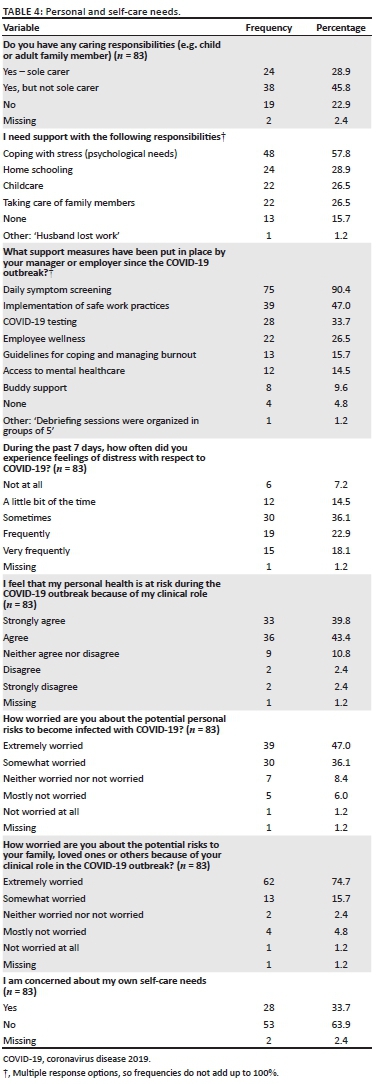
More than half of the participants indicated that they needed support for coping with stress (n = 48, 57.8%), whilst 41% (n = 34) frequently or very frequently experienced feelings of distress related to COVID-19; however, only 33.7% (n = 28) were concerned about their self-care needs (see Table 4). One participant's comment may explain why so few were concerned about their self-care needs:
'Due to the nature of my work I have to put the patient first; therefore, my personal health always comes last.' (Male, 43 years, correctional services)
Themes related to self-care and mental health needs were identified in the open-ended questions. These included fear because of comorbidities such as diabetes and hypertension; uncertainty about PPE requirements; lack of ability to take care of personal health (exercise, rest, etc.) because of other responsibilities; fear of infecting a partner or family members (social life changes); difficulty isolating because of having children at home or not knowing what to do during isolation; and a lack of employer support, which are evident in the following quotes:
'I have 2 kids, I am a single parent only stay with them; [the] first born is 16 years and [the] last born is 3 years and I don't have a carer to look after them. I work Monday to Friday; no time for home schooling, I am working with high-risk clients.' (Female, 30 years, non-governmental organisation)
'When staff tested positive, they must hide the status, no support from company when one tested positive, no deep cleaning at all.' (Female, 36 years, community health centre)
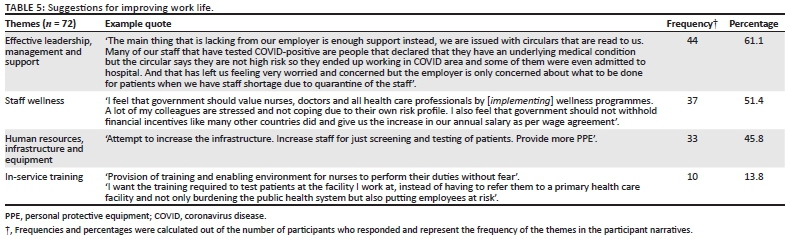
Participants made suggestions for improving their work life and these are depicted in Table 5.
Inferential statistics did not indicate any significant differences between rural and urban areas and the responses provided by the participants.
Discussion
We set out to determine the preparedness of PC nurses for the COVID-19 pandemic in the Western Cape province. Only 56.7% of the participants indicated that they were partly or fully prepared to provide care to patients with COVID-19. Primary care nurses were more confident to screen possible PUI than to manage individuals with COVID-19. In the United Kingdom, 52.0% of nurses reported confidence in their training about COVID-19.111415
The COVID-19 pandemic necessitated the training of PC workers, specifically nurses, to respond to patient care needs.4,16,17 This should ideally also include simulation training to facilitate critical thinking skills unique to pandemics.1819
Guidelines appeared to be available and accessible to most participants. This is contrary to an Australian study where only 47.3% of participants reported access to COVID-19-specific guidelines.1520
Less than one-third of participants reported adequate infrastructure, indicating that PC facilities are not tailored to manage patients during pandemics. Personal protective equipment were not always available in facilities. Similarly, in Australia and the United Kingdom, PC workers reported insufficient PPE.15,21 This highlights the need to strengthen primary healthcare systems globally1722
Congruent with other studies,1,11,15,23 59% of PC nurses in the Western Cape considered providing COVID-19 services and care to be important. However, they were worried about the possible risk to themselves and their families. Only 34.9% felt comfortable or very comfortable to provide care to patients with COVID-19, compared to 59% of PC nurses in an Australian study.151
Participants reported support needs such as childcare, home schooling and taking care of family members. Similar carer responsibilities were reported amongst Australian PC nurses.1523,24 A lack of support from management was identified in this study. In Australia, only 54.8% of PC nurses reported feeling supported by management.1525
The study participants indicated that effective management and staff wellness were the most pertinent needs. A study in the United States of America found that healthcare workers requested to be heard, protected, prepared, supported and cared for during a pandemic.2417
Strengths and limitations
The limitations of the study include its cross-sectional nature, the relatively low response rate, the focus on the public health system and the dominance of respondents from urban areas. Furthermore, the fact that the questionnaire was administered online, and that the participants were all from the same university, could have introduced sampling or response bias. The inclusion of other universities within the Western Cape may have provided a more representative sample, but may have also delayed data collection during the peak of the pandemic. The findings, however, resonate with global literature. Further, the qualitative participant responses provide rich contextual information that increases the transferability of the findings.
Conclusion
Primary care nurses remain central to ensure 'health for all' and continuous quality healthcare. The findings of this study indicate that PC nurses were not optimally prepared for the COVID-19 pandemic. Challenges included adequate training, infrastructure, the availability of PPE, COVID-19 testing of healthcare workers and management support. Personal care nurses need comprehensive support to manage stress and anxiety. The findings of this study may be used to inform nursing curricula and future PC preparedness interventions.
Competing interests
The authors declare that they have no financial or personal relationships that may have inappropriately influenced them in writing this article.
Authors' contributions
T.C., D.K., F.d.L.-C., J.B., S.d.L., C.Y., T.E. and I.C. contributed to the proposal writing, data collection, analysis and the preparation of the manuscript.
Funding information
This research received no specific grant from any funding agency in the public, commercial or not-for-profit sectors.
Data availability
Data sharing is not applicable to this article, as no new data were created or analysed in this study.
Disclaimer
The views and opinions expressed in this article are those of the authors and do not necessarily reflect the official policy or position of any affiliated agency of the authors.
Acknowledgements
References
-
1. Adams JG, Walls RM. Supporting the health care workforce during the COVID-19 global epidemic. JAMA. 2020;323(15):1439-1440. https://doi.org/10.1001/jama.2020.3972
» https://doi.org/10.1001/jama.2020.3972 -
2. World Health Organisation. The state of the World's Nursing: Investing in education, jobs and leadership [homepage on the Internet]. 2020 [cited 2020 Nov 12]. Available from: https://www.who.int/publications/i/item/9789240007017
» https://www.who.int/publications/i/item/9789240007017 -
3. Wyk VP, Msemburi W, Laubscher R, et al. Mortality trends and diff erentials in South Africa from 1997 to 2012: Second National Burden of Disease Study. Lancet Glob Health. 2012;4(9):e642-e653. https://doi.org/10.1016/S2214-109X(16)30113-9
» https://doi.org/10.1016/S2214-109X(16)30113-9 -
4. Huh S. How to train the health personnel for protecting themselves from novel coronavirus (COVID-19) infection during their patient or suspected case care. J Educ Eval Health Prof. 2020;17:10. https://doi.org/10.3352/jeehp.2020.17.10
» https://doi.org/10.3352/jeehp.2020.17.10 -
5. Republic of South Africa. The Department of Employment and Labour Workplace Preparedness : COVID-19 (SARS-CoV-19 virus) [homepage on the Internet]. 2020 [cited 2020 Nov 12]. Available from: https://www.labourguide.co.za/workshop/1773-covid-19-guideline-mar2020/file
» https://www.labourguide.co.za/workshop/1773-covid-19-guideline-mar2020/file -
6. Infections Diseases Society of Southern Africa. COVID-19 primary care facility preparedness guide [homepage on the Internet]. 2020 [cited 2020 Nov 12]. Available from: http://www.differentiatedcare.org/Portals/0/adam/Content/y-IAY91fnUuqJ1hd2T0cvw/File/COVID-19%20primary%20care%20facility%20preparedness%20guide%2008042020-1.pdf
» http://www.differentiatedcare.org/Portals/0/adam/Content/y-IAY91fnUuqJ1hd2T0cvw/File/COVID-19%20primary%20care%20facility%20preparedness%20guide%2008042020-1.pdf -
7. Huang L, Lin G, Tang L, Yu L, Zhou Z. Special attention to nurses' protection during the COVID-19 epidemic. Crit Care. 2020;24(1):10-12. https://doi.org/10.1186/s13054-020-2841-7
» https://doi.org/10.1186/s13054-020-2841-7 -
8. Alduraywish T, West S, Currie J. Investigation of the pandemic preparedness education of critical care nurses. Int J Health Life Sci. 2019;5(1):40-61. https://doi.org/10.20319/lijhls.2019.51.4061
» https://doi.org/10.20319/lijhls.2019.51.4061 -
9. Edeghere O, Fowler T, Wilson F, et al. Knowledge, attitudes, experience and behaviour of frontline health care workers during the early phase of 2009 influenza A(HlNl) pandemic, Birmingham, UK. J Health Serv Res Policy. 2015;20(1):26-30. https://doi.org/10.1177/1355819614554243
» https://doi.org/10.1177/1355819614554243 -
10. Ives J, Greenfield S, Parry JM, et al. Healthcare workers' attitudes to working during pandemic influenza: A qualitative study. BMC Public Health. 2009;9:56. https://doi.org/10.1186/1471-2458-9-56
» https://doi.org/10.1186/1471-2458-9-56 -
11. Hackett K. COVID-19: Redeployment training is non-existent or inadequate, nurses reveal. Nurs Stand [serial online]. 2020 [cited 2020 Nov 12]. Available from: https://rcni.com/nursing-standard/newsroom/news/covid-19-redeployment-training-non-existent-or-inadequate-nurses-reveal-160301
» https://rcni.com/nursing-standard/newsroom/news/covid-19-redeployment-training-non-existent-or-inadequate-nurses-reveal-160301 -
12. Erlingsson C, Brysiewicz P. A hands-on guide to doing content analysis. Afr J Emerg Med. 2017;7(3):93-99. https://doi.org/10.1016/j.afjem.2017.08.001
» https://doi.org/10.1016/j.afjem.2017.08.001 -
13. Simonds AK, Sokol DK. Lives on the line? Ethics and practicalities of duty of care in pandemics and disasters. Eur Respir J. 2009;34(2):303-309. https://doi.org/10.1183/09031936.00041609
» https://doi.org/10.1183/09031936.00041609 -
14. Nemati M, Ebrahimi B, Nemati F. Assessment of Iranian nurses ' knowledge and anxiety toward COVID-19 during the current outbreak in Iran. Arch Clin Infect Dis. 2020 April;15(COVID-19):e102848. https://doi.org/10.5812/archcid.102848
» https://doi.org/10.5812/archcid.102848 -
15. Halcomb E, Hons BN, Mcinnes S, et al. The experiences of primary healthcare nurses during the COVID-19 pandemic in Australia. J Nurs Scholarsh. 2020;52(5):553-563. https://doi.org/10.1111/jnu.12589
» https://doi.org/10.1111/jnu.12589 -
16. Choi KR. Nursing and the novel coronavirus : Risks and responsibilities in a global outbreak. J Adv Nurs. 2020;76(6):1486-1487. https://doi.org/10.1111/jan.14369
» https://doi.org/10.1111/jan.14369 -
17. Fields B, Sibanda B, Couper I. Support nurses and midwives to strengthen healthcare systems. Rural Remote Health. 2020;20(2):4-6. https://doi.org/10.22605/RRH6110
» https://doi.org/10.22605/RRH6110 -
18. Rega PP, Fink BN. Immersive simulation education: A novel approach to pandemic preparedness and response. Public Health Nurs. 2014;31(2):167-174. https://doi.org/10.1111/phn.12064
» https://doi.org/10.1111/phn.12064 -
19. Laurant M, Van der Biezen M, Wijers N, Watananirun K, Kontopantelis E, Van Vught A. Nurses as substitutes for doctors in primary care (Review). Cochrane Database Syst Rev. 2018;7(7):CD001271. https://doi.org/10.1002/14651858.CD001271.pub3
» https://doi.org/10.1002/14651858.CD001271.pub3 -
20. Krist A, DeVoe J, Cheng A, Ehrlich T, Jones S. Redesigning primary care to address the COVID-19 pandemic in the midst of the pandemic. Annu Fam Med. 2020;18(4):349-354. https://doi.org/10.1370/afm.2557
» https://doi.org/10.1370/afm.2557 -
21. Majeed A, Maile EJ. The primary care response to COVID-19 in England's National Health Service. J R Soc Med. 2020;113(6):208-210. https://doi.org/10.1177/0141076820931452
» https://doi.org/10.1177/0141076820931452 -
22. Livingston E, Desai A, Berkwits M. Sourcing personal protective equipment during the COVID-19 pandemic. JAMA. 2020;323(19):1912-1914. https://doi.org/10.1001/jama.2020.5317
» https://doi.org/10.1001/jama.2020.5317 -
23. Liu Q, Luo D, Haase JE, et al. The experiences of health-care providers during the COVID-19 crisis in China: A qualitative study. Lancet Glob Health. 2020;8(6):E790-E798. https://doi.org/10.1016/S2214-109X(20)30204-7
» https://doi.org/10.1016/S2214-109X(20)30204-7 -
24. Shanafelt T, Ripp J, Trockel M. Understanding and addressing sources of anxiety among health care professionals during the COVID-19 pandemic. JAMA. 2020;323(21):2133-2134. https://doi.org/10.1001/jama.2020.5893
» https://doi.org/10.1001/jama.2020.5893 -
25. Bielicki JA, Duval X, Gobat N, et al. Personal view monitoring approaches for health-care workers during the COVID-19 pandemic. Lancet Infect Dis. 2020;20(10):e261-e267. https://doi.org/10.1016/S1473-3099(20)30458-8
» https://doi.org/10.1016/S1473-3099(20)30458-8

Accepted: 08 Apr. 2021
Published: 28 May 2021