Self-reported knowledge, attitude and mental health status of in-school adolescents in Nigeria
Abstract
BACKGROUND: The global rise in adolescent mental health conditions highlights the need for preventive interventions particularly in schools for timely access to young people, building on inherent strengths and competencies AIM: The study aims to determine the knowledge, attitude, mental health status and the predictors of mental health status of in-school adolescents SETTING: The study was conducted in government-owned secondary schools in Lagos State, Nigeria. Simple random sampling was used to select one of three senatorial districts; one junior and one senior secondary school with a nurse-led school clinic were purposively selected from the sampled district METHODS: Within a cross-sectional survey design, a self-administered questionnaire was used to obtain data from a sample of in-school adolescents aged 10-19 years (n = 148), enrolled in junior and senior classes RESULTS: Most in-school adolescents reported poor knowledge (62.2%; n = 92) and poor attitude (54.7%; n = 81) towards mental health; 37.2% (n = 55) reported being substantially at risk of conduct problems. A high proportion (79.7%) indicated normal prosocial behaviours. Level of knowledge (odds ratio [OR] = 3.25; p < 0.05; 95% confidence interval [CI] = 1.34-7.86) as well as third or higher birth order (OR = 3.46; p < 0.05; 95% CI = 1.34-8.94) were significant predictors of mental health status CONCLUSION: Most in-school adolescents lack knowledge, have a poor attitude towards mental health and are more likely to display conduct problems impacting their mental health status CONTRIBUTION: The study provides baseline evidence for designing in-school programmes with a mental wellness focus to promote the mental health of adolescents, leveraging professional and parental networks
knowledge; attitude; mental health; mental health status; in-school adolescents
Introduction
Adolescents tend to grow rapidly, learning, adapting and developing in neurobiological and formational ways. Adolescence, typically between the ages of 10 and 19 years, encompasses development in all spheres of life - physical, social, emotional and intellectual. Experiences of and the ability to cope with developmental changes differ among adolescents. Being unable to cope with or adjust to physical, social, mental and emotional changes puts adolescents at risk of mental health conditions.12,3,4
The worldwide prevalence of mental health disorders or conditions for a pooled sample of children and adolescents aged below 18 years is estimated to range between 10% and 20%.5,678891011
There is a growing body of literature on adult mental health literacy. However, there are fewer studies on the mental health of children and adolescents,12,1314151617
Adolescents' mental well-being, also known as mental health status, is apt for overall health. Mental health is defined as a state of mental well-being that enables people to cope with normal life's stresses, realise their abilities, learn well and work well and contribute to community endeavours1814
The high level of needs for adolescents with mental health conditions in low and middle-income countries and the paucity of data prompted further research. This study aimed to determine the knowledge, attitude and mental health status of in-school adolescents in Lagos, Nigeria. The objectives of the study were three-fold: to determine in-school adolescents' knowledge of and attitude towards mental health and mental health conditions; to establish the extent to which these mental health conditions are predictive of clinically significant mental health problems; and lastly, to assess adolescents' mental health status based on their self-reported mental health strengths and difficulties.
Research methods and design
Study design
A descriptive, cross-sectional, multi-stage design was employed to collect self-reported data from a sample of in-school adolescents regarding their mental health status and their knowledge of and attitude towards mental health and mental health conditions.
Setting
The study was conducted in two government-owned secondary schools in Lagos State in South-Western Nigeria. The East senatorial district was chosen among the three districts using a simple random sampling. Purposive sampling was used to select one junior and one senior secondary school that had a sick bay or a school clinic being managed by a Registered Nurse.
Study population and sampling strategy
The target population included junior and senior school adolescents aged 10-19 years from junior class 1-3 and senior class 1-3 (N = 621). The sample size estimation was done using the formula by Charan and Biswas19p-value of the study as 0.05, precision of 5% for type 1 error and the expected proportion based on a previous study carried out.2021

The purposively selected schools were stratified across both levels and classes to ensure adequate representation. The sample recruited from each grade level was proportional to the number of students in the total population. Using the class list as a frame, a sampling interval was calculated after randomly selecting the first element using a table of random numbers. Participants were recruited following written assent and consent from adolescents and parents, respectively; 148 participated, yielding a response rate of 92.5%.
Data collection
The data-collection tool comprised of four components -three semi-structured questionnaires and one standardised questionnaire. Part one elicited participants' socio-demographic data (12 items), which included age, gender, class, number of children in the family and the respondents' position in the family (Table 1). Part two (29 items) comprised of a knowledge survey adopted from the Mental Health and High School Curriculum.22
Using Cronbach Alpha, the reliability measures were acceptable at α = 0.617 for each of the domains: knowledge about mental health, attitude towards mental health issues and mental health status of adolescents.
Data analysis
Data were entered in a Microsoft Excel spreadsheet and imported into the Statistical software package, 'STATA', version 15. The data were analysed at univariate, bivariate and multivariate levels. Socio-demographic and family socioeconomic characteristics of the study participants were described using percentage distributions, while means and standard deviations were used for the description of respondents' scores on knowledge, attitude and mental health indicators. Chi-square was used to determine associations between reported mental health status, demographic and family characteristics. Significance was set at p < 0.05. Binary logistic regression was used to predict the relationship between independent (categorical) variables by selecting the predictive model for dichotomous dependent variables.
Ethical considerations
Ethical approval was obtained from the Health Research Ethics Committee of the Federal Neuro-Psychiatric Hospital, Lagos State, Nigeria (FNPH/HREC/19/18), and the University of the Witwatersrand Human Research Ethics Committee (Medical) (Certificate number M190802). Permission was granted by the office of the Head Service and the Education District II of Lagos State to conduct the study in the selected secondary schools. Prior visits were made to the selected schools and permission was sought from the school principals. Information sheets were given to both parents and adolescents. Adolescents who participated in the study were those who had both signed assent forms by themselves to affirm their willingness to participate in the study and consent forms from their parents or guardians. Anonymity and confidentiality were maintained throughout the study using research codes during data collection. All students in the schools selected were referred to the school nurses.
Results
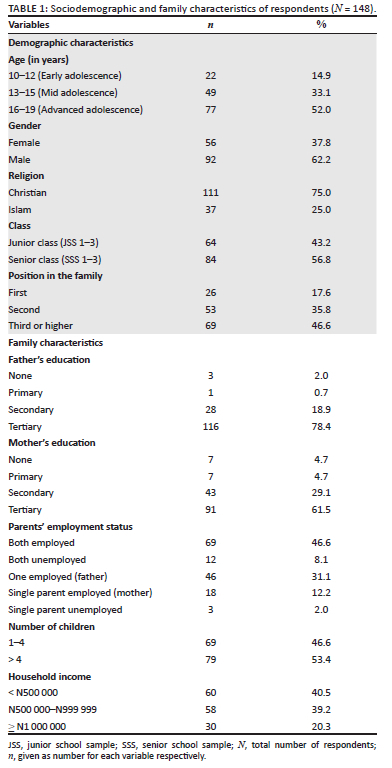
The mean age of respondents was 14.43 years (standard deviation [s.d.] = 1.95). More than half (52.0%; n = 77) were between the ages of 16 and 19, predominantly male (62.2%; n = 92) and of Christian religion (75.0%; n = 111). The majority (56.8%; n = 84) were in the senior classes and the rest were in the junior classes. Considering adolescents' family characteristics, most had a father and/or a mother with tertiary education at 78.4% (n = 116) and 61.5% (n = 91), respectively. Parental employment status varied with less than half (46.6%; n = 69) of adolescents reporting that both parents were employed. The majority of households (53.4%) comprised of more than four children; the highest proportion of participants (82.4%) were in the second, third or higher birth order in the family, implying that most of them had at least one older sibling (Table 1). More than half (n = 58; 59.5%) of the respondents reported their income as N500 000 and above. The rest (n = 60; 40.5%) reported their income as less than N500 000 per month. However, more than half of the families (n = 79; 53.4%) had large family sizes, with more than four children in the family while the rest had fewer than four children.
Mental health knowledge and attitude
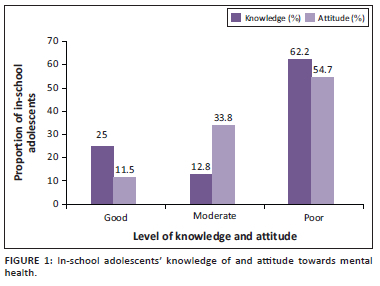
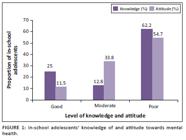
Most in-school adolescents reported poor knowledge and attitude towards mental health and mental health conditions (62.2%; n = 92 and 54.7%; n = 81, respectively). A quarter (25%; n = 37) were rated as having good knowledge of mental health, and a lower percentage (11.5%) were rated as displaying a good attitude towards mental health and mental health conditions (Figure 1).
Adolescents' mental health status
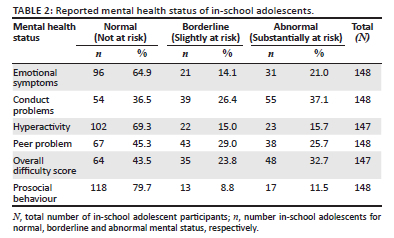
In respect of mental health difficulties informed by the SDQ, most in-school adolescents considered themselves as 'normal' or not at risk for emotional symptoms (64.9%; n = 96), hyperactivity (69.4%; n = 102) and peer problems (45.3%; n = 67). More than one-third (37.2%; n = 55) of the adolescents indicated being substantially at risk of conduct problems. Overall, most in-school adolescents (43.5%) indicated that they are not at risk for difficulties associated with mental health conditions; 79.7% (n = 118) reported normal prosocial behaviour, which indicates a measure of mental health strength (Table 2). There were missing data in the case of 'hyperactivity' (n = 147), which reflected in the overall Difficulty score. There was no statistically significant association between mental health status and age (p = 0.952); class (p = 0.117); gender (p = 0.819); household income (p = 0.882); parental education (p = 0.860) and parental employment status (p = 0.663) except for adolescent position in the family, shown to be significant at p = 0.040.
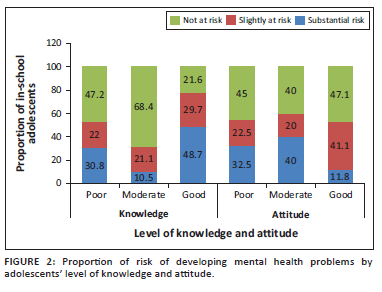
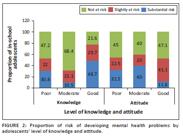
In determining the risk for mental health problems in relation to mental health knowledge, 48.6% (n = 72) of adolescents with good knowledge of mental health had a substantial risk of mental health problems. Approximately two-thirds (68.4%) with moderate knowledge of mental health reported not to be at risk of mental conditions; 47.1% of adolescents with good attitude towards mental health reported not to be at risk of mental health problems (Figure 2). There was a statistically significant association between mental health status and adolescents' knowledge (p = 0.005) but not between mental health status and attitude towards mental health (p = 0.187).
Predictors of mental health problems among in-school adolescents
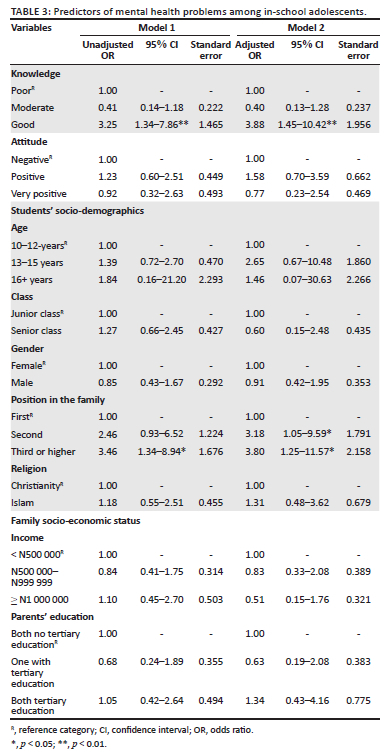
Binary logistic regression was used to determine the association between adolescents' knowledge of and attitude towards mental health, and the possibility of a clinically significant mental health problem. The unadjusted odds ratio (OR) in Model 1 shows that adolescents who reportedly have good knowledge levels have three-fold higher odds of being at risk of a clinically significant mental health problem (OR = 3.25; 95% confidence interval [CI] = 1.34-7.86) compared to their counterparts who had poor knowledge (reference group). Adolescents who were moderately knowledgeable were not significantly different from the reference group. The associations remain consistently significant when adjusting for other factors, including the adolescents' involvement in physical activity, socio-demographics and family characteristics in Model 2 as shown in Table 3. Adolescents in the third or higher birth order (OR = 3.46; 95% CI = 1.34-8.94) had a more than three-fold higher odds of being at risk of clinically significant mental health problems than those who were the firstborn in the family. This association was consistent after adjusting for other factors in Model 2.
Discussion
The mean age of in-school adolescents in this study was 14.43 years (middle adolescence), which falls within the predicted group at risk for developing mental health problems. Gleaning from prior studies, half of the mental health problems reported in the literature emerge during adolescent development with three-quarters emerging before 25 years of age and half before 14 years.17,23,242521
There are varying results from studies across regions regarding the effect of socioeconomic status on adolescents' mental health. Some of these include parental educational level, parental employment status and family income. In addition, mental health inequities among adolescents because of their socioeconomic status, education and income reportedly affect their mental health negatively.25,262626
Findings from this study suggest that adolescents who were third-born or later in their family were more likely to be at risk of significant mental health conditions compared to firstborns. Birth order is a variable that researchers rarely investigate; however, it is a significant variable during adolescent development. The impact of birth order on mental health is intertwined with biological conditions in utero, and social and environmental factors.272727282930
Most in-school adolescents in our study reported poor knowledge of and attitude towards mental health. This is similar to the results of an Omani study on adolescents' knowledge and attitude towards mental health in which 60% and 80% of students reported poor knowledge and attitude, respectively.313233,3434,3535,36,3735373638
Substantial risk of mental health problems was found among adolescents who reported good knowledge and attitude towards mental health. Although there are some limitations with self-report data, it is generally understood that having good knowledge of mental health does not automatically translate into effective coping skills and other ways of lowering risk. On the other hand, being knowledgeable about their mental health means that adolescents may be more likely to seek help on time compared to those without good knowledge and attitude. On the other hand, high expectations and pressure from the society, parents and self to be able to adapt and deal with stressful situations may lead to internalised stress and a greater risk for mental health conditions. There is limited research to support or refute our results. To appreciate the risk of mental health conditions, Renwick et al.394041,42,4341
The mental health status of adolescents was determined by their reported difficulties and strengths according to five subscales in the SDQ.1444,45,464534,4434,44,45,4614,47
Strengths and limitations
This study involved in-school adolescents in two government-owned secondary schools from only one senatorial district in Lagos State. While this was beneficial for a better understanding of the associations between the variables, more schools should be involved - government-owned and private schools, to increase the generalisability of the study. Although participants were encouraged to answer the questions with sincerity, self-reports run the risk of bias because participants may provide responses that they believe are socially acceptable or correct according to the researcher's expectations. Including teachers and parents to provide their versions may assist in substantiating adolescent reports or accounts.
Recommendations
The school environment has consistently shown to be an appropriate space for mental health screening, monitoring, education and support of children and adolescents in different classes or education levels. Equipping adolescents with mental health knowledge and help-seeking skills is not enough unless it harnesses a professional approach and a wellness focus when providing education and services. It is recommended that the services of school nurses and/or primary care nurses be formalised in education settings for targeted mental health promotion strategies. The emphasis is on maintaining positive mental well-being and developing competencies that foster positive help-seeking behaviours. School nurses are best positioned to identify adolescents at risk through screening and monitoring, and for early interventions. Collaboration with teachers, parents and other health professionals to create a supportive network to address mental health holistically, is further recommended.
This study was conducted among in-school adolescents in South-Western Nigeria - similar studies from other regions in the country are recommended. This is necessary to leverage diverse perspectives because of each region's unique cultural, social and economic contexts. Also, this will help researchers to develop targeted interventions by understanding specific challenges faced by in-school adolescents in different regions. Further research by way of longitudinal and cohort studies should examine the impact and outcomes of interventions to strengthen adolescent mental health. This should include evaluation and comparative studies of mental health education programmes that have been mainstreamed in the school curriculum or provided as standalone mental health courses.
Conclusion
A significant gap in mental health knowledge and attitude among in-school adolescents was identified, which calls for an urgent need for health and educational interventions that focus on mental well-being as opposed to mental illness. Adolescents with high knowledge of mental health are predicted to be at higher risk of having a clinically significant mental health problem. This counterintuitive finding further accentuates the need for comprehensive approaches to equip adolescents with a range of life skills for mental well-being. While mental health education is crucial, the association between higher birth order and adolescents at risk highlights the role of family dynamics in optimising mental health among adolescents - here, the role of parents, guardians and family cannot be overemphasised.
Competing interests
The authors declare that they have no financial or personal relationships that may have inappropriately influenced them in writing this article.
Authors' contributions
A.O.O., A.M.T. and J.C.B. conceptualised the study and prepared the original draft. A.O.O. contributed to the statistical analysis, and J.C.B. was involved in the writing, review and editing of the article. All authors, A.O.O., A.M.T. and J.C.B. have read and agreed to the published version of the manuscript.
Funding information
This research received no specific grant from any funding agency in the public, commercial or not-for-profit sectors.
Data availability
Anonymised study data are available upon motivated and reasonable request to the corresponding author, A.M.T.
Disclaimer
The views and opinions expressed in this article are those of the authors and are the product of professional research. The article does not necessarily reflect the official policy or position of any affiliated institution, funder, agency or that of the publisher. The authors are responsible for this article's results, findings and content.
Acknowledgements
References
-
1. Anderson K, Priebe S. Concepts of resilience in adolescent mental health research. J Adolesc Health. 2021;69(5):689-695. https://doi.org/10.1016/j.jadohealth.2021.03.035
» https://doi.org/10.1016/j.jadohealth.2021.03.035 -
2. Inchley J, Cunningham E, McMellon C, Maclachlan A. New mental health research goals are an important step forward for child and adolescent mental health. J Ment Health. 2021;32(6):1014-1015. https://doi.org/10.1080/09638237.2021.1898560
» https://doi.org/10.1080/09638237.2021.1898560 -
3. Long E, Zucca C, Sweeting H. School climate, peer relationships, and adolescent mental health: A social ecological perspective. Youth Soc. 2021;53(8):1400-1415. https://doi.org/10.1177/0044118X20970232
» https://doi.org/10.1177/0044118X20970232 -
4. Solmi M, Radua J, Olivola M, et al. Age at onset of mental disorders worldwide: Large-scale meta-analysis of 192 epidemiological studies. Mol Psychiatry. 2022;27(1):281-295. https://doi.org/10.1038/s41380-021-01161-7
» https://doi.org/10.1038/s41380-021-01161-7 -
5. Chaulagain A, Kunwar A, Watts S, Guerrero APS, Skokauskas N. Child and adolescent mental health problems in Nepal: A scoping review. Int J Ment Health Syst. 2019;13(1):1-8. https://doi.org/10.1186/s13033-019-0310-y
» https://doi.org/10.1186/s13033-019-0310-y -
6. Dray J, Bowman J, Campbell E, et al. Effectiveness of a pragmatic school-based universal intervention targeting student resilience protective factors in reducing mental health problems in adolescents. J Adolesc. 2017;57(1):74-89. https://doi.org/10.1016/j.adolescence.2017.03.009
» https://doi.org/10.1016/j.adolescence.2017.03.009 -
7. World Health Organization. Adolescent mental health [homepage on the Internet]. Geneva; 2019 [cited 2024 Jun 18]. Available from: https://www.who.int/news-room/fact-sheets/detail/adolescent-mental-health
» https://www.who.int/news-room/fact-sheets/detail/adolescent-mental-health -
8. Schor EL. Developing a structure of essential services for a child and adolescent mental health system. Milbank Q. 2021;99(1):62-90. https://doi.org/10.1111/1468-0009.12490
» https://doi.org/10.1111/1468-0009.12490 -
9. Buchweitz C, Caye A, Kieling C. On our minds: The state of child and adolescent mental health. Brazilian J Psychiatry. 2022;44(3):2021-2022. https://doi.org/10.1590/1516-4446-2021-2344
» https://doi.org/10.1590/1516-4446-2021-2344 -
10. Anjum S, Ullah R, Rana MS, et al. COVID-19 pandemic: A serious threat for public mental health globally. Psychiatria Danubina. 2020;32(2):245-250. https://doi.org/10.24869/PSYD.2020.245
» https://doi.org/10.24869/PSYD.2020.245 -
11. Jörns-Presentati A, Napp AK, Dessauvagie AS, et al. A systematic review of youth and teen mental health first aid: Improving adolescent mental health. PLoS One. 2021;16(5):e0251689. https://doi.org/10.1371/journal.pone.0251689
» https://doi.org/10.1371/journal.pone.0251689 -
12. Aluh DO, Anyachebelu OC, Anosike C, Anizoba EL. Mental health literacy: What do Nigerian adolescents know about depression? Int J Ment Health Syst. 2018;12:8. https://doi.org/10.1186/s13033-018-0186-2
» https://doi.org/10.1186/s13033-018-0186-2 -
13. Goodwin J, Savage E, O'Donovan A. "I Personally Wouldn't Know Where to Go": Adolescents' perceptions of mental health services. J Adolesc Res. 2022;39(5):1384-1412. https://doi.org/10.1177/07435584221076056
» https://doi.org/10.1177/07435584221076056 -
14. Hoosen N, Davids EL, De Vries PJ, Shung-King M. The Strengths and Difficulties Questionnaire (SDQ) in Africa: A scoping review of its application and validation. Child Adolesc Psychiatry Ment Health. 2018;12(1):2-39. https://doi.org/10.1186/s13034-017-0212-1
» https://doi.org/10.1186/s13034-017-0212-1 -
15. Radez J, Reardon T, Creswell C, Lawrence PJ, Evdoka-Burton G, Waite P. Why do children and adolescents (not) seek and access professional help for their mental health problems? A systematic review of quantitative and qualitative studies. Eur Child Adolesc Psychiatry. 2021;30:183-211. https://doi.org/10.1007/s00787-019-01469-4
» https://doi.org/10.1007/s00787-019-01469-4 -
16. Kutcher S, Wei Y, Coniglio C. Mental health literacy: Past, present, and future. Can J Psychiatry. 2016;61(3):154-158. https://doi.org/10.1177/0706743715616609
» https://doi.org/10.1177/0706743715616609 -
17. Nobre J, Oliveira AP, Monteiro F, Sequeira C, Ferré-Grau C. Promotion of mental health literacy in adolescents: A scoping review. Int J Environ Res Public Health. 2021;18(18):9500. https://doi.org/10.3390/ijerph18189500
» https://doi.org/10.3390/ijerph18189500 -
18. World Health Organization. Mental health. WHO Factsheet. 2022. [cited 2024 Jun 18]. Available from: https://www.who.int/news-room/fact-sheets/detail/mental-health-strengthening-our-response
» https://www.who.int/news-room/fact-sheets/detail/mental-health-strengthening-our-response -
19. Charan J, Biswas T. How to calculate sample size for different study designs in medical research? Indian J Psychol Med. 2013;35(2):121-126. https://doi.org/10.4103/0253-7176.116232
» https://doi.org/10.4103/0253-7176.116232 -
20. Atilola O, Ola B, Abiri G, et al. Status of mental-health services for adolescents with psychiatric morbidity in youth correctional institutions in Lagos. J Child Adolesc Ment Health. 2017;29(1):63-83. https://doi.org/10.2989/17280583.2017.1321550
» https://doi.org/10.2989/17280583.2017.1321550 -
21. Balegha AN, Yidana A, Abiiro GA. Knowledge, attitude and practice of hepatitis B infection prevention among nursing students in the Upper West Region of Ghana: A cross-sectional study. PLoS One. 2021;16(10):e0258757. https://doi.org/10.1371/journal.pone.0258757
» https://doi.org/10.1371/journal.pone.0258757 -
22. Kutcher S, Wei Y. Mental health and high school curriculum guide understanding mental health and mental illness version 3. 2017 [cited 2024 Jun 18]. Available from: https://mentalhealthliteracy.org/schoolmhl/wp-content/uploads/2015/09/Mental-Health-High-School-Curriculum-Guide.pdf
» https://mentalhealthliteracy.org/schoolmhl/wp-content/uploads/2015/09/Mental-Health-High-School-Curriculum-Guide.pdf -
23. Hendrickx G, De Roeck V, Maras A, et al. Challenges during the transition from child and adolescent mental health services to adult mental health services. BJPsych Bull. 2020;44(4):163-168. https://doi.org/10.1192/bjb.2019.85
» https://doi.org/10.1192/bjb.2019.85 -
24. Ng SH, Tan NJH, Luo Y, Goh WS, Ho R, Ho CSH. A systematic review of youth and teen mental health first aid: Improving adolescent mental health. J Adolesc Health. 2021;69(2):199-210. https://doi.org/10.1016/j.jadohealth.2020.10.018
» https://doi.org/10.1016/j.jadohealth.2020.10.018 -
25. Richter LM, Ahun MN, Besharati S, Naicker SN, Orri M. Adolescent mental health problems and adult human capital: Findings from the South African birth to twenty plus cohort at 28 years of age. J Adolesc Health. 2021;69:782-789. https://doi.org/10.1016/j.jadohealth.2021.04.017
» https://doi.org/10.1016/j.jadohealth.2021.04.017 -
26. Weinberg D, Stevens GWJM, Duinhof EL, Finkenauer C. Adolescent socioeconomic status and mental health inequalities in the Netherlands, 2001-2017. Int J Environ Res Public Health. 2019;16(19):6-8. https://doi.org/10.3390/ijerph16193605
» https://doi.org/10.3390/ijerph16193605 -
27. Stannard S, Berrington A, Alwan N. Associations between birth order with mental wellbeing and psychological distress in midlife: Findings from the 1970 British Cohort Study (BCS70). PLoS One. 2019;14(9):e0222184. https://doi.org/10.1371/journal.pone.0222184
» https://doi.org/10.1371/journal.pone.0222184 -
28. Easey KE, Mars B, Pearson R, Heron J, Gunnell D. Association of birth order with adolescent mental health and suicide attempts: A population-based longitudinal study. Eur Child Adolesc Psychiatry. 2019;28:1079-1086. https://doi.org/10.1007/s00787-018-1266-1
» https://doi.org/10.1007/s00787-018-1266-1 -
29. Fukuya Y, Fujiwara T, Isumi A, Doi S, Ochi M. Association of birth order with mental health problems, self-esteem, resilience, and happiness among children: Results from A-CHILD Study. Front Psychiatry. 2021;12:638088. https://doi.org/10.3389/fpsyt.2021.638088
» https://doi.org/10.3389/fpsyt.2021.638088 -
30. Cost KT, Mudiyanselage P, Unternaehrer E, et al. The role of parenting practices in parent and child mental health over time. BJ Psych Open. 2023;9:e147, 1-11. https://doi.org/10.1192/bjo.2023.529
» https://doi.org/10.1192/bjo.2023.529 -
31. Al Omari O, Wynaden D, Alkhawaldeh A, et al. Knowledge and attitudes of young people toward mental illness: A cross sectional study. Comprehen Child Adolesc Nurs. 2020;43(4):301-313. https://doi.org/10.1080/24694193.2019.1670752
» https://doi.org/10.1080/24694193.2019.1670752 -
32. Honnappa VY, Omkarappa DB. Knowledge and attitude towards mental illness among adolescents in selected schools of Tumakuru. Rajiv Gandhi University of Health Sciences. J Nurs Sci. 2021;11(3):113-117. https://doi.org/10.26463/rjns.11_3_6
» https://doi.org/10.26463/rjns.11_3_6 -
33. Mori R, Uchino T, Mizuno M, Yamaguchi T, Katagiri N, Nemoto T. Effectiveness of a comprehensive mental health literacy educational programme for junior high school students: A randomised controlled trial examining changes in their knowledge, attitudes, and behaviour. J Pers Med. 2022;12(8):1281. https://doi.org/10.3390/jpm12081281
» https://doi.org/10.3390/jpm12081281 -
34. Addy ND, Agbozo F, Runge-Ranzinger S, Grys P. Mental health difficulties, coping mechanisms and support systems among school-going adolescents in Ghana: A mixed-methods study. PLoS One. 2021;16(4):e0250424. https://doi.org/10.1371/journal.pone.0250424
» https://doi.org/10.1371/journal.pone.0250424 -
35. Beukema L, Tullius JM, Korevaar L, et al. Promoting mental health help-seeking behaviors by mental health literacy interventions in secondary education? Needs and perspectives of adolescents and educational professionals. Int J Environ Res Public Health. 2022;19:11889. https://doi.org/10.3390/ijerph191911889
» https://doi.org/10.3390/ijerph191911889 -
36. Milin R, Kutcher S, Lewis SP, et al. Impact of a mental health curriculum on knowledge and stigma among high school students: A randomized controlled trial. J Am Acad Child Adolesc Psychiatry. 2016;55(5):383-391.e1. https://doi.org/10.1016/j.jaac.2016.02.018
» https://doi.org/10.1016/j.jaac.2016.02.018 -
37. Freţian AM, Kirchhoff S, Bauer U, Okan O. The effects of an adapted mental health literacy curriculum for secondary school students in Germany on mental health knowledge and help-seeking efficacy: Results of a quasi-experimental pre-post evaluation study. Front Public Health. 2023;11:1219925. https://doi.org/10.3389/fpubh.2023.1219925
» https://doi.org/10.3389/fpubh.2023.1219925 -
38. Mansfield R, Patalay P, Humphrey NA. Systematic literature review of existing conceptualisation and measurement of mental health literacy in adolescent research: Current challenges and inconsistencies. BMC Public Health. 2020;20(1):607. https://doi.org/10.1186/s12889-020-08734-1
» https://doi.org/10.1186/s12889-020-08734-1 -
39. Renwick L, Pedley R, Johnson I, et al. Mental health literacy in children and adolescents in low- and middle-income countries: A mixed studies systematic review and narrative synthesis. Eur Child Adolesc Psychiatry. 2024;33:961-985. https://doi.org/10.1007/s00787-022-01997-6
» https://doi.org/10.1007/s00787-022-01997-6 -
40. Patafio B, Miller P, Baldwin R, Taylor N, Hyder S. A systematic mapping review of interventions to improve adolescent mental health literacy, attitudes and behaviours. Early Interv Psychiatry. 2021;15(6):1470-1501. https://doi.org/10.1111/eip.13109
» https://doi.org/10.1111/eip.13109 -
41. Martínez-Casanova E, Del Mar Molero-Jurado M, Del Carmen Pérez-Fuentes M. Self-esteem and risk behaviours in adolescents: A systematic review. Behaviour Sci. 2024;14:432. https://doi.org/10.3390/bs14060432
» https://doi.org/10.3390/bs14060432 -
42. Kedia SK, Dillon PJ, Jiang Y, James W, Collins AC, Bhuyan SS. The association between substance use and violence: Results from nationally representative sample of high school students in the United States. Community Ment Health J. 2021;57:294-306. https://doi.org/10.1007/s10597-020-00648-x
» https://doi.org/10.1007/s10597-020-00648-x -
43. Quimby EG, Brogan L, Atte T, Diamond G, Fein JA. Evaluating adolescent substance use and suicide in the pediatric emergency department. Pediatr Emerg Care. 2022;38(2):595-599. https://doi.org/10.1097/PEC.0000000000002453
» https://doi.org/10.1097/PEC.0000000000002453 -
44. Keyho K, Gujar NM, Ali A. Prevalence of mental health status in adolescent school children of Kohima District, Nagaland. Ann Indian Psychiatry. 2019;3(1):39-42. https://doi.org/10.4103/aip.aip_52_18
» https://doi.org/10.4103/aip.aip_52_18 -
45. Mohangi Y, Magagula TG, Van der Westhuizen D. Adolescent psychiatric outpatients and their caregivers: Comparing the Strengths and Difficulties Questionnaire. S Afr J Psychiatry. 2020;26:a1394. https://doi.org/10.4102/sajpsychiatry.v26.i0.1394
» https://doi.org/10.4102/sajpsychiatry.v26.i0.1394 -
46. Lindhardt L, Lindholdt L, Lund T, Mortensen OS. Self-reported mental health in adolescents attending school and its association with later school dropout: A prospective 2.5-year follow-up study. Scand J Public Health. 2022;50(8):1164-1171. https://doi.org/10.1177/14034948221089112
» https://doi.org/10.1177/14034948221089112 -
47. De Vries PJ, Davids EL, Mathews C, Aarø LE. Measuring adolescent mental health around the globe: Psychometric properties of the self-report Strengths and Difficulties Questionnaire in South Africa, and comparison with UK, Australian and Chinese data. Epidemiol Psychiatr Sci. 2018;27(4):369-380. https://doi.org/10.1017/S2045796016001207
» https://doi.org/10.1017/S2045796016001207
Accepted: 03 Feb. 2025
Published: 10 Apr. 2025