Thirty-five years of family medicine training and development in Uganda
Abstract
In Uganda, family medicine training was started in 1989 to train an all-round generalist able to provide comprehensive care at a district hospital. Since then, the training programme has undergone several changes to cater for the needs of communities in a changing world. Very low numbers of applicants and poor understanding of the discipline have been a persistent challenge. Availability of non-family physician champions, family physician role models and collaborative networks are key to development of family medicine.
family medicine; family physicians; primary care; medical education; training
Introduction
Uganda is a landlocked country in East Africa with an estimated population of 46 million people.12324
In Uganda, primary care as the service delivery component of the PHC approach is provided at five levels: Health Centre I-HCI (the village health team, consisting of a team of volunteer community members), Health Centre II-HCII (the community dispensary serving a ward or parish), Health Centre III-HCIII (serving a sub-county), Health Centre IV-HCIV (serving a county) and the district (community) hospital acting as a primary care referral centre.45
The different levels of health care provide different packages of primary care services. However, the primary care services should be accessible, comprehensive and coordinated provided with continuity and person-centredness. In Uganda, primary care quality is sub-optimal and the services lack comprehensiveness, coordination and continuity, but is strongly person-centred.6
Background
Specialised family medicine training started in 1989 with a Master of Medicine in Community Practice.7
In 2005, the programme's name was changed from Community Practice to Family Medicine to align with similar programmes in other parts of the world. This name change was greatly informed by Ugandan family physicians' interactions with their international colleagues. Family physicians in Uganda through their national professional association have been part of global and regional bodies, associations and networks including the World Organization of Family Doctors (WONCA) and the Primary Care and Family Medicine (Primafamed) network, among others. This greatly assisted the development of the discipline through collaborative learning and sharing experiences.
Family physicians are recognised as specialists with clearly designated employment positions in the public sector and are paid at the same level as other specialists.89
Training
Family medicine training started as a postgraduate programme. Currently, there are two family medicine training programmes in Uganda: at Makerere University and Mbarara University of Science and Technology. These institutions graduate an average of five family physicians per year. A third programme was started in the private sector at the Clarke International University (CIU) in the early 2010s as a part-time programme targeting practising doctors with no postgraduate qualification as potential trainees. Its approach was mainly work-place based learning and assessment using the trainee's workplace. Unfortunately, the programme closed after graduating two cohorts of students.
The curricula for the training programmes have undergone multiple revisions to cater for new developments and updates in family medicine and primary care. These regular reviews ensure that the graduates are fit for purpose to address health system challenges in a changing world. The revisions have re-oriented the curriculum towards community-oriented primary care with the graduates able to integrate clinical care with public health in order to meet the diverse health needs of the populations and communities across the life course. In the early years of the programme, most of the teaching was conducted by other specialists because of the scarcity of family physicians. This has slowly changed with an increase in the number of family physicians choosing their careers in academic medicine. Most of the training is now conducted by family physicians within the district, which helps the trainees to acquire the principles and values of family medicine. The final assessment for knowledge and skills competence to provide primary care is done by individual universities. After university graduation, specialist licensure is done by the Uganda Medical and Dental Practitioners' Council, the regulatory body of medical and dental practice, on presentation of academic documents with no further assessment.
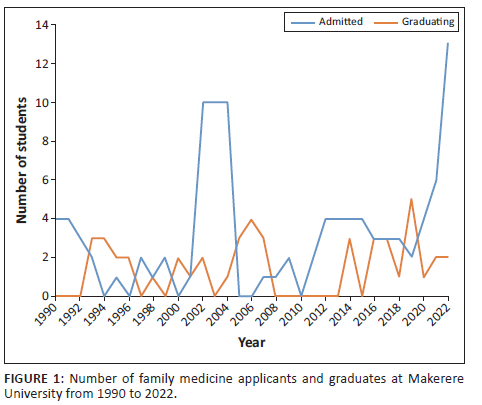
Recruitment of trainees has been the main challenge. Very few doctors choose careers in family medicine and primary care. This is probably because of poor awareness and understanding of the discipline as well as the health system's focus on hospital and specialist care. Figure 1 shows the number of applicants and graduates at Makerere University from 1990 to 2022. The average annual intake has been five trainees and a graduation rate of about four per year. There is a recent sudden increase in the number of family medicine applicants. This might be a response to the recently created family physician posts at all levels of hospitals in the outpatient and community health departments of public sector hospitals. A similar increase in the number of applicants occurred between the year 2000 and 2005 when the Uganda MOH, in an attempt to increase the number of family physicians, committed to fund all admitted trainees for that particular period.
Several medical schools in Uganda have introduced family medicine in the undergraduate curriculum. This was done to address the lack of primary care competences among graduates.10
Lessons learnt
Advocacy for family medicine is a continuous activity mainly spearheaded by committed champions who may be family physicians or non-family physicians. Alliances with supportive non-family physician specialists are helpful.
Continuous review and revision of curricula to match the current updates and advances in family medicine and primary care is necessary. This will ensure that the training addresses the needs of society in a changing world.
Family physicians can motivate doctors to choose family medicine as a career path by being excellent role models in clinical practice. Most applicants for the family medicine training come from districts and/or facilities where family physicians are working.
The existing training programmes can help initiate programmes at other medical schools by sharing curricula, teaching materials and other relevant activities such as faculty development. The department of family medicine at Makerere University has supported three medical schools to start and implement undergraduate family medicine. The department is also helping the CIU to restart postgraduate family medicine training which had started and closed.
Networking with international organisations and regional networks provides a platform for collaboration and co-learning in the process of developing family medicine programmes. Such organisations and networks provide opportunities for educational and research capacity development relevant for faculty development. They also provide collaborative opportunities in research, student exchange and external examiners.
Competing interests
The authors declare that there are no financial or personal interests which may have inappropriately influenced them to write this article.
The author, I.K.B., serves as an editorial board member of this journal. I.K.B. has no other competing interests to declare.
Authors' contributions
I.K.B. and B.T. wrote the draft article. All the authors, I.K.B., B.T., M.M. and F.N., reviewed, revised and approved the final article.
Ethical considerations
This article followed all ethical standards for research without direct contact with human or animal subjects.
Funding information
This work did not receive any funding from any agency in the public, commercial or not-for-profit sectors.
Data availability
Data sharing is not applicable to this article as no new data were created or analysed in this study.
Disclaimer
The views and opinions expressed in this article are those of the authors and are the product of professional research. The article does not necessarily reflect the official policy or position of any affiliated institution, funder, agency or that of the publisher. The authors are responsible for this article's results, findings and content.
Acknowledgements
The authors are grateful to all those who contributed to the establishment of family medicine in Uganda and those who continue to support its development.
References
-
1.Uganda Bureau of Statistics. National Population and Housing Census 2024 [hompeage on the Internet]. Kampala: UBOS; 2024 [cited 2024 Oct 15]. Available from: https://www.ubos.org/wp-content/uploads/2024/07/Censu-2024-PRELIMINARY-report.pdf
» https://www.ubos.org/wp-content/uploads/2024/07/Censu-2024-PRELIMINARY-report.pdf -
2.Ministry of Health. The second national health policy [hompeage on the Internet]. Kampala: MOH; 2010 [cited 2024 Oct 15]. Available from: https://library.health.go.ug/sites/default/files/resources/Second%20National%20Health%20Policy%202010.pdf
» https://library.health.go.ug/sites/default/files/resources/Second%20National%20Health%20Policy%202010.pdf - 3.Turyamureba M, Yawe B, Oryema JB. Health care delivery system in Uganda: A review. Tanzan J Health Res. 2023;24(2):57-64.
-
4.Ministry of Health. Ministry of health strategic plan 2020/21-2024/25 [hompeage on the Internet]. Kampala: MOH; 2024. Available from: https://www.health.go.ug/wp-content/uploads/2022/02/MoH-Strategic-Plan-2020_25.pdf
» https://www.health.go.ug/wp-content/uploads/2022/02/MoH-Strategic-Plan-2020_25.pdf -
5.Mbonye MK, Burnett SM, Colebunders R, et al. Disease diagnosis in primary care in Uganda. BMC Fam Pract. 2014;15:1-13. https://doi.org/10.1186/1471-2296-15-165
» https://doi.org/10.1186/1471-2296-15-165 -
6.Besigye IK, Mash RJ. Primary care performance in a Ugandan rural district: Cross-sectional descriptive study. BJGP Open. 2024. https://doi.org/10.3399/BJGPO.2024.0105
» https://doi.org/10.3399/BJGPO.2024.0105 - 7.Ross JM. General practice training in Uganda. Part 1: Setting, personnel, and facilities. Can Fam Physician. 1996;42:213-216.
-
8.Besigye IK, Namatovu JF. Scaling up family medicine in Uganda. Afr J Prim Health Care Fam Med. 2014;6(1):1-3. https://doi.org/10.4102/phcfm.v6i1.664
» https://doi.org/10.4102/phcfm.v6i1.664 -
9.Besigye IK, Onyango J, Ndoboli F, Hunt V, Haq C, Namatovu J. Roles and challenges of family physicians in Uganda: A qualitative study. Afr J Prim Health Care Fam Med. 2019;11(1):1-9. https://doi.org/10.4102/phcfm.v11i1.2009
» https://doi.org/10.4102/phcfm.v11i1.2009 -
10.Kiguli S, Baingana R, Paina L, et al. Situational analysis of teaching and learning of medicine and nursing students at Makerere University College of Health Sciences. BMC Int Health Hum Rights. 2011;11:1-9. https://doi.org/10.1186/1472-698X-11-S1-S3
» https://doi.org/10.1186/1472-698X-11-S1-S3

Accepted: 13 Mar. 2025
Published: 22 May 2025