Retention of clients in HIV oral pre-exposure prophylaxis care in Engela, Namibia
Abstract
BACKGROUND: Namibia has made tremendous progress in controlling the HIV epidemic. The progress has resulted in significant incidence and AIDS-related mortality reductions. However, new infections continue to persist. AIM: The study aimed to measure the clients' retention rate in pre-exposure prophylaxis (PrEP) care and associated factors. SETTING: Engela District, in Namibia's Ohangwena region. METHODS: We chose an analytical cross-sectional study design for this study. We selected 275 participants using a proportional stratified random sampling method. We used a self-administered questionnaire to collect data. We employed Chi-square tests and logistic regression for data analysis. RESULTS: Participants' retention rate in PrEP care at 3 months was 35.6%, 95% CI (35.2% - 36.0%). Binomial logistic regression showed that men and the unemployed were less likely to be retained in PrEP, crude odds ratio (OR) = 0.52, 95% CI (0.30-0.91), and OR = 0.27, 95% CI (0.15-0.49), respectively. Participants who were divorced or in a relationship were also less likely to be retained in PrEP care, OR = 0.41, 95% CI (0.18-0.96), and OR = 0.43 95% CI (0.23 - 0.80), respectively. Furthermore, participants at Engela District Hospital were less likely to be retained in PrEP care, OR = 0.52, 95% CI (0.29 -0.93). CONCLUSION: Addressing the specific challenges unemployed individuals face in continuing on PrEP is crucial. Strategies should include decentralising PrEP services in the district and employing community-based models. CONTRIBUTION: In addition, comprehensive PrEP education targeting men should be provided in diverse settings to improve their PrEP knowledge.
pre-exposure prophylaxis; retention; factors; Engela District; Namibia
Introduction
In 2021, approximately 38 million individuals were living with HIV globally.11122223,455
Antiretroviral drugs (ARVs) used by HIV-negative people who are at substantial risk of HIV infection are known as PrEP.6,768891011
The Centres for Disease Control and Prevention (CDC) defines retention rate as the number of PrEP users who continue the medication for three consecutive months after initiating it.12131415,16,171818
Retention in PrEP care has been reported to decrease with time. A study in Cameroon revealed a retention rate of 37% at 3 months and 28% at 6 months.192020,21,22
Despite the growing adoption of PrEP in clinical practice, there remains a scarcity of data regarding retention in care among individuals using PrEP in most districts in Namibia. Understanding the variables that affect care retention in regions with the highest HIV prevalence in Namibia, such as the Ohangwena region, where Engela district is situated, is essential for successful PrEP implementation.23
Research methods and design
Study area and study period
We conducted this study in the Engela District of Namibia. Engela district is one of the districts in the Ohangwena region of Namibia. It has a population of about 25 000 people. Ten public healthcare facilities serve the population. We conducted the study at three public healthcare facilities in Engela district: Engela District Hospital, Odibo Health Centre and Hamukoto Wakapa Clinic. We based the selection of facilities on the high cumulative number of clients (> 50 clients) initiated on PrEP before January 2019 with clear documentation records of the clients. Odibo Health Centre had 180 clients, Engela District Hospital had 160 and Hamukoto Wakapa Clinic had 60 clients initiated on PrEP between January and December of 2019. We collected the data in September 2022.
Study design
We chose a quantitative analytical cross-sectional study design for this study because the design allowed for assessing associations between PrEP care retention and the participants' sociodemographic characteristics.
Study population
The study population comprised all clients initiated on PrEP in Engela district at selected healthcare facilities, namely, Engela District Hospital, Odibo Health Centre and Hamukoto Wakapa Clinic between January and December of 2019.
Sample size
Yamane's formula for sample size calculation  was used to determine the sample size. In this formula, n is the anticipated sample size, N is the population size and alpha is the significance level. In this current study, N = 400 and alpha is 0.05. Therefore, from the calculation, n = 250. However, after factoring in a 10% contingency for non-responders, the sample size was 275.
Inclusion criteria
Eligible participants included in this study were clients above 18 years of age who were initiated on PrEP at the selected healthcare facilities between January and December of 2019 and were reachable through telephones or cell phones.
Exclusion criteria
We excluded clients on PrEP below the age of 18 years and without contact details in the registers from the study. The exclusion of participants without contact details was necessary as the participants had to be contacted by the researchers to receive information about the study, and those willing to participate had to be provided with appointment dates at the clinics to complete the questionnaire.
Sampling method
We used a proportional stratified random sampling method to select participants for the study. After stratifying the target population by the healthcare facility, we implemented simple random sampling for each stratum using Microsoft Excel. The names of all the 180 clients initiated on PrEP at Odibo Health Centre, 160 at Engela District Hospital and 60 at Hamukoto Wakapa Clinic who met the inclusion criteria were entered into Microsoft Excel separately, and we created a random number for each name. We determined the number of participants selected from each facility by multiplying the sample size by the proportion each facility contributed to the total number of clients initiated on oral PrEP between January and December of 2019. We arranged the random numbers from smallest to biggest, and we chose the first 124 patients initiated on PrEP at Odibo Health Centre, 110 at Engela District Hospital, and 41 at Hamukoto Wakapa Clinic on the list as potential respondents. We chose 275 participants to ensure that the total of 250 participants we required for the study would be met after accommodating those who refused to participate.
Data collection
In this study, we used a self-administered questionnaire with closed-ended questions. After consulting the literature on retention in PrEP care, the researchers designed the questionnaire. It was available in both English and Oshikwanyama, a local language spoken by the majority of the people in the Engela District. An Oshikwanyama language expert conducted forward and backward translation of the questionnaire to ensure the accuracy of the Oshikwanyama version. The questionnaire consisted of different sections, and the sections had questions on the sociodemographic profile of the participants and retention in PrEP care 3 months after initiation. We contacted clients randomly selected from the sampling frame and provided them with information about the study's purpose and their rights during the study. We then offered appointment dates and times for questionnaire completion at the clinics to those willing to participate in the study. We distributed the questionnaire to 250 participants at the selected three healthcare facilities in Engela District.
Reliability
We determined the reliability of the questionnaire in this study by administering it to the same 25 participants on two different occasions a month apart and then comparing the first and second responses. The selected participants did not take part in the main study. Pearson's correlation coefficient for the two sets of responses was 0.83. We deemed the questionnaire reliable as a reliable questionnaire should have a coefficient between 0.80 and 0.90.
Validity
In this study, we used a judgemental approach to determine the validity of the questionnaire's content. We performed a literature review of retention in PrEP care and consulting experts. The researchers identified the essential aspects of PrEP retention research from the literature review. The consulted experts confirmed the validity of the content of the questionnaire.
Outcome variable
The outcome variable for this study was retention in PrEP care. We defined retention in PrEP care as continuing on oral PrEP for 3 consecutive months after initiation.12
Explanatory variables
There were six explanatory variables in the study. The explanatory variables were age, sex, relationship status, education, healthcare facility and employment status. We categorised age responses into five groups: 18-25, 26-35, 36-45, 46-55 and >55 years; sex into male and female; relationship status into single, divorced, widowed and in a relationship; education into no formal education, primary education, secondary education and tertiary education; healthcare facility into Odibo Health Centre, Engela District Hospital and Hamukoto Wakapa Clinic and employment status into employed and not employed.
Data analysis
The researchers coded the responses before entering the data into IBM SPSS Statistics version 28 for data analysis. Nominal data in the questionnaire included sex, relationship status and employment status, while ordinal data included age groups and level of education. We used descriptive statistics such as percentages and frequencies to analyse nominal and ordinal variables. For clarity, we expressed the frequency of each response as a percentage. We performed Chi-square tests to determine if there were associations between retention in PrEP care and the sociodemographic characteristics of the participants. We performed logistic regression analyses to assess the extent of these associations. The literature review findings informed the reference groups chosen for the logistic regression analyses. We used a 95% level of confidence and Chi-square p-values to determine the statistical significance of the findings.
Ethical considerations
Ethical clearance to conduct this study was obtained from the University of Namibia Research Ethics Committee (REC) (No. DEC OSH 0009) and the Ministry of Health and Social Services (MoHSS) (No. 22/4/2/3). The researcher explained to all potential participants that participation was voluntary and that those who chose not to participate in the study would not be penalised. The researcher also presented the study details to all the study participants. Those who agreed to participate in the study were requested to sign an informed consent form. The researcher protected the privacy and confidentiality of all participants by making the questionnaires anonymous. After the data analysis, we kept the data on a password-protected computer. The completed questionnaires were kept in locked steel cabinets that only the researchers could access. The data were to be kept for 5 years, after which they would permanently delete it from the computer and the hardcopy questionnaires will be destroyed through shredding.
Results
Characteristics of participants
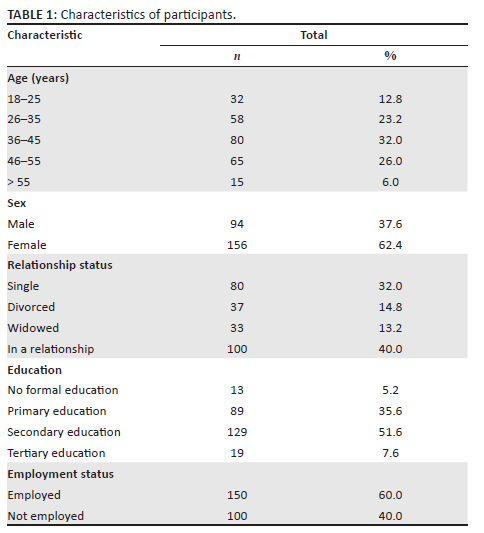
Among the 275 potential participants, only 250 participated in the study (Response rate = 90.9%). Most participants (n = 156; 62.4%) were women, while 94 (37.6%) were men. Most participants (n = 129; 51.6%) had secondary education and were employed (n = 150; 60%). More details are presented in Table 1.
Retention in pre-exposure prophylaxis care
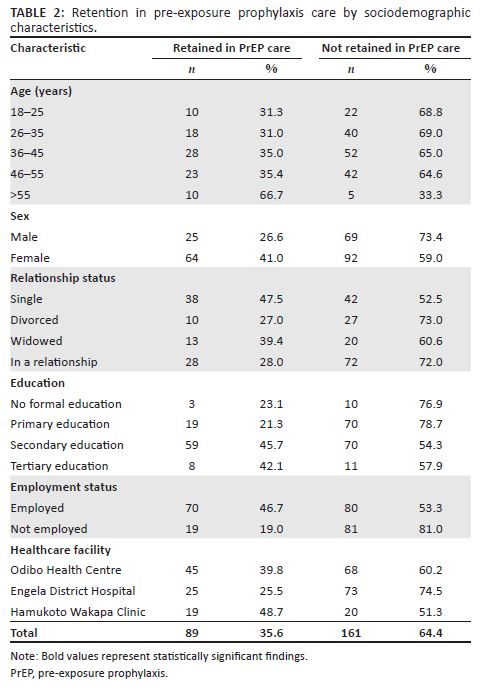
Among the 250 participants, the majority (n = 161; 64.4%; 95% CI: 64.0% - 64.8%) were not retained in PrEP care, while a few (n = 89; 35.6%; 95% CI: 35.2% - 36.0%) were retained in PrEP care. Participants above the age of 55 years had the highest PrEP retention in care rate (66.7%), while those aged 26-35 had the lowest (31.0%). Women had a higher PrEP retention in care rate than men (41.0% vs. 26.6%). Single participants had the highest retention in care rate (47.5%), while the divorced had the lowest (27.0%). Participants with secondary education had the highest retention in care rate (45.7%), while those with primary education had the lowest (21.3%). Employed participants had a higher retention in care rate (46.7%) than the unemployed (19.0%). Participants at Hamukoto Wakapa Clinic had the highest retention rate (48.7%), while those at Engela District Hospital had the lowest rate (25.5%). More details are presented in Table 2.
Characteristics associated with retention in pre-exposure prophylaxis care at 3 months after initiation
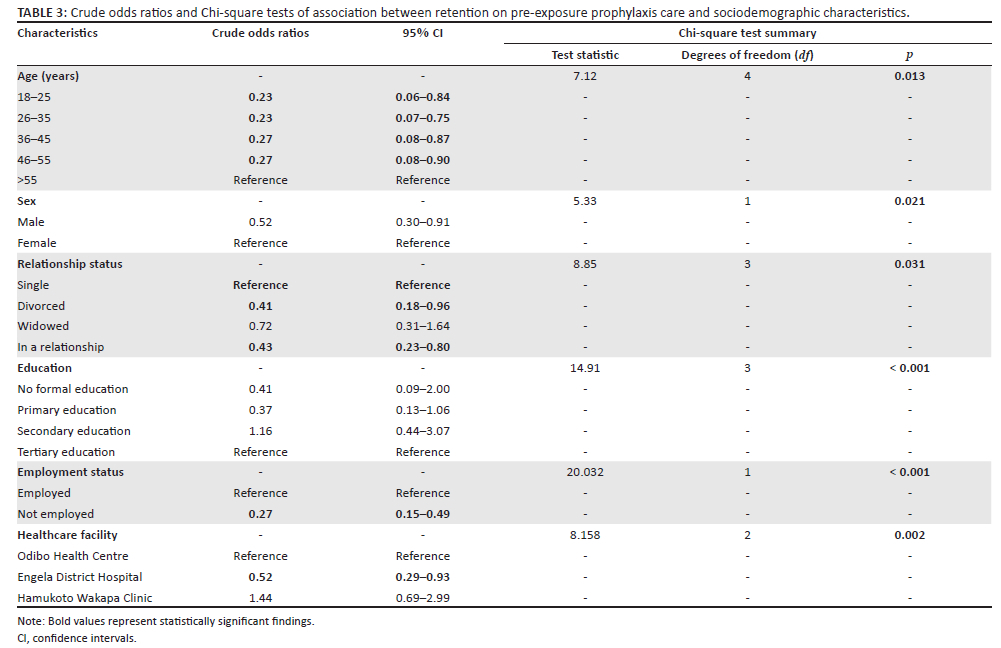
The Chi-square tests performed revealed there was a statistically significant association between participants' sex and their retention in PrEP care, χ2df = 1, n = 250) = 5.33, p = 0.021; between participants' relationship status and their retention in PrEP care, χ2df = 3, n = 250) = 8.85, p = 0.031; between participants' education and their retention in PrEP care, χ2df = 3, n = 250) = 14.91, p < 0.01; between participants' healthcare facility and their retention in PrEP care, χ2n = 250) = 8.158, p = 0.02 and between participants' employment status and their retention in PrEP care, χ2df = 1, n = 250) = 20.032, p < 0.01. Using age group > 55 years as the reference group, the odds of being retained in PrEP care were significantly less for age groups 18-25 years (crude odds ratio [OR] = 0.23, 95% CI [0.06-0.84]); 26-35 years (OR = 0.23, 95% CI [0.07-0.75]); 36-45 years (OR = 0.27, 95% CI [0.08-0.90]); and 46-55 years (OR = 0.27, 95% CI [0.08-0.87]). Using women as the reference groups, men were statistically significantly less likely to be retained in PrEP care than women, OR = 0.52, 95% CI (0.30-0.91). Using single participants as the reference group, divorced participants and participants in a relationship were statistically significantly less likely to be retained in PrEP care compared to single participants, OR = 0.41, 95% CI (0.18-0.96) and OR = 0.43 95% CI (0.23-0.80), respectively. Using employed participants as the reference groups, the unemployed participants were statistically significantly less likely to be retained in PrEP care than those employed, OR = 0.27, 95% CI (0.15-0.49). Participants at Engela District Hospital were statistically significantly less likely to be retained in PrEP care than those at Hamukoto Wakapa Clinic, OR = 0.52, 95% CI (0.29-0.93). More details are presented in Table 3.
Discussion
The findings of this study indicated that 35.6% of the participants were retained in PrEP care 3 months after initiation. This retention rate was notably lower compared to the reported rate among men who have sex with men in the United States, which stood at 72%.24
The findings of this study indicated that participants younger than 55 years had a lower likelihood of remaining engaged in PrEP care 3 months after initiation compared to those aged 55 years and above. The results of this research concur with the results of an earlier study conducted in Uganda, which showed that older women were more likely to be retained in PrEP care than younger ones.25
This study indicated that men were less likely to be retained in PrEP care at 3 months than women. Men were 48% less likely to remain engaged in PrEP care than women. These results differ from those of a study conducted in the United States of America, which showed no significant difference in retention between men and women.2627
This study revealed that participants in a relationship had a lower likelihood of being retained in PrEP care at 3 months compared to those who were single. These results align with a study conducted in Zambia, which demonstrated that individuals in a relationship were less likely to be retained in ART care than those who were single.282930
This study revealed no association between participants' educational level and their retention in PrEP care at 3 months of initiation in binomial logistic regression analysis. This research's findings concur with those of a study conducted in the United States of America,3132
This study revealed that unemployed participants were less likely to be retained in PrEP care at 3 months of initiation than those employed. Furthermore, the results of this study concur with the findings of a study conducted in the Democratic Republic of Congo, which similarly reported that employed participants were more likely to be retained in PrEP care compared to those who were unemployed.3334
To enhance retention in PrEP care, it is crucial to address the specific challenges faced by unemployed individuals who comprise the majority of clients not retained in care within 3 months of initiation. One effective strategy is the implementation of differentiated PrEP service delivery models, including community-based approaches and decentralisation of services within the district to ensure proximity to where people live. Evidence from a study conducted in Kenya supports the notion that devolution and differential service delivery can improve retention in PrEP care.35
We also recommend offering PrEP education at healthcare facilities and other public places such as schools, colleges and churches in the district. The education can be provided through public talks by healthcare workers, posters with PrEP information in public places, advertisements in both electronic and print media and testimonies from people who have used PrEP before. These actions may increase PrEP knowledge among people below the age of 55 years who were less likely to be retained in PrEP care. Targeted PrEP educational programmes should also be offered where men meet, such as bars and sports tournaments, because they are less likely to be retained in PrEP care. Furthermore, if the communities acquire enough knowledge about PrEP, they can offer support to their friends and partners who are taking PrEP, improving the retention rate of PrEP care. A study conducted in the United States of America among MSM revealed that PrEP education improved PrEP awareness and use among them.36
One of the limitations of this study is that it was was conducted in one district of the country, making it difficult to generalise the findings to other regions. Another limitation is that this research relied on self-reported information, which may have been influenced by recall or desirability biases.
Conclusion
Successful PrEP implementation requires understanding factors influencing care retention in Namibia, particularly among regions with a high HIV prevalence. This study in the Engela District of Namibia identified low odds of retention in PrEP care among clients younger than 55 years, men, those divorced or in a relationship, the unemployed and those at Engela District Hospital. Targeted strategies are needed to address factors that lower PrEP retention in the Engela District. Addressing the specific challenges unemployed individuals face in continuing on PrEP is crucial. Strategies should include decentralising PrEP services in the district and employing community-based models to improve retention in care. In addition, comprehensive PrEP education targeting men should be provided in diverse settings to improve their PrEP knowledge, which may increase their odds of being retained in PrEP care.
Competing interests
The authors declare that they have no financial or personal relationships that may have inappropriately influenced them in writing this article.
Authors' contributions
K.K. contributed towards the conceptualisation, data collection and analysis and writing the original draft. E.M. contributed towards the data analysis and writing the original draft. M.H., P.M. and T.D. contributed towards writing review and editing. A.S. assisted with the supervision, writing review and editing.
Funding information
This research received no specific grant from any funding agency in the public, commercial or not-for-profit sectors.
Data availability
The dataset associated with this manuscript can be provided on reasonable request from the corresponding author, T.D.
Disclaimer
The views and opinions expressed in this article are those of the authors and are the product of professional research. It does not necessarily reflect the official policy or position of any affiliated institution, funder, agency or that of the publisher. The authors are responsible for this article's results, findings and content.
Acknowledgements
The authors would like to thank the Ministry of Health and Social Services for allowing them to conduct the study at the healthcare facilities. They also thank the participants for participating in the study. This article is partially based on the authors thesis 'Factors influencing the retention of clients receiving HIV pre-exposure prophylaxis in Engela district, Namibia' towards the degree of Master of Public Health in the Department of Public Health, University of Namibia, Namibia on 01 April 2023, with supervisor Dr Anna Shilunga. It is available here: https://repository.unam.edu.na/items/7797c90e-c69b-47da-b317-4cea76552fa1.
References
-
1.Joint United Nations Programme on HIV/AIDS (UNAIDS). UNAIDS global AIDS update 2022 [homepage on the Internet]. 2022 [cited 2023 Jan 03]. Available from: https://www.unaids.org/en/resources/documents/2022/in-danger-global-aids-update
» https://www.unaids.org/en/resources/documents/2022/in-danger-global-aids-update -
2.U.S President's Emergency Plan for AIDS Relief (PEPFAR). Namibia Country Operational Plan (COP) 2022: Strategic direction summary [homepage on the Internet]. 2022 [cited 2023 Jan 09]. Available from: https://www.state.gov/wp-content/uploads/2022/09/Namibia-COP22-SDS.pdf
» https://www.state.gov/wp-content/uploads/2022/09/Namibia-COP22-SDS.pdf - 3.Ministry of Health and Social Services (MOHSS). Surveillance report of the 2016 National HIV Sentinel Survey. Windhoek: Ministry of Health and Social Services; 2016.
-
4.Joint United Nations Programme on HIV/AIDS (UNAIDS). UNAIDS Strategy 2016-2021 [homepage on the Internet]. 2015 [cited 2023 Feb 10]. Available from: https://www.unaids.org/en/resources/documents/2015/UNAIDS_PCB37_15-18
» https://www.unaids.org/en/resources/documents/2015/UNAIDS_PCB37_15-18 - 5.Ministry of Health and Social Services (MOHSS). National guidelines for antiretroviral therapy. 6th ed. Windhoek: Ministry of Health and Social Services; 2021.
- 6.World Health Organization (WHO). Consolidated guidelines on the use of antiretroviral drugs for treating and preventing HIV infection: Recommendations for a public health approach. 2nd ed. Geneva: WHO; 2022.
-
7.Davies O, Ustianowski A, Fox J. Pre-exposure prophylaxis for HIV prevention : Why, what, who and how. Infect Dis Ther. 2016;5(4):407-416. https://doi.org/10.1007/s40121-016-0128-8
» https://doi.org/10.1007/s40121-016-0128-8 -
8.Chou R, Evans C, Hoverman A, et al. Pre-exposure prophylaxis for the prevention of HIV infection: Evidence report and systematic review for the US Preventive Services Task Force. JAMA. 2019;321(22):2214-2230. https://doi.org/10.1001/jama.2019.2591
» https://doi.org/10.1001/jama.2019.2591 -
9.Roberts E, Matthews D. HIV and chemoprophylaxis, the importance of considering social structures alongside biomedical and behavioral intervention. Soc Sci Med. 2012;75(9):1555-1561. https://doi.org/10.1016/j.socscimed.2012.02.016
» https://doi.org/10.1016/j.socscimed.2012.02.016 -
10.Haberer J. Current concepts for PrEP adherence in the PrEP revolution: From clinical trials to routine practice. Curr Opin HIV AIDS. 2016;11(1):10-17. https://doi.org/10.1097/COH.0000000000000220
» https://doi.org/10.1097/COH.0000000000000220 -
11.Spinelli M, Buchbinder S. Pre-exposure prophylaxis persistence is a critical issue in prep implementation. Clin Infect Dis. 2020;71(3):583-585. https://doi.org/10.1093/cid/ciz896
» https://doi.org/10.1093/cid/ciz896 -
12.Centers for Disease Control and Prevention (CDC). Pre-exposure prophylaxis for the prevention of HIV infection in the United States-2021 update: A clinical practice guideline [homepage on the Internet]. 2021 [cited 2023 Feb 29]. Available from: https://www.cdc.gov/hiv/pdf/risk/prep/cdc-hiv-prep-guidelines-2021.pdf
» https://www.cdc.gov/hiv/pdf/risk/prep/cdc-hiv-prep-guidelines-2021.pdf -
13.Sullivan P, Siegler A. Getting pre-exposure prophylaxis (PrEP) to the people: Opportunities, challenges and emerging models of PrEP implementation. Sex Health. 2018;15(6):522-527. https://doi.org/10.1071/SH18103
» https://doi.org/10.1071/SH18103 -
14.Eakle R, Venter F, Rees H. Pre-exposure prophylaxis (PrEP) in an era of stalled HIV prevention: Can it change the game ? Retrovirology. 2018;15(1):9. https://doi.org/10.1186/s12977-018-0408-3
» https://doi.org/10.1186/s12977-018-0408-3 -
15.Montgomery MC, Oldenburg CE, Nunn AS, et al. Adherence to pre-exposure prophylaxis for HIV prevention in a clinical setting. PLoS One. 2016;11(6):e0157742. https://doi.org/10.1371/journal.pone.0157742
» https://doi.org/10.1371/journal.pone.0157742 -
16.Hojilla JC, Vlahov D, Crouch PC, Dawson-Rose C, Freeborn K, Carrico A. HIV Pre-exposure prophylaxis (PrEP) uptake and retention among men who have sex with men in a community-based sexual health clinic. AIDS Behav. 2018;22(4):1096-1099. https://doi.org/10.1007/s10461-017-2009-x
» https://doi.org/10.1007/s10461-017-2009-x -
17.Andrzejewski J, Pines HA, Morris S, et al. Determinants of HIV pre-exposure prophylaxis (PrEP) retention among transgender women: A sequential, explanatory mixed methods study. Int J Environ Res Public Health. 2024;21(2):133. https://doi.org/10.3390/ijerph21020133
» https://doi.org/10.3390/ijerph21020133 -
18.Rusie LK, Orengo C, Burrell D, et al. Pre-exposure prophylaxis initiation and retention in care over 5 years, 2012-2017: Are quarterly visits too much? Clin Infect Dis. 2018;67(2):283-287. https://doi.org/10.1093/cid/ciy160
» https://doi.org/10.1093/cid/ciy160 -
19.Ndenkeh JJN, Bowring AL, Njindam IM, et al. HIV pre-exposure prophylaxis uptake and continuation among key populations in Cameroon: Lessons learned from the CHAMP program. J Acquir Immune Defic Syndr. 2022;91(1):39-46. https://doi.org/10.1097/QAI.0000000000003012
» https://doi.org/10.1097/QAI.0000000000003012 -
20.Joseph Davey DL, Mvududu R, Mashele N, et al. Initiation and continued use of oral pre-exposure prophylaxis among pregnant and postpartum women in South Africa (PrEP-PP): A demonstration cohort study. Lancet HIV. 2024;11(11):E746-E755. https://doi.org/10.1016/S2352-3018(24)00240-6
» https://doi.org/10.1016/S2352-3018(24)00240-6 -
21.Joseph Davey DL, Mvududu R, Mashele N, et al. Early pre-exposure prophylaxis (PrEP) initiation and continuation among pregnant and postpartum women in antenatal care in Cape Town, South Africa. J Int AIDS Soc. 2022;25(2):e25866. https://doi.org/10.1002/jia2.25866
» https://doi.org/10.1002/jia2.25866 -
22.Dzenga T, Moyo E, Moyo P, Kamangu J, Dzinamarira T. Factors influencing the retention of clients in oral pre-exposure prophylaxis (PrEP) care at 3 months after initiation in the Omusati region of Namibia. Int J Afr Nurs Sci. 2023;19:100623. https://doi.org/10.1016/j.ijans.2023.100623
» https://doi.org/10.1016/j.ijans.2023.100623 -
23.Pyra MN, Haberer JE, Hasen N, Reed J, Mugo NR, Baeten JM. Global implementation of PrEP for HIV prevention: Setting expectations for impact. J Int AIDS Soc. 2019;22(8):e25370. https://doi.org/10.1002/jia2.25370
» https://doi.org/10.1002/jia2.25370 -
24.Chan PA, Mena L, Patel R, et al. Retention in care outcomes for HIV pre-exposure prophylaxis implementation programmes among men who have sex with men in three US cities. J Int AIDS Soc. 2016;19(1):20903. https://doi.org/10.7448/IAS.19.1.20903
» https://doi.org/10.7448/IAS.19.1.20903 -
25.Kagaayi J, Batte J, Nakawooya H, et al. Uptake and retention on HIV pre-exposure prophylaxis among key and priority populations in South-Central Uganda. J Int AIDS Soc. 2020;23(8):e25588. https://doi.org/10.1002/jia2.25588
» https://doi.org/10.1002/jia2.25588 -
26.Herns S, Panwala R, Pfeil A, et al. Predictors of PrEP retention in at risk patients seen at a HIV primary care clinic in San Diego. Int J STD AIDS. 2023;34(11):785-790. https://doi.org/10.1177/09564624231179276
» https://doi.org/10.1177/09564624231179276 -
27.Teye-Kwadjo E, Kagee A, Swart H. Condom use negotiation among high school adolescents in Ghana: The role of gender. S Afr J Psychol. 2018;48(4):465-475. https://doi.org/10.1177/0081246317730282
» https://doi.org/10.1177/0081246317730282 -
28.Mukumbang F, Mwale J, Van Wyk B. Conceptualising the factors affecting retention in care of patients on antiretroviral treatment in Kabwe District, Zambia, using the ecological framework. AIDS Res Treat. 2017;2017(1):7356362. https://doi.org/10.1155/2017/7356362
» https://doi.org/10.1155/2017/7356362 -
29.Giovenco D, Gill K, Fynn L, et al. Experiences of oral pre-exposure prophylaxis (PrEP) use disclosure among South African adolescent girls and young women and its perceived impact on adherence. PLoS One. 2021;16(3):e0248307. https://doi.org/10.1371/journal.pone.0248307
» https://doi.org/10.1371/journal.pone.0248307 -
30.Ogolla M, Nyabiage OL, Musingila P, et al. Uptake and continuation of HIV pre-exposure prophylaxis among women of reproductive age in two health facilities in Kisumu County, Kenya. J Int AIDS Soc. 2023;26(3):e26069. https://doi.org/10.1002/jia2.26069
» https://doi.org/10.1002/jia2.26069 -
31.Sevelius JM, Glidden DV, Deutsch M, et al. Uptake, retention, and adherence to pre-exposure prophylaxis (PrEP) in TRIUMPH: A peer-led PrEP demonstration project for transgender communities in Oakland and Sacramento, California. J Acquir Immune Defic Syndr. 2021;88(S1):S27-S38. https://doi.org/10.1097/QAI.0000000000002808
» https://doi.org/10.1097/QAI.0000000000002808 -
32.Ekholuenetale M, Barrow A. Decomposing education-based inequalities in pre-exposure prophylaxis knowledge for HIV prevention among women in Cote d'Ivoire. Int J Womens Health. 2024;16:1113-1125. https://doi.org/10.2147/ijwh.s464008
» https://doi.org/10.2147/ijwh.s464008 -
33.Carlos S, Burgueño E, Ndarabu A, Reina G, Burgo CL, Osorio A. Predictors of retention in the prospective HIV prevention OKAPI cohort in Kinshasa. Sci Rep. 2021;11:5431. https://doi.org/10.1038/s41598-021-84839-w
» https://doi.org/10.1038/s41598-021-84839-w -
34.Kayesu I, Mayanja Y, Nakirijja C, et al. Uptake of and adherence to oral pre-exposure prophylaxis among adolescent girls and young women at high risk of HIV-infection in Kampala, Uganda: A qualitative study of experiences, facilitators and barriers. BMC Womens Health. 2022;22(1):440. https://doi.org/10.1186/s12905-022-02018-z
» https://doi.org/10.1186/s12905-022-02018-z -
35.Jackson-Gibson M, Ezema AU, Orero W, et al. Facilitators and barriers to HIV pre-exposure prophylaxis (PrEP) uptake through a community-based intervention strategy among adolescent girls and young women in Seme Sub-County, Kisumu, Kenya. BMC Public Health. 2021;21:1284. https://doi.org/10.1186/s12889-021-11335-1
» https://doi.org/10.1186/s12889-021-11335-1 -
36.Raifman J, Nunn A, Oldenburg CE, et al. An evaluation of a clinical pre-exposure prophylaxis education intervention among men who have sex with men. Health Serv Res. 2018;53(4):2249-2267. https://doi.org/10.1111/1475-6773.12746
» https://doi.org/10.1111/1475-6773.12746

Accepted: 12 Mar. 2025
Published: 04 June 2025