Epidemiology of hypertension among patients with type 2 diabetes in the Democratic Republic of Congo
Abstract
BACKGROUND: Hypertension is a common comorbidity among patients with type 2 diabetes (T2D) and is associated with poorer treatment outcomes AIM: To describe the epidemiology of hypertension among patients with T2D in Kinshasa, Democratic Republic of the Congo SETTING: A multisite study among 20 randomly selected health facilities in Kinshasa METHODS: This was an analytical cross-sectional study among 620 participants with T2D. The overall prevalence of hypertension and uncontrolled hypertension was determined. Multivariable mixed effects logistic regression determined factors associated with hypertension and hypertension control among participants with T2D RESULTS: One-third (34.7%) of study participants were classified as having hypertension. The factors associated with hypertension were unemployment (adjusted odds ratio [aOR] = 1.93, 95% confidence interval [CI]: 1.18-3.17), overweight (aOR = 2.71; 95% CI: 1.78-4.13), diabetes duration ≥ 5 years (aOR = 1.84, 95% CI: 1.24-2.73), protestant religion (aOR = 0.48, 95% CI: 0.29-0.82) and severe diabetes distress (aOR = 0.47; 95% CI: 0.28-0.79). The prevalence of uncontrolled hypertension among participants with diabetes-hypertension comorbidity was 50.2%. Being overweight was associated with uncontrolled hypertension (aOR = 2.02; 95% CI: 1.08-3.79 CONCLUSION: Hypertension was common among patients with T2D in Kinshasa, Democratic Republic of Congo (DRC), and in most patients it was uncontrolled. There is a need to strengthen the hypertension prevention and control strategies among patients with T2D, including lifestyle modifications to maintain optimal body weight CONTRIBUTION: This study provides insight into the diabetes-hypertension comorbidity in an African urban setting
type 2 diabetes; hypertension; epidemiology; urban setting; sub-Saharan Africa
Introduction
Type 2 diabetes (T2D) is a major global health challenge,121222,345
Type 2 diabetes is frequently accompanied by various comorbidities such as renal disease,6789101112
This comorbidity is influenced by multiple factors, including increasing age, overweight, physical inactivity, dietary habits, employed, longer duration of diabetes, male sex and urban residence.107,1312121
In SSA, as in the DRC, recent studies have shown that less than one-third of persons with diabetes reached glycaemic targets in SSA and in Kinshasa.14,15159,13
Uncontrolled hypertension remains a significant challenge among T2DM patients.16,17,18,1919,20199,16,17
Effective management of these conditions can prevent complications, improve quality of life and reduce healthcare costs.1,2,2122
Several studies have reported on hypertension,7,10,11,12,139,16,17
This study aimed to investigate the epidemiology of hypertension, and of uncontrolled hypertension, among T2D patients in Kinshasa, DRC.
The findings of this study would inform the need for interventions to improve hypertension prevention and optimal treatment outcome among patients with T2D.
Research methods and design
Study design
This study was an analytical cross-sectional survey of patients with T2D from Kinshasa, DRC.
Setting
The study was multisite within Kinshasa, which is the capital of the DRC. It has a population of 17 032 322 inhabitants spread over an area of 9965 km2223242526
Study population and sampling strategy
The study population consisted of persons with T2D attending Kinshasa Primary Care Network for diabetes care. There were 7326 patients with T2D registered in 2020. The inclusion criteria were age ≥ 18 years, receiving diabetes treatment for at least 6 months and consenting to the study. Exclusion criteria were pregnancy and having difficulty in communicating. For this study, all participants in the dataset were included in the analysis. Given the varying numbers of patients with diabetes across these facilities, sampling with probability proportional to size method was used. In the first stage, 20 healthcare facilities were randomly chosen from a total of 48. In order to increase the probability of individuals in the population to enter in the study, the same number of individuals were sampled from each selected health centre. Thus, 31 participants with T2D were systematically sampled from each of the chosen healthcare facilities.26
Data collection
The data were collected with questionnaires designed on REDCap,27
Variables
Outcome variables
In this study, two outcomes of interest were considered: the presence of hypertension and control of blood pressure. The presence of hypertension was defined as the existence of hypertension in the medical history of the participant. In our setting, hypertension is defined as a systolic blood pressure level of 140 mmHg or higher and/or a diastolic blood pressure level of 90 mmHg or higher,28
The blood pressure was considered as uncontrolled with systolic blood pressure of 130 mmHg or higher and/or a diastolic blood pressure of 80 mmHg or higher28
Exposure variables
The exposure variables were sociodemographic, clinical and psychological.
Sociodemographic parameters: A distance from the participant's place of residence to the health centre of ˂ 5 km or ˂ 1 h was defined as less than 5 km, while ˃ 5 km or > 1 h was defined as 5 km or more, in line with the health system norms in the DRC and as illustrated in the study by Kaboru and Namegabe.2930
Clinical parameters: The body mass index (BMI) was calculated as weight (kg)/height (square metres) and was categorised as follows: underweight (BMI < 18.5 kg/m22222313233
Psychological parameters: The Multidimensional Scale for Perceived Social Support (MSPSS)34
The Patient Health Questionnaire-9 (PHQ-9) was used to screen for depression.3535
The Diabetes Distress Scale (DDS) was used to measure diabetes distress,3636
Data analysis
All data were checked for completeness and encoded. The data were then exported to a Microsoft Excel sheet, which was imported into Stata software version 18 for analysis. Descriptive analysis was computed using frequency and proportions for each explanatory categorical variable. Pearson's Chi-square test was used to determine associations between the presence of hypertension on one hand and the control of blood pressure on the other hand with exposure variables in bivariate analysis.
A multiple logistic regression model that accounted for clustering by health facility was used to identify the independent factors for the occurrence of hypertension. Age, sex, and duration of diabetes were included in the model as a priori guided by literature.37,38a priori selected variables and variables with p-value < 0.20 in bivariate analysis.39p-value of < 0.05 was considered statistically significant in the final model.
For the control of blood pressure, a multilevel multivariable fixed effects logistic regression model was computed to account for clustering (facility). Only participants with a past history of hypertension were considered in the analysis. The multivariable model included variables with p-value < 0.20 on bivariate analysis. Adjusted odds ratio and the corresponding 95% CI were reported. A two-tailed p-value of < 0.05 was considered statistically significant in the final model.
Ethical considerations
The study obtained ethical clearance from two universities, one from ethics committees of the Protestant University of Congo (reference number: CEUPC 0067; date: 05 February 2021) and the Human Research Ethics Committee (Medical) of the University of the Witwatersrand (reference number: M210308; date: 26 August 2021). The study was conducted according to the ethical guidelines of the Declaration of Helsinki. The authors obtained permission from the managers of diabetes healthcare centres in Kinshasa to conduct the study. Informed consent was obtained from each participant. Data collection was performed in strict adherence to local coronavirus disease 2019 (COVID-19) regulations. The researcher obtained written informed consent prior to participation. At the respective facilities, data were collected in quiet rooms. The data collected were anonymous and contained no personal information. They were stored in the REDCap software, and only the principal investigator had the password to access all the data. Analyses were performed and published on pooled data.
Results
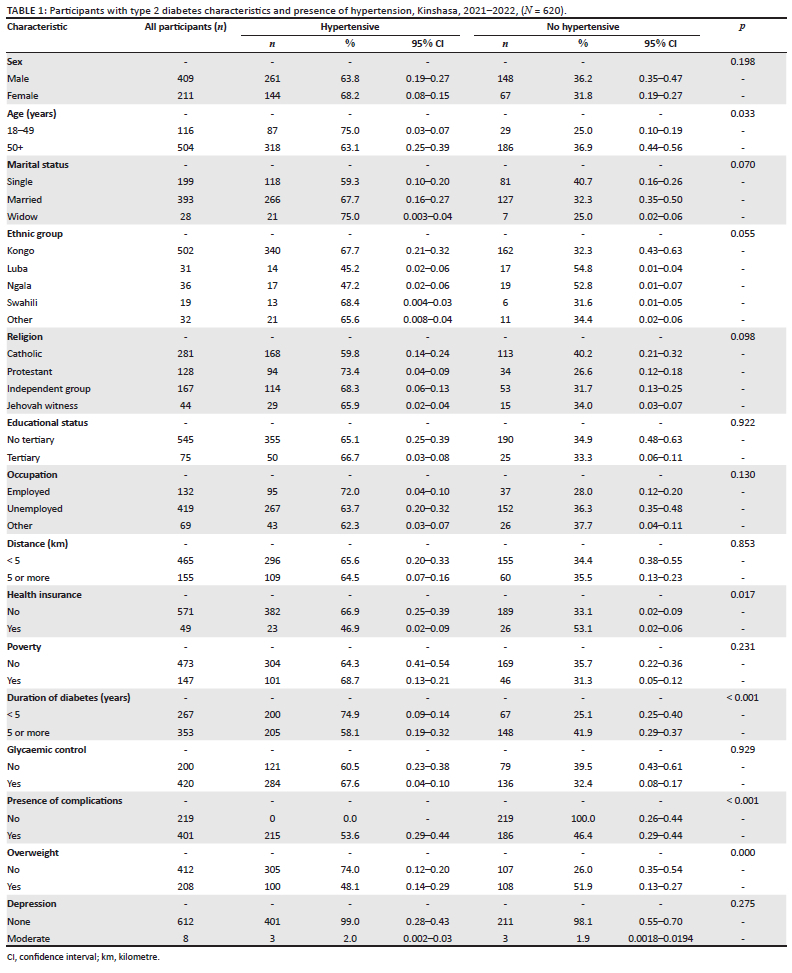
A total of 620 participants were enrolled in the study. The mean age of the participants was 60 ± 12 years. Almost two-thirds of the participants were females (66.0% [409/620]), four-fifths being adults aged 50 years and above (81.3% [504/620]). About two-thirds were married (63.4% [393/620]); the majority were from the Kongo ethnic group (81.0% [502/620]), had not reached university (87.9% [545/620]), were unemployed (67.6% [419/620]), residing near the healthcare centre (74.8% [464/620]), had no health insurance (92.1% [571/620]) and lived below the poverty line (76.3% [473/620]). More than half of the study population were on an insulin-based regimen (53.9% [334/620]). A few had more than five medications (1.3% [8/620]) (Table 1). Out of the 215 who were hypertensive, only a small proportion (29.3% [63/215]) was taking medication.
Hypertension-associated factors
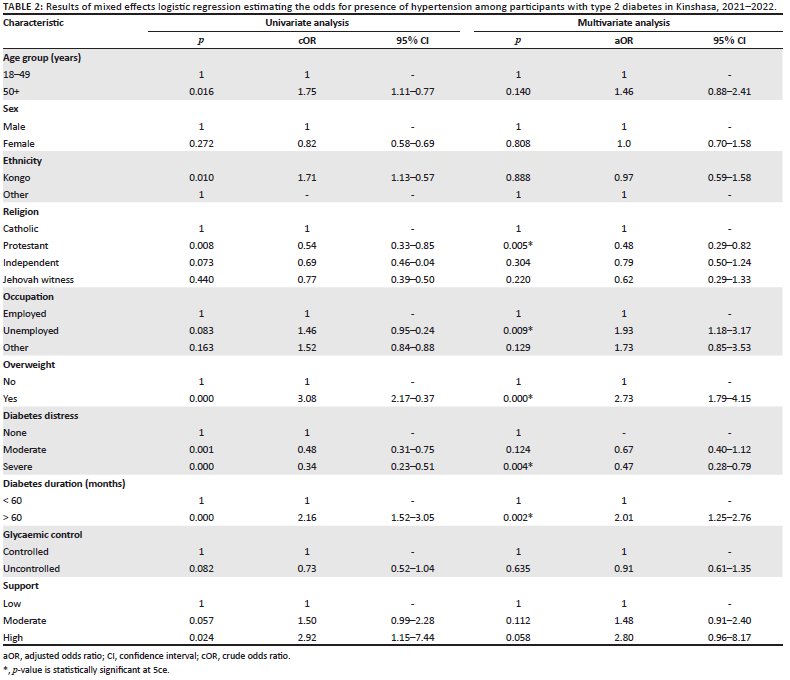
After adjusting for random and fixed effects at facility level in the multivariable logistic model, overweight (aOR = 2.73; 95% CI: 1.79-4.15; p = 0.000), diabetes duration (aOR = 2.01; 95% CI: 1.25-2.76; p = 0.002), severe diabetes distress (aOR = 0.47; 95% CI: 0.28-0.79; p = 0.004), unemployment (aOR = 1.93; 95% CI: 1.18-3.17; p = 0.009) and being of the protestant religion (aOR = 0.48; 95% CI: 0.29-0.82; p = 0.005) were associated with hypertension (Table 2).
Blood pressure control and associated factors
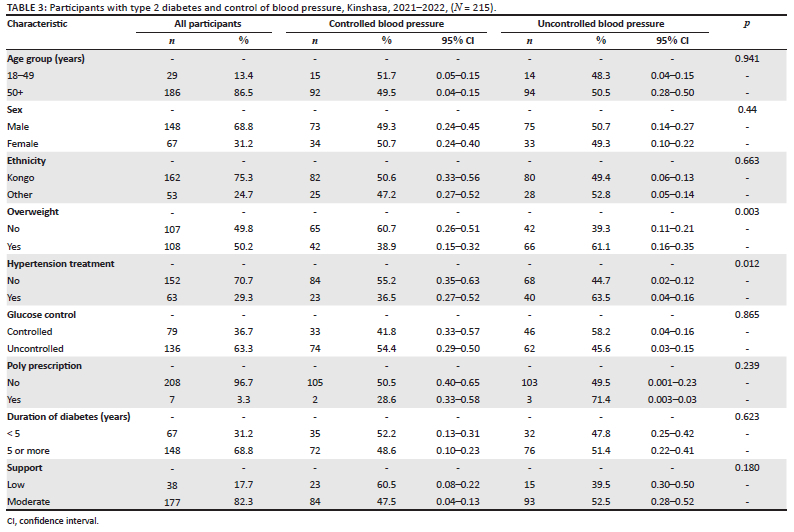
From all the participants, 67.6% (419/620) had uncontrolled blood pressure, while for those participants considered as hypertensive, 50.2% (108/215) had uncontrolled hypertension (Table 3).
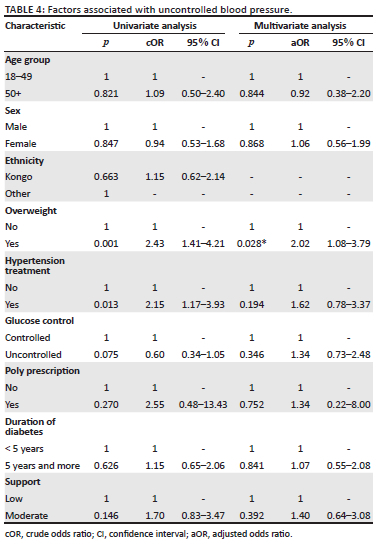
After adjusting for random and fixed effects at facility level in the multivariable logistic model, only overweight remained a significant determinant of uncontrolled hypertension. The odds of having uncontrolled blood pressure were significantly higher among overweight diabetic patients (aOR=2.02; 95% CI: 1.08-3.79; p = 0.028; Table 4).
Discussion
The study sought to determine the prevalence of hypertension and that of uncontrolled hypertension and their respective associated factors among patients with T2D in a primary care setting in Kinshasa, DRC. The study showed that more than one-third of T2D patients had hypertension and among those hypertensives over half had uncontrolled hypertension. Being overweight, unemployment and longer duration of diabetes were associated with increased odds of hypertension while having severe diabetes distress and being of the protestant religion decreased odds of hypertension. In terms of blood pressure control, only overweight was found to be significantly associated with an increased risk of uncontrolled hypertension.
The prevalence of hypertension in this study was consistent with findings from other settings. For instance, a study conducted in Ethiopia found that the prevalence of hypertension was 37.4%.371040
Sociodemographic factors such as unemployment and religious affiliation were significantly associated with hypertension. Unemployment emerged as a significant risk factor, aligning with previous research that indicates financial stress associated with unemployment contributes to poor health outcomes, including hypertension.411042
This study found that being of the protestant affiliation was associated with decreased odds of hypertension. The available literature has conflicting findings on the effects of religion on chronic conditions such as diabetes and hypertension.43,4443,4445
Among the clinical characteristics, the duration of diabetes and being overweight were significantly associated with hypertension. The duration of diabetes was the sole nonmodifiable factor identified. Patients diagnosed with diabetes for more than 5 years had nearly twice the odds of developing hypertension compared to those diagnosed within the last 5 years. This finding aligns with the literature suggesting that the duration of diabetes significantly influences hypertension development among type 2 diabetic patients.10,4647
Consistent with previous studies, overweight was found to be associated with hypertension.10,48,49,5051525253
Our study found that participants with high diabetes distress had decreased odds of having hypertension. Our finding was in discordance with what is usually described in the literature.54
The study identified a high prevalence of uncontrolled hypertension among T2D patients, with over half (50.2%) of the participants having uncontrolled hypertension. This uncontrolled hypertension could be attributed to the fact that there was less than one-third of hypertensive patients who were on hypertension treatment in this study. This prevalence is consistent with other studies conducted in Africa and beyond, such as Uganda (82.5%),2117161955
Overweight was the only significant factor contributing to uncontrolled hypertension among patients with T2DM in Kinshasa, and these findings are consistent with findings from other settings.16,56
Limitations and strengths of the study
The cross-sectional nature of the study is unable to draw a definitive conclusion on the relationships found in the study regarding the presence of hypertension among patients with T2D on one hand and uncontrolled hypertension on the other hand. Some of the information sought from the participants was sensitive; our findings could have been influenced by social desirability bias. We sought to minimise this bias by training the data collectors to be nonjudgemental. The sampling method used enhanced the generalisation of the study findings to the patients with T2D in Kinshasa Primary Care Network and similar settings in DRC and SSA.
Beyond these limitations, this study provided an overview of the epidemiology of hypertension and its control among patients with T2D in Kinshasa, DRC. However, future longitudinal studies could further explore the drivers of hypertension and uncontrolled hypertension among diabetes patients in Kinshasa and other similar settings.
Conclusion
This study in Kinshasa, DRC, investigated the epidemiology of hypertension and uncontrolled hypertension among patients with T2D. The findings revealed that about one-third of participants with T2D were hypertensive and half of them had uncontrolled hypertension. Being overweight was the sole nonmodifiable factor related to the risk of hypertension and that of uncontrolled hypertension. There is a need to strengthen lifestyle modifications as part of hypertension management among patients with T2D. Particularly, the adoption of cost-effective interventions in our setting and tackling weight gain must be encouraged among patients with T2D. There is need to strengthen the healthcare system for diabetes care through the integration of new approaches for better management and more active participation of the patients with diabetes through better education and motivation.
Competing interests
The authors declare that they have no financial or personal relationships that may have inappropriately influenced them in writing this article. The author, J.-P.F.-L., serves as an editorial board member of this journal. The peer review process for this submission was handled independently, and the author had no involvement in the editorial decision-making process for this article. The authors have no other competing interests to declare.
Authors' contributions
X.S., J.-P.F.-L. and J.M.F. conceptualised the study and methods. X.S. analysed and interpreted the data under the supervision of J.-P.F.-L., and J.M.F. X.S. and J.-P.F.-L. wrote the draft manuscript, and J.M.F. performed critical review and substantial revisions. X.S., J.-P.F.-L. and J.M.F. approved the final version.
Funding information
This research received no specific grant from any funding agency in the public, commercial or not-for-profit sectors.
Data availability
The data that support the findings of this study are available from the corresponding author, J.-P.F.-L., upon reasonable request.
Disclaimer
The views and opinions expressed in this article are those of the authors and do not necessarily reflect the official policy or position of any affiliated agency of the authors.
Acknowledgements
The authors would like to acknowledge the research support training, training, mentorship provided by the Division of Epidemiology and Biostatics, School of Public Health, Faculty of Health Sciences, University of the Witwatersrand, Johannesburg, South Africa.
References
-
1. Magliano DJ, Boyko EJ. IDF Diabetes Atlas 10th edition scientific committee. IDF Diabeted Atlas [homepage on the Internet]. 10th ed. Brussels: International Diabetes Federation; 2021 [cited 2024 Dec 09]. Available from: https://www.ncbi.nlm.nih.gov/books/NBK581934/
» https://www.ncbi.nlm.nih.gov/books/NBK581934/ -
2. Sun H, Saeedi P, Karuranga S, et al. IDF Diabetes Atlas: Global, regional and country-level diabetes prevalence estimates for 2021 and projections for 2045. Diabetes Res Clin Pract. 2022;183:109119. https://doi.org/10.1016/j.diabres.2021.109119
» https://doi.org/10.1016/j.diabres.2021.109119 -
3. Ogurtsova K, Guariguata L, Barengo NC, et al. IDF Diabetes Atlas: Global estimates of undiagnosed diabetes in adults for 2021. Diabetes Res Clin Pract. 2022;183:109118. https://doi.org/10.1016/j.diabres.2021.109118
» https://doi.org/10.1016/j.diabres.2021.109118 -
4. Lubaki JPF, Omole OB, Francis JM. Consensus on potential interventions for improving glycaemic control among patients with type 2 diabetes in Kinshasa, Democratic Republic of the Congo: A Delphi study. Glob Health Action. 2023;16(1):2247894. https://doi.org/10.1080/16549716.2023.2247894
» https://doi.org/10.1080/16549716.2023.2247894 -
5. International Diabetes Federation: Democratic Republic of Congo [homepage on the Internet]. [cited 2024 Aug 08]. Available from: https://idf.org/our-network/regions-and-members/africa/members/democratic-republic-of-congo/
» https://idf.org/our-network/regions-and-members/africa/members/democratic-republic-of-congo/ -
6. Emerging Risk Factors Collaboration. Diabetes mellitus, fasting blood glucose concentration, and risk of vascular disease: A collaborative meta-analysis of 102 prospective studies. Lancet. 2010;375(9733):2215-2222. https://doi.org/10.1016/S0140-6736(10)60484-9
» https://doi.org/10.1016/S0140-6736(10)60484-9 -
7. Petrie JR, Guzik TJ, Touyz RM. Diabetes, hypertension, and cardiovascular disease: Clinical insights and vascular mechanisms. Can J Cardiol. 2018;34(5):575-584. https://doi.org/10.1016/j.cjca.2017.12.005
» https://doi.org/10.1016/j.cjca.2017.12.005 -
8. Nowakowska M, Zghebi SS, Ashcroft DM, et al. The comorbidity burden of type 2 diabetes mellitus: Patterns, clusters and predictions from a large English primary care cohort. BMC Med. 2019;17(1):145. https://doi.org/10.1186/s12916-019-1373-y
» https://doi.org/10.1186/s12916-019-1373-y -
9. Uthman OA, Ayorinde A, Oyebode O, Sartori J, Gill P, Lilford RJ. Global prevalence and trends in hypertension and type 2 diabetes mellitus among slum residents: A systematic review and meta-analysis. BMJ Open. 2022;12(2):e052393. https://doi.org/10.1136/bmjopen-2021-052393
» https://doi.org/10.1136/bmjopen-2021-052393 -
10. Hinneh T, Akyirem S, Bossman IF, et al. Regional prevalence of hypertension among people diagnosed with diabetes in Africa, a systematic review and meta-analysis. PLOS Glob Public Health. 2023;3(12):e0001931. https://doi.org/10.1371/journal.pgph.0001931
» https://doi.org/10.1371/journal.pgph.0001931 -
11. Haile TG, Mariye T, Tadesse DB, Gebremeskel GG, Asefa GG, Getachew T. Prevalence of hypertension among type 2 diabetes mellitus patients in Ethiopia: A systematic review and meta-analysis. Int Health. 2023;15(3):235-241. https://doi.org/10.1093/inthealth/ihac060
» https://doi.org/10.1093/inthealth/ihac060 -
12. Katchunga P, Hermans MP, Manwa B, Lepira F, Kashongwe Z, M'Buyamba-Kabangu J-R. Hypertension artérielle, insulinorésistance et maladie rénale chronique dans un groupe de diabétiques de type 2 du Sud-Kivu, RD Congo. Néphrol Thér. 2010;6(6):520-525. https://doi.org/10.1016/j.nephro.2010.04.002
» https://doi.org/10.1016/j.nephro.2010.04.002 -
13. Adeloye D, Basquill C. Estimating the prevalence and awareness rates of hypertension in Africa: A systematic analysis. PLoS One. 2014;9(8):e104300. https://doi.org/10.1371/journal.pone.0104300
» https://doi.org/10.1371/journal.pone.0104300 -
14. Fina Lubaki JP, Omole OB, Francis JM. Glycaemic control among type 2 diabetes patients in sub-Saharan Africa from 2012 to 2022: A systematic review and meta-analysis. Diabetol Metab Syndr. 2022;14(1):134. https://doi.org/10.1186/s13098-022-00902-0
» https://doi.org/10.1186/s13098-022-00902-0 -
15. Fina Lubaki JP, Omole OB, Francis JM. Poor glycaemic control: Prevalence, factors and implications for the care of patients with type 2 diabetes in Kinshasa, Democratic Republic of the Congo: A cross-sectional study. Front Clin Diabetes Healthc. 2023;4:1241882. https://doi.org/10.3389/fcdhc.2023.1241882
» https://doi.org/10.3389/fcdhc.2023.1241882 -
16. Rabizadeh S, Gholami B, Mahmoudzadeh Kani S, et al. Uncontrolled hypertension in patients with type 2 diabetes: What are the correlates? J Clin Hypertens. 2021;23(9):1776-1785. https://doi.org/10.1111/jch.14352
» https://doi.org/10.1111/jch.14352 -
17. Hammad MA, Syed Sulaiman SA, Mohamed Noor DA. Prevalence of uncontrolled blood pressure among patients with type 2 diabetes mellitus. Value Health. 2018;21(S3):S244. https://doi.org/10.1016/j.jval.2018.09.1459
» https://doi.org/10.1016/j.jval.2018.09.1459 -
18. Makukule A, Modjadji P, Thovhogi N, Mokgalaboni K, Kengne AP. Uncontrolled hypertension, treatment, and predictors among hypertensive out-patients attending primary health facilities in Johannesburg, South Africa. Healthcare. 2023;11(20):2783. https://doi.org/10.3390/healthcare11202783
» https://doi.org/10.3390/healthcare11202783 -
19. Mohamed SF, Uthman OA, Mutua MK, Asiki G, Abba MS, Gill P. Prevalence of uncontrolled hypertension in people with comorbidities in sub-Saharan Africa: A systematic review and meta-analysis. BMJ Open. 2021;11(12):e045880. https://doi.org/10.1136/bmjopen-2020-045880
» https://doi.org/10.1136/bmjopen-2020-045880 -
20. Shaikh A. A practical approach to hypertension management in diabetes. Diabetes Ther. 2017;8(5):981-989. https://doi.org/10.1007/s13300-017-0310-3
» https://doi.org/10.1007/s13300-017-0310-3 -
21. Saasita PK, Senoga S, Muhongya K, Agaba DC, Migisha R. High prevalence of uncontrolled hypertension among patients with type 2 diabetes mellitus: A hospital-based cross-sectional study in Southwestern Uganda. Pan Afr Med J. 2021;39:142. https://doi.org/10.11604/pamj.2021.39.142.28620
» https://doi.org/10.11604/pamj.2021.39.142.28620 -
22. Rohwer A, Uwimana Nicol J, Toews I, Young T, Bavuma CM, Meerpohl J. Effects of integrated models of care for diabetes and hypertension in low-income and middle-income countries: A systematic review and meta-analysis. BMJ Open. 2021;11(7):e043705. https://doi.org/10.1136/bmjopen-2020-043705
» https://doi.org/10.1136/bmjopen-2020-043705 -
23. World Population Review: Kinshasa population [homepage on the Internet]. [cited 2024 Aug 06]. Available from: https://worldpopulationreview.com/world-cities/kinshasa-population
» https://worldpopulationreview.com/world-cities/kinshasa-population -
24. World Bank: Democratic Republic of Congo overview: Development news, research, data [homepage on the Internet]. [updated 2024 Apr 08; cited 2024 Aug 06]. Available from: https://www.worldbank.org/en/country/drc/overview
» https://www.worldbank.org/en/country/drc/overview -
25. Kapongo RY, Lulebo AM, Mafuta EM, Mutombo PB, Dimbelolo JCM, Bieleli IE. Assessment of health service delivery capacities, health providers' knowledge and practices related to type 2 diabetes care in Kinshasa primary healthcare network facilities, Democratic Republic of the Congo Health services research in low and middle income settings. BMC Health Serv Res. 2015;15:9. https://doi.org/10.1186/s12913-015-0679-5
» https://doi.org/10.1186/s12913-015-0679-5 -
26. Fina Lubaki JP, Omole OB, Francis JM. Protocol: Developing a framework to improve glycaemic control among patients with type 2 diabetes mellitus in Kinshasa, Democratic Republic of the Congo. PLoS One. 2022;17(9):e0268177. https://doi.org/10.1371/journal.pone.0268177
» https://doi.org/10.1371/journal.pone.0268177 -
27. REDCap [homepage on the Internet]. [cited 2024 Jul 15]. Available from: https://redcap.core.wits.ac.za/redcap/
» https://redcap.core.wits.ac.za/redcap/ -
28. Ministry of Public Health of the Democratic Republic of the Congo. Standards and guidelines for diabetes care [homepage on the Internet]. [cited 2024 Jul 15]. Available from: https://extranet.who.int/ncdccs/Data/COD_B6_NV_Draft%20final_Normes%20Diab%C3%A8te_09_11_13final%20%282%29.pdf
» https://extranet.who.int/ncdccs/Data/COD_B6_NV_Draft%20final_Normes%20Diab%C3%A8te_09_11_13final%20%282%29.pdf -
29. Kaboru BB, Namegabe EN. Geographical, health systems' and sociocultural patterns of TB/HIV co-infected patients' health seeking behavior in a conflict affected setting: The case of Eastern Democratic Republic of Congo. J Community Med Health Edu. 2013;4(1):1-6. https://doi.org/10.4172/2161-0711.1000263
» https://doi.org/10.4172/2161-0711.1000263 -
30. Ferreira FHG, Chen S, Dabalen A, et al. A global count of the extreme poor in 2012: Data issues, methodology and initial results. J Econ Inequal. 2016;14:141-172. https://doi.org/10.1007/s10888-016-9326-6
» https://doi.org/10.1007/s10888-016-9326-6 -
31. World Health Organization. Obesity: Preventing and managing the global epidemic: Report of a WHO consultation [homepage on the Internet]. Geneva: World Health Organization; 2000 [cited 2024 Jul 15]. Available from: https://apps.who.int/iris/handle/10665/42330
» https://apps.who.int/iris/handle/10665/42330 -
32. Wake AD. Incidence and predictors of hypertension among diabetic patients attending a diabetic follow-up clinic in Ethiopia: A retrospective cohort study. J Int Med Res. 2023;51(10):3000605231201765. https://doi.org/10.1177/03000605231201765
» https://doi.org/10.1177/03000605231201765 -
33. Gnjidic D, Tinetti M, Allore HG. Assessing medication burden and polypharmacy: Finding the perfect measure. Expert Rev Clin Pharmacol. 2017;10(4):345-347. https://doi.org/10.1080/17512433.2017.1301206
» https://doi.org/10.1080/17512433.2017.1301206 -
34. Zimet GD, Dahlem NW, Zimet SG, Farley GK. The multidimensional scale of perceived social support. J Pers Assess. 1988;52(1):30-41. https://doi.org/10.1207/s15327752jpa5201_2
» https://doi.org/10.1207/s15327752jpa5201_2 -
35. Van Steenbergen-Weijenburg KM, De Vroege L, Ploeger RR, et al. Validation of the PHQ-9 as a screening instrument for depression in diabetes patients in specialized outpatient clinics. BMC Health Serv Res. 2010;10:235. https://doi.org/10.1186/1472-6963-10-235
» https://doi.org/10.1186/1472-6963-10-235 -
36. Polonsky WH, Fisher L, Earles J, et al. Assessing psychosocial distress in diabetes: Development of the diabetes distress scale. Diabetes Care. 2005;28(3):626-631. https://doi.org/10.2337/diacare.28.3.626
» https://doi.org/10.2337/diacare.28.3.626 -
37. Abdissa D, Kene K. Prevalence and determinants of hypertension among diabetic patients in Jimma University Medical Center, Southwest Ethiopia, 2019. Diabetes Metab Syndr Obes. 2020;13:2317-2325. https://doi.org/10.2147/DMSO.S255695
» https://doi.org/10.2147/DMSO.S255695 -
38. Hirpa D, Abdissa D. Comorbid hypertension and its associated factors among diabetic outpatients in West Shewa Zone public hospitals, Ethiopia: An institution based cross-sectional study. medRxiv. 2023. https://doi.org/10.1101/2023.03.25.23287734
» https://doi.org/10.1101/2023.03.25.23287734 -
39. Desta F, Mengesha S, Belayneh F, et al. Blood Pressure Control and Associated Factors among Hypertension Comorbid Type 2 Diabetic Patients in Southeast Ethiopia. Int J Hypertens. 2024; 16:6668436. https://doi.org/10.1155/2024/6668436
» https://doi.org/10.1155/2024/6668436 - 40. WHO. WHO package of essential noncommunicable (PEN) disease interventions for primary health care. Geneva: World Health Organization; 2020.
-
41. Rumball-Smith J, Nandi A, Kaufman JS. Working and hypertension: Gaps in employment not associated with increased risk in 13 European countries, a retrospective cohort study. BMC Public Health. 2014;14:536. https://doi.org/10.1186/1471-2458-14-536
» https://doi.org/10.1186/1471-2458-14-536 -
42. Jackson Y, Lozano Becerra JC, Carpentier M. Quality of diabetes care and health insurance coverage: A retrospective study in an outpatient academic public hospital in Switzerland. BMC Health Serv Res. 2016;16(1):1-7. https://doi.org/10.1186/s12913-016-1801-z
» https://doi.org/10.1186/s12913-016-1801-z -
43. Souza VM, Frizzo HCF, Paiva MHP, Bousso RS, Santos AS. Espiritualidade, Religiosidade e Crenças Pessoais de Adolescentes com Câncer. Rev Bras Enferm. 2015;68(5):791-796. https://doi.org/10.1590/0034-7167.2015680504i
» https://doi.org/10.1590/0034-7167.2015680504i -
44. Meng Q, Zhang X, Shi R, Liao H, Chen X. Correlation between religion and hypertension. Intern Emerg Med. 2019;14(2):209-237. https://doi.org/10.1007/s11739-018-1791-4
» https://doi.org/10.1007/s11739-018-1791-4 -
45. Koenig HG. Religion, spirituality, and health: The research and clinical implications. ISRN Psychiatry. 2012;2012(1):1-33. https://doi.org/10.5402/2012/278730
» https://doi.org/10.5402/2012/278730 -
46. Saasita P, Nzanzu A, Kibendelwa Z, Bunduki G. Outcome of hypertension among diabetic patients at Matanda Hospital in Butembo, Democratic Republic of the Congo. Int Blood Res Rev. 2017;7(4):1-6. https://doi.org/10.9734/IBRR/2017/32269
» https://doi.org/10.9734/IBRR/2017/32269 -
47. Naseri MW, Esmat HA, Bahee MD. Prevalence of hypertension in type-2 diabetes mellitus. Ann Med Surg (Lond). 2022;78:103758. https://doi.org/10.1016/j.amsu.2022.103758
» https://doi.org/10.1016/j.amsu.2022.103758 -
48. Carey RM, Muntner P, Bosworth HB, Whelton PK. Prevention and control of hypertension: JACC health promotion series. J Am Coll Cardiol. 2018;72(11):1278-1293. https://doi.org/10.1016/j.jacc.2018.07.008
» https://doi.org/10.1016/j.jacc.2018.07.008 -
49. Kenore Y, Abrha S, Yosef A, Gelgelu TB. Determinants of hypertension among patients with diabetes mellitus in public hospitals of Kembata Tambaro Zone, south nations nationalities and peoples region, Ethiopia, 2021: A case control study. J Multidiscip Healthc. 2022;15:2141-2152. https://doi.org/10.2147/JMDH.S379293
» https://doi.org/10.2147/JMDH.S379293 -
50. Musung JM, Kakoma PK, Kaut Mukeng C, et al. Prevalence of hypertension and associated factors in Lubumbashi City, Democratic Republic of Congo: A community-based cross-sectional study. Int J Hypertens. 2021;2021(1):6674336. https://doi.org/10.1155/2021/6674336
» https://doi.org/10.1155/2021/6674336 -
51. Kotsis V, Nilsson P, Grassi G, et al. New developments in the pathogenesis of obesity-induced hypertension. J Hypertens. 2015;33(8):1499-1508. https://doi.org/10.1097/HJH.0000000000000645
» https://doi.org/10.1097/HJH.0000000000000645 -
52. Carey RM, Wright JT, Jr, Taler SJ, Whelton PK. Guideline-driven management of hypertension: An evidence-based update. Circ Res. 2021;128(7):827-846. https://doi.org/10.1161/CIRCRESAHA.121.318083
» https://doi.org/10.1161/CIRCRESAHA.121.318083 -
53. James PA, Oparil S, Carter BL, et al. 2014 Evidence-based guideline for the management of high blood pressure in adults: Report from the panel members appointed to the Eighth Joint National Committee (JNC 8). J Am Med Assoc. 2014;311(5):507-520. https://doi.org/10.1001/jama.2013.284427
» https://doi.org/10.1001/jama.2013.284427 -
54. Alfian SD, Wicaksono AI, Putri AN, Abdulah R. Prevalence of diabetes distress and associated factors among patients with diabetes using antihypertensive medications in community health centres in Bandung City, Indonesia. Pharmaciana. 2021;11(2):195. https://doi.org/10.12928/pharmaciana.v11i2.20094
» https://doi.org/10.12928/pharmaciana.v11i2.20094 -
55. World Health Organization. Global action plan for the prevention and control of NCDs 2013-2020 [homepage on the Internet]. [updated 2015 May 10; cited 2024 Aug 06]. Available from: https://www.who.int/news/item/10-05-2015-global-action-plan-for-the-prevention-and-control-of-ncds-2013-2020#
» https://www.who.int/news/item/10-05-2015-global-action-plan-for-the-prevention-and-control-of-ncds-2013-2020# -
56. Sreedevi A, Krishnapillai V, Menon VB, et al. Uncontrolled blood pressure and associated factors among persons with diabetes: A community based study from Kerala, India. Front Public Health. 2022;9:778235. https://doi.org/10.3389/fpubh.2021.778235
» https://doi.org/10.3389/fpubh.2021.778235

Accepted: 16 Dec. 2024
Published: 20 Mar. 2025