Primary healthcare practitioners and patient blood management in Africa in the time of coronavirus disease 2019: Safeguarding the blood supply
The coronavirus disease 2019 (COVID-19) pandemic has highlighted various weaknesses in global healthcare services. The blood supply in Africa is a critical element of the healthcare service that may be significantly affected by the pandemic. By implementing principles of patient blood management, primary healthcare practitioners may play an important role in the resilience of the blood supply during the COVID-19 pandemic.
Blood supply; patient blood management; Africa; COVID-19; resilience; transfusion
Primary healthcare practitioners and patient blood management in Africa in the time of coronavirus disease 2019: Safeguarding the blood supply
Claire L. Barrett
School of Clinical Medicine, Faculty of Health Sciences, University of the Free State, Bloemfontein, South Africa
ABSTRACTThe coronavirus disease 2019 (COVID-19) pandemic has highlighted various weaknesses in global healthcare services. The blood supply in Africa is a critical element of the healthcare service that may be significantly affected by the pandemic. By implementing principles of patient blood management, primary healthcare practitioners may play an important role in the resilience of the blood supply during the COVID-19 pandemic.
Keywords: Blood supply; patient blood management; Africa; COVID-19; resilience; transfusion.
Resilience, the pandemic and the blood supply in Africa
Tomorrow belongs to the people who prepare for it today. (African Proverb)
The World Health Organization (WHO) defines resilience in the context of the provision of essential health and health-related services as 'the inbuilt capacity of the system to sustain provision of essential health and health-related services even when challenged by outbreaks, disasters or other shocks'.1
The COVID-19 pandemic showcases weaknesses, shortcomings and lack of resilience in global healthcare services. Whilst commendable work has been performed in health disaster risk management in Africa,23,415,6784
Road safety has improved as a result of COVID-19 because of enforced travel restrictions, which has translated to fewer road traffic accidents (RTAs) in South Africa9,1011anaemia are the most common indications for transfusion.12131214
Patient blood management
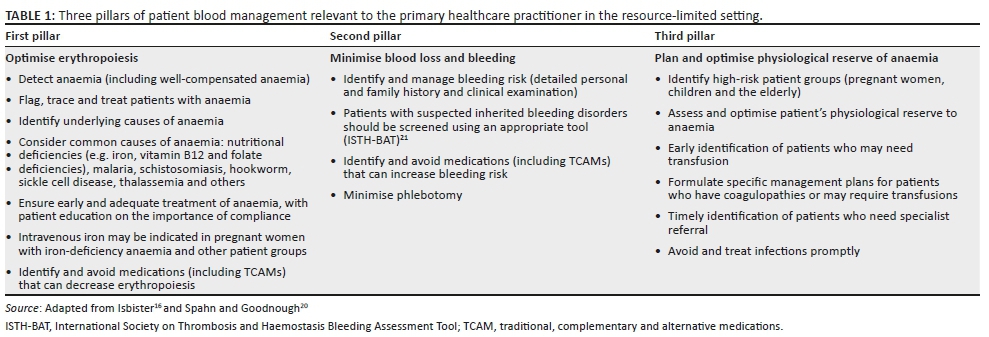
Implementation of the principles of PBM may prove to be a vital step in maintaining a sustainable blood supply in Africa in the face of the pandemic. Patient blood management is defined by the WHO as 'a patient-focussed, evidence-based and systematic approach to optimise the management of patient and transfusion of blood products for quality and effective patient care'.15151614,17,1819Table 1 is adapted from the three-pillar approach from Isbister and Spahn,16,20 reworked for use by primary healthcare practitioners in the outpatient setting in Africa.
These recommendations are contextualised in light of the pandemic and can be applied to all patients who access WHO-compliant priority services, including the care of pregnant women, and patients who access care for emergency conditions, vaccination and the acceptable auxiliary services.2214
Conclusion
Primary healthcare practitioners may play an important role in the resilience of the blood supply during the COVID-19 pandemic. The principles of PBM outlined in this article are inexpensive and relatively easy to implement. If these principles are applied to all patients who receive primary healthcare during the pandemic, the blood supply may be safeguarded for those who need it most.
Competing interests
The author has declared that no competing interest exists.
Author's contributions
I declare that I am the sole author of this research article.
Ethical consideration
This article used data and information from the public domain and primary authors are cited where appropriate.
Funding information
This research received no specific grant from any funding agency in the public, commercial or not-for-profit sectors.
Data availability statement
Data sharing is not applicable to this article as no new data were created or analysed in this study.
Disclaimer
The views and opinions expressed in this article are those of the author and do not necessarily reflect the official policy or position of any affiliated agency of the author.
Acknowledgements
Prof. Colleen Aldous for encouraging me to write the article.
References
-
1.World Health Organization. The state of health in the WHO African Region: An analysis of the status of health, health services and health systems in the context of the Sustainable Development Goals [homepage on the Internet]. Brazzaville: WHO Regional Office for Africa; 2018 [cited 2020 Apr 13]. p. 42. Available from: https://www.afro.who.int/sites/default/files/sessions/documents/StateofhealthintheAfrican Region.pdf
» https://www.afro.who.int/sites/default/files/sessions/documents/StateofhealthintheAfrican Region.pdf -
2.Olu O, Usman A, Manga L, et al. Strengthening health disaster risk management in Africa: Multi-sectoral and people-centred approaches are required in the post-Hyogo Framework of Action era. BMC Public Health;2016;16:1-8. https://doi.org/10.1186/s12889-016-3390-5
» https://doi.org/10.1186/s12889-016-3390-5 -
3.World Health Organization. Protecting the blood supply during infectious disease outbreaks [homepage on the Internet]. 2019 [cited 2020 Apr 13]. Available from: https://apps.who.int/iris/bitstream/handle/10665/311443/9789241515214-eng.pdf?ua=1
» https://apps.who.int/iris/bitstream/handle/10665/311443/9789241515214-eng.pdf?ua=1 -
4.World Health Organization. Maintaining a safe and adequate blood supply during the pandemic outbreak of coronavirus disease (COVID-19): Interim guidance [homepage on the Internet]. Oms. 2020 [cited 2020 Apr 13]. p. 1-5. Available from: https://apbnonline.com/images/apbnrapidb
» https://apbnonline.com/images/apbnrapidb -
5.World Health Organization and International Federation of Red Cross and Red Crescent Societies. Towards 100% voluntary blood donation: A global framework for action [homepage on the Internet]. World Health Organization; 2010 [cited 2020 Apr 13]. p. 9-13. Available from: https://apps.who.int/iris/bitstream/handle/10665/44359/9789241599696_eng.pdf?s equence=1&isAllowed=y&ua=1
» https://apps.who.int/iris/bitstream/handle/10665/44359/9789241599696_eng.pdf?s equence=1& isAllowed=y&ua=1 -
6.Khan KS, Wojdyla D, Say L, Gülmezoglu AM, Van Look PF. WHO analysis of causes of maternal death: A systematic review. Lancet. 2006;367(9516):1066-1074. https://doi.org/10.1016/S0140-6736(06)68397-9
» https://doi.org/10.1016/S0140-6736(06)68397-9 -
7.Kanagasabai U, Chevalier MS, Drammeh B, et al. Trends and gaps in national blood transfusion services - 14 sub-Saharan African countries, 2014-2016. Morb Mortal Wkly Rep. 2018;67(50):1392-1396. https://doi.org/10.15585/mmwr.mm6750a4
» https://doi.org/10.15585/mmwr.mm6750a4 -
8.World Health Organization. Global status report on blood safety 2016 [homepage on the Internet]. Geneva: WHO; 2017 [cited 2020 Apr 13]. p. 173. Available from: https://apps.who.int/iris/bitstream/handle/10665/254987/9789241565431-eng.pdf?sequence=1
» https://apps.who.int/iris/bitstream/handle/10665/254987/9789241565431-eng.pdf?sequence=1 -
9.Vhahangwele N. SA records 26 road crashes with 28 fatalities over Easter weekend. The Citizen [homepage on the Internet]. 2020 [cited 2020 Apr 23]; Available from: https://citizen.co.za/news/south-africa/accidents/2270677/sa-records-26-road-crashes-with-28-fatalities-over-easter-weekend/
» https://citizen.co.za/news/south-africa/accidents/2270677/sa-records-26-road-crashes-with-28-fatalities-over-easter-weekend/ -
10.Droppa D. Fikile Mbalula reports Easter road death toll plunges 82% [homepage on the Internet]. Times Live. 2020 [cited 2020 Apr 23]. Available from: https://www.sowetanlive.co.za/news/south-africa/2020-04-17-fikile-mbalula-reports-easter-road-death-toll-plunges-82/
» https://www.sowetanlive.co.za/news/south-africa/2020-04-17-fikile-mbalula-reports-easter-road-death-toll-plunges-82/ -
11.Kerlin K. California COVID-19 traffic report finds silver lining | UC Davis. Sci Tech [serial online]. 2020 [cited 2020 Apr 23]. Available from: https://www.ucdavis.edu/news/california-covid-19-traffic-report-finds-silver-lining/
» https://www.ucdavis.edu/news/california-covid-19-traffic-report-finds-silver-lining/ -
12.Barro L, Drew VJ, Poda GG, et al. Blood transfusion in sub-Saharan Africa: Understanding the missing gap and responding to present and future challenges. Vox Sang. 2018;113(8):726-736. https://doi.org/10.1111/vox.12705
» https://doi.org/10.1111/vox.12705 - 13.Thomson J, Poole C, Van den Berg K. Towards the future of blood transfusion - The South African National blood service's perspectives on cellular therapeutic services and products. S Afr Med J. 2019;109(8):12720.
-
14.Shander A, Goobie SM, Warne MA, et al. The essential role of patient blood management in a pandemic: A call for action Anesth Analg [serial online]. 2020. Available from: https://journals.lww.com/anesthesia-analgesia/Fulltext/publishahead/The_Essential_Role_of_Patient_Blood_Management_in.95719.aspxNS-
» https://journals.lww.com/anesthesia-analgesia/Fulltext/publishahead/The_Essential_Role_of_Patient_Blood_Management_in.95719.aspxNS- -
15.World Health Organization. Global forum for blood safety: Patient Blood Management (PBM) structured observations [homepage on the Internet]. 2011 [cited 2020 Apr 13]. p. 14-15. Available from: https://www.who.int/bloodsafety/events/gfbs_01_pbm_concept_paper.pdf
» https://www.who.int/bloodsafety/events/gfbs_01_pbm_concept_paper.pdf -
16.Isbister JP. The three-pillar matrix of patient blood management - An overview. Best Pract Res Clin Anaesthesiol [serial online]. 2013;27(1):69-84. https://.doi.org/10.1016/j.bpa.2013.02.003
» https://.doi.org/10.1016/j.bpa.2013.02.003 -
17.Thomson A, Farmer S, Hofmann A, Isbister J, Shander A. Patient blood management - A new paradigm for transfusion medicine? ISBT Sci Ser. 2009;4(n2):423-435. https://doi.org/10.1111/j.1751-2824.2009.01251.x
» https://doi.org/10.1111/j.1751-2824.2009.01251.x -
18.Althoff FC, Neb H, Herrmann E, et al. Multimodal patient blood management program based on a three-pillar strategy: A systematic review and meta-analysis. Ann Surg. 2019;269(5):794-804. https://doi.org/10.1097/SLA.0000000000003095
» https://doi.org/10.1097/SLA.0000000000003095 -
19.Kassebaum NJ, Jasrasaria R, Naghavi M, et al. A systematic analysis of global anemia burden from 1990 to 2010. Blood J. 2014;123(5):615-624. https://doi.org/10.1182/blood-2013-06-508325
» https://doi.org/10.1182/blood-2013-06-508325 -
20.Spahn DR, Goodnough LT. Alternatives to blood transfusion. Lancet [serial online]. 2013;381(9880):1855-1865. https://doi.org/10.1016/S0140-6736(13)60808-9
» https://doi.org/10.1016/S0140-6736(13)60808-9 -
21.Fasulo MR, Biguzzi E, Abbattista M, et al. The ISTH bleeding assessment tool and the risk of future bleeding. J Thromb Haemost. 2018;16(1):125-130. https://doi.org/10.1111/jth.13883
» https://doi.org/10.1111/jth.13883 -
22.World Health Organizaton. Operational guidance for maintaining essential health services during an outbreak [homepage on the Internet]. 2020 [cited 2020 Apr 13]. p. 1-10. Available from: https://www.who.int/publications-detail/covid-19-operational-guidance-for-maintaining-essential-health-services-during-an-outbreak
» https://www.who.int/publications-detail/covid-19-operational-guidance-for-maintaining-essential-health-services-during-an-outbreak

Accepted: 24 Apr. 2020
Published: 21 May 2020