A qualitative study exploring the primary health care nurses' lived experiences of cervical cancer screening
Abstract
BACKGROUND: In the low- and middle-income countries (LMICs), cervical cancer is the primary cause of cancer-related female deaths. Lesotho has a cervical cancer incidence that is 2.7 times higher than the global average. This disease can be prevented by vaccination, which is not available in all countries, and through screening, which has been shown to have low uptake even among health professionals. AIM: To explore primary health care (PHC) nurses' lived experiences of cervical cancer screening in Lesotho. Thus, to better understand how these experiences can impact nurses' subsequent screening or their goal of offering screening services to their patients SETTING: The study was conducted at four PHC centres in the selected district. METHODS: This is a qualitative study in which a phenomenological design was used. Ten nurses were purposively selected and participated in the in-depth interviews. The data were analysed thematically RESULTS: The findings revealed participants' positive and negative experiences with cervical cancer screening. Positive experiences, including good nursing services, freedom of choice and pain prevention, influenced the nurses' intentions to continue to test in the future and to strongly recommend screening to other women. The negative experiences included a lack of privacy, the absence of counselling and receiving results late. These negative experiences had a detrimental effect on nurses' intentions to undergo screening in the future. However, they had no impact on their goal of offering screening to other women. CONCLUSION: The findings provided essential insights into why cervical cancer screening uptake is low among nurses. CONTRIBUTION: This evidence is critical for augmenting the knowledge of how cervical cancer screening programmes could be improved to enhance nurses' screening uptake and invariably facilitate higher screening rates within the general population.
cervical cancer screening; nurses' screening experiences; negative experiences; positive experiences; subsequent screening
Background
Cervical cancer occurs when cells in the transformation zone of the cervix grow abnormally.1234
Globally, breast cancer is the leading cause of cancer-related deaths among women.5678
Screening is the gold standard for controlling the disease.89
In 2022, among women of all ages in Lesotho (n = 1 100 612), there were 598 new cases of cervical cancer and 413 deaths.1011121213
Research methods and design
Study design
This is a qualitative inquiry in which a phenomenological approach was used. According to Alase,1415
Study setting
The Leribe district, where this study was conducted, is the second most populated district in Lesotho, with a population of 298 352.16
Participants' profile
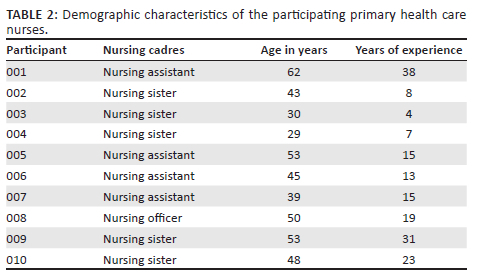
The participants in this study were female nurses employed in PHCCs in one of the districts in Lesotho. Their ages ranged between 29 years and 62 years. Four of them were nursing assistants; five were nursing sisters and one was a nursing officer. All had undergone cervical cancer screening as the study aimed to explore the participants' lived experiences of cervical cancer screening.
Participant selection
This study's unit of analysis was the PHC nurses who had undergone cervical cancer screening; that is, male nurses and female nurses who had never undergone cervical cancer screening tests were excluded. To invite female nurses who were willing to participate in this study, the study's information sheet, which included invitations to participate, was emailed to the District Health Management Team (DHMT) to distribute or send to all female nurses within the district. Then, the researcher called PHCCs in the nearby area to enquire about the availability of nurses interested in participating in the study and scheduled appointments for interviews with those nurses. On the scheduled interview days, the researcher interviewed eligible, available and willing nurses to participate. Two to three participants were selected for each of the four identified facilities. The researcher conducted interviews in nearby PHCCs and then moved to distal PHCCs. Thus, this study employed a purposive sampling technique, particularly the maximum variation sample, where the participants with various work experiences, training, skills and different age groups were selected.
Data collection and analysis
In-depth, face-to-face, semi-structured interviews were conducted using an interview guide with a reliable audio recorder, enabling the researcher to observe non-verbal behaviour. The semi-structured interview guide enabled the researcher to pose spontaneous questions, follow-up questions and probe for more information. Interviews lasted between 20 min and 30 min, and participants granted permission to be recorded.
While the interviews were conducted in English, the participants were allowed to respond in Sesotho, which is their home language, and were afforded the expression of their choice. The researcher transcribed and translated the audio from Sesotho to English. The transcribed data were then analysed using thematic analysis, using the following steps as explained by Maguire and Delahunt.17
The coding process resulted in the discovery of potential themes. The themes were then reviewed and refined based on the relevant and supporting data from the transcripts. After the themes had been finalised, they were further divided into sub-themes, which provided more insight into the basic concepts of the main themes as well as the meaning these sub-themes expressed. Finally, the themes and sub-themes were thoroughly discussed among the two researchers until consensus was reached.
Measure of trustworthiness
Credibility is described as the extent to which the findings correctly reflect the truth about what the participants went through.18
Transferability refers to the extent to which qualitative research findings can be transferred to other settings with different respondents.18
Dependability refers to the consistency of results over comparable contexts.191919
Confirmability aims to ensure that the study's findings are not impacted by any biases or preferences of the researcher.18
Ethical considerations
Ethical clearance to conduct this study was obtained from the University of KwaZulu-Natal Biomedical Research Ethics Committee (BREC/00006211/2023).
Results
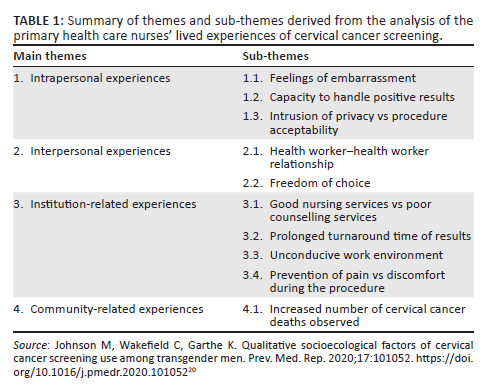
The findings are presented in relation to an adapted version of the socio-ecological model (SEM) in Table 1. They are mapped against five constructs of SEM as defined by Lang et al.,21
Table 2 presents the demographic composition of the study sample. The ages of the participants ranged from 29 years to 62 years, and the years of work experience ranged from 4 years to 38 years. Similarly, the participants' designations varied.
Theme 1: Intrapersonal experiences
The participants were asked about their experiences regarding cervical cancer screening, where they would describe their experiences with screening and how they felt about them. The following categories represent the sub-themes that emerged from the intrapersonal experiences.
Sub-theme 1.1: Feelings of embarrassment
Most participants reported feeling embarrassed during the procedure:
'As a person, I was embarrassed to open [the legs] so the procedure could be done. Even though I am a nurse and know how this procedure is done, especially because I was screened by a man, being like that was embarrassing.' (Participant 009, 53 years, nursing sister)
As can be seen from the statement above, some participants find it embarrassing to have their examinations performed by a male HCW. Conversely, other participants noted that it is embarrassing to be screened by their colleagues. Thus, being screened by their colleagues is the issue, not whether a nurse is male or female. Participant 004 emphasised this by saying:
'I have realised that even these Basotho women only go for screening because we beg them. It is not easy to get naked in front of another person, and it is even worse if the other person is your colleague. I don't want to get naked in front of my colleagues.' (Participant 004, 29 years, nursing sister)
Participants also cared about the screeners' age:
'… the negative experience was that the person conducting my screening was young.' (Participant 008, 50 years, nursing officer)
Therefore, for future screening, participants expressed a preference for screeners who are older:
'I will not be screened by children …' (Participant 007, 39 years, nursing assistant)
'Yes, but only if I am screened by an older person.' (Participant 009, 53 years, nursing sister)
Sub-theme 1.2: Capacity to handle positive results
Participants were also anxious about what the results would show. To underscore this, here is what two participants said:
'I felt I would not survive receiving positive results.' (Participant 001, 62 years, nursing assistant)
'I wondered what would happen should I be told that I have cancer. The thought of positive results makes me anxious.' (Participant 002, 43 years, nursing sister)
Sub-theme 1.3: Intrusion of privacy vs procedure acceptability
Most participants did have their subsequent screening tests, but they did so long after the due dates. Past screening experiences, such as a lack of privacy, may be the cause of this, as articulated by participants:
'Yes, indeed, I will go for screening after some time; I won't go at the expected time … Seriously, no! As for the other person looking at my private parts, it is a no. Even if it is someone you know or someone you don't know, the fact remains that they are going to look at your private parts. So, no!' (Participant 008, 39 years, nursing assistant)
'There is no privacy there because while I was in lithotomy position, other people kept coming in.' (Participant 010, 48 years, nursing sister)
There might be fewer screening recommendations and less education for the public by these health professionals who understand the importance of screening yet prefer to postpone the planned screening because of these concerns. However, not every participant had concerns about their private parts being exposed, as articulated by one participant:
'It was a positive experience because I was not bothered by the procedure. I can do it again and again, I don't mind.' (Participant 001, 62 years, nursing assistant)
Theme 2: Interpersonal experiences
Sub-theme 2.1: Health worker-health worker relationship
Even though some participants expressed feelings of embarrassment when screened by their colleagues, for some, being screened by coworkers was a motivating element to get screened:
'… and one of the days in the morning, I prepared the equipment and called my colleague to come and see. When she arrived, I asked her to screen me for cervical cancer. She was surprised but was obliged to act because the table was fully equipped.' (Participant 006, 45 years, nursing assistant)
'Yes. So, the person who was examining me, I had started with her first … I said no, I can't miss the opportunity of being screened, yet there are only the two of us in here. I am climbing that bed immediately when you get down.' (Participant 005, 53 years, nursing assistant)
Sub-theme 2.2: Freedom of choice
Some of the participants expressed preferences in terms of screening methods. Thus, they were granted the opportunity to choose what suited them the most:
'What I wanted was to get screened with disposable speculums, not reusable ones, to prevent infection. I asked her to use VILI for me, not VIA. She used VILI because I realised that it is reliable.' (Participant 004, 29 years, nursing sister)
Other participants noted how they were at liberty to exercise their choice of a healthcare provider:
'I had already asked for a nurse that I thought I would be comfortable with.' (Participant 010, 48 years, nursing sister)
In addition to choice, the participants were also at liberty to confirm their findings:
'I wanted her to just give me the results and take a picture so I could see myself. I asked her to use iodine so I could see that my cervix was black and not mustered yellow. Also, if she used VIA, I wouldn't be able to interpret my results from the photo I asked her to take.' (Participant 004, 29 years, nursing sister)
This suggests that if nurses do not take responsibility for deciding who should conduct their screenings and how to carry them out, or if they do not take a self-directed approach, there is a strong likelihood that the screenings will not be done. Two participants emphasised this point further:
'I am never taking the test again until the HPV test is available, then I can conduct my screening …' (Participant 004, 29 years, nursing sister)
'I felt that screening is important, even though I did not go back because my nurse was no longer there …' (Participant 010, 48 years, nursing sister)
In summary, these interpersonal experiences indicate that, unlike their patients, nurses may have certain advantages when it comes to cervical cancer screening because they are at liberty to assert their rights as patients.
Theme 3: Institution-related experiences
Sub-theme 3.1: Good nursing services vs poor counselling services
During their screening process, the participants cited that they were provided with good nursing services:
'I was treated well, I was given health education, and they ensured that the room was conducive and confidential … the equipment was in good condition, the speculum was warm enough to prevent irritation.' (Participant 002, 43 years, nursing sister)
Another participant reflected on the post-screening process and noted:
'When the results came back, they sat me down so I wouldn't worry too much about them (results) and could accept whatever they showed.' (Participant 001, 62 years, nursing assistant)
Although some participants reported receiving health education or an explanation of the procedure before being screened, one participant stated that she never received any explanation:
'When health professionals conduct our screening or for other health professionals, they say we already know, so they don't even give us counselling.' (Participant 004, 29 years, nursing sister)
Sub-theme 3.2: Prolonged turnaround time of results
Among the techniques mentioned by the participants, the pap smear was thought to be the most effective:
'… they did a pap smear whose results never came back. I think the only thing negative was not getting the results, which leaves you feeling like you did nothing to know if you have the disease or not.' (Participant 009, 53 years, nursing sister)
Not only did the long turnaround time of the results or not receiving the results make the participants feel like they neglected their health, but they were also anxious about what the results would eventually show. To underscore this, participant 006 said:
'… after taking the test, I was stressed about my results and wondered how I would feel if they came back positive. That's why I wanted them out urgently to escape the stress of waiting …' (Participant 006, 45 years, nursing assistant)
Sub-theme 3.3: Unconducive work environment
One participant reported inadequacy in the efficacy of the interventions to address the sterility of the air between the procedures:
'The other one is the smell in the room, which is offensive, and the spraying of air freshener in between the patients made me question myself if the bad smell came from me or the person who was screened before me.' (Participant 008, 39 years, nursing sister)
Sub-theme 3.4: Prevention of pain vs discomfort during the procedure
Most participants described cervical cancer screening as painful based on the observations they made as they screened other women or observed the procedure done to other women. But for them, they reported that all that could be done to prevent pain was done:
'I did not feel anything that everyone has been saying about the pain. I had no problem with the speculum because it was warm and lubricated …' (Participant 002, 43 years, nursing sister)
'… but this time around, there was no discomfort. I think it's because the procedure was explained, and the screeners were instructed to select speculum sizes based on the patient's body size. Also, they were told not to tilt the speculum but to go just straight and open it.' (Participant 003, 30 years, nursing sister)
While other participants described strategies to prevent pain when screening for cervical cancer, some participants mentioned pain as one of the discomforting feelings they experienced:
'I just felt that inserting a speculum in there was painful, especially when it was opened. Hey, it is very painful, even if it is a plastic speculum, it is not comfortable at all … when Lugol's iodine encounters the vaginal walls, you will feel like you are burning … I experienced burning pain; I can't even explain that pain.' (Participant 004, 29 years, nursing sister)
Theme 4: Community-related experiences
Sub-theme 4.1: Increased number of cervical cancer deaths observed
In addition to their personal lived experiences, participants also shared experiences from caring for their communities:
'I feared cancer and noticed that people who have cancer suffer a lot, so I did not want to suffer.' (Participant 001, 62 years, nursing assistant)
'Maybe it is because we have seen so many women with cancer at certain stages, some having to go under hysterectomy. So, I don't want to find myself in such situations.' (Participant 003, 30 years, nursing sister)
Discussion
This section discusses the study's findings in relation to the literature and the research objective. The study focused on exploring PHC nurses' lived experiences of cervical cancer screening in the Leribe district, Lesotho. Four dominating themes emerged from the data: intrapersonal experiences, interpersonal experiences, institution-related experiences and community-related experiences. Below is a brief analysis of participants' ages, work experiences and educational backgrounds in relation to cervical cancer screening.
The participants who were nursing sisters aged 30 years and under and had less than 10 years of experience seemed to have more knowledge of cervical cancer screening. However, even with that knowledge, they only had one screening instead of at least two, as the guidelines state that screening starts at age 25 years and is then repeated every 2-3 years, depending on the patient's human immunodeficiency virus (HIV) status.222324
The findings of the study were mostly consistent with most previous research among nurses. However, these studies did not report on cervical cancer screening among nurses, but rather on when nurses needed medical attention. For example, the study by Shattnawi et al.2526,27222728
According to the Lesotho cervical cancer screening guidelines, the screening procedure involves a brief general examination that entails assessing for pallor, blood pressure, breast examination and speculum examination. A speculum is explained by Taylor et al.29213030
In contrast to the other participants who reported receiving excellent care, such as an explanation of the process, some participants reported negative experiences, such as not receiving counselling prior to the process. Their screeners assumed that because the participants were nurses, they had knowledge of cervical cancer screening and, therefore, needed no counselling. These findings are congruent with those of a study conducted by Hunt and Buckley,2731
Feelings of uneasiness, such as pain, embarrassment, an unpleasant screening environment and being screened by their colleagues, were among the experiences cited by the participants. These findings are similar to the findings of a study conducted by Suantika et al.,1032323334
Limitations
As this study was self-funded and conducted by a full-time employed student, the interviews were only conducted among nurses working in PHCCs located in lowland areas. Therefore, the findings of this study may be transferable to similar urban settings. Hence, larger studies with PHC nurses in the country could be conducted in the future to explore this topic in-depth for greater applicability.
Recommendations
Based on the study findings, the authors recommend the following. Firstly, since most nurses were inspired to detect cervical cancer from what they learned about it and how they could reduce pain during the procedure, regular cervical cancer training is recommended among HCWs. Also, not only did those trainings inspire the nurses to get screened, but they also inspired them to offer screening services to all women, including those who come for family planning services only. Thus, we recommend that this practice of offering screening services to all women, regardless of their reasons for visiting health facilities, be adopted as a standard practice in the health system. Secondly, interventions to improve the turnaround time of the results should be explored, as one of the factors that deterred nurses from screening was the waiting period for the results. Thirdly, less intrusive screening modalities should be investigated to alleviate the discomfort caused by existing methods of cervical cancer screening. One of these less intrusive screening modalities, HPV testing, was only introduced in the Leribe district months after data collection. Therefore, we recommend further studies on how to improve the screening experience, as the new Guide for HPV test35 explains that with a positive HPV test, triage tests for treatment using visual inspection with acetic acid (VIA), visual inspection using Lugol's iodine (VILI) and pap smear are recommended.
Conclusion
The study findings provided important insights into PHC nurses' lived experiences of cervical cancer screening. This evidence is important for the amendment and redesigning of cervical cancer screening programmes to improve cervical cancer screening uptake among nurses, who may have more honest conversations with other women based on their positive experiences and hence be able to recommend screening to other women. Furthermore, even with the self-sampling HPV test, the recently implemented guidance for HPV tests and management for the prevention of cervical cancer in Lesotho35 recommends triage tests following positive HPV tests. These include VIA, pap smear and others. Therefore, improving the cervical cancer screening experience with VIA, VILI and pap smear is a promising approach to improve cervical cancer screening uptake. Thus, further studies on how to improve the screening experience are recommended.
Competing interests
The authors, Maliketso G. Polane and Siyabonga B. Dlamini, declare that they have no financial or personal relationships that may have inappropriately influenced them in writing this article.
CRediT authorship contribution
Maliketso G. Polane: Conceptualisation, Methodology, Formal analysis, Investigation, Writing - original draft, Project administration, Validation, Data curation, Writing - review & editing, Funding acquisition. Siyabonga B. Dlamini: Conceptualisation, Methodology, Formal analysis, Resources, Writing - review & editing, Supervision, Funding acquisition. All authors reviewed the article, contributed to the discussion of results, approved the final version for submission and publication and take responsibility for the integrity of its findings.
Funding information
The authors received no financial support for the research, authorship and/or publication of this article.
Data availability
The datasets generated and/or analysed during the current study are not publicly available due to confidentiality but are available from the corresponding author, Maliketso G. Polane, upon reasonable request.
Disclaimer
The views and opinions expressed in this article are those of the authors and are the product of professional research. They do not necessarily reflect the official policy or position of any affiliated institution, funder, agency or that of the publisher. The authors are responsible for this article's results, findings, and content.
Acknowledgements
The authors would like to thank all their participants for their active participation despite their busy schedules. They would like to thank the Leribe District Health Management Team and the PHCC managers for permitting them to conduct this research in their facilities.
References
-
1.Tesfaye B, Tilahun T, Dechasa Heyi W, Oljira R. Associated factors of positive visual inspection of cervix with acetic acid test among women screened for cervical cancer at public health facilities in Woliso town, Southwest Shoa, Ethiopia: A case-control study. SAGE Open Med. 2022;10:20503121221108227. https://doi.org/10.1177/20503121221108227
» https://doi.org/10.1177/20503121221108227 -
2.Bouvard V, Wentzensen N, Mackie A, et al. The IARC perspective on cervical cancer screening. N Engl J Med. 2021;385(20):1908-1918. https://doi.org/10.1056/NEJMsr2030640
» https://doi.org/10.1056/NEJMsr2030640 -
3.Kessler TA. Cervical cancer: Prevention and early detection. Sem Oncol Nurs. 2017;33(2):172-183. https://doi.org/10.1016/j.soncn.2017.02.005
» https://doi.org/10.1016/j.soncn.2017.02.005 -
4.Hull R, Mbele M, Makhafola T, et al. Cervical cancer in low and middle-income countries. Oncol Lett. 2020;20(3):2058-2074. https://doi.org/10.3892/ol.2020.11754
» https://doi.org/10.3892/ol.2020.11754 - 5.Trayes KP, Cokenakes SE. Breast cancer treatment. Am Fam Physician. 2021;104(2):171-178.
-
6.Ramathebane MM, Sooro MA, Kabuya RM, Sayed AR. Knowledge and attitudes relating to cervical and breast cancer among women in Maseru, Lesotho. Afr J Prim Health Care Fam Med. 2022;14(1):8. https://doi.org/10.4102/phcfm.v14i1.3459
» https://doi.org/10.4102/phcfm.v14i1.3459 -
7.Petersen Z, Jaca A, Ginindza T, et al. Barriers to uptake of cervical cancer screening services in low-and-middle-income countries: A systematic review. BMC Women's Health. 2022;22(1):486. https://doi.org/10.1186/s12905-022-02043-y
» https://doi.org/10.1186/s12905-022-02043-y -
8.Yimer NB, Mohammed MA, Solomon K, et al. Cervical cancer screening uptake in sub-Saharan Africa: A systematic review and meta-analysis. Public Health. 2021;195:105-111. https://doi.org/10.1016/j.puhe.2021.04.014
» https://doi.org/10.1016/j.puhe.2021.04.014 - 9.Anyebe E, Opaluwa S, Muktar H, Philip F. Knowledge and practice of cervical cancer screening amongst nurses in Ahmadu Bello University Teaching Hospital Zaria. Cancer. 2014;4(27):33-40.
-
10.Cancer IAfRo. Global cancer observatory [homepage on the Internet]. 2022 [cited 2024 July 22]. Available from: https://gco.iarc.who.int/media/globocan/factsheets/populations/426-lesotho-fact-sheet.pdf
» https://gco.iarc.who.int/media/globocan/factsheets/populations/426-lesotho-fact-sheet.pdf -
11.Suantika PIR, Hermayanti Y, Kurniawan T. Factors associated with participation of nurses in early detection of cervical cancer. Belitung Nurs J. 2019;5(1):47-53. https://doi.org/10.33546/bnj.610
» https://doi.org/10.33546/bnj.610 -
12.Owolabi BA, Adejumo PO. Utilization of cervical cancer screening service among nurses in Ekiti State, Nigeria. Cancer Res J. 2021;9(1):71. https://doi.org/10.11648/j.crj.20210901.19
» https://doi.org/10.11648/j.crj.20210901.19 -
13.Oyekale R, Oluwatosin A, Edet B. Predictors of uptake of cervical cancer screening among nurses in Ogbomoso, Oyo State, Nigeria. J Glob Oncol. 2018;4:7s. https://doi.org/10.1200/jgo.18.88000
» https://doi.org/10.1200/jgo.18.88000 -
14.Alase A. The interpretative phenomenological analysis (IPA): A guide to a good qualitative research approach. Int J Educ Literacy Stud. 2017;5(2):9-19. https://doi.org/10.7575/aiac.ijels.v.5n.2p.9
» https://doi.org/10.7575/aiac.ijels.v.5n.2p.9 -
15.Butler CR, O'Hare AM, Kestenbaum BR, Sayre GG, Wong SP. An introduction to qualitative inquiry. J Am Soc Nephrol. 2021;32(6):1275-1278. https://doi.org/10.1681/ASN.2021040473
» https://doi.org/10.1681/ASN.2021040473 -
16.Lesotho Go. National strategic development plan [homepage on the Internet]. 2018 [cited 2023 Apr 01]. Available from: https://www.gov.ls/wp-content/uploads/2021/06/National-Strategic-Development-Plan-II-2018-19-2022-23.pdf
» https://www.gov.ls/wp-content/uploads/2021/06/National-Strategic-Development-Plan-II-2018-19-2022-23.pdf - 17.Maguire M, Delahunt B. Doing a thematic analysis: A practical, step-by-step guide for learning and teaching scholars. AISHE-J. 2017;9(3): 3351.
-
18.Ahmed SK. The pillars of trustworthiness in qualitative research. J Med Surg Public Health. 2024;2:100051. https://doi.org/10.1016/j.glmedi.2024.100051
» https://doi.org/10.1016/j.glmedi.2024.100051 -
19.Haq ZU, Rasheed R, Rashid A, Akhter S. Criteria for assessing and ensuring the trustworthiness in qualitative research. Int J Bus Reflect. 2023;4(2):150-173. https://doi.org/10.56249/ijbr.03.01.44
» https://doi.org/10.56249/ijbr.03.01.44 -
20.Johnson M, Wakefield C, Garthe K. Qualitative socioecological factors of cervical cancer screening use among transgender men. Prev. Med. Rep. 2020;17:101052. https://doi.org/10.1016/j.pmedr.2020.101052
» https://doi.org/10.1016/j.pmedr.2020.101052 -
21.Lang S, Gibson S, Ng KW, Truby H. Understanding children and young people's experiences pursuing weight loss maintenance using the socio-ecological model: A qualitative systematic literature review. Obes Rev. 2021;22(5):e13172. https://doi.org/10.1111/obr.13172
» https://doi.org/10.1111/obr.13172 - 22.Lesotho Ministry of Health. Guidelines for screening and treatment of cervical pre-cancer in Lesotho. 2020.
-
23.Ifemelumma CC, Anikwe CC, Okorochukwu BC, et al. Cervical cancer screening: Assessment of perception and utilization of services among health workers in low resource setting. Int J Reprod Med. 2019;2019:6505482. https://doi.org/10.1155/2019/6505482
» https://doi.org/10.1155/2019/6505482 -
24.Yörük S, Açıkgöz A, Türkmen H, Ergör G. Risk factors and relationship between screening periodicity and risk of cervical cancer among nurses and midwives. A cross-sectional study. Sao Paulo Med J. 2019;137:119-125. https://doi.org/10.1590/1516-3180.2018.0244230119
» https://doi.org/10.1590/1516-3180.2018.0244230119 -
25.Shattnawi KK, Abdallah IH, Khater W, Alashram SA. Experiences of neonatal intensive care unit nurses as mothers of newborns in neonatal intensive care units: A Jordanian qualitative study. J Pediatr Nurs. 2021;59:e77-e83. https://doi.org/10.1016/j.pedn.2021.02.003
» https://doi.org/10.1016/j.pedn.2021.02.003 -
26.Buckley T. The unique challenge of the nurse-patient in the intensive care. Aust Crit Care. 2021;34(1):1-2. https://doi.org/10.1016/j.aucc.2020.12.006
» https://doi.org/10.1016/j.aucc.2020.12.006 -
27.Hunt L, Buckley T. The experiences and challenges of nurses who become patients in a hospital setting: A scoping review of the literature. J Adv Nurs. 2024;80(1):110-123. https://doi.org/10.1111/jan.15834
» https://doi.org/10.1111/jan.15834 - 28.De Queiroz Neves KT, Oliveira AWN, Galvão TRAF, Ferreira IT, Mangane EM, De Sousa LB. Users'perception of screening tests for preventing cervical cancer. Cogitare Enferm. 2016;21(4):1-7.
-
29.Taylor GA, McDonagh D, Hansen MJ. Improving the pelvic exam experience: A human-centered design study. Des J. 2017;20(suppl 1):S2348-S2362. https://doi.org/10.1080/14606925.2017.1352750
» https://doi.org/10.1080/14606925.2017.1352750 -
30.Behnke AL, Krings A, Wormenor CM, Dunyo P, Kaufmann AM, Amuah JE. Female health-care providers' advocacy of self-sampling after participating in a workplace program for cervical cancer screening in Ghana: A mixed-methods study. Glob Health Act. 2020;13(1):1838240. https://doi.org/10.1080/16549716.2020.1838240
» https://doi.org/10.1080/16549716.2020.1838240 -
31.Basagoitia A, Burrowes S, Solis-Soto MT, MacMillan G, Sullivan S. Community and provider perceptions and experiences of cervical cancer screening in Rural Bolivia: A qualitative study. BMC Womens Health. 2023;23(1):359. https://doi.org/10.1186/s12905-023-02500-2
» https://doi.org/10.1186/s12905-023-02500-2 - 32.Lewaherilla NC, Siahanenia S, Payapo RW. Enhancing nurses' organizational citizenship behaviors in hospitals: Examining the mediating role of culture between seniority and OCB. J Syst Manage Sci. 2024;14(9):413-437.
- 33.McDowell J, Lazzaro-Salazar M, Marra M. A discourse of caring: A case study of male nurses' discourse and identity construction in the United Kingdom and New Zealand. In: McDowell J, editor. De-gendering gendered occupations. New York: Routledge, 2020; p. 62-83.
-
34.Sarcheshme MS, Mahdizadeh M, Tehrani H, Vahedian-Shahroodi M. Exploring the barriers to pap smear test compliance: A qualitative study for improving cervical cancer screening in the primary health care. Health Promot Perspect. 2024;14(1):80. https://doi.org/10.34172/hpp.42485
» https://doi.org/10.34172/hpp.42485 - 35.Lesotho Ministry of Health. Guidance for human papilloma virus test and management for the prevention of cervical cancer in Lesotho. 2024.

Accepted: 12 Nov. 2025
Published: 26 Jan. 2026