Hearing screening of Grade R learners in Qumbu: Referral rates and potential hearing loss
Abstract
BACKGROUND: Hearing loss in children has a profound impact on development. It negatively affects speech production, language acquisition, social interaction and early cognitive growth. These challenges influence emergent literacy if undetected and untreated AIM: This study aimed to determine the referral rate and potential prevalence of hearing loss among Grade R learners in the Qumbu Circuit Management Centre (CMC). SETTING: Nine primary schools located in Qumbu CMC, a rural area within the O.R. Tambo Inland District of the Eastern Cape province, South Africa. METHODS: A quantitative, cross-sectional design was used. Out of 215 schools, 10 were conveniently selected using Slovin's formula. From these, 259 Grade R learners aged 5-6 years were randomly selected to participate. Hearing screening followed the minimum standards for school-based screening set by the Professional Board for Speech, Language, and Hearing Professions in October 2018. Data were analysed using Statistical Package for Social Sciences (SPSS) version 27. RESULTS: Screening outcomes revealed that 25.5% of the learners presented with ear-related conditions requiring referral for further diagnostic evaluation and management. Conditions on findings included wax impaction and otitis media. CONCLUSION: The study revealed a notable referral rate and potential prevalence of both temporary and permanent hearing loss among learners in Qumbu CMC. These results emphasise the importance of regular screening, early detection and timely intervention in underserved rural communities. CONTRIBUTION: This study provides baseline data to guide future research and inform planning for hearing healthcare in the Eastern Cape.
hearing screening; Grade R learners; Eastern Cape; referral rate; childhood hearing loss
Introduction
It is noted that around 466 million people are living with a hearing loss, and 34 million are children worldwide.11213456
Early detection of hearing loss is vital for communication development and school readiness.781,9
Further to these guidelines, Martin and Clark10109,11,12
Children exposed to these risk factors require ongoing surveillance and periodic hearing screening, as hearing loss can develop at any stage.913,1469159111
In South Africa, there are few reports on hearing screening programmes, and the available reports are mostly from developed provinces such as the Western Cape,163,17181920181819
The review of the ISHP conducted in 2012 aimed to address immediate health challenges of learners and stimulate their overall well-being throughout childhood and adolescence.21n = 21); research conducted by undergraduates from the University of KwaZulu-Natal in 2015 revealed that Grade 1 learners in urban Durban experienced common ear issues such as cerumen impaction, middle ear pathologies and possible hearing loss.18
Audiologists from the Eastern Cape Department of Education noted that the mass hearing screening conducted during 'World Hearing Week' in 2019 across various districts enabled early detection of hearing loss in Grade R learners.22
Early detection of hearing loss is critical for optimal communication development and school readiness. Although the WHO and HPCSA provide guidelines for hearing screening across developmental stages, implementation is limited in many parts of South Africa. This is especially true in predominantly rural and under-resourced provinces such as the Eastern Cape, where routine screening for preschool-aged children is rare and audiology services are scarce, particularly at primary health care and school levels.
While some screening programmes have been reported in the Western Cape, Gauteng and KwaZulu-Natal, the Eastern Cape still lacks sufficient published data. Phanguphangu et al. and Kgare et al. have published work in a similar context, but the focus was on social determinants of health in relation to hearing loss in children, HIV exposure and hearing loss in children and availability of screening resources in healthcare facilities. A mass hearing screening conducted in 2019 by provincial audiologists revealed a high prevalence of unidentified hearing problems among Grade R learners, emphasising the need for structured interventions in this region.22
Given the documented risk factors and healthcare challenges in the Eastern Cape, this study seeks to provide essential data to inform health policy and improve early hearing detection services for young children.6
Research methods and design
Study design
A descriptive quantitative cross-sectional study design was used.
Study setting
The study was carried out in primary schools under the Qumbu Circuit Management Centre (CMC), which includes 129 public primary schools. The Qumbu CMC falls within the jurisdiction of the Qumbu Satellite, located in the O.R. Tambo Inland District of the Eastern Cape province, South Africa. Qumbu is a predominantly rural area situated approximately 61 km north of Mthatha, comprising a total of 207 public primary schools. These are distributed between the Qumbu CMC (n = 129) and Tsolo (n = 78).
The Eastern Cape is among the provinces most affected by structural poverty, with rates estimated between 20% and 60%. Within the province, poverty levels are particularly high in Alfred Nzo (57.7%), O.R. Tambo (53.9%) and Joe Gqabi (49.8%).16 Qumbu was selected as the study site, as it represents the socio-economic and infrastructural challenges characteristic of rural and under-resourced communities in South Africa.
The study was carried out in school settings to ensure that the environment was familiar to learners. Hearing screening was conducted in a quiet classroom with reduced ambient noise, thereby minimising external interferences with the testing procedure.
Study population and sampling strategy
The study population comprised 259 Grade R learners aged 5-6 years enrolled in 9 of the 129 public primary schools in Qumbu CMC. The 10th school did not participate, as the term for data collection at schools had lapsed. Learners were eligible if they were within the target age range, enrolled in Grade R at a public school in the district and if informed parental consent was obtained. Learners were excluded if they were outside the specified age range or if parental consent was not granted.
The sample size of the schools was calculated using Slovin's formula,23
The total number of learners enrolled in Grade R at these 10 schools was 481. Using the Slovan's formula with an error margin of 5%, a total of 219 learners would be sufficient. A pleasant surprise of 259 learners ultimately participated in the study, reflecting voluntary participation and positive parental consent. This participant's turnout strengthened the results of the study.
Before data for the main study were collected, a pilot study preceded. A pilot study was conducted in two schools that met the inclusion criteria for schools but would not be included in the main study. The objective of the pilot study was to assess the validity and reliability of the research tools and instruments. The results identified the need to distribute the consent forms in advance, as same-day completion was not giving adequate time for parents to fully engage with the content of the forms before deciding whether to participate or not. Recommendations from the pilot were then implemented for the main study.
Data collection
Three research tools were utilised to collect data. These were, namely, the screening audiogram and the hearing screening equipment. Hearing assessments were conducted in quiet classroom settings to minimise ambient noise and ensure accurate measurement. Clinical screening equipment, including an otoscope, screening tympanometer and screening audiometer, was used to perform the evaluations. Data gathering was done using a screening audiogram to record hearing screening results. The audiogram was based on a hearing screening form developed by the Eastern Cape Department of Education, aligning with local screening protocols. Learners' results were recorded directly on an audiogram, using standard symbols, to indicate right- and left-ear thresholds across frequencies and intensities.10
Screening equipment included a Welch-Allyn Mini 3000 otoscope, a GSI 33 hand-held screening tympanometer and a GSI 17 audiometer (HASS Group; Grason-Stadler). Equipment maintenance and calibration adhered to South African Bureau of Standards (SABS) 0154-1/2 and 0182 standards, in line with HPCSA Minimum Standards for Hearing Screening in Schools.914,15,16
The procedure of data collection was conducted in three phases:
• Preliminary consultations: Parents were engaged during annual school meetings to explain the purpose of the study and procedures, address concerns and ensure understanding and voluntary participation.
• Informed consent issuing: Parents were given informed consent forms to take home and completed whenever they were comfortable doing so and returned them to the school within two weeks for collection and analysis.
• Hearing screening: Screening followed HPCSA Minimum Standards for Hearing Screening in Schools (2018) and consisted of:
▪ Otoscopy: This was the first step of the screening process. It is an examination of the external ear and auditory canal using a Welch-Allyn Mini 3000 otoscope to detect obstructions or foreign bodies.9,10
▪ Tympanometry: The second step was the tympanometry. This is an objective assessment of middle ear function using a hand-held GSI 33 tympanometer.109,10
▪ Screening audiometry: This was the third and final step of the screening process. This is a subjective measurement of pure-tone thresholds at 500, 1000, 2000 and 4000 Hz using a GSI 33 audiometer, calibrated according to SABS standards. The learners were instructed to raise their hands whenever they heard a sound, whether it was soft or loud. The sound intensity was initiated at 40 dB for all learners and reduced by 5 dB steps until a threshold was reached. A pass decision was made when learners responded at 20 dB and below.9,10
•Following the screening process, referrals were made as required, and communication of results was made to parents in writing.
Data analysis
All hard copy data have been kept in a safe and locked office (the researcher's office). All hearing screening data have been transferred and stored on a computer as well as a backup.24t-test has been calculated using statistical software. Thereafter, the p-value has also been investigated so that the researcher can conclude whether the study was significant with a p-value < 0.05. All results were interpreted and displayed as graphs, tables and charts.25
Ethical considerations
Ethical clearance to conduct this study was obtained from the University of Fort Hare Health Research Ethics Committee (Ref#2022=11=10=Pierce A), and permission was granted by the Eastern Cape Department of Basic Education. The study followed the principles of the Declaration of Helsinki.26
Results
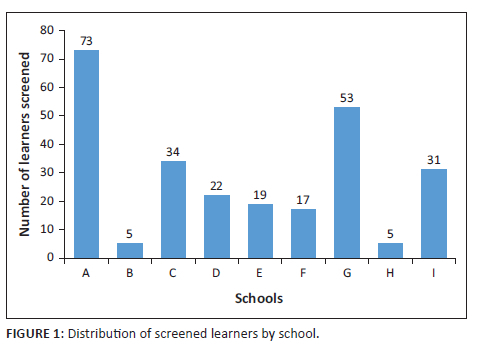
These are results of the hearing screening, which aimed to determine the potential prevalence of hearing loss of Grade R learners in Qumbu CMC. The total number of schools recruited was 10; however, only 9 schools participated in the study. The 10th school could not be accessed because of the policy for conducting research in the last term of the year. Figure 1 shows the participation of learners per school. Table 1 shows the demographics of participants in terms of age, sex and race.
The total number of participants was 259 out of a total of 481 learners from the 9 schools that participated in the research. This was a good turnout rate of 53.84%. Table 1 shows the demographic profile of participants.
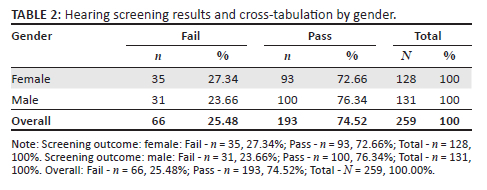
Results show that out of the 259 participants, 66 (25%) failed the screening in at least one of their ears. The failing results applied at any stage of the screening (otoscopic examination, tympanometry or pure-tone screening audiometry). The remaining 193 (75%) learners passed the hearing screening. Passing meant that the learner had been to all three screening procedures and passed at all stages. The ones who had failed were referred to local health facilities for further diagnostic assessment and/or management. Refer to Table 2.
The investigation according to gender distribution consists of the 66 (25.5%) who failed the hearing screening test shows that, 35 (53%) were females and 31 (47%) were males. This suggests that the potential prevalence of hearing problems was higher among females than among males. To determine if this difference is statistically significant, the Chi-squared test for independence was carried out, and the results showed that there was no significant association between gender and hearing problems (Chi2p = 0.496). The odds ratio for the association was found to be 1.2 with a 95% confidence interval of (0.69, 2.12). The confidence interval contains 1, the null value of odds ratios, which means the proportion of girls with hearing problems is not significantly different from that of boys.
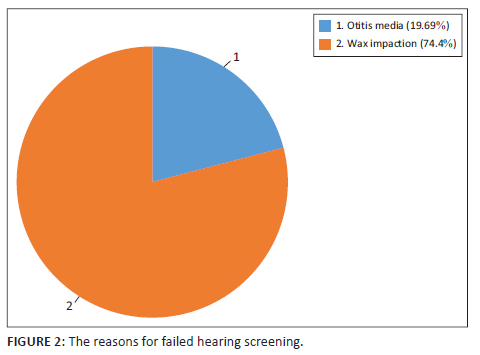
In terms of the causes of screening failure, the results refer to Figure 2. Figure 2 depicts the results from the screening of wax impact on learners as a risk factor.
Hearing screening results showed that 66 learner participants failed one of the hearing screening tests. Of the learner participants who failed the hearing screening, 13 (19.69%) presented with middle ear pathology (otitis media), and 49 (74.4%) presented with impacted wax. The learners who passed the otoscopic examination and middle ear pathologies have all passed the pure-tone hearing screening; hence, the pure-tone hearing screening results do not appear in the Figure 2.
Discussion
The discussion is based on the results and objectives of the study. The first objective was to determine the referral rates and potential prevalence of hearing loss amongst 5-6-year-old Grade R learners in Qumbu CMC by conducting hearing screening.
The results of this study revealed a 25.5% referral rate, which needed further diagnostic assessment and management, which could confirm some prevalence of hearing loss among Grade R learners in Qumbu CMC or not. A majority of failures were caused by wax impaction, which causes temporal hearing loss. This is particularly concerning in a district with limited access to diagnostic services. Practically, it suggests that approximately 250 out of every 1000 Grade R learners may be living with an undetected cause of potential temporal or permanent hearing impairment. Given the importance of hearing in early childhood development, this figure indicates an urgent educational and developmental risk for the local population. The prevalence of impacted cerumen in Qumbu CMC was also notable. While often considered minor, wax impaction can cause temporary conductive hearing loss and interfere with screening accuracy. Govender et al. similarly identified cerumen impaction as a major factor in school hearing screenings in underserved South African areas.2799,27
When compared to global benchmarks, the reported referral rates in Qumbu CMC are significantly higher. For example, a school-based screening in South India found hearing loss in only 11.9% of children aged 5-6 years,28182929
If follow-up diagnostic testing were conducted, the actual prevalence might be lower because of the nature of screening tools and settings. The comparison of these screening results and existing literature increases the reliability of the findings.
The high referral rate and potential prevalence of hearing loss in Qumbu CMC are likely because of contextual factors such as inadequate access to healthcare, poor middle ear health management and low parental awareness. This region is in a similar context as a study done by Phanguphangu et al. in 2025, and these results concur with the results of social determinants of health and hearing loss in children.13
Limitations of the study
The study was conducted in the period post-coronavirus disease 2019 (COVID-19) pandemic in 2022, and although at the time of data collection, the lockdown restrictions were lighter, some participants, especially parents, did not participate to avoid unknown consequences of mass data collection. Learners also took turns attending schools at the time, as a full-capacity class was not allowed. The context-relevant statistics on hearing loss within the Eastern Cape province were generally not available on the databases, and it was difficult to compare any similar studies. The data collection and results are only based on screening results, and no diagnostic follow-ups were conducted, which makes these results non-confirmatory of prevalence but only depicts a referral rate and a potential prevalence. This affects their generalisability, and inference to these findings should be avoided. This study can be used as a case example.
Recommendations
It is recommended that structured, school-based hearing screening programmes, supported by diagnostic services and public education campaigns, be implemented. Without such interventions, undetected hearing loss will continue to compromise school readiness and learning.
Routine screening should be prioritised at school entry age and repeated once in every school phase, in line with policy requirements. These screenings should be conducted by trained school nurses and local clinic nurses to ensure accessibility and sustainability.
Health practitioners should also provide parents and teachers with information on ear hygiene, hearing health and the critical role of hearing in educational development.
A holistic approach that combines screening, diagnostic follow-up and education is essential to prevent long-term communication and learning difficulties, particularly among children in rural districts such as Qumbu.
Conclusion
The hearing screening of Grade R learners aged 5-6 years in 2022 revealed a referral rate of 25.5% for wax impaction and middle ear pathologies. The primary objective of this study was to generate essential data to inform health policy and strengthen early hearing detection services for young children. This objective was achieved, and the study provides context-specific evidence that can guide future screening, research, policy development and management strategies for childhood hearing loss.
Competing interests
The authors declare that they have no financial or personal relationships that may have inappropriately influenced them in writing this article.
CRediT authorship contribution
Antonette R. Pierce: Conceptualisation, Methodology, Formal analysis, Investigation, Writing - original draft, Writing - review & editing. Unati Stemela-Zali: Conceptualisation, Methodology, Supervision, Writing - original draft, Writing - review & editing.
Funding information
This research received no specific grant from any funding agency in the public, commercial or not-for-profit sectors.
Data availability
The data that support the findings of this study are available from the corresponding author, Unati Stemela-Zali, upon reasonable request.
Disclaimer
The views and opinions expressed in this article are those of the authors and are the product of professional research. It does not necessarily reflect the official policy or position of any affiliated institution, funder, agency or that of the publisher. The authors are responsible for this article's results, findings and content.
Acknowledgements
We acknowledge the participants of the research and the Eastern Cape Department of Education at all levels for granting permissions.
References
-
1.World Health Organization. Deafness and hearing loss [homepage on the Internet]. 2019 [cited 2025 Jun 11]. Available from: https://www.who.int/news-room/fact-sheets/details/deafness-and-hearing-loss
» https://www.who.int/news-room/fact-sheets/details/deafness-and-hearing-loss - 2.Butler I. Identification and management of childhood hearing loss. Sabinet Afr J. 2012;30:314-317.
-
3.Khoza-Shangase K, Harbinson S. Evaluation of universal newborn hearing screening in South African primary care. Afr J Prim Health Care Fam Med. 2015;7(1):769. https://doi.org/10.4102/phcfm.v7i1.769
» https://doi.org/10.4102/phcfm.v7i1.769 -
4.Tucci D, Merson MH, Wilson BS. A summary of the literature on global hearing impairment: Current status and priorities for action. Otol Neurotol. 2010;31(1):31-41. https://doi.org/10.1097/MAO.0b013e3181c0eaec
» https://doi.org/10.1097/MAO.0b013e3181c0eaec -
5.Eksteen S, Eikelboom RH, Kuper H, et al. Prevalence and characteristics of hearing and vision loss in preschool children from low-income South African communities: Results of a screening program of 10,390 children. BMC Pediatr. 2022;22(1):22. https://doi.org/10.1186/s12887-021-03095-z
» https://doi.org/10.1186/s12887-021-03095-z -
6.Phanguphangu M, Kgare K, Ross AJ. Age of detection of congenital hearing loss in South Africa: A systematic review. J Public Health Africa. 2025;16(1):777. https://doi.org/10.4102/jphia.v16i1.777
» https://doi.org/10.4102/jphia.v16i1.777 -
7.Lieu JEC, Kenna M, Anne S, Davidson L. Hearing loss in children: A review. J Am Med Assoc. 2020;324(21):2195-2205. https://doi.org/10.1001/jama.2020.17647
» https://doi.org/10.1001/jama.2020.17647 -
8.Mazlan R, Dar HM. Evaluating parental knowledge and attitudes toward childhood hearing loss: A cross-sectional study in Rawalpindi, Pakistan. BMC Pediatr. 2024;24(1):740. https://doi.org/10.1186/s12887-024-05230-y
» https://doi.org/10.1186/s12887-024-05230-y -
9.Health Professions Council of South Africa. Early Hearing Detection and Intervention (EHDI) Position Statement, 2018. Professional board for speech, language and hearing professions [homepage on the Internet]. 2018 [cited 2025 Jun 11]. Available from: https://www.hpcsa.co.za
» https://www.hpcsa.co.za - 10.Martin FN, Clark JG. Introduction to audiology. 9th ed. Boston: Pearson Educational Inc.; 2006.
-
11.Kanji A, Khoza-Shangase K, Maluleke NP. School readiness and academic achievement of children with hearing impairment: A South African exploratory study. S Afr J Child Educ. 2021;11(1):a898. https://doi.org/10.4102/sajce.v11i1.898
» https://doi.org/10.4102/sajce.v11i1.898 -
12.Casoojee A, Khoza-Shangase K, Kanji A. A comparative study of learning outcomes for hearing-impaired foundation phase learners. S Afr J Child Educ. 2024;14(1):1-11. https://doi.org/10.4102/sajce.v14i1.1419
» https://doi.org/10.4102/sajce.v14i1.1419 -
13.Phanguphangu M, Ross AJ, Smythe T. Association between social determinants of health and hearing loss in South African children: A secondary data analysis. PLOS Glob Public Health. 2025;5(6):e0004790. https://doi.org/10.1371/journal.pgph.0004790
» https://doi.org/10.1371/journal.pgph.0004790 -
14.Phanguphangu M, Ross AJ. Clinical utility of smartphonebased audiometry for early hearing loss detection in HIV-positive children: A feasibility study. Afr J Prm Health Care Fam Med. 2021;13(1), a3077. https://doi.org/10.4102/phcfm.v13i1.3077
» https://doi.org/10.4102/phcfm.v13i1.3077 - 15.Joint Committee on Infant Hearing. Year 2019 position statement: Principles and guidelines for early hearing detection and intervention programs. Pediatrics. 2019;144(2):e20192765.
-
16.Matthiassen CN, Singh SA. The hearing profile among learners in schools in the Western Cape. Int J Pediatr Otorhinolaryngol. 2006;71:113-118. https://doi.org/10.1016/j.ijporl.2006.09.012
» https://doi.org/10.1016/j.ijporl.2006.09.012 -
17.Swanepoel D, Hugo R, Louw B. Infant hearing screening at immunization clinics in South Africa. Int J Pediatr Otorhinolaryngol. 2006;70(6):1241-1249. https://doi.org/10.1016/j.ijporl.2006.01.002
» https://doi.org/10.1016/j.ijporl.2006.01.002 -
18.Govender S, Latiff N, Asmal N, Ramsaroop S, Mbele T. Evaluating the outcomes of a hearing screening service for grade one learners in urban areas at Durban, South Africa. J Public Health Afr. 2015;6:52-57. https://doi.org/10.4081/jphia.2015.529
» https://doi.org/10.4081/jphia.2015.529 -
19.Kgare K, Joubert K. Community-based infant hearing screening: Outcomes of a rural pilot programme. S Afr J Commun Disord. 2024;71(1):e1045. https://doi.org/10.4102/sajcd.v71i1.1045
» https://doi.org/10.4102/sajcd.v71i1.1045 -
20.Health Professions Council of South Africa. Minimum standards for the hearing screening in schools [homepage on the Internet]. Pretoria: HPCSA; 2018 [cited 2025 Jun 11]. Available from: https://www.hpcsa.co.za/
» https://www.hpcsa.co.za/ -
21.Rasesemola RM, Matshoge GP, Ramukumba TS. Compliance to the integrated school health policy: Intersectoral and multisectoral collaboration. Curationis. 2019;42(1):a1912. https://doi.org/10.4102/curationis.v42i1.1912
» https://doi.org/10.4102/curationis.v42i1.1912 - 22.Eastern Cape Department of Education. Annual report 2019/2020. Bhisho: Eastern Cape Department of Education; 2020.
-
23.Ellen S. Slovin's formula sampling techniques [homepage on the Internet]. 2020 [cited 2025 Jun 11]. Available from: https://sciencing.com/how-6188297-do-determine-audit-sample-size-.html
» https://sciencing.com/how-6188297-do-determine-audit-sample-size-.html -
24.Chawinga WD, Zinn S. Use of Web 2.0 by students in the faculty of information science andcommunications at Mzuzu University, Malawi. S Afr J Inf Manag. 2020;18(1):694. https://doi.org/10.4102/sajim.v18i1.694
» https://doi.org/10.4102/sajim.v18i1.694 - 25.Joubert GR. Big data: Insights and the scientific method. Adv Parallel Comput. 2015;25:3-17.
-
26.Beauchamp T, Childress J. Principles of biomedical ethics: Marking its fortieth anniversary. Am J Bioeth. 2019;19(11):9-12. https://doi.org/10.1080/15265161.2019.1665402
» https://doi.org/10.1080/15265161.2019.1665402 - 27.Jacob A, Joseph A, Rupa V. Chronic otitis media: Prevalence and practices among rural South Indian children. Int J Pediatr Otorhinolaryngol. 1999;39:133-138.
- 28.Hall J, Morton S, Braakhuis J, Perry M. A framework for knowledge translation in allied health. J Allied Health. 2018;47(1):28-33.
- 29.Joubert G. Social Epidemiology. In: Ehrlich R, Joubert G, editors. Epidemiology: A research manual for South Africa. Cape Town: Oxford University Press Southern Africa (Pty) Ltd; 2014, p. 147-161.

Accepted: 26 Oct. 2025
Published: 11 Dec. 2025