Outcomes of a model integrating tuberculosis testing into COVID-19 services in South Africa
Abstract
The coronavirus disease 2019 (COVID-19) pandemic led to a reordering of healthcare priorities. Health resources were turned to the screening and diagnosis of COVID-19, leading to a reduction in tuberculosis (TB) testing and treatment initiation. An innovative model that integrated TB and COVID-19 services was adopted at primary care facilities in Johannesburg Health District, Gauteng. This short report illustrates results from this model's implementation in two facilities. Patients were screened for COVID-19 at a single point of entry and separated according to screening result. Self-reported human immunodeficiency virus (HIV) status, symptom, and symptom duration were then used to determine TB risk amongst those screening positive for COVID-19. Data from clinical records were extracted. Approximately 9% of patients with a positive symptom screen (n = 76) were sent for a TB test and 84% were sent for a COVID-19 test. Amongst those sent for a TB test, 8% (n = 6) had TB detected, and amongst those sent for a COVID-19 test, 18% (n = 128) were positive. Amongst those with COVID-19-related symptoms, 15% (n = 130) presented with a cough or fever and were known HIV positive and 121 (93%) of these were sent for a COVID-19 test and 31 (24%) were sent for a TB test. Given the HIV prevalence and symptoms in our study, our results show lower-than-expected TB tests conducted. CONTRIBUTION: Our study documents the outcomes of an innovative way to combine operational workflows for TB and COVID-19. This provides a starting point for countries seeking to integrate TB and COVID-19 screening and testing
COVID-19; tuberculosis; South Africa; clinical algorithm; primary health care
Introduction
Until the emergence of severe acute respiratory syndrome coronavirus 2 (SARS-CoV-2), the virus that causes coronavirus disease 2019 (COVID-19), in 2020, tuberculosis (TB) caused the highest number of infectious disease-related deaths globally1,2,345167
Integrated tuberculosis/COVID-19-testing model
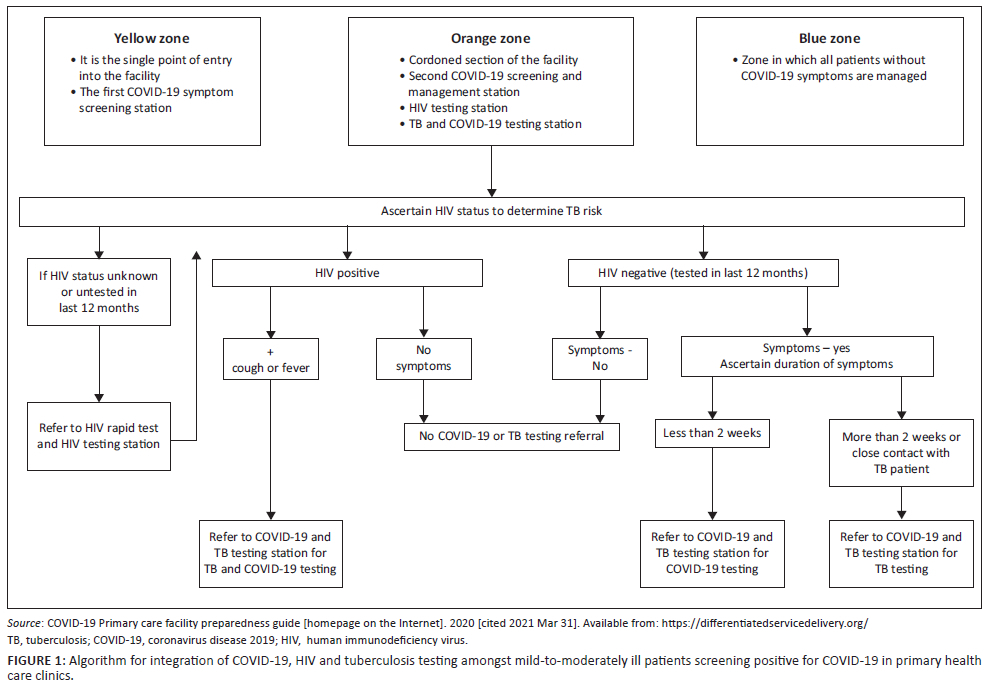
An integrated primary care facility approach to ensure appropriate testing for TB in patients' screening positive for COVID-19 was developed88910
Patients in the orange zone were assessed by a clinician, with severely ill patients being referred to a higher level of care. For all the other patients, the need for COVID-19 testing was then determined using updated person under investigation criteria. Oropharyngeal, nasopharyngeal or sputum sample was collected for diagnosing COVID-19.
The clinician then ascertained the HIV status of all patients in order to determine TB risk (see Figure 110® MTB/RIF Ultra. Patients with a known HIV-negative test result in the last 12 months and who reported TB symptoms for more than two weeks or reported close contact with a TB patient were also classified as at risk for TB and received sputum-based testing. Details of patients who had a COVID-19 PCR test conducted or TB were recorded in a paper register.
Outcomes of the model at two facilities in Johannesburg
This study was conducted at two purposively selected community healthcare centres Alexandra (Alexandra township) and Stretford (Orange Farm township) in Johannesburg Health District, Gauteng Province, South Africa.
Data were collected retrospectively from paper registers and the National Health Laboratory Service laboratory information system. A clinical note form and COVID register were developed for the purposes of rapid model implementation. The clinical note forms were completed for all patients entering the orange zone, and the COVID-19 register was completed for all patients who had a COVID-19 test. All available clinical stationaries for patients visiting the orange zone between May 2020 and July 2020 were captured. These months fall within a period in which the country experienced its first wave of COVID-19.
A total of 2217 records for patients who had a COVID-19 test and 846 clinical notes for patients who visited the orange zone (positive COVID-19 symptom screen) were captured into Research Electronic Data Capture (REDcap) database.11n = 293) of those with a captured symptom had a recorded symptom duration; of these, 9% (n = 26) had a symptom duration of more than two weeks. Forty-five percent of patients were known to be HIV negative (n = 377), 20% were known HIV positive (n = 168), 35% reported an unknown HIV status on initial assessment (n = 297) and four patients had no data for HIV status captured. We cannot report HIV results for those with unknown status, as test results were not recorded on the same form. Amongst those with COVID-19-related symptoms, 15% (n = 130) presented with a cough or fever and were known HIV-positive and 121 (93%) of these were sent for a COVID-19 test and 31 (24%) were sent for a TB test. Data from the clinical forms show that approximately 76 (9%) patients with a positive COVID-19 symptom screen were sent for both a TB and COVID-19 test, 3 were sent for a TB test only and 635 (75%) were sent for a COVID-19 test only. Amongst those sent for a TB test, 8% (n = 6) had TB detected and all were bacteriologically confirmed. Amongst those sent for a COVID-19 polymerase chain reaction (PCR) test, 18% (n = 128) were positive. Amongst those sent for both a COVID-19 and TB test, none came back positive for both.
Ethical considerations
Ethical approval was provided by the Human Sciences Research Council (HSRC) (No. REC 3/22/08/18), and permission was obtained from the Johannesburg District Research Committee.
Discussion
Our study describes outcomes of a simple, innovative model that integrated TB and COVID-19 diagnosis at primary health care clinics in the early stages of the COVID-19 pandemic in South Africa. Health systems across the world were challenged by COVID-191213,141516,1718
While the decision to offer TB testing was at the discretion of the clinician, our algorithm prompted the clinician to initiate TB testing in the presence of cough of any duration, fever, night sweats, or weight loss if HIV infected, or cough for greater than two weeks, fever, night sweats, or weight loss if HIV uninfected. Very few patients had symptoms of greater than two weeks, possibly as these patients were not screened positive for COVID-19, but went directly to TB services, and so TB testing would have been predominantly indicated amongst patients with HIV.
Our findings showed that approximately 9% (n = 79) of patients who screened positive for COVID-19 were tested for TB. Only 24% of those who were HIV positive and presented with a cough or fever received a TB test. Given that our study collected data from the early phases of the model's implementation, we suspect that there was so much focus on COVID-19 that TB continued to be neglected despite the algorithm. The model was faced with initial implementation challenges such as healthcare worker confusion around when a patient should be tested for both COVID-19 and TB and number of samples to send. Providing clear standard operating procedures for joint sample collection would help in avoiding this confusion in the future. It would also be useful for future research to assess the outcomes of an integrated model, such as this changes several months into its implementation.
Data extracted from the District Health Information System for these two facilities for the period May 2020 to July 2020 show on average a 11% decline in primary head count for those older than 20 years and 63% decline in TB testing when compared with data for the same period in the previous year (a decline from 1010 to 370 TB investigations done). Using the same data periods, we also find a 59% decline in positive TB cases (a drop from 91 to 37 positive TB tests). Our study shows that TB testing during COVID-19 continued at these two facilities. The reduction in TB testing recorded at the onset of COVID-19 is most likely explained by movement restriction and patients' fear of contracting COVID-1919,20
Our study has a number of limitations. Our results cannot be generalised, as they represent only two purposively selected facilities. Implementation of fidelity and outcomes may vary across facilities in which the model was implemented. There are a large amount of missing data, as clinical record forms were located for only 846 of 2217 patients entering the orange zone; however, there was no clear pattern of missingness across facilities, suggesting that ascertainment bias was limited. Some records were also poorly captured on the clinical forms. For example, symptom duration was only captured in 40% of the forms. Missing data are a common challenge when using clinical records; however, we have described outcomes of the model as implemented in programmatic conditions which is, therefore, likely scalable. Thirty-five percent of patients had unknown HIV status on presentation, and although the algorithm directed them to HIV-testing services, the results were not available to us.
In conclusion, this study demonstrates the outcomes of a simple and feasible model for integrating TB testing services into COVID-19 care pathways at primary care facilities. Integration of TB and COVID-19 screening and testing should be scaled up, and the results of such scale up were documented.
This material is based upon work supported by the United States President's Emergency Plan for AIDS Relief (PEPFAR) through the United States Agency for International Development (USAID) under Cooperative Agreement number 72067418CA00023 to the Anova Health Institute. Anova Health Institute is a USAID funded PEPFAR district support partner in South Africa. As such, Anova provides technical assistance at public sector facility level and directs service delivery via healthcare workers employed by Anova. The contents are the responsibility of Anova Health Institute and do not necessarily reflect the views of USAID or the United States Government.
References
-
1.Stop TB Partnership. Simultaneous, integrated diagnostic testing approach to detect COVID-19 and TB in high TB burden countries [homepage on the Internet]. 2020 [cited 2021 May 30]. Available from: https://www.stoptb.org
» https://www.stoptb.org -
2.Malik AA, Safdar N, Chandir S, et al. Tuberculosis control and care in the era of COVID-19. Health Policy Plan. 2020;35(8):1130-1132. https://doi.org/10.1093/heapol/czaa109
» https://doi.org/10.1093/heapol/czaa109 - 3.World Health Organization. Global tuberculosis report 2020. Geneva: World Health Organization; 2020.
-
4.National Department of Health. The First National TB Prevalence Survey: South Africa 2018. Short report; 2021 [cited 2021 May 25]. Available from: https://www.knowledgehub.org.za/elibrary/first-national-tb-prevalence-survey-south-africa-2018
» https://www.knowledgehub.org.za/elibrary/first-national-tb-prevalence-survey-south-africa-2018 -
5.World Health Organization. Who coronavirus disease (COVID-19) Dashboard [homepage on the Internet]. World Health organization; 2020 [cited 2021 Jun 05]. Available from: https://covid19.who.int/explorer
» https://covid19.who.int/explorer -
6.The Stop TB Partnership. 12 months of COVID-19 eliminated 12 years of progress in the global fight against tuberculosis [homepage on the Internet]. 2021 [cited 2021 May 30]. Available from: http://www.stoptb.org/news/stories/2021/ns21_011.html
» http://www.stoptb.org/news/stories/2021/ns21_011.html -
7.Hofman K, Madhi S. The unanticipated costs of COVID-19 to South Africa's quadruple disease burden. S Afr Med J. 2020;110(8):689-699. https://doi.org/10.7196/SAMJ.2020.v110i8.15125
» https://doi.org/10.7196/SAMJ.2020.v110i8.15125 -
8.Wilkinson L, Moosa S, Cooke R, Muller A, Boyles T. Preparing healthcare facilities to operate safely and effectively during the COVID-19 pandemic: The missing piece in the puzzle. S Afr Med J. 2020;110(9):835-836. https://doi.org/10.7196/SAMJ.2020.v110i9.150
» https://doi.org/10.7196/SAMJ.2020.v110i9.150 -
9.International AIDS Society (IAS). Covid-19 DSD resources [homepage on the Internet]. 2021 [cited 2021 Nov 18]. Available from: https://differentiatedservicedelivery.org/Resources/Resource-Library/COVID-19-DSD-resources
» https://differentiatedservicedelivery.org/Resources/Resource-Library/COVID-19-DSD-resources -
10.COVID-19 Primary care facility preparedness guide [homepage on the Internet]. 2020 [cited 2021 Mar 31]. Available from: https://differentiatedservicedelivery.org/
» https://differentiatedservicedelivery.org/ -
11.Harris PA, Taylor R, Thielke R, Payne J, Gonzalez N, Conde JG. Research electronic data capture (REDCap) - A metadata-driven methodology and workflow process for providing translational research informatics support. J Biomed Inform. 2009;42(2):377-381. https://doi.org/10.1016/j.jbi.2008.08.010
» https://doi.org/10.1016/j.jbi.2008.08.010 -
12.Khetrapal S, Bhatia R. Impact of COVID-19 pandemic on health system & Sustainable Development Goal 3. Indian J Med Res. 2020;151(5):395. https://doi.org/10.4103/ijmr.IJMR_1920_20
» https://doi.org/10.4103/ijmr.IJMR_1920_20 -
13.Dlangalala T, Musekiwa A, Brits A, et al. Evidence of TB services at primary healthcare level during COVID-19: A scoping review. Diagnostics. 2021;11(12):2221. https://doi.org/10.3390/diagnostics11122221
» https://doi.org/10.3390/diagnostics11122221 -
14.Zokufa N, Lebelo K, Hacking D, et al. Community-based TB testing as an essential part of TB recovery plans in the COVID-19 era. Int J Tuberc Lung Dis. 2021;25(5):406. https://doi.org/10.5588/ijtld.21.0077
» https://doi.org/10.5588/ijtld.21.0077 -
15.MacLean EL, Villa-Castillo L, Ruhwald M, Ugarte-Gil C, Pai M. Integrated testing for TB and COVID-19. Med. 2022;3(3):162-166. https://doi.org/10.1016/j.medj.2022.02.002
» https://doi.org/10.1016/j.medj.2022.02.002 -
16.Khobragade RN, Murthy N, Aloysius S, Surendran D, Rakesh P, Balakrishnan S. Experience of integrated screening and testing for TB and COVID19 from Kerala, India. Public Health Pract (Oxf). 2021;2:100198. https://doi.org/10.1016/j.puhip.2021.100198
» https://doi.org/10.1016/j.puhip.2021.100198 -
17.Government of Kerala. Integrated diagnostic algorithm for diagnosis of TB in Kerala in the context of COVID-19 [homepage on the Internet]. No 31/F2/2020, Thiruvananthapuram; 2020 [cited 2022 Jan 15]. Available from: https://dhs.kerala.gov.in/wp-content/uploads/2020/09/Guidelines-Integrated-TB-Diagnosis-algorithm-in-context-COVID-19.pdf
» https://dhs.kerala.gov.in/wp-content/uploads/2020/09/Guidelines-Integrated-TB-Diagnosis-algorithm-in-context-COVID-19.pdf -
18.Loveday M, Cox H, Evans D, et al. Opportunities from a new disease for an old threat: Extending COVID-19 efforts to address tuberculosis in South Africa. S Afr Med J. 2020;110(12):1160-1167. https://doi.org/10.7196/SAMJ.2020.v110i12.15126
» https://doi.org/10.7196/SAMJ.2020.v110i12.15126 -
19.National Institute for Communicable Diseases. COVID-19 special public health surveillance bulletin: Volume 18. Supplementary issue 4. 2020 [cited 2021 Jun 01]. Available from: https://www.nicd.ac.za/wp-content/uploads/2021/04/COVID-19-Special-Public-Health-Surveillance-Bulletin-_Issue-4_TB-testing.pdf
» https://www.nicd.ac.za/wp-content/uploads/2021/04/COVID-19-Special-Public-Health-Surveillance-Bulletin-_Issue-4_TB-testing.pdf -
20.National Institute for Communicable Diseases S.A. Impact of COVID-19 intervention on TB testing in South Africa [homepage on the Internet]. 2020 [cited 2021 May 24]. Available from: https://www.nicd.ac.za/wp-content/uploads/2020/05/Impact-of-Covid-19-interventions-on-TB-testing-in-South-Africa-10-May-2020.pdf
» https://www.nicd.ac.za/wp-content/uploads/2020/05/Impact-of-Covid-19-interventions-on-TB-testing-in-South-Africa-10-May-2020.pdf

Accepted: 05 Sept. 2022
Published: 13 Dec. 2022