Women's perspective of facility-based childbirth services in Ghana: A qualitative study
Abstract
BACKGROUND: Many policy makers at country level in both medium and low to middle-income countries still have great difficulty deciding which quality intervention would have the greatest impact on the health outcomes delivered by their health systems. AIM: To investigate women's perceptions about the factors that hinders or facilitates the provision of quality childbirth services in Ghana's health care services to guide improvement efforts. SETTING: The study was conducted in the greater Accra region of Ghana in two primary level hospitals (district hospitals). METHODS: A qualitative study design, which is exploratory, descriptive and contextual in nature, was used. Semi-structured interviews were used to examine the perspectives of 15 women on the factors that influence the quality of childbirth services and how services could be improved in Ghana. Data were analysed through data reduction, data display and generation of themes. RESULTS: The findings in this study revealed two major themes, firstly, barriers to quality childbirth with five subthemes: high workload, shortage of health workers, non-availability of some services, as well as poor coordination, unacceptable staff behaviour and lack of cooperation from some clients, were identified by the participants as the major causes of poor quality. Secondly, ways to improve care reported, were encouraging health workers to be patient with clients, promoting open communication, friendliness and attentiveness. The need to reorganise service provision to make it more client centred, was also highlighted. CONCLUSION: The study findings highlight the importance of paying attention to factors such as service organisation and coordination, high workload, inadequate number of staff, as well as limitations in infrastructure and logistics for quality services delivery. Equally important are institutionalisation of systems to continuously assess and improve staff competence and attitudes and the creation of an environment that can foster good interpersonal relationship between health care providers and patients.
Introduction
The need to continuously search for mechanisms to address health care quality cannot be understated. This need is evident even in well-developed and resourced health systems.1
The World Health Organization (WHO)94,1011
Maternal and child health research needs to be directed towards innovative interventions involving consumer participation, particularly those that can be implemented in middle and low-income countries where the accessibility and quality of the health systems are poor.10,113
Research methods and design
Study design
An exploratory descriptive design was used, which helped the researcher to understand the phenomenon studied from the participants' viewpoint in the context where the activities took place. A descriptive design facilitated data gathering, pertaining to the views of women regarding the quality of childbirth services in health facilities in Ghana.
Setting
The study was conducted in the greater Accra region of Ghana. The population of Ghana is estimated to be about 24.7 million with a growth rate of 2.4% and is divided into 10 regions with 216 administrative districts.1213Population and Housing Census Report,141516
Population and sampling
The study was limited to government hospitals because they seem to be amongst those who have more unacceptable media publicity regarding quality of childbirth services. The regional hospital was purposely selected because it is large and provides a wide range of childbirth services, including antenatal, intrapartum and postnatal care. Two primary level hospitals (district hospitals) were randomly selected from the 10 government owned hospitals.15
All women who had utilised childbirth services in the selected hospitals constituted the population of interest. Purposive sampling technique was used to select women delivered at the hospitals during the period of data collection and who were willing to be part of the study. As the goal of the study was not to generalise the findings to a population but to who obtain insights into a phenomenon and understand the experiences of individuals, the purposive sampling was deemed to be appropriate.16,1716
Prior arrangement was made with the midwives in charge of the maternity units of the hospitals for recruitment. All women who delivered in the hospitals were contacted by the ward in charge to discuss the purpose of the study and to elicit their willingness to participate in the study. This notwithstanding, women below 18 years of age who were not accompanied by their spouse, parent or guardian to give consent and women who had observable psychiatric or substance abuse problems, were excluded from the study. Once the women agreed to participate in the study, the information was relayed to the researcher who visited the women in the hospital for further discussion and arrangement of interview. A total of 19 women agreed to participate in the study.
Data collection
Interviews were conducted just after discharge by the researcher in a private office in the hospitals. Interviews were audiotaped, and field notes were taken on observations. The interview requested women to describe factors that in their view influenced the quality of childbirth services. They were also requested to suggest solutions. Probes were used to further explore responses. Of the 19 women agreed to participate in the study, 15 were interviewed as the point of theoretical saturation was reached. The timing of the interviews was appropriate as it offered the opportunity to limit recall bias because of time lapse.
Data analysis
All interviews were transcribed and analysed using Miles and Huberman's1718
Trustworthiness
The principles of trustworthiness proposed by Lincoln and Guba18
Ethical considerations
Approval was obtained from the Research Ethics Committee of the Ghana Health Service and Ministry of Health for the larger study. Ethical approval was also obtained from the Research Ethics Committee of the University of South Africa (HSHDC/95/2012). In addition, participation in the study was done with the consent (verbal and/or written) of the participants. The participating hospitals gave permission for the study to be conducted. The participants were informed that they could opt out of the research at any stage without being penalised or victimised. Refusal to participate or to continue did not lead to any loss of personal benefit. In adherence to the principle of anonymity and confidentiality, coded identifiers were used in the interview recording or transcripts. The responses cannot be linked to any individual woman. Copies of the typed transcripts were offered to the participants for verification.
Results
Profile of women interviewed
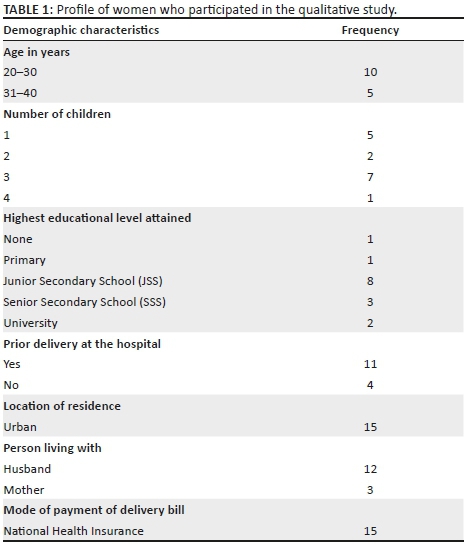
Table 1 presents the characteristics of the women. The age of the women ranged 21 - 37 years and the mean number of children (alive or dead) was two. Majority of the women had delivered before and only four were first-time mothers. Two women had a caesarean section and 13 had spontaneous vaginal delivery. All the women paid their bills through the National Insurance Scheme. Although some of them had to pay cash for other items such as mackintoshes, those were provided by the health facility staff.
Themes
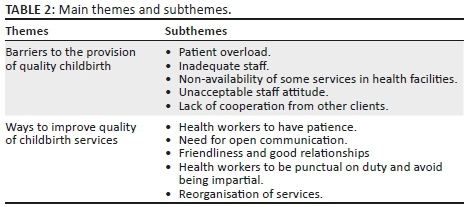
The themes emerged from the data (Table 2) and both negative and positive sentiments were expressed; examples of these are provided under each theme.
Participants' perspectives on barriers to the provision of quality childbirth
The participants in this study talked about a number of organisational and individual health worker factors that in their view constituted barriers to the provision, utilisation and unacceptable experiences during childbirth. They felt that the inability of staff to deliver quality care could partly be because of the high number of patients. The high number of clients contributed to long waiting time during labour, inadequate staff time to attend to clients and even affected availability of beds and space. At the prenatal stage, some participants said that they had to leave their home very early on their antenatal clinic days to avoid the long delays because of the high number patient. Clients also indicated that they could notice at times that the staff were tired, stressed and often hindered themselves from making demands. In describing their experiences, the women noted that the small number of staff caused too much delays and inability on the part of the staff to have time for the clients. Shortage of staff was also indicated by the participants. The participants in this study seemed to be echoing the agenda that they do not want to be going to different places to obtain services. This barrier related mainly to sonography and other laboratory tests and to some extent pharmaceuticals. Some participants complained unacceptable staff attitude.
One participant commented that:
'… the point is we are many sometimes, and it's like sometimes, we quarrel amongst ourselves because of the queue. You are in front of me; I'm behind you, and all that. That's what brings about quarrel, getting to the Holy Saturday, we were many. And honestly, I will applaud the nurses who attended to us that day because we were many and in fact they come, and they go. People come to give birth and they go, and there are some also wailing and all that. And we were many; so, when you come, you will have to wait. There were no beds. You will be asked to sit. Me like this - I was asked to lie there because there were no beds. So, I laid on the floor there. As I said earlier, it's because we are many than them. We are much. So, she is always tired. So, if you come and then you want to prove stubborn a bit, she would have to just say something to you in order to attend to the next person. And also, if you need some assistance too, because there is somebody on the waiting list too, when she is done with you, you have to go for somebody else to come. So, we are many. So, if they would also address that.' (Wp11, Female, 26 years old)
One participant narrated an instance where a client had some complications because the staff did not have enough time to effectively care for her. Her narrative and another from a participant on the staff issues are as follows:
'…the client that came that day were many, and the midwives were only two, so they didn't have time at all; a friend of mine came to deliver and after delivering they didn't have time to remove unnecessary things from her because another client was in; so, I saw that the clients were more than the workers. Just as I said, the nurses at the labour ward should be more.' (Wp8, Female, 33 years old)
'Every time, I want a doctor available for consultation. Sometimes when you come in there is no doctor. The last time, for instance, I came in to conduct a scan. I sat there for a long time, because there were many people all accessing services. I joined the queue for a long time; secondly the doctor was not around. So, I wish that there is a doctor around always for consultation.' (Wp12, Female, 27 years old)
The women found the process of having to go to different government, private laboratories and diagnostic centres outside their primary health facility premises for different tests cumbersome and waste of time. Also, the women did not understand why they had to do a scan on every prenatal visit and expressed frustrations about the fact that they were only informed of these diagnostic tests when they arrived in the health facility. The following were some of their sentiments:
'As for that, it is a major problem, because when you come in, they say go over there and have it done [scan or other laboratory tests]. By the time you get there, for instance, the personnel at that hospital facility are not working. When that occurs, it becomes a bit troubling. So, they have to put all those facilities in place so that, when we come in to access facilities, we don't have to cross the road to a different place. If we had all at the same place, it would be helpful; they should have the tests available so that when we come in, everything would be done here in a continuous fashion. We don't have to do it elsewhere, so it creates confusion.' (Wp9, Female, 26 years old)
'… the lab [laboratory], I first did the first here, and whenever I go there, they tell me that they don't have the medicine for that lab, so the first one I went there, and they told me they don't have the medicine. Since then, I didn't go there again. I would have loved that any medicine needed should be presented to them so that when we go there they wouldn't tell us stories.' (Wp6, Female, 22 years old)
Many participants considered some of the staff attitudes they observed or experienced as a barrier. One participant described her experience as follows:
'… so when I got to the top, no one attended to me. It was a certain girl that they said she's at 7 cm, so they were standing at her, and I was suffering so I get to the down. I brought a chamber pot so I was 'wee-wee' [urinating]…it pour down on the floor; I asked a certain nurse that what should I use [to clean it]; the nurse told me if I brought T-roll [toilet roll] I should use it. So I was using the T-roll when a certain nurse came to tell me that, me, I have 'poo-pooed' [defecated] on myself, and am using a T-roll. The way I have done myself, do I think cleanliness will come to me? Meanwhile, the bay [washroom] was just here; I haven't delivered before so I didn't see. I was not happy. She said, "get up, get up, let's go".' (Wp6, Female, 22 years old)
Another barrier to provision of quality care was the lack of cooperation from some clients. Some participants were of the view that the behaviour of some clients provoked health workers. In their view, it is imperative for clients to show respect and adhere to the advice of health workers. Their comments included the following:
'Some people [clients] come with different behaviours from their homes. Some are just annoying so when there is any misunderstanding, it's the fault of those who come here, the way they talk. Sometimes, they only need to be patient but they rather make noise.' (Wp1, Female, 37 years old)
'If you come here and behave like you are "too known", then they would be angry at you. They would talk against you so if you come with patience for them, they would also be patient with you. So when I come they don't do any of that to me.' (Wp3, Female, 29 years old)
'We normally provoke them because when we come and they tell us to sit at a particular place, we should obey them. They teach us. You will see some people walking about, if you do that, they shout at you, they won't be angry but will shout at you. They have made us to also know that they are training us. So, it is good.' (Wp7, Female, 32 years old)
Participants' perspectives on ways to improve quality of childbirth services
To improve the quality of childbirth services, it is essential that health organisations study and understand how women think and feel about services so that they can factor their inputs in improvement strategies. Therefore, the following were suggested: health workers to have patience, need for open communication, friendliness and good relationship, health workers to be attentive and reorganisation of services. Women in this study overwhelmingly felt that there was the need for health workers to have and exercise patience when dealing with clients.
One participant had this to say:
'Well, I, I, believe labour itself is something that makes people go mad. And it seems our nurses are used to [it]. So when you come and you are screaming, it's like it is normal. So they don't care. But I would entreat if they can be a bit patient, because some of them have been through [it]. So if they can be a bit patient with us, because it's not so easy. So, when you come and you are, at least they should say something nice. But it's like, and they will be like, there is nothing I can do about it, in spite of your shouting. I say lie down, go and lie down. And at least if you say 'sorry, it will be over soon' and all that. That is a bit good. But if you are telling me it's painful and all that, you are rather adding salt to my injury.' (Wp11, Female, 26 years old)
Participants expressed the value of health workers sharing information with them in an open and truthful manner. The participants noted that if they are involved in discussions, then they might have some suggestions to assist in their care. One of such comments was:
'When a patient or a pregnant woman comes and they are attending to them, they must be chatting [talking] with them, so that may be, the ailment disturbing the person, maybe she has some efforts [suggestions] that could help her better. Or do this, do that for her but when you are not happy with them chatting with them, you alone, you may not know where exactly the problem is and you will be struggling searching for it. Maybe, when you ask her [woman], she can tell you.' (Wp14, Female, 21 years old)
'I would want to have a good relationship with them because for doctors and nurses, God has chosen them as our gods, you understand? So, if you come and are not in a good relationship with them, it could happen that you would lose your life. If you come and don't obey them and respect, they could ignore you and you might lose your life. So, we have to, left to me alone, give them our respect and obey them.' (Wp15, Female, 37 years old)
'When you come, they should be quick to attend to you'. (Wp2, Female, 26 years old)
'Okay, what I would say is that some come early in the morning, like we come early. Upon getting here, they do not see to you. Some [staff] who know where you work, when they get there then they see to them. I don't like that and it worries me. I would want that when we all come, we all be seen to, according to the time we get here.' (Wp3, Female, 29 years old)
'The only thing is may be the late attendance of nurses to work that is the little problem. May be you come and they say the one to attend to you is not in yet. So you would have to wait for the person that is our only problem.' (Wp7, Female, 32 years old)
'Here if you are coming for antenatal, you have to wake up early and come. Honestly, around 5:00 am, because we are many. So anytime it gets to my turn and I need to come to antenatal, when I sleep I'm not able to sleep. You have to wake up, come early. You have to come and sit and wait for them also. And if that [the working hours] would be changed, I would love that, yes, because as early as 5:00 am, as early as 4:30 am, you come here, you meet pregnant women sitting down, just because they want to come early and go early….' (Wp11, Female, 26 years old)
The second aspect was providing a better coordinated care where all services will be sourced in their primary hospital. Suggestions were made for the health facility authorities to provide the necessary equipment and logistic for laboratory and diagnostic tests:
'So, they have to put all those facilities in place so that when we come in to access facilities, we don't have to cross the road to a different place. If we had all at the same place, it would be helpful; they should have the tests available so that when we come in, everything would be done here in a continuous fashion. We don't have to do it elsewhere, so it creates confusion.' (Wp9, Female, 26 years old)
The third key area was putting in measures to formalise the orientation of women to the labour ward so that they could familiarise themselves with what goes on at the ward prior to labour. If possible, the participants would prefer a system where they could be assigned to a primary delivery care midwife in the labour ward.
Discussion
From the findings of this study, it is indicated that in order to attain quality of care for pregnant women in Ghana, the following should be followed: improving staff attitude for them to be patient, attentive and friendly and establishing good relationship with clients through tailor-made training programmes. Aiyedun et al.19920
Many participants in this study complained about and considered some of the staff attitudes they observed or experienced as a barrier. Ashraf et al.212223242526
Some of the participants indicated that they could notice at times that the staff were tired, stressed and often hindered themselves from making demands. The influence of high workload on quality of care has been well documented.27,28 It was interesting; however, for participants in this study to identify 'too many clients' as a barrier as this was not identified as one of the variables that service users often mention as a barrier in the literature reviewed. Challenges with high workload were also identified by Assibi et al.293031
As indicated by some women, the small number of staff caused too much delays and inability on the part of the staff to have time for the clients. This is supported by Fagbamigbe and Idemudia3231,32,33 The devastating impact on care includes serious obstetrics complications and high maternal mortality.3334
Some women complained about a poorly coordinated referral system for women in accessing other services that are not available in their primary hospital. Sending women to other places for services is characteristic of many health facilities in low and middle-income countries.353637
Strength and limitations of the study
The following are the strengths and limitations of the study: criticism levelled at qualitative research in general often pertains to issues of lack of randomisation, small sample size subjectivity and interpretation bias, and inability to establish a causal relationship. The researchers are of the view that the rich description of the sample, data collection methods and the process of analysis demonstrates the transparent nature of this research paradigm and makes the findings of this study useful. Finally, another limitation is that the data were based on self-reports. A direct observation of the care process and other contextual issues would have added further dimension to enrich the findings. It must be noted; however, that the participants were very open and clearly articulated details of their views.
Although the participants voluntarily participated in the study, the views of those who did not volunteer may be different. Although the interviews were conducted on the hospital premises immediately after discharge, it is possible that the location could have hindered some of the participants from fully expressing their views for fear of possible reprimand.
The findings may not be generalisable because the study was conducted in only three hospitals in one of the 10 regions but could be transferable to other settings of similar characteristics. It must be noted also that most of the themes identified were supported by the local and international literature, and as such the findings could be very useful to health organisations that desire to improve the quality of childbirth services.
Recommendations
To facilitate quality of care for pregnant women in Ghana: improving staff attitude for them to be patient, attentive and friendly and establishing good relationship with clients through tailor-made training programmes. It will also be beneficial to systematically investigate other contextual factors that affect staff attitude for redress, for example, addressing staffing levels in hospitals by carrying out workload analysis and scheduling staff per need. It also includes instituting of measures to review and reorganise the following services: scheduling of both doctors and midwives so that they can have continuous interaction with clients to build relationships, reviewing of hospital opening hours at the antenatal clinic, instituting outreach or home-based services to take some of the workload from hospitals, instituting measure to ensure a better coordinated care and formalising the orientation of women to the labour ward so that they could familiarise themselves with what goes on at the ward prior to labour. Further research needs to be conducted in nursing education to incorporate or re-enforce communication and/or relational skills of midwives.
Conclusion
Women's perception of care is important as it contributes to their satisfaction with maternal services. In this study, pertinent issues that influence quality of care of pregnant women were identified. These findings, although not novel, reinforce the known detrimental effects of high workload, shortage of health workers, unacceptable staff attitude, lack of or inadequate infrastructure and logistics, fragmentation and ineffective coordination of services on maternal outcomes. Unproductive behaviours of some patients and how these contribute to poor care show that although health system structures may hinder quality health care, it is important to address human elements such as patience, effective and open communication, friendliness and attentiveness.
Competing interests
The authors declare no conflict of interest with regard to the writing of this article.
Authors' contributions
G.S.A. wrote the proposal, conducted the study and developed the initial draft and final submission of the article. L.M.M. supervised the study and provided crucial feedback and guidance regarding the study and drafting of the article.
Acknowledgements
The authors would like to thank all the female participants for their participation in the study.
References
- 1. World Health Organization. Quality of care: A process for making strategic choices in health systems. Geneva: WHO; 2006.
-
2. Hulton L, Matthews Z, Stones RW. A framework for the evaluation of quality of care in maternity services, opportunity and choice [homepage on the Internet]. Department of Social Statistics, University of Southampton; 2000 [cited 2012 Mar 11]. Available from: http://r4d.dfid.gov.uk/
» http://r4d.dfid.gov.uk/ -
3. Raven JH, Tolhurst RJ, Tang S, Van den Broek N. What is quality in maternal and neonatal health care? Midwifery. 2012;28:e676-e683. https://doi.org/10.1016/j.midw.2011.09.003
» https://doi.org/10.1016/j.midw.2011.09.003 - 4. Bowser D, Hill K. Exploring evidence for disrespect and abuse in facility-based childbirth: Report of a landscape analysis. Geneva, Switzerland: USAID-TRAction Project; 2010.
-
5. Althabea F, Bergelb E, Cafferatac ML, et al. Strategies for improving the quality of health care in maternal and child health in low- and middle-income countries: An overview of systematic reviews. Paediatr Perinat Epidemiol. 2008;22(1):42-60. https://doi.org/10.1111/j.1365-3016.2007.00912.x
» https://doi.org/10.1111/j.1365-3016.2007.00912.x -
6. Jamas MT, Hoga LAK, Tanaka ACA. Mother's birth care experiences in a Brazilian birth center. Midwifery. 2011;27:693-699. https://doi.org/10.1016/j.midw.2009.10.004
» https://doi.org/10.1016/j.midw.2009.10.004 -
7. Tuncalp O, Hindin MJ, Adu-Bonsaffoh K, Adanu R. Listening to women's voices: The quality of care of women experiencing severe maternal morbidity, in Accra, Ghana. PLoS One. 2012;7(8):e44536. https://doi.org/10.1371/journal.pone.0044536
» https://doi.org/10.1371/journal.pone.0044536 - 8. Dzomeku MV. Maternal satisfaction with care during labour: A case study of the Mampong-Ashanti district hospital maternity unit in Ghana. Int J Nurs Midwifery. 2011;3(3):30-34.
- 9. World Health Organization. Maternal mortality: Fact sheet no. 348. Geneva: WHO; 2012.
-
10. Romano AM. Creating a culture of consumer engagement in maternity care. J Perinat Educ. 2010;19(2):50-54. https://doi.org/10.1624/105812410X495550
» https://doi.org/10.1624/105812410X495550 -
11. Belizán JM, Belizán M, Mazzoni A, et al. Maternal and child health research focusing on interventions that involve consumer participation. Int J Gynaecol Obstet. 2009;108(2):154-155. https://doi.org/10.1016/j.ijgo.2009.09.013
» https://doi.org/10.1016/j.ijgo.2009.09.013 -
12. Ghana Statistical Service. 2010 Population and housing census provisional results summary of findings [homepage on the Internet]. 2011 [cited 2012 Jun 30]. Available from: http://www.ghana.gov.gh/census/phc2010.pdf
» http://www.ghana.gov.gh/census/phc2010.pdf -
13. Schieber G, Cashin C, Saleh K, Lavado R. Health financing in Ghana [homepage on the Internet]. The World Bank; 2012 [cited 2015 Jul 20]. Available from: https://openknowledge.worldbank.org/
» https://openknowledge.worldbank.org/ -
14. Ghana Statistical Service. 2010 Population and housing census report: Women and men in Ghana [homepage on the Internet]. 2013 [cited 2015 Jun 30]. Available from: http://www.ghana.gov.gh/census/phc2010.pdf
» http://www.ghana.gov.gh/census/phc2010.pdf -
15. Ghana Health Service. The health sector in Ghana: Facts and figures [homepage on the Internet]. 2009 [cited 2012 Jul 15]. Available from: www.ghanahealthservice.org
» www.ghanahealthservice.org -
16. Ghana Health Service. 2013 Annual reproductive and child health report [homepage on the Internet]. 2014 [cited 2015 Jul 13]. Available from: www.ghanahealthservice.org
» www.ghanahealthservice.org - 17. Miles MB, Huberman AM. Qualitative data analysis. 2nd ed. London: Sage; 1994.
- 18. Lincoln Y, Guba EG. Naturalistic inquiry. London: Sage; 1985.
- 19. Aiyedun JI, Chukwu LN, Musa RH. Interpersonal relationship between health care providers: A challenge to quality health care in University of Abuja Teaching Hospital Gwagwalada, F.C.T. Abuja, Nigeria. Int J Med Public Health Sci Res. 2014;2(4):101-108.
-
20. Andrissi L, Petraglia F, Giuliani A, et al. The influence of doctor-patient and midwife-patient relationship in quality care perception of Italian pregnant women: An exploratory study. PLoS One 2015;10(4):1-12. https://doi.org/10.1371/journal.pone.0124353
» https://doi.org/10.1371/journal.pone.0124353 - 21. Ashraf F, Rahman A, Khan R. Assessing women's satisfaction level with maternity services: Evidence from Pakistan Mariam Ashraf. Int J Collab Res Intern Med Public Health. 2012;4(11):1841-1851.
-
22. Shumba CS, Atukunda R, Memiah P. Patient-centred quality care: An assessment of patient involvement. Int J Med Public Health. 2013;3:77-80. https://doi.org/10.4103/2230-8598.115159
» https://doi.org/10.4103/2230-8598.115159 -
23. Creel LC, Sass JV, Yinger NV. Client-centred quality: Clients' perspectives and barriers to receiving care [homepage on the Internet]. Population Council and Population Reference Bureau; 2002 [cited 2014 May 20]. Available from: www.popcouncil.org/frontiers/frontiers.html
» www.popcouncil.org/frontiers/frontiers.html -
24. Tinti C, Schmidt S, Businaro N. Pain and emotions reported after childbirth and recalled 6 months later: The role of controllability. J Psychosom Obstet Gynecol. 2011;32(2):98-103. https://doi.org/10.3109/0167482X.2011.557756
» https://doi.org/10.3109/0167482X.2011.557756 -
25. Peters E, Hibbard J, Slovic P, Dieckmann N. Numeracy skill and the communication, comprehension, and use of risk-benefit information. Health Affairs (Millwood). 2007;26(3):741-748. https://doi.org/10.1377/hlthaff.26.3.741
» https://doi.org/10.1377/hlthaff.26.3.741 -
26. Holmes W, Goldstein M. 'Being treated like a human being': Attitudes and behaviours of reproductive and maternal health care providers [homepage on the Internet]. 2012 [cited 2015 May 12]. Available from: https://www.burnet.edu.au/system/asset/file/1408/
» https://www.burnet.edu.au/system/asset/file/1408/ -
27. Kostick KM, Whitley R, Bush PW. Client-centeredness in supported employment: Specialist and supervisor perspectives. J Ment Health. 2010;19(6):523-531. https://doi.org/10.3109/09638237.2010.520364
» https://doi.org/10.3109/09638237.2010.520364 -
28. Mead N, Bower P. Patient-centeredness: A conceptual framework and review of the empirical literature. Soc Sci Med. 2000;51(7):1087-1110. https://doi.org/10.1016/S0277-9536(00)00098-8
» https://doi.org/10.1016/S0277-9536(00)00098-8 - 29. Assibi AR, Atindanbila S, Mwini-Nyaledzoghor PP, Abepuoring P. The causes of stress and job satisfaction among nurses at Ridge and Pantang hospitals in Ghana. Int J Asian Soc Sci. 2013;3(3):762-771.
-
30. Bradley S, Kamwendo F, Chipeta E, Chimwaza W, De Pinho H, McAuliffe E. Too few staff, too many patients: A qualitative study of the impact on obstetric care providers and on quality of care in Malawi. BMC Pregnancy Childbirth. 2015;15:65. https://doi.org/10.1186/s12884-015-0492-5
» https://doi.org/10.1186/s12884-015-0492-5 -
31. Choices and Challenges in Changing Childbirth Research Network. Routines in facility-based maternity care: Evidence from the Arab World. Br J Obstet Gynaecol. 2005;112:1270-1276. https://doi.org/10.1111/j.1471-0528.2005.00710.x
» https://doi.org/10.1111/j.1471-0528.2005.00710.x - 32. Fagbamigbe AF, Idemudia ES. Barriers to ante-natal care use in Nigeria: Evidences from non-users and implications for maternal health programming. BMC Pregnancy Childbirth. 2015;15(95):1-10.
-
33. Amnesty International. Struggle for maternal health barriers to ante-natal care in South Africa [homepage on the Internet]. 2014 [cited 2015 Jun 14]. Available from: http://www.health-e.org.za/wp-content/uploads/2014/10/Struggle-for-Maternal-Health-.pdf
» http://www.health-e.org.za/wp-content/uploads/2014/10/Struggle-for-Maternal-Health-.pdf -
34. Institute of Medicine (IOM). Crossing the quality chasm: A new health system for the 21st century [homepage on the Internet]. Washington, DC: Committee on Quality of Health care in America National Academy Press; 2001 [cited 2012 Jan 12]. Available from: http://www.nap.edu/catalog/10027.html
» http://www.nap.edu/catalog/10027.html - 35. Mason L, Dellicour S, Kuile FT, et al. Barriers and facilitators to ante-natal and delivery care in western Kenya: A qualitative study. BMC Pregnancy Childbirth. 2015;15(26):1-10.
-
36. Christensen EW, Dorrance KA, Ramchandani S, et al. Impact of a patient-centred medical home on access, quality, and cost. Mil Med. 2013;178:135-141. https://doi.org/10.7205/MILMED-D-12-00220
» https://doi.org/10.7205/MILMED-D-12-00220 -
37. Avortri GS, Beke A, Abekah-Nkrumah G. Predictors of satisfaction with child birth services in public hospitals in Ghana. Int J Health Care Qual Assur. 2011;24(3):223-237. https://doi.org/10.1108/09526861111116660
» https://doi.org/10.1108/09526861111116660

Accepted: 13 Feb. 2018
Published: 09 July 2018